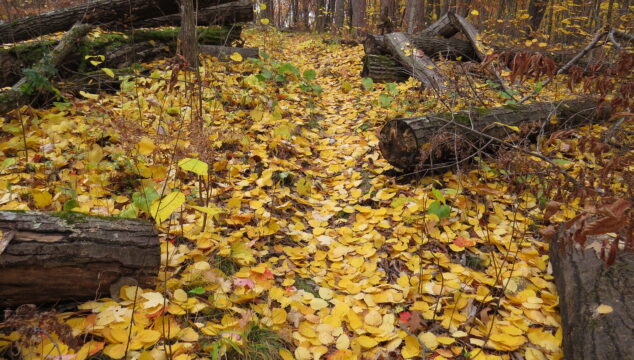
Come walk with me in the peak Autumn beauty of the Northwoods. To say that I love this time of year is an understatement. Most everyone can appreciate the colorful falling leaves---it reveals the 'true self' of a tree when its leaves are no longer producing chlorophyll. Their true colors are revealed, and there is something simple … [Read More...]
Love is the River and the Bridge
One of the satisfying aspects of growing older is looking back at the line of your life and noticing how you have changed. I don’t mean only in physical appearances, though certainly they are the most apparent changes. Gray highlights, added pounds, lines that accentuate the movement of your face over the years. How has your spiritual life changed? Your politics? Your ability to handle your emotions? How has your thinking matured? Your wants and needs? How have the things you deem ‘important’ changed from when you were younger? My guess is, that like me, the path of your life has changed and moved and morphed.
On the high prairies of Buffalo River State Park, one can see a line of trees that runs alongside the winding Buffalo River. Before reaching the river from the prairie, there is a huge drop-off, then a wide flood plain where the trees have grown. Chris and I wondered if they named the river from the fact that buffalo ran or were chased through the prairie grasses off the cliff to their death.
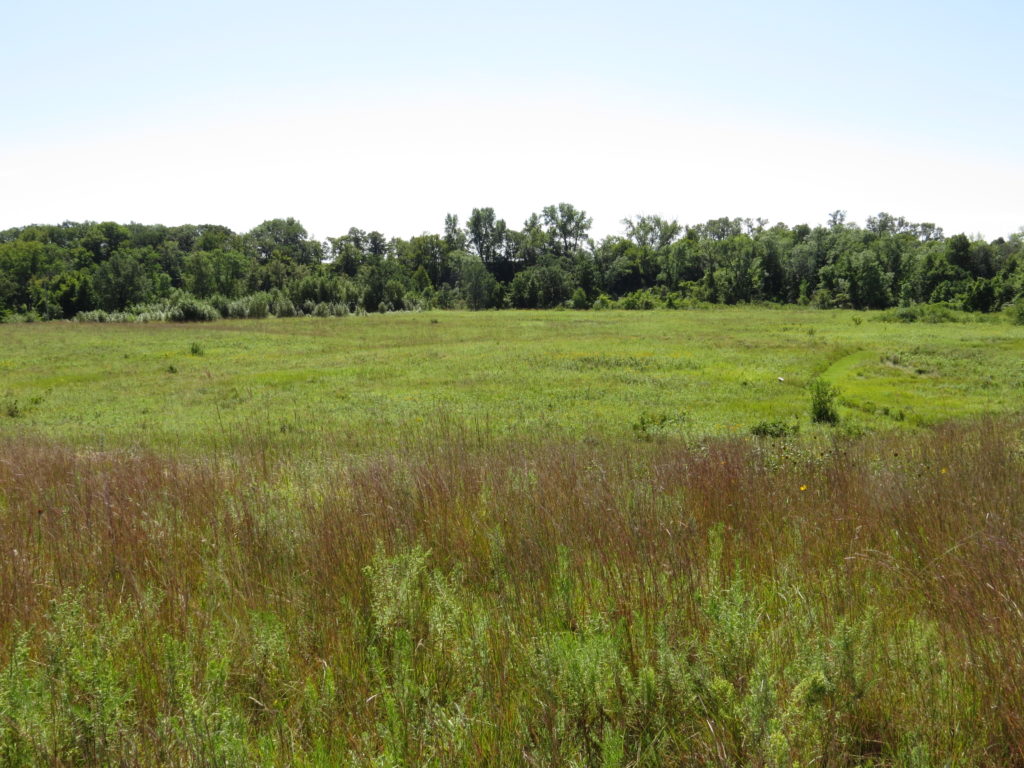
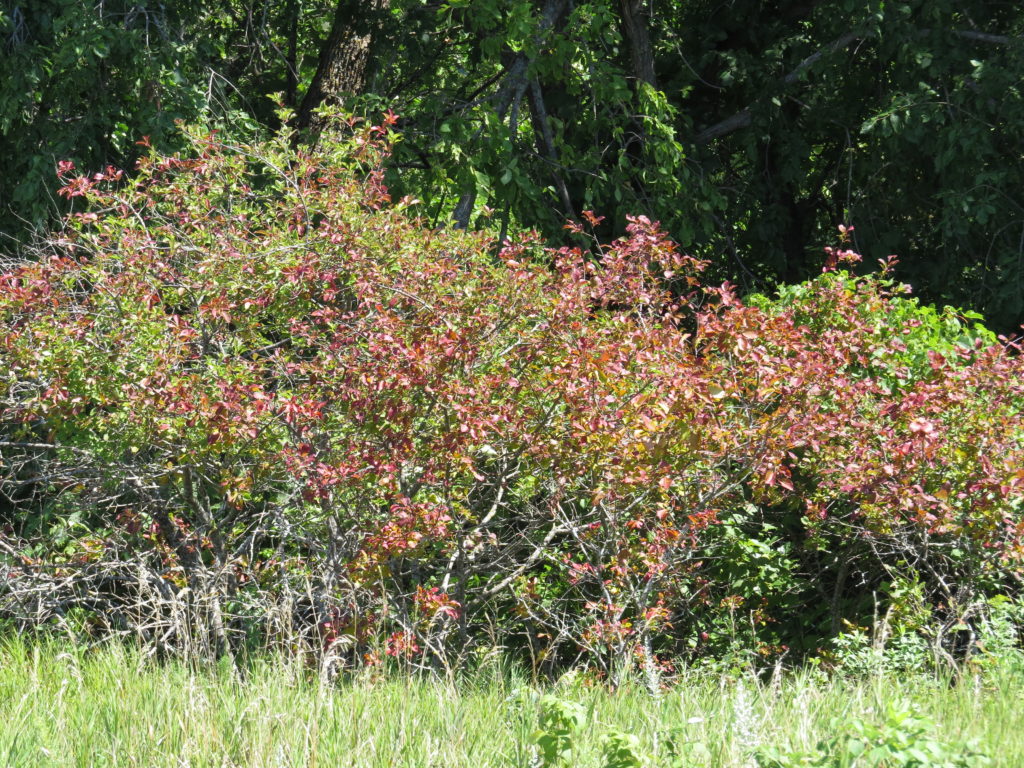
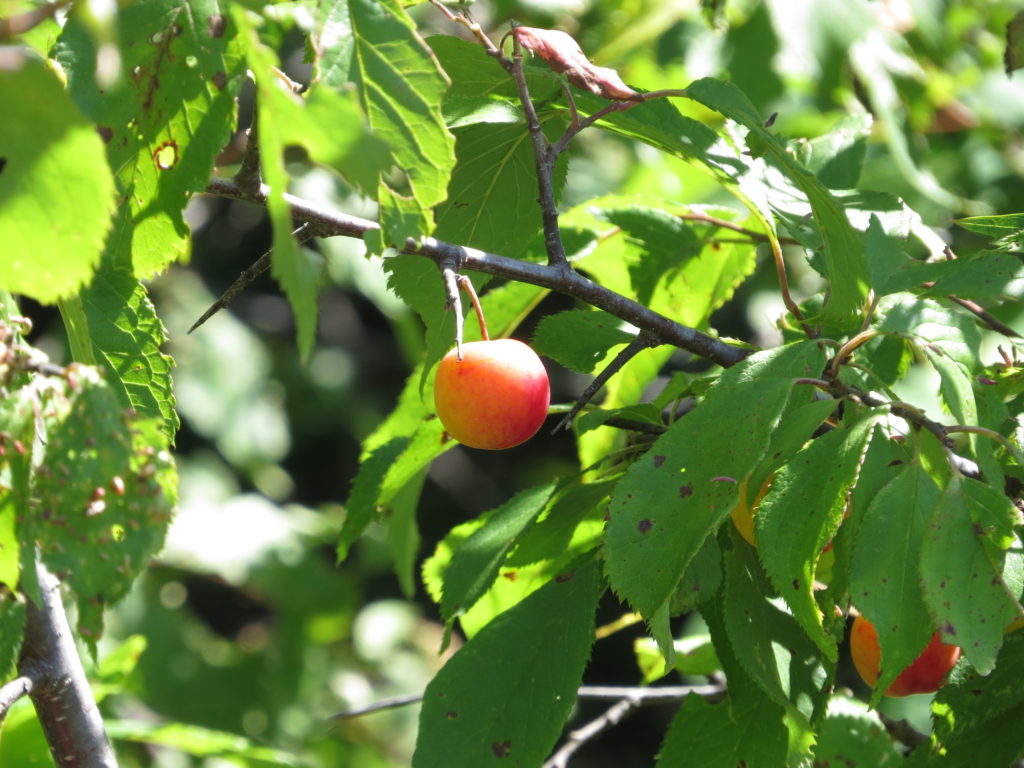
We walked from the prairie down a path by a draw that opened up to the flood plain. Shrubs were changing to fall colors, and Wild Plums were ripening.
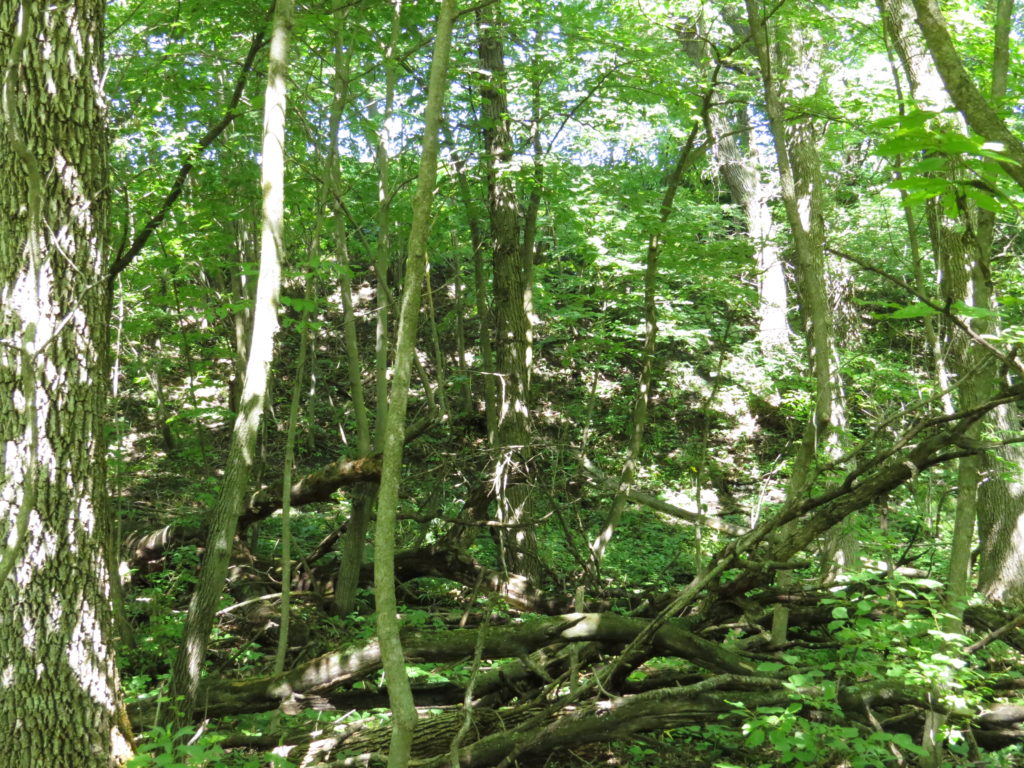
The cliff from prairie to flood plain is called a ‘cutbank,’ a steep bank where a river runs against the side of a hill, undercutting and eroding it. It produces a wide plain of underlying sediments. It also illustrates that over time, the path of the Buffalo River has changed—first cutting away from the north bank, then the south bank (or east and west depending on where the winding river is flowing.) We walked on the floodplain, looking up on the steep cutbank that has been populated by trees.
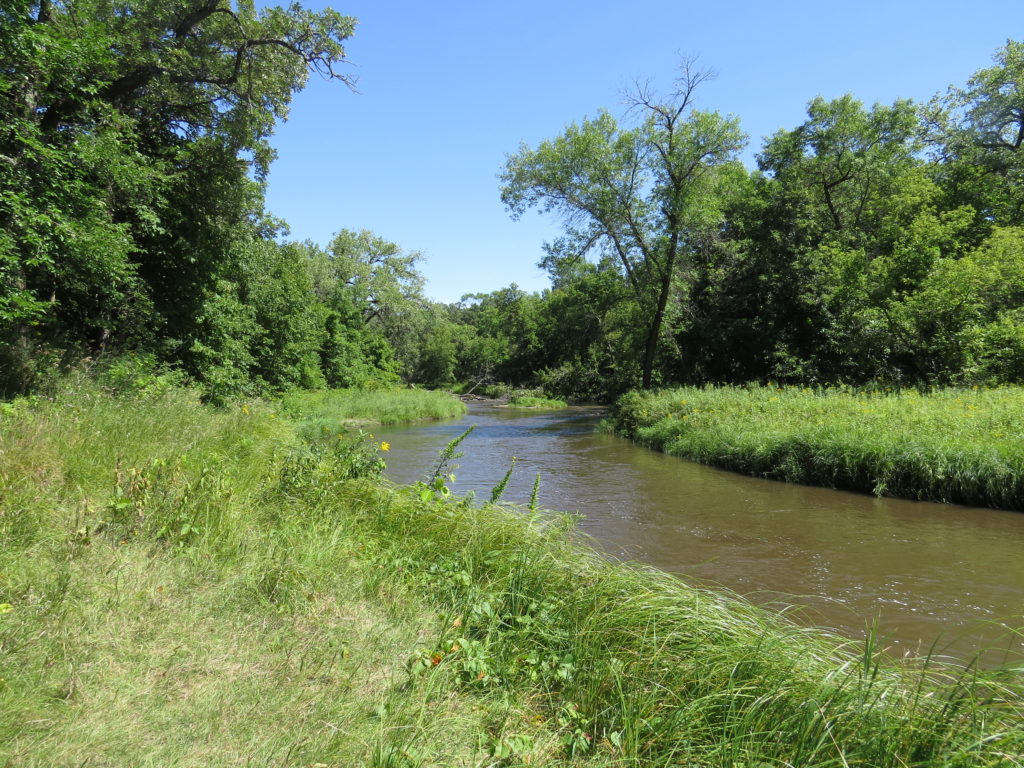
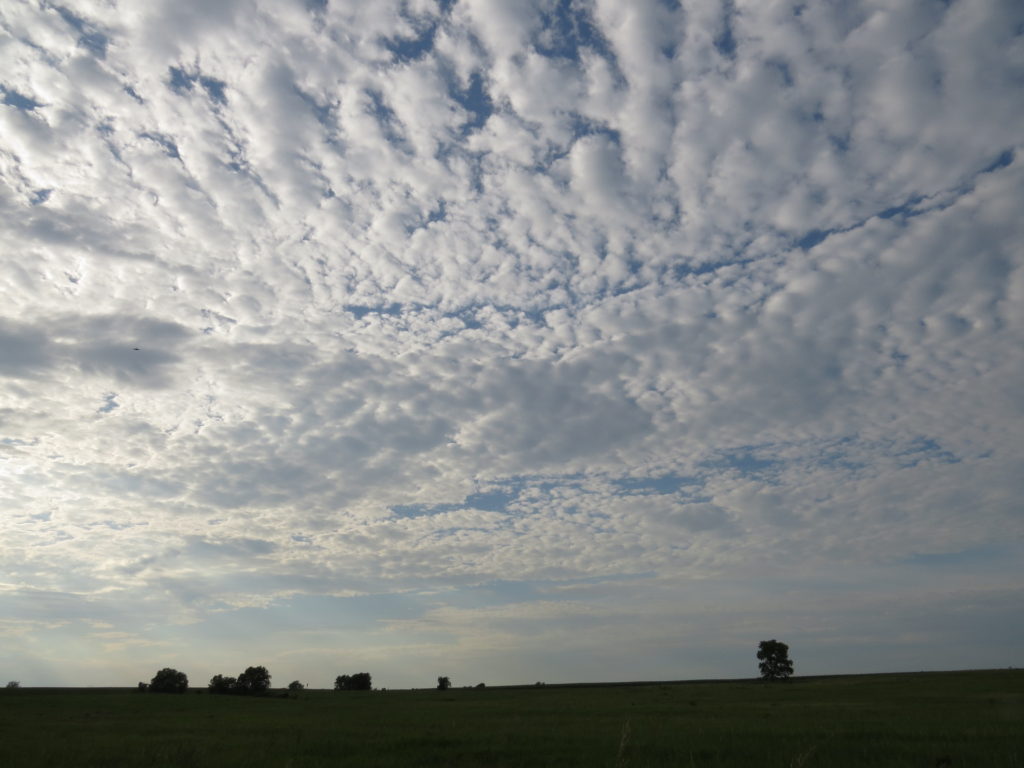
The River was high, swift, and muddy from the strong storms that had pushed through Minnesota and brought tornado warnings and those fabulous mammatus clouds to our doorstep two days before.
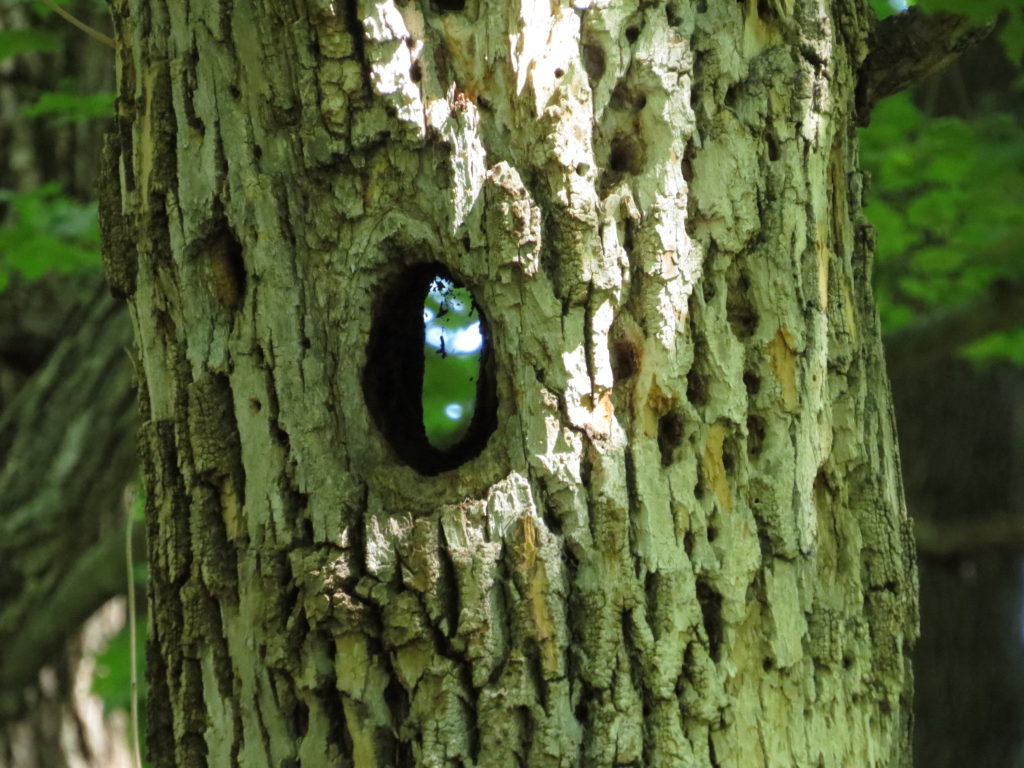
The mosquitoes we were hoping to foil on the prairie found us as we walked along the River through the trees. One particular dead tree was riddled with woodpecker holes—one even went all the way through it. We could see from one side to the other through something that normally would not allow such a thing.
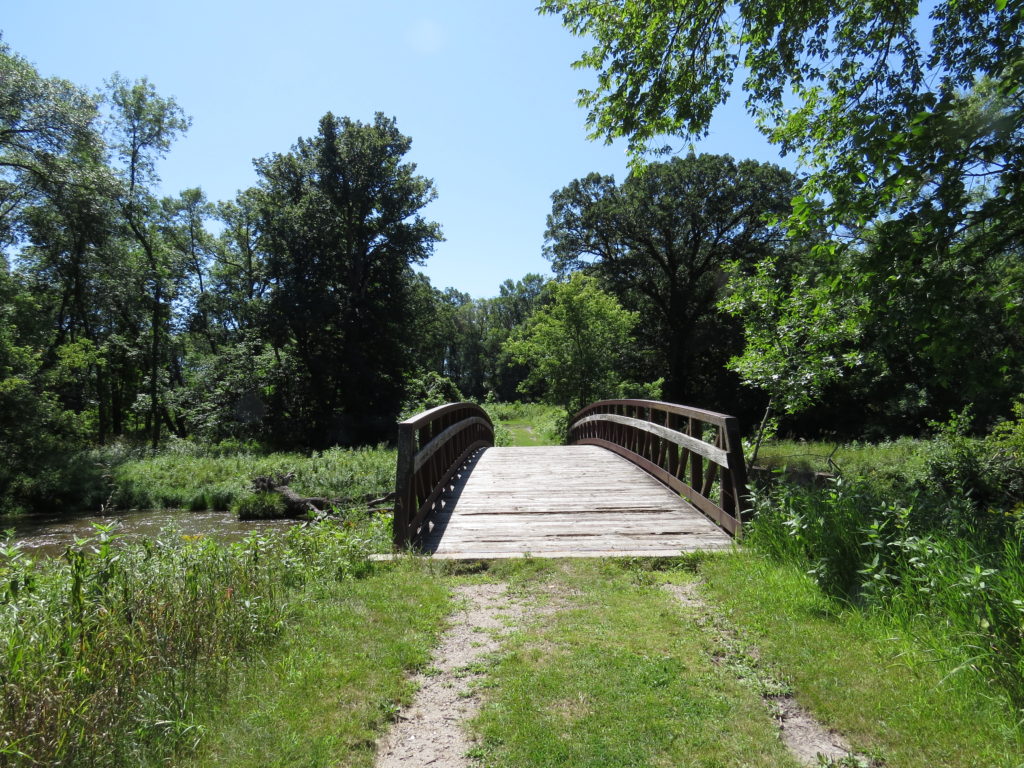
Speaking of one side to the other, eventually we came to a bridge where we could cross the River to explore the uplands of prairie on the other side.
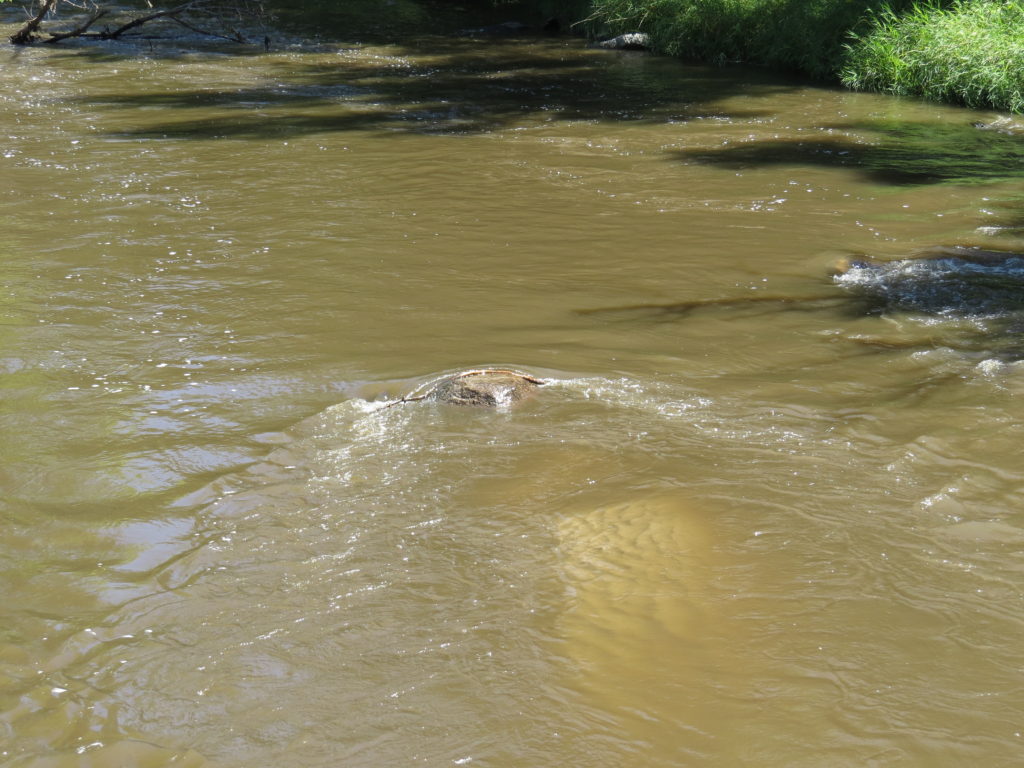
The muddy water flowed around a large rock in the middle of the River, depositing sediment in the wake of it. The resistance caused the build-up.
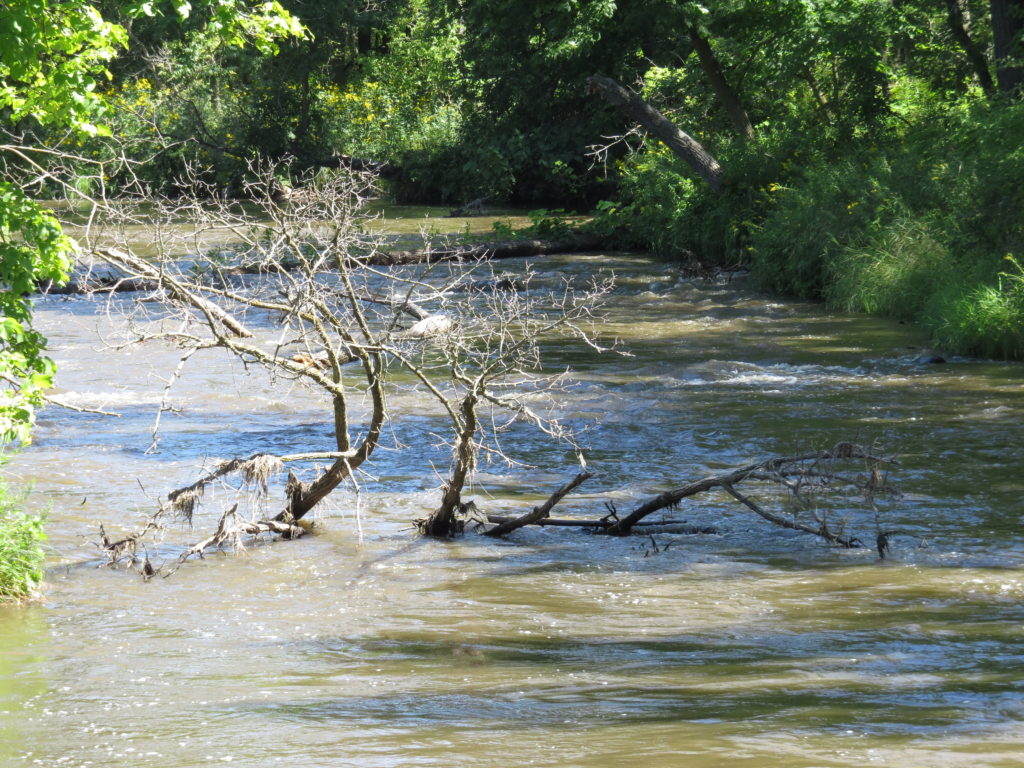
Up river, fallen trees dammed up the flow of the water, piling up debris as the River flowed on.
The prairie resumed on the other side of the River—grasses waving, flowers blooming, butterflies lighting, and seeds dispersing.
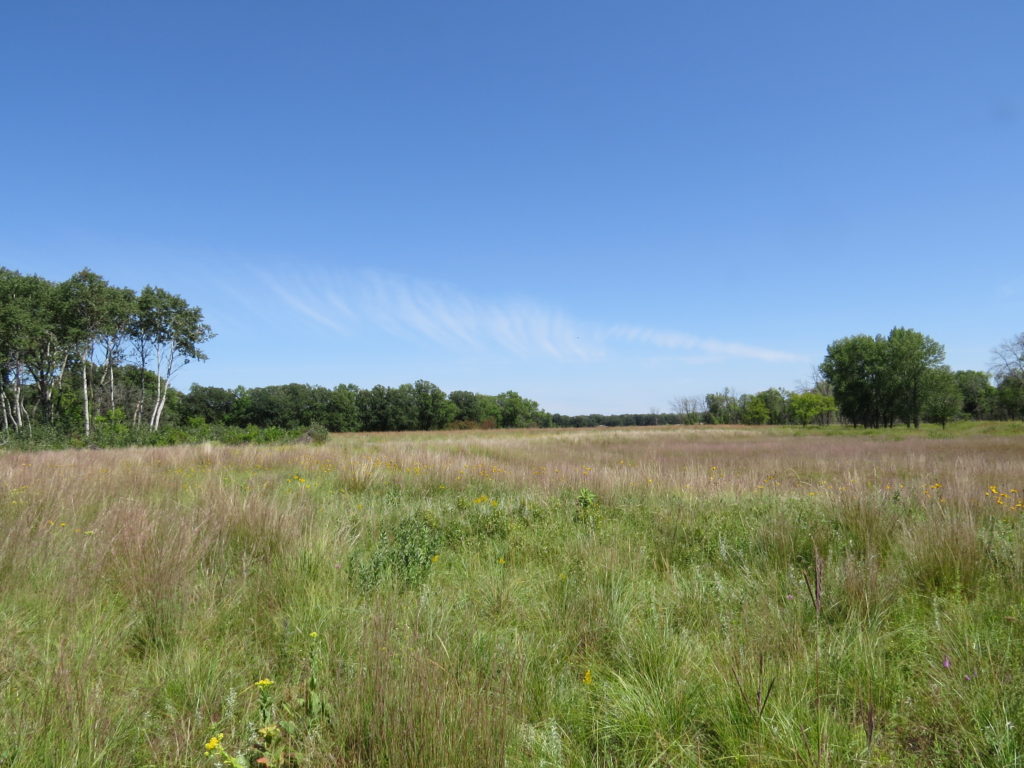
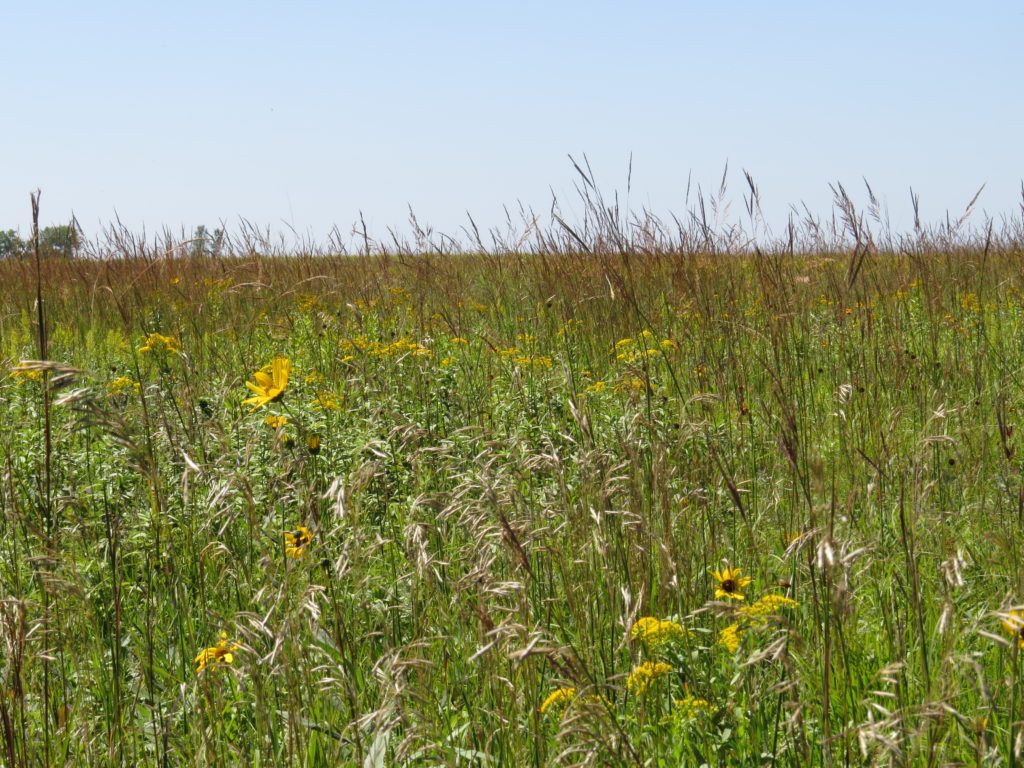
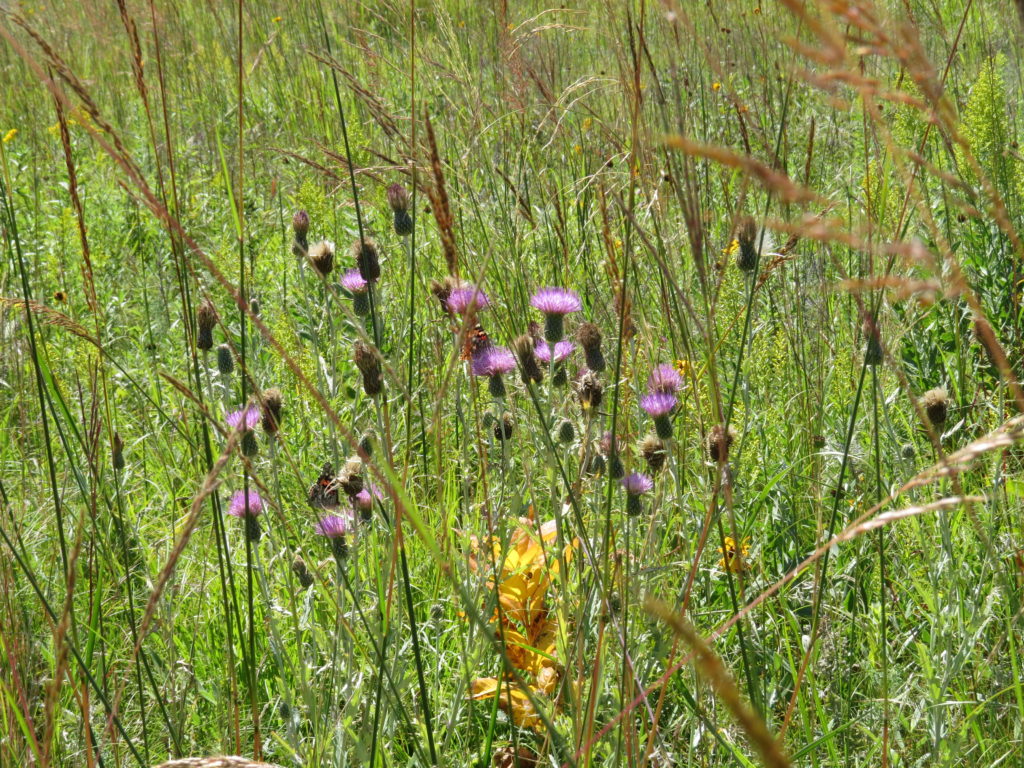

One could not distinguish one side of the prairie from the other—each has a myriad of grasses and colorful flowers. Both have cutbanks, trees, and mosquitoes. Both have butterflies, seeds, and seedlings. The Buffalo River runs through it. And the Buffalo River has moved and changed over time.
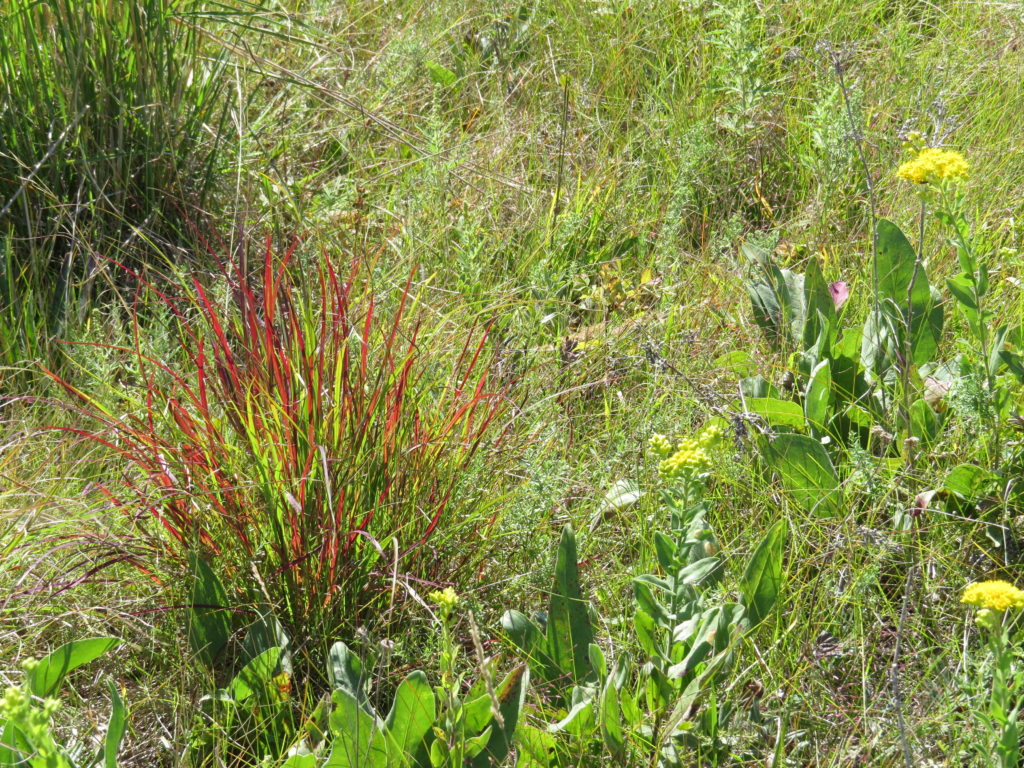
The long view of life changes and evolves. This place used to be a glacier, then a sea, then a prairie with glacier-deposited erratic boulders with a River that runs through it. Even the River has changed course in the relatively near past. We do the same. Civilizations change. Societies change, and each one of us changes in the course of our lives. So how have you changed? And more importantly, what happened to you that led to those changes? Our development from infant to elder includes changes to our physical selves imprinted in our DNA, the expression of which is influenced by our environment. Our personalities and experiences influence our thinking, our emotional responses, and our actions. The River of Life runs through us. What rocks of resistance are impeding the flow? What kind of debris is getting in the way? I think for most of us we want to be better than we once were. That desire is the cornerstone of failure and forgiveness. It is the challenge of our physical, social, political, emotional selves. What allows us to see from one side to the other? What allows us to walk to the other side? What reminds us that we are grasses and colorful flowers with seeds and seedlings that all live together in this world? Love, and I mean that with a capital L, is the river and the bridge. Let it flow through you and allow you to walk to the other side.
Here in All Their Beauty–Then Gone
Death has imbued my mind over the last week. It was the one year anniversary of Chris’ brother’s death, and I wonder how it can be so long already. It still feels unreal, like it didn’t happen, that maybe when we go back to Kansas City, he will be there. Then a dream of walking with my cousin through a garden adorned with art sculptures of cars, then realizing it was a cemetery for people who had died in car accidents. A dream of talking to my Dad at a party, and he died almost five years ago now. Then a brother of a friend of my daughter died in his mid-30’s—so, so young. And that makes me remember with a heavy heart the death of one of my greatest friends who died at the age of 34. We worked together at church camp on the prairies of South Dakota, and we took an epic horseback ride across the state from the North Dakota border to the Nebraska border. We both loved the prairie.
We come and go, but the land will always be here. Those people who love and understand it are the only ones who really own it—for a while. –Willa Cather
Last weekend Chris and I went to Buffalo River State Park, one of the largest and best of Minnesota’s prairie preserves. Our main idea was to foil the mosquitoes who have been swarming us in the woods and go to the sunny, wind-swept prairie where mosquitoes are less likely to bother us. And then there’s the thing that happens to my soul when I face an expanse of grass and sky—I am filled with goodness and calm.
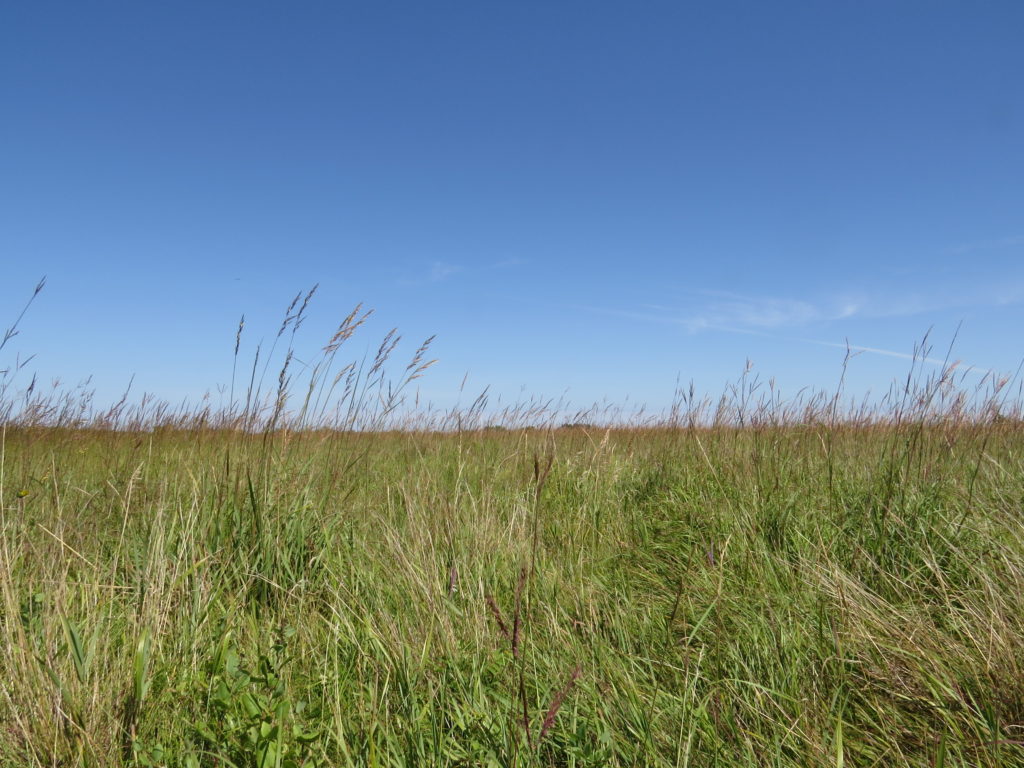
Side by side we walked the mowed path through the prairie. Occasionally there would be an erratic boulder lying amidst the grass, boulders that were deposited there by the glacier eons ago. And they are literally called ‘erratics.’
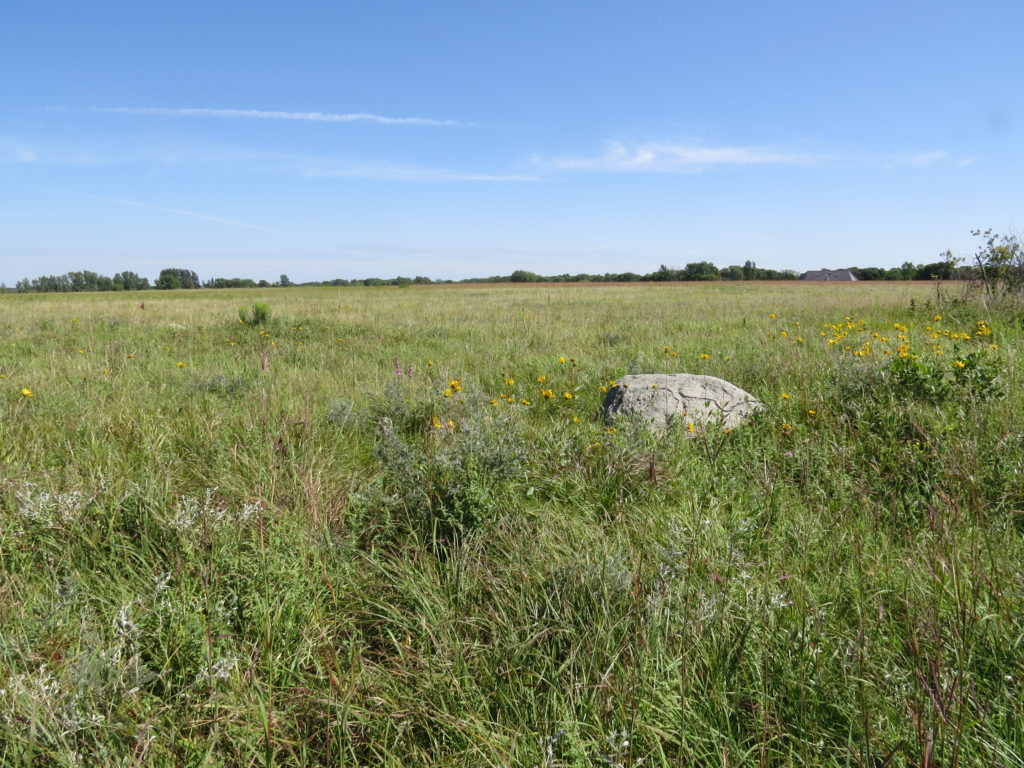
I thought it looked like a prairie gravestone.
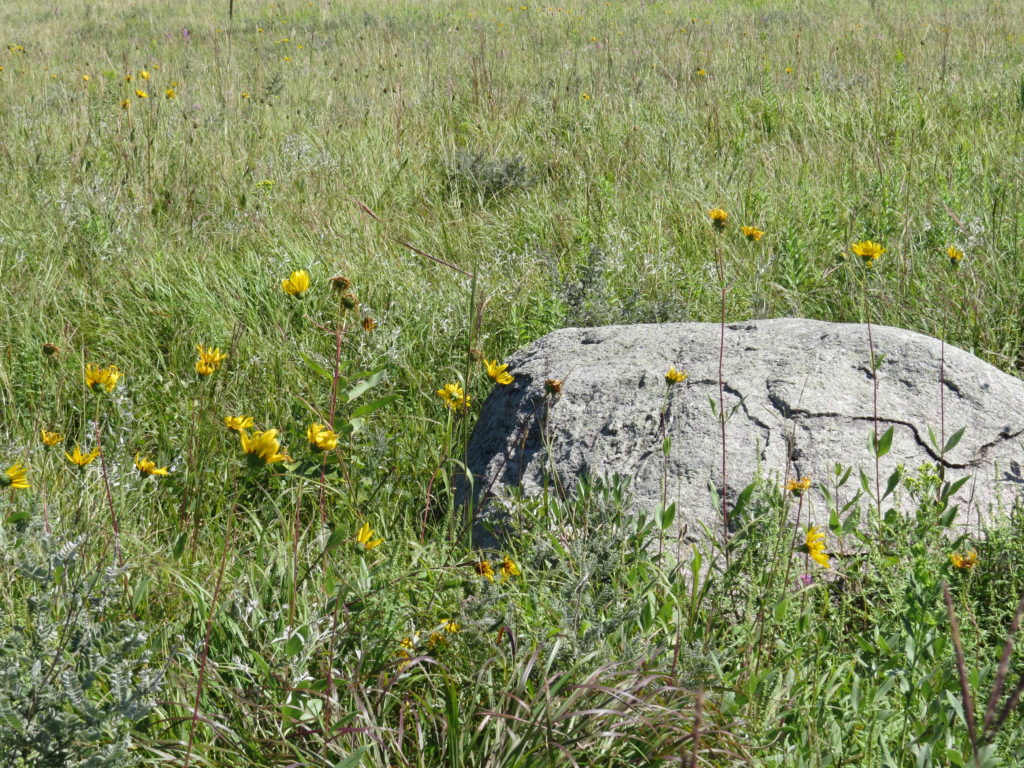
There’s no great loss without some small gain. –Laura Ingalls Wilder
The park was actually a combination of the State Park prairie, the Bluestem Prairie Scientific and Natural Area, and Minnesota State University, Moorehead Regional Science Center Land, and through the middle of it all flowed the winding, tree-lined Buffalo River. A vast expanse of blooming Indian grass with a sweep of Little Bluestem stretched from the path to the Science Center.
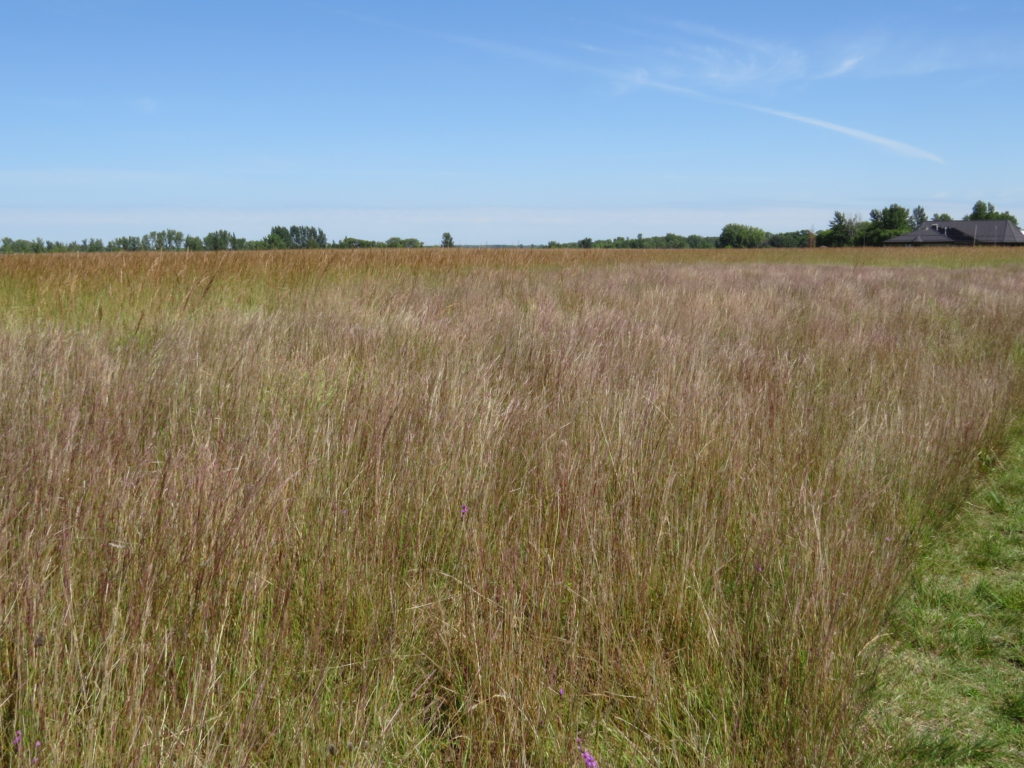
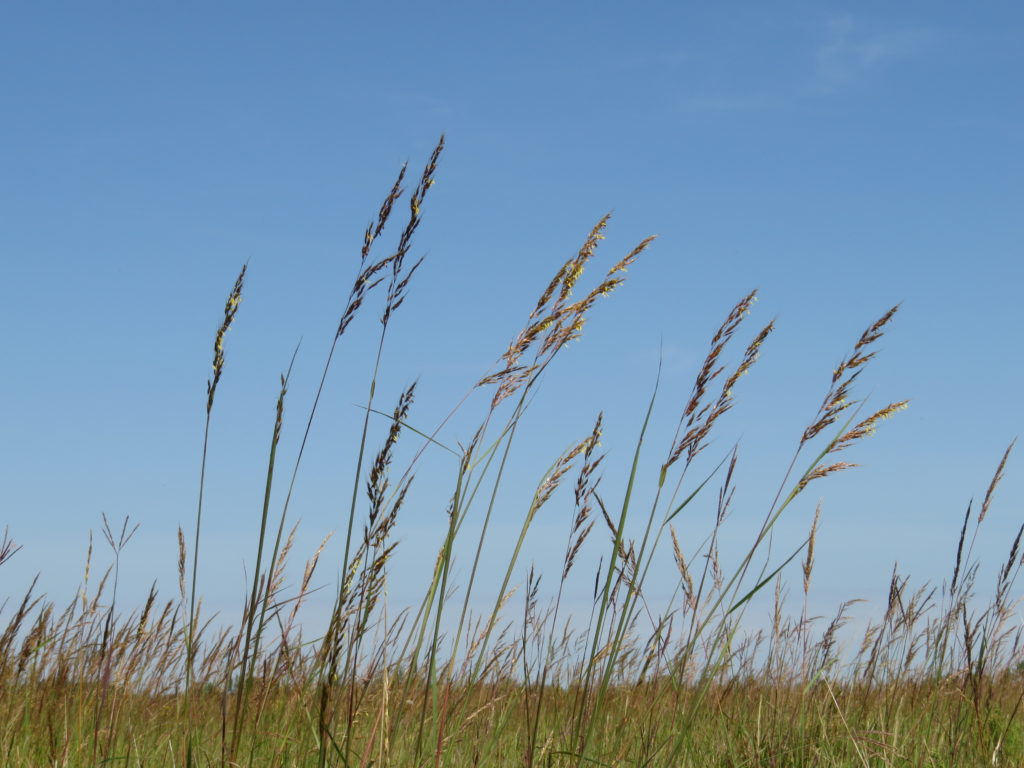
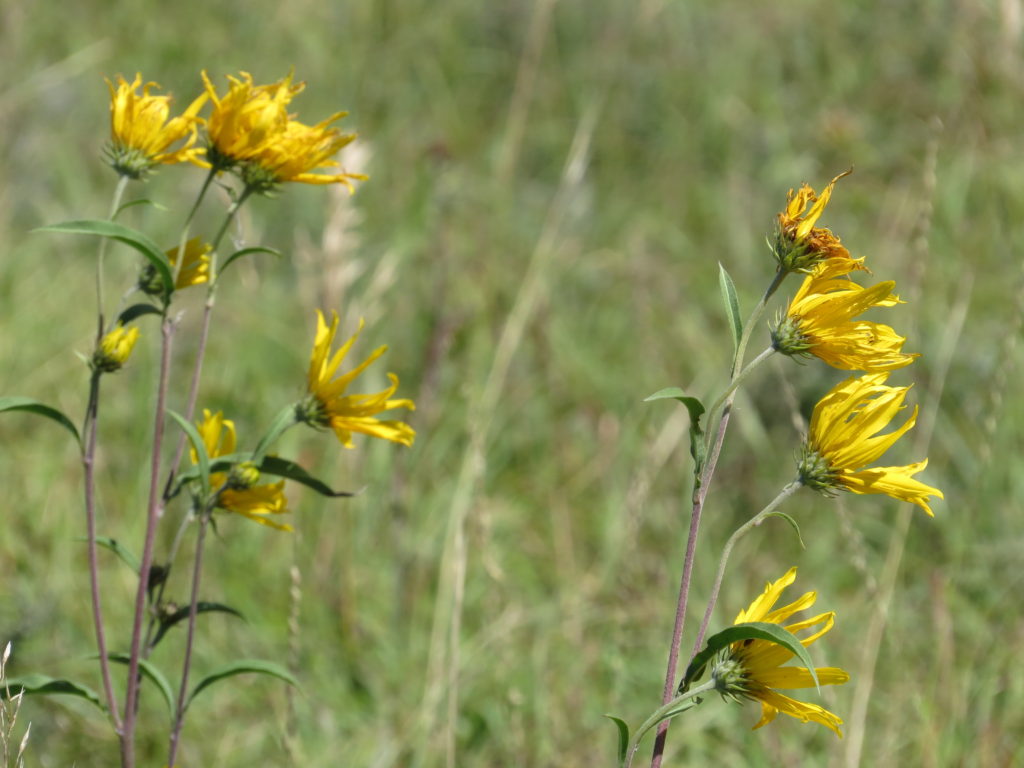
Sunflowers and Liatris sprinkled the prairie with bright summer color, and Painted Lady Butterflies were everywhere!
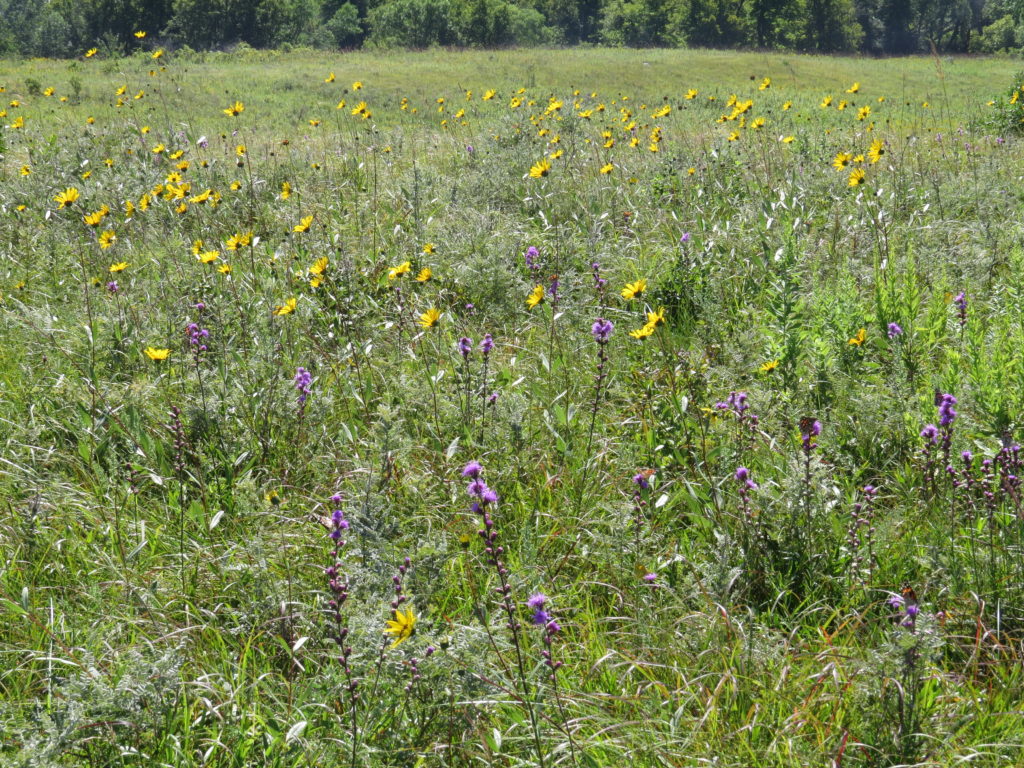
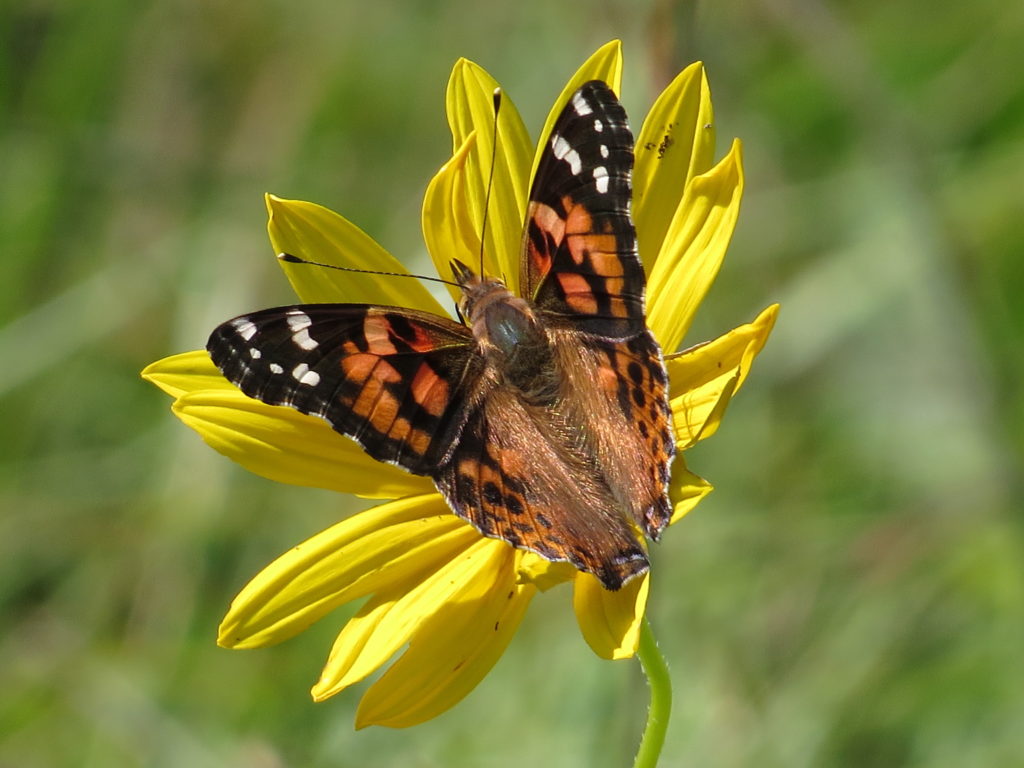
They are here in all their beauty…
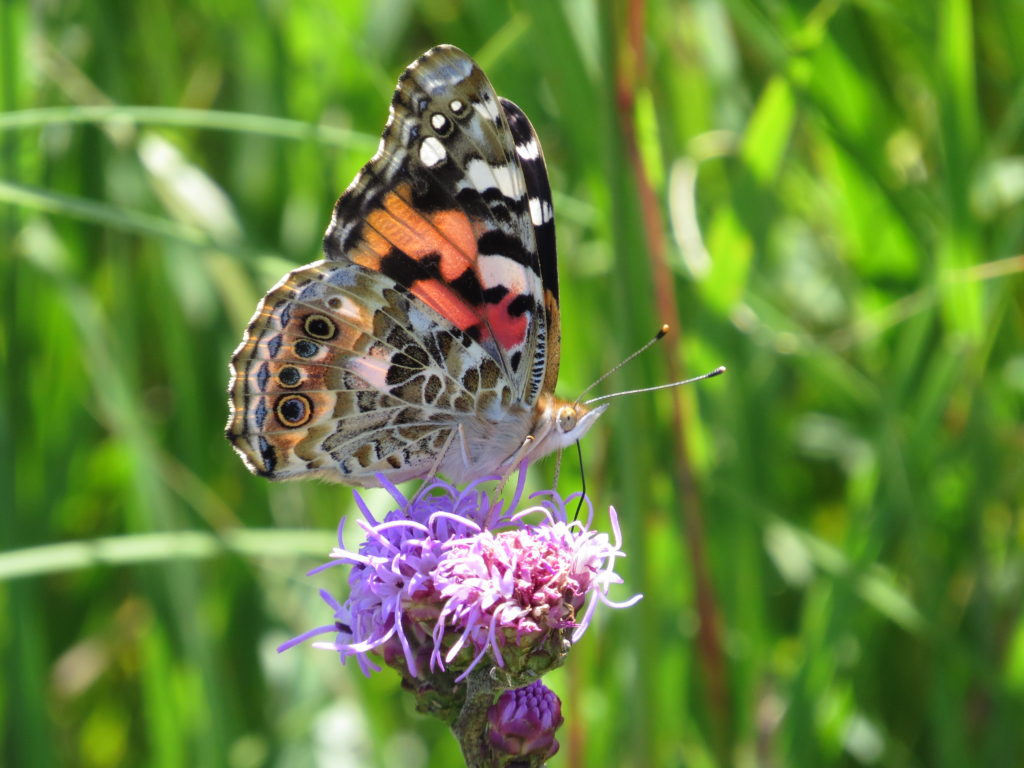
…then gone.
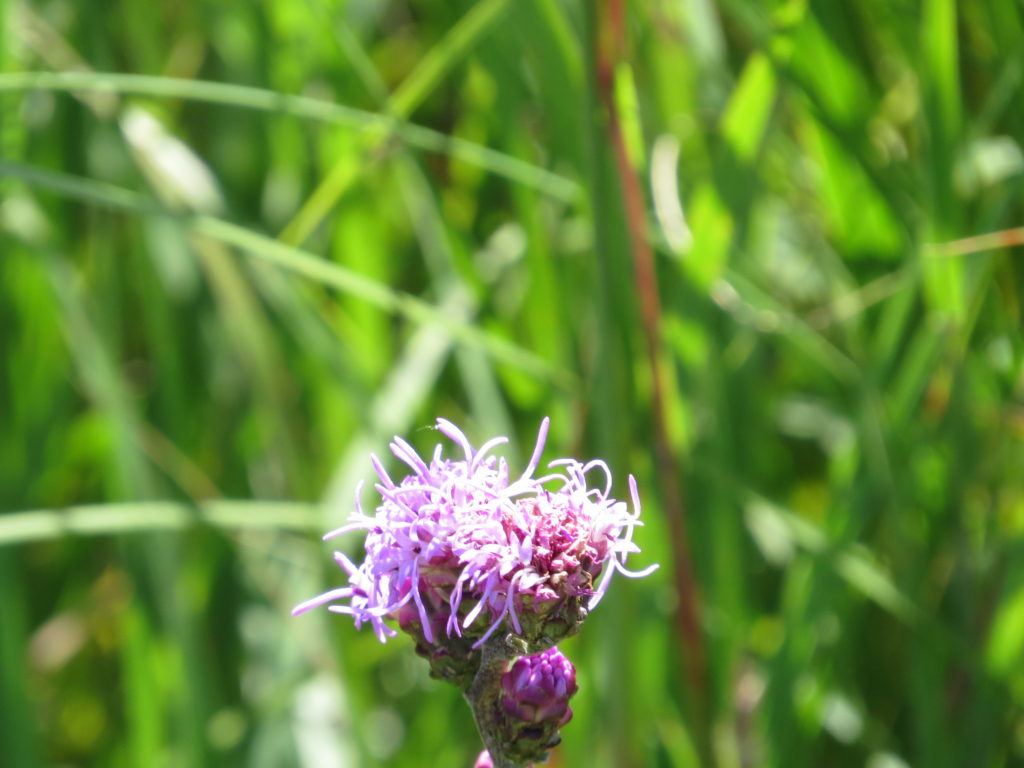
The ones we lose eventually fade into the background of our lives, yet they are with us always.
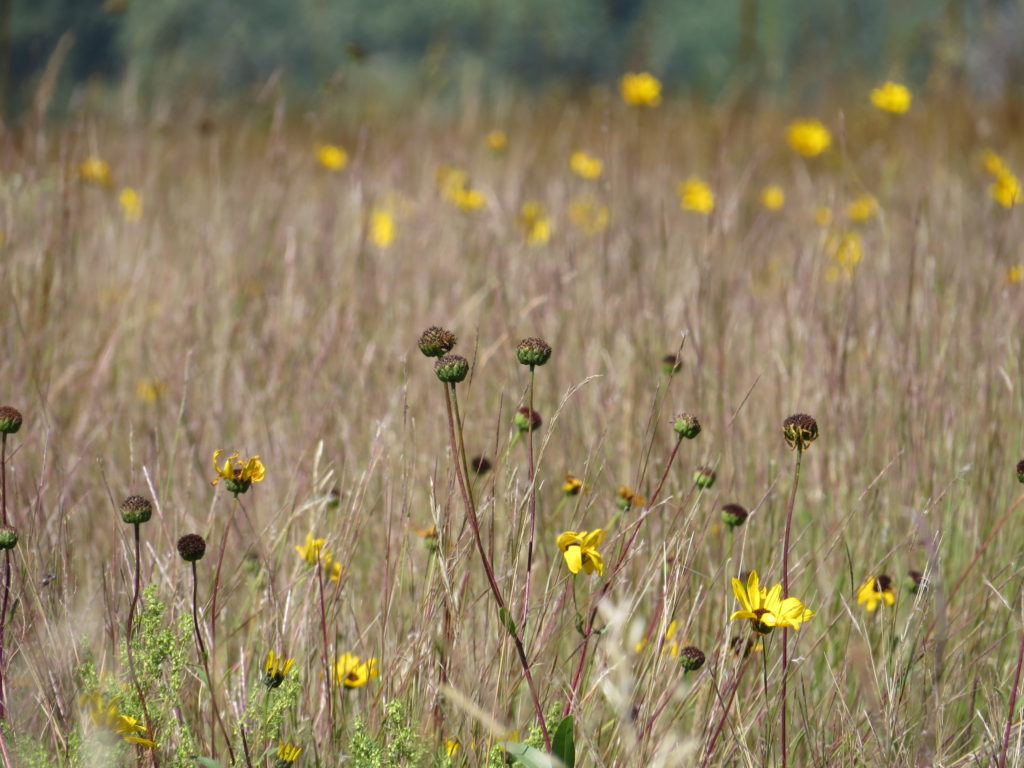
At times, with anniversaries, or dreams, or renewed memories, they feel much closer to us again—thus the nature of erratic, unpredictable grief.
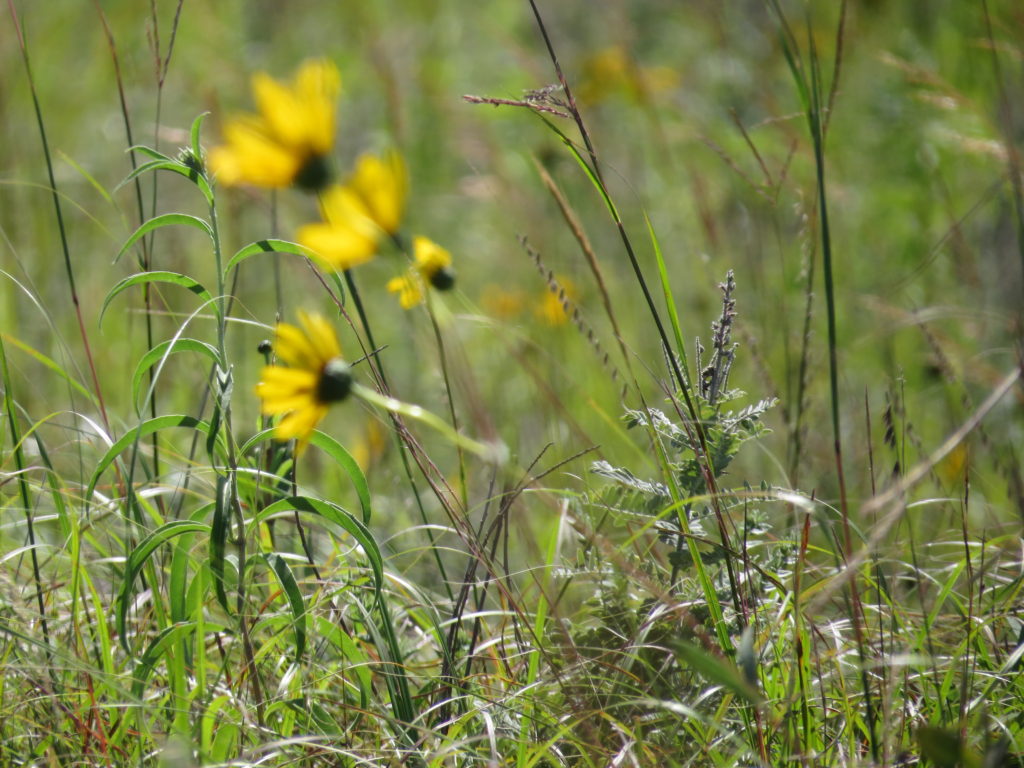
Death is not far from anybody’s mind these days as the death count from Covid-19 ticks into the hundreds of thousands—if you are not one who is personally impacted by that, thank your lucky stars and kindly say a prayer for all those who are. Please don’t quibble about the Covid count being ‘wrong.’ A beautiful person was here, and then they were gone, and many people are mourning.
We have the people, things, and land we love only for a while—until their demise, or ours. It will soon be thirty years since my friend died. Many things remind me of him—Appaloosa horses, polka-dot hats, strumming wildly on the guitar and singing silly songs, and so many more. But being on the prairie always brings him closer to me again. I have shared this poem about the prairie within the last year—what I didn’t say before was that it was my friend Joe’s favorite. The land will always be here. May it bring you goodness and calm.
The prairie, these plains….It was as if nature had taken solitude and fashioned it into something visible, carved out the silences into distances, into short grass forever flowing and curving, a vast sky forever pressing down, nothing changing, nothing but sameness, day after day after day, as far as you could see, as far as you could go. It was like the solitude of God…as awesome, and as beautiful. –Janice Holt Giles
Prairie Tough and Beautiful
I was sitting in my circle of trees the other evening. The sun was low in the sky, not to be seen through all the layers of Pine trees. But I noticed that the tip-top of the tallest Aspen tree caught the twilight rays of the sun with a shining amber color. A slight breeze quivered the leaves in a soft song as the light faded away. So much of Nature is quiet and unassuming. She does her work without fanfare and most often without notice.
One of the places of Mother Nature that often goes unnoticed is the prairie. Travelers erroneously say ‘there’s nothing there’ or ‘it’s boring.’ I am a lover of prairies and will refute such talk. There is so much there! I am fortunate, not only to be surrounded by trees, but also to have a patch of prairie in the front yard. The soil is sandy and quickly dries, and whoever lives in my little prairie has to be tough. Quiet, unassuming grasses and wildflowers grow and thrive in the open, sunny spot.
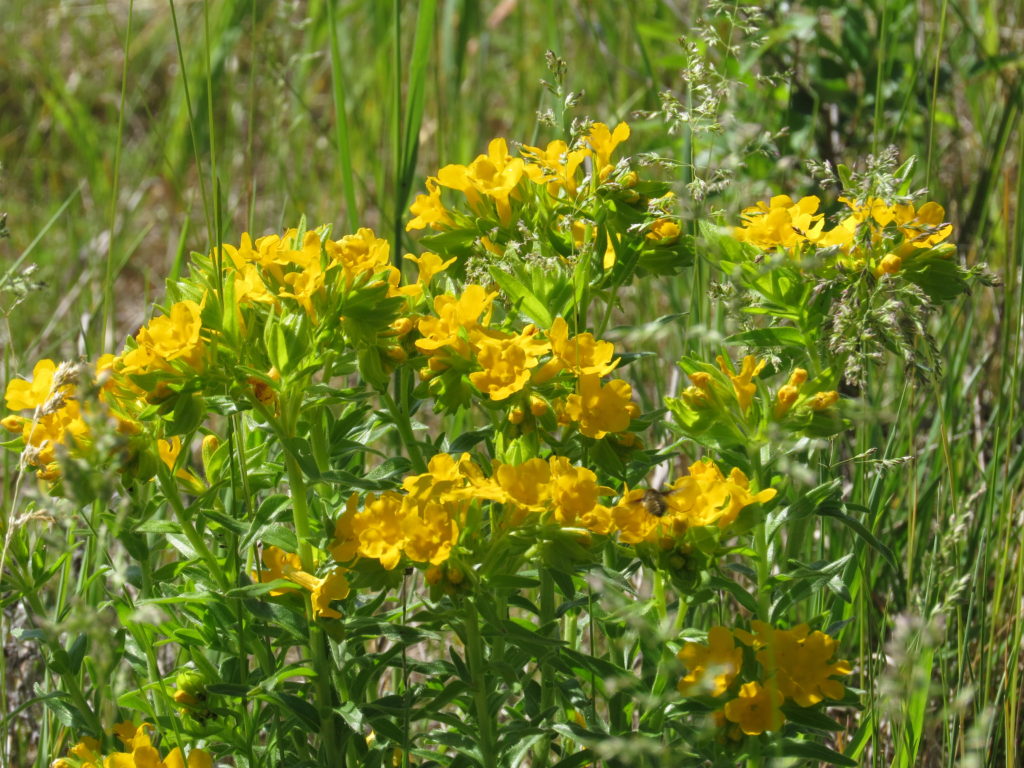
One June-blooming wildflower that does garner some attention with its bright yellow-orange clusters of flowers is Hoary Puccoon. The roots were used by Native Americans to make a red dye.
A common prairie flower, one of the early bloomers, is Prairie Smoke. The bell-shaped flowers hang down, but after pollination, the stems straighten up, and the seed heads of feathery plumes form.
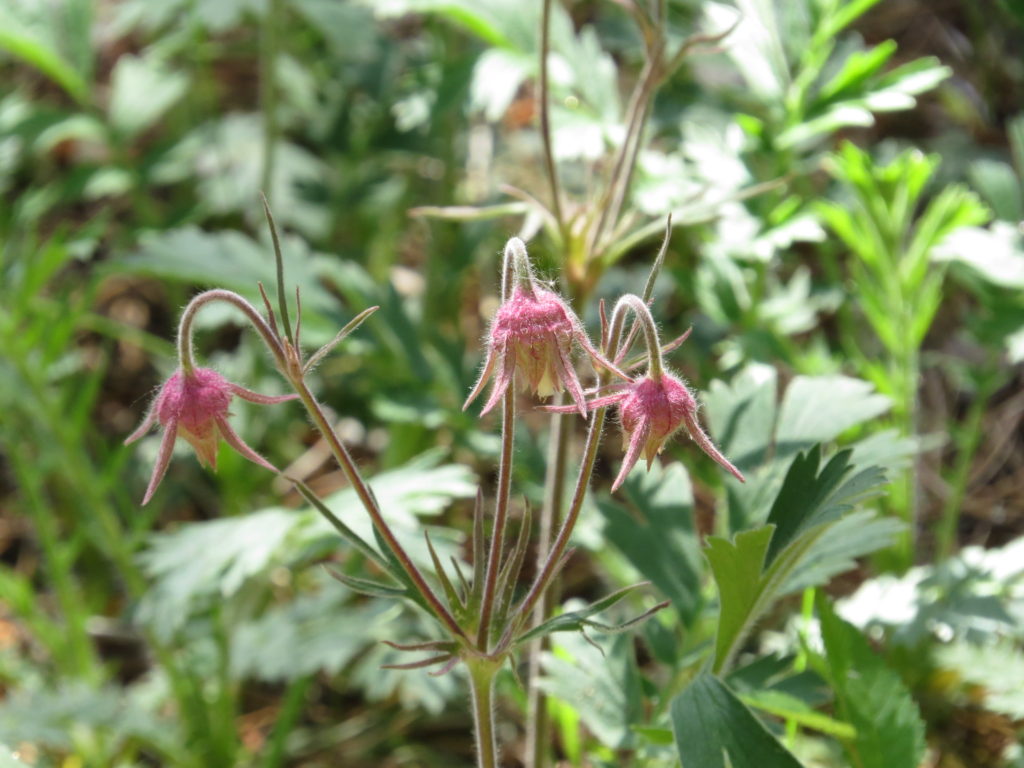
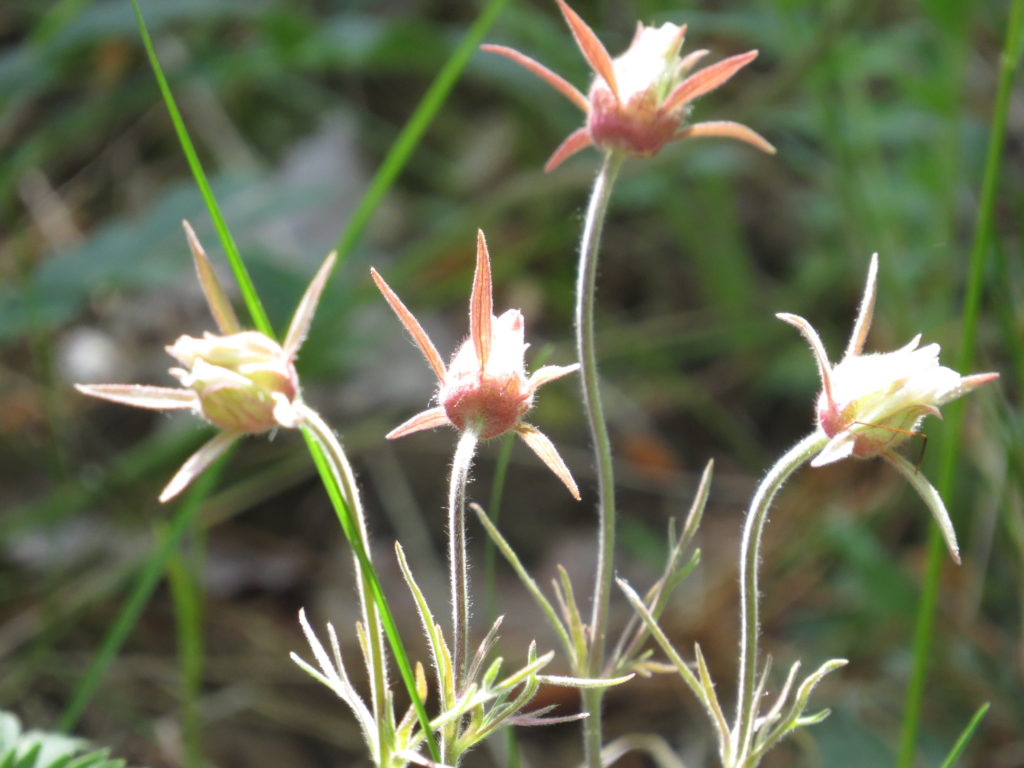
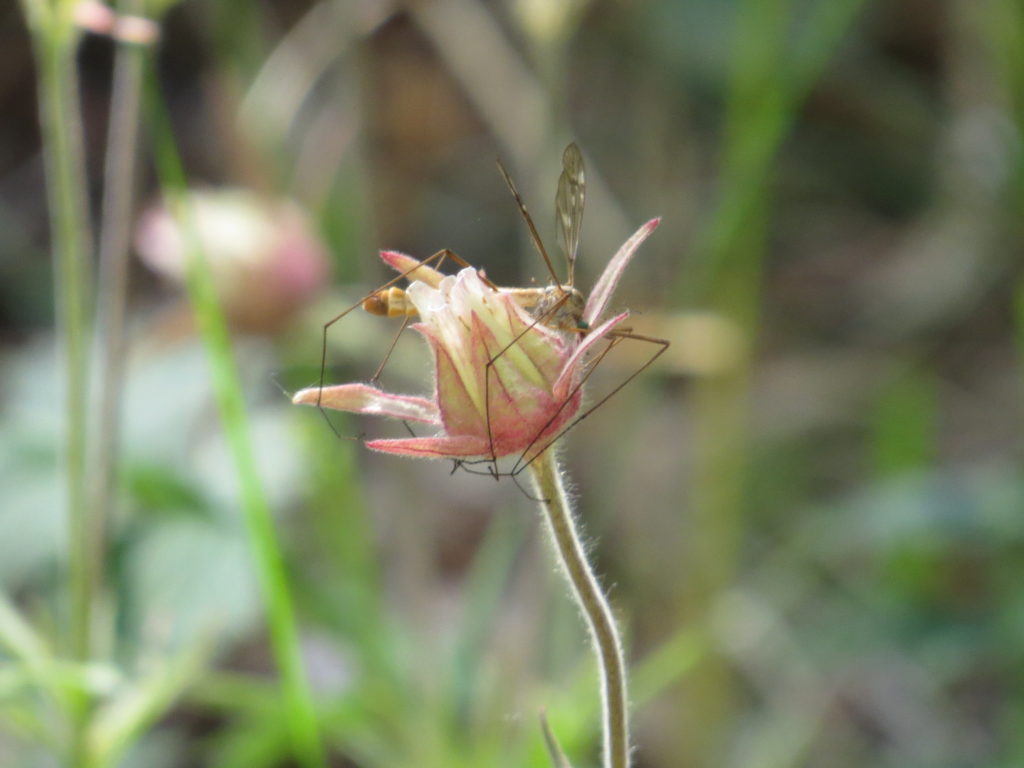
Pollinators are another quiet, most often unseen part of Nature that work hard and do important work. In essence, they provide the movement of male parts of the flower (pollen) to the female parts (stigma)—they help the process of fertilization so the fruits and seeds can develop. Pollinators include birds, bats, butterflies, moths, flies, beetles, and most importantly bees.
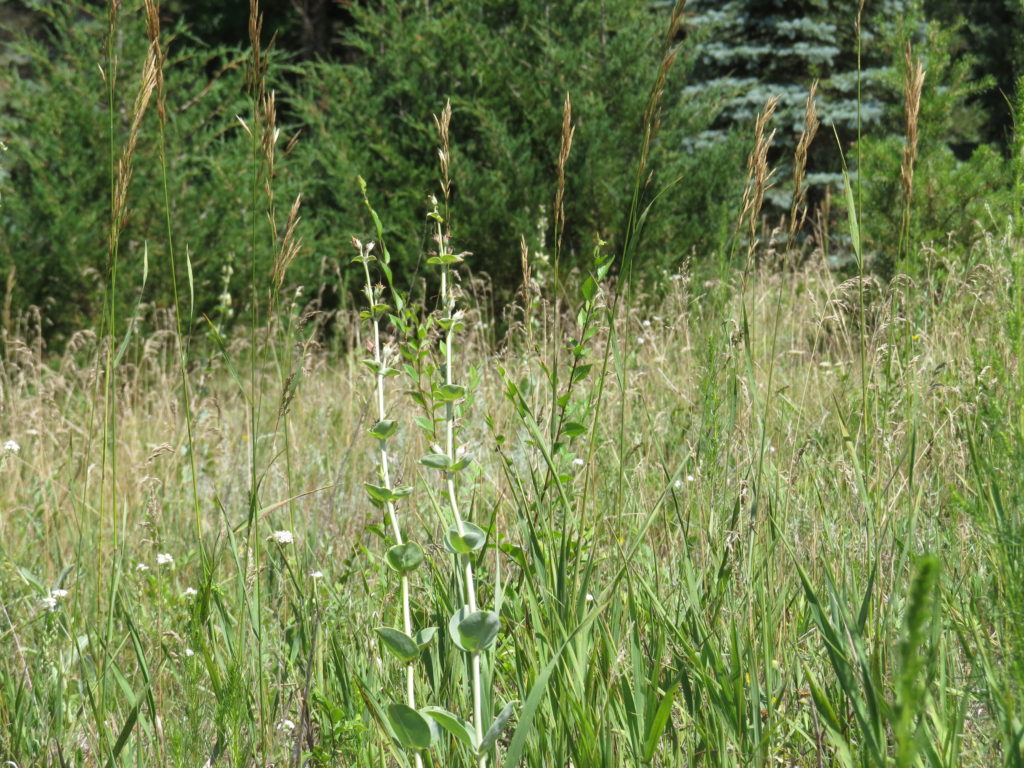
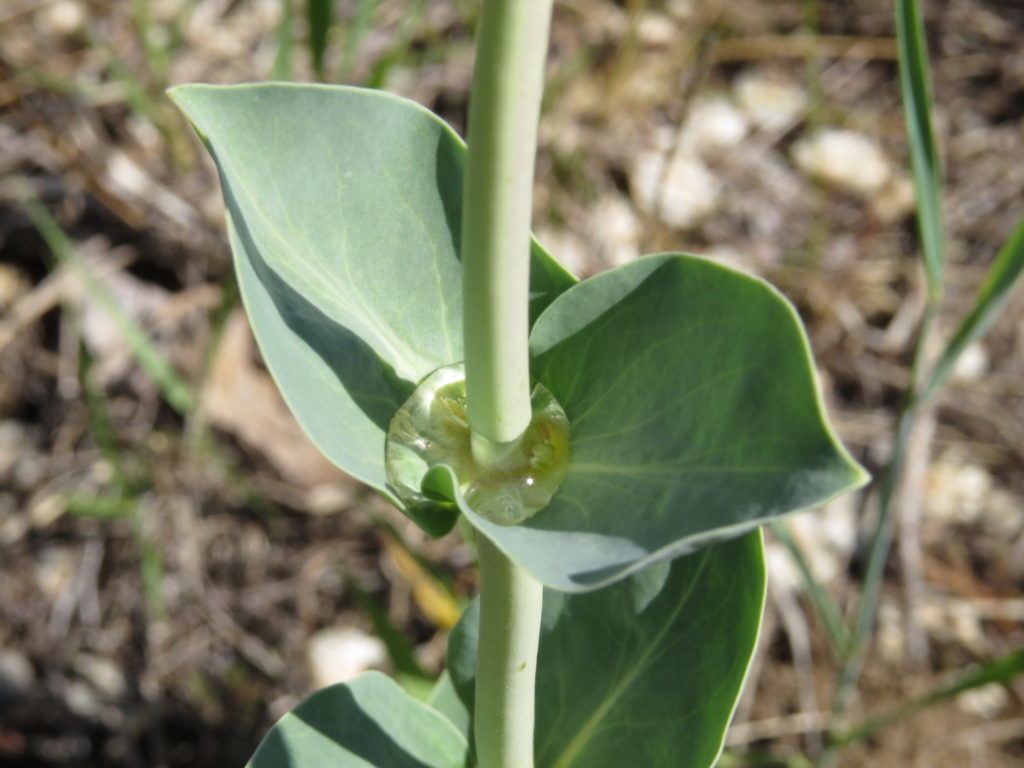
Another June-blooming wildflower in our little prairie is Shell Leaf Penstemon. Its large lavender flowers whorl around a single stalk above the opposite, clasping leaves that hold rainwater like a small shell.
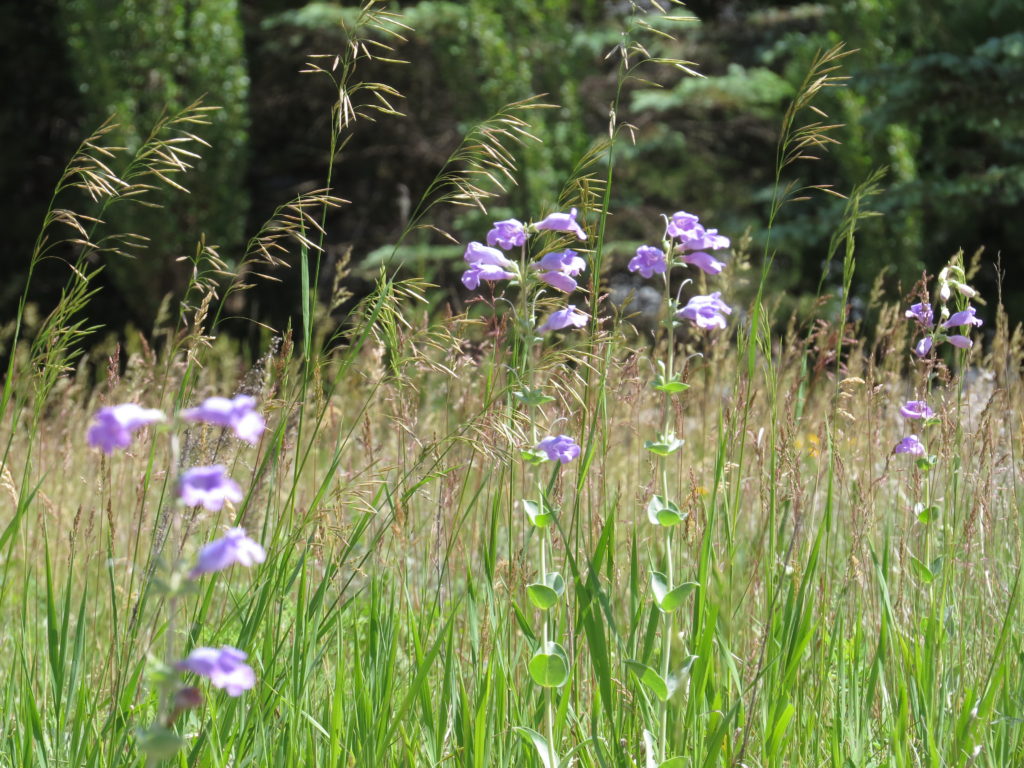
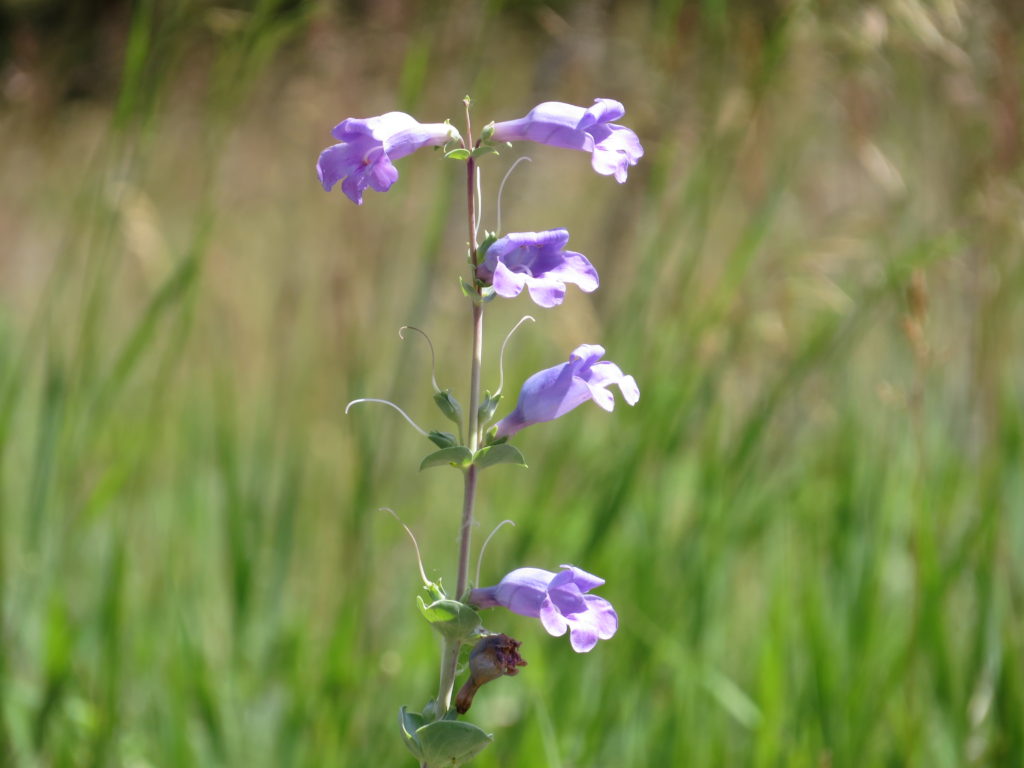
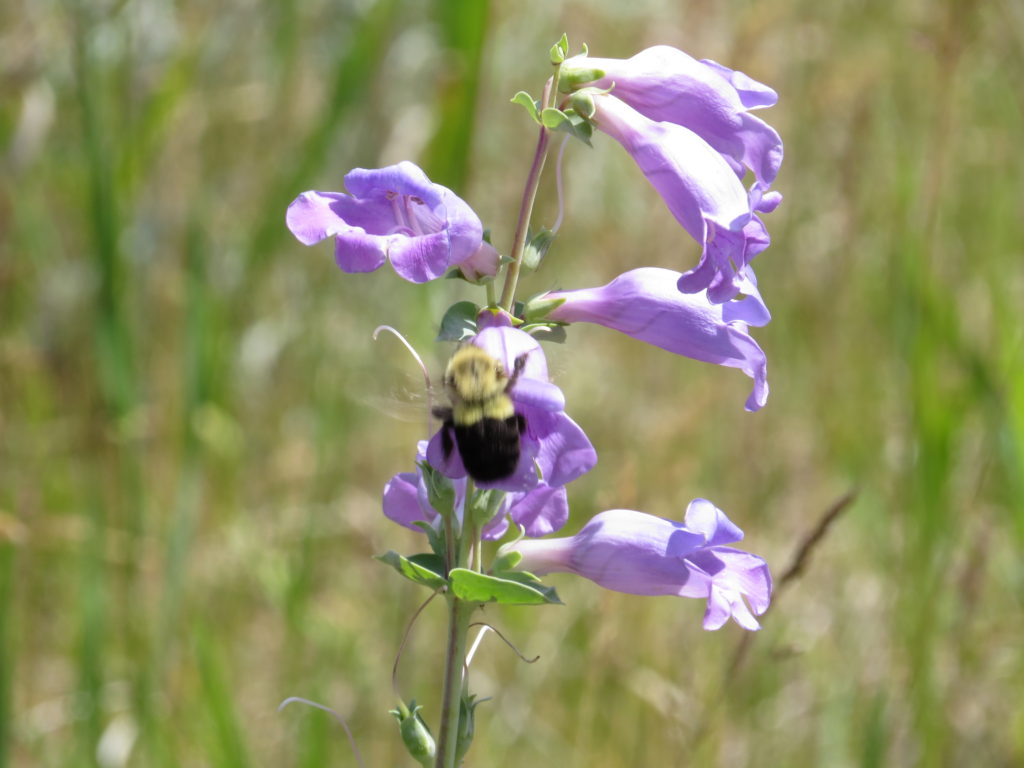
The flower tubes are large enough for bumblebees to crawl inside to perform their pollinator duties.
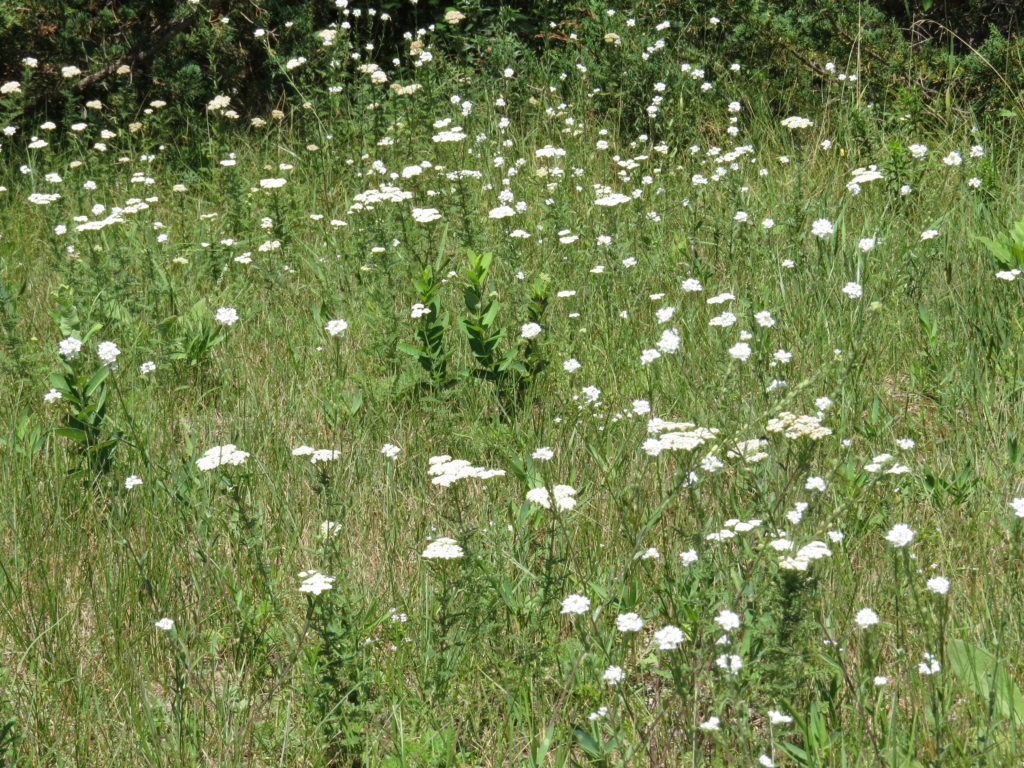
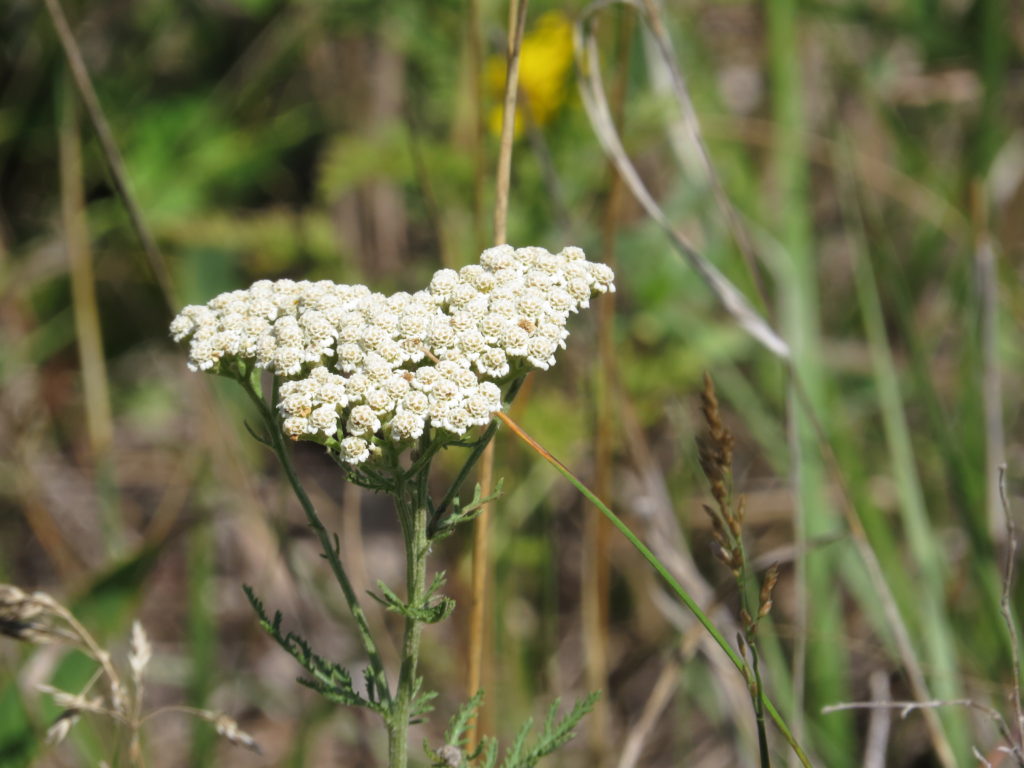
No prairie is complete without the tough, fragrant presence of Yarrow. The leaves are fern-like, as described by its species name, millefolium, meaning ‘thousand leaves.’ The flowers are flat-topped clusters of many tiny flowers, all ‘working’ together as one.
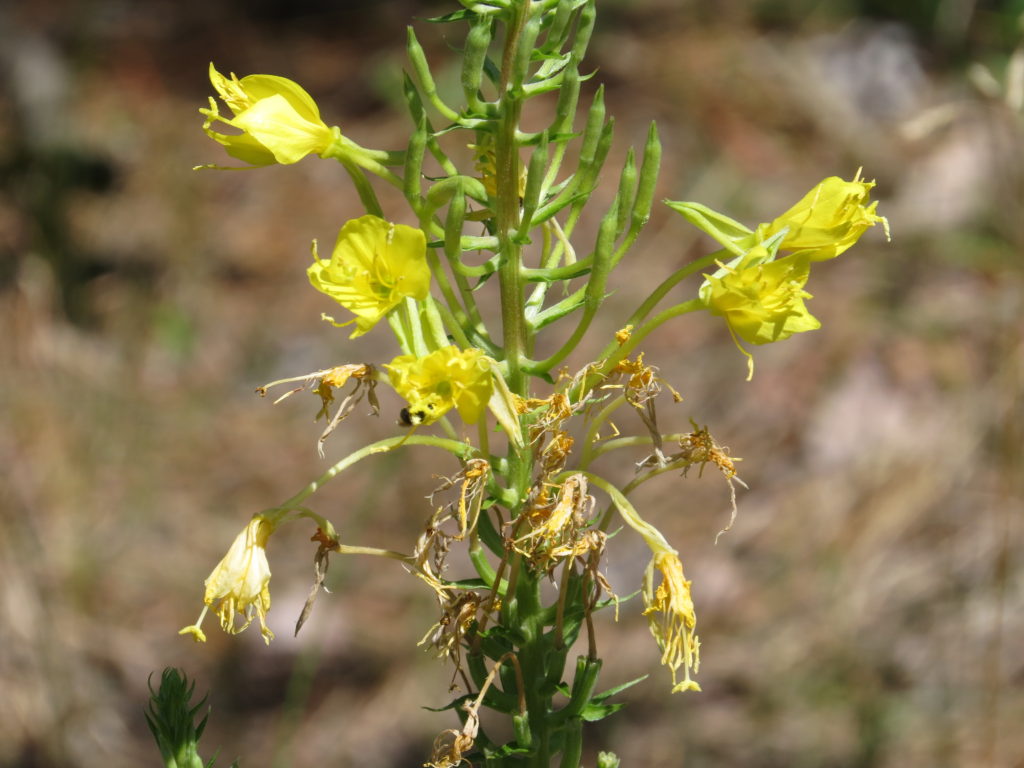
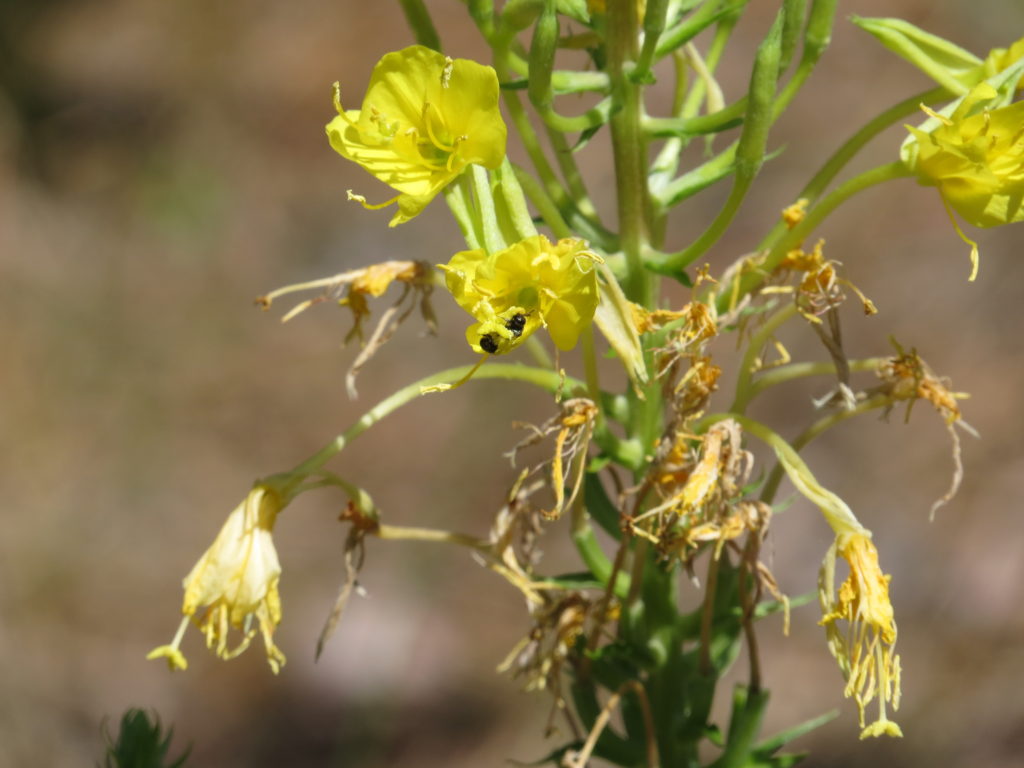
Evening Primroses do as their name says—bloom in the evenings! The stalk of flowers bloom from the bottom up, a few flowers at a time. They open in the evenings and wilt by noon of the next day. Sphinx moths pollinate them during the night, but I also see a small bee on one of the flowers.
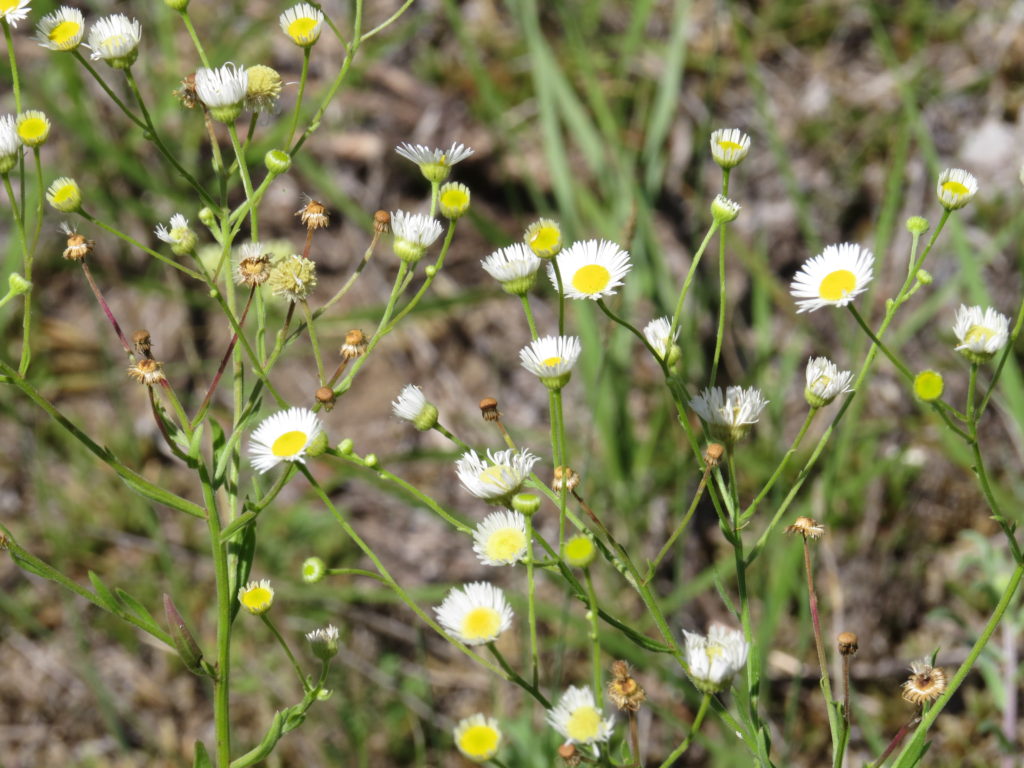
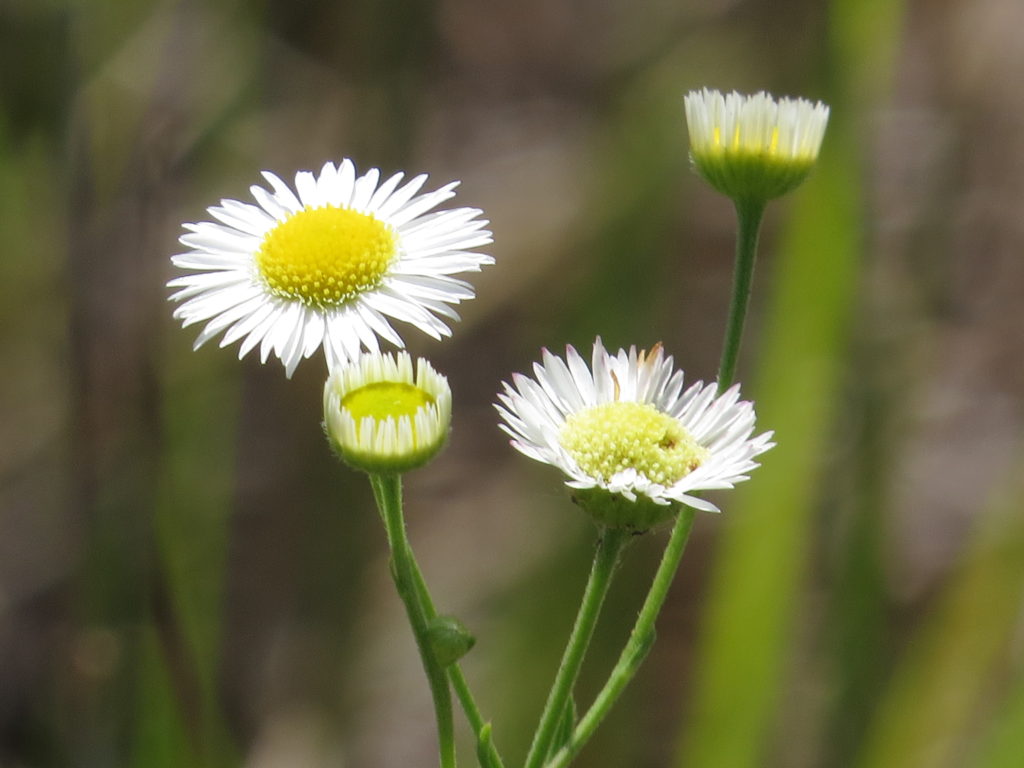
Daisy Fleabane is another self-described name. It was used by pioneers in their beds to keep away fleas. The radiant daisy-like flowers (actually asters) bloom from Spring to Fall on leafless flower stems.
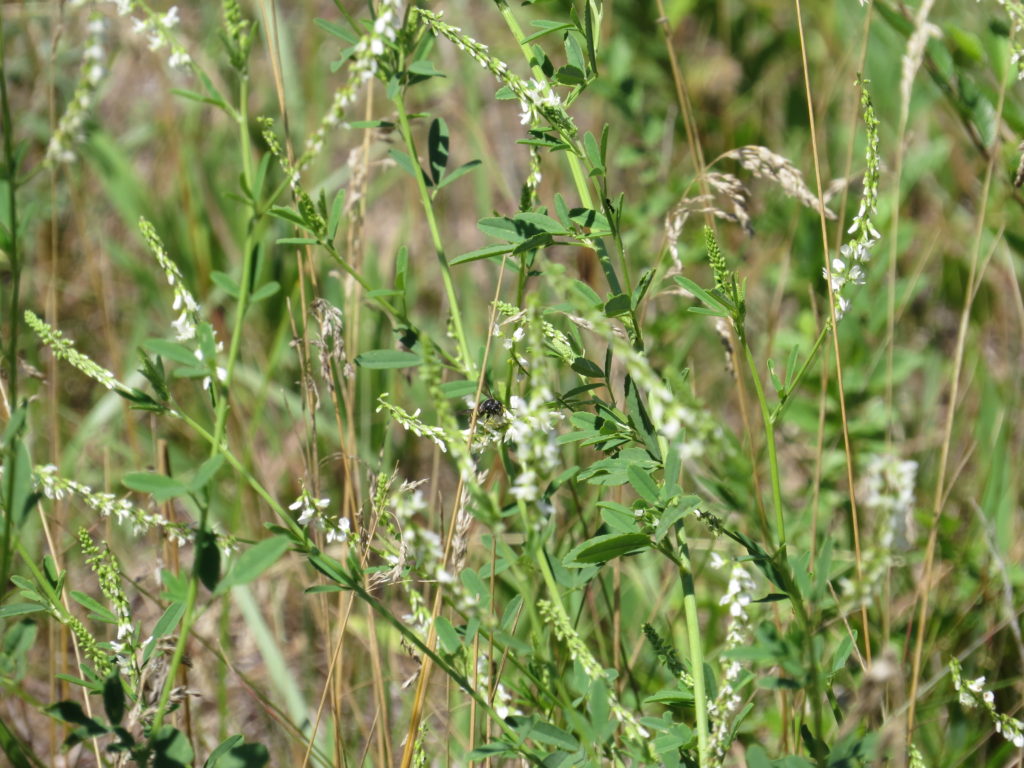
Once grown as a hay crop, this escaped plant now grows ‘wild.’ White Sweet Clover, along with its sister Yellow Sweet Clover, is a major source of nectar for the Honeybee to make honey. The genus name, Melilotus, is Greek for ‘honey.’ Can you see the bee?
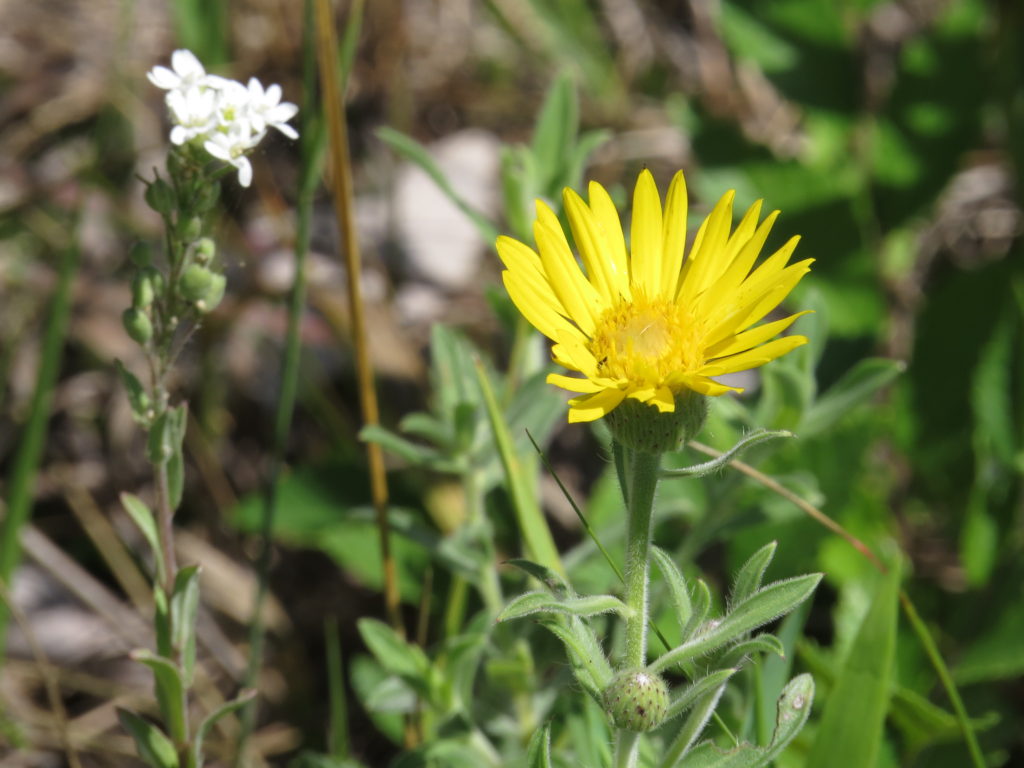
A member of the Mustard family, Hoary Alyssum is an inconspicuous white-blooming wildflower common on the prairie. It pairs well with Hairy False Goldenaster—both are covered in downy white hairs (thus their names.)
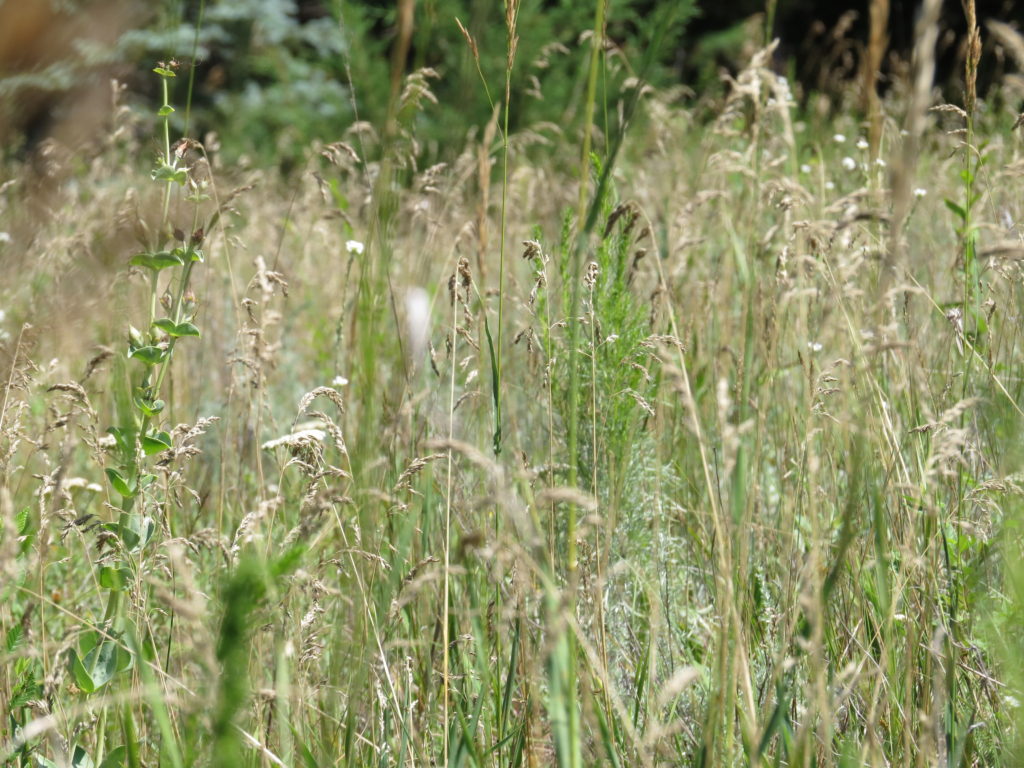
June and July on my little prairie with grasses, wildflowers, silver sages, and pollinators! It is a diverse, ever-changing ecosystem full of tough, unique, and beautiful plants.
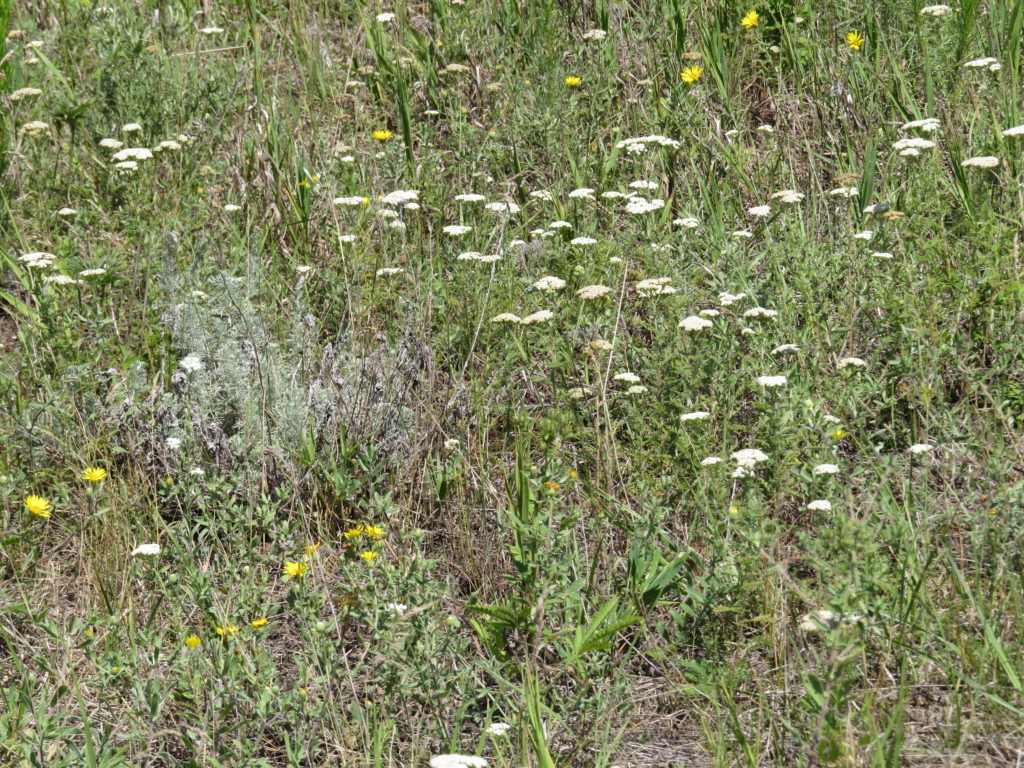
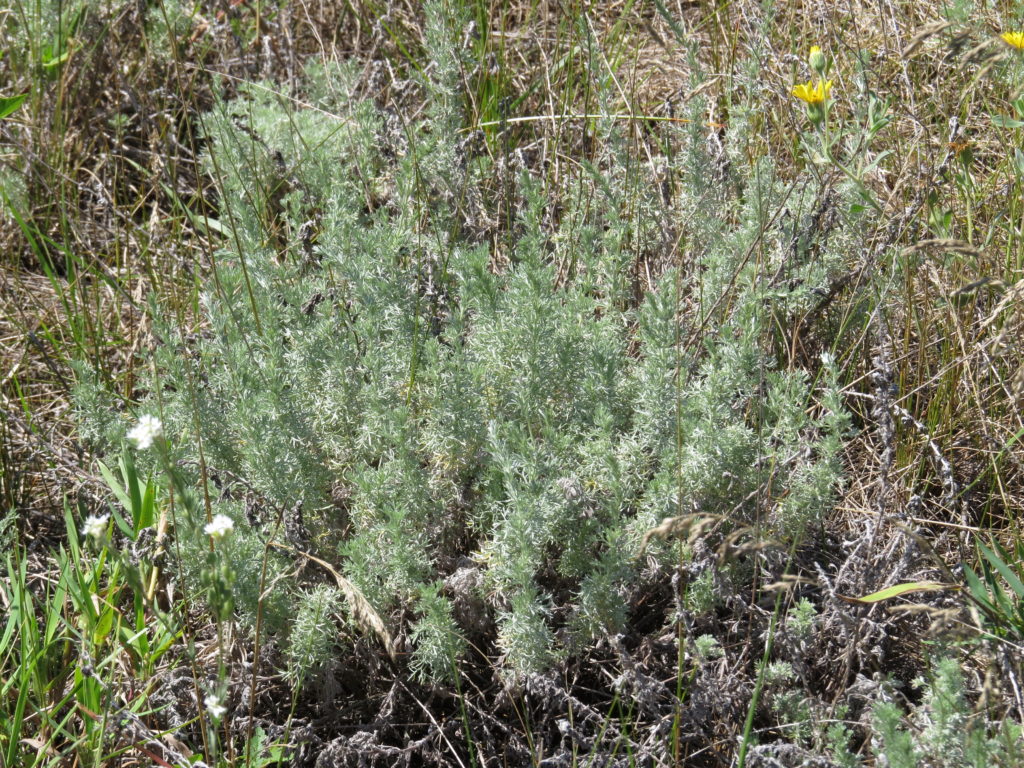
Prairie plants and their busy pollinators, in their quiet and unassuming way, remind me of all the front-line workers of this pandemic we are living through. The nurses, EMTs, police and fire workers, housekeepers, RTs, caretakers, doctors, funeral workers, grocery store workers, and all the other workers who risk their lives in order to take care of our needs. They do their work without fanfare and so often go unnoticed and under-appreciated. They are tough—they wear their masks all day long to keep the rest of us as safe as possible. Their work is hard, and it’s important. A thousand thanks to the tough, unique, and beautiful people on the front lines of this pandemic. You are the shining stars.
Stand at the Crossroads
Every single day we are presented with a fresh expanse of time and place. On one side of that present is the old past, both recent and long ago. On the other side is the future, the new, the unknown, the potential. Our challenge is walking the alley of our day, not getting hopelessly tangled in the rusty barbwire of the past or leaping into the electric fantasy of the future.
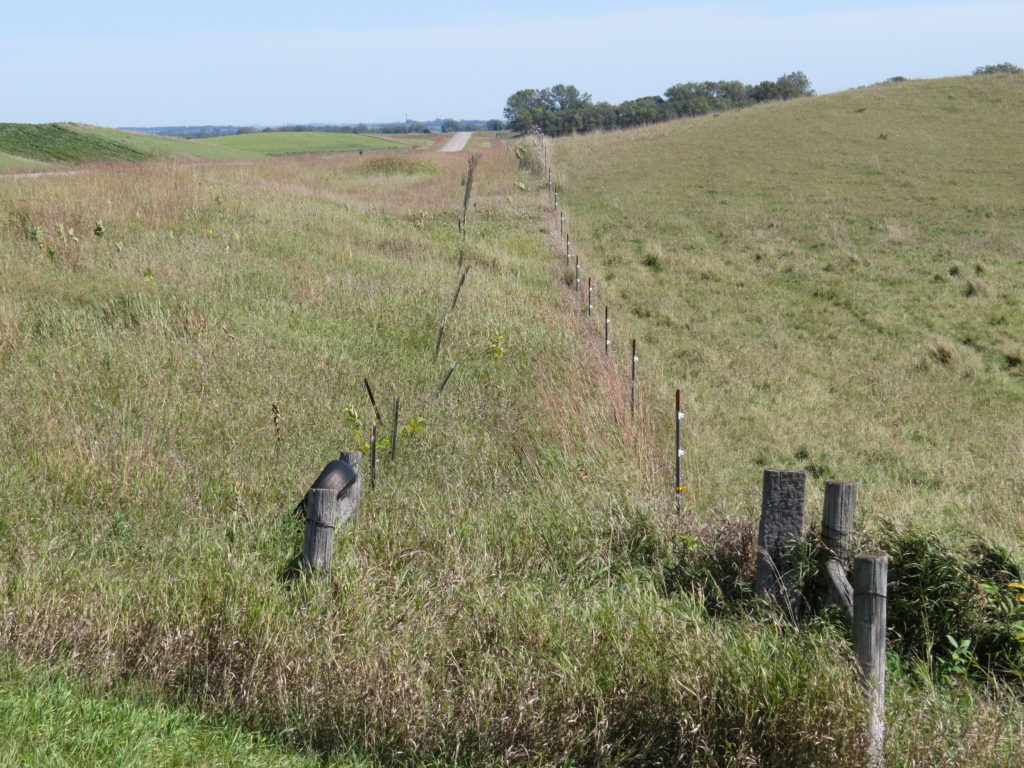
During my time in South Dakota I walked most every day. At the mailbox, I could look east and see my destination—the crossroads that were one mile away. Easy; just walk. At the same time, each night I read from a new book a friend had given me. Easy; just read. On page 5 of the first chapter was a scripture reflection by John Valters Paintner, and these were the words:
Thus says the Lord: Stand at the crossroads, and look, and ask for the ancient paths, where the good way lies; and walk in it, and find rest for your souls. –Jeremiah 6:16
I was walking to the crossroads each day, so with that passage stuck in my head, I began to stand at the crossroads also. I memorized the words as I walked, rolled them over in my mind. What are the chances these two happenings had happened at the same time? Pay attention. What are the chances of literally standing at the crossroads in rural South Dakota without getting run over? Pretty darn good.
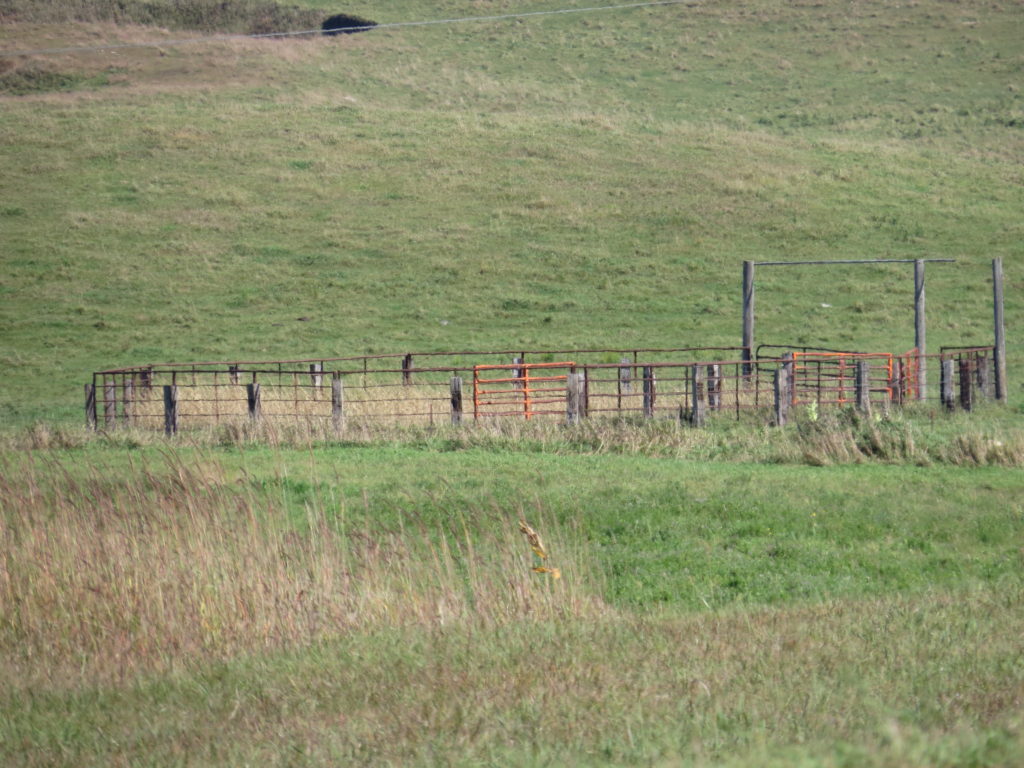
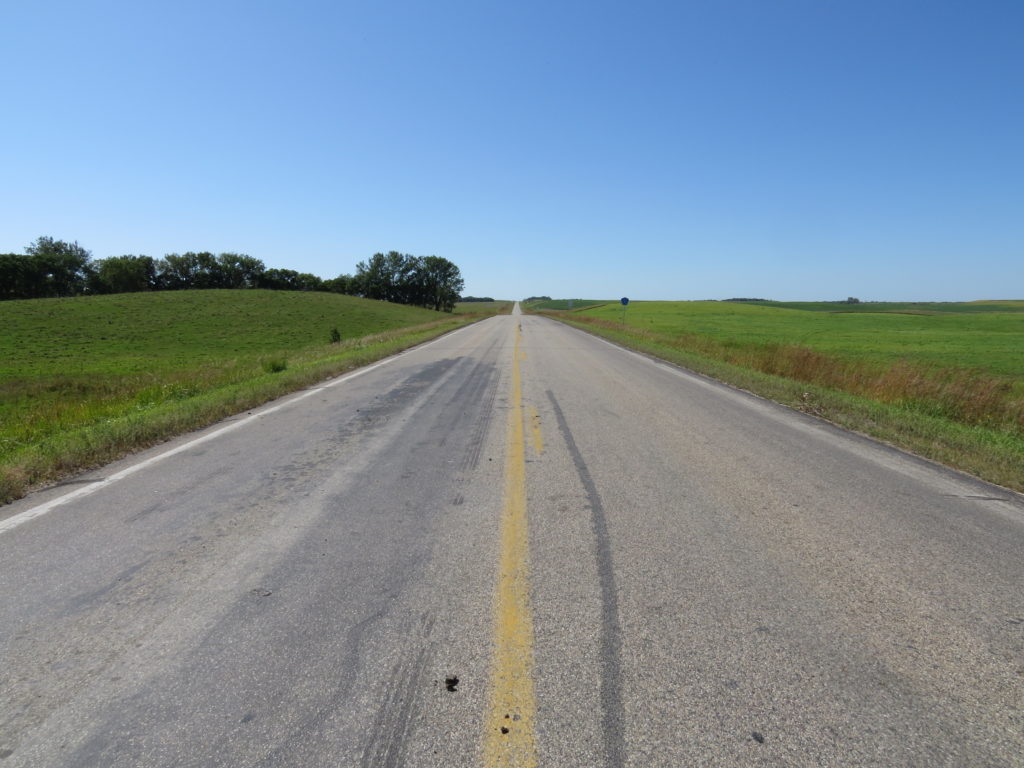
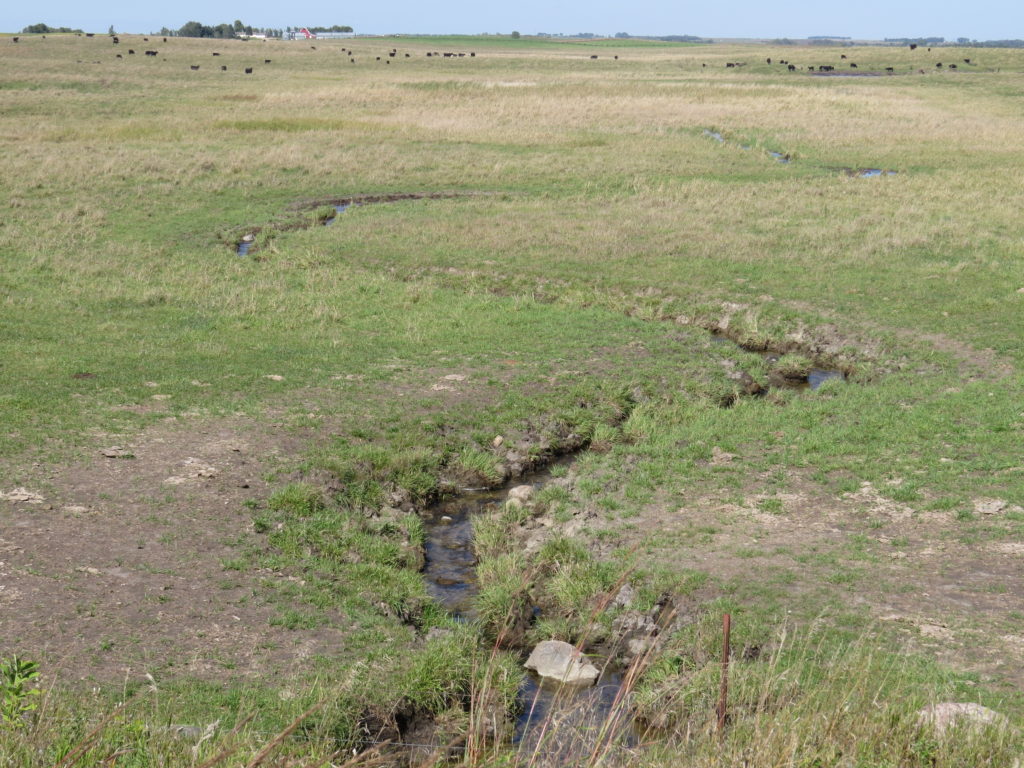
I stood and looked east. A corral, an old windmill, a cemetery on the hill.
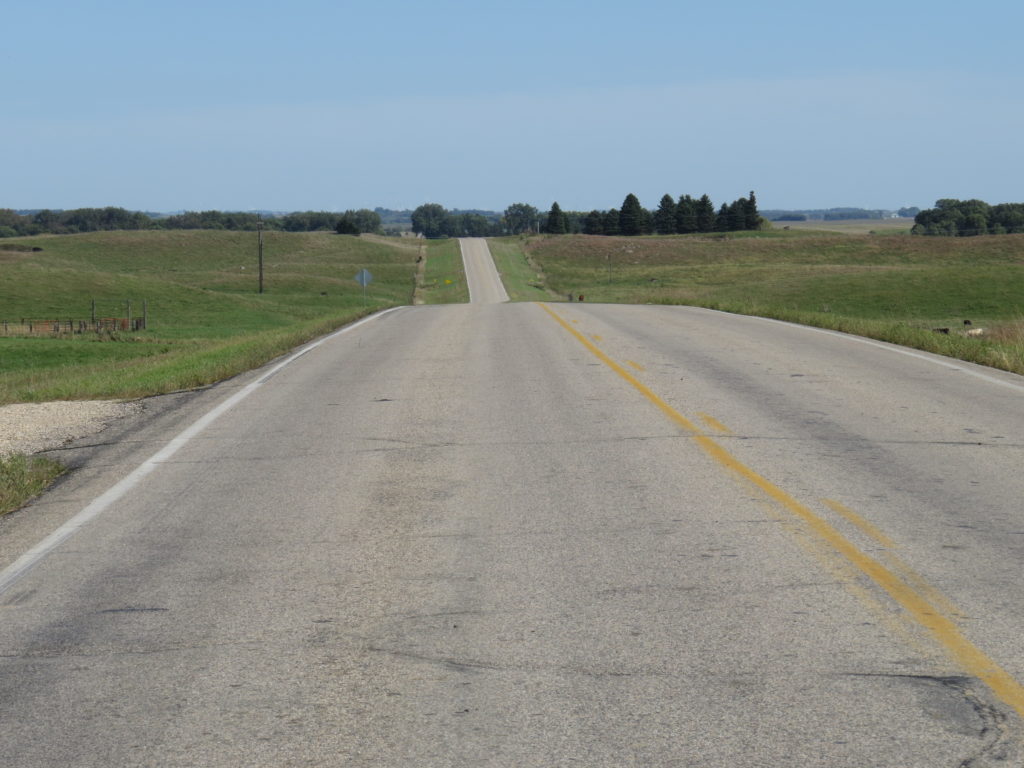
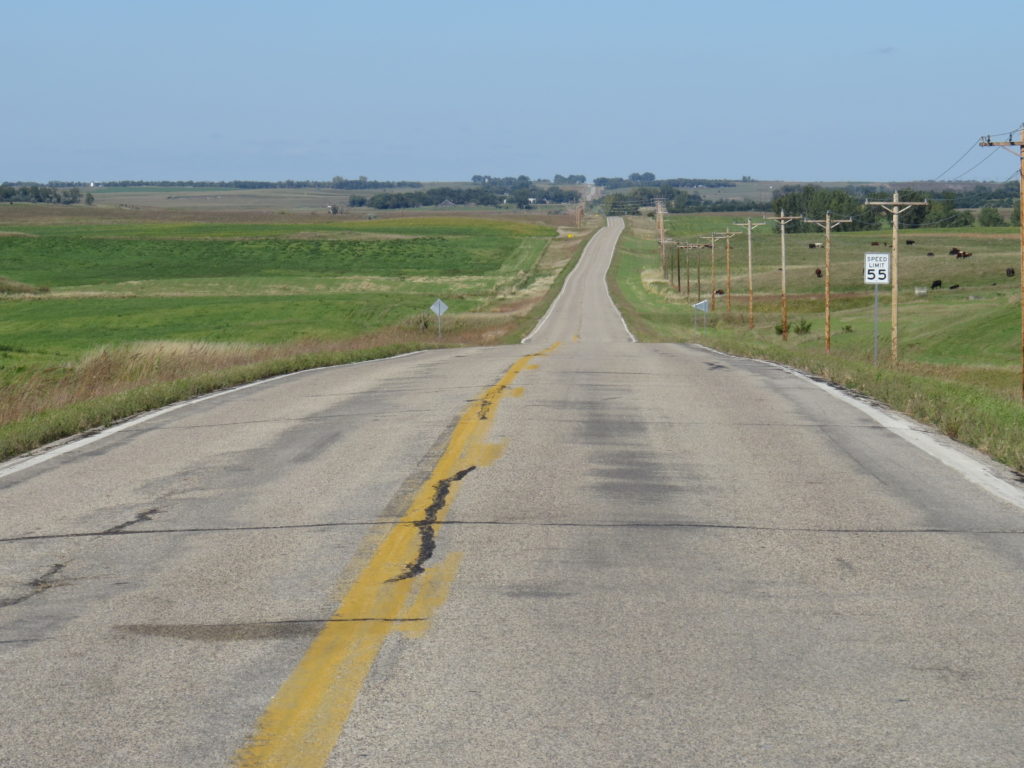
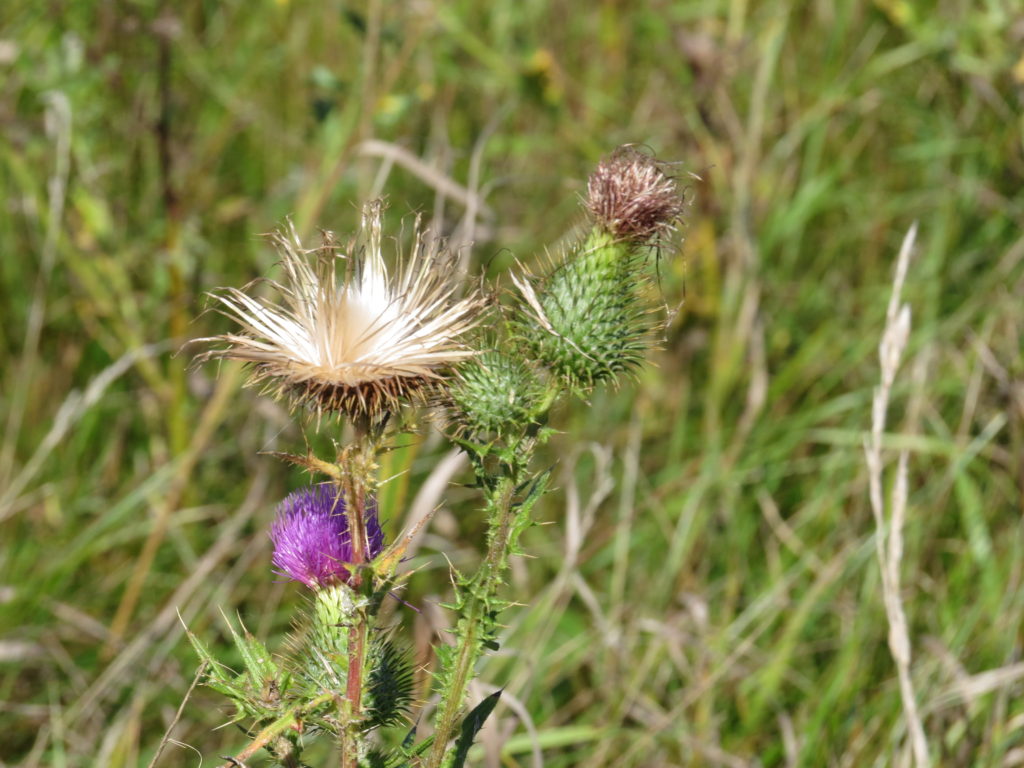
I stood and looked north. A highline wire, fields and farms, a thistle gone to seed, a distant hill.
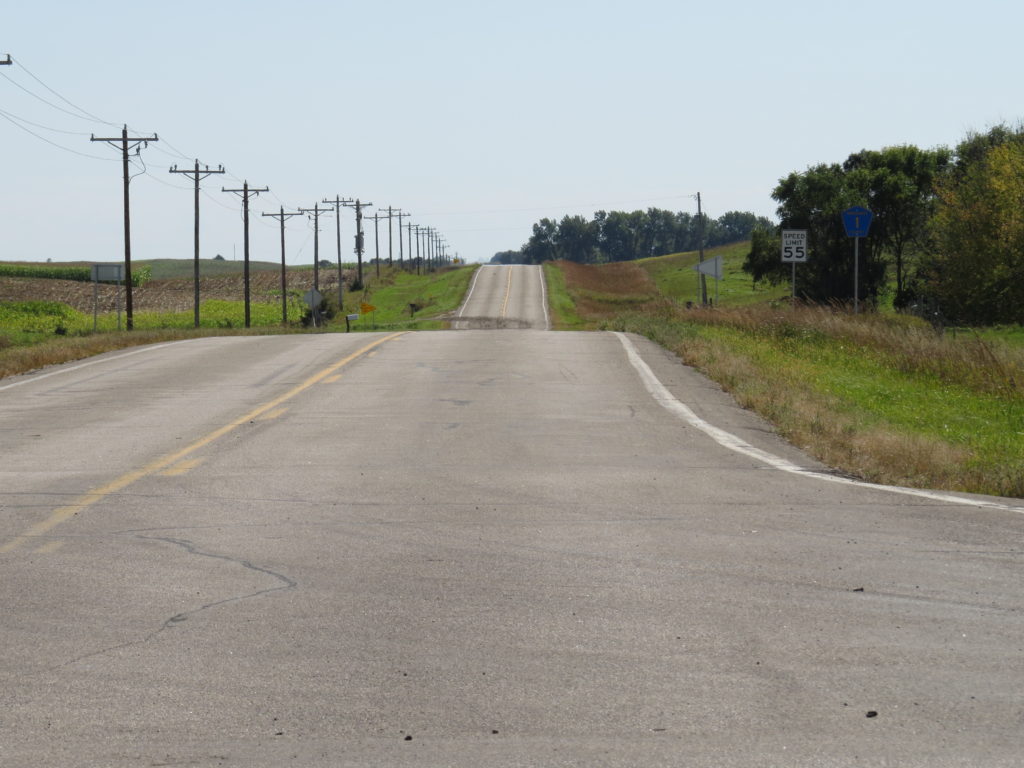
I stood and looked south. I couldn’t see very far. The highline wire, tractor mud on the road, Indiangrass in the ditch.
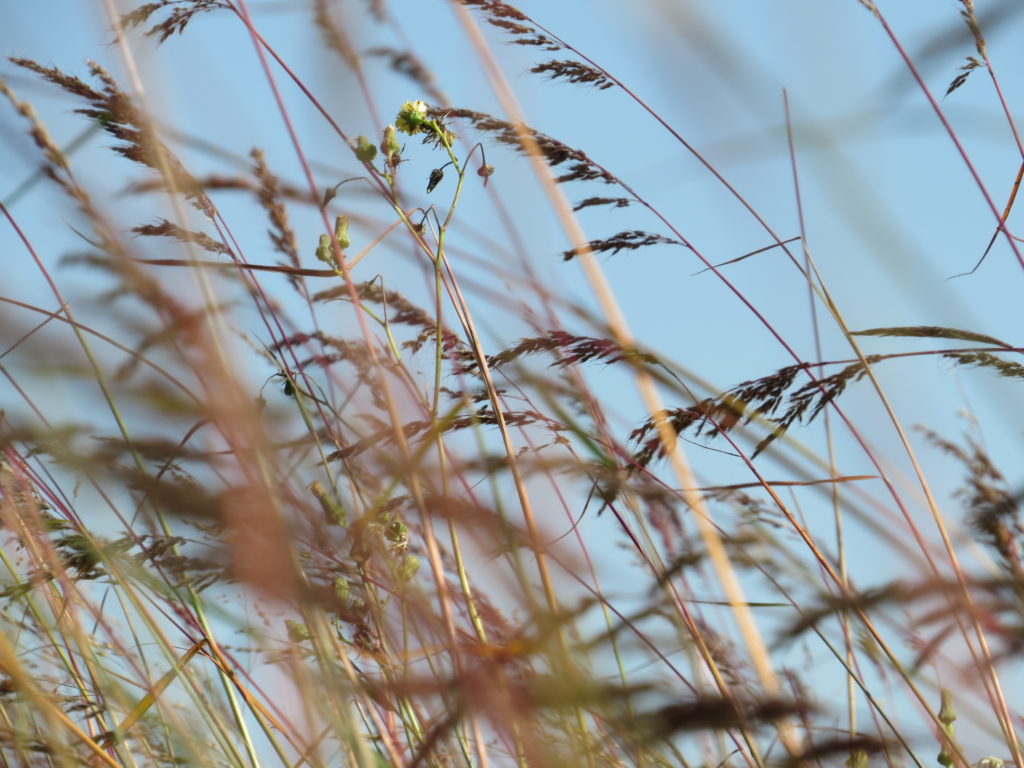
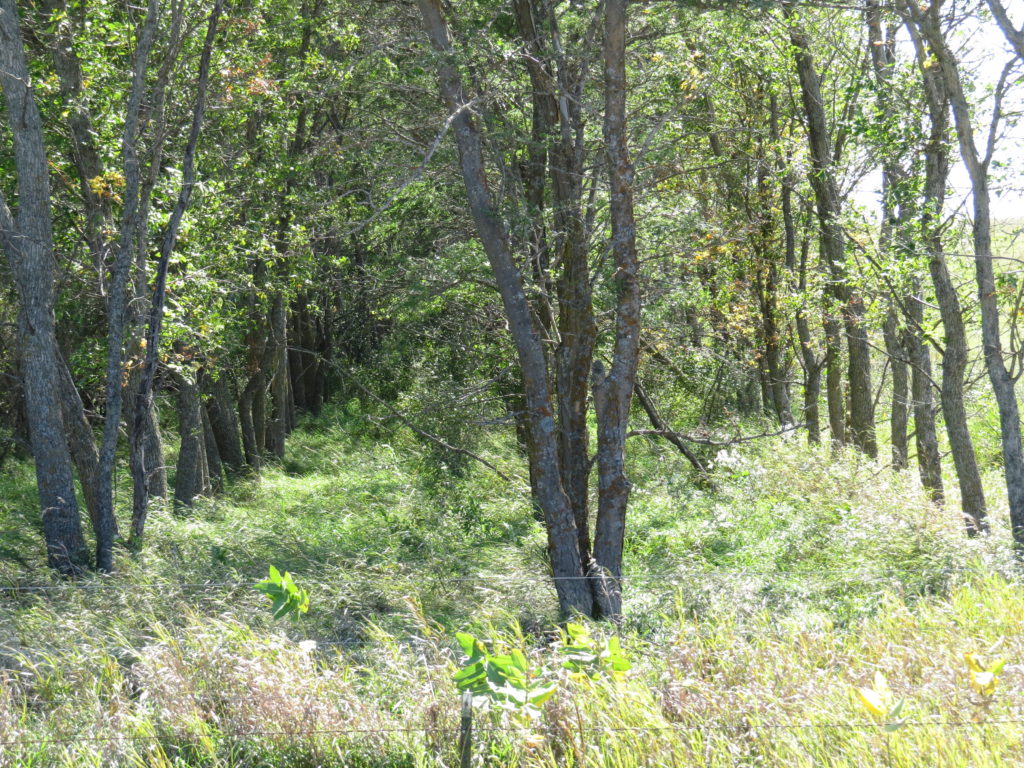
I stood and looked west. Prairie grasses and pastures, a straight and narrow shelterbelt of trees, a clear, blue sky.
Jeremiah’s passage was so imperative, so direct: stand, look, ask, walk, and find. Easy? I stood, I looked, I walked, and I got caught up on “ask for the ancient paths.” What does that mean? “…the ancient paths, where the good way lies.” I have always tried to make my decisions with intention of following the good way. Is the ancient path easy, or the way of Nature, or is it hard, like taking the high road?
Paintner describes the book of Jeremiah as “an important aid to learning from the mistakes of the past and discerning the path ahead.” Stand at the crossroads. Look. Ask for the good way. Walk through the gate and down the alley between past and future. Find rest for your soul.
The Solitude of the Prairie
“The prairie, these plains….It was as if nature had taken solitude and fashioned it into something visible, carved out the silences into distances, into short grass forever flowing and curving, a vast sky forever pressing down, nothing changing, nothing but sameness, day after day after day, as far as you could see, as far as you could go. It was like the solitude of God…as awesome, and as beautiful.” from Johnny Osage by Janice Holt Giles
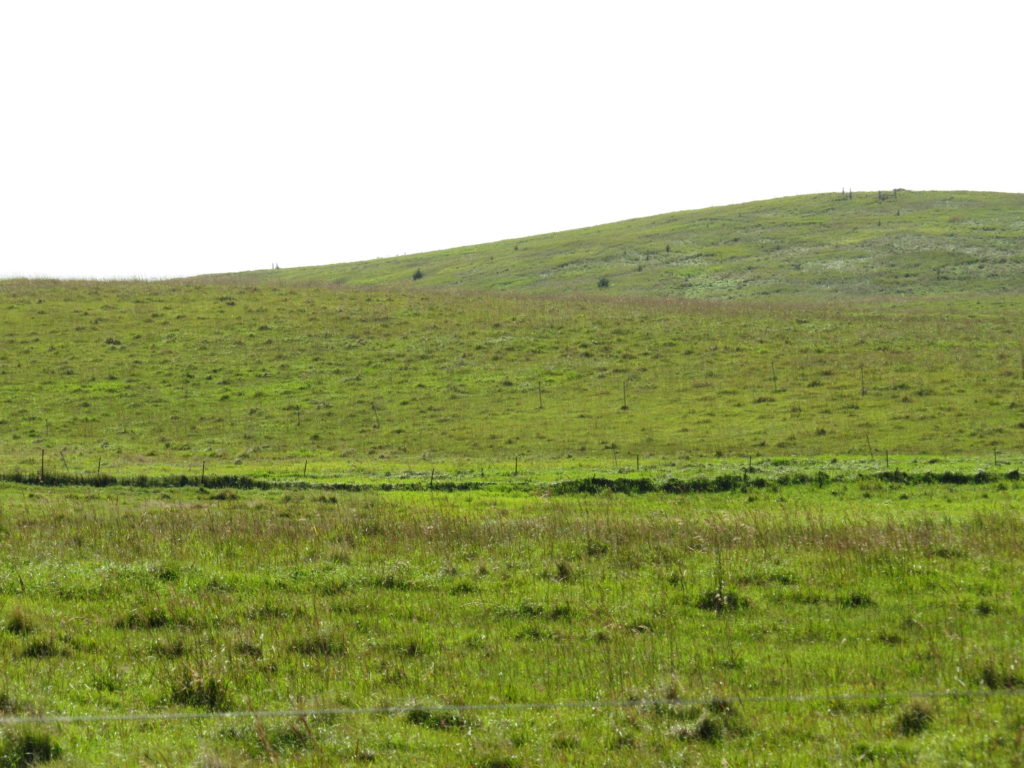
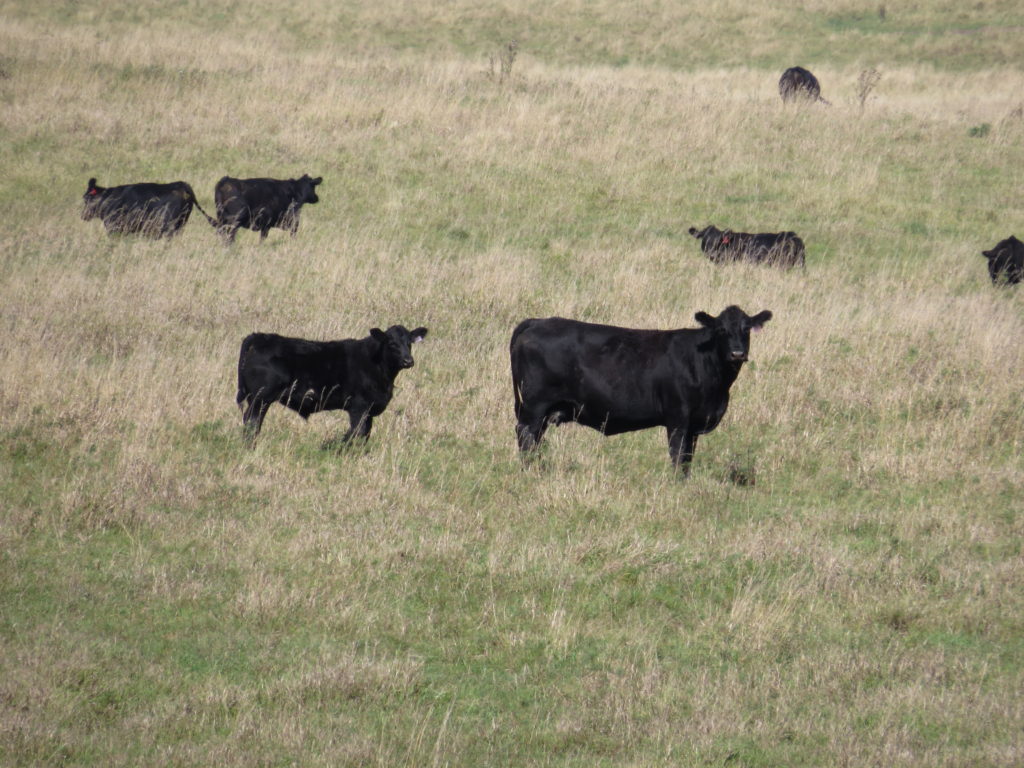
Seeking the solitude and healing of the prairie, I drove my wretched self to my Mom’s place. It’s not an endless prairie like the early 1800’s of Johnny Osage’s time, but there is still enough around to calm my nerves and soothe my soul. Seeing cattle out on the grassland adds another layer of calm and ‘right-ness’ to my world.
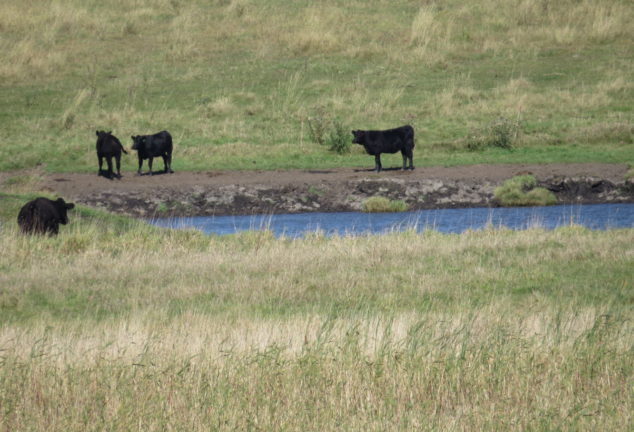
There are certain sights that are so familiar to me, almost to the point of not noticing—like the cattle standing around the dirt perimeter of a ‘stock dam’ dug out of the prairie grass. Every stock dam, slough, creek, and lake were filled and overflowing with all the rain that has fallen, from Spring thaw until this late summer. There was more water and more fallow fields (from flooding) than I have ever seen in eastern South Dakota. Too much of a good thing. Too much for normal boundaries to handle.
Late summer is the perfect time to appreciate the beauty of the prairie grasses: the maroonish-red of Big Bluestem, the delectable native grass that is like ‘ice cream for cows’…
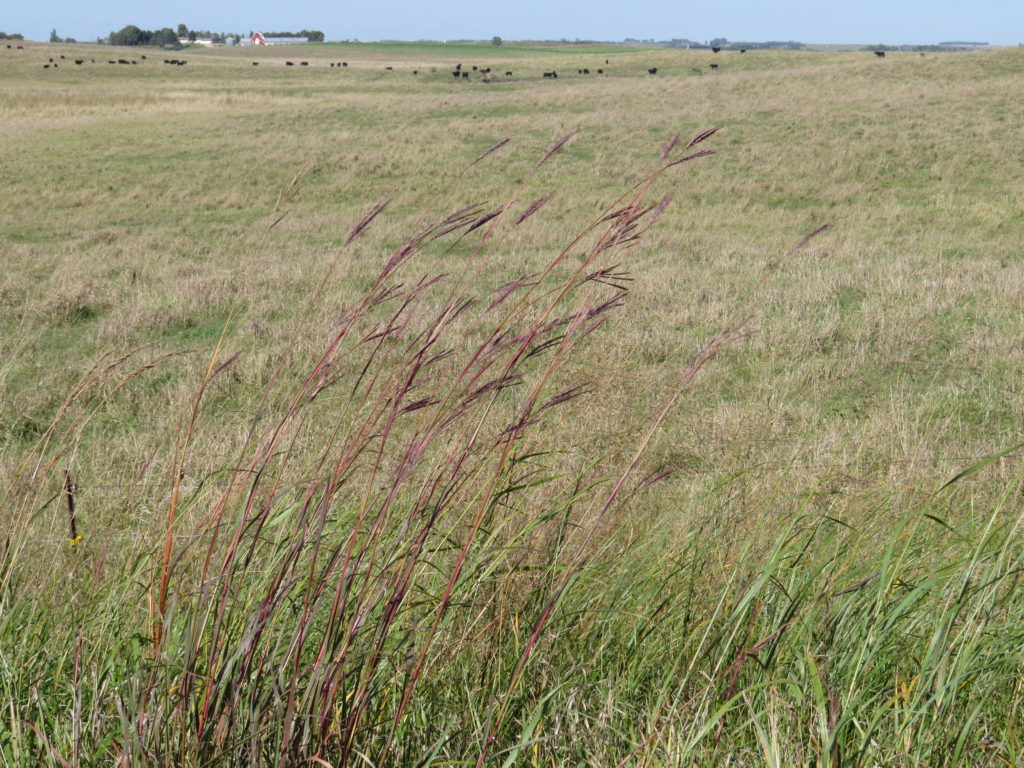
the golden-brown of the tall, sturdy Indiangrass…
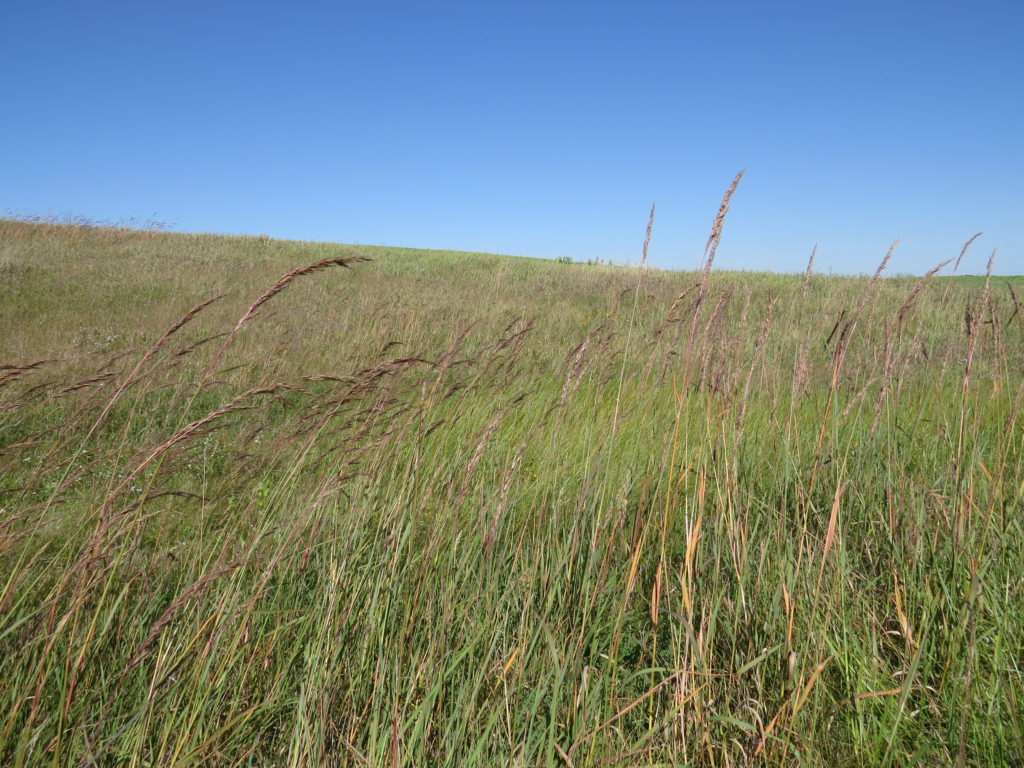
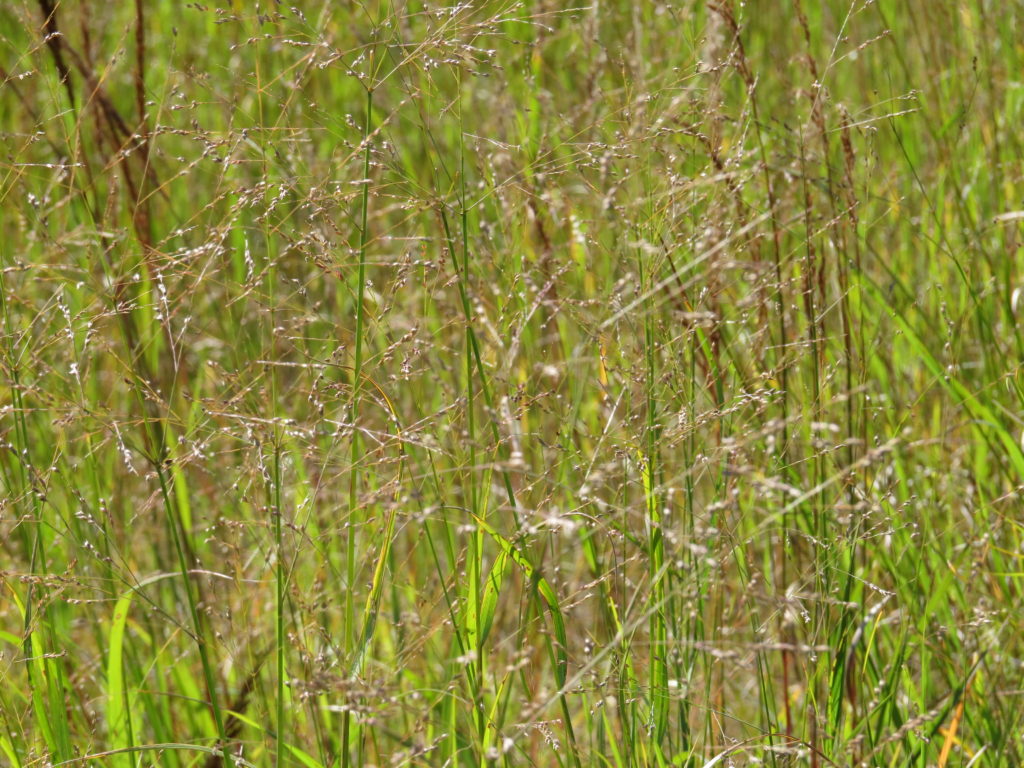
and the wispy green-gold of Switchgrass.
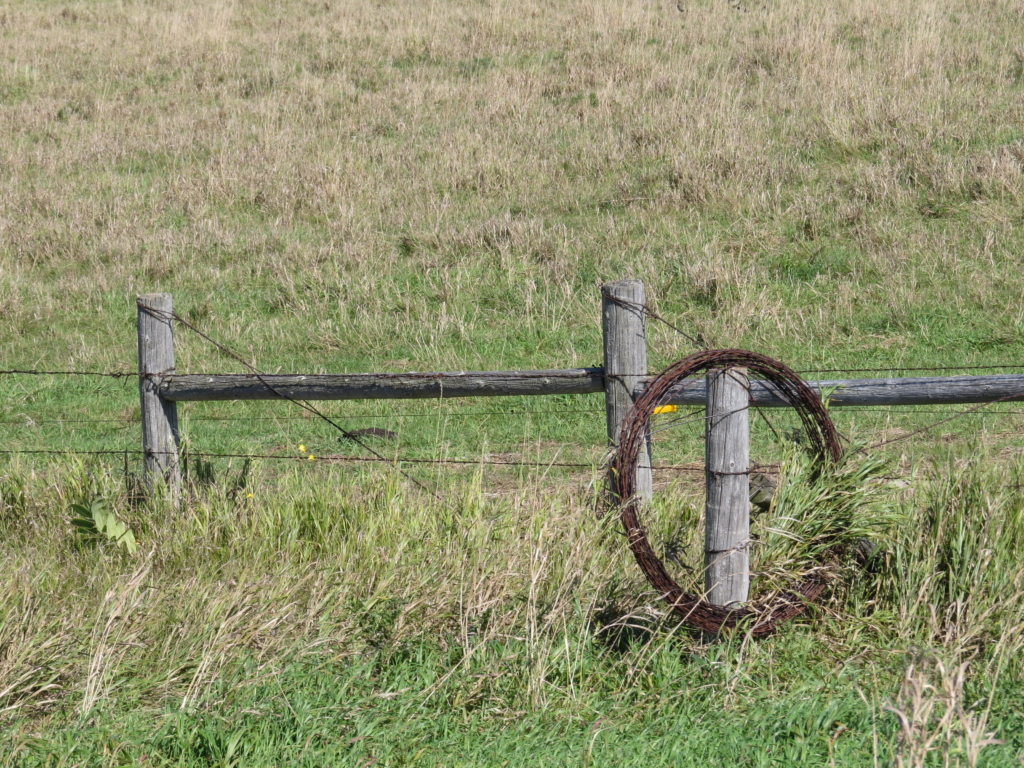
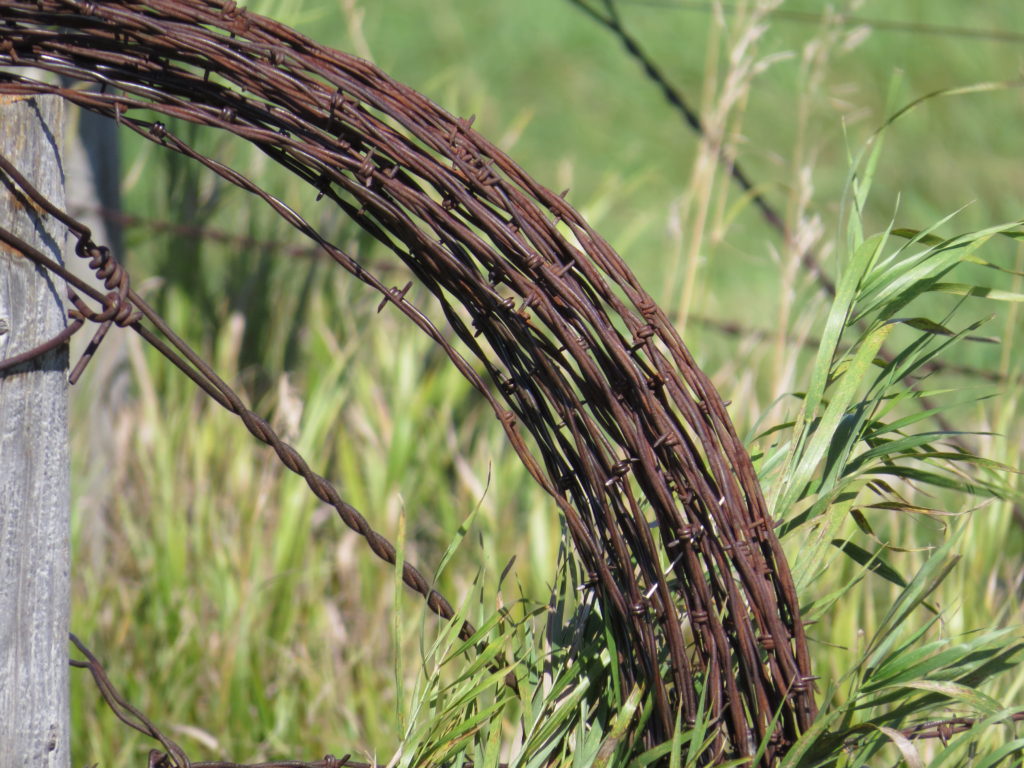
Old barb-wire fencing rolled into a neat circle hung on a gray corner post. Electric fencing is taking over boundary patrol for most cattle pastures, it seems. But the words cattle and prairie cannot be put together without the iconic image of the rusty wire and gray posts.
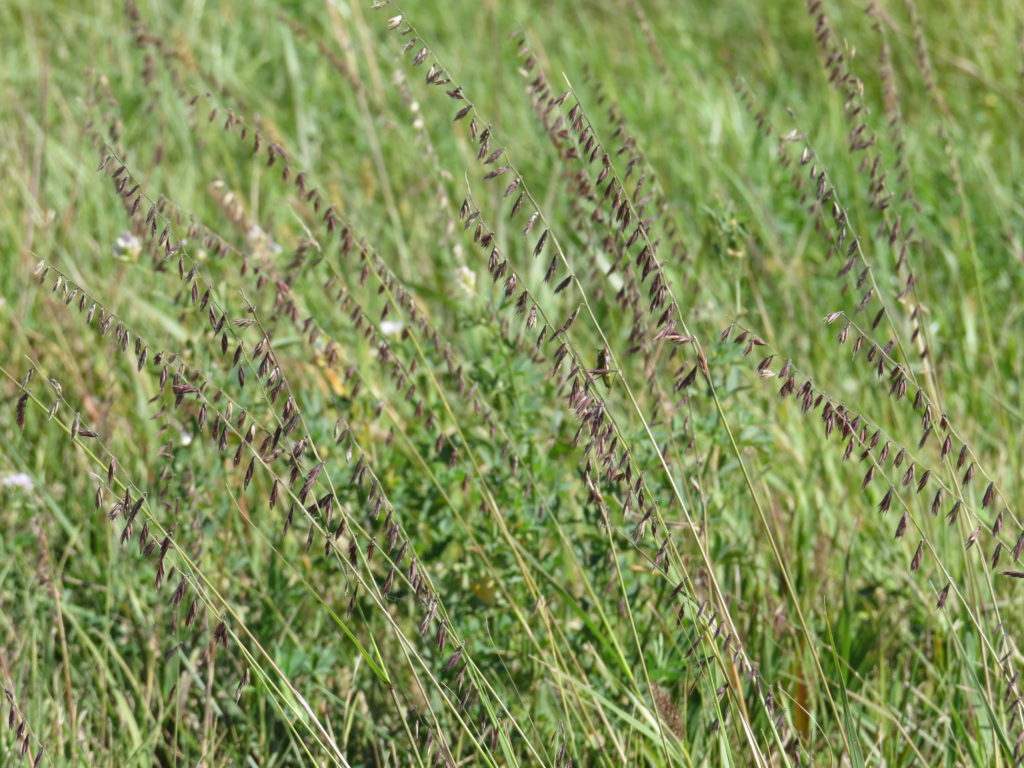
Another prairie grass, shorter in statue than the above three, is Sideoats Grama. The small oat-like seeds hang on one side of the grass stem.
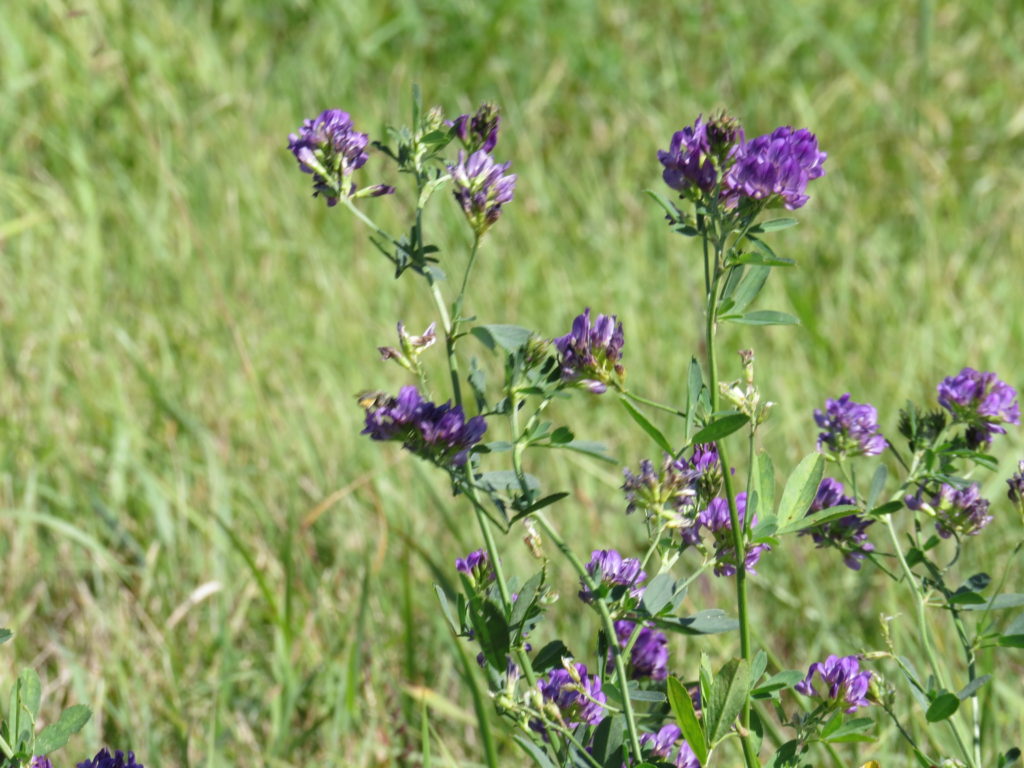
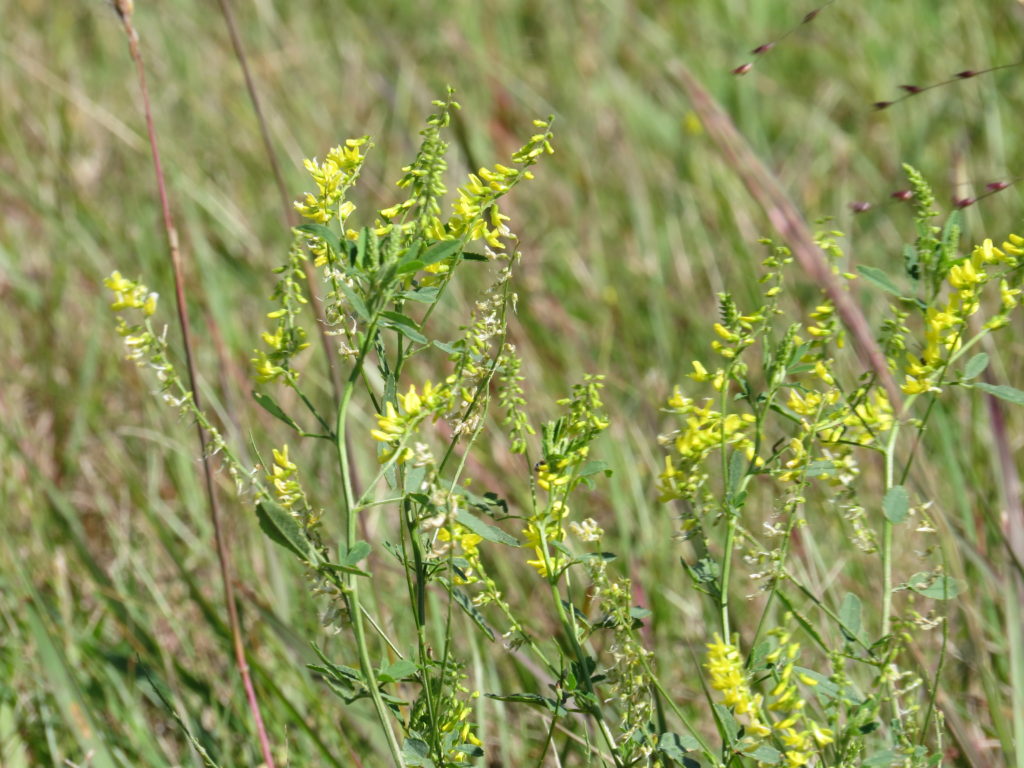
Alfalfa and Sweet Yellow Clover are other haymakers found among the grasses. These legumes add more protein content to all-grass hay.
No prairie pasture picture is complete without a standard barb-wire gate attached to the fence post with a tight, smooth wire. If in a vehicle, the passenger usually ‘gets the gate’; on horseback, we used to take turns.
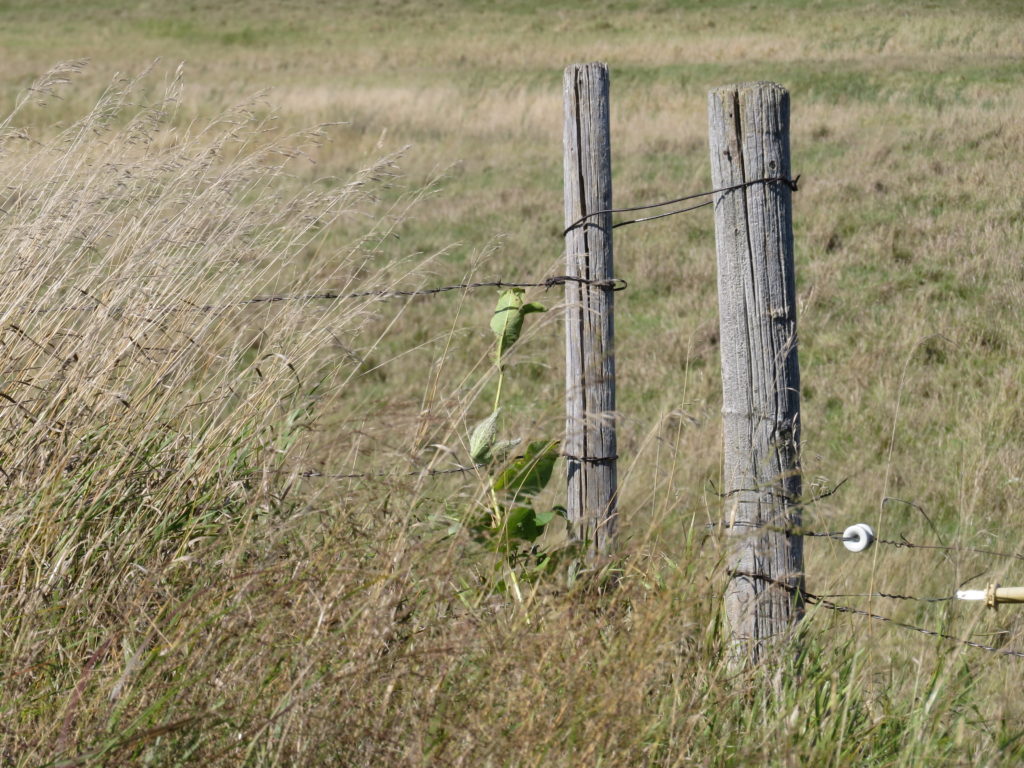
On the post that anchors the barb-wire gate is an old weathered board. It used to display a ‘No Trespassing’ and/or ‘No Hunting’ sign. In other words, ‘Stay Out.’ This is private property; this protects the cattle who live here.
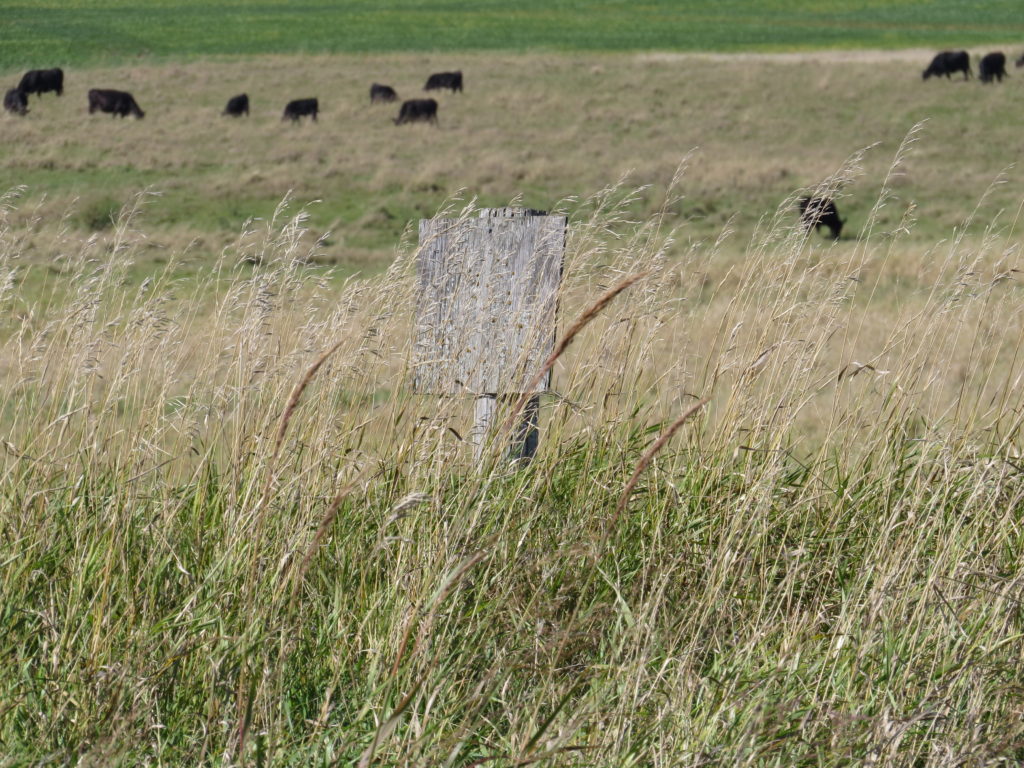
Rarely is it one event in our lives that brings us to our knees—or takes me to the prairie. Usually it is a foggy-morning-freeway-pile-up of things that descend upon us. We are built to be resilient to the many physical and emotional assaults that we experience in life, but at times, it is too much for our normal boundaries (and bodies) to handle. We need familiarity, protection, good nutrition, sleep, and solitude to ‘right’ ourselves, to calm ourselves, and to heal ourselves. That’s what the prairie does for me—the awesome and beautiful solitude of God.
We The Spiritual People
One of the ways you know you’re on the prairie is the huge expanse of sky. Save for a lone tree or two, nothing impedes the view of the blue dome, the clouds, the sun and stars. Stretched out at your feet is a waving sea of grasses with golden seedheads, interspersed with a colorful variety of wildflowers.
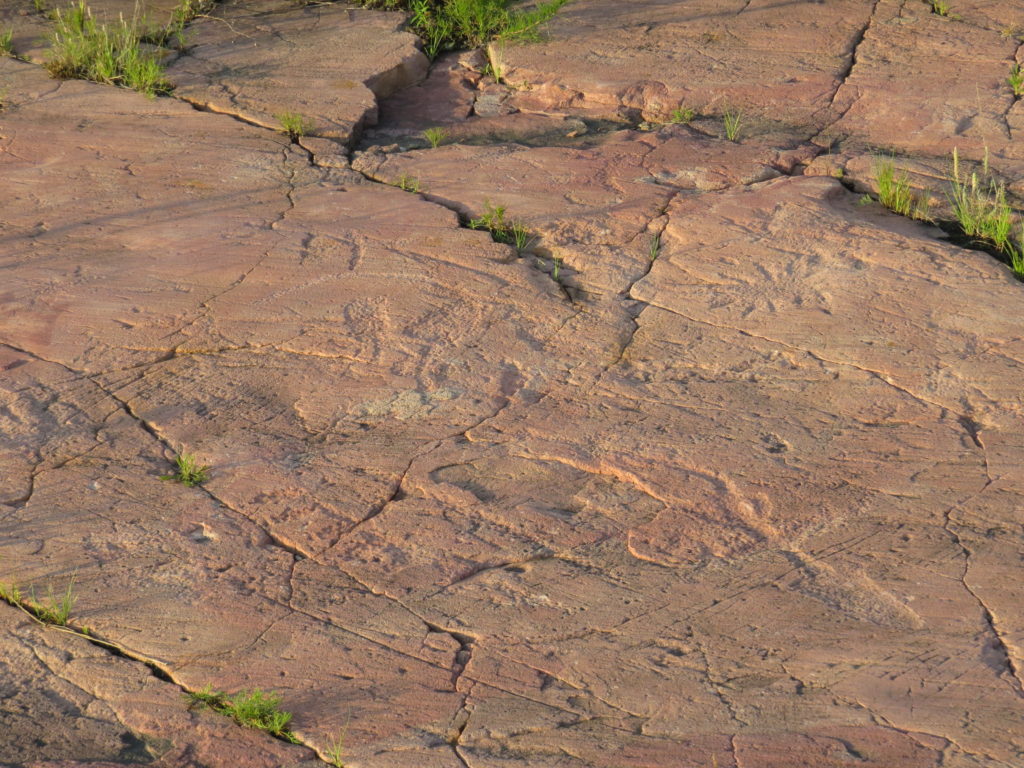
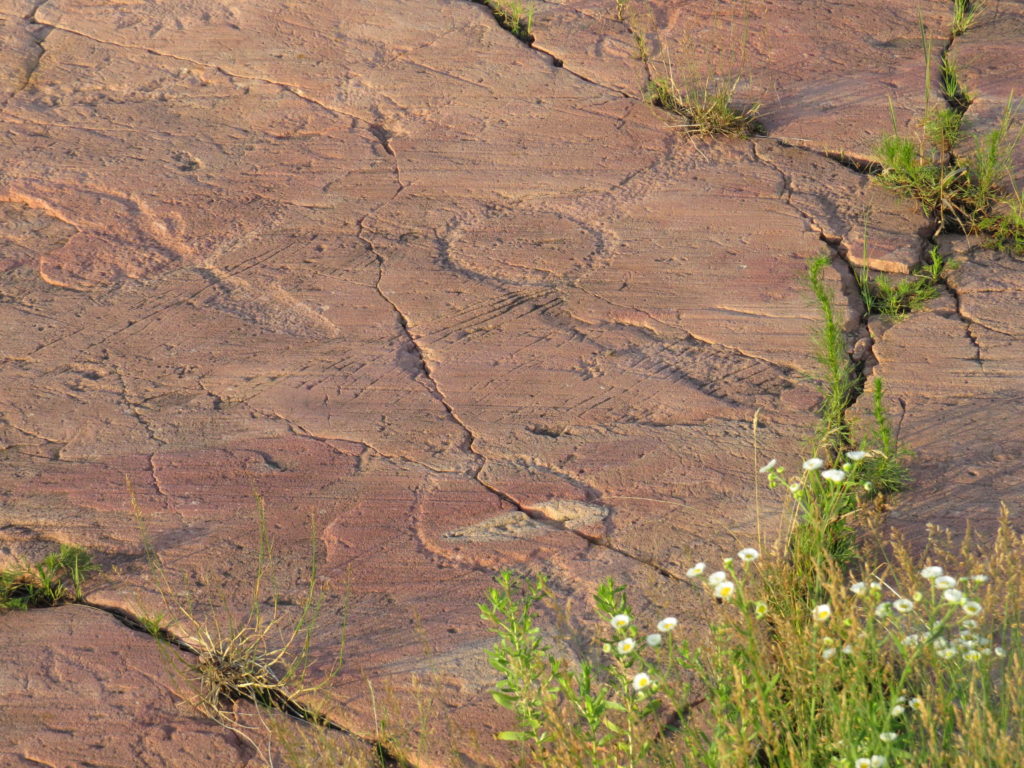
On our way home from Missouri, we took old U.S. Highway 71 instead of the Interstate, and we navigated the old-fashioned way—by map. When we crossed the line from Iowa into Minnesota, I noticed a place on the map called Jeffers Petroglyphs. That sounds interesting! It was nearing seven in the evening by the time we saw the turn-off but decided to check it out anyway. Just four miles off the highway, we pulled into an almost empty parking lot. One man on a motorcycle was just getting ready to leave. He instructed us to find a booklet about the petroglyphs on a picnic table at the backside of the interpretive center, which had closed at five. We walked through the prairie grasses and flowers to a red rock ridge and began a scavenger hunt of sorts, to see and identify the rock carvings that had been cataloged in the booklet and on the signs. We stepped back in time by thousands of years!
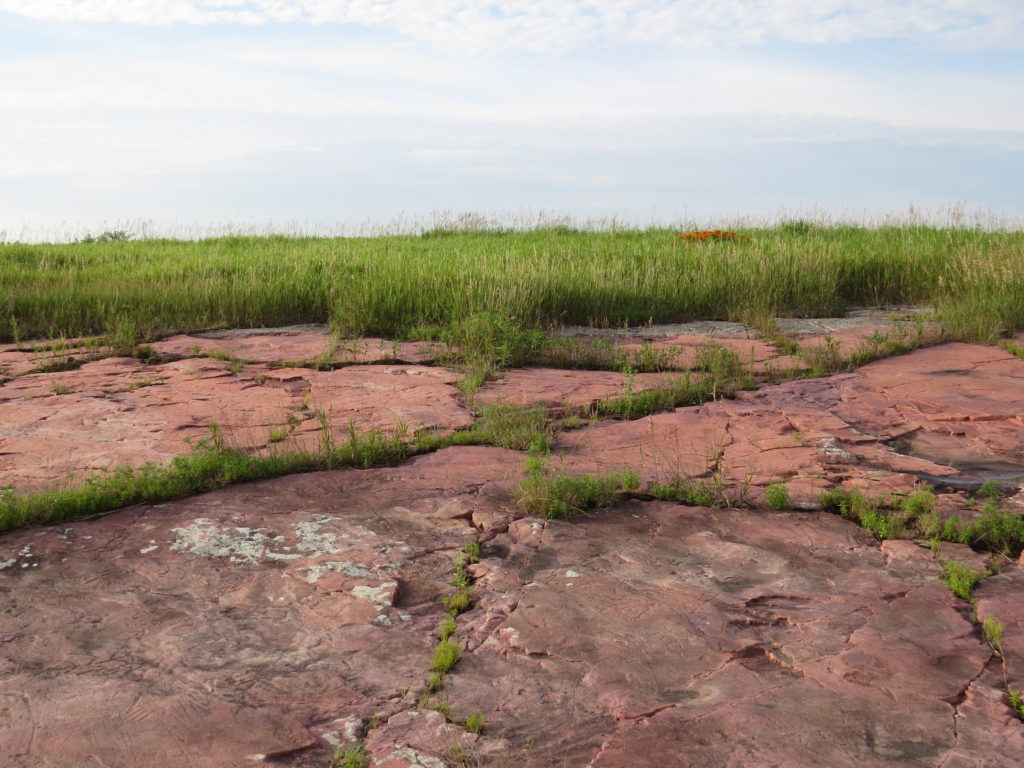
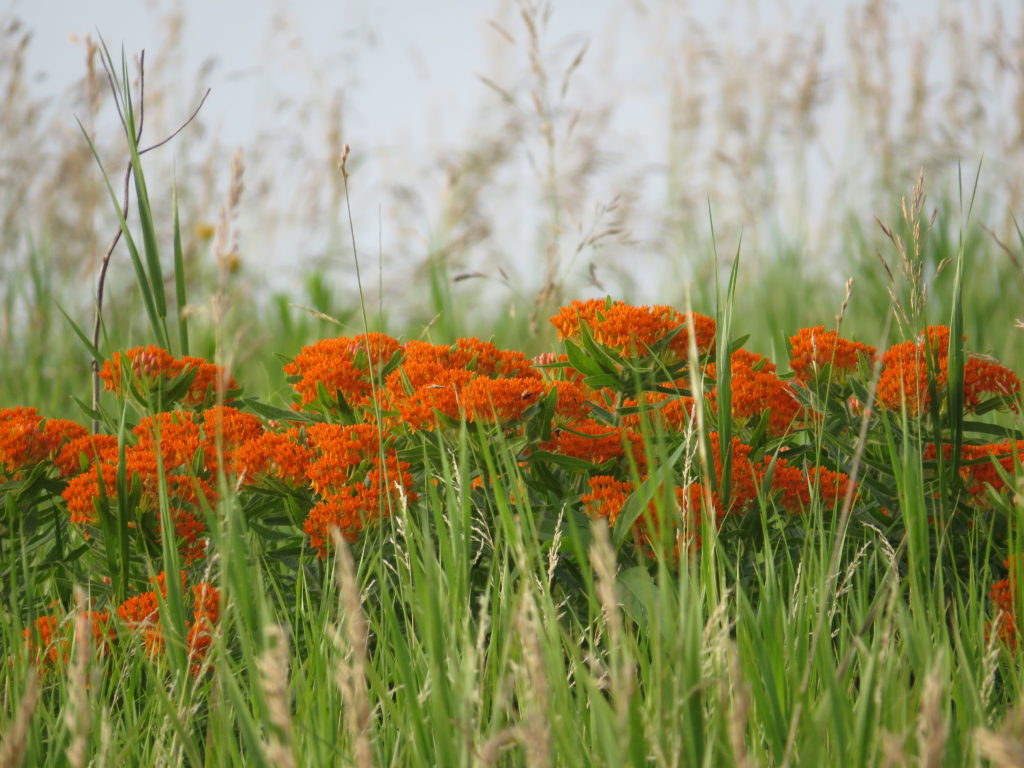
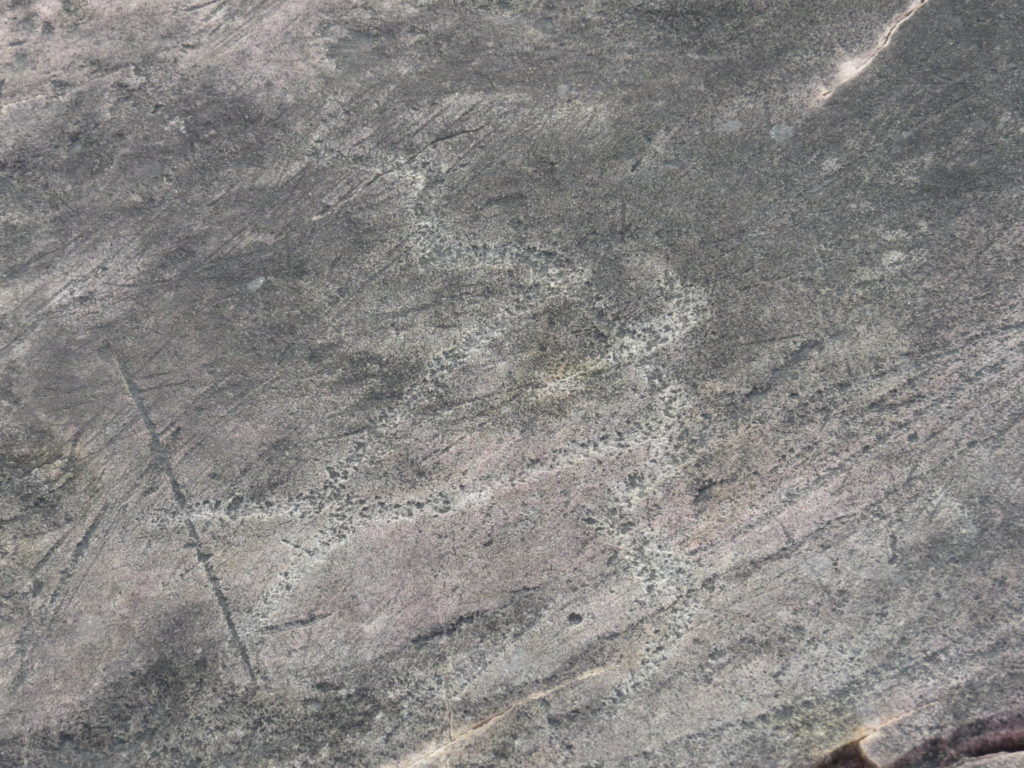
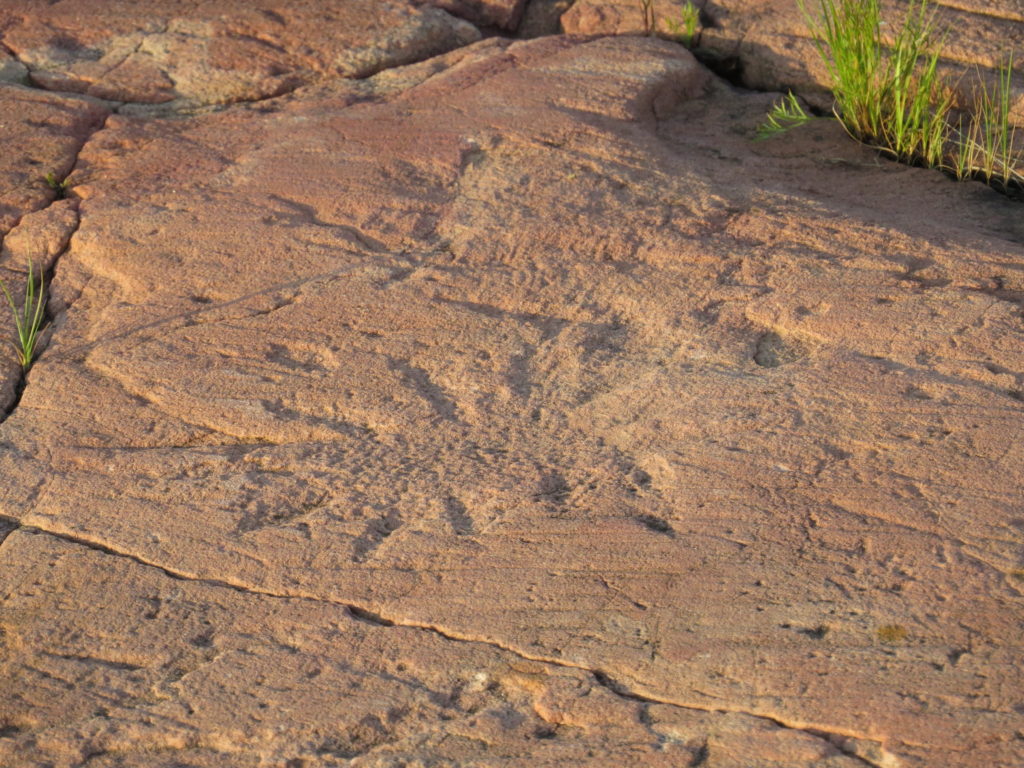
Following a roped-off pathway, at first we had a hard time seeing anything but rock. As our eyes adjusted to what the carvings looked like in texture, we began to see shapes and forms. There’s a hand print and an arrow!
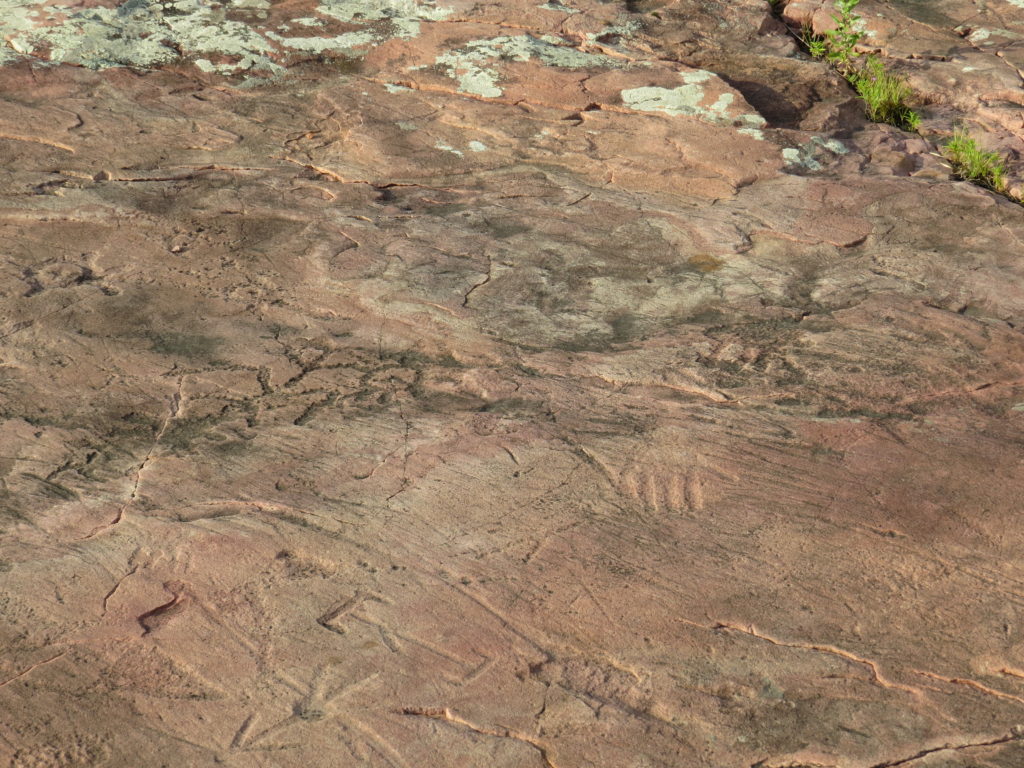
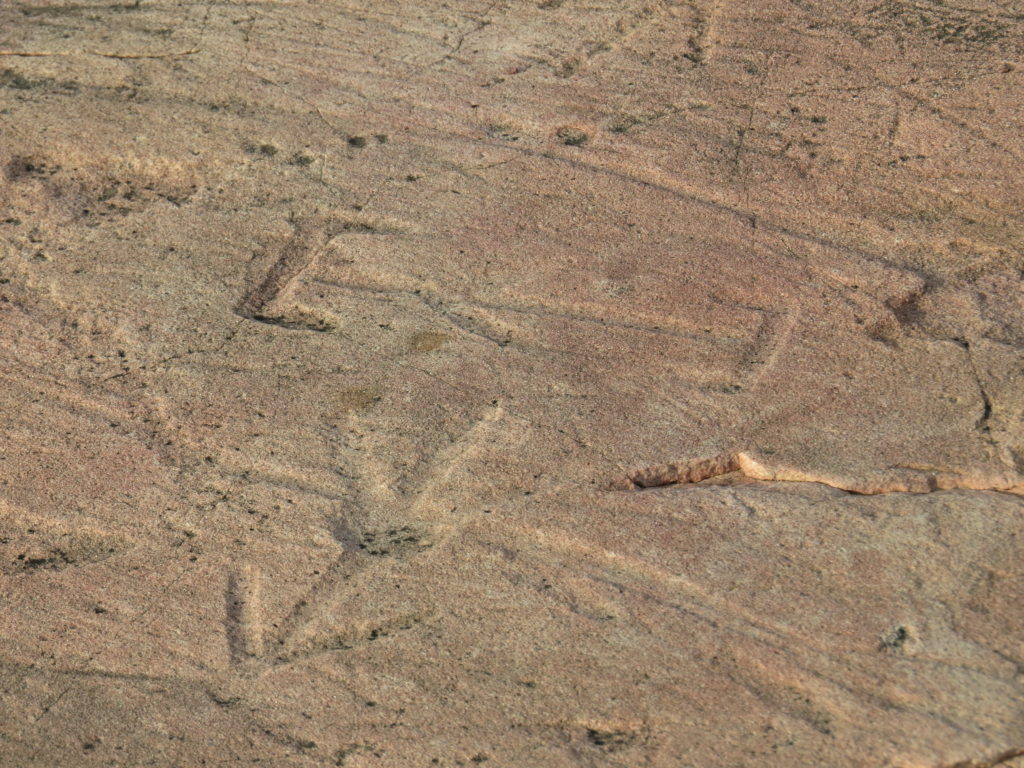
Is it a bird and a buffalo?
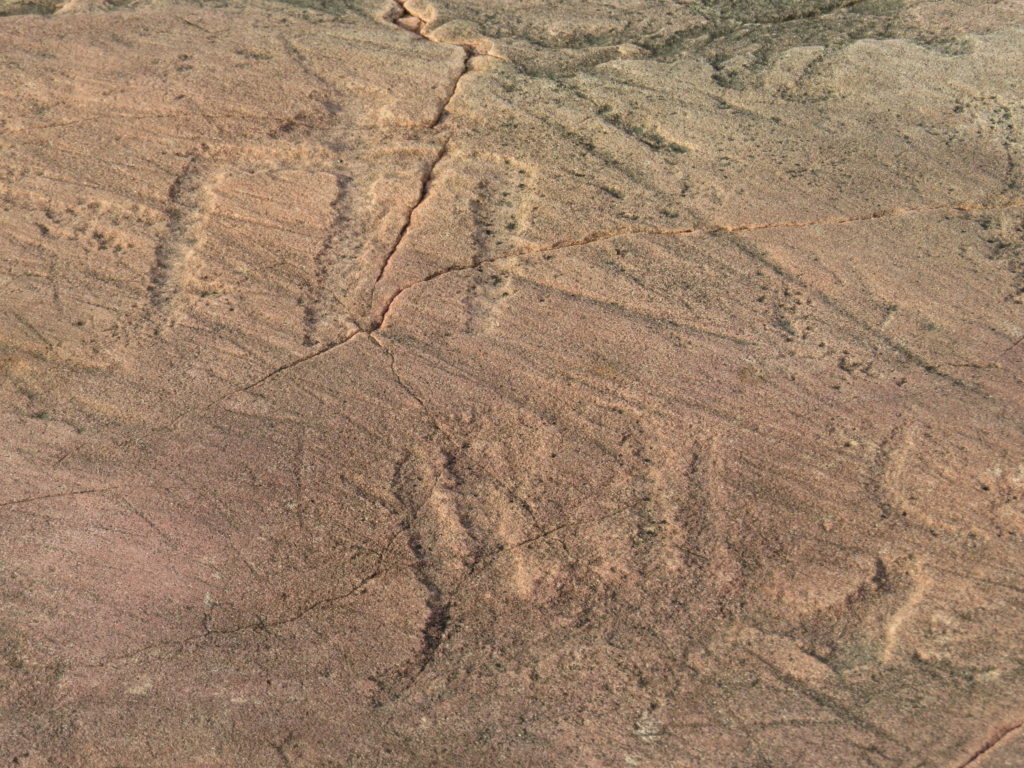
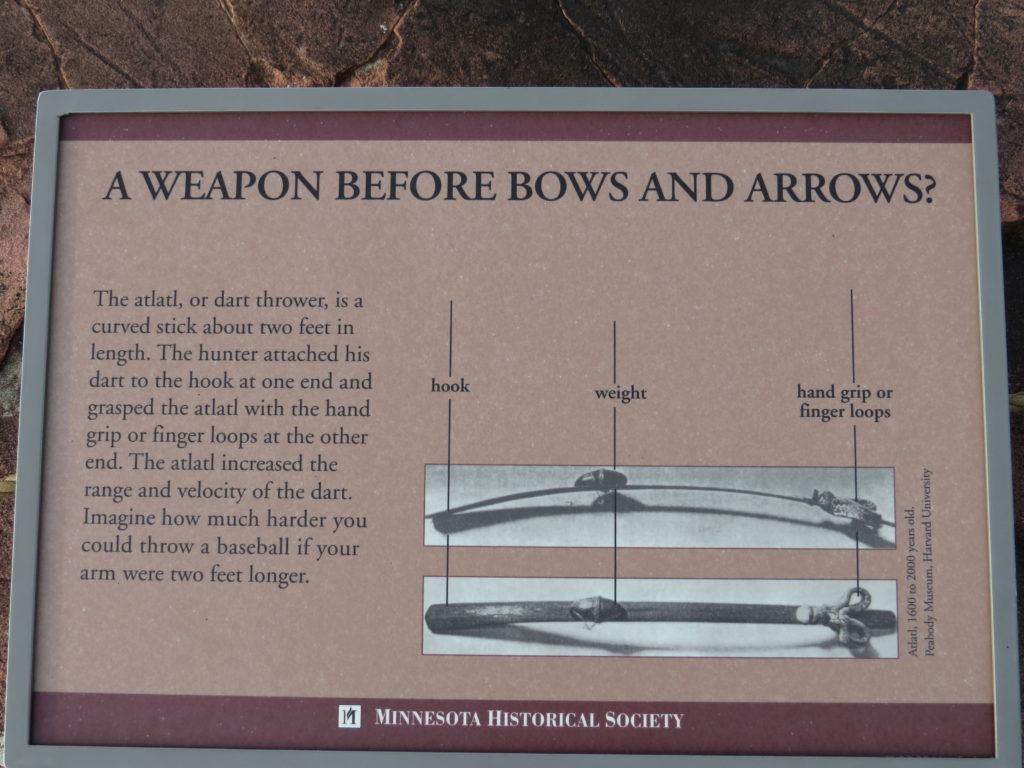
Interpretive signage told us about an ancient dart-throwing weapon used before bows and arrows called an atlatl that was used as early as 12,000 years ago. There were many carvings of atlatls, most with an exaggerated-sized stone weight on the shaft. Historians speculate that it was a ‘vision’ to increase the spiritual power that guides the hunter’s shot. Hunting, their literal livelihood, is a common theme—whether documenting actual hunts or visions of hunts to come.
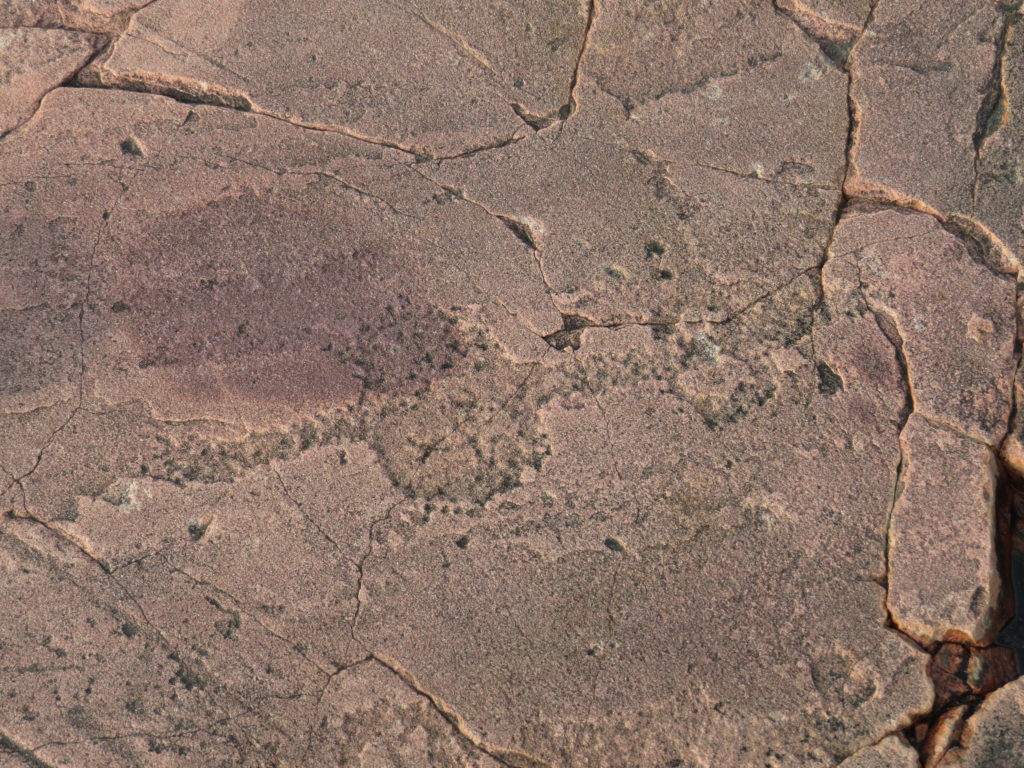
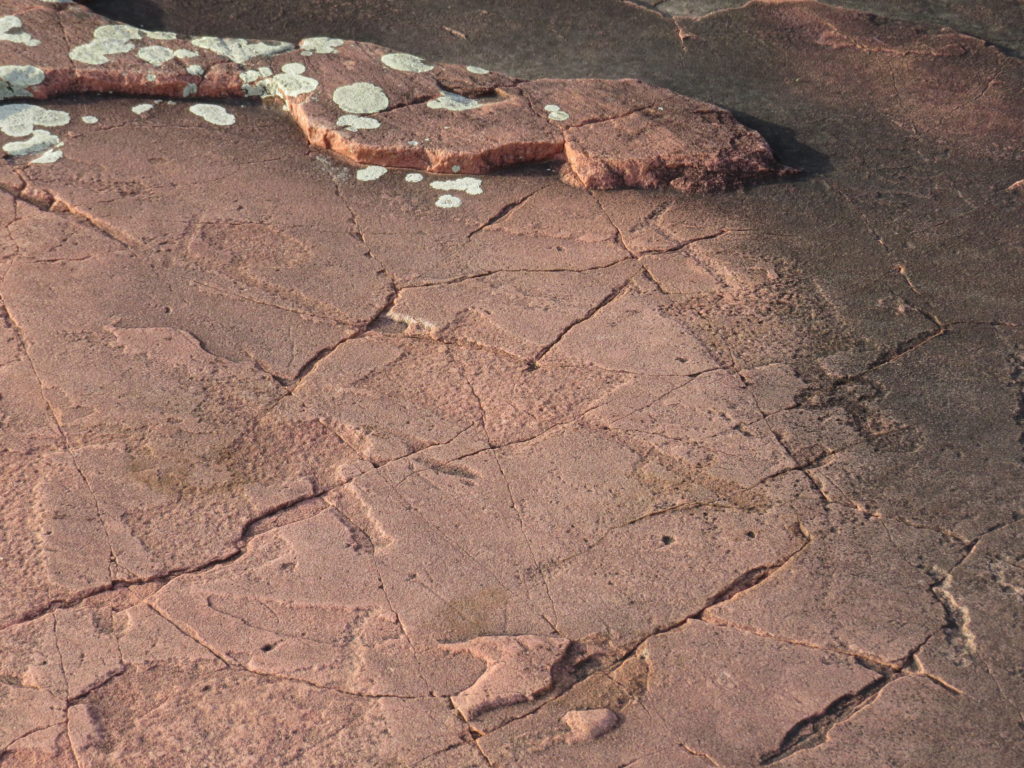
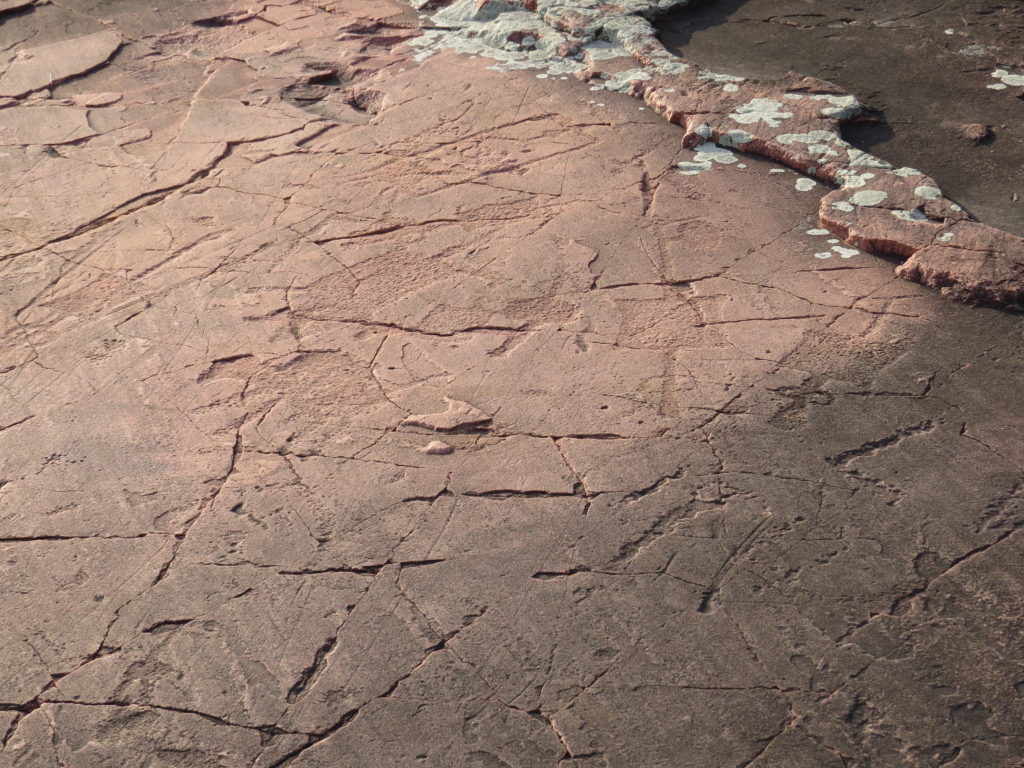
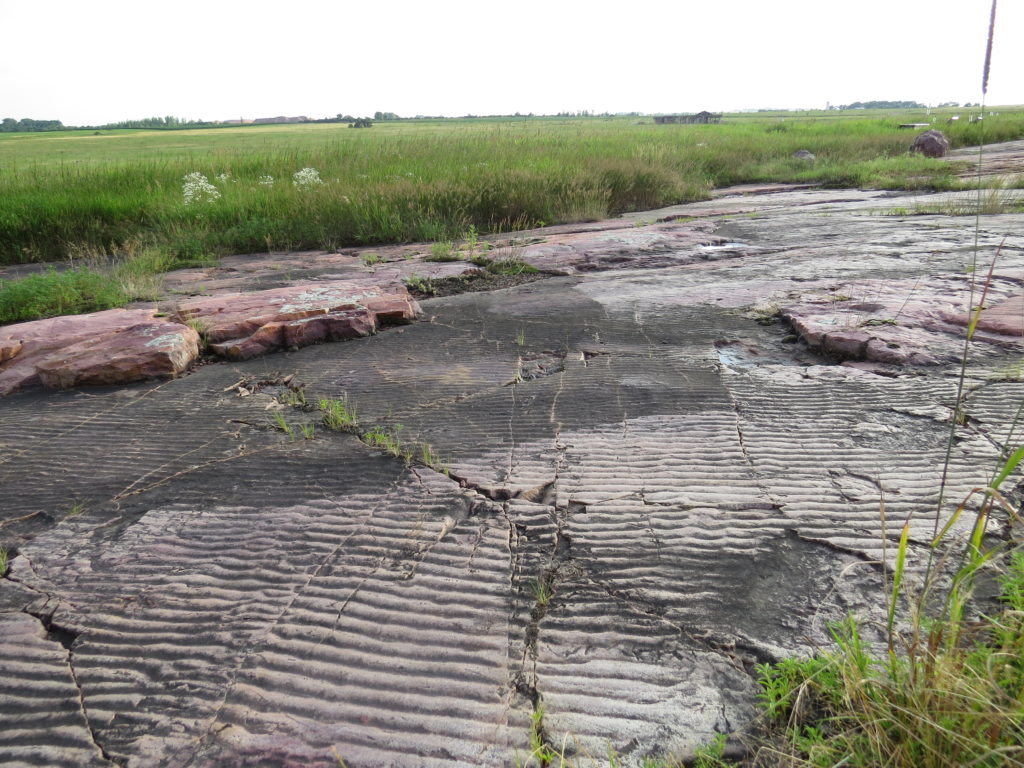
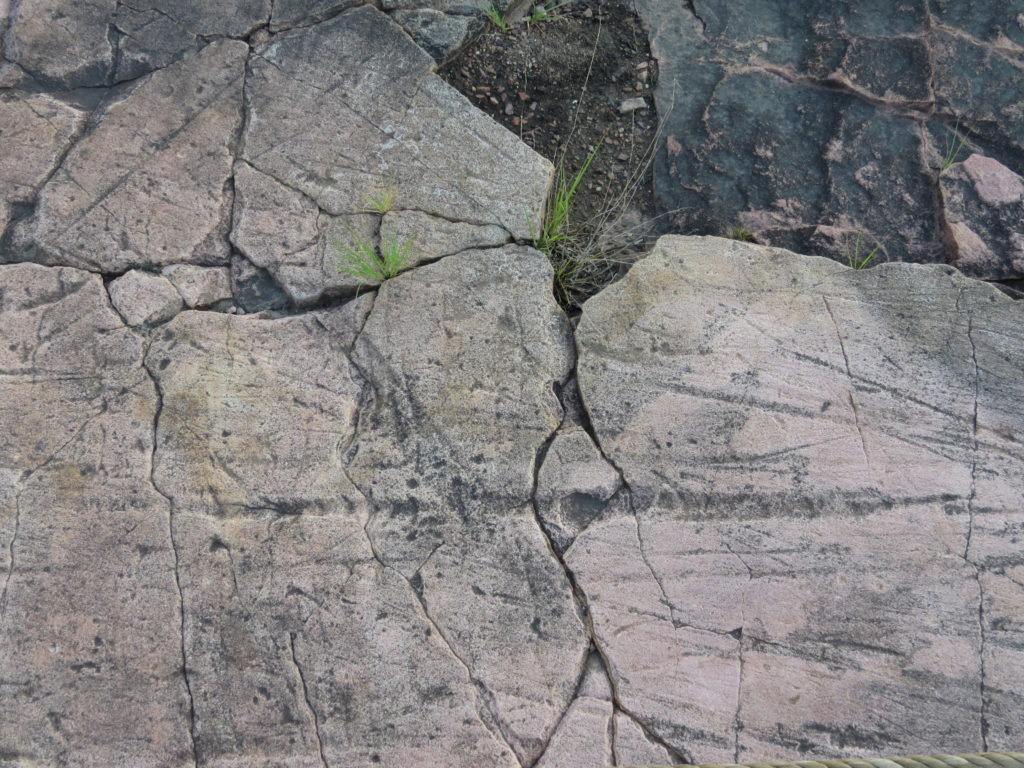
The red rock is Sioux Quartzite, the oldest bedrock formation in Minnesota, where a shallow sea deposited sand and mud for millions of years, and heat and pressure formed the metamorphic rock. It was exposed again by glaciers, wind, and water. The long scraping lines on the rock face are from the ancient moving glaciers.
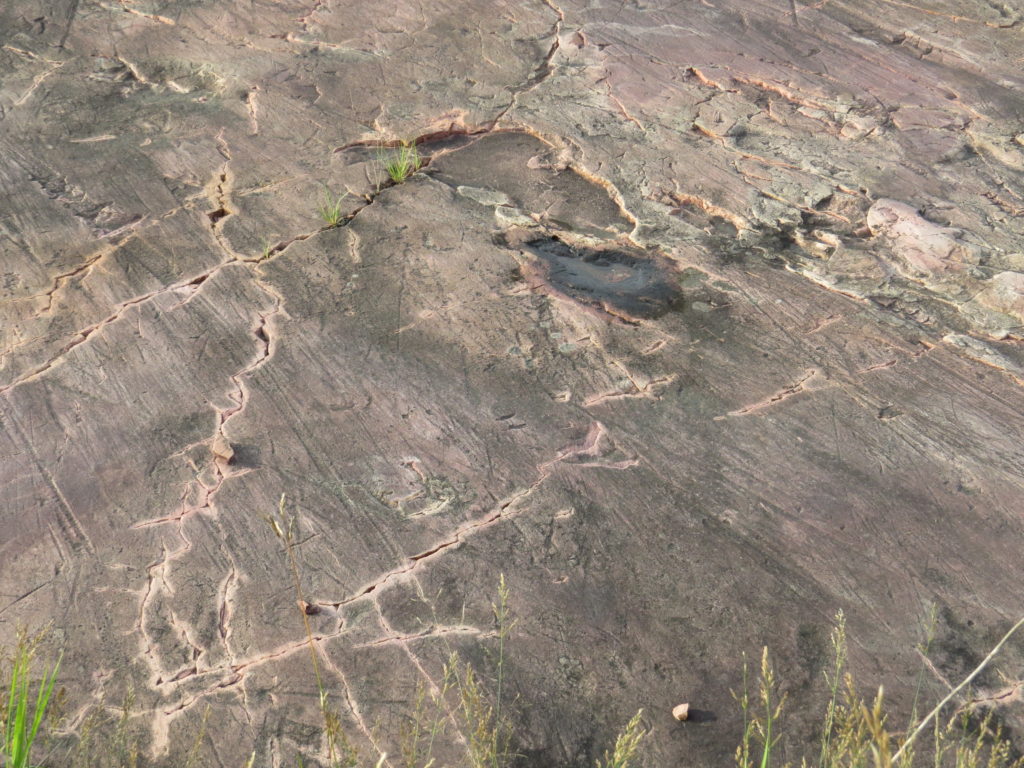
In 1966, the Minnesota Historical Society purchased 40 acres to preserve this site and later added more for a total of 160 acres. It has been and still is considered to be a sacred site for Native American tribes, including Ioway, Otoe, Cheyenne, and the Dakota. Sacred ceremonies are still performed here amidst the carvings depicting the spiritual power of people and place over thousands of years. Horns or lines radiating from a head often indicates wisdom or the ability to communicate with the spirit world. The circle feet may represent a place of powerful spirits. According to the Plains Indians, the Thunderbird is a sacred spirit, giver of life and death, that can be heard as thunder as it flaps its wings and seen as lightning bolts from its eyes.
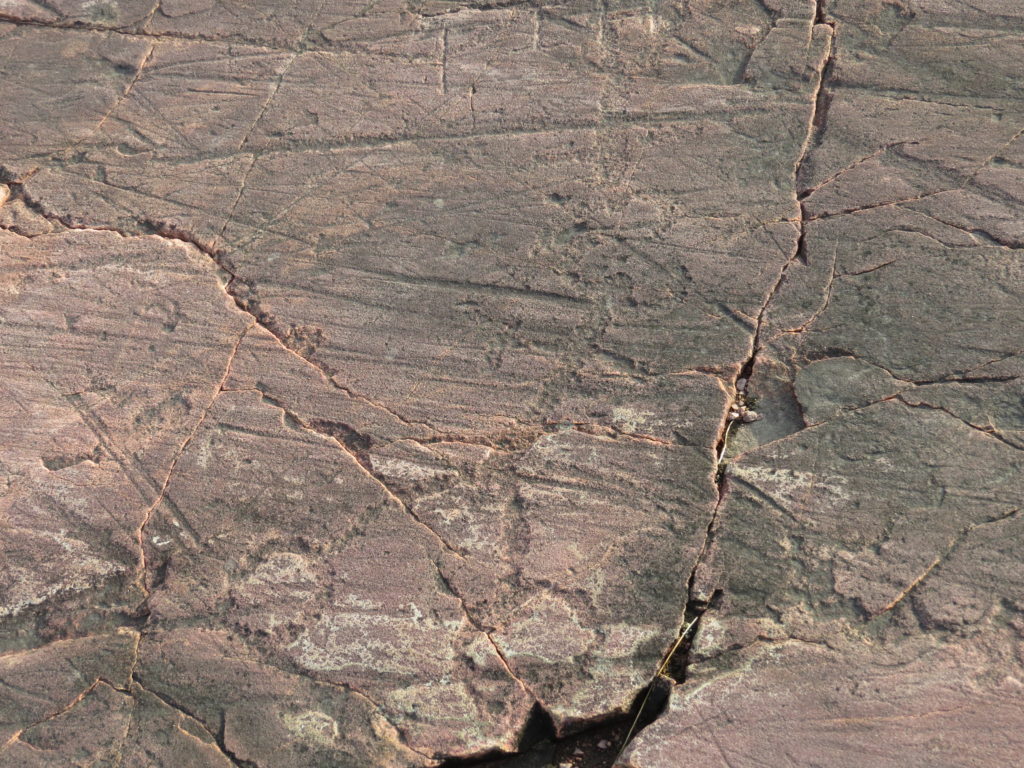
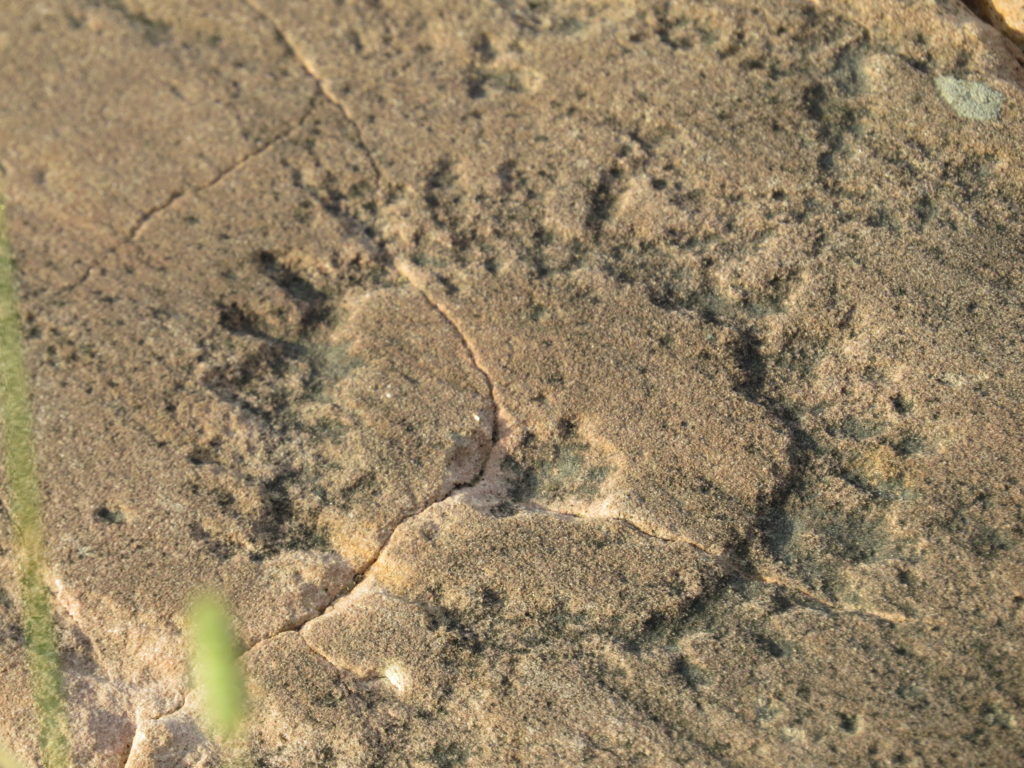
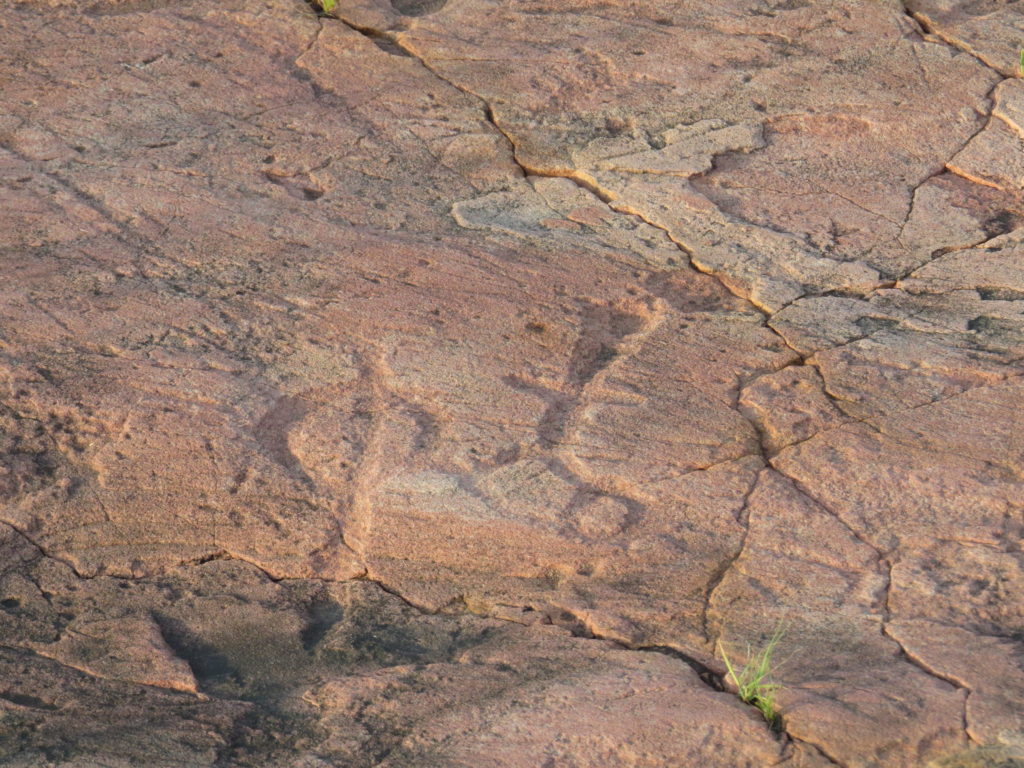
Parts of the rock face are preserved as they were 1.6 billion years ago—as sand ripples and mud flats. These interesting geological formations are a treasure that the prairie never covered up.
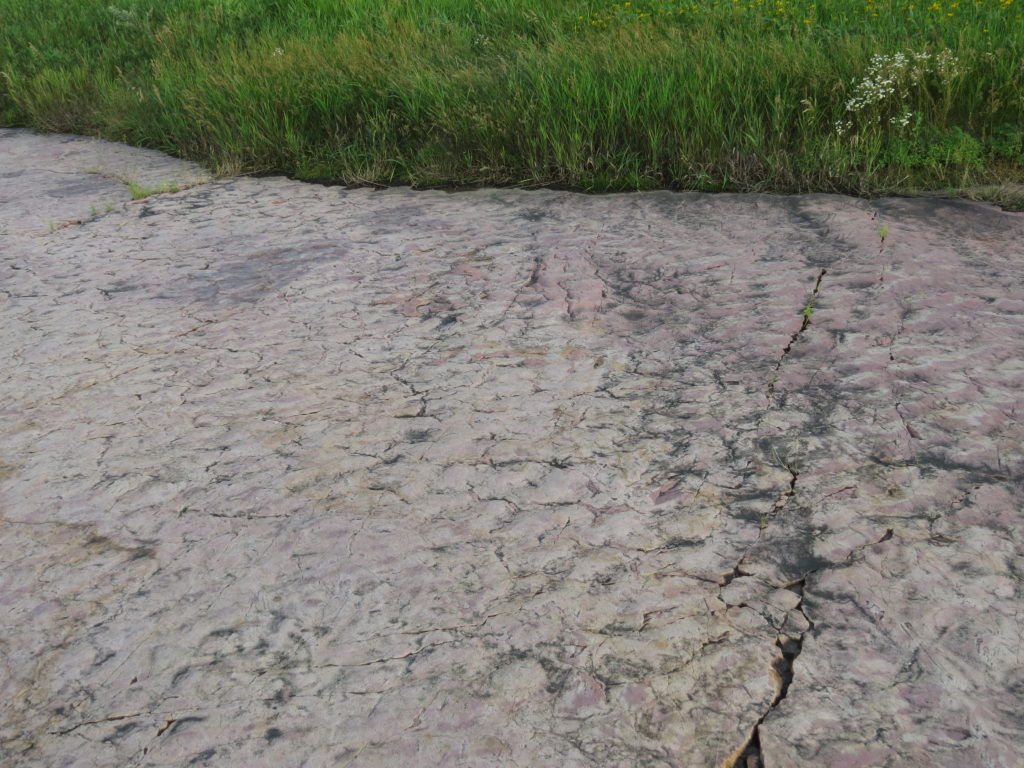
The carvings were done over a span of thousands of years—it is estimated the earliest were 7,000 years ago and the most recent 250 years ago. (Though there is some ‘graffiti’ by early twentieth century persons.) Another theme of the carvings were kinship ceremonies—how the bonds of kinship and social life were nurtured and strengthened. There are dozens of symbols in these next three pictures, the last, of a large carving of a woman in a shawl.
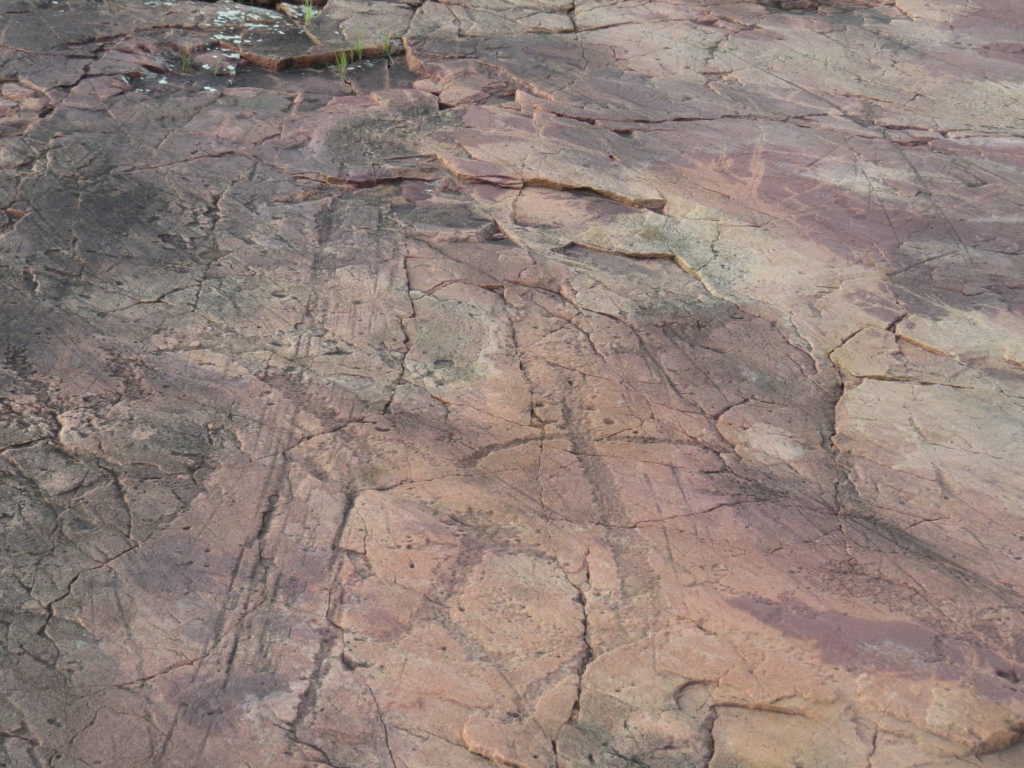
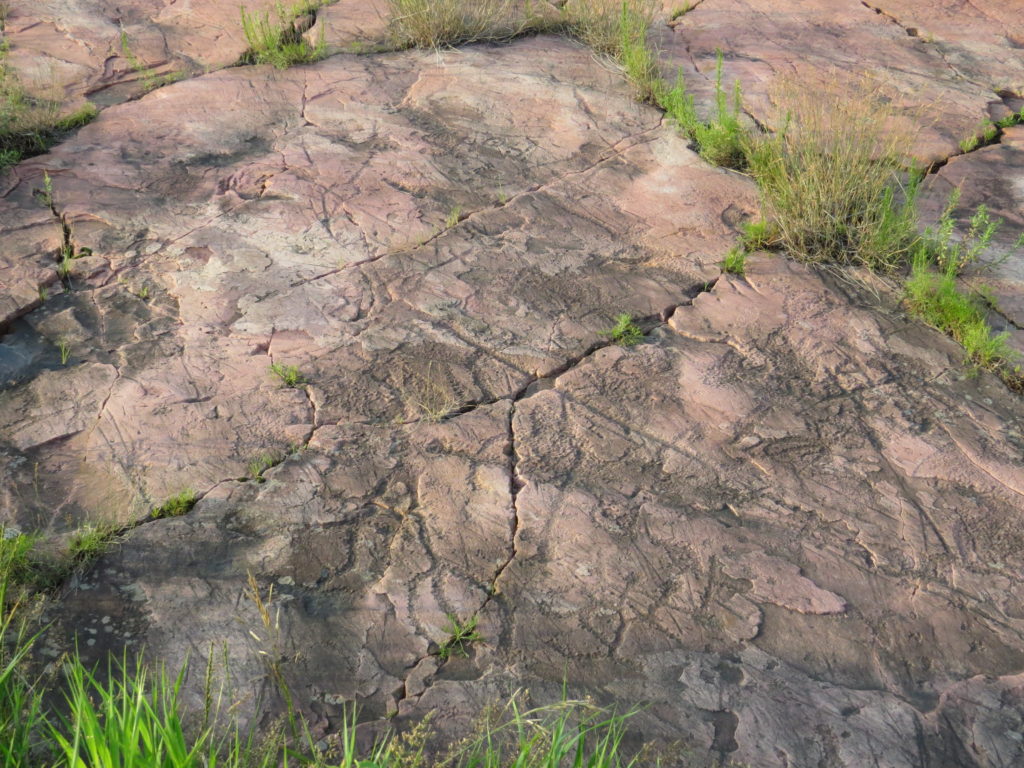
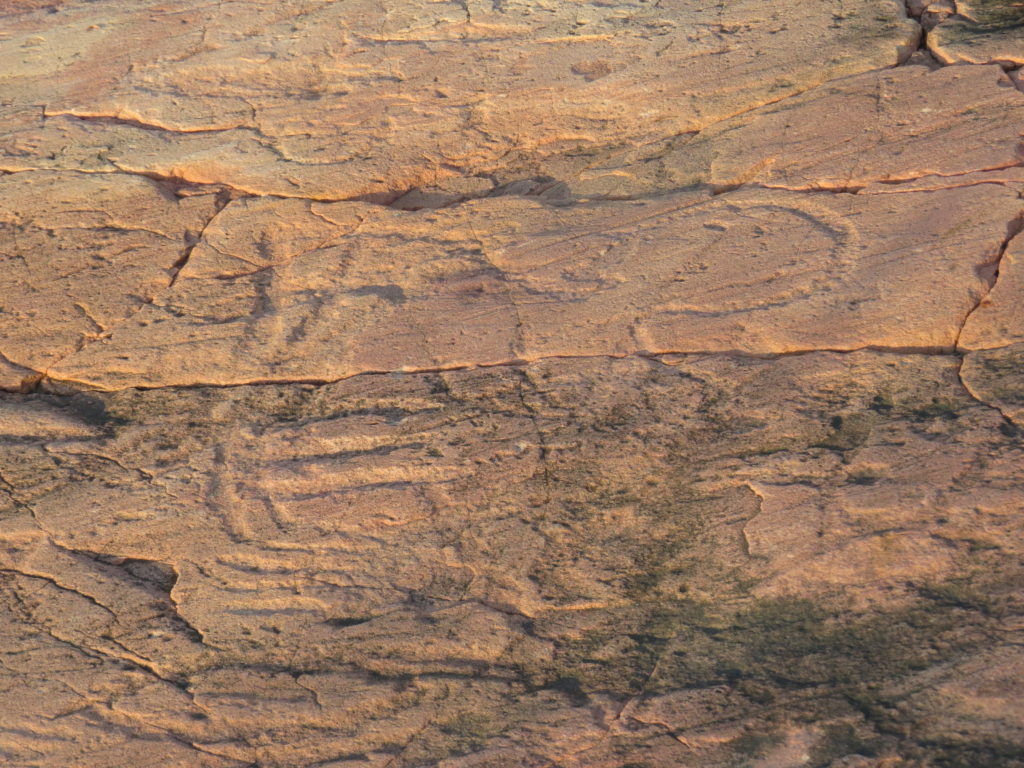
One area looked like a map, perhaps a hunting map or record of some kind of journey. Dots were carved between figures of people and other places or animals. Besides pictures of buffalo, other animals and tracks were carved in all areas of the pictographs, like birds and bear.
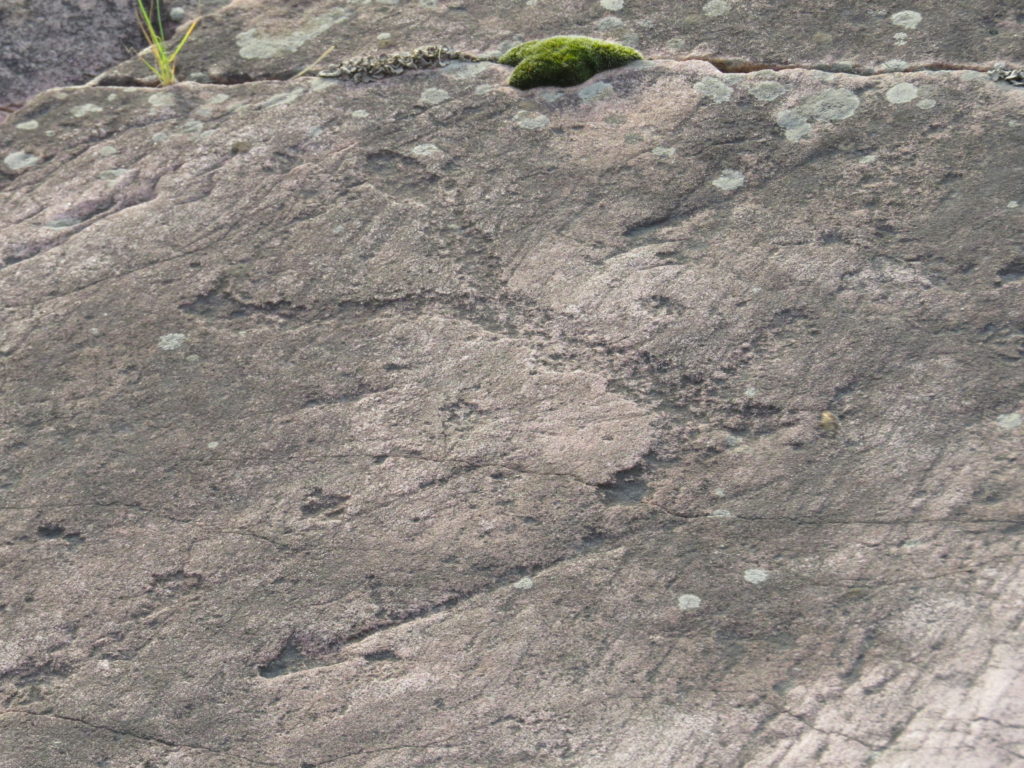
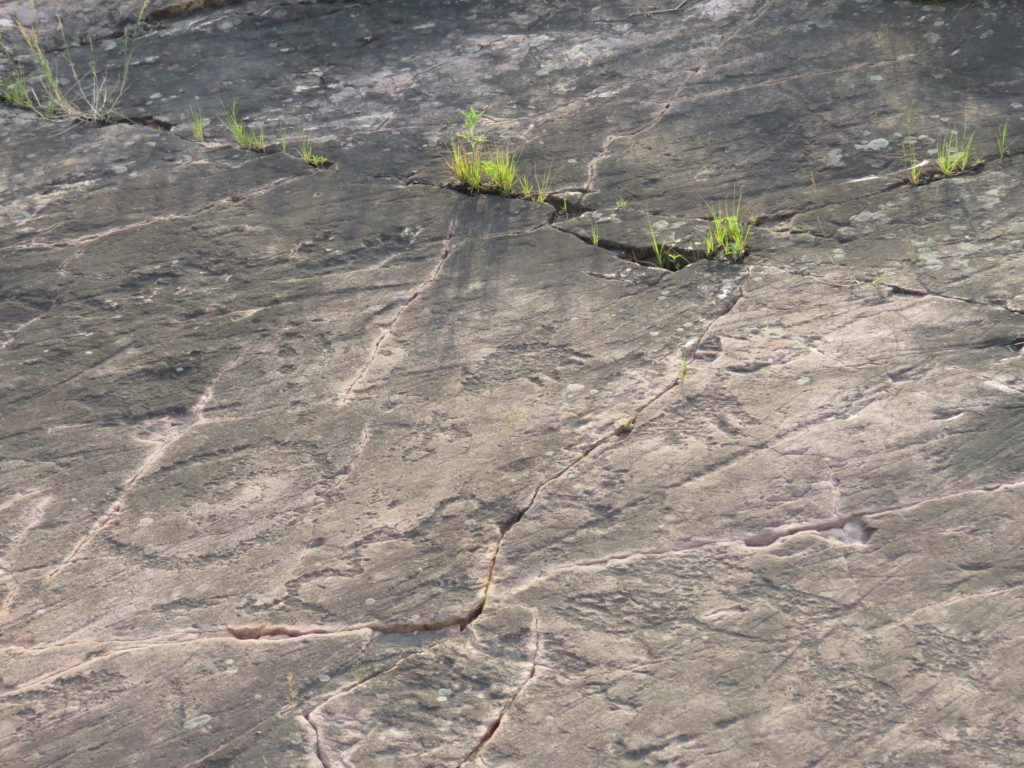
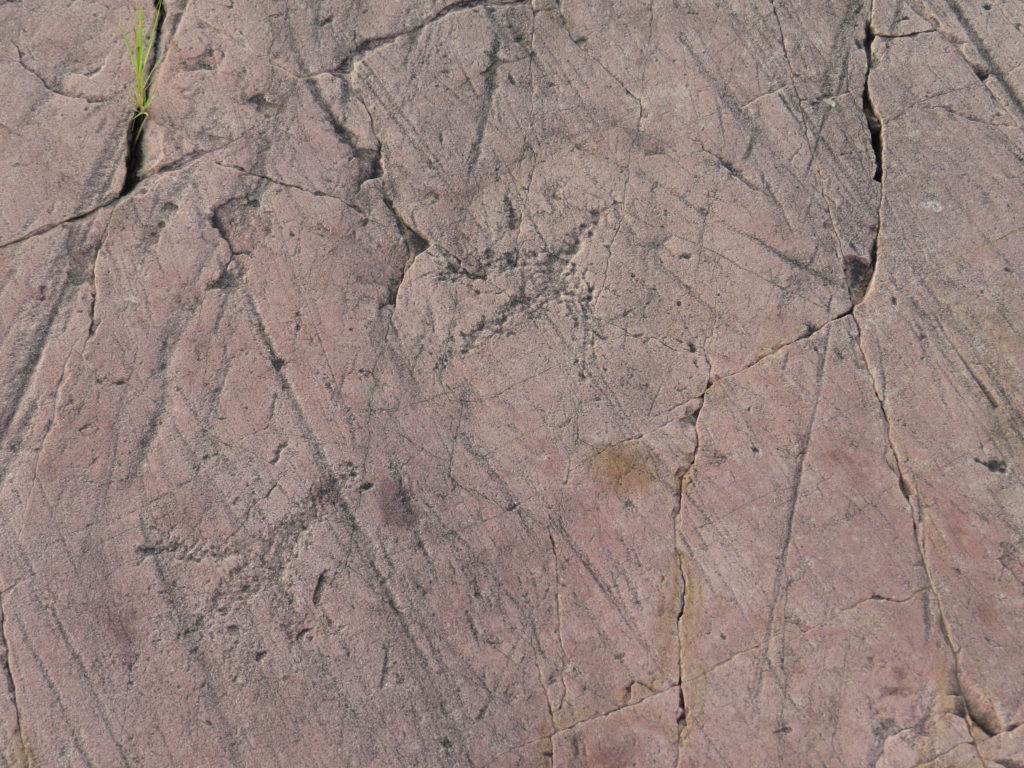
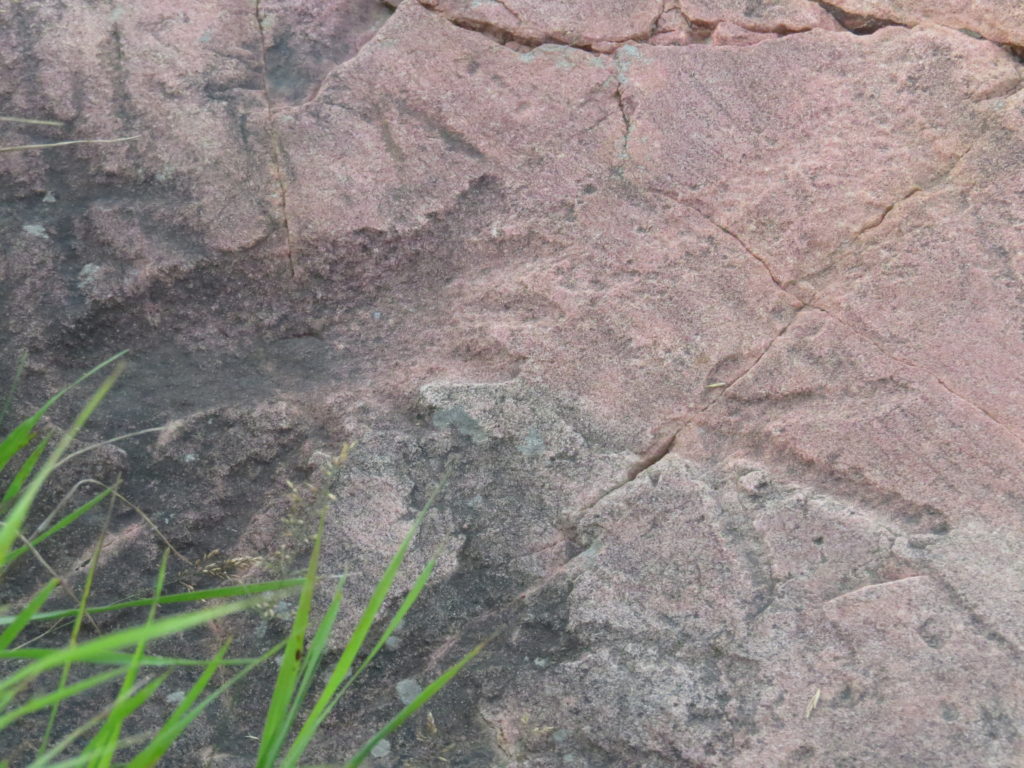
There are 33 acres of native prairie here, undisturbed for thousands of years. Most of the other acres have been restored to prairie. The Earth and Sky are represented in the rock carvings also. The many shapes and figures in parts of the rock face are not known—perhaps they are warriors hunting buffalo, figures of the underworld, or constellations from the starry prairie sky. Other shapes may be butterflies or dragonflies—it’s all part knowledge from the elders and historians and part imagination.
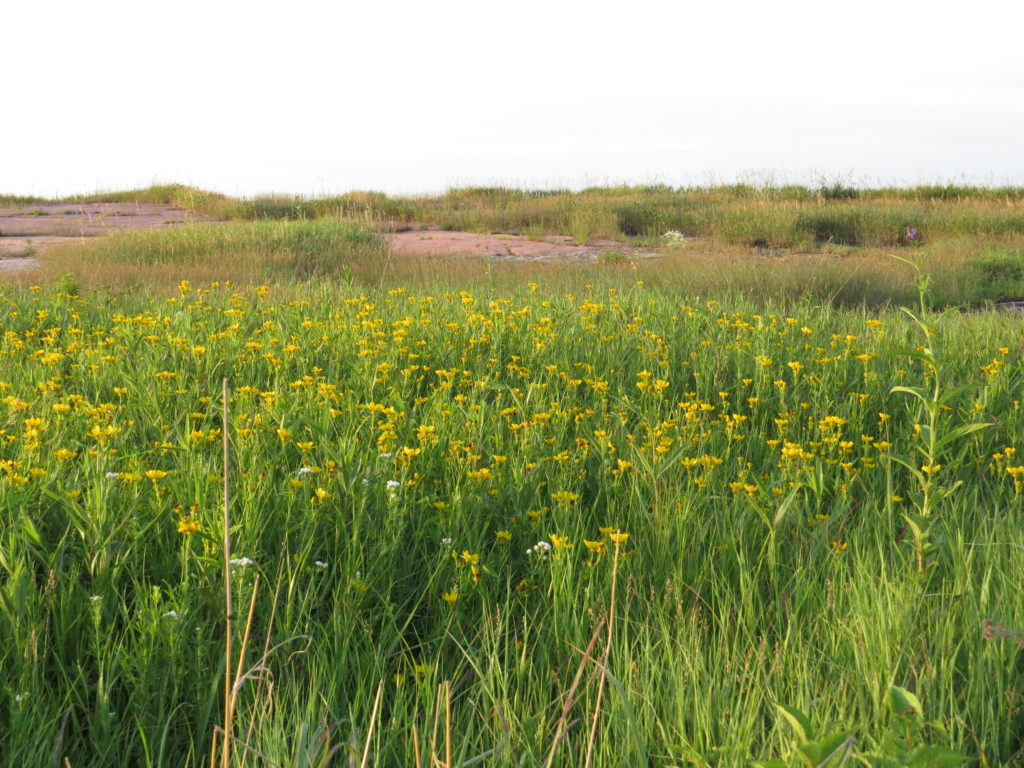
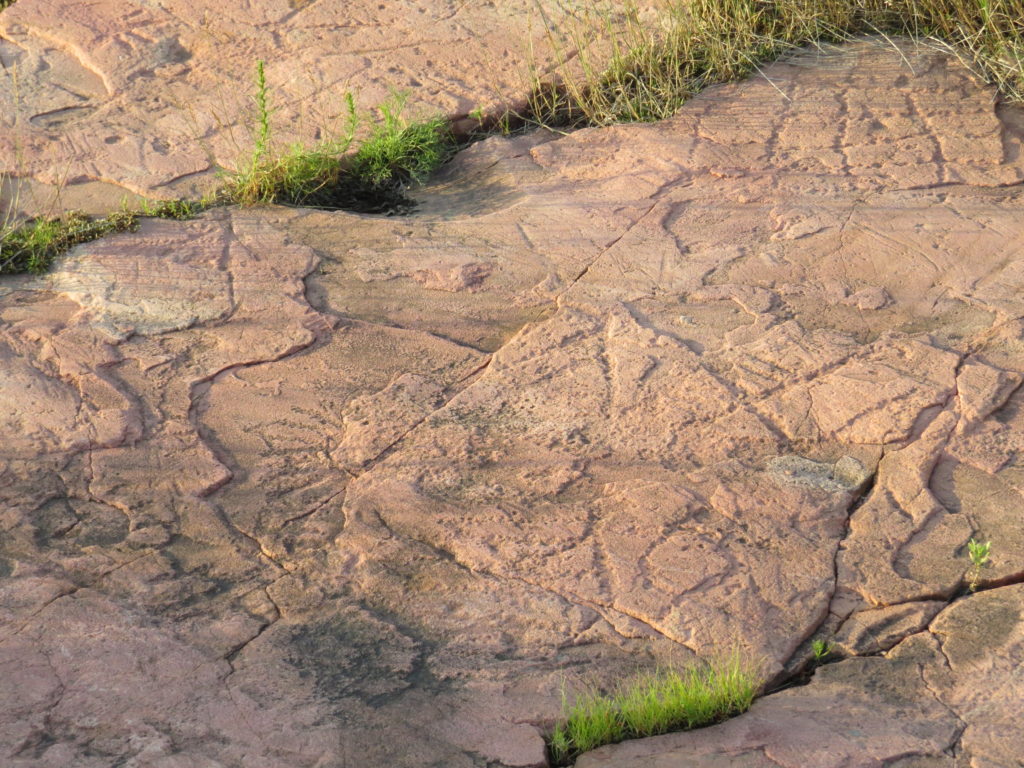

We were at the site for a little over an hour, and we were actually there at a good time, as the signage said mornings and evenings are the best time to see the carvings.
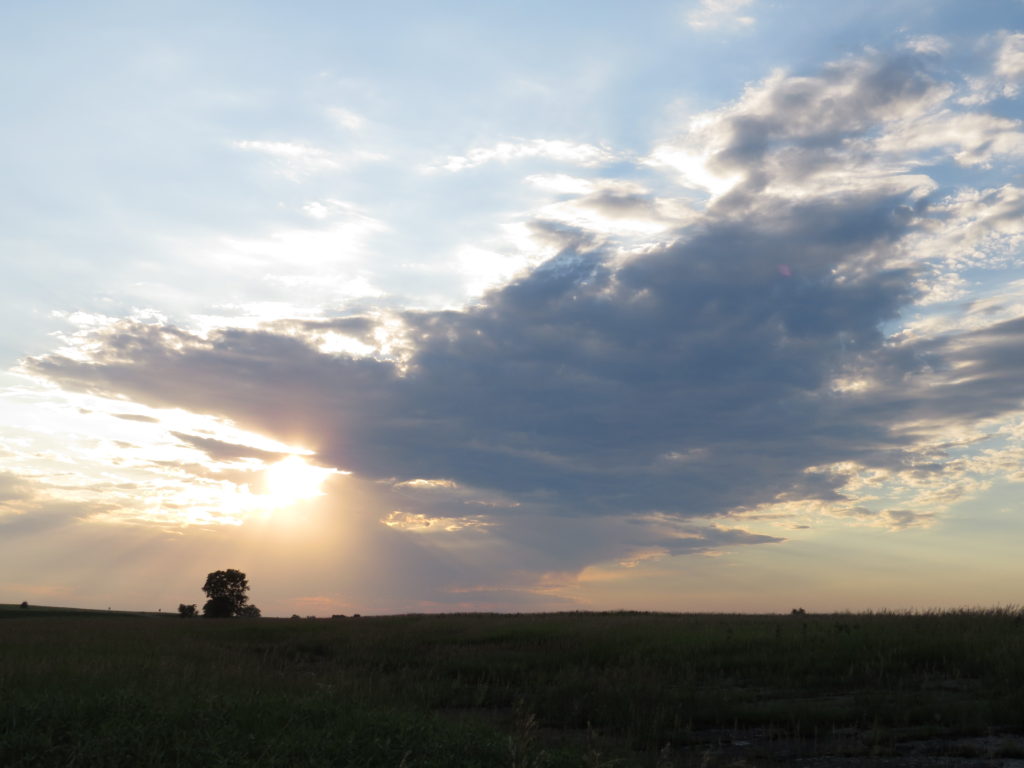
Interpretation of the carvings, along with the ongoing spiritual importance, was documented by elders from different tribes. (see MN Historical Society) Although the historical and archaeological aspects of the site were important in its preservation, it is the input from the Native Americans whose ancestors lived here that highlights the incredible significance of this place and what we can learn from it. (Italics in the following quotes are mine.)
“…and the last thing I would suggest to a visitor who wasn’t a tribal or indigenous person… somewhere back down your family tree, if you can go back far enough you’re going to find out you came from a tribal people and if you let that part of you speak… maybe you’ll find something out about yourself and your own history and your place in the world.” -Tom Ross, Dakota Elder, Upper Sioux Community Pejuhutazizi Oyate, Minnesota
“And when you walk around out there and just take your time and it’s like everything you feel is you’re walking amongst the spirit of all our people. And I know that they do enjoy our company. And the things, the signs, everything that they had left out there for us -is to remind us of who we are.” -Carrie Schommer, Upper Sioux Dakota Elder, Upper Sioux Community Pejuhutazizi Oyate, Minnesota
This site is where Minnesota’s recorded history begins, but it tells the story of the whole continent before it was named. It illustrates sacred ceremonies and important events, visions and dreams, prayers and messages, spiritual and social life. It depicts the daily substance of livelihood—the means of securing the necessities of life. It portrays the map of life’s journeys, both lived and envisioned. It demonstrates the inexplicable connection we humans have with Earth and Sky and all of Nature. It describes how imperative kinship is to our well-being and to that of our society. And finally, it illuminates that we the people—all of us, no matter our livelihood, no matter where we come from, no matter the color of our skin—are spiritual beings living in a spiritual world.
The Prairie and the Grazing Buffalo
I love the prairie, and I mourn the demise of it as more and more prairie grasslands are tilled and converted to row crop farming. The prairie ecosystem evolved with the American bison—and the buffalo became the source of life for the Native Americans of the Great Plains. The closely interwoven relationships between prairie, buffalo, and Native Americans have been severed, for the most part, for oh so many reasons. Yet there is a pull to preserve that way of life, even in the smallest of ways, because of what we can learn from the prairie, from the buffalo, and from the people whose lives intertwined with both.
Driving along the highways in Missouri in the month of July, one notices a sweet triad of color, shape, and form—Queen Anne’s Lace, blue Chicory, and Purple Clover. Tall, willowy Queen Anne’s Lace, a member of the carrot family, is the most striking of the three with large, lacy flower heads that sway in the breeze. We stopped at the Eagleville rest area on southbound I-35, the welcome center for Missouri. A large prairie area with a mown walking path covers the hillside behind the building, and Queen Anne’s Lace grows along the periphery.
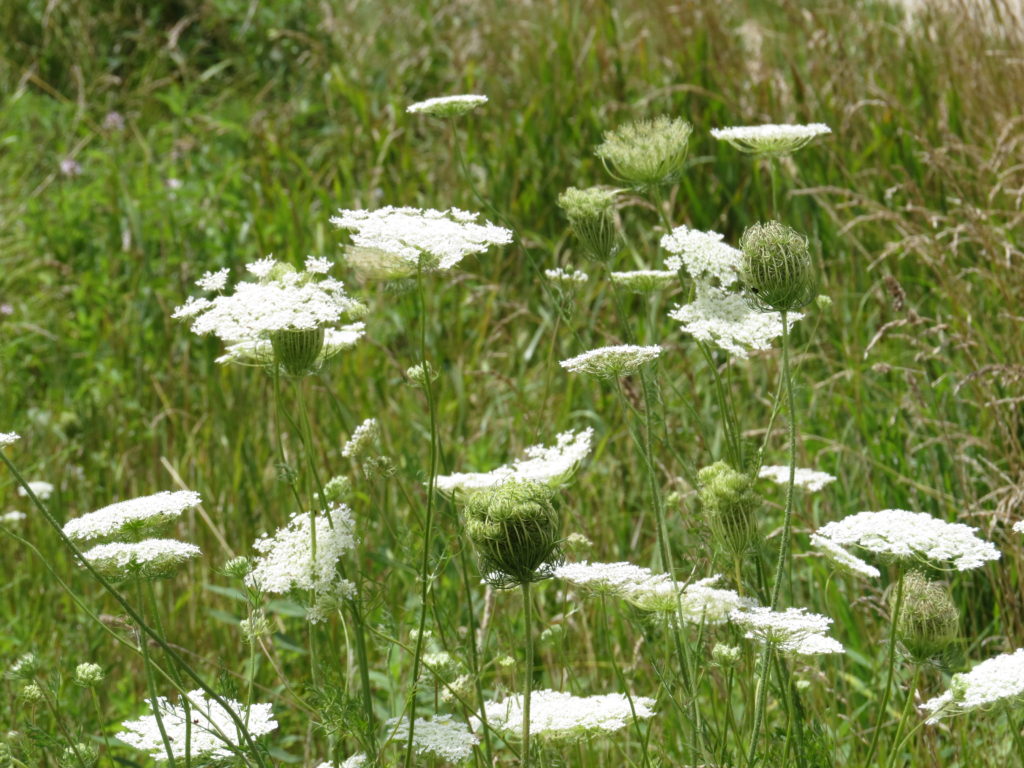
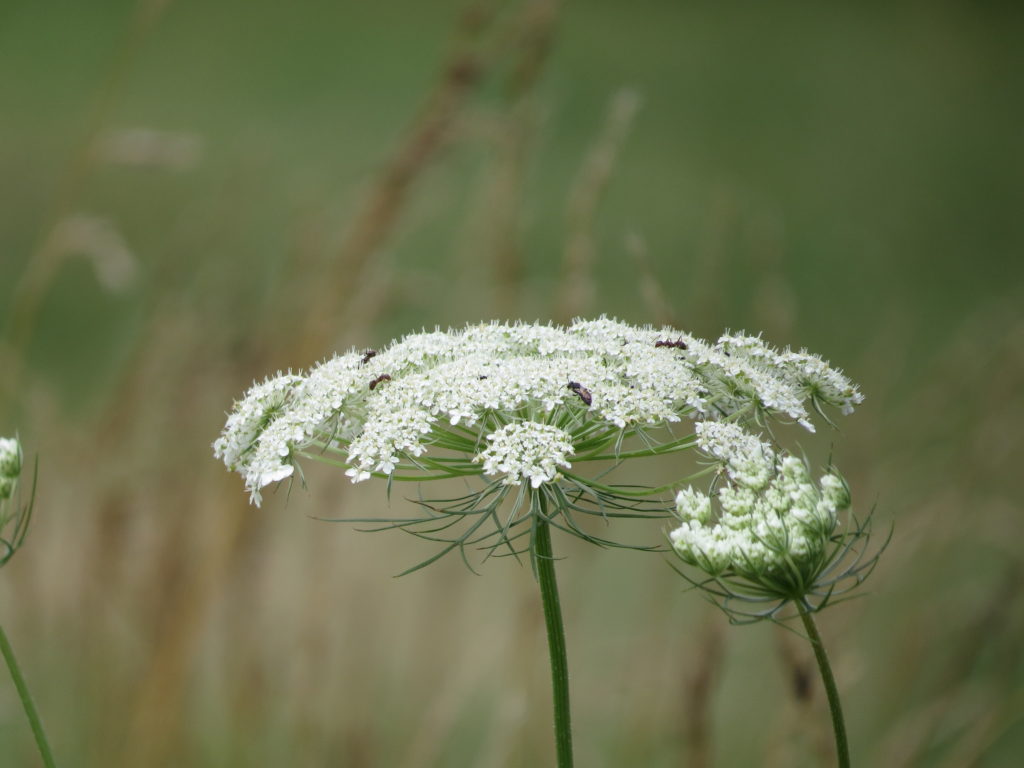
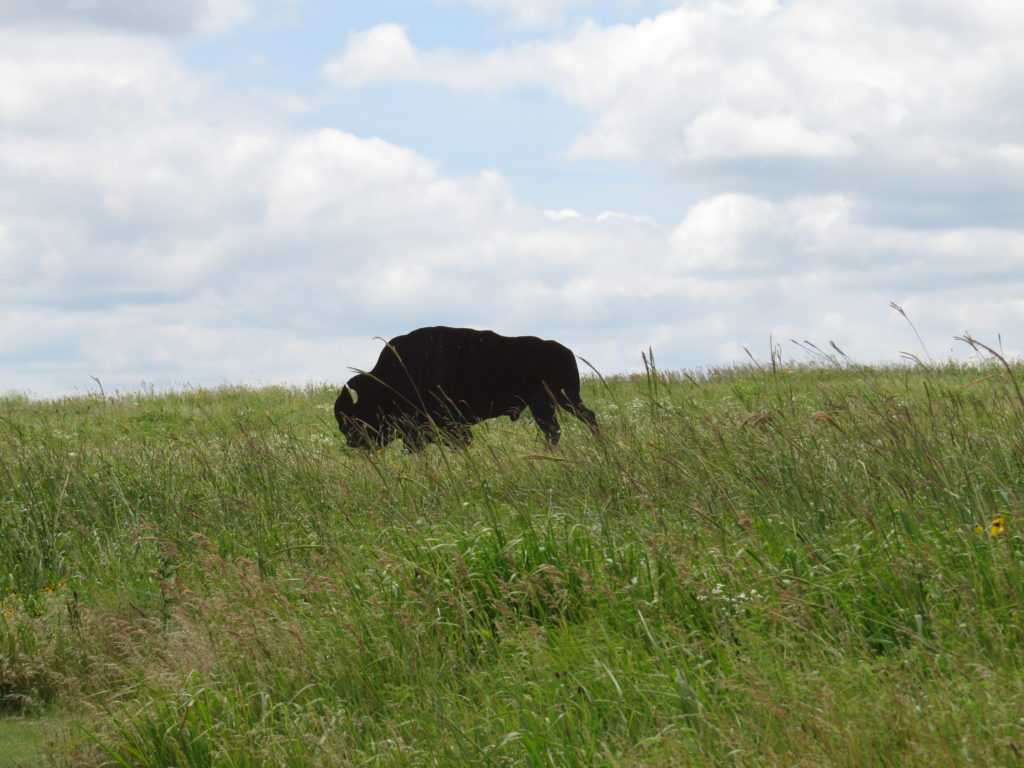
Up on the hill, a grazing buffalo dropped his large head into the tall prairie grass. Animals need to feel ‘safe enough’ to graze—if there is a threat or danger of any kind in the area, they won’t be eating. Grazing or feeding and digestion are processes that are undertaken when the body is relaxed (a parasympathetic state.)
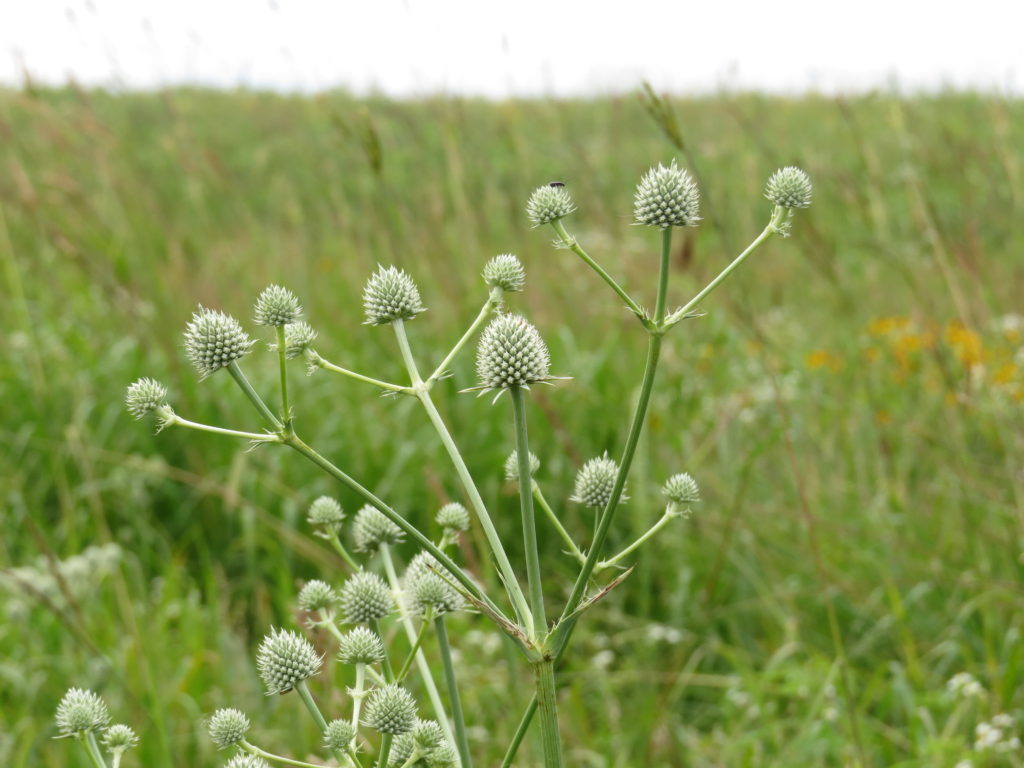
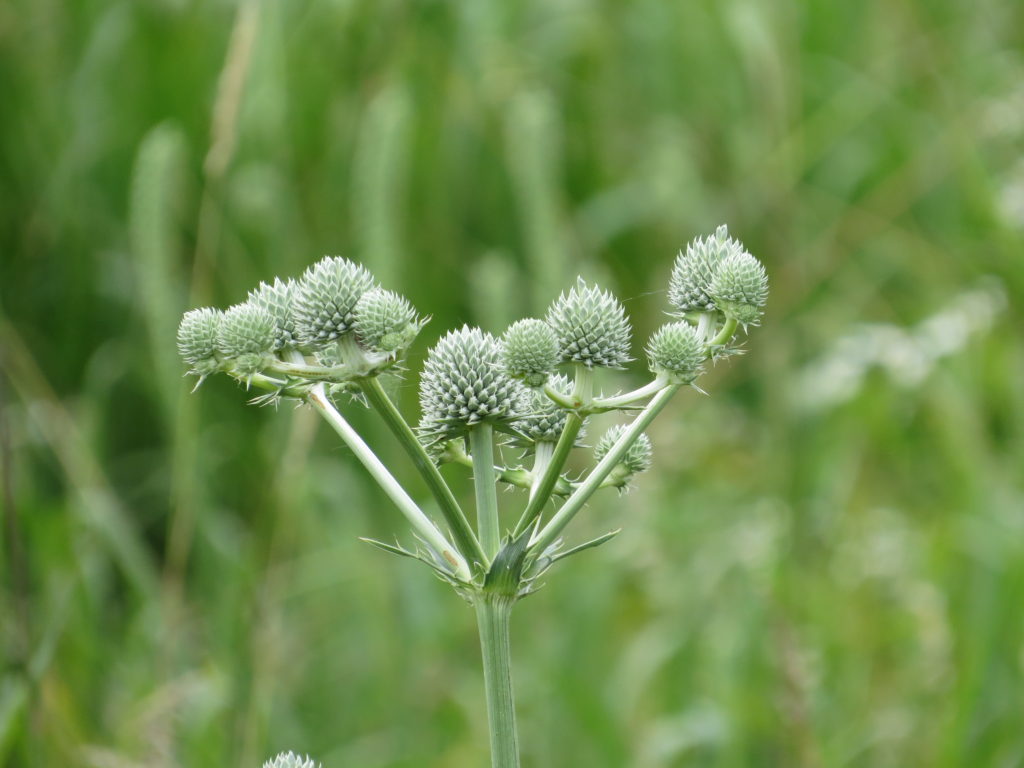
Another eye-catching and unusual plant in the tall grass prairie is Rattlesnake Master. Along with its great name, this plant is also a member of the carrot family. The gray-green seedheads hold small clusters of white flowers and were dried and used as rattles by native people.
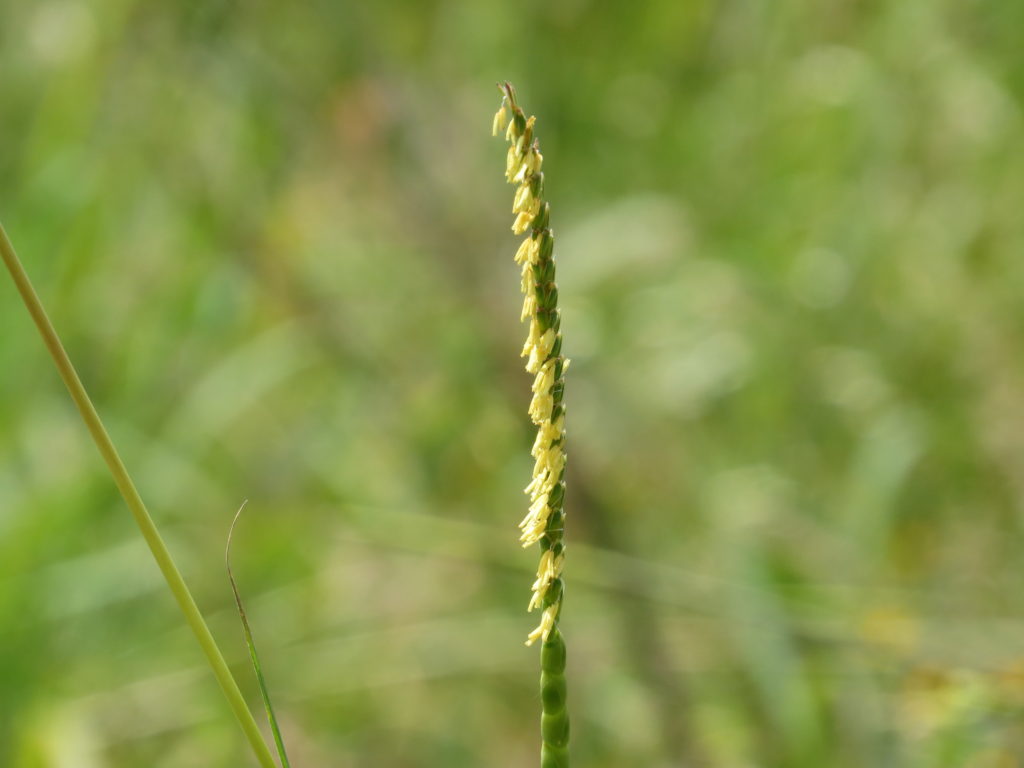
We don’t often think about grasses flowering, but every plant that produces seeds has some kind of flower, as indistinct as it may be.
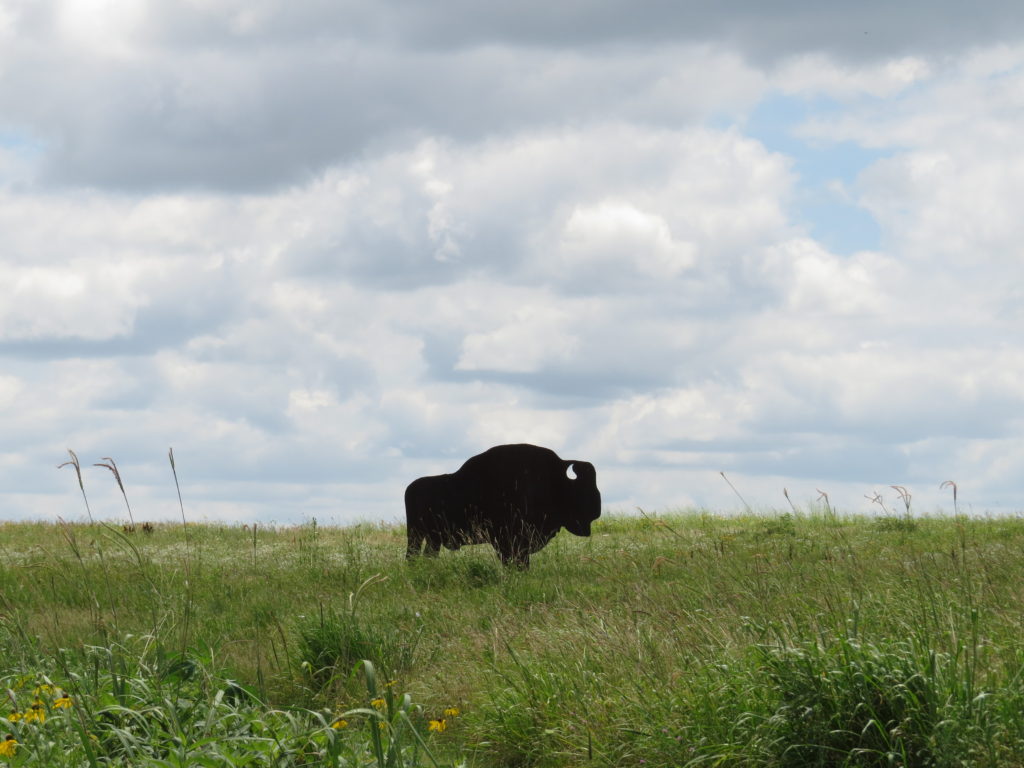
A standing buffalo on the hill was alert and watchful. Often herds of animals will have a sentry or ‘look out’ who will be aware of the surroundings and will warn others if there is some danger or predator.
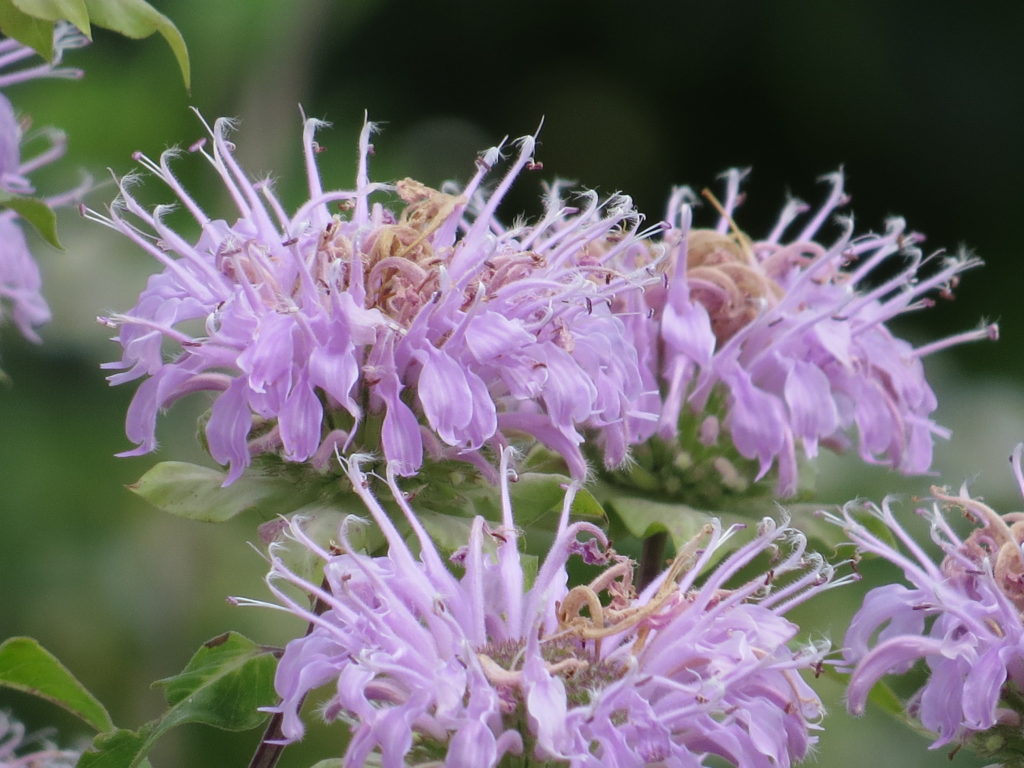
Spiky crowns of lavender flower petals top Wild Bergamot or Bee Balm. Native Americans used teas and tinctures of this minty plant to treat respiratory illness and other ailments.
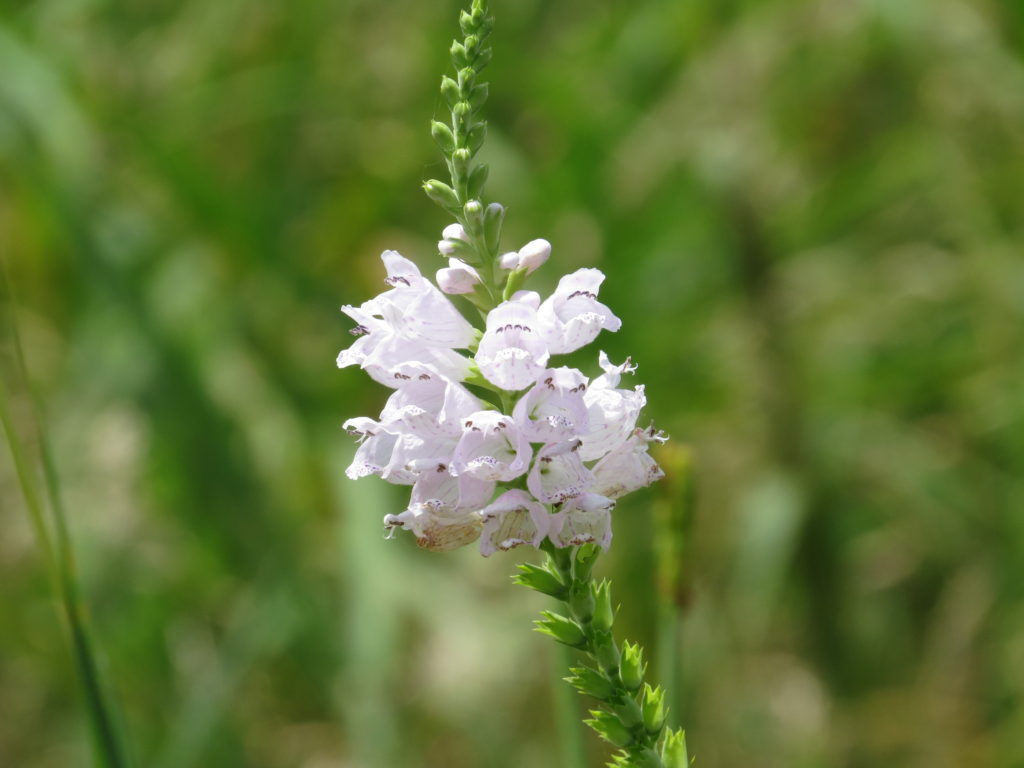
Another member of the Mint family is the Obedient Plant with snapdragon-like flowers that will stay in position after being turned in a certain way.
A charging buffalo haunched down in the prairie grass, head lowered, muscles taut, tail lifted. When danger has threatened the herd, energy is activated (sympathetic response), and the animals run or fight. (Running is the usual first line of defense. Males and closely threatened mamas will turn and fight.)

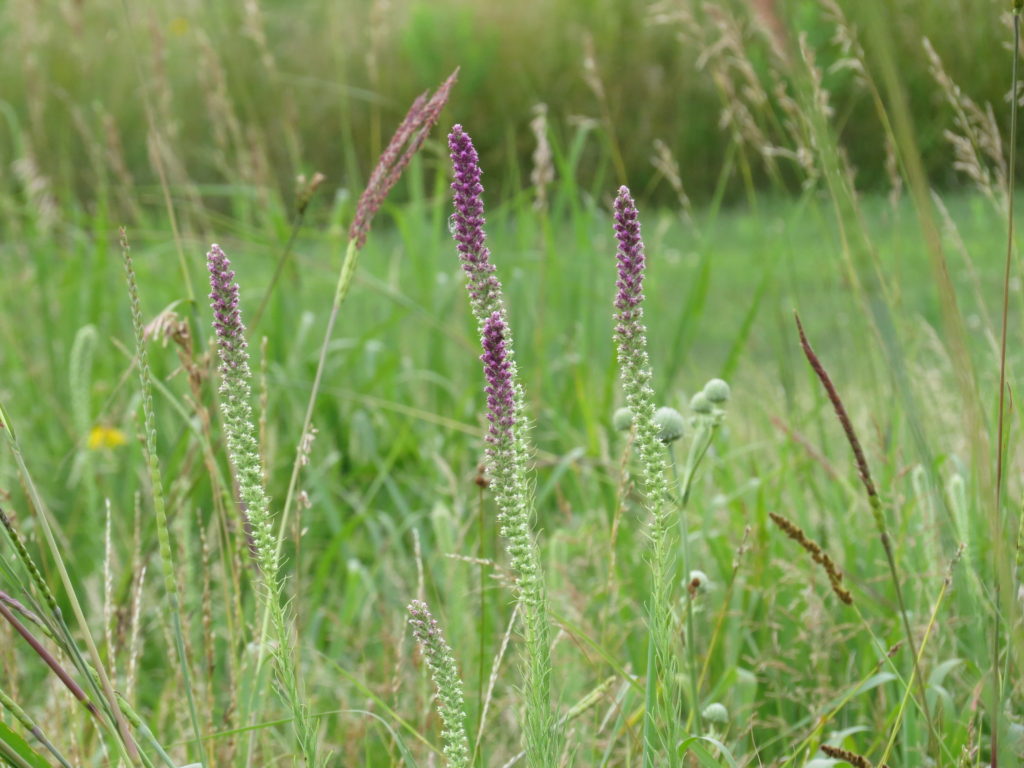
Blazing star or Liatris was just beginning to bloom from the top down on the purple-flowering spikes.
Dogbane is a toxic plant that was used by some native tribes as a fiber. The stems were rolled into strong, fine threads and twines.

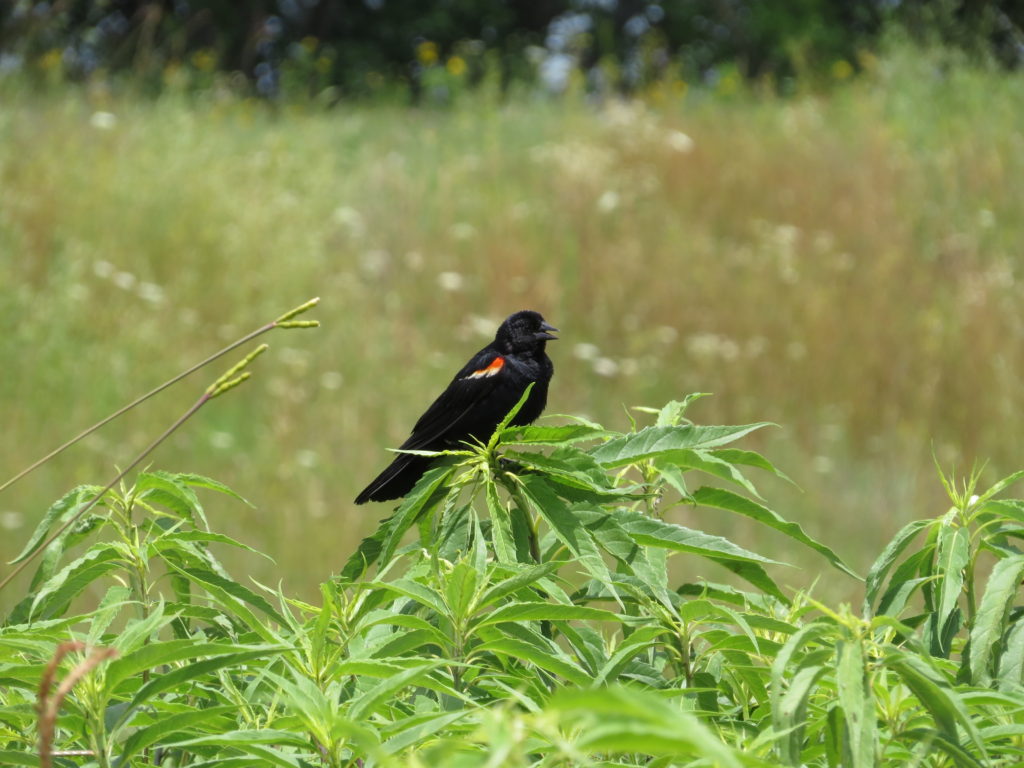
While walking the prairie, stretching my legs, and appreciating the summer grasses and wildflowers, a Red-winged Blackbird chatted and sang its summer song.
To me, walking through a prairie feels like ‘coming home.’ It is familiar, reliable, sustainable, and beautiful—like a sanctuary. It relaxes my body, calms my mind, and feeds my soul. The wide-open sky gives me perspective on how small each of us really is compared with the world at large. The prairie grasses and plants remind me that, as small as we each are, we are part of an ecosystem or community that works together to create the greater whole. We grow and bloom in our own unique and wonderful ways. The buffalo sculptures were produced by Creative Edge Master Shop in Fairfield, Iowa, a great tribute to the icons of the prairie. Their depictions of the different states of the herd animals reflect the physiology of every mammal, including humans. One state not depicted, or not seen at least, was that of the freeze state—like that of a young calf lying in the grass, hiding from danger. Freeze, fight or flight, and rest and digest are all states that we humans slide in and out of automatically, just like the buffalo. Ideally, we would spend most of our time between the alert, aware, yet calm state and the relaxed rest and digest state, and use the freeze and fight only when absolutely needed. But how often do we find ourselves immobilized by some threat or fear? How often do we feel like running away from our life and its problems? How often do we fight with sharp words, lowered heads, and win-at-all-cost ways? Feel it. Think about it. Make a strong, powerful rope out of a toxic situation. Find your place that feels like ‘coming home.’
A Snapshot of Our Lives
What would a snapshot of your day look like? How about snapshots of your life? There were many times when the kids were growing up that we took them to outdoor events celebrating a variety of holidays, animals, and seasons—a butterfly festival, May Day celebration, harvest festival, etc. We have a few candid snapshots of some of those events—when cameras were extra things to carry around with all the paraphernalia needed for three kids of various ages.
Last weekend we attended the Wildlife Festival at Sherburne National Wildlife Refuge. It was a chilly, raw day—as we walked from the car, most of us wished we had more and warmer clothes. Babies were wrapped in snowsuits and cute fleece hats. An outdoor fire and an indoor gift shop were popular places to warm up. Tents and tables with snakes, birds, furs, and photographs engaged the kids and adults alike. We had two of our adult kids with us, plus one, reminiscent of the events in years past. Following are snapshots of our day with captions from some of the five of us:
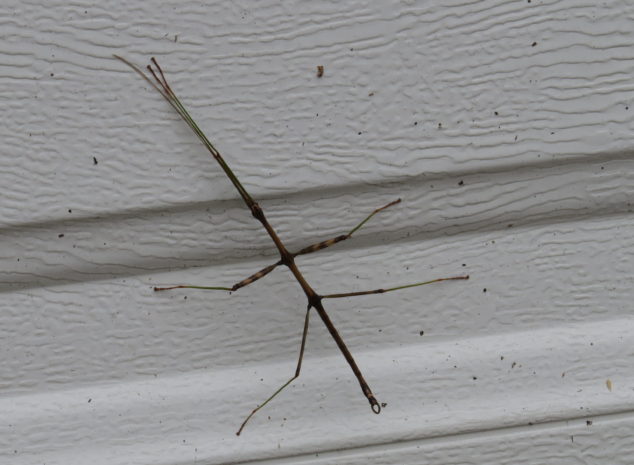
- Morning surprise 2. A Walking Stick before our walk in the sticks 3. Stickin’ around
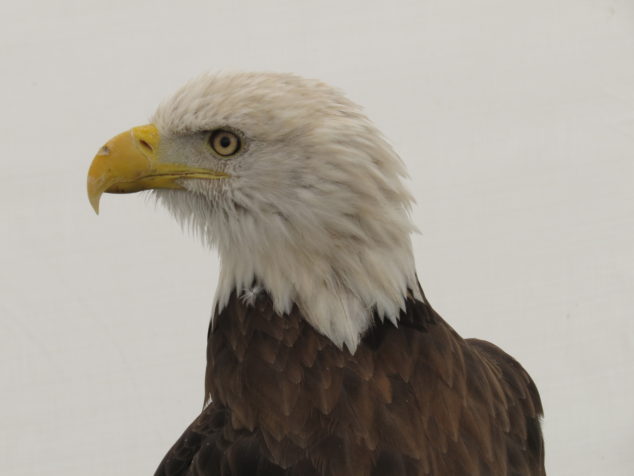
- Eagle eye 2. Injured glory 3. Head and shoulders above the rest
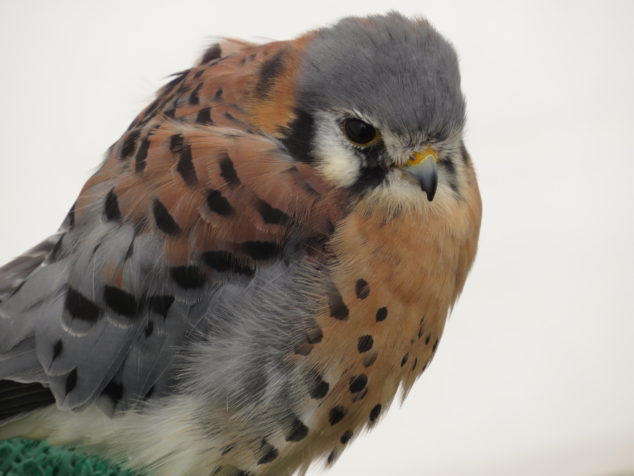
- Feathered friend 2. Small but mighty 3. Bundled up
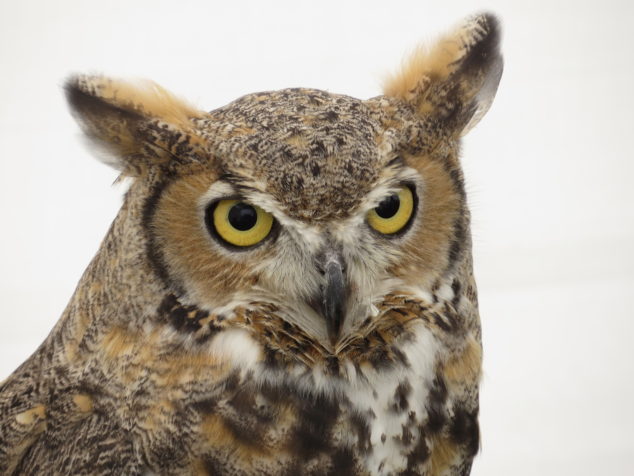
- Who?! 2. Feeling owley 3. Here’s lookin’ at you, kid
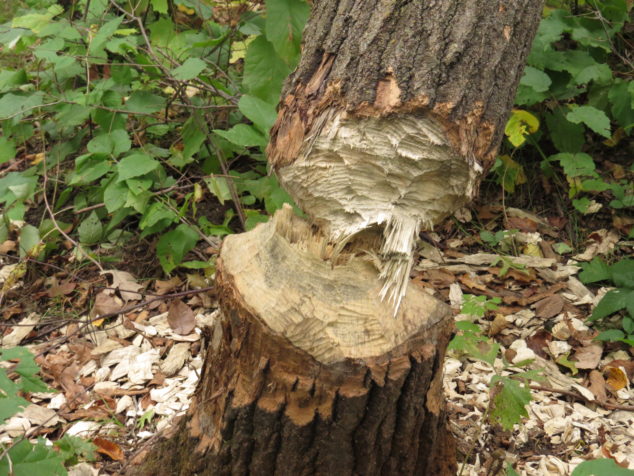
- Busy beavers 2. Construction zone 3. I could sure use a toothpick
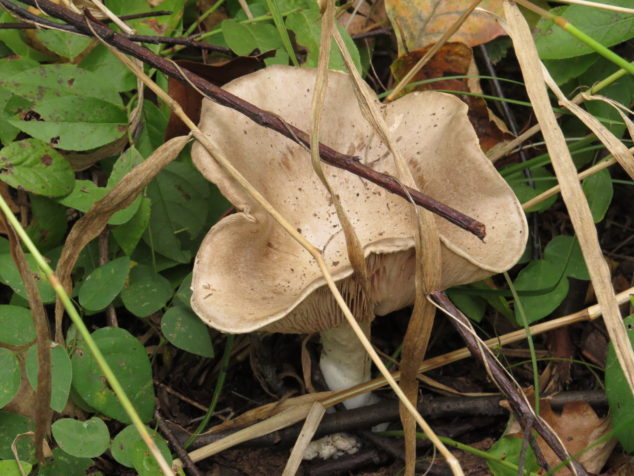
- Not mush room 2. Unstoppable 3. Mushrooms are having a moment
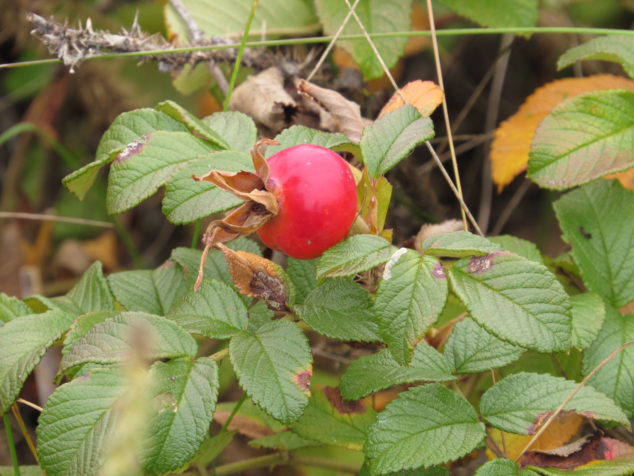
- Hipsters in red 2. Roses for next year 3. Hips don’t lie
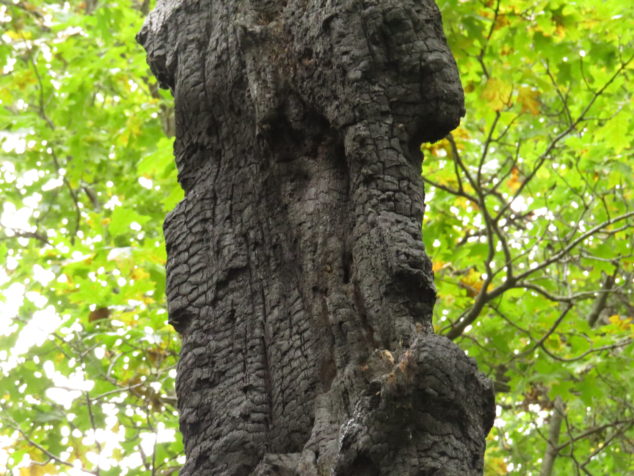
- Feel the burn 2. Tree-mains 3. Vertical coal
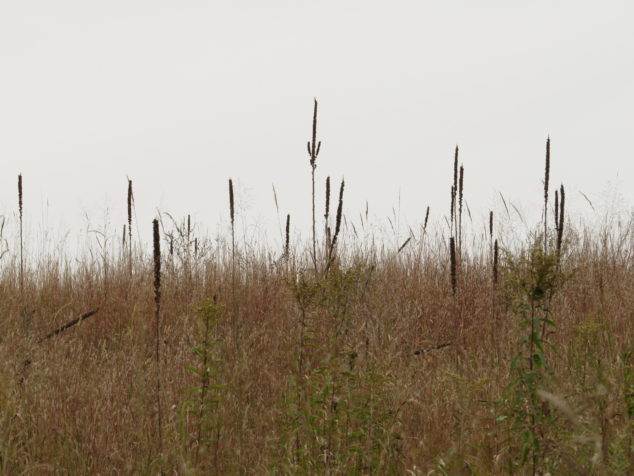
- All the sad prairie 2. Cactus of Minnesota 3. Prairie sentries
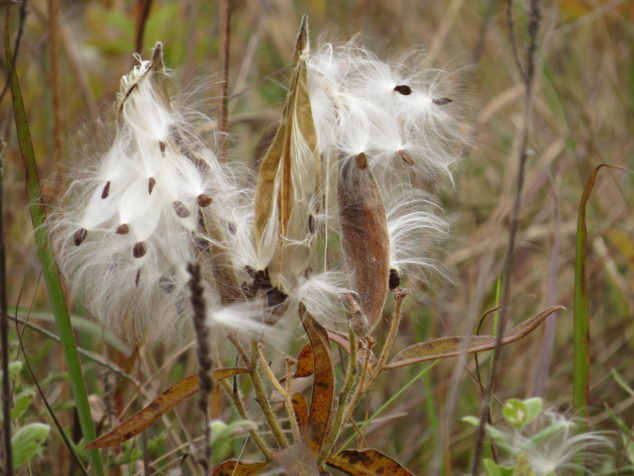
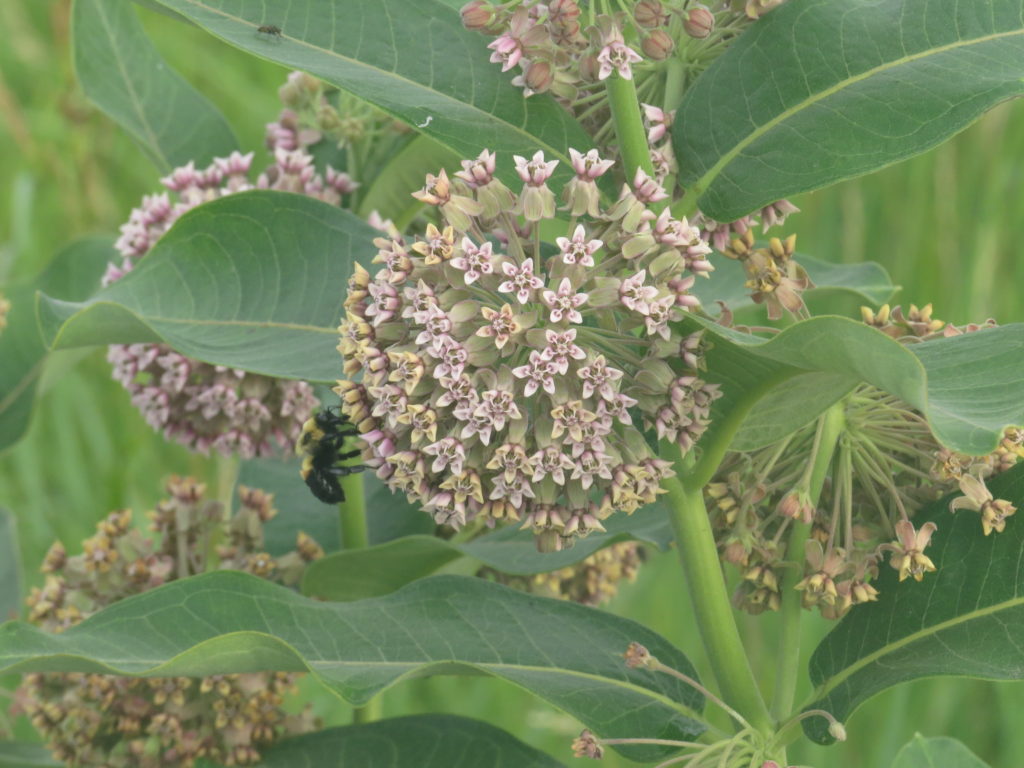
- Mess ‘o Milkweed 2. Fluff in the wind 3. It’s time to sail
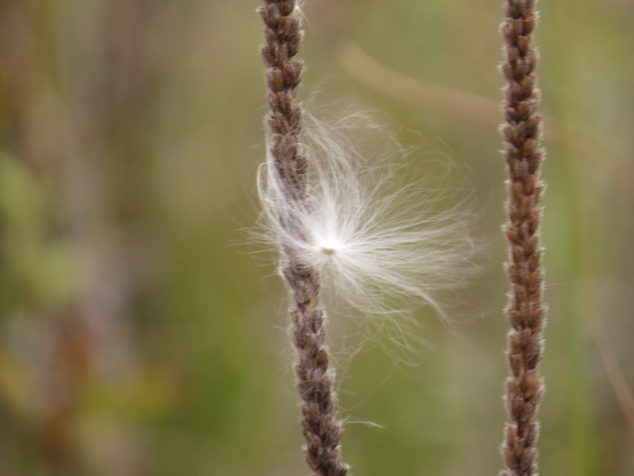
- Hanging on 2. Feathered and tethered 3. Clinging
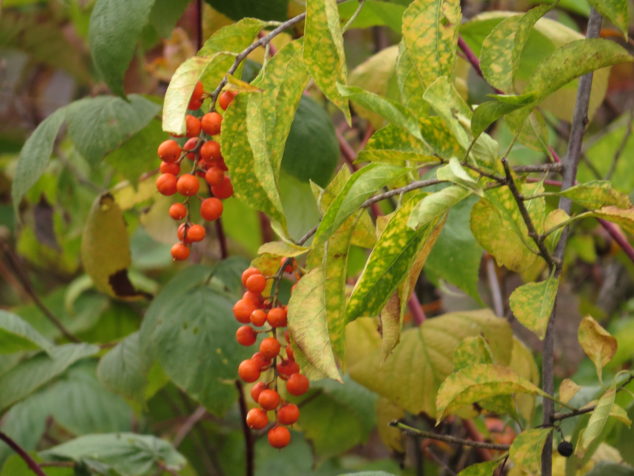
- Missouri memories 2. The circle of life 3. Bittersweet goodbye
A snapshot is a quick record of something or someone; a brief appraisal or summary. My photos and our captions are snapshots of our day together. They can stir memories of past times and connect us with a quiet part of ourselves that we may not be aware of. How do we walk through life? What do we see or not want to see? How do we carry ourselves? Who are we really? What is the work of our lives? What’s stopping us? How do we want our future to look? How do we look at things from a different point of view? Who do we surround ourselves with? How do we realize our mission? What do we do when we get stuck? How do we gather the sweet fruit from our memories? We are all entwined in this circle of life—each of us only a snapshot in the huge panorama of our Earth and its history. But each snapshot is important, and this time is our time. The mushrooms and all of us are having a moment.
Call of the Wild Geese
We were heading home again when we traveled through the storm. The last time we were home was two Januarys ago for my Dad’s frigid funeral. My body and soul love the prairie, the clear blue sky, and the call of the wild geese—all of which run down my nervous system like a calm stream and fill my soul’s cup to frothy fullness.
Wild Geese
You do not have to be good.
You do not have to walk on your knees
For a hundred miles through the desert, repenting.
You only have to let the soft animal of your body
love what it loves.
Tell me about your despair, yours, and I will tell you mine.
Meanwhile the world goes on.
Meanwhile the sun and the clear pebbles of the rain
are moving across the landscapes,
over the prairies and the deep trees,
the mountains and the rivers.
Meanwhile the wild geese, high in the clean blue air,
are heading home again.
Whoever you are, no matter how lonely,
the world offers itself to your imagination,
calls to you like the wild geese, harsh and exciting —
over and over announcing your place
in the family of things.
–Mary Oliver
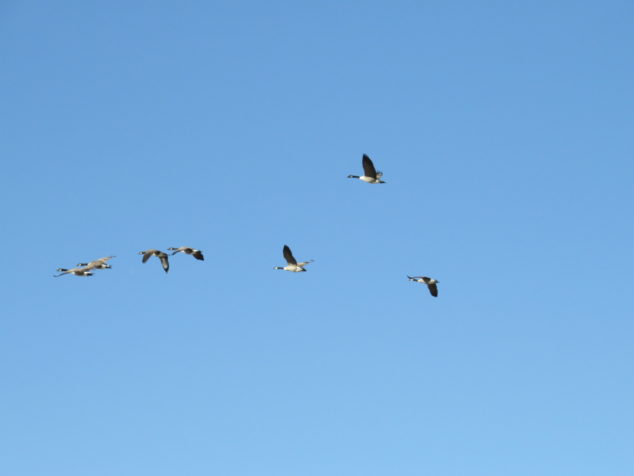
The cows have left my Mom’s pasture for the season, leaving behind the geese who gladly claim this domain as their own again.
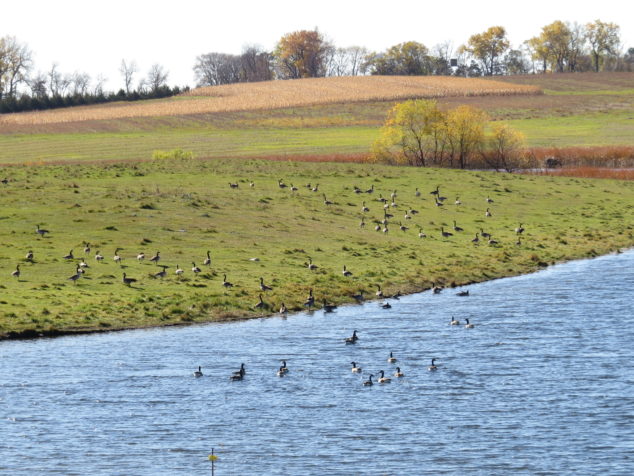
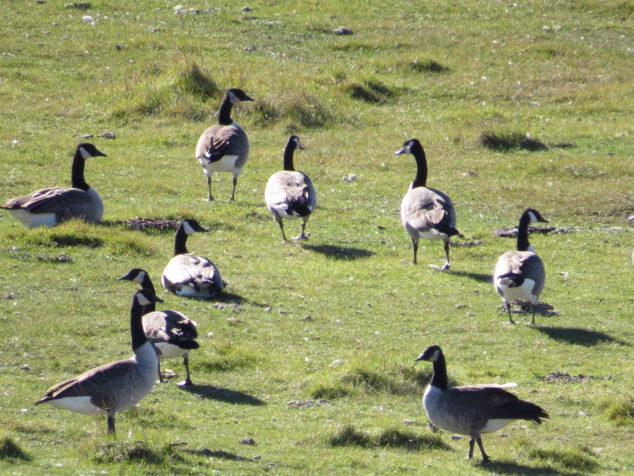
They graze and lay on the cowpie-strewn grass, decorating it with their own little fertilizer pellets and down confetti, and loudly chatter to one another as we humans approach.
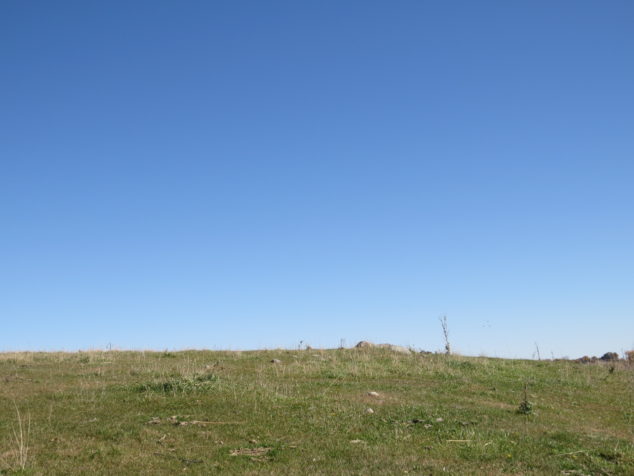
What is it about the prairie? On the surface, it’s simple—sky and grassland. Many travelers call it boring or lonely. I think the prairie allows a person to see one’s Self. It takes away the distractions of busyness and gives away freedom in its openness. We ask ourselves the questions, “Who am I in relation to the expansive blue sky?” “What is my place in this green, good Earth?” Many aren’t ready for the questions or the answers, but the invitation is there.
Meanwhile, the geese have made the prairie their home. Most will be traveling on to warmer lands for the winter; some will find open water and stay despite the cold.
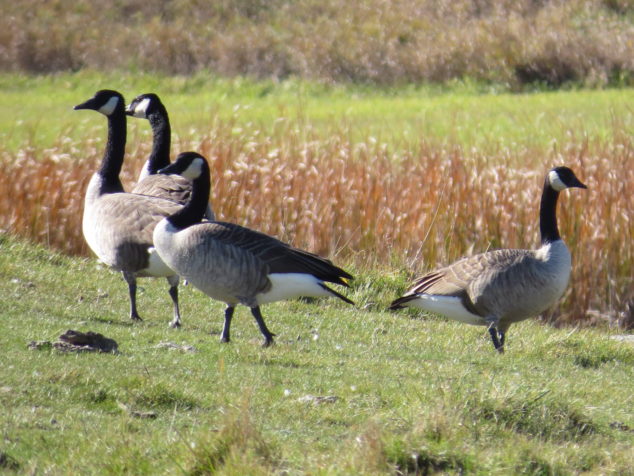
Unlike most animals and birds, geese are at home on land, in the water, and in the air. Wherever they are, they claim it for their own.
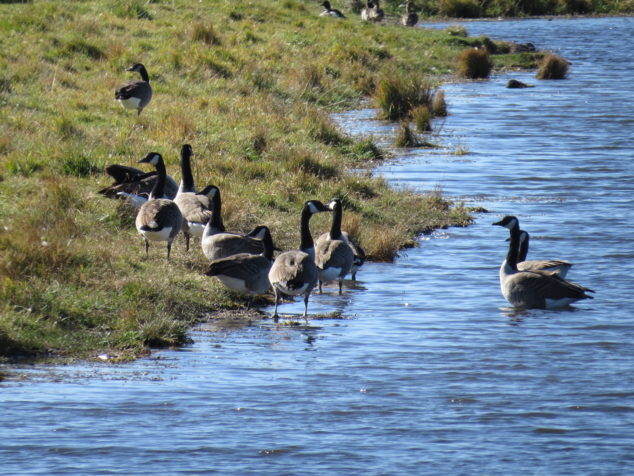
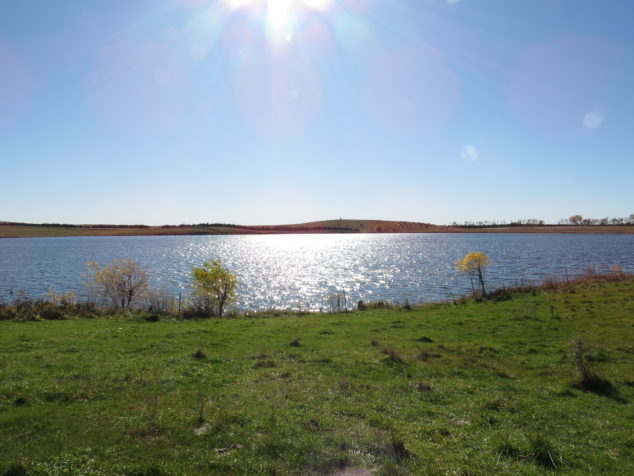
Meanwhile, the sun moves over the prairie, moves over the unnamed water…
…moves over the geese swimming in sunshine.

The geese have staked their claim in their temporary home, and they will carry that assurance and presence with them as they travel through the air to other lands and other lakes. If only I had their assurance.
When I first read Mary Oliver’s Wild Geese poem, not that many years ago, tears welled up in my eyes with the first line. “You do not have to be good.” ‘Being good’ had been my internal mantra, motivator, manager, and ball and chain for a handful of decades. And I had walked many a mile on my knees in self punishment for not being ‘good enough.’ Oliver was gently and with assurance stating that I don’t have to do that anymore. I could lay down my black and white thinking that if I wasn’t ‘good,’ I was ‘bad.’ ‘Being good’ in this sense is not the intrinsic, God-given goodness we are all born with—it is the man-made, mind-made perfectionist roles and rules that society or family places upon us or that we place upon ourselves in order to get the love and attention we need. Oliver was saying to just let my mammalian body be present and love what it loves. I could decide, from my own inner, God-given goodness. Oliver tempers any egoistic instructions with the fact that we are always in relationship with others—there is a give and take—tell me about your despair, your loves, your struggles, your joy, and then, I will tell you mine. Built into that exchange is a container of safety—that we will be listened to, protected, believed, and beloved. (Therein lies the grounds for betrayal.) Then Oliver pulls us out of our little worlds to remind us of the big world. In our despair, the world goes on. In the midst of our struggles, the sun moves over the land and water. In the energy of our joy, the wild geese call. Not only are we in relationship with one another, we are in relationship with all of Nature! The wild geese are calling to all of us announcing our place in the world—it is our job to claim it for our own.
This Huge Nest Called Earth
Come forth into the light of things, let nature be your teacher.
–William Wordsworth
Last weekend I was off the internet for three and a half days, and I feel ridiculous for even saying that like it’s some big deal, since I have lived two-thirds of my life on Earth without that technology. (And having lived two-thirds of my life without it, I can honestly proclaim that the internet is a-mazing!) I didn’t miss it; though along with not having tv, I did have a slight feeling of missing out on what was going on in the world. But since most of what’s on the news right now gives me a sinking feeling in my stomach, I was better off not knowing. So what did I do? I visited with my Mom who came for the weekend. I cooked food for our Easter celebration. I laughed with my family around the dinner table. I read a little bit of the Sunday paper. And we all went outside to hike, to take pictures, to walk the dog, to bask in the warm sunshine on a wind-cooled day, and to revel in the emerging signs of Spring.
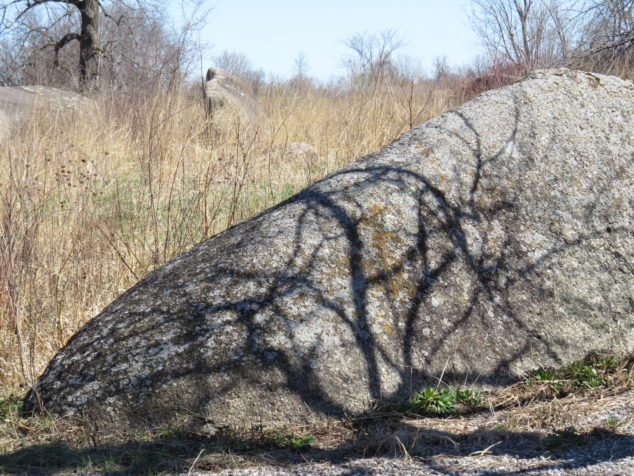
We hiked at our nearby Eagle Park and were disappointed when we saw no movement of gray fluff or adult guardian in the huge eagle’s nest—the second of three years now with no viable eaglets. We wondered whether it was the age of the parent eagles or if the nearby Sauk River food source was contaminated with something that interfered with the egg development. (Happily, the other nearby eagle’s nest did have a couple of gray fluffy babies and a watchful parent.) The bright-light sunshine cast shadows on the tomb-size boulders scattered throughout the park.
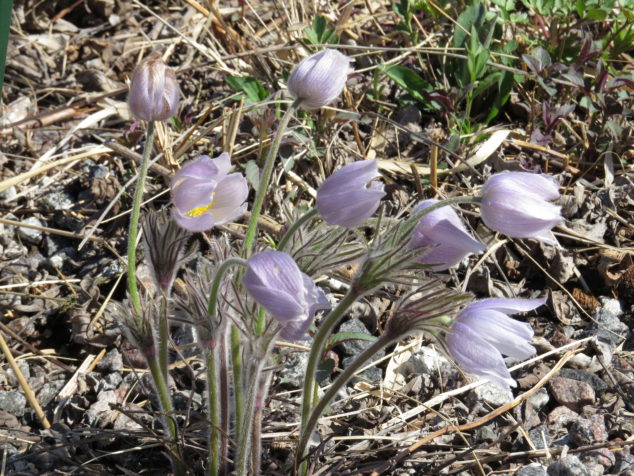
A clump of Pasque flowers, also called Easter flower and prairie crocus, bloomed along the trail.
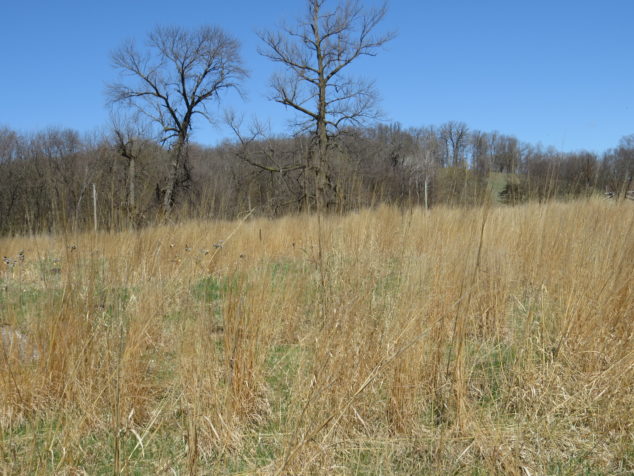
Golden stands of last year’s prairie grasses waved in the wind with hints of green growing up between them.
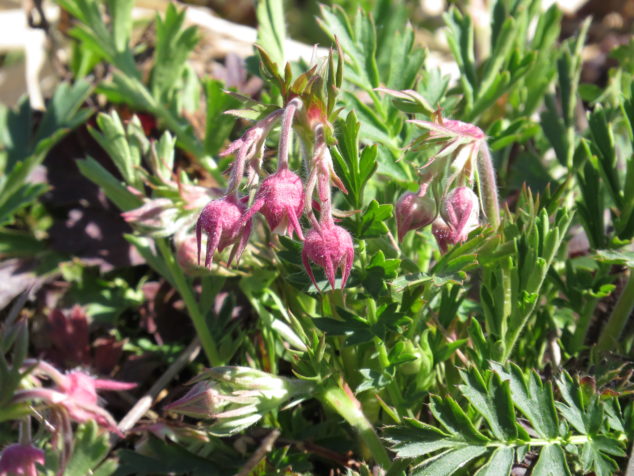
Nodding heads of Prairie Smoke flower buds hung from early Spring foliage.
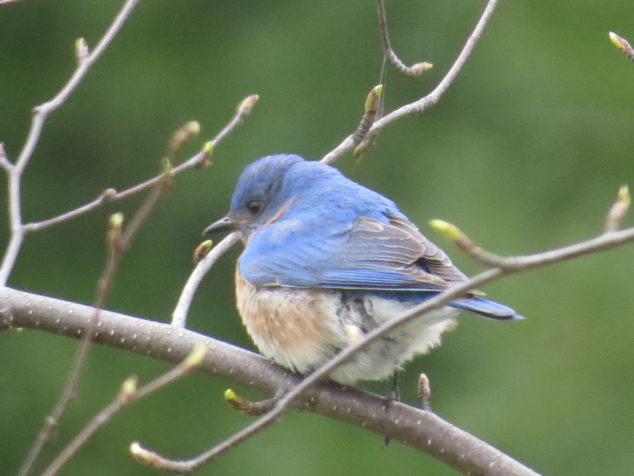
We saw the first Bluebird of Spring at Eagle Park, then later delighted that our pair had returned to the yard to check out the houses Chris hastily put up.
Our Spring crocuses were an absolute sight for sore eyes, a shocking display of regal purple, pure white, and purple striped color after a winter of gray, white, and brown. I couldn’t help but smile and marvel at the sight of them!
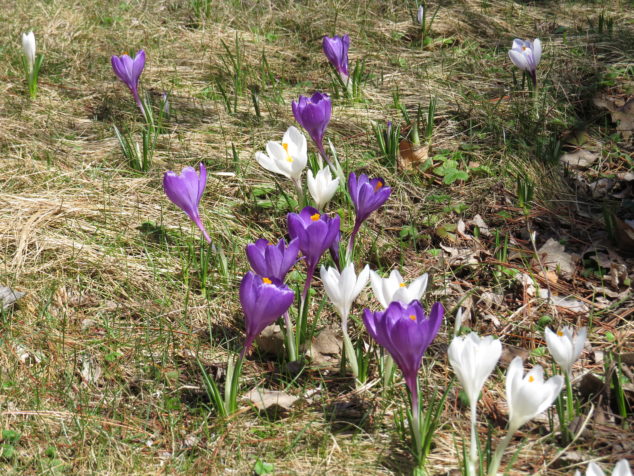
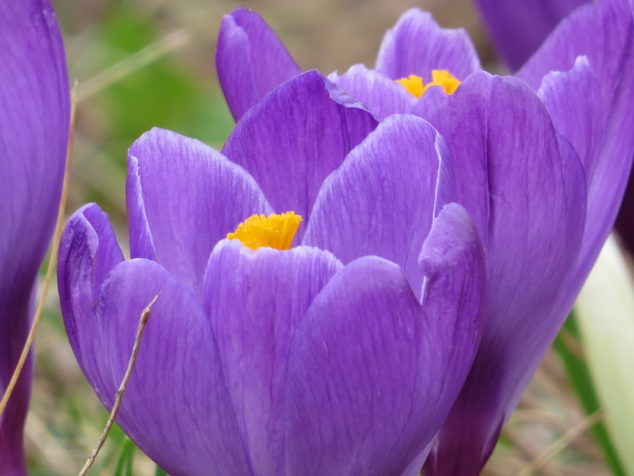
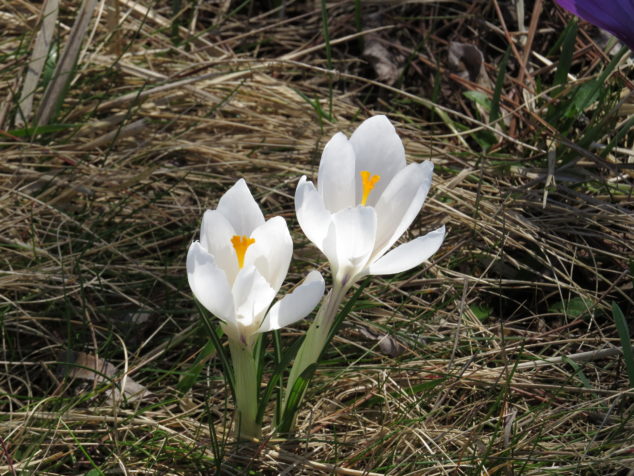
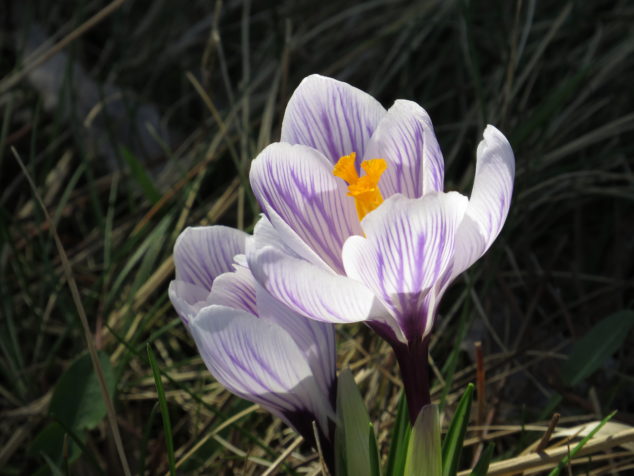
Every year, as we come forth into the light of Spring, we are inundated with marvelous, amazing examples of creation, renewal, and transformation. The old, golden grasses give way to the growing green. The birds return to their northern breeding grounds and prepare for raising their young. The miraculous perennials push through the chilly soil for another year of growth and flowering and bearing fruit. We are just another part of Nature’s transforming miracle. We are Easter people. We come together with family and friends. We prepare nourishing food to share with one another. We commune around the table with prayer, talk, and laughter. And then we are drawn outside to commune with Nature, with that from which we come and whom sustains us. In September of 1965, President Lyndon B. Johnson signed a bill establishing the Assateague Island Seashore National Park with these words, “If future generations are to remember us more with gratitude than sorrow, we must achieve more than just the miracles of technology. We must also leave them a glimpse of the world as God really made it, not just as it looked when we got through with it.” Through the miracle of the internet, I commission all of us to become guardians of our little parts of this huge nest called Earth. Happy Earth Day to us all!