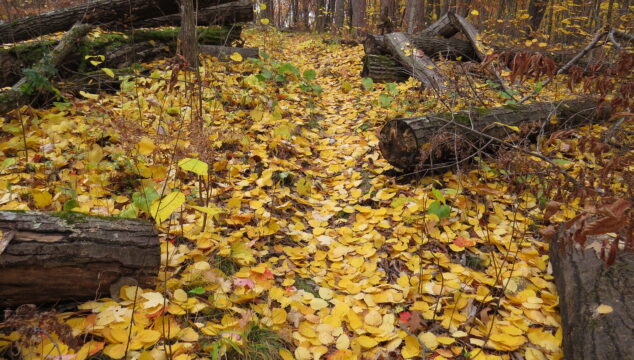
Come walk with me in the peak Autumn beauty of the Northwoods. To say that I love this time of year is an understatement. Most everyone can appreciate the colorful falling leaves---it reveals the 'true self' of a tree when its leaves are no longer producing chlorophyll. Their true colors are revealed, and there is something simple … [Read More...]
Gleanings from July–Animal Behavior
Animals have always been such an important part of my life. When I was very young, we had a menagerie of farm animals–Holstein dairy cows, a black Mustang horse, chickens, cats, dogs, pigs, and sheep. Later in my growing up years we had a rabbit, ducks, cats, dogs, and horses. (I tend to leave out the hamster who I did not like–he was too squishy and mouse-like.) Horses were the best; I loved everything about them–brushing their dusty coats and tangley tails, feeding them sweet feed and fragrant hay, saddling and riding them through fields and woods, and even cleaning out and shaking fresh straw into their stalls.
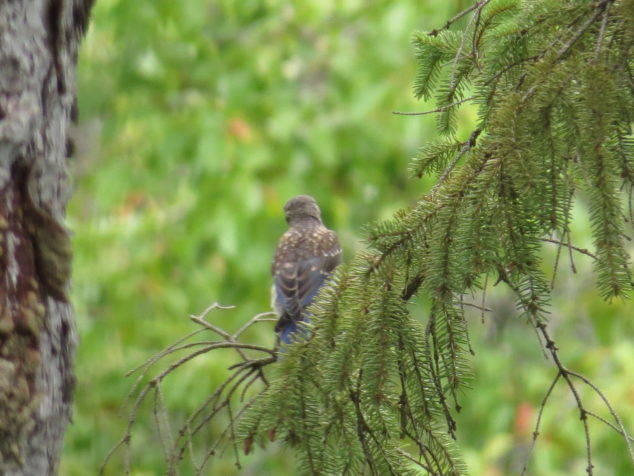
July has not only been a month of flowers, but one of animals, too. The young Bluebirds who fledged the nest have been swooping to the ground to pick up insects, then quickly flying back up to tree branches, just like their parents.
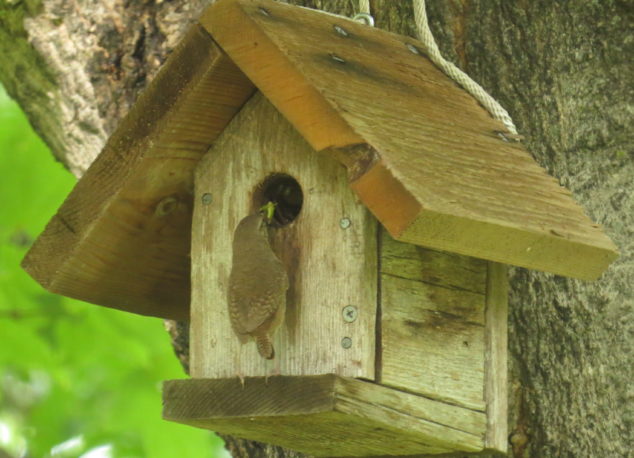
The chattering House Wrens are on their second brood of young ones and spend most of the day hunting for insects for the hungry houseful. (See my post of wren babies fledging from the nest.)
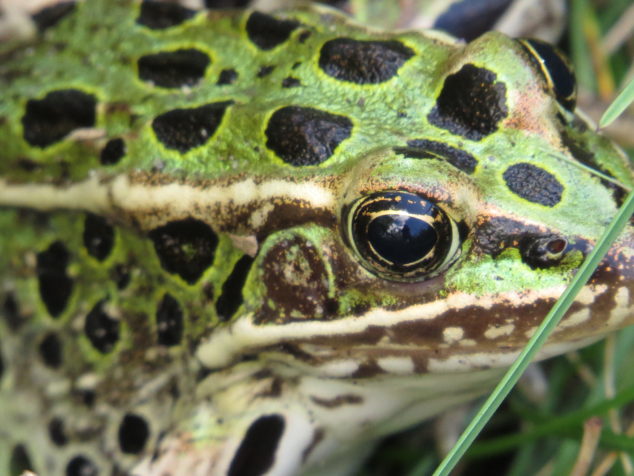
When I was weeding the garden one day, a Leopard frog leaped out from under the kale and hid in the grass.
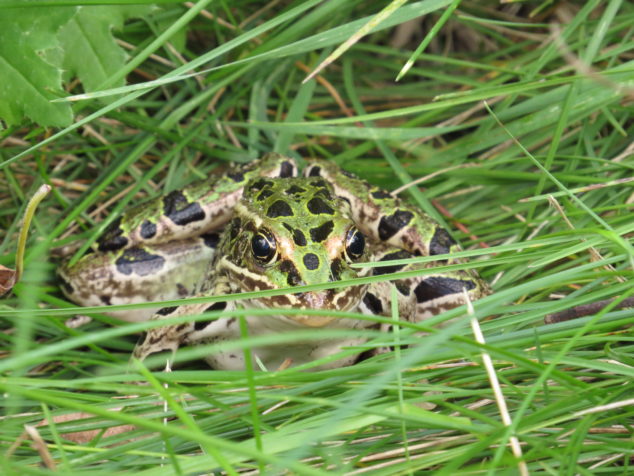
Have you ever seen your reflection in the eye of a frog?
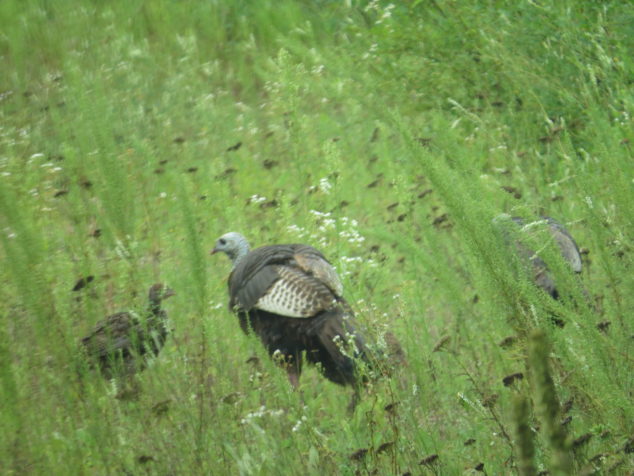
Mother turkeys and their young broods have been wandering through the yard and woods, scratching and pecking for food.
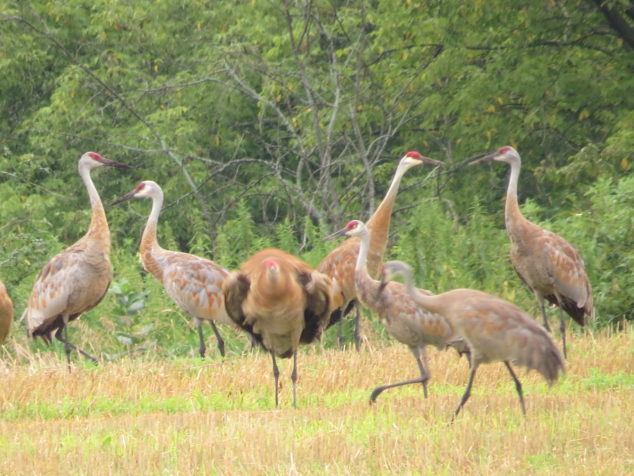
A call from Chris one morning alerted me to come check out a field close to his work. I pulled into a field driveway, walked across the road, and saw a large community of Sand Hill Cranes! There were about forty in all, gleaning the kernels from the grain field.
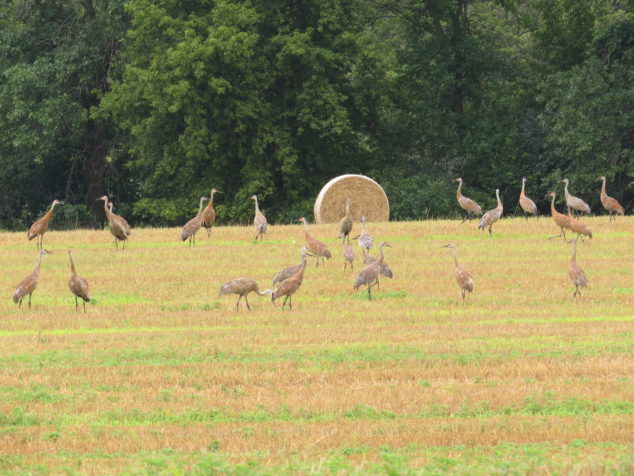
Sandhill cranes mate for life, choosing their partners based on spring mating dancing displays. They live for twenty years or longer.
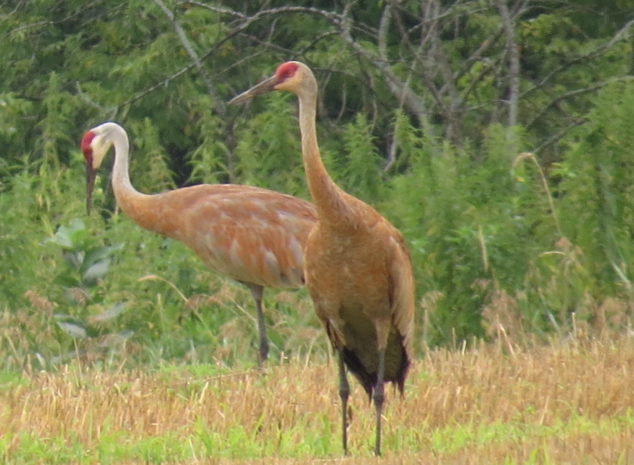
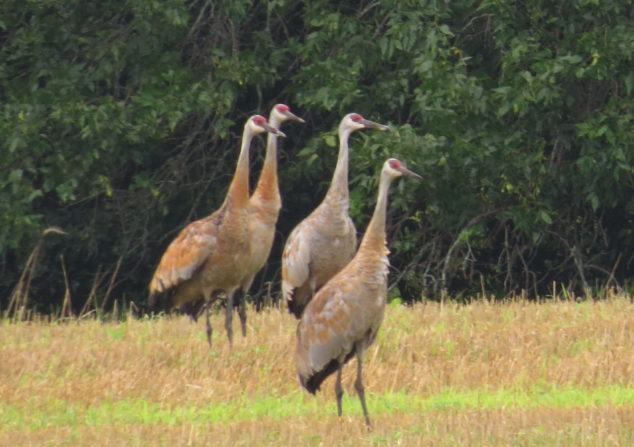
The young ones stay with their parents through the winter and separate the following spring, but can take up to seven years to choose a mate.
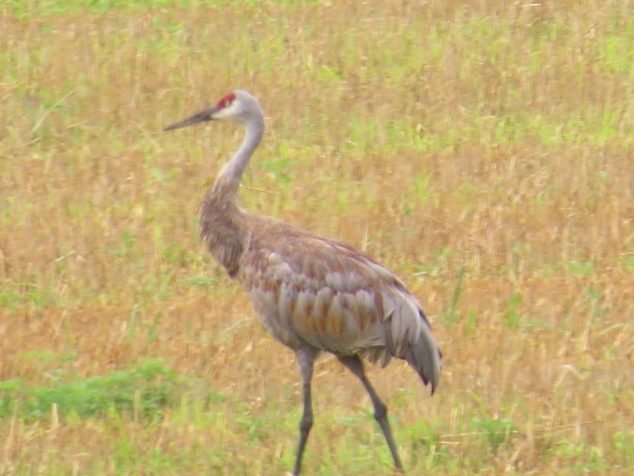
A pair of sentries closest to me, but still on the far side of the field, started making alarm calls as they watched me.
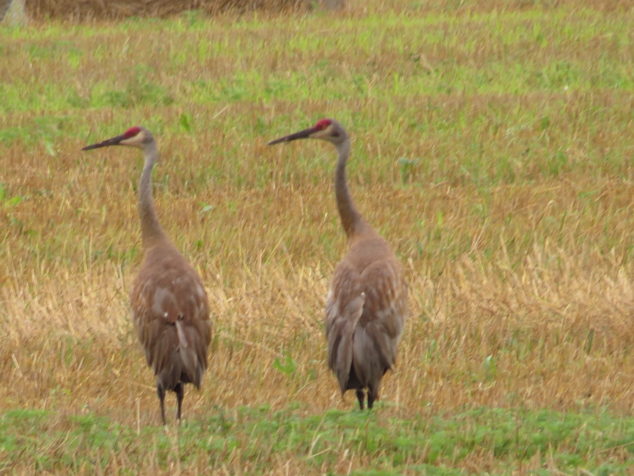
The others slowly began gathering and walking along the edge of the field.
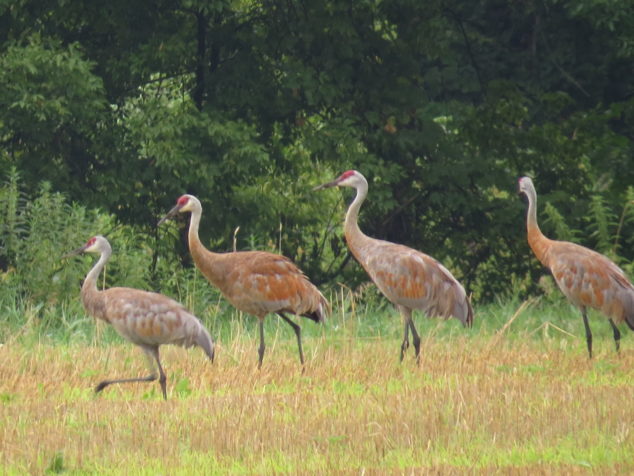
This photograph of beautiful bird behavior, after the sentries sounded the ‘beware’ call, illustrates a variety of responses. The one in the middle is ‘shaking it off,’ the two adults in the back right seem to be discussing the problem–“what do you think–is that figure holding the black box really a threat?” and the young ones in the front are following directions–“walk to your left.”
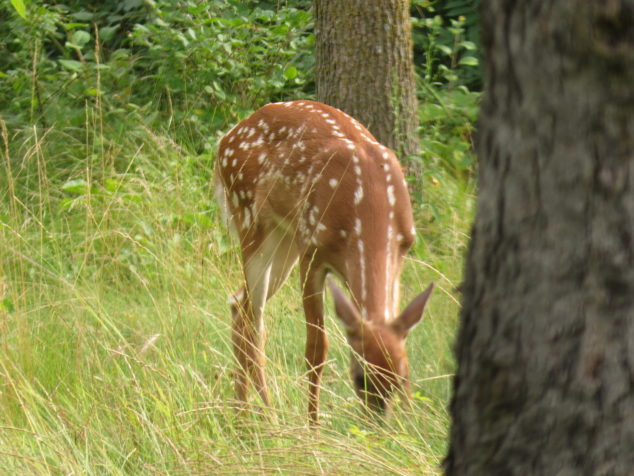
I was fortunate to witness another display of articulate animal behavior in our front yard the other day. I saw a doe with her fawn grazing along the edge of our yard. (Look at the line of spots on either side of the spine.)
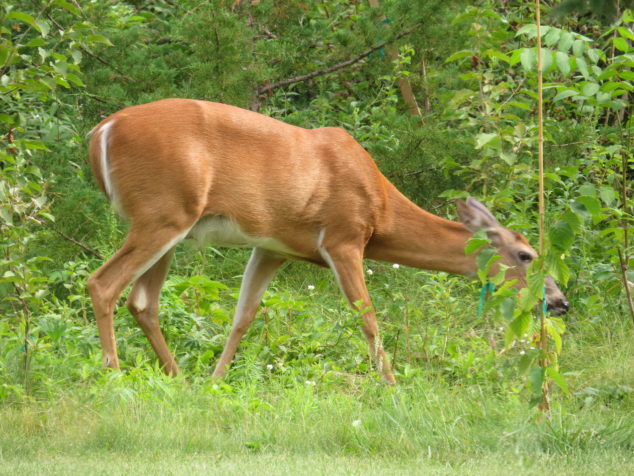
The doe stayed in much the same spot, and I hoped she wasn’t munching on the hazelnuts Chris recently planted. She was as sleek and healthy-looking as I’ve ever seen a deer, so she must have been eating nutritious food. (Hmm, some of our hostas had been eaten down to the stems…)
The fawn wandered out in front of the doe.
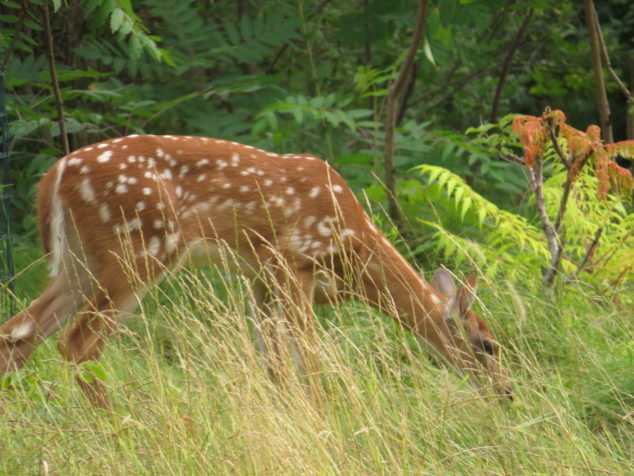
Soon he ventured out into the mowed part of the lawn, bucked, and kicked up his heels.
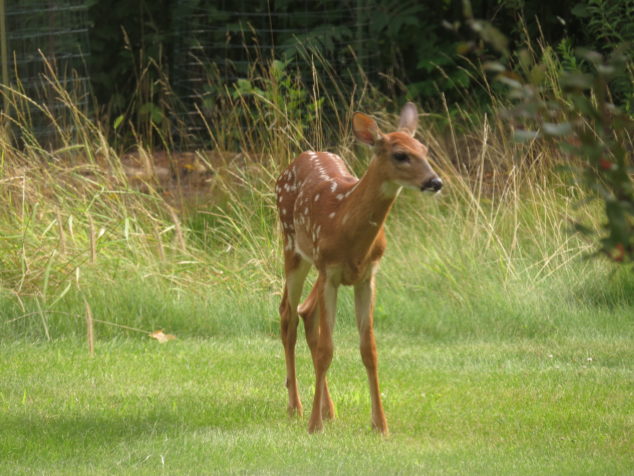
With cautious curiosity, he walked to the crabapple tree and nibbled on a few leaves.
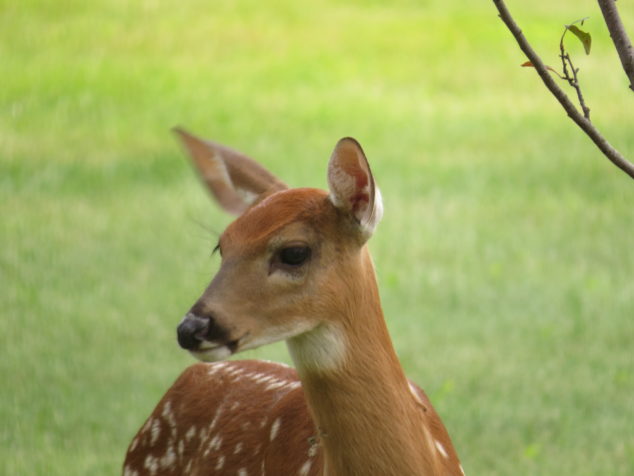
Suddenly, something scared him, and he ran as fast as he could back to his mom! Immediately she started licking him. He stood close to her and continued to graze as she licked his back, reassuring him that he was okay. After a few minutes of that, he slowly pulled away to wander on his own again.
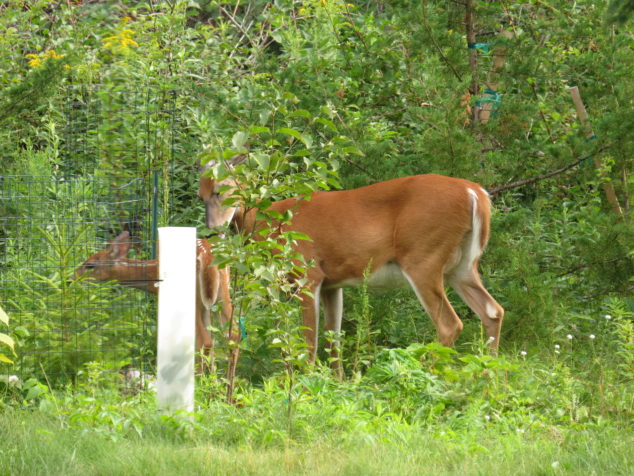
Then they slipped back into the woods.
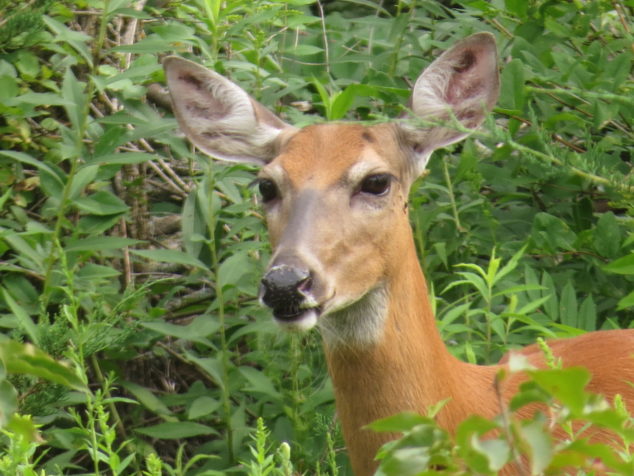
I have learned many things about myself and life from all the animals over the years. Anyone who has ever been astride a horse that is spooked by something, knows in his/her body what the fight or flight response feels like. Consequently, one learns how to soothe the horse and let him know that he’s okay. If you have seen a mother cat caring for her kittens–nursing them, hunting for them, cleaning them, keeping them safely hidden when small, and teaching them to be on their own–then you know what parenting entails. We often forget that we are one of the many animal species and that we have much in common with them. So watch closely in the presence of animals–we can see the reflection of ourselves in their eyes.
Gleanings from September
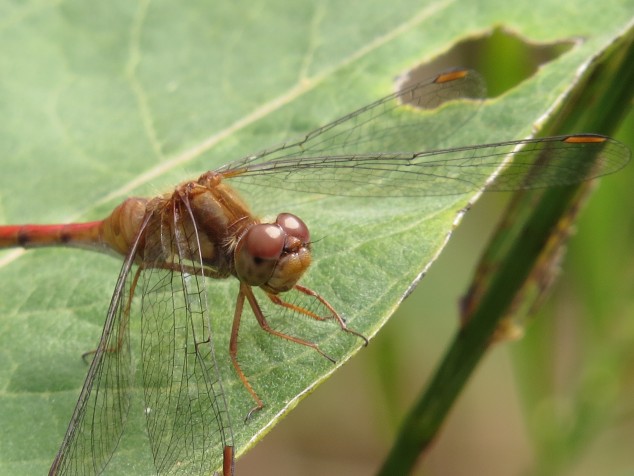
September has flown by it seems. These are the last weeks of summer and the introduction to fall. There is the scare of frost that pushes one to fling bed sheets over potted annuals and tender basil and tomato plants because we cannot bear to see their darkened, wilted leaves just yet. Later, we resign ourselves to its inevitability–but that is an October state of mind. We want to hang on to the warmth and jubilant growth and production of summer–even as we see the reverse process going on right before our eyes–the cooling, turning, falling, and wilting.
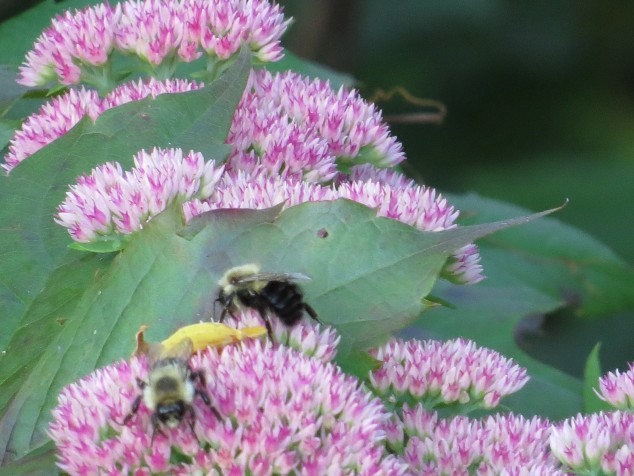
Bees still feed on sedum flowers, though not with the busy energy of playing children. They are placid and slow in the coolness.
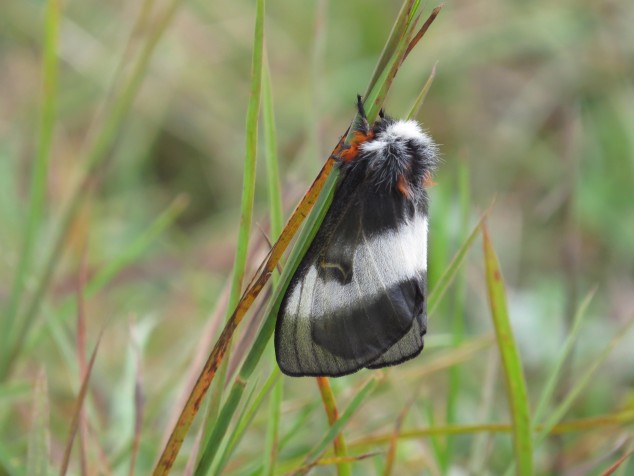
A Buck moth–so named because it emerges during the rutting season of whitetail bucks–clings to the prairie grass at St. John’s Arboretum. It looks as if it wears a warm fur coat to get it through its short, egg-laying Autumn life.
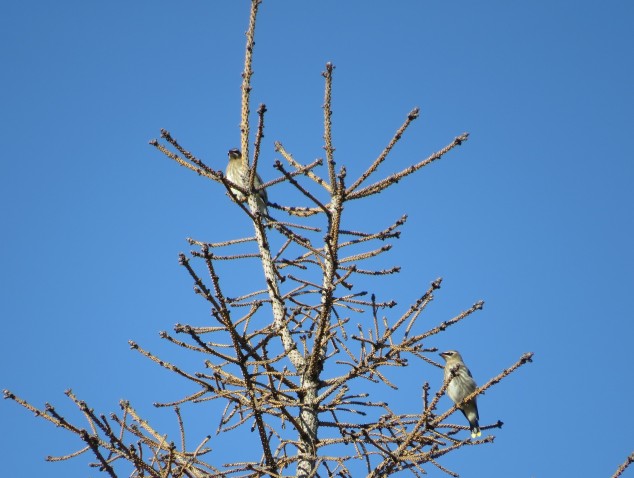
One afternoon as I walked out our driveway, I looked up at the top of a dead spruce tree. Birds perched like Christmas ornaments on its branches. Most of them flew away before I got a good look at them with the camera, but I discovered they were Cedar waxwings.
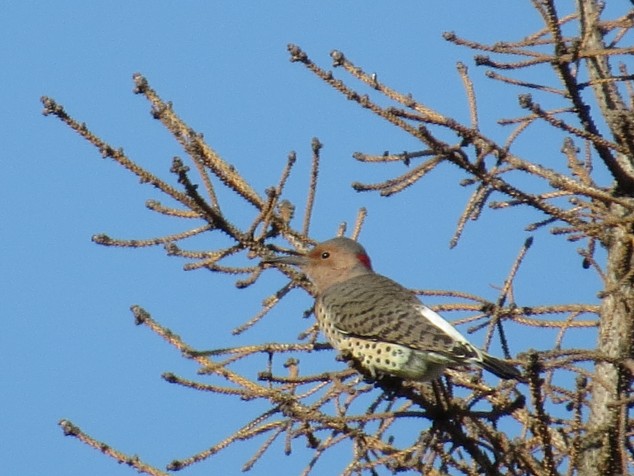
 Another visitor to the dead spruce was a Northern flicker, stout of body and bill with the red nape of its Woodpecker family. It’s one of the only woodpeckers to feed on the ground and to migrate from its northern areas.
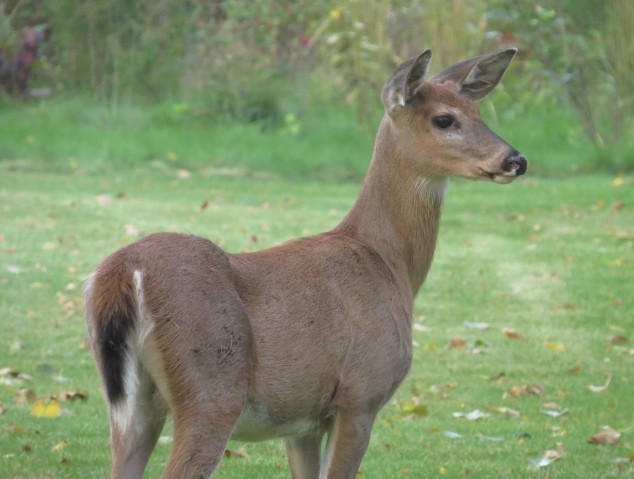
In September we saw some of our frequent yard visitors mature into young adulthood. The small, spotted, twin fawns now looked muscular with thick coats, and I had a feeling of sadness to think of them in the sight of a gun instead of my camera.
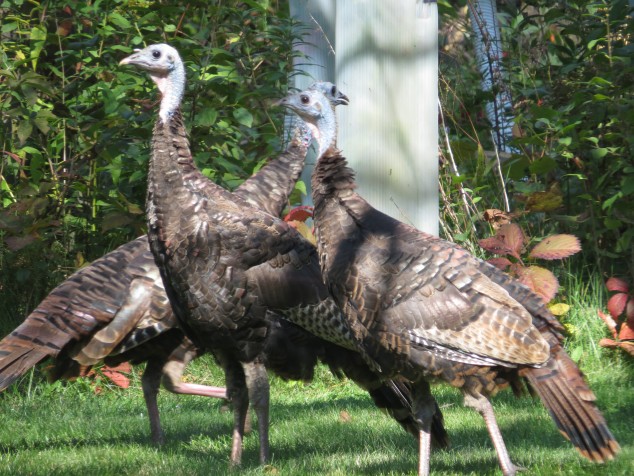
The young turkeys, once scurrying balls of feathers, were indistinguishable from the adult females who wrangled them around all summer. Their feathers shone in the sunlight with the diverse markings and rich copper, brown, and bronze colors of the adult bird.
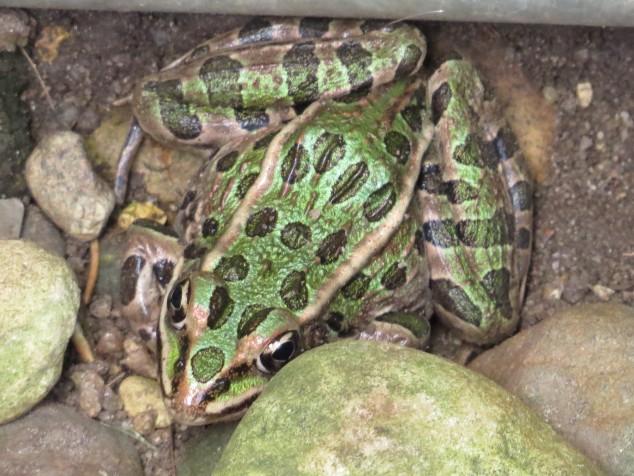
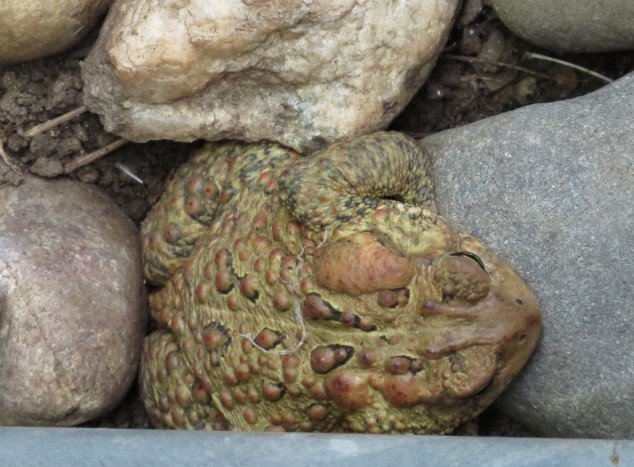
I carried out an amphibian rescue from the deep egress window well on the northeast side of our house after our Black lab would run to it and peer over the edge at the critters who had inadvertently fallen into the abyss. Three Tiger salamanders, two Leopard frogs and a Partridge in a…..no, I mean a chubby, bumpy, brown toad.
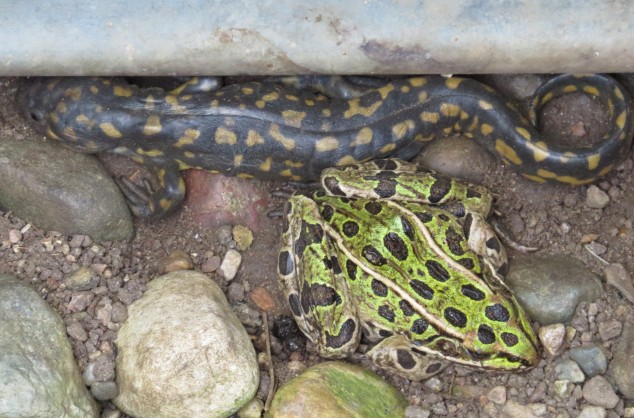
(This one is so shimmery and pretty!)
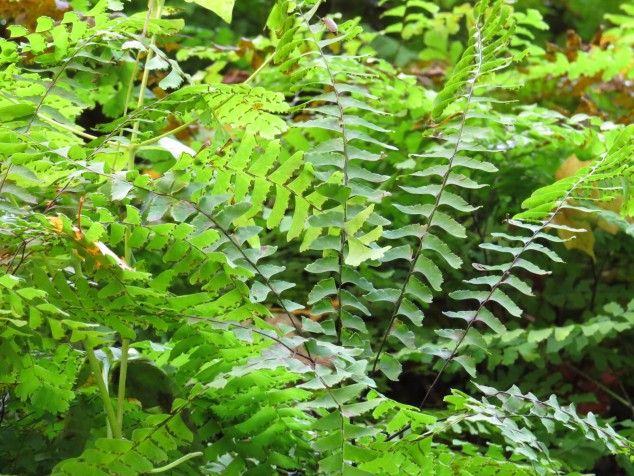
And finally, I wanted to show you my favorite fern–Northern Maidenhair–with a whorl of lighter green fronds floating on dark, wiry stems. They grow along the shady narrow road that climbs the bluff from the bank of the Mississippi River at Cassville, Wisconsin to the cemetery where Chris’ folks are buried. That’s the first place I remember seeing them. These grew where the woods and the wetlands merged at St. John’s Arboretum. My attempt to establish them at our place has met with disappointment, as our hilltop sandy soil drained away the moisture they require. But I’m not giving up yet–Chris has a project going that may be the solution to my problem….
It is human nature to not want to let go of the things in life we love or that give us pleasure. Summer is a pleasurable time in Minnesota, a time we do not take for granted. It is short and sweet, and we want to hold on to that sweetness. But the night temperatures fall into the thirties, the colorful, fallen leaves cover the green grass, the produce from the garden is mostly all harvested, and the denial of what’s coming is getting pried away by reality. We get out our warmer clothes that have been put aside, not even put away, and we start to make our mental list of things that need to be done before winter. We rescue what we can, and with loving appreciation we let go and give the other up to God. We move on to our October state of mind.