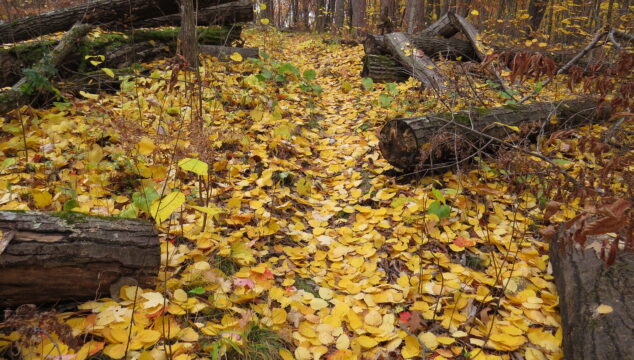
Come walk with me in the peak Autumn beauty of the Northwoods. To say that I love this time of year is an understatement. Most everyone can appreciate the colorful falling leaves---it reveals the 'true self' of a tree when its leaves are no longer producing chlorophyll. Their true colors are revealed, and there is something simple … [Read More...]
Modern Day Hay Haulers
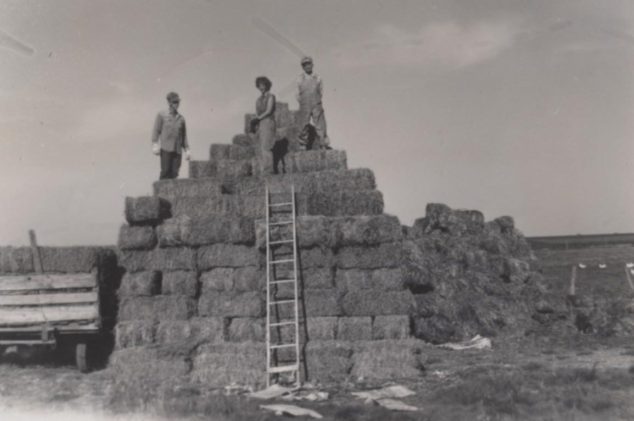
There is something to be said for hauling hay bales. Those of us who have done it may run the gamut of feelings about doing so—from ‘I hated having to haul bales’ to ‘gotta get it done’ to ‘I love being out there on the hay rack’—all are legitimate things to say. I fall towards the ‘love’ side. Some of that has to do with my love of the animals we were feeding the hay to—if you have horses, you have to put up hay, even if it’s stacking the bought hay in the hayloft. The same goes for straw bales for bedding in the stalls. It’s all part of caring for the animals we love. I also loved being outdoors—driving the tractor or bracing my legs on the hay rack as we bumped over the stubble or stacking high on the pile as we completed a load. It was usually hot, sometimes muggy, always sweaty and dirty. And it was awesome! The thing about putting up hay—small square bales and back in the day—was it was a team effort. (Not that my Dad never let the tractor run down the field by itself while he picked up and stacked by himself.) For efficiency and some peace of mind, family, friends, and young, strong helpers were recruited to help with the work that needed to be done. So we did it together.
This photo was taken in the early 60’s when I was too young yet to help with hay, but this is my Mom and Dad and Grandpa Andrew.
Most of the hay these days is rolled up into big round bales and hauled with tractors and trucks. But we did something this week that reminded me of the old hay-hauling days. We did some outreach in our ‘Battle of the Buckthorn.’ Most of the large buckthorn trees on our property have been removed thanks to the diligence and hard work of Chris, so we were glad to help some young friends of ours with their overgrown buckthorn problem. Armed with gloves, saws, pullers, and loppers, we went to work in the hot, slightly muggy afternoon. We sweated, got dirty, made big piles, and cleared the invasive trees from under the pines, oaks, and cedars.
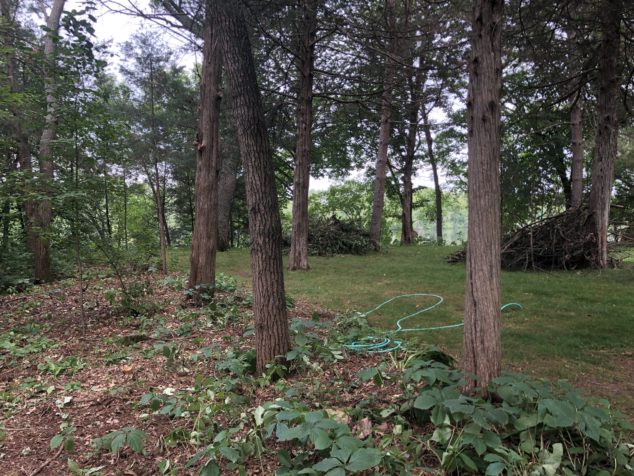
While working, we also kept an eye on the kids who ran a lemonade stand for the passersby in the neighborhood. When the afternoon’s work was done, we sat down together for ‘a little lunch’ as my Grandmas used to call it. With tired bodies and a distinct feeling of satisfaction for the work we just accomplished together, we ate a sweet treat with relish and appreciation. We were like modern day hay haulers—working together to do a big, physical job and feeling the satisfaction in our bodies and souls that we could do it together.
Battle of the Buckthorn
The War on Buckthorn at the Brake woods continued with a recent battle in the south corner. Just a warning–these are not pretty pictures! Armed with a chain saw, hand saw, loppers, Round-up, and gloves, Chris and I went to work. He’s the chainsaw man, I’m the Round-up stump painter, and we both load the pickup bed with the piles of brush that need to be hauled away. Of course, I was so excited about attacking this patch of undesirables that I forgot to take a ‘before’ picture!
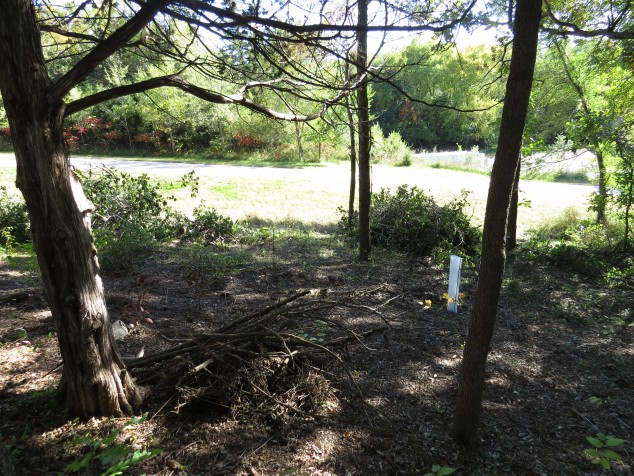 But this is what it looks like right next to the cleared area, which will give you an idea of what it looked like ‘before.’
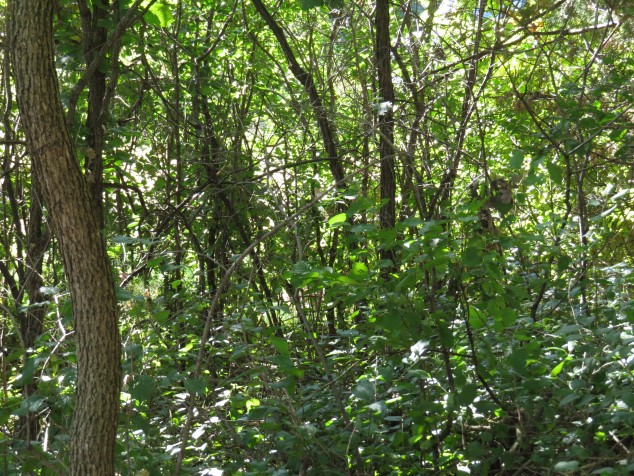
And this is another section of the woods where the buckthorn was cut down but not yet removed. It is dense, prickly, nasty, invasive stuff.
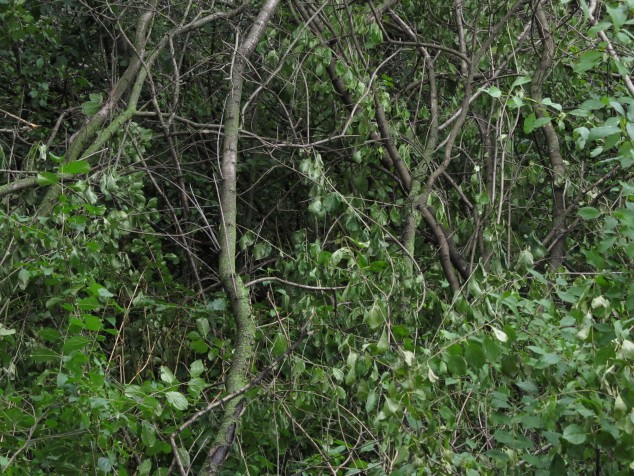
Every square foot of our woods looked like that when we moved to our little plot of land above the river. Five years of battles against the buckthorn, area by area, has made a huge difference in the way our woods look now. As the buckthorn came out, Chris planted new things. He mulched paths through the woods, planting trees, shrubs, ground covers and perennials along the way.
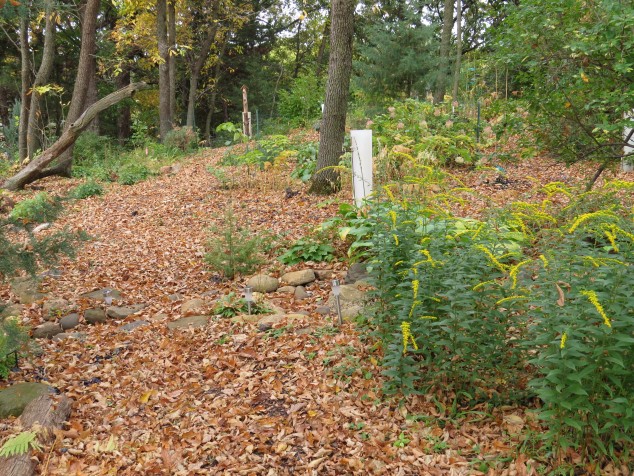
He built a winding dry stream bed of rocks that can be ‘turned on’ to be a babbling brook.
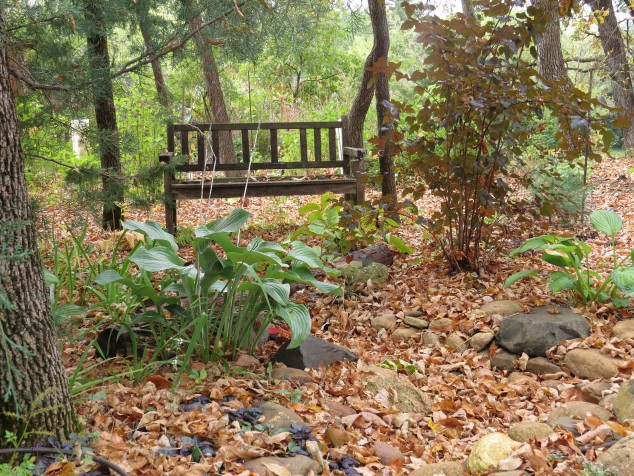
He planted a small grove of Hazelnut shrubs that he grew from seeds. American hazelnuts are native to this area as an understory shrub or small tree. The nuts are small with thick shells, are high in protein and vitamins, and are highly favored by squirrels, birds, and other wildlife. European hazelnuts–the kind you get at the store–are not hardy in this area.
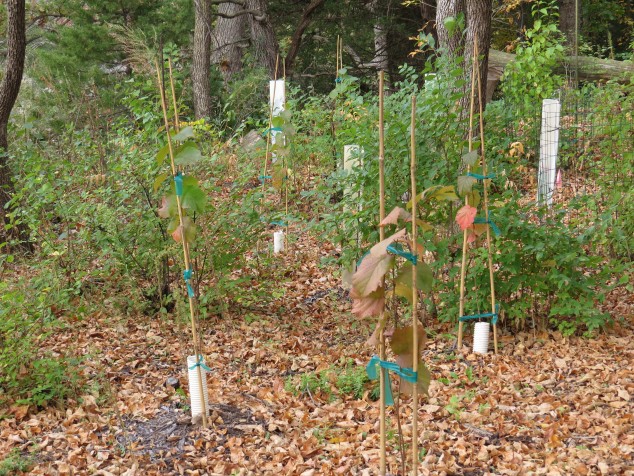
We left a fallen tree for interest and as a dividing line between the more cultivated area at the top of the hill and the ‘wilder’ planted hillside below. The white plastic cylinders protect oak seedlings from rabbits and deer.
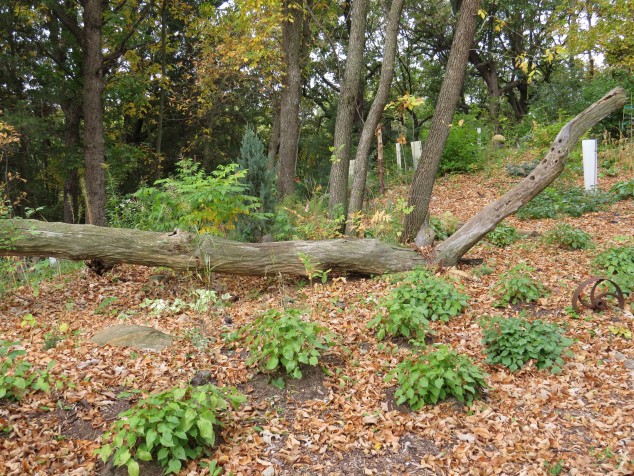
Low grow sumac helps prevent erosion on the sandy hillside. Cedars, oaks, and honeysuckle seed themselves and are free to grow without the suffocating buckthorn. Raspberries, gooseberries, and many woodland perennials, including Jack in the Pulpit, have reappeared in the cleared areas.
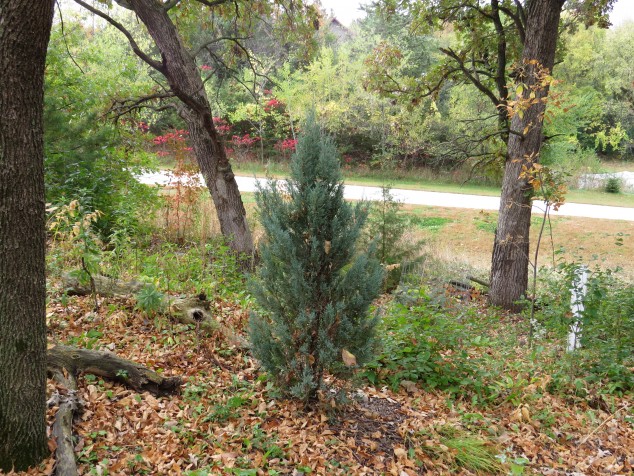 Tamba and I enjoy our daily strolls through the woods. Every day is different–new shoots, new flowers, areas of weeds to be tackled, or the first red leaf of fall. You can feel the vibrancy!
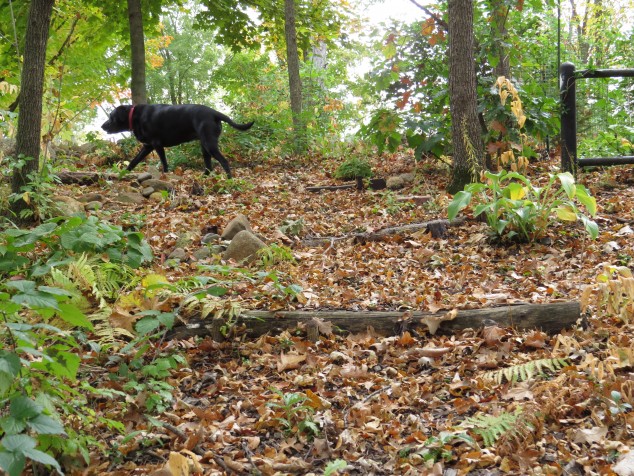 The restoration of our woods is an ongoing project. Getting rid of the mature buckthorn is just the beginning–pulling the seedlings that grow from the years of seed production is the part that really tries one’s patience. A cleared area can be covered with buckthorn shrubs four to five feet high in a year or two if diligence is not taken to pull the young seedlings. But it does get better after a number of years! Seeing the woods come alive again with native plants along with what Chris has planted, has been such a joy! We see the unfolding of life, the glory of flowers and fruit, and the colors and strengths of the seasons–not the snuffing out of life by the buckthorn.
This is a story of hard work, years of time, patience, and perseverance. It is a story of hope, new growth, restoration, and redemption. It is a story of enjoyment, peacefulness, beauty, and bounty. It is the story of love and life.
The Woods
A ‘wall of green’ was how my husband described our woods when we first moved to our Central Minnesota home six years ago. We could see the tops of impressive oak trees and spindly cedars, but the first 10-20 feet was a thick, impenetrable wall of green vegetation. It was armed with thorns that easily scratched our arms to bleeding if we tried to push through the denseness. The wall had blue-black berries in the fall that stained anything they touched.
I don’t think we found out until the next summer that our ‘wall of green’ was buckthorn–and from then on, it became a bad word in our household–a word said with scorn. And it became my husband’s new hobby. Common and glossy buckthorn are on the Minnesota DNR’s list of restricted noxious plants–it’s illegal to import, sell or transport it in Minnesota. And we had a whole woods full of it.
This shrub or small tree was imported from Europe in the mid-1800s and used as a fast-growing hedge until the 1930s when it was found to be so invasive. It’s an understory tree that takes over the floor of the woods. It has a relatively shallow root system that creates a mat that doesn’t allow native understory plants to grow–buckthorn hogs the sunlight, the nutrients, and the moisture. It’s also a prolific seeder and is spread around by birds eating the berries and excreting the seeds. Our woods had the old, mature oaks and cedars, a few hardy honeysuckles, and the buckthorn. The ground beneath them was eerie-looking and barren of other vegetation.
So Chris began the war on buckthorn. He purchased a handy-dandy buckthorn puller for the ones with 2″ or smaller diameter trunks. The larger ones were sawn down with a bow saw or chain saw, and the stumps or staubs, as Chris calls them, were painted with full strength Round-up. The tangly, pokey branches had to be hauled off to a composter–pick-up load after pick-up load. We are five years in, and the battles still rage. The seedlings have to be pulled for a number of years after cutting the mature buckthorn. They grow fast and thick. We still have large patches that we haven’t tackled yet–and that says nothing of all that is on neighboring properties.
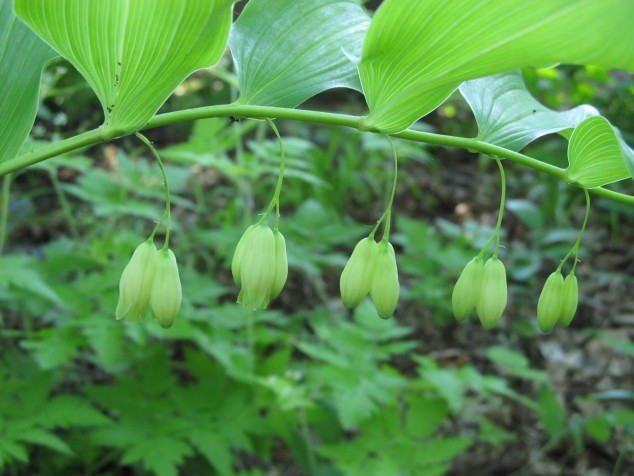
But there have been many victories. We have removed close to 80% of the mature buckthorn in our woods. We can see the dark, shapely trunks and branches of the Oak trees. Oak seedlings are popping up all over. Ferns are spreading their airy fronds along the understory. Solomon’s seal is populating great sweeps with their nodding flowers.
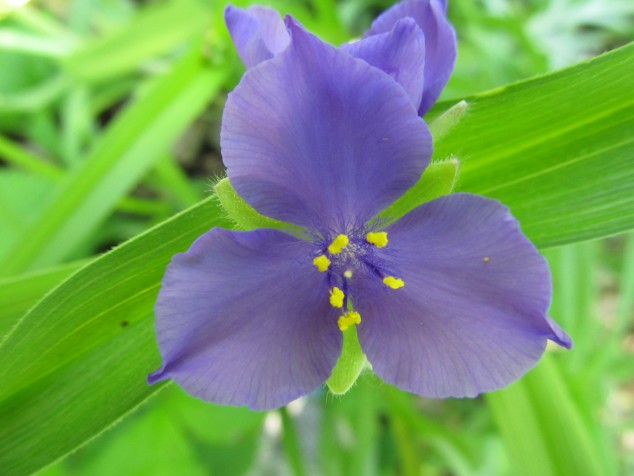
Gooseberry shrubs are growing. Spiderwort is a bright blue star shining in the green.
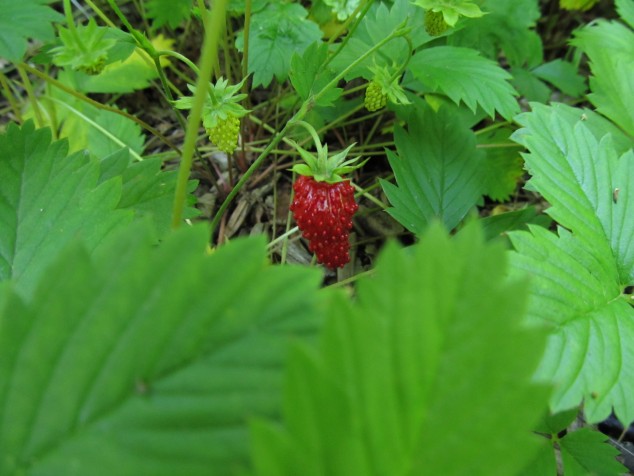
Wild strawberries carpet the ground, producing their tiny red fruit.
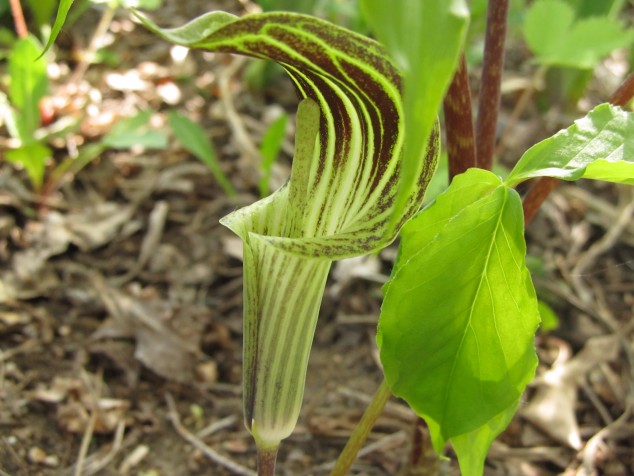
The greatest woodland treasure that has returned is the Jack in the Pulpit. As we cleared the buckthorn back, one appeared close to the yard under a honeysuckle shrub.
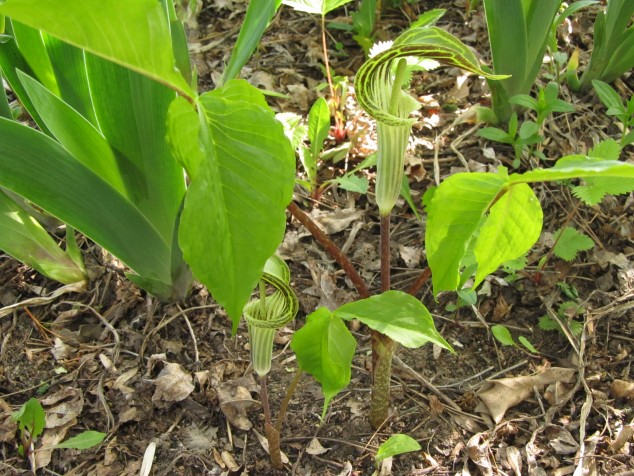
Last year, in a newly cleared area, a huge Jack in the Pulpit sprang up. It was like it had been waiting a long time to come back to the woods after being suffocated under the roots of the buckthorn–and it came back strong and robust! With hard work we cleared the buckthorn, and with hard work we continue to improve the woods by pulling the buckthorn seedlings and other undesirables that sprout up each year. The woods are coming alive again, and it is beautiful and inspiring!
We may all have a ‘buckthorn’ in our lives–something that looks good or works well to begin with, but slowly invades our life and starts choking out the good stuff of who we really are. It may be a way of thinking we developed in our childhood that no longer serves us well or an addiction that is running our life. We need to recognize what it is and work hard to tear down the wall, so the treasures of our life and soul can grow and flourish.