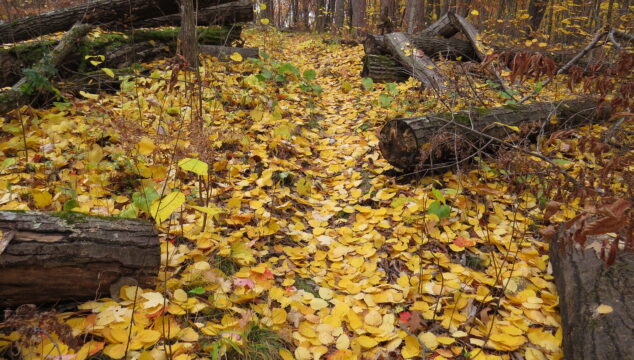
Come walk with me in the peak Autumn beauty of the Northwoods. To say that I love this time of year is an understatement. Most everyone can appreciate the colorful falling leaves---it reveals the 'true self' of a tree when its leaves are no longer producing chlorophyll. Their true colors are revealed, and there is something simple … [Read More...]
Leap of Faith
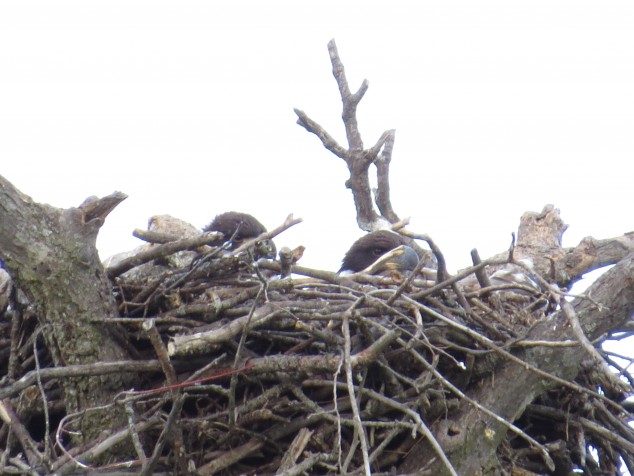
We checked in at Eagle Park to see if the young eaglets had ‘fledged’ or flown from the nest. At the beginning of last week, we went on a cool, windy day. The two eaglets were hunkered down in the nest with only their heads showing, and that’s where they stayed the entire time we were there. We didn’t see either of the parents.
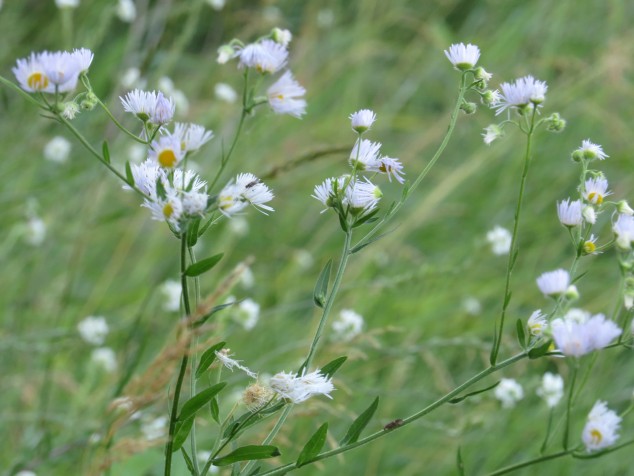
So we wandered around the park trail looking at wildflowers, grasses, and rocks. One of my favorite wildflowers is the delicate Daisy fleabane. This common, understated member of the Sunflower family is so named because of its use to repel fleas. I wonder if the eagles use it in their nest.
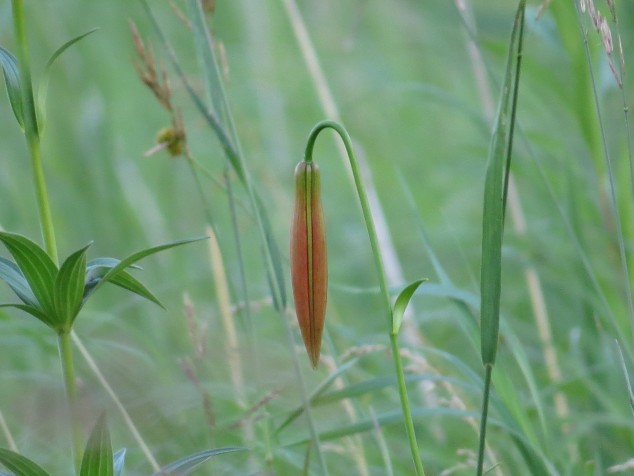
I love the ‘potential’ in a flower bud. The following photo is the bud of a Turk’s-cap lily. The petals unfold and curve back to showcase the extended stamens and showy anthers. Isn’t it amazing that the bud contains all of that!
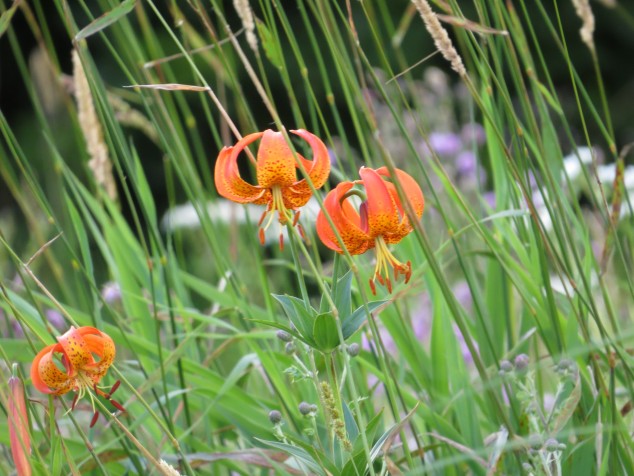
The Butterfly weed was still looking spectacular, also.

We returned to the park last evening. The Goldfinches were flying from the bare branches of a crabapple tree to the large sweeps of thistles that were going to seed.
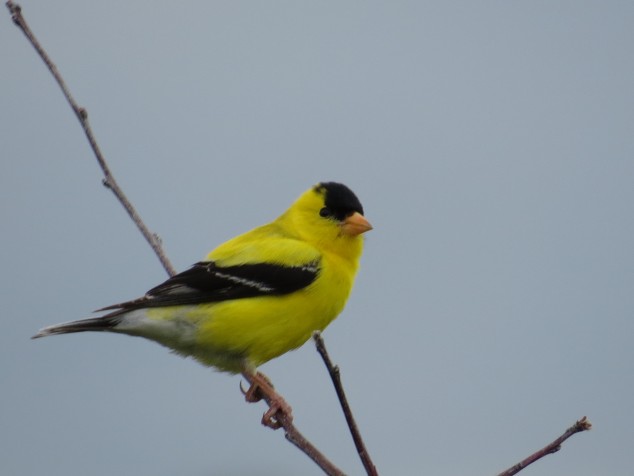
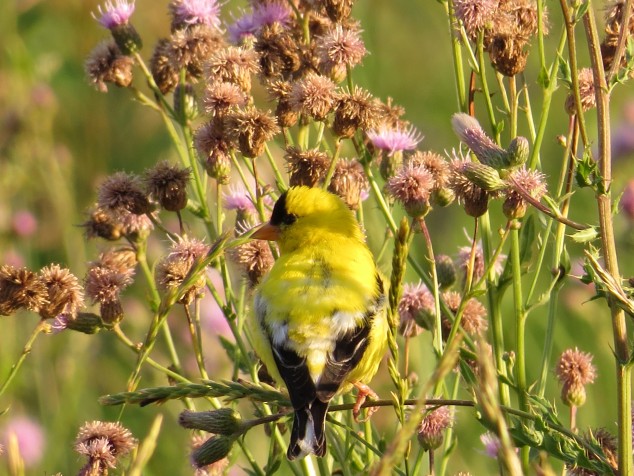
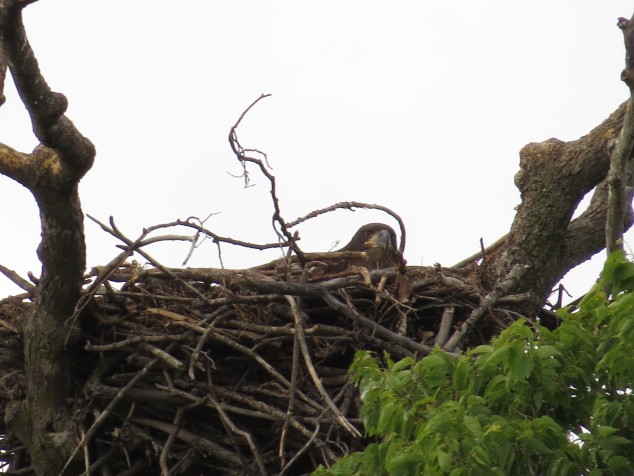
And who was in the nest this time?
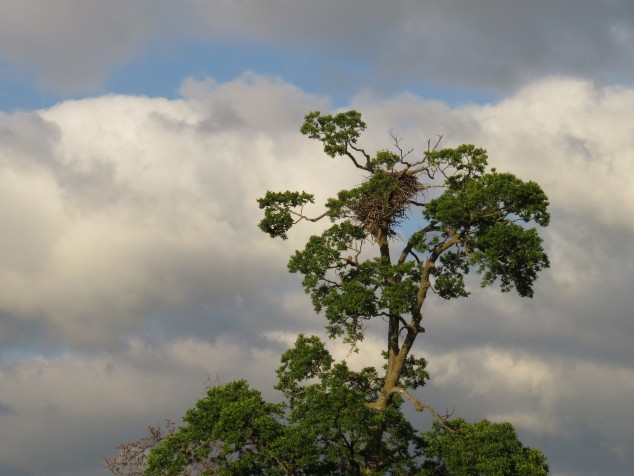
We found only one eaglet in the nest. He stayed there for most of the time we hiked around the trail.
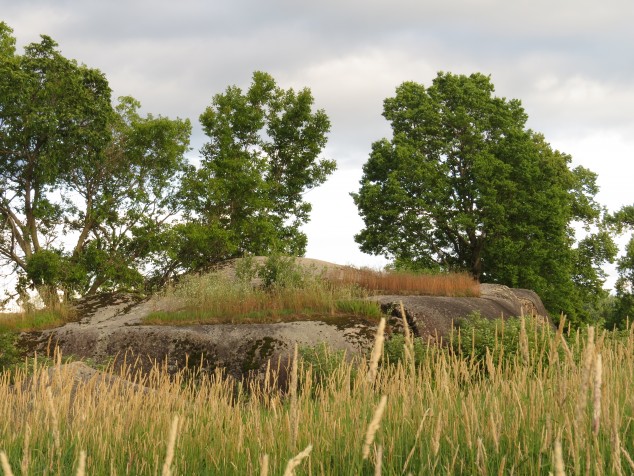
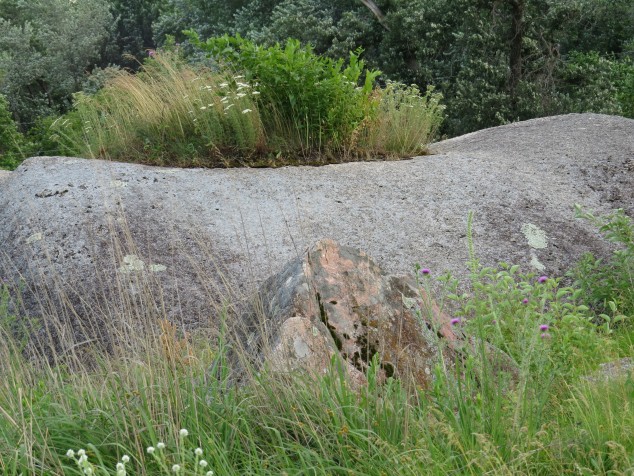
I like this pink granite boulder and the tuft of wildflowers and grasses that are growing on the top of it.
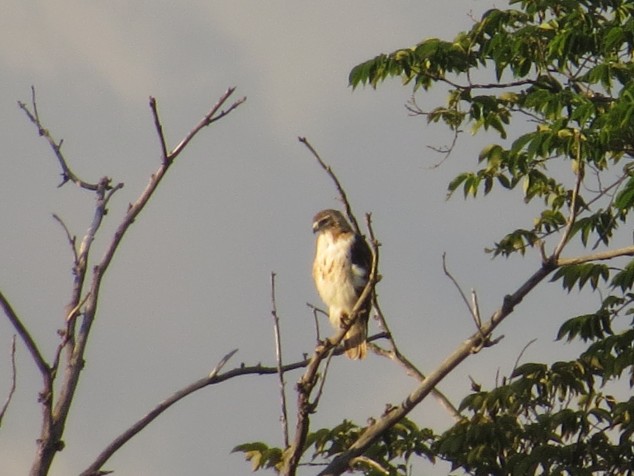
We saw a Red-tailed hawk scanning the ground for glimpses of movement that might mean a tasty meal.
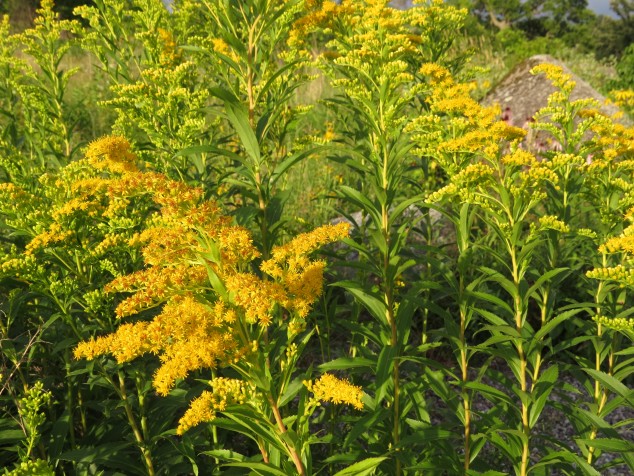
The goldenrod was blooming–is it trying to move us out of summer already?!
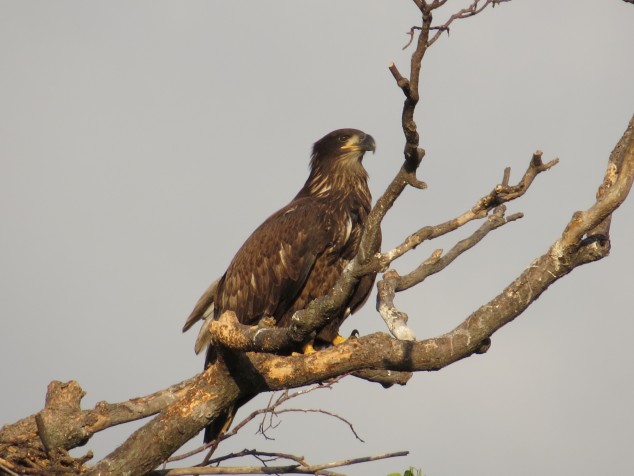
As we were talking about the flowers, I saw the young eagle jump out of the nest onto a branch.
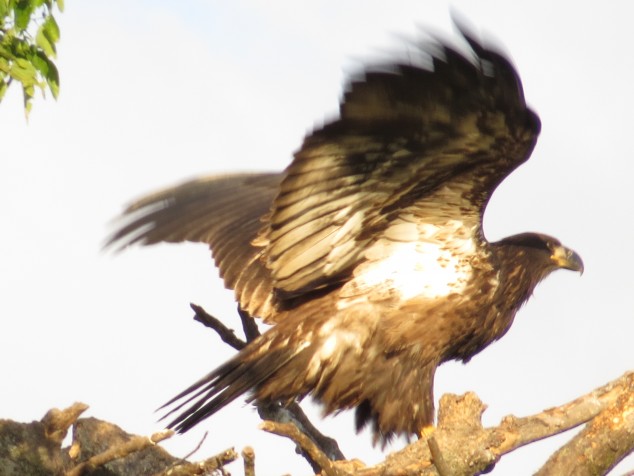
And then he lifted his wings, and with a leap of faith he flew away! Just like that!
Not only is the goldenrod pointing us towards fall, but the eagles are also. They will all occupy the nest for a number of weeks more as the young eagles learn about hunting. The parents will continue to bring food back to the nest as the fledglings practice their hunting skills. Then they will begin their solitary life of four or five years to mature and change color before picking out a mate.
The Spring egg holding the potential young eagle. The lily bud holding the glorious Turk’s-cap flower. The flowering thistles holding hundreds of the favored seeds for the Goldfinches. Let’s all take our innate potential and fly!
Flying Dreams
Have you ever dreamed of flying? Not the airplane kind of flying, but the bird kind–where you are actually flying like a bird? It’s a common dream, especially among men. Most flying dreams are also what is called a lucid dream–one where the dreamer takes control of part of the dream. They are an escape from the pressures of the real world and represent freedom and rising above the concerns of the ‘ground.’
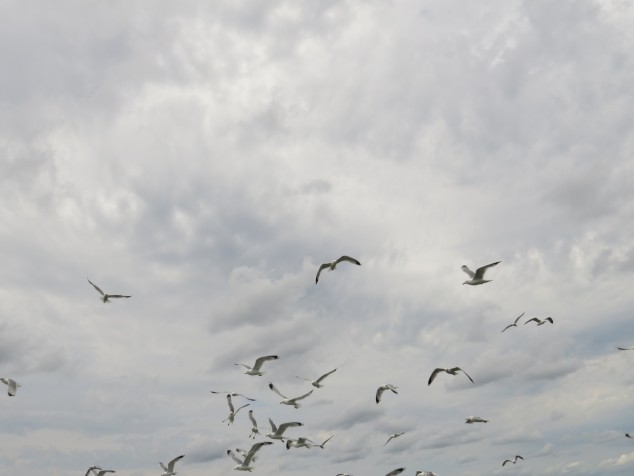
Over the weekend Chris and I visited a camp in the Brainerd Lakes area where a young woman friend of ours works for the summer. The camp was spread out under stately pines and birch trees and bordered a clear, large lake. Mid-afternoon we boarded the pontoon boat with family, friends and a loaf of bread. The sky was cloudy, and it was cool enough on the water that wearing a sweatshirt felt good. We toured around the lake looking at charming cabins, an impressive log mansion, and miles of sandy beaches. And then we cruised by Bird Island! Birds meaning seagulls. Seagulls who knew that certain pontoon boats–usually filled with kids–would throw chunks of bread up in the air for them! The people in the back of our boat started throwing the bread, and the seagulls gathered behind us like a flowing train as we sped through the water.
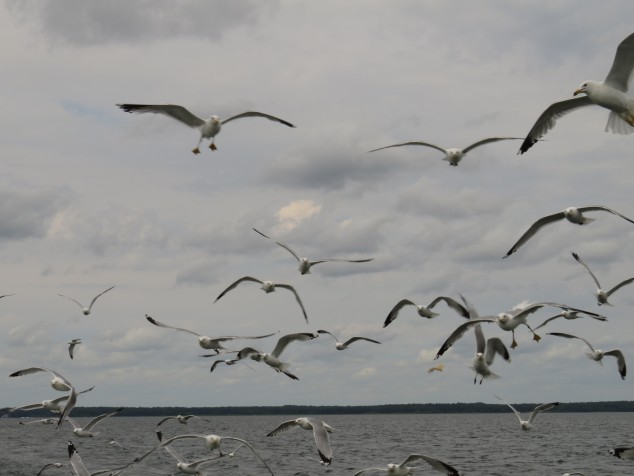
The gulls were like flying acrobats–each trying valiantly to get a piece of that yummy bread! They dipped and dived, swooped and turned, and glided right above our heads.
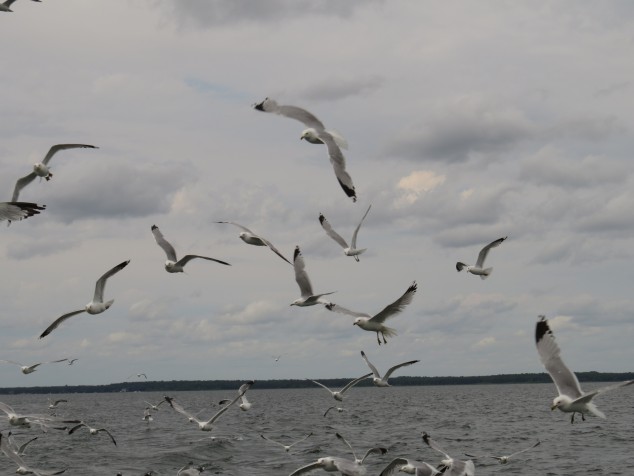
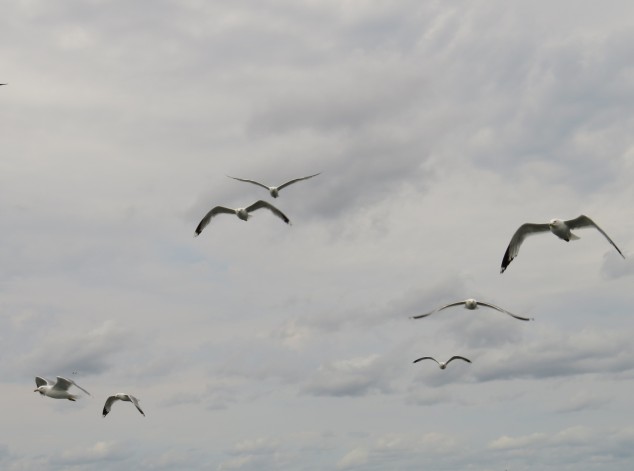
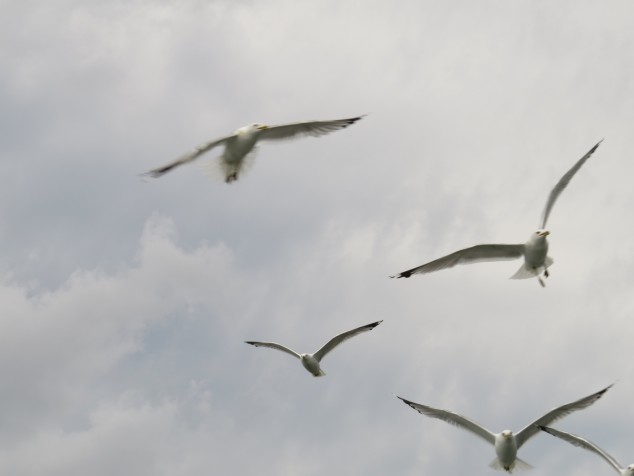
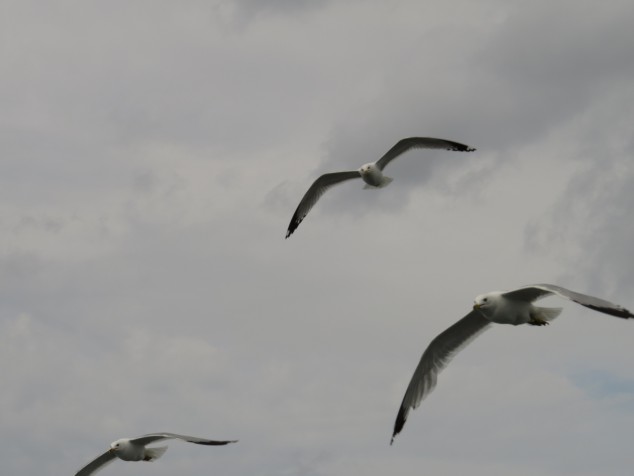
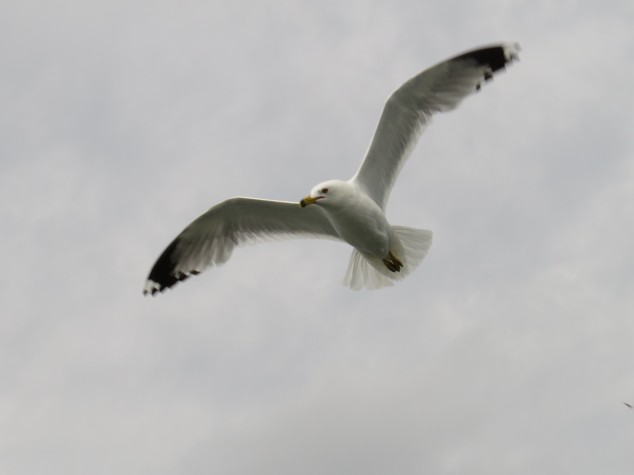
It was a surreal feeling speeding along the water with this flock of seagulls flying with us overhead! It was like time sort of stopped–I was so in the moment. It felt exhilarating and joyful and awesome–in every sense of the word. There was an interaction with us and them–like a playful game–that left us feeling happy and liberated from worries. I guess we just found ourselves in a flying dream!
The Rescue
One day after mowing the lawn, I walked past our egress window well and heard some insistent chirping. Peering into the four-foot deep hole, I saw a fledgling bluebird staring up at me. She repeatedly tried to fly out but was only able to get about halfway up the corrugated tin walls. Run, fly, fall, run, fly, fall.
I don’t know whether she had flown/fallen from her nest in the maple tree straight past the soft landing of green grass to the rocky bottom of the window well or if she was scampering on the ground trying to get away from the scary mower. At any rate, she was uninjured, quite feisty, and determined to get out of there. But it was plain to see that she wasn’t going to be able to do that without a little help.
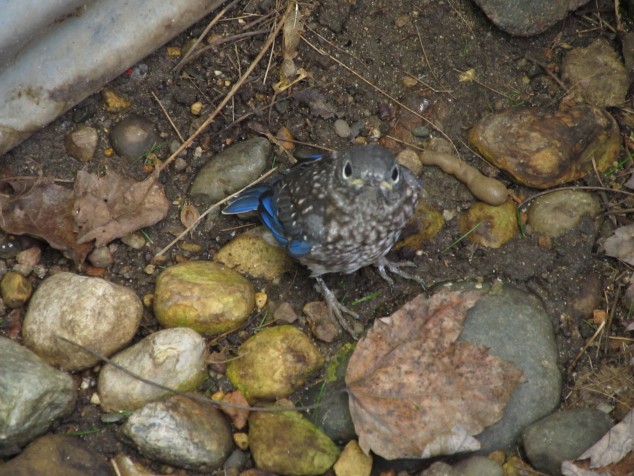
So I rummaged through the shed and found an old board and slowly slid it into the window well to make a ramp. She flew over it a few times, then landed on it and took a tentative step or two up the board. My presence at the topside was still too distracting for her, however, and she hopped back down to the rocks.
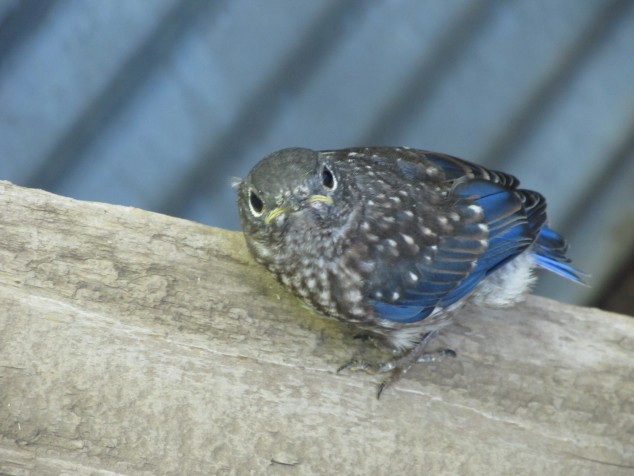
I decided I would watch her ascent through the window in the basement. She quickly turned to watch me watching her one more time! She clung to the board with her tiny claws but would go no further while the camera and I looked her way.

So I left. I walked into the laundry room to put something away. And she left. I didn’t see her walk up the board or fly from her open-aired prison. In less than thirty seconds, this determined little fledgling had made her way up and out to the place where she belonged–but she could not have done it without a little help from a friend.
Eagles Among the Granite and Wildflowers
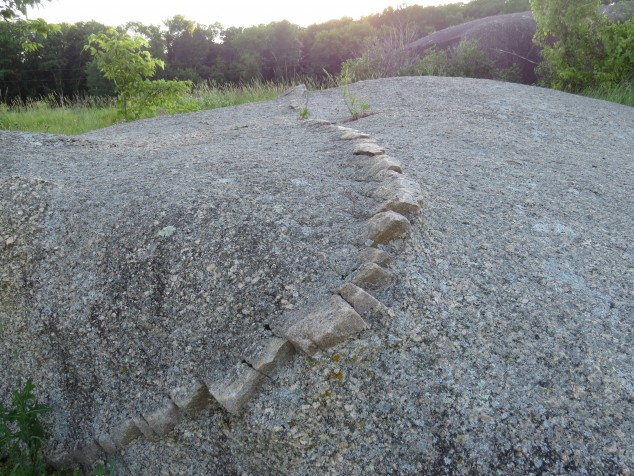
We live in granite country. Quarries–some old and some still productive–are everywhere, and there are a number of granite warehouses within miles of our place. Commercial buildings are sheathed in granite of different hues. Our garden walls and steps are granite, and everywhere a person may want to dig, there will be granite. Eagle Park is strewn with granite boulders called core stones that have surfaced from the granite bedrock. The igneous rock in this area is made up of clear to gray quartz, black mica, with pink and white feldspar crystals and is called Rockville Granite. I’ll walk you around the park of granite boulders, eagles and wildflowers.
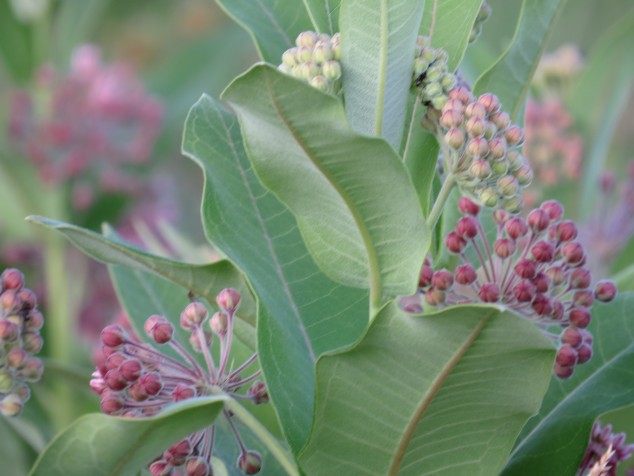
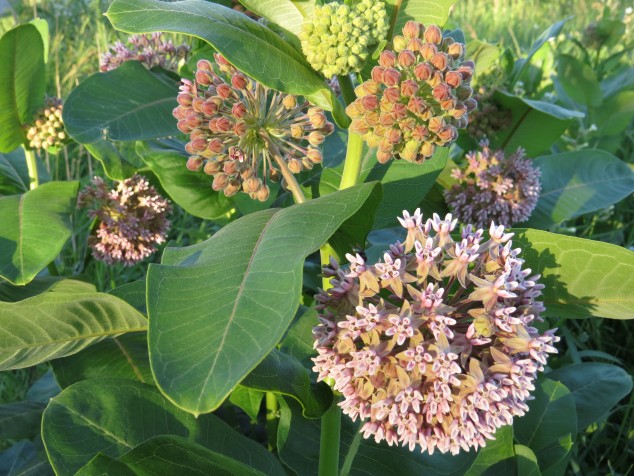
The milkweed was abundant, and each ball of buds or blooms was a shade of candy-confection pink. No wonder the monarch butterflies love this plant!
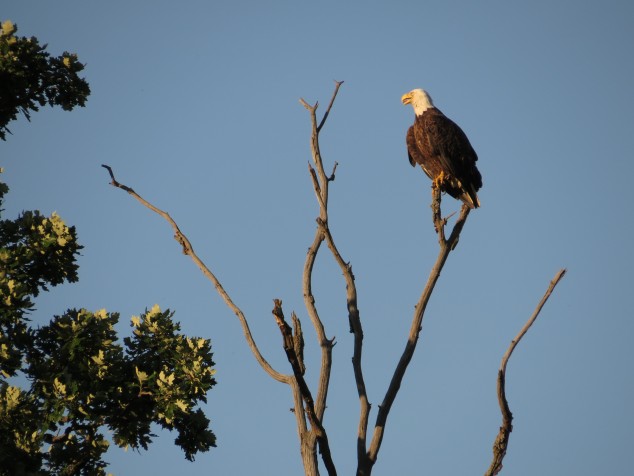
While I was looking at flowers, Chris spotted an eagle in the tree ahead of us. It is hard to differentiate the male and female bald eagle, especially when they are not side by side. The female is larger and has a deeper beak. The male generally has a sleeker head, so by comparing the pictures from the last post, I would say this is father eagle! He flew from this perch overlooking the floodplain back to the nest in the gnarled hackberry tree in the center of the park.
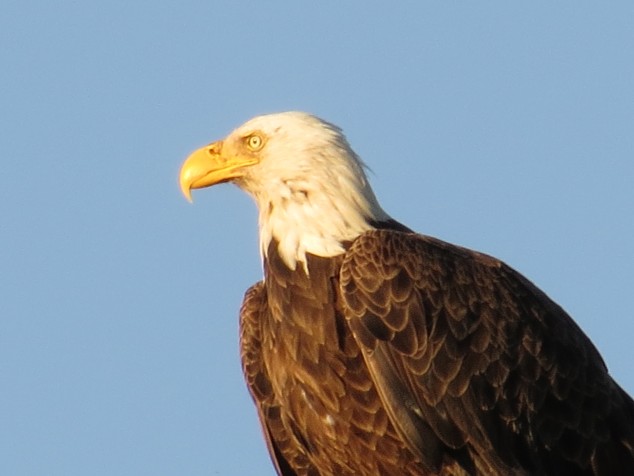
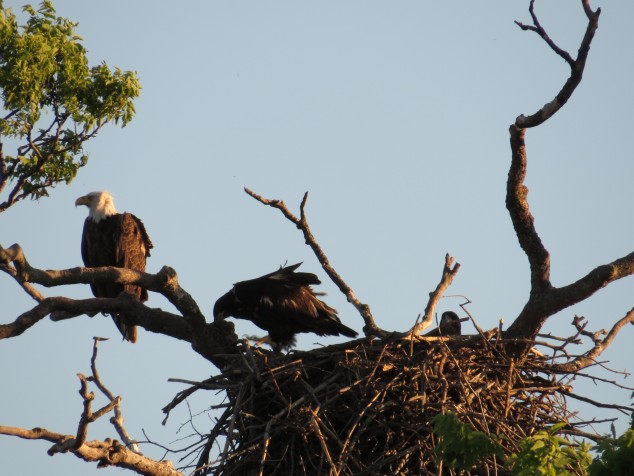
The path circles the park, skirting the immense granite boulders and winding past giant oak trees.
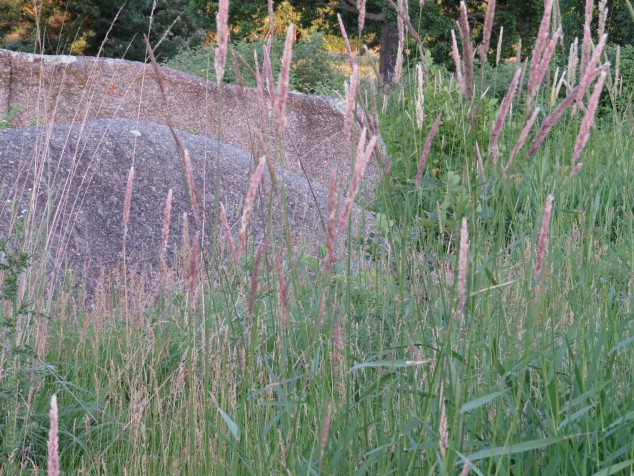
Thistles have encroached upon the park from an adjacent untended pasture, living side by side with the prairie grasses and wildflowers. The prolific seeders take over more ground year after year.
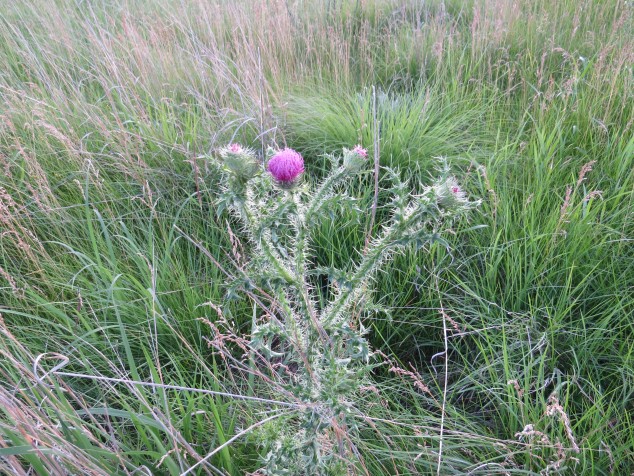
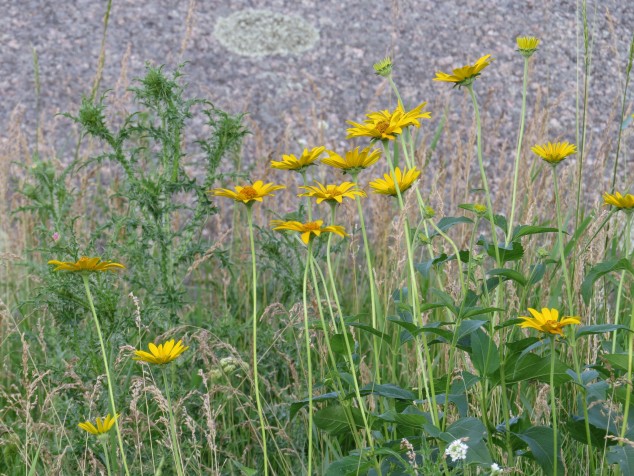
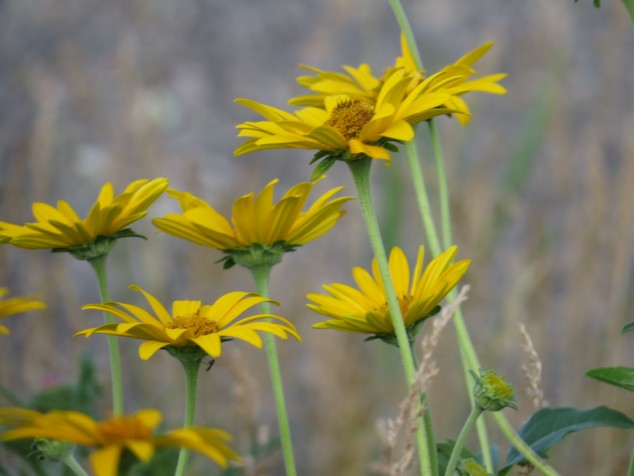
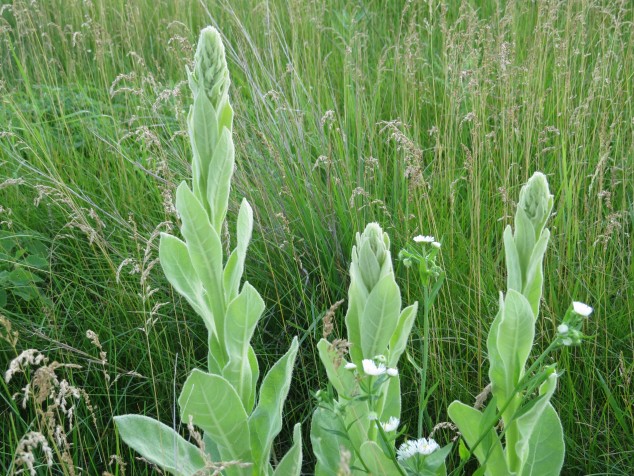
A trio of fuzzy-leaved mullein stands poised, ready to bloom.
Meadow rue and prairie phlox adorn the granite.
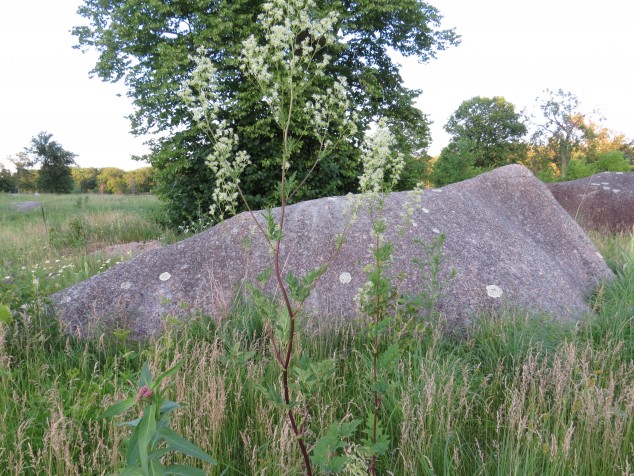
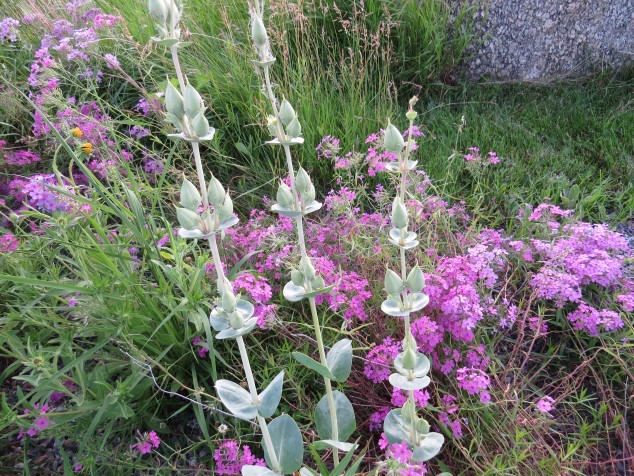
Leadplant and butterfly weed brighten the landscape.
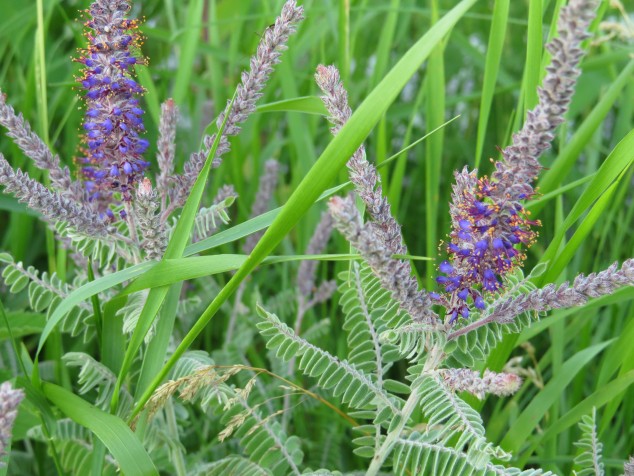
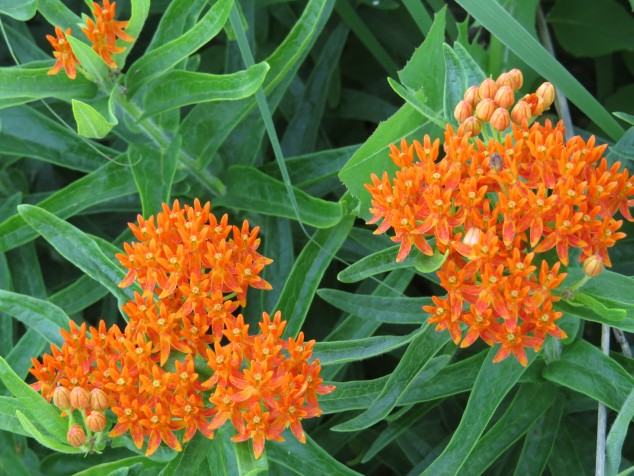
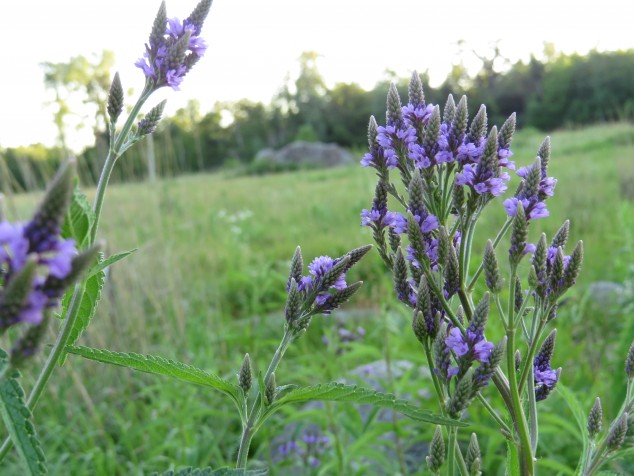
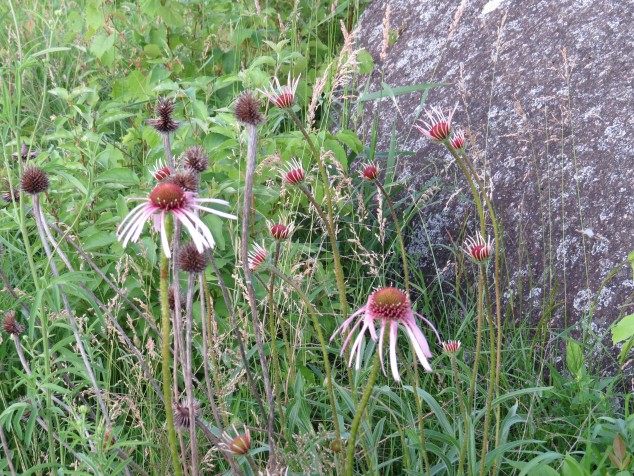
Blue vervain and purple coneflower have prominent seed heads, insuring the propagation of their kind for another year.
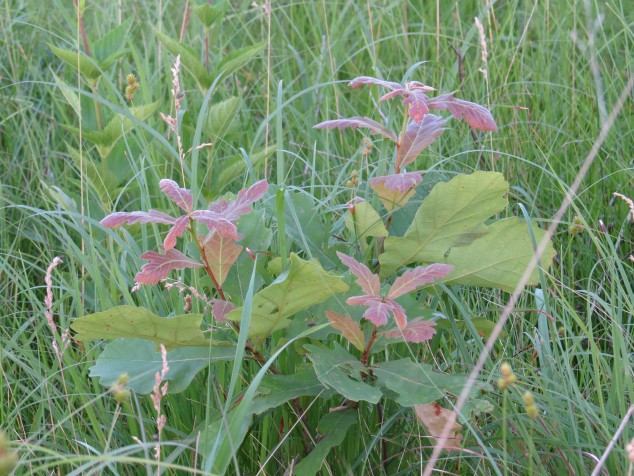
And a lovely young oak puts on its yearly coat of new growth.
The granite has been in this place for eons. This pair of eagles has been here for ten years now. They have adapted to the circling of curious spectators as they raise their eaglets in their home high above the grasses, thistles, and wildflowers. We all take our place in the history of the eons, adapting to the changes that come our way. We learn from the hard times and the thorny issues that invade the beauty of our lives. We need to feed upon the candy-confection beauty of the world and let the seeds of that beauty–love, compassion, kindness, faith and hope–spread beyond our own selves. We need to view the world from that high home in the sky.
Land of the Free
Besides our bright, waving, stars and stripes flag, what best symbolizes America–the land of the free and the home of the brave? Yep, the Bald Eagle–our National Bird! Two evenings ago, we went to visit Eagle Park–the home of a pair of these great birds–not far from our house. It was our first outing there for the season. The nearby Sauk River was out of its banks with all the rain that had fallen in the month of June. The prairie surrounding the eagle tree was lush and blooming.
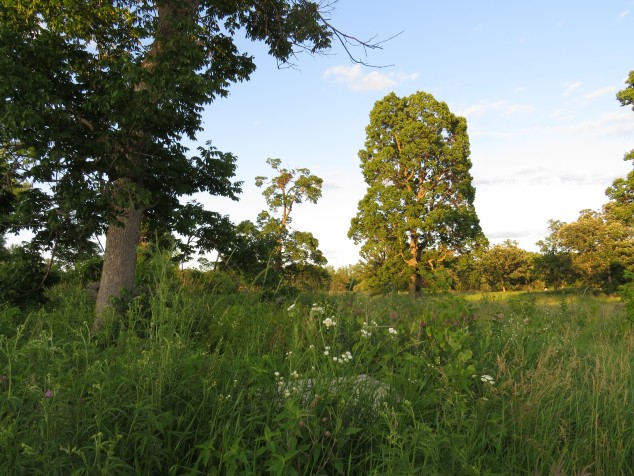 I had another borrowed camera with more powerful zoom (thank you, Aaron), a tripod, a gracious helper (thank you, Chris), and a beautiful evening. (We did, however, forget the mosquito repellant.) When I focused in on the nest, I was surprised to see the two fledglings, nearly as large as a mature eagle! And what a nest! Eagles usually return to the same nest each year, repairing and adding to it. Most are around five feet in diameter, while some get up to eight feet across and are estimated to weigh almost two tons.
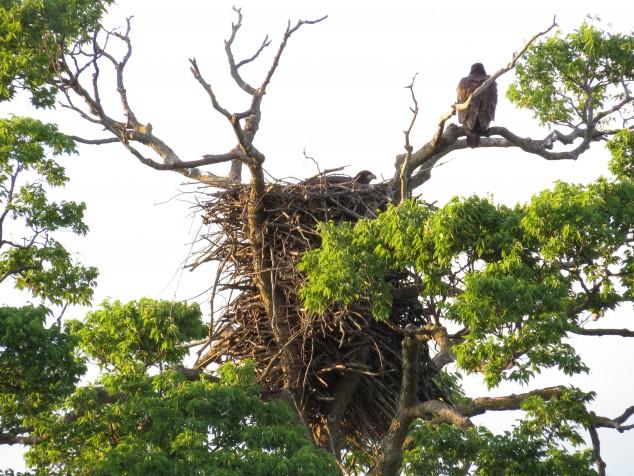
Now using the term fledgling would imply that the eaglets have ‘fledged’ or left the nest. I don’t think these two have done that yet, though they must be close to the 11-13 weeks when that normally occurs. One eaglet stayed in the nest while the other perched on a branch, flapped his wings, and hopped from one side of the nest to the other. He looks like he is ready to fly!
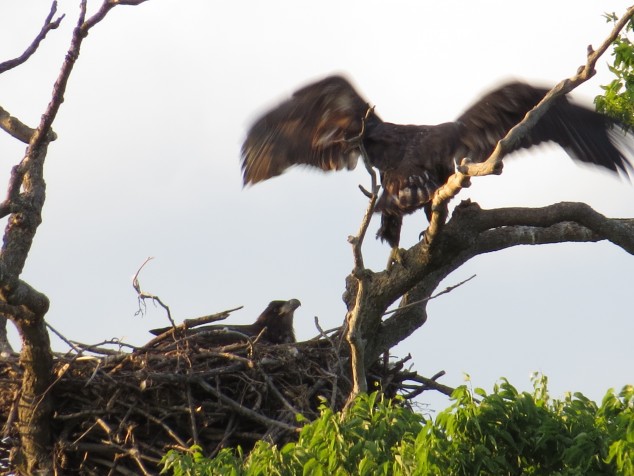
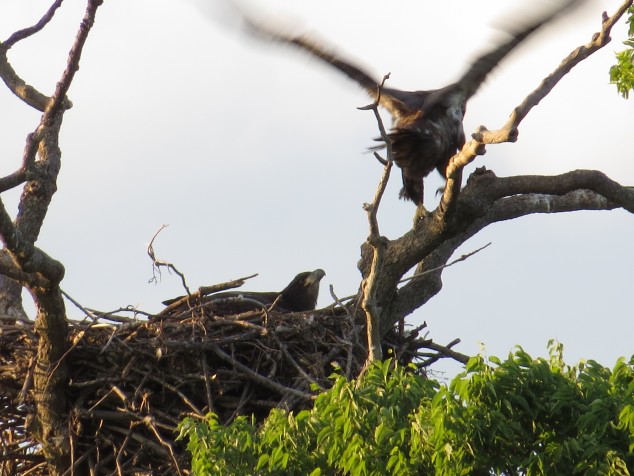
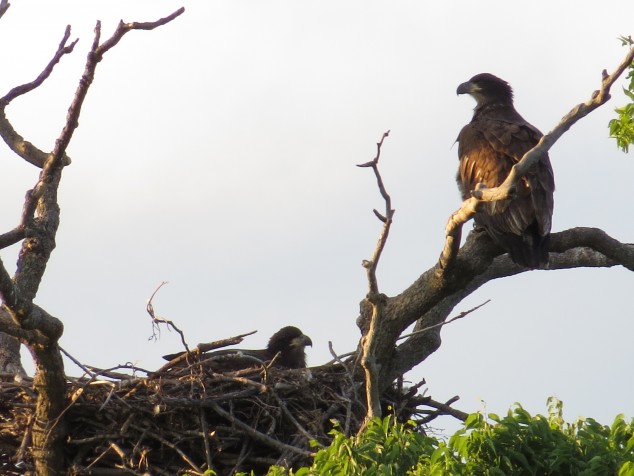
Eagle chicks grow very rapidly and are almost adult size by six weeks old. By eight weeks, their parents are hunting almost continuously to feed them. This fledgling looked like he was waiting for one of his parents to return with a meal.
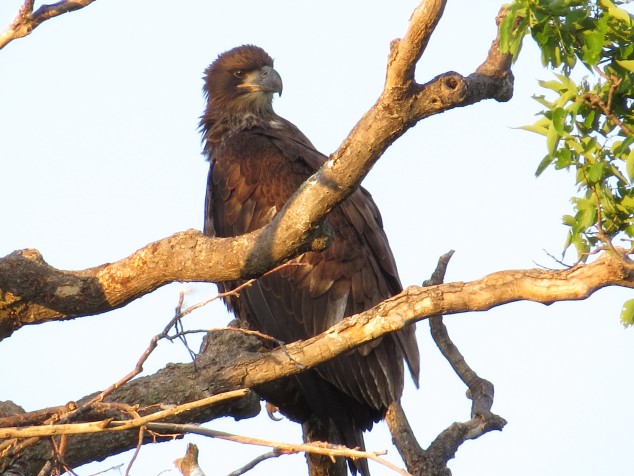
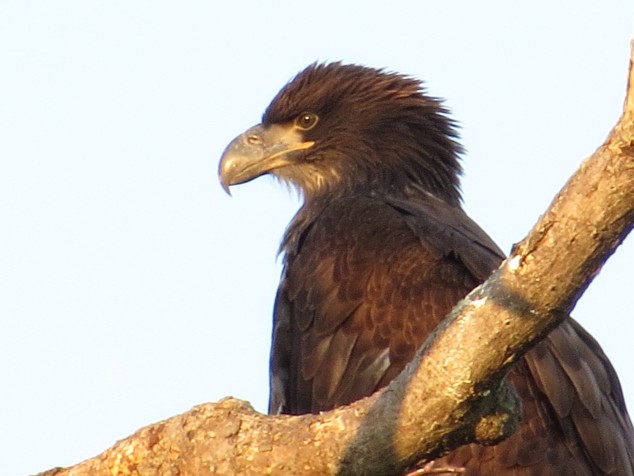
But look at how sharp his beak is! Once he has fledged from the nest, he will learn to hunt as the parents still provide food. It will take 4-5 years for the eaglets to mature. Gradually their head and tail feathers turn white while their eyes and beaks turn yellow. Eagles mate for life, and both parents can incubate the eggs, though most often the female stays on the nest, and the male hunts for food for her. After the chicks hatch, one parent stays on the nest or close by.
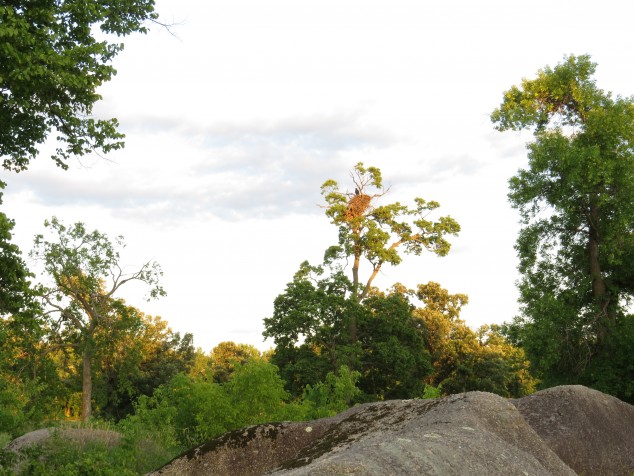
The sun was getting lower to the horizon but shone on the top of the tree where the young eagles were patiently waiting for the return of their parents.
Then as we were walking back, we heard the fledglings start to vocalize–and there was mother eagle! She came back empty-clawed–no food from this round of hunting.
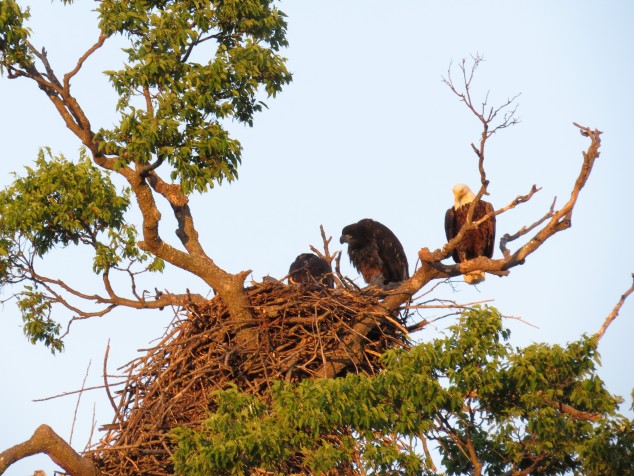
The eaglet that had been in the nest and quiet the whole time was very excited to see the mother eagle!
Even after that wonderful display, the mother eagle didn’t pay much attention to the young ones.
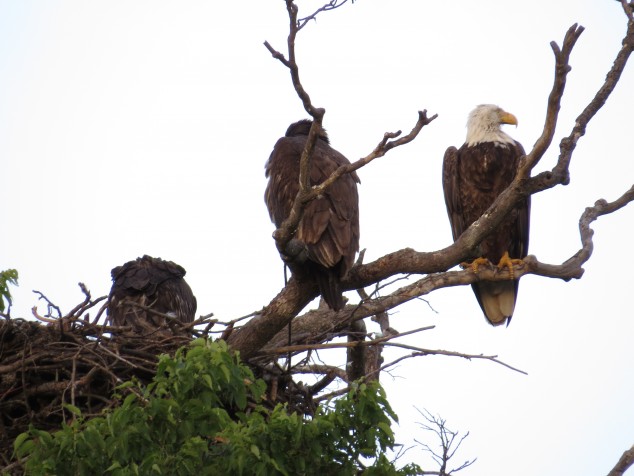
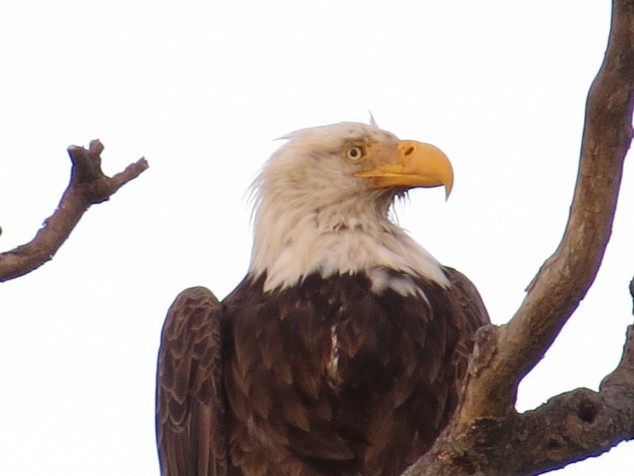
With the sun going down, we left the eagles and their extraordinary habitat. I was so happy I saw the three of them and was hoping the father eagle had better luck with his evening hunt.
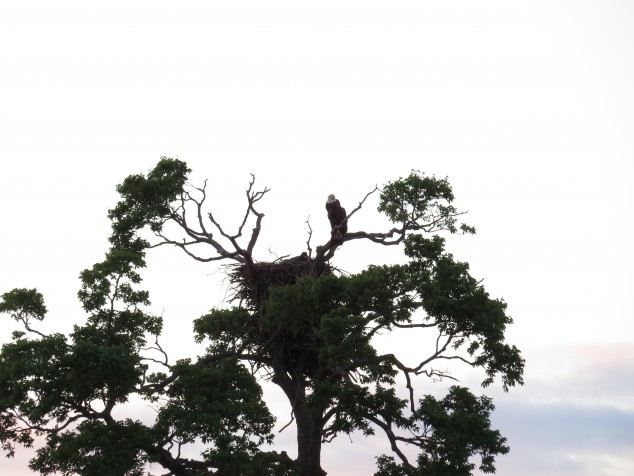
What a symbol of Freedom! We often look at freedom in the context of purely external forces on our lives, but I contend that a majority of the battles that individual Americans face actually come from within. Be proud and celebrate our country’s Independence today, but be brave and give some thought to what it is that is holding you back, what it would take to make your spirit soar!
Nest Quest
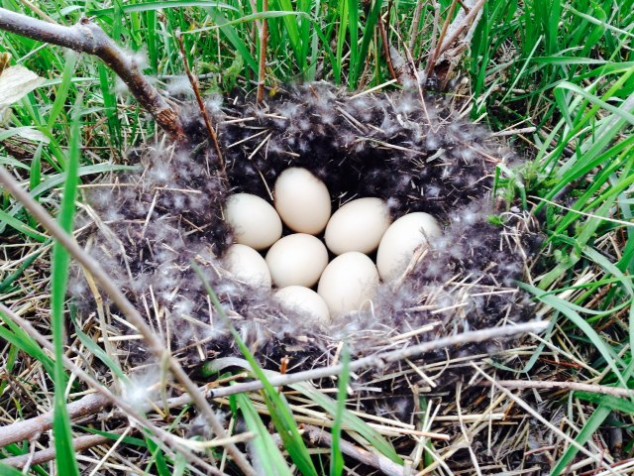
My sister found a duck nest in a willow thicket in the horse pasture. Constructed in the protection of branches with grasses growing all around for camouflage, it was a perfect place to build. The nest was lined with down that the mother duck pulled from her breast and used to cover the eggs when she left the nest to feed. Her clutch needed to stay safe from raccoons, skunks, and foxes for 23-29 days after all the eggs were laid. Baby ducks hatch alert and covered with down and are ready to follow their mama to water within 16 hours! And it appears like that’s what they did!
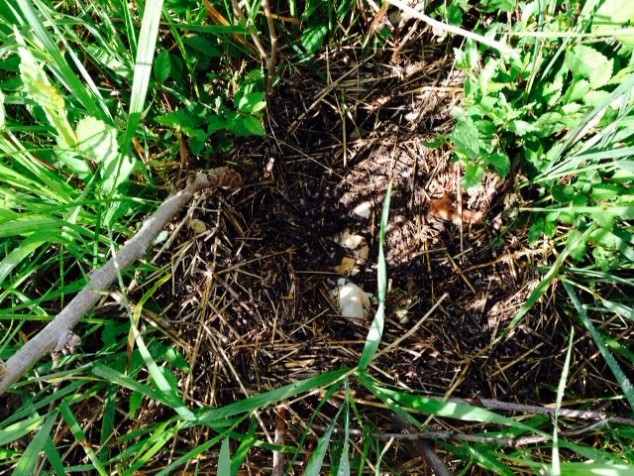
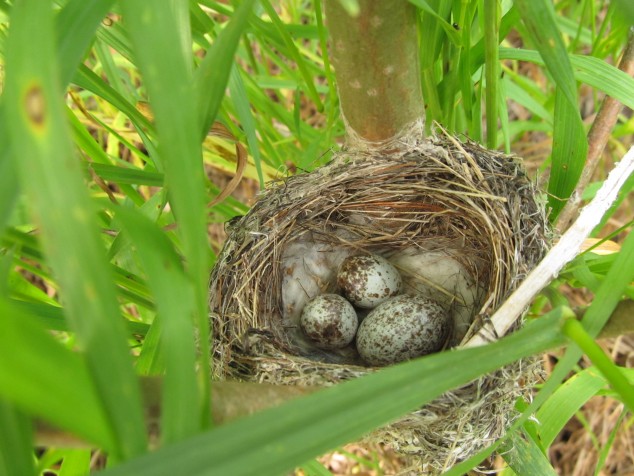
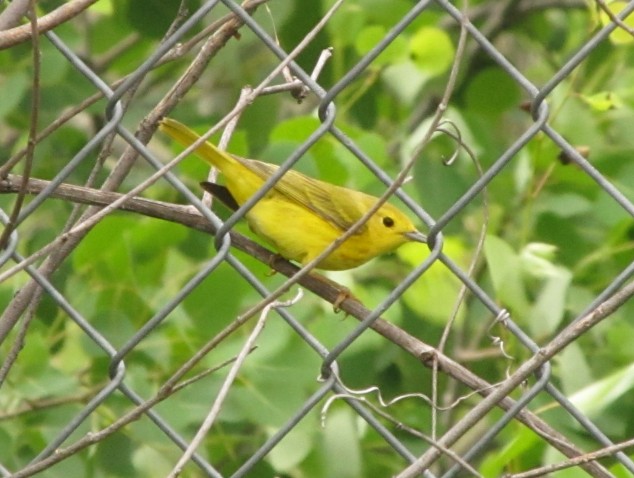
A Yellow Warbler’s nest and eggs didn’t fare as well. On my daily walk, I noticed the warbler flying from a young, four-foot high poplar whenever I got close. When I examined the tree, I found a small nest in the crook of the branches–probably only two feet off the ground. Inside the nest were three eggs, one noticeably larger than the other two.
Mama warbler nervously flitted from place to place on the other side of the quarry fence but always kept me within her sight.
Two days after I found her nest, the ditch was mowed. The little tree was tipped slightly and most of the tall grass that had hidden the nest on one side was gone. I checked the nest a few days later–no mama bird and only one egg left in the nest. Abandoned. At first I thought it was because of the damage done by the tractor and mower–and that may have contributed to it. But with reading about Yellow Warblers, I found that Brown-headed Cowbirds often parasitize their nests, which would account for the one bigger egg. Often, then, the Warblers abandon those eggs and build another nest right on top of the old one, but since the site was compromised by the mower, she must have moved to a new place.
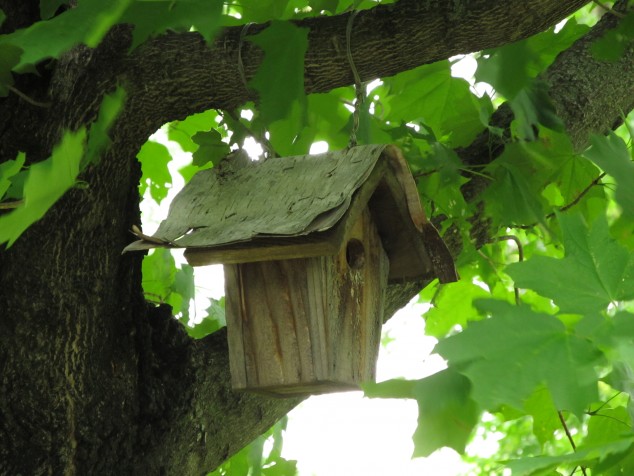
Every spring the House Wrens have occupied three cedar wood and birch bark houses we have hanging in the maple trees. But when Chris put up the new bluebird houses, these fierce little competitors took over the larger dwellings. The males build nests of twigs to entice their mates. The nests are then lined with feathers, grasses and other plant material to make it soft for the eggs and newborn chicks.
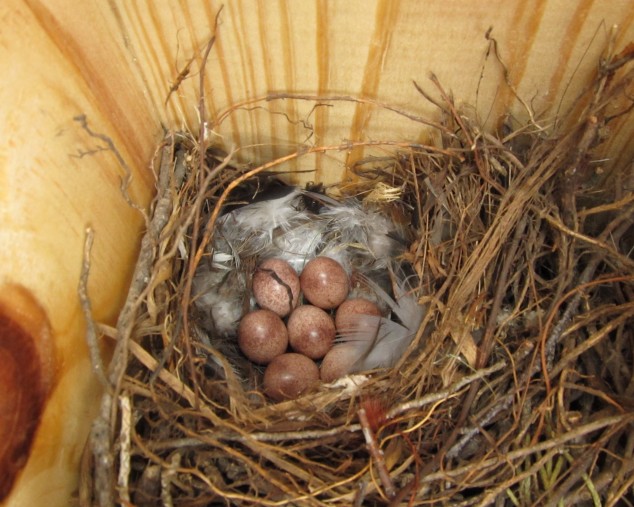
The mama wren was not happy with me looking at her nest–she flew from branch to branch and chattered loudly.
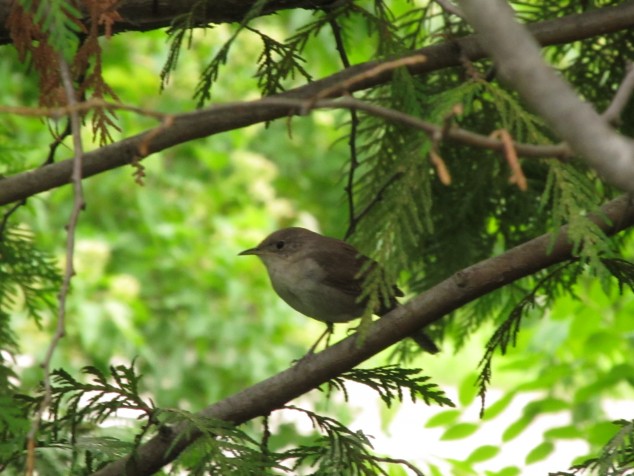
Her nest of seven eggs has hatched, and when I looked today, the chicks are almost fully feathered. They will soon be leaving the nest.
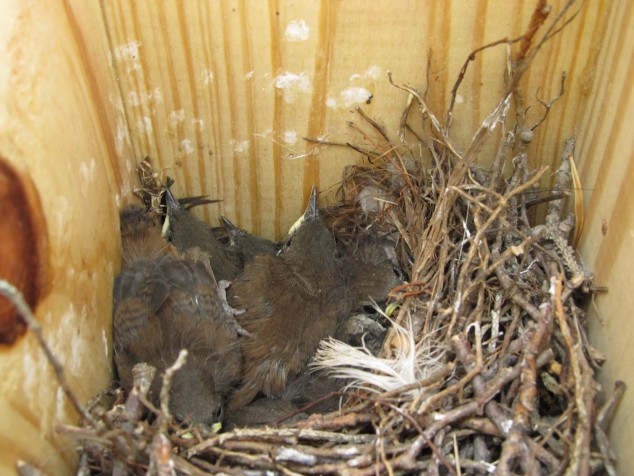
The search to find a mate and the perfect place to build a nest. The work it takes to build the home. The time needed to lay the eggs and incubate them. The energy it takes to feed the brood and keep them safe until they leave. Things that can derail the whole process. Mishaps and mistakes that change the course. Daily problems that need attention. This is the life of parents–whether warbler, wren or human.
Duck nest pictures by Dawn Gehrke
Spring Snowstorm
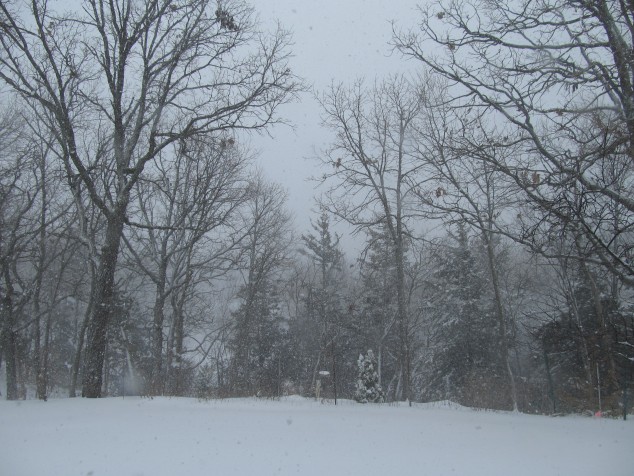
The shovels were put away in the garage after standing sentry at the front door for over four months. The snowblower was drained of gas and had a fresh oil change. The opaque plastic had been joyfully pulled off the screened-in porch. We had declared that Winter was over! Mother Nature had other plans.
It snowed all day yesterday, and the wind blew like crazy. Schools shut down early and evening events were cancelled. Mother Nature’s Spring snowstorm reminded us that we’re not in charge. Officially, we had 8.5 inches, bringing our winter season total to 75.5 inches and breaking a daily record.
Yesterday, I found the Yellow-bellied Sapsucker in the maple tree during the snowstorm. He was trying to stay out of the howling wind and snow.
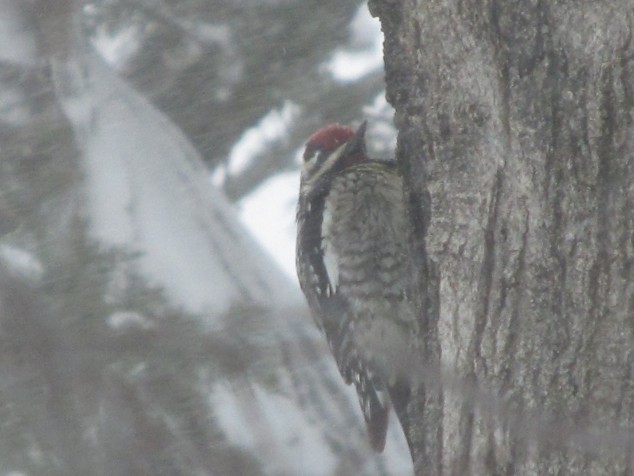
But every once in a while, he slipped down to the holes he had drilled over the weekend only to find that his sap supply had frozen!
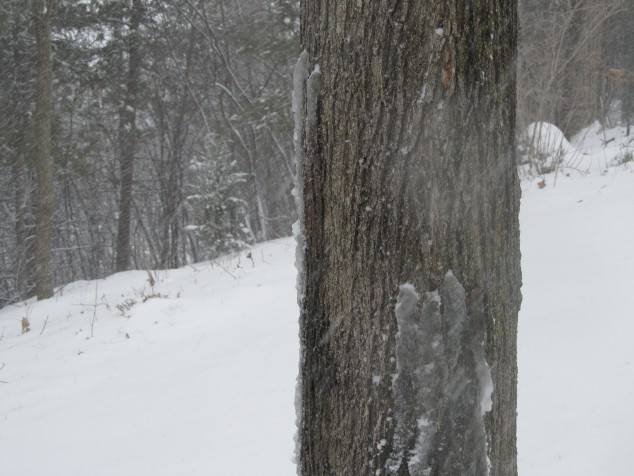
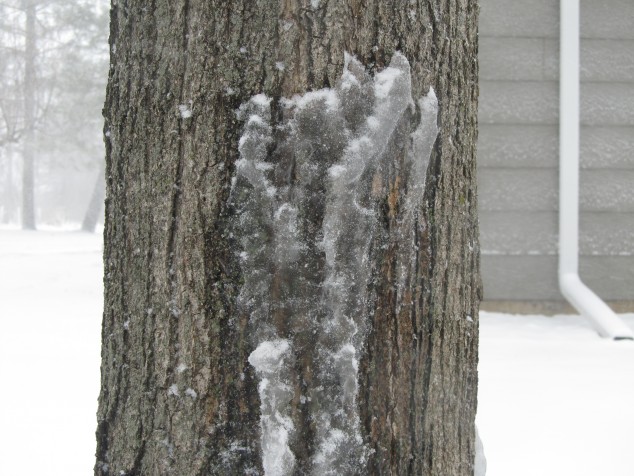
Today is sunny and close to 40 degrees, and the snow is already melting. The Yellow-bellied Sapsucker was busy once again in the maple tree.
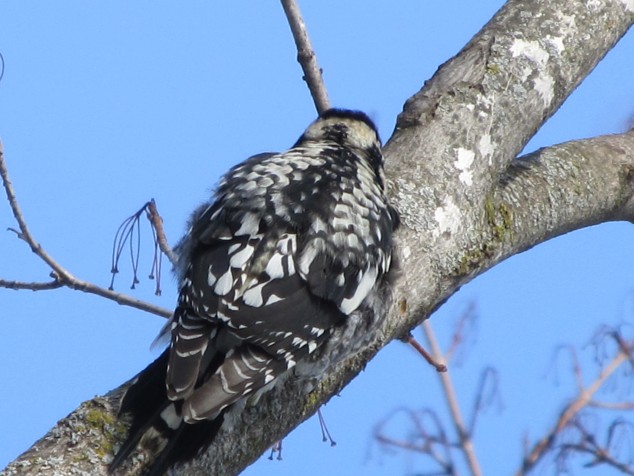
And you can see the maple tree is blooming! There was also another woodpecker flitting about with the Sapsucker–a little Downy.
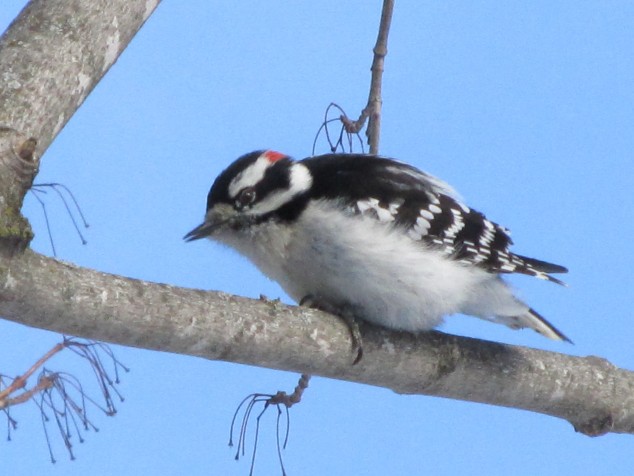
The Spring snowstorm changed plans, caused some accidents, froze the Sapsucker’s food supply, and was a big headache for my husband Chris who had to clear the snow from campus walkways. But it also reminded us to be humble and strong in the face of the Storm and hopeful in the Light of the blue-sky Spring morning.
Sustenance
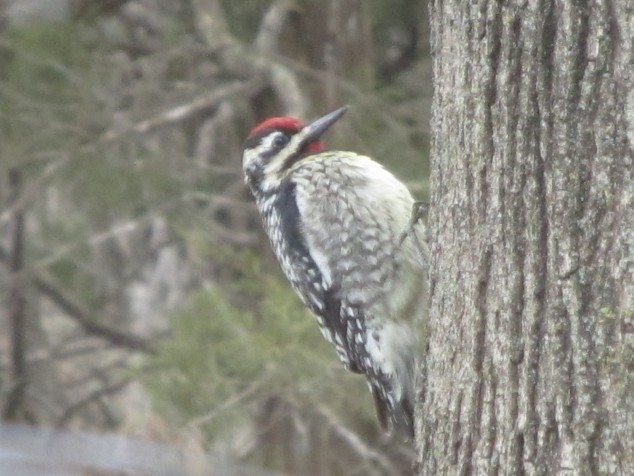
The day was gray in a good way–no shadows to distract or sun to blind. And it was chilly–only reaching into the 30’s after our week of 50’s and 60’s. The wind was blowing strong enough from the north to put a nasty windchill on those thirty degrees. From my living room window, I caught sight of a woodpecker on the side of a maple tree. He had already done his work of drilling holes in a horizontal line into the cambium layer, and the trunk of the tree was dark and wet with the flowing sap. The Yellow-bellied Sapsucker was a handsome male with a red crown and throat and a black and white streaked face. The ‘yellow belly’ was actually just a faint yellow stripe running down from his shoulders into his chest. The rest of his feathers were mottled black and white.
I pulled out the tattered green-bound Audubon Society Field Guide to North American Birds to find out more about him. Another good source for bird identification and information is The Cornell Lab of Ornithology. It has great pictures, audio of calls, and video of some species. I found out that sapsuckers have a specialized brush-like tongue to lap up the sap and will also eat insects that are attracted to the sap.
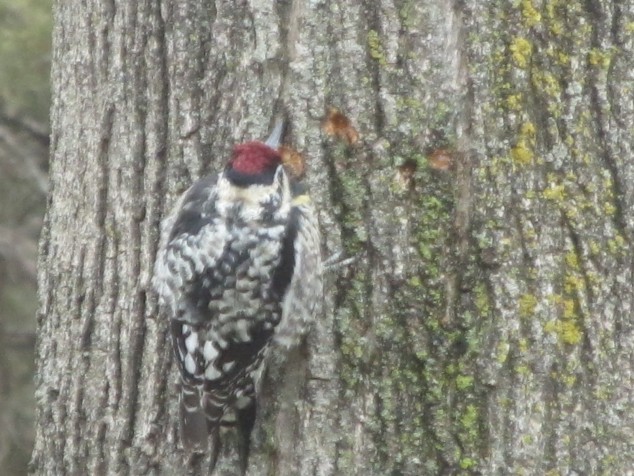
Our Yellow-bellied Sapsucker spent most of the afternoon hitching himself around the tree from one set of holes to another. He would dip his beak into one drilled hole then turn his head to the next one, drinking in the sweet sustenance. Occasionally a squirrel would come by, and he would shyly fly away. But he returned again and again to the maple tree and its nourishment. At times he would tranquilly hang on the bark with his head tipped back looking plump and content.
Sustenance–food, provisions, something that gives support, endurance or strength. We may not have names that describe where our sustenance comes from like the little Sapsucker, and we may not give it much thought beyond the grocery list and the daily rush of getting supper on the table. Perhaps we all need to quiet our movement, tip our heads back, breathe deeply, and contemplate what gives us strength when we are weak, what supports us when we need help, and what sustains us when we lose hope. So, at the end of the day, what gives you sustanance?
- « Previous Page
- 1
- …
- 5
- 6
- 7