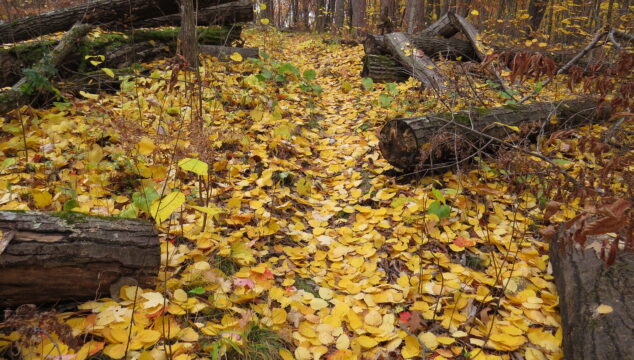
Come walk with me in the peak Autumn beauty of the Northwoods. To say that I love this time of year is an understatement. Most everyone can appreciate the colorful falling leaves---it reveals the 'true self' of a tree when its leaves are no longer producing chlorophyll. Their true colors are revealed, and there is something simple … [Read More...]
Tracks and Paths
When I was a young child, we lived on a farm in eastern South Dakota. My Dad milked cows along with raising pigs, sheep, and chickens. After their morning milking, the cows were let out to the pasture to graze their way through the day until the next milking. This daily ritual made its mark in the pasture. A network of cow paths crisscrossed the green grass as these creatures of habit made their grazing rounds. We used to walk to the neighbor’s place through the pasture–and the best way to get there was to follow the cow path. Except for the occasional fresh cow pie to skirt around, it was the path of least resistance.
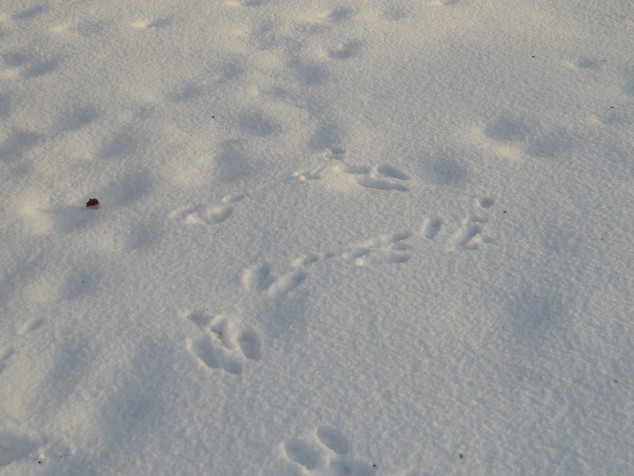
Snow fell the night of Thanksgiving. By morning, the animal activity of the night was evident by the tracks and paths in the fresh snow. Birds visiting the feeders left their marks as they hopped in search of fallen seeds.
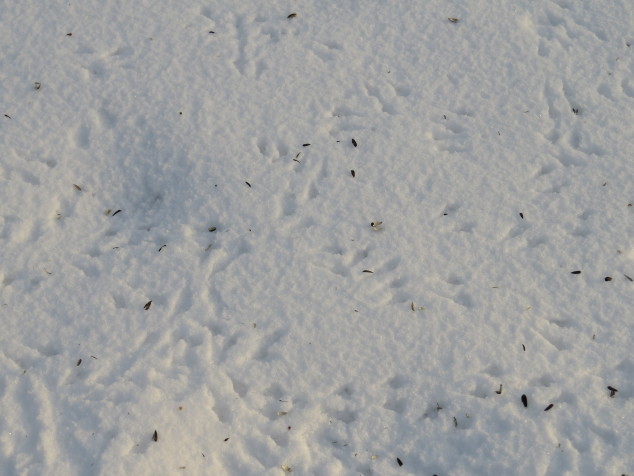
Squirrel tracks were everywhere! We seem to have quite a population this winter.
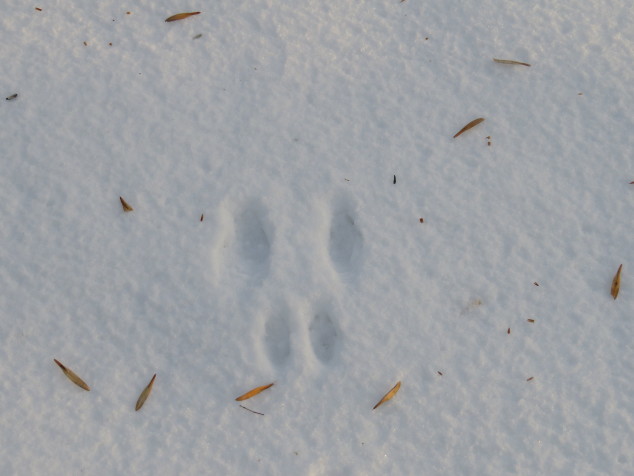
I wonder what made this squirrel take a quick U-turn. Perhaps the appearance of a big black dog?
The most popular place for the squirrels is the backyard bird feeder.
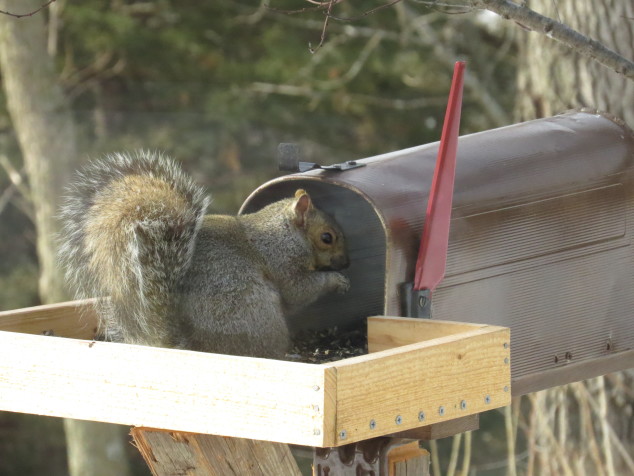
They make their way from the woods to the feeder, and then when alarmed, they run out the back of the mailbox, jump down to the ground, and make a beeline for the maple tree. They have made a squirrel path in the snow!

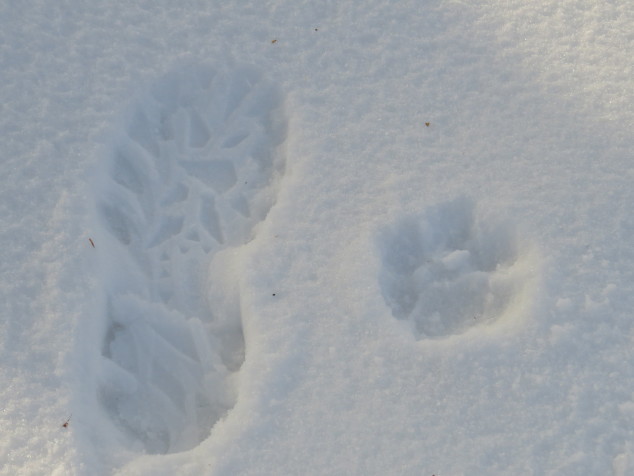
Another set of tracks that crosses the yard is made by the red fox. She trots with a purpose, going from one end of the yard to the other on her hunting treks.
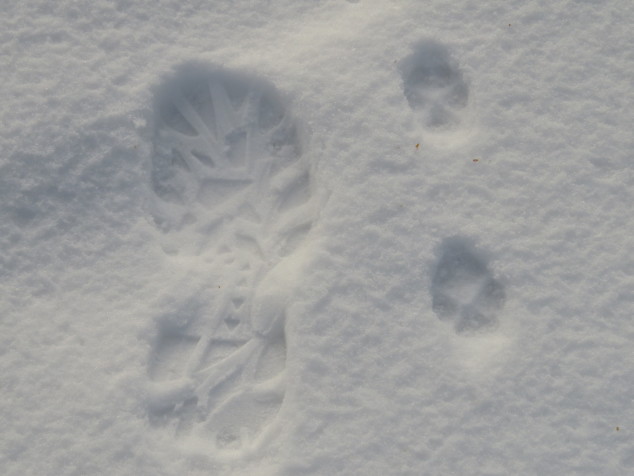
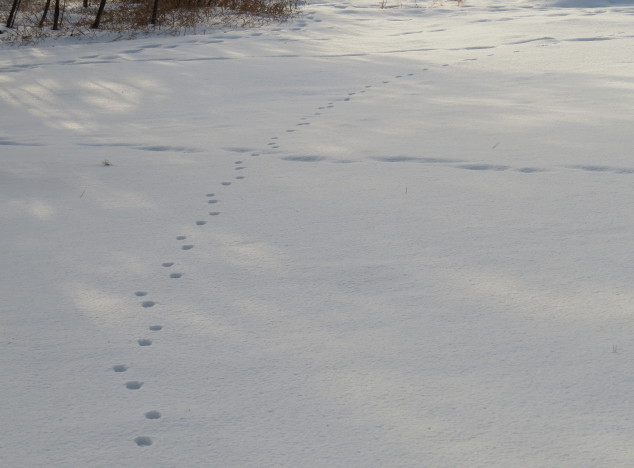 Her paws are much smaller than our Black Lab’s. I put my footprint beside each track to show the size difference.
Fresh fallen snow highlights the activity that takes place day and night around our home. It’s a vivid indicator of how we coexist with all the creatures around us.
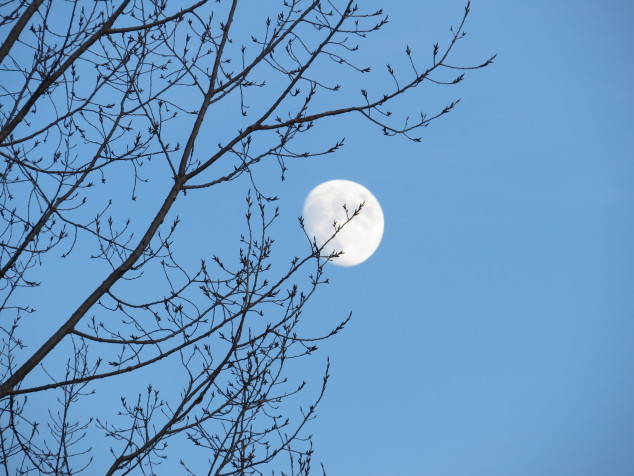
Tracks and paths–we all make them! From the tiny mice to the squirrels to the Holstein cows to college students across campuses, we are creatures of habit that tend to take the path of least resistance. Sometimes our tracks cannot be seen, and we may wonder where we’ve been, if we’ve been seen, and whether our trekking has even made a difference. Other times, our steps are noticed as we beeline or U-turn our way through life. We may make our own path or follow one that is already well-worn. What path are you on today?
Gleanings from November
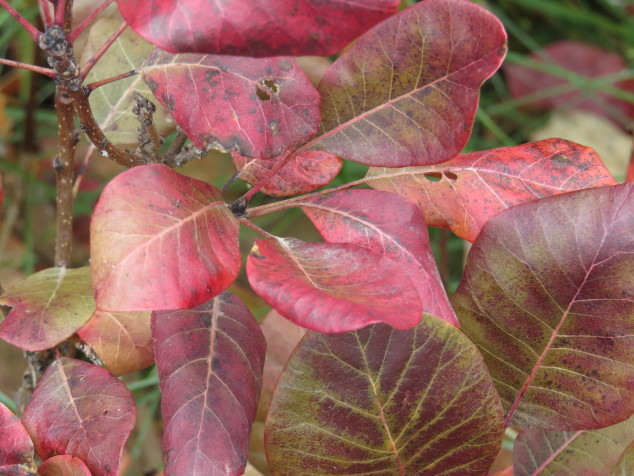
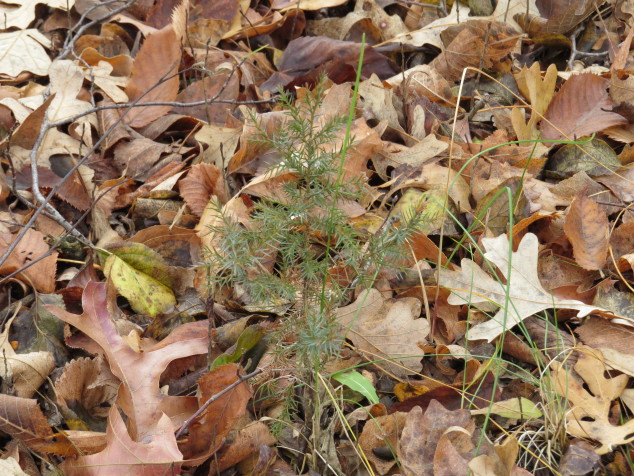
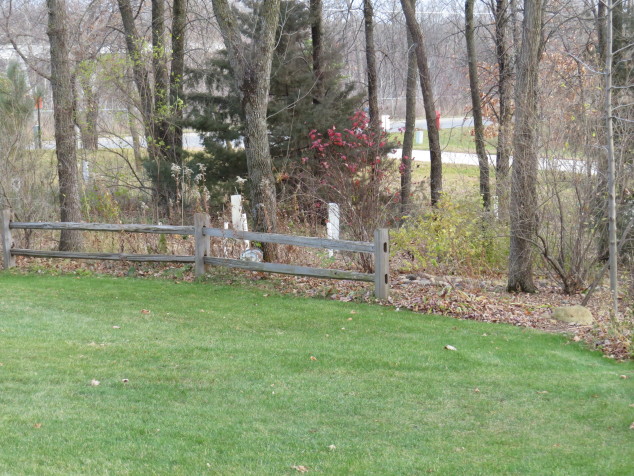
November began in a quiet, easy way. The ritual of ‘getting ready for winter’ was progressing nicely with one eye on the extended forecast and four hands on rakes and shovels. Our slow-growing Purple Smoke tree was changing from its dark purple-red to brilliant scarlet, the last to change and hold its fall foliage. Most leaves were brown and on the ground by then. The oak and elm leaves carpeted the floor of the woods, skirting this tiny cedar tree with mulch and protection.
By the second weekend, the green lawn was raked free of leaves, and plastic sheeting covered the screened-in porch. The barometer was falling, and the forecast had changed from an inch of snow to nine inches of snow. In one day’s time, we fell into Winter.
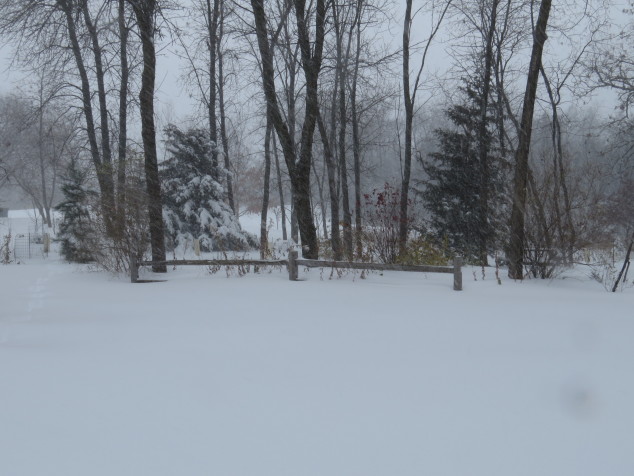
Nine inches quickly turned into fourteen, as schools were closed and travel stalled.
 Since the storm, a couple of warm (above freezing) days have melted some of the snow, and a few new inches have been added. Whiteness is the new normal, and snow is just part of the picture.
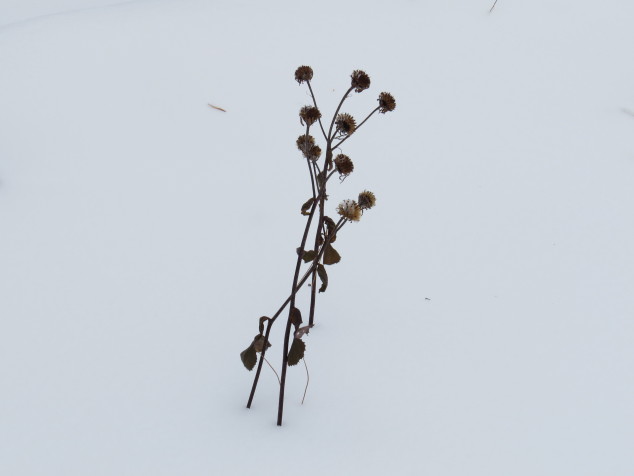
The winter birds are now our showy ‘flowers’–their brilliant colors are beacons of brightness in the white and brown landscape.
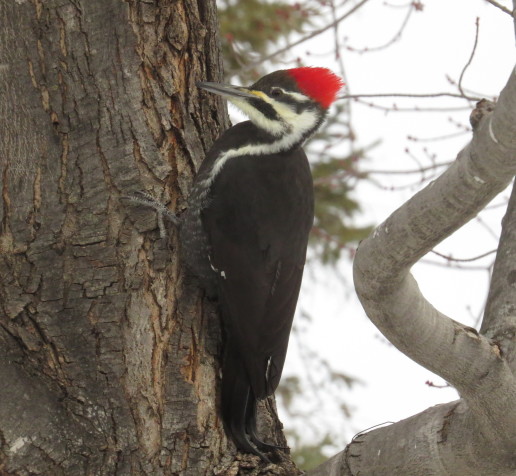
November is the month of Thanksgiving. Every day, from morning sunrise to early evening sunset, is a gift to each one of us that contains so much to be thankful for.
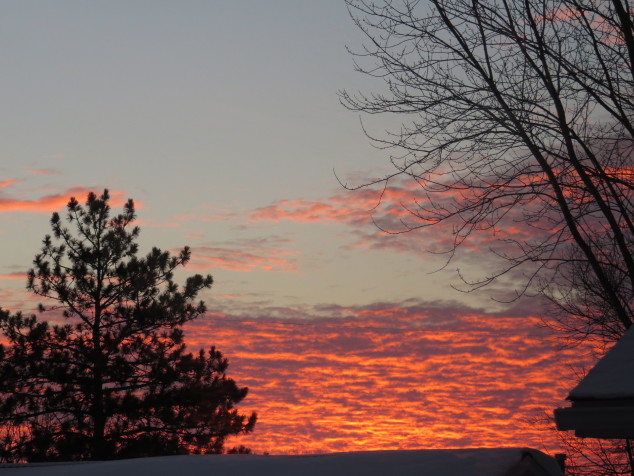
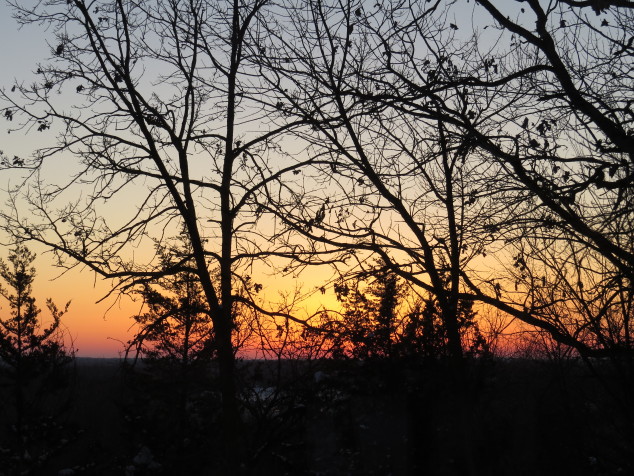
November also begins the season of reflection–when we look back at where we have been and choose the path that will move us where we want to go.
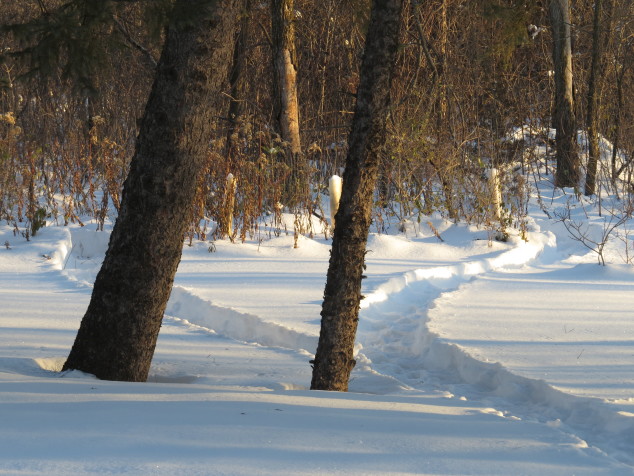
The month of November started as Autumn and abruptly changed to Winter. Changes happen whether or not the calendar agrees, whether we are ready or not, and regardless of whether they ‘should’ occur. All the more reason to be thankful for the very simple and often mundane things in our everyday lives. At the same time, we need to be aware of the beacons of brightness that surround us. What puts a smile on our faces? What amazes us? What makes us feel warm and loved? And finally, if we are having trouble seeing the brightness, we can use this hibernation time to reflect on what is shading our eyes, what wall is built up in front of us, or what erroneous thoughts are stuck in our heads. And then, with courage, we choose a path that will get us to a better place.
Thanksgiving Day
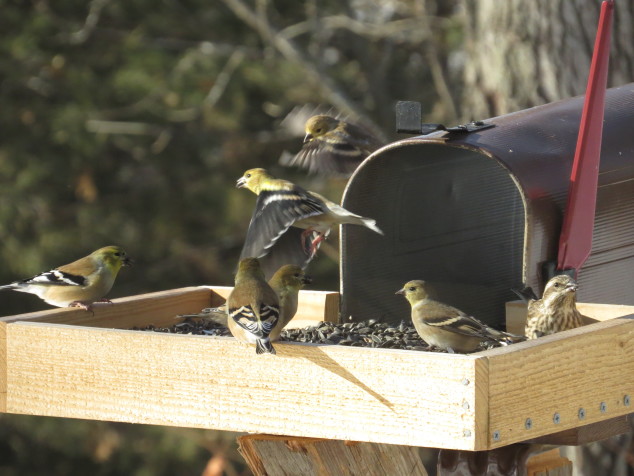
It’s Thanksgiving Day! Time to gather together and share a meal!
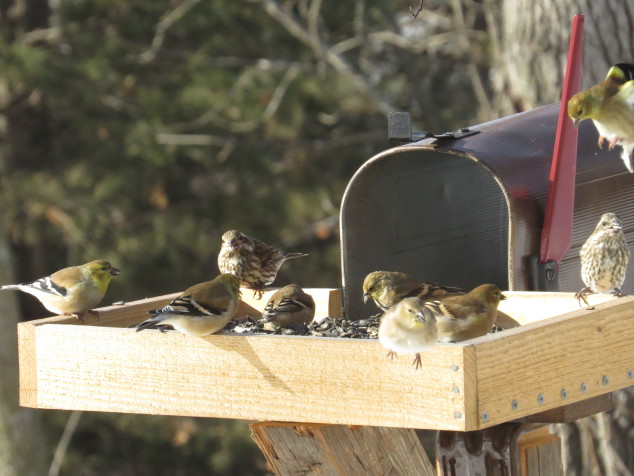
Time to think about the many blessings in our lives, both past and present.
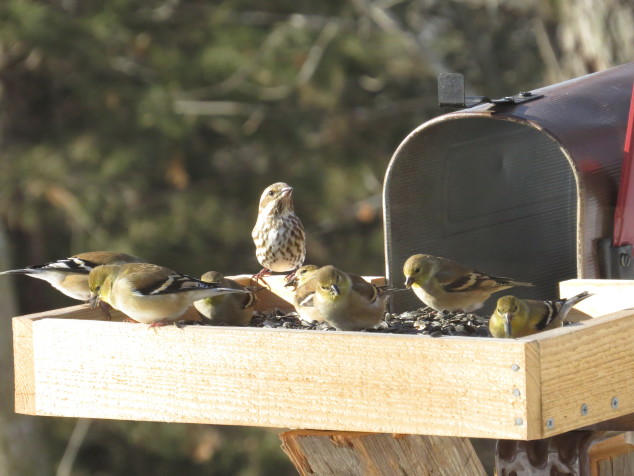
I’m thankful for all the creatures and features of our beautiful, amazing Earth that make not only my blog possible, but also all our lives and livelihoods. And I’m thankful for all of you who read and share my posts. Happy Thanksgiving to all!
The Community Feeder
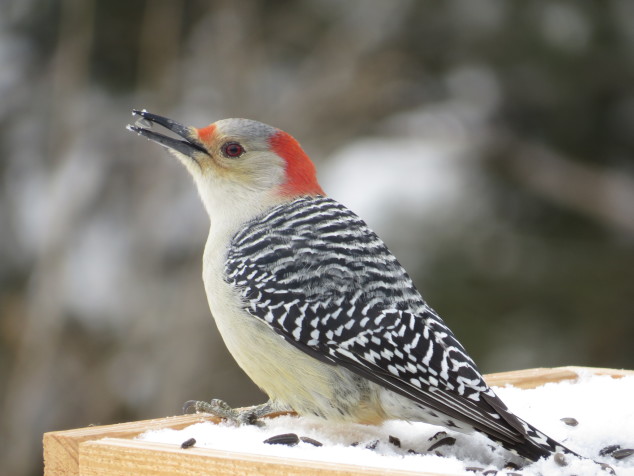
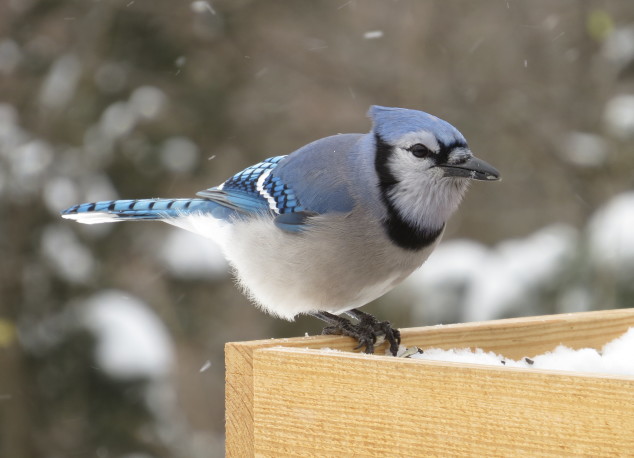
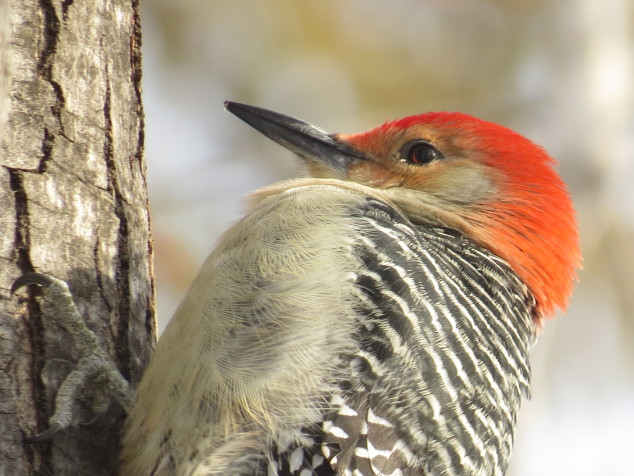
When snow covers the ground, the feeders become the community center for the birds in the area. They have feeding times when activity is high–swooping in, grabbing a seed, flying away. The black-capped chickadees flit to a nearby branch to peck open the seed covering and swallow the seed. The noisy blue jay will pick at his seed in the feeder after scaring all the other birds away. Woodpeckers, like the Red-bellied woodpecker, often carry their food away to store in the cracks and crevices of trees and fence posts for a later time. The ‘Zebraback’, with its barred black and white wings and back, has a creamy buff underside that covers the red patch on the lower abdomen. The female (above) has a red nape and patch at the base of the beak, while the male (below) has a red crown and nape.
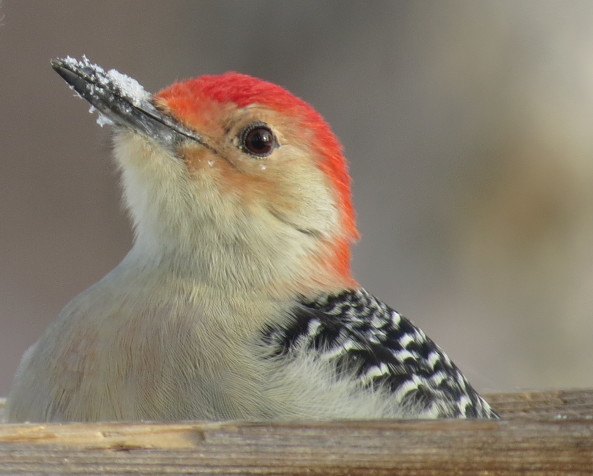
It was a bitterly cold day when the male visited the feeder. His feathers were all fluffed up, and he looked like he was wearing a fur coat!
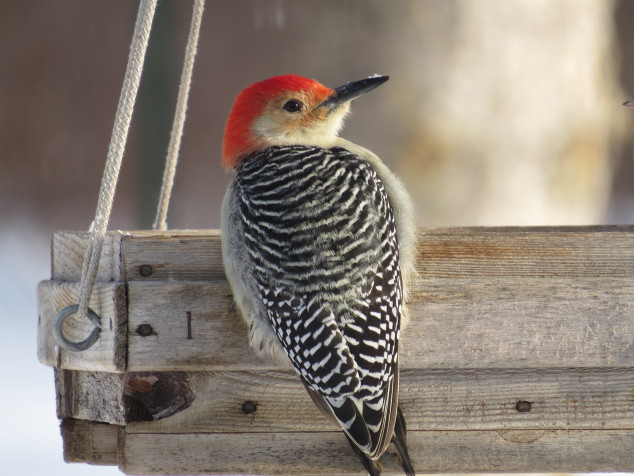
Along with seeds from annuals and perennials, the red-bellied woodpecker also eats wood-boring beetles, grasshoppers, spiders, acorns, pine nuts, and fruit. They have a barbed tongue and sticky saliva that makes it easier to catch their prey.
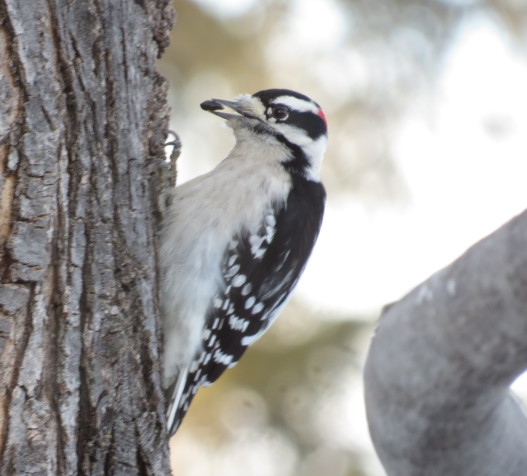
 This small Downy woodpecker is another frequent flier to the community feeder. When he flew to the tree, he may have been storing the seed in the crevice of the bark or may have placed it there to hold as he pecked it open.
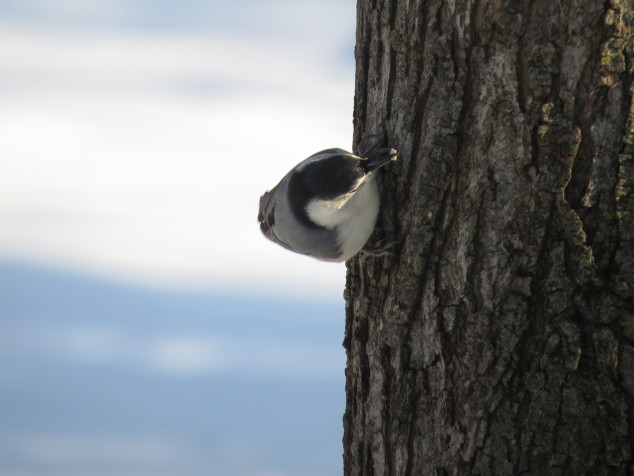
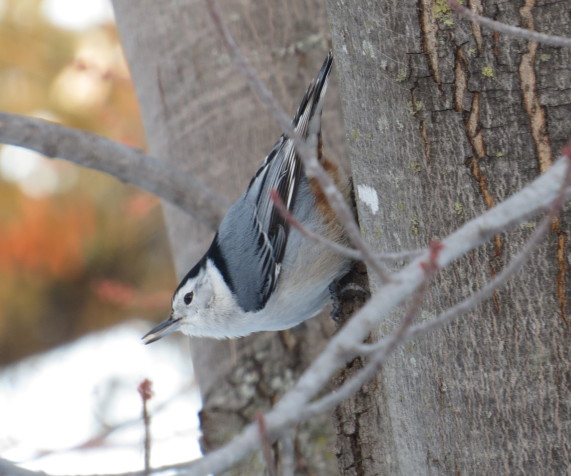
 Another tree-clinging bird is the White-breasted nuthatch. It is often seen creeping headfirst down a tree trunk, enabling it to store food in crevices and to find food that right-side up birds might miss.
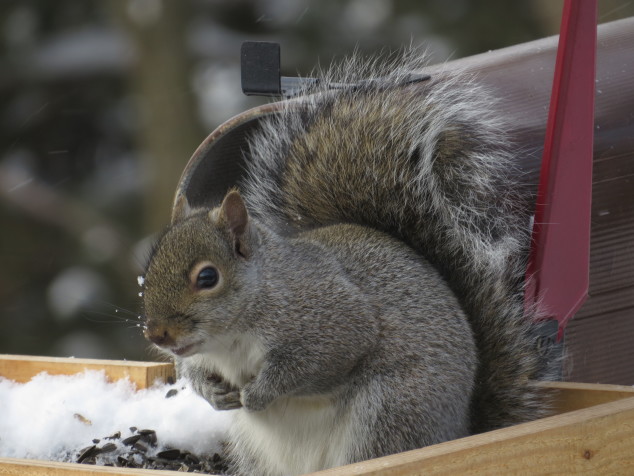
But the birds are not the only ones in the community that come to the feeders. The squirrels show off their acrobatic skills by scaling the trees and climbing or jumping to the food source. The new mailbox feeder is becoming the favorite for the little nutkins–it is closer to their oak trees, easier to climb, and has less of a chance that the big black dog will chase them away from it.
Yesterday morning we had more visitors enjoying some black oil sunflower seeds.
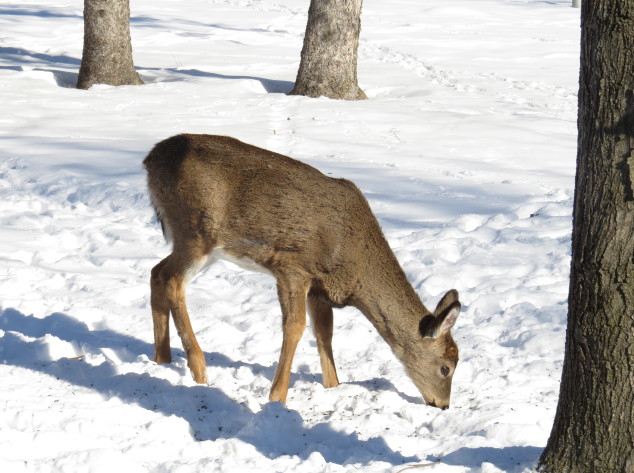
There were four in all, and they watched me through the window and got a little nervous about being so close to the house. Their winter coats gave them rounded haunches, thick necks, and jowly faces.
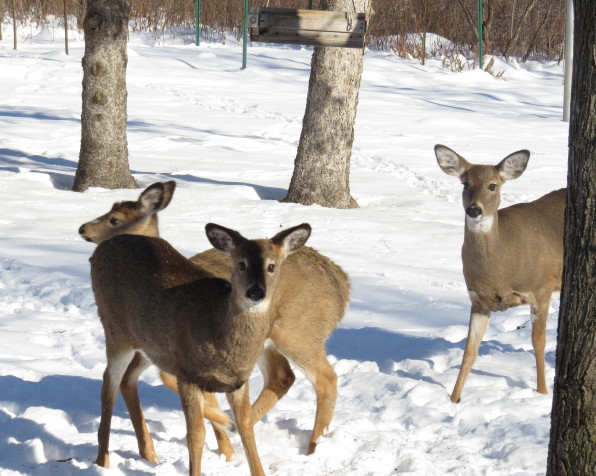
They ate some seeds, then wandered and grazed their way back to the woods
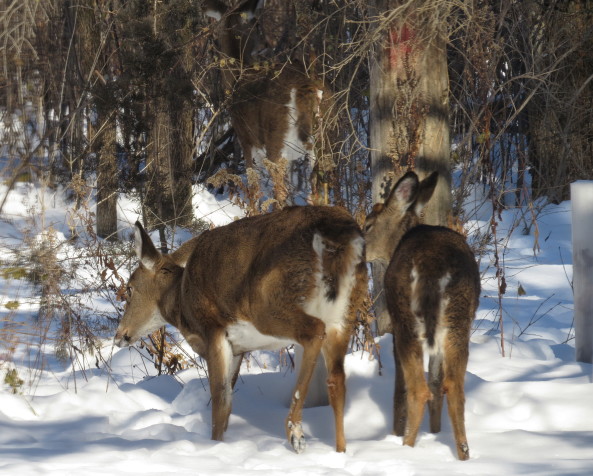
The beautifully feathered birds come to the community feeder in the winter, because it’s all about the food. Each has specialized physiology that enables them to search, find, and eat the food that is best for them. In the snow-covered months of fall and winter, it is hard for the birds and other animals to find sufficient food, so the seed-laden feeders provide an oasis for them. In this week of Thanksgiving and abundant food for most of us, please remember the ones who are having a harder time providing adequate food for their families. Let us all give thanks for our blessings and bless the givers who provide an oasis for those in need.
At the Feeder
It has been a cold, snowy week and a half of Fall-Winter. It’s hard to still call it Fall when we have over a foot of snow on the ground with high temperatures in the teens and lows in the single digits or below. Winter’s march into our lives has not been contained to the northern states–its icy presence has been felt by most of the country. Perhaps Old Man Winter is teaching us a lesson for our hubris of making the holiday season come early. Christmas decorations before Halloween? Black Friday shopping deals in early November? Forget about Thanksgiving? Then Winter it shall be!
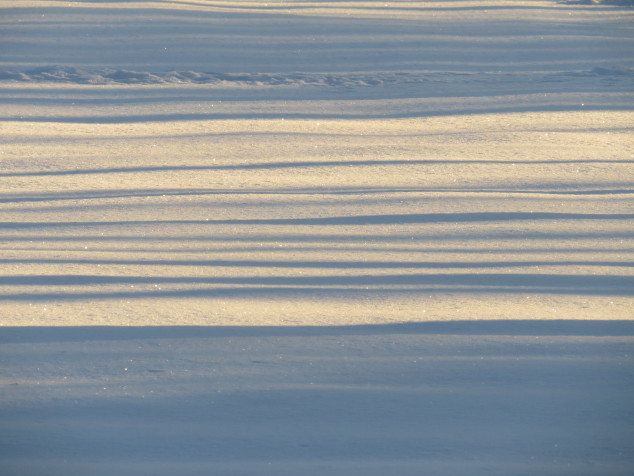
While it seems like the snow has been here for more than ten days, it is only the beginning of our long, hard winter. The icy temperatures wash the world in a cool, blue color. Early morning shadows from the rays of the brave sunlight through the trees, create a dazzling quilt of stripes and sparkles. Blue-white is the new green.
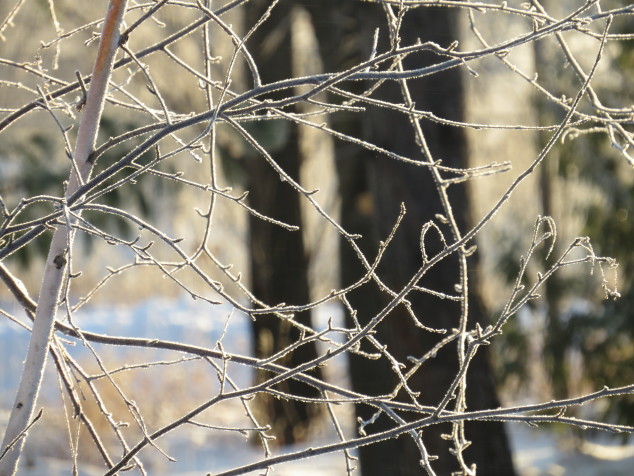
Low pressure and moisture-laden clouds overnight paint the trees with frost. The Artist doesn’t hibernate in Winter.
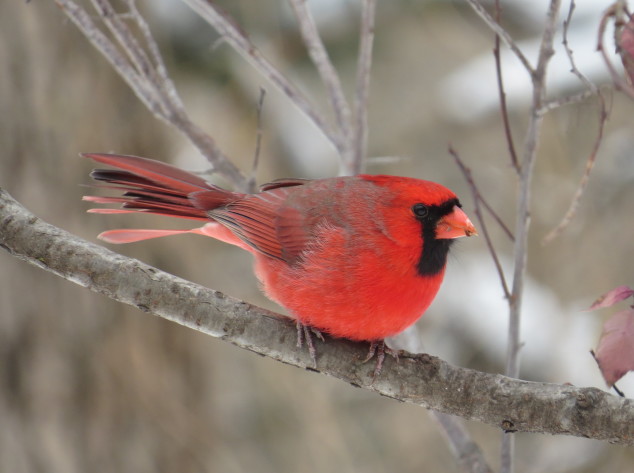
 The stars of the snowy, winter season are the birds. Our three feeders bring them close to the house. They provide great color and entertainment as they zip and dive from tree branch to feeder to snowy ground. The cardinals are seldom seen during the green season but are one of the first to arrive when the feeders are full of black oil sunflower seeds. The male is brilliant with his large crest, black face, and scarlet feathers. He knows he looks good!
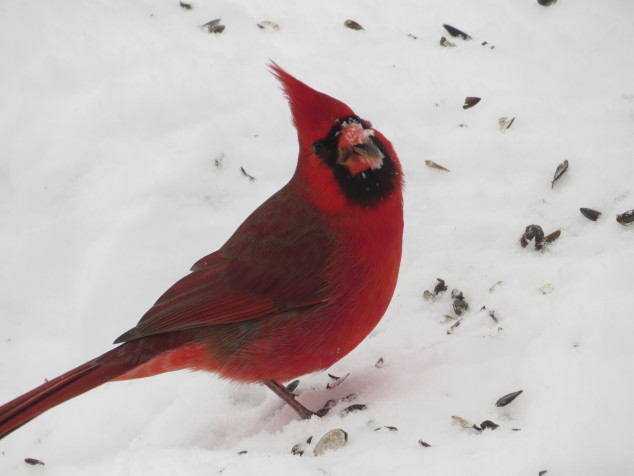 The female cardinal, as often is the case, has a more subtle, but equally beautiful coloring. They make a handsome pair!
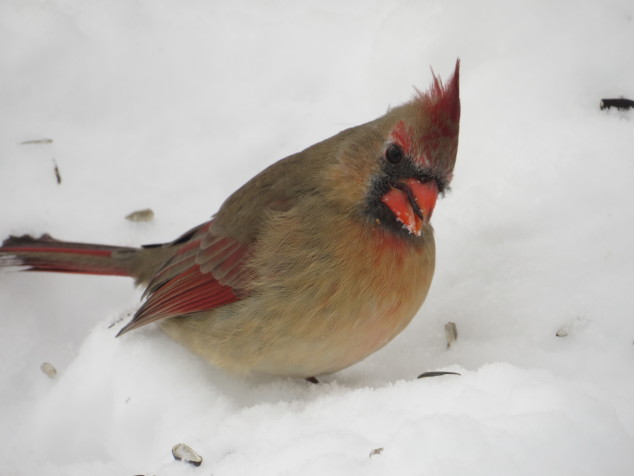
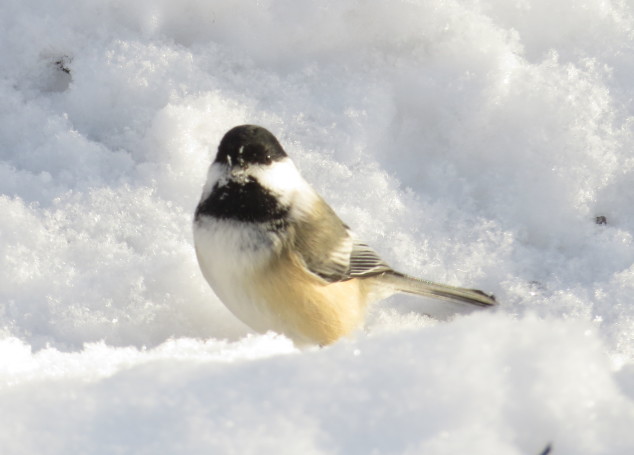
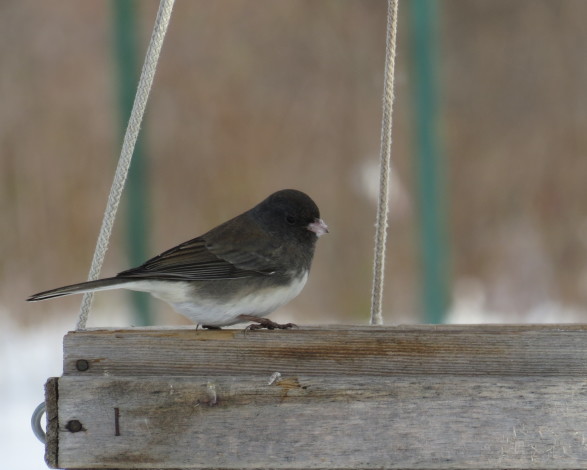
Black-capped chickadees and dark-eyed juncos are two of the most abundant birds to visit the feeders. The black-capped chickadees dart to the feeder, pick up a seed, and quickly fly away. The juncos, with their dark gray topsides and white undersides, spend much of their time on the ground cleaning up the seeds that have fallen. But when the traffic has cleared, they will linger at the source.
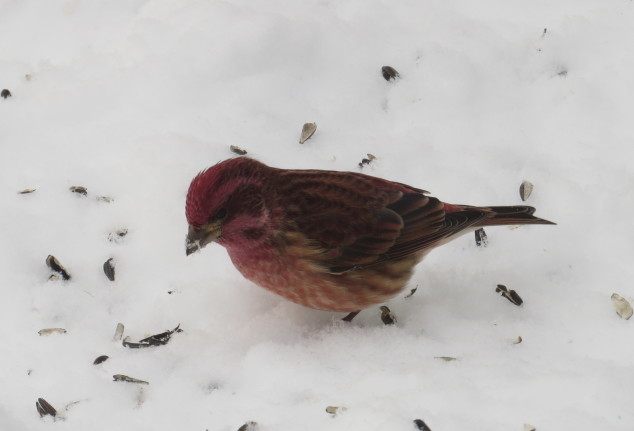
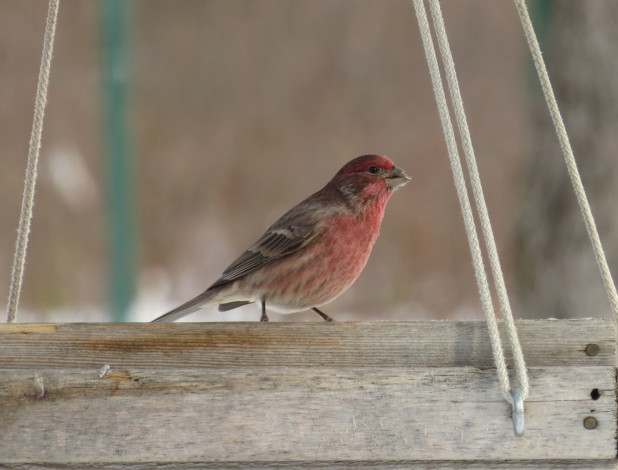
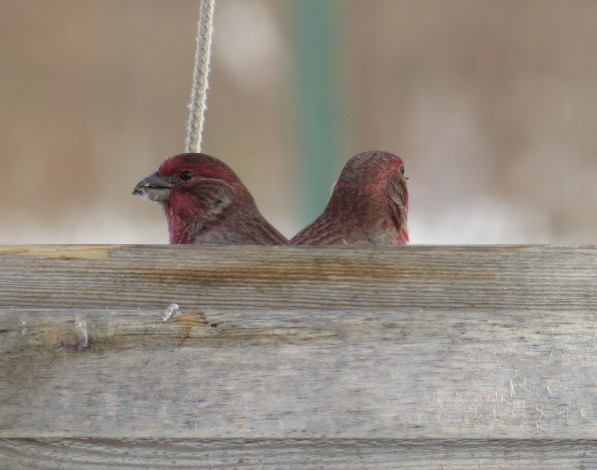
 Purple finches occasionally visit the feeder, looking more rosy-red than purple. They seem to be calm little birds who are not afraid to really get into their food.
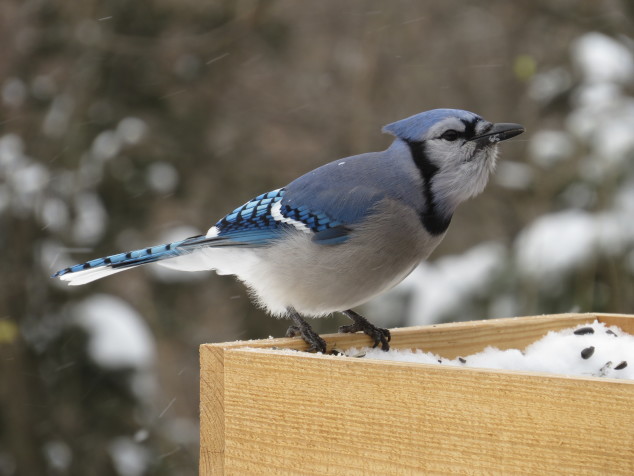
The shrill call of a blue jay demands attention. Actually, almost everything about him demands attention. He’s flashy in his blue suit with crest, black collar and necklace, and white and black spotted wings and tail. The other birds scatter when he swoops to the feeder where he will shovel the snow and seeds around with his large black beak.
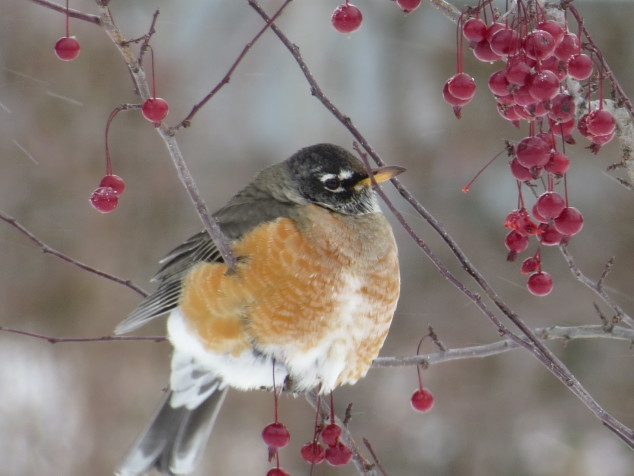
These are a few of the common winter birds in our area, but this morning I caught a glimpse of one who usually makes his way south for the winter. This little puffed-up robin doesn’t look too happy to be in Minnesota in this frigid weather. I wonder if the early snowstorm derailed the migration plan. At least he has some luscious looking crab apples to eat!
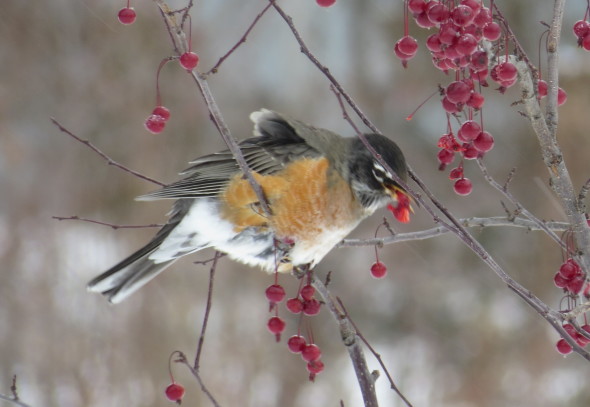
The below-freezing temperatures and thick blanket of snow came early this year and are probably here for the duration. Mother Nature humbles us and lets us know that we are not in control. Each season has its drawbacks, challenges, and hardships along with its beauty, gifts, and inspirations. The birds are one of our beautiful gifts. Their unique characteristics and personalities remind us that we’re all in this together at the feeder of Life.
The Story of the Early Snowstorm
Snow is a normal thing here in Central Minnesota. Our last spring snowstorm was in April, and now it isn’t even the mid-mark of November and we have nearly 14 inches. Many years the first substantial snowfall comes after Thanksgiving and stays the rest of the winter, blanketing the ground with white well into the spring months.
It’s normal to see snow on the hardy cedar trees scattered throughout our woods. Their branches hold the whiteness in winter-postcard splendor.
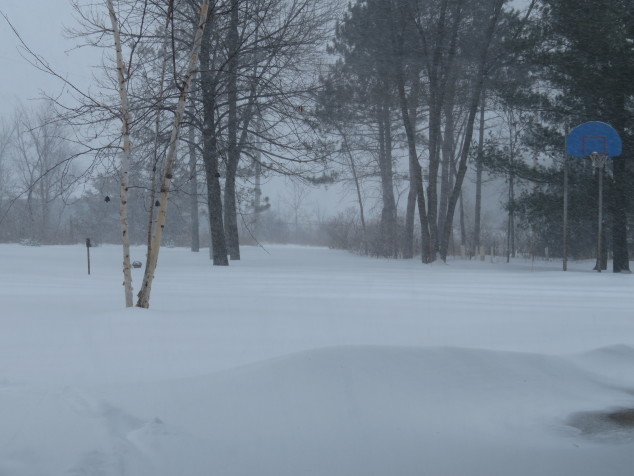
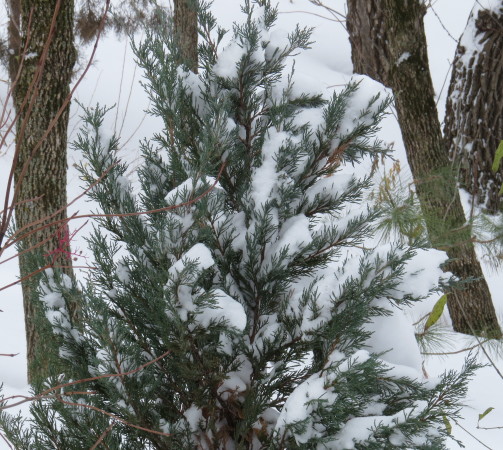 It’s expected to see snow on the driveway and sidewalk. It is the site of the winter workout with shovels poised at the house and garage doors. On a snow-stormy day, one can choose many reps with lower weights or less reps with heavy weights. Even wielding the snowblower through the plowed windrow of snow at the end of the driveway provides its own workout.
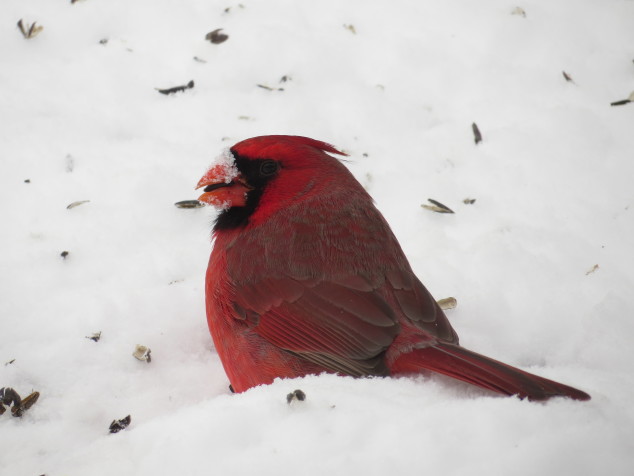
Cardinals and snow go together. As soon as the snow flies, the cardinals swoop in to the feeders looking picturesque in their scarlet plumage.
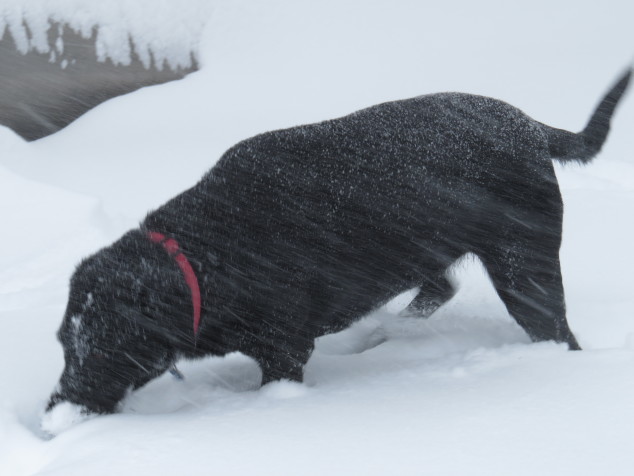
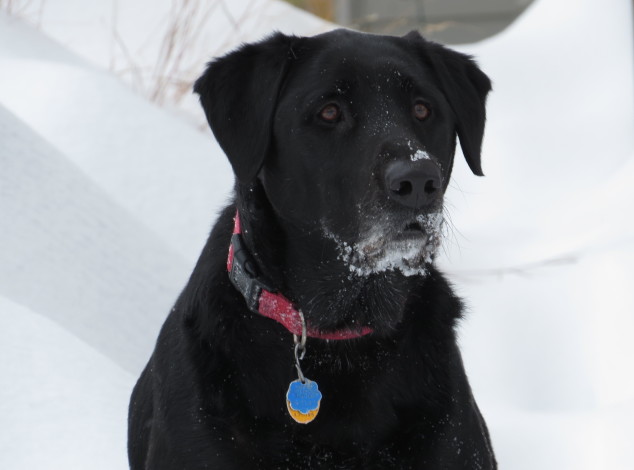
And our Black Lab loves the snow, leaping through the belly high fluff and plunging her head in for a mouthful of snow cone delight.
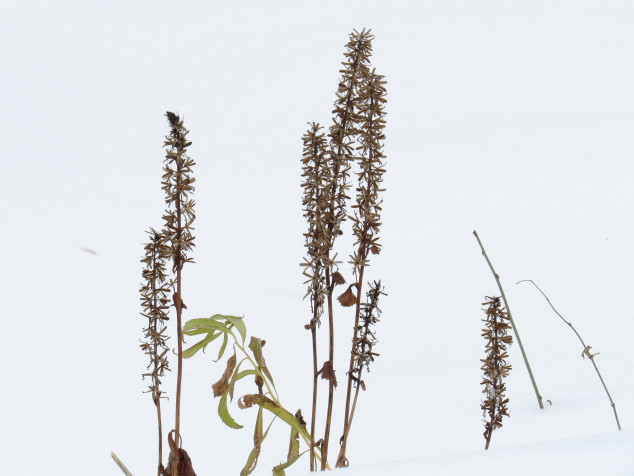
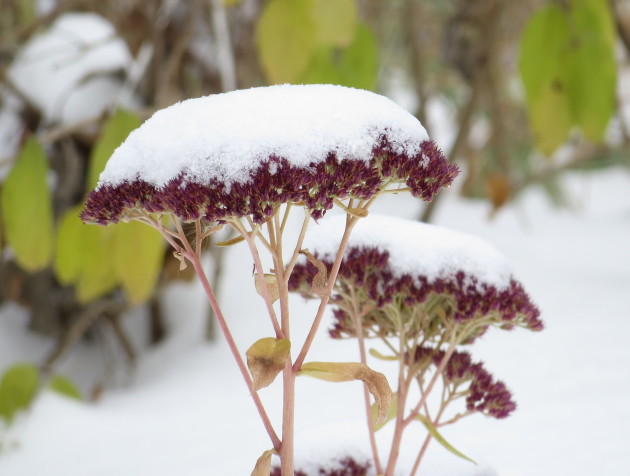
It’s a winter garden of interest when the snow lands and mounds up on spent seed heads of perennials and on the rough branches of the oak trees. Even the lingering leaves of the honeysuckle don’t look out-of-place in the snowscape.
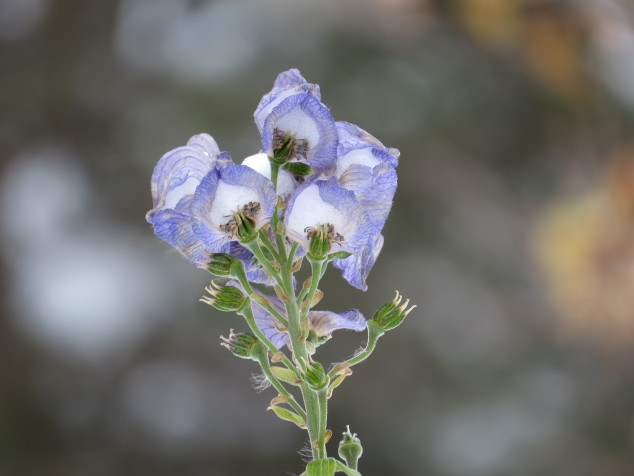
But this is the picture that has been on my mind since I took it on Tuesday. The delicate, still-blue petals of the Monkshood flower, not long past its prime, are filled with snow. This tells the story of the early snowstorm and exemplifies the unexpected.
Minnesotans know snow. We know frigid temperatures, long months of winter, being prepared, snow fun, discomfort and hard work, winter boots and hats, and snow weariness.
The snow-filled Monkshood flower reminds me of our vulnerabilities. The vibrant, late-blooming flower looks fragile in its frozen state. But there is also a haunting loveliness and a porcelain-like strength to it. No matter how prepared or how hard-working we are, there will be times when unexpected things happen. We are all vulnerable in certain ways and sometimes it takes an early snowstorm to see the beauty and strength of our own frailties.
Gleanings from September
September has flown by it seems. These are the last weeks of summer and the introduction to fall. There is the scare of frost that pushes one to fling bed sheets over potted annuals and tender basil and tomato plants because we cannot bear to see their darkened, wilted leaves just yet. Later, we resign ourselves to its inevitability–but that is an October state of mind. We want to hang on to the warmth and jubilant growth and production of summer–even as we see the reverse process going on right before our eyes–the cooling, turning, falling, and wilting.
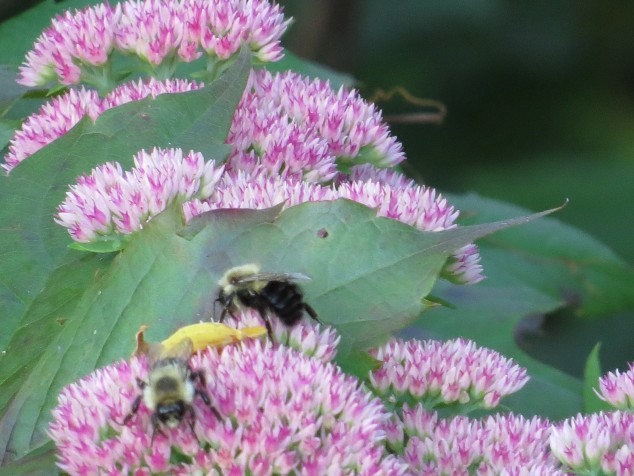
Bees still feed on sedum flowers, though not with the busy energy of playing children. They are placid and slow in the coolness.
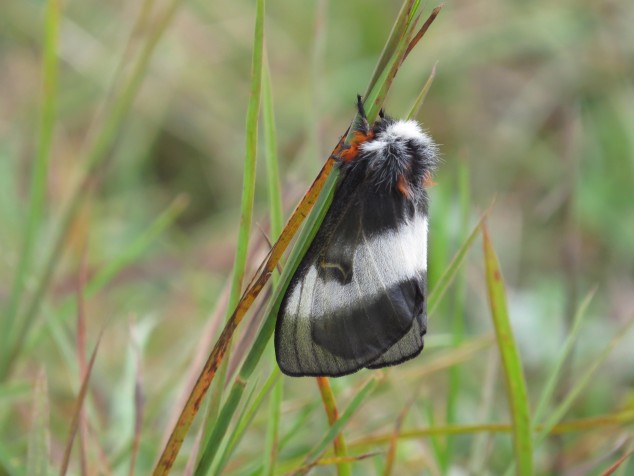
A Buck moth–so named because it emerges during the rutting season of whitetail bucks–clings to the prairie grass at St. John’s Arboretum. It looks as if it wears a warm fur coat to get it through its short, egg-laying Autumn life.
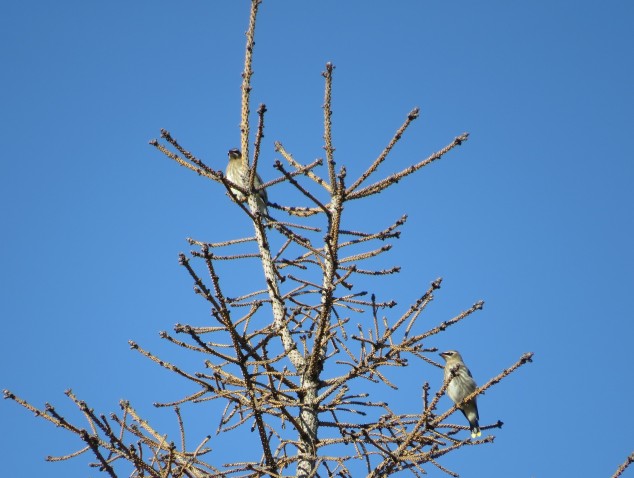
One afternoon as I walked out our driveway, I looked up at the top of a dead spruce tree. Birds perched like Christmas ornaments on its branches. Most of them flew away before I got a good look at them with the camera, but I discovered they were Cedar waxwings.
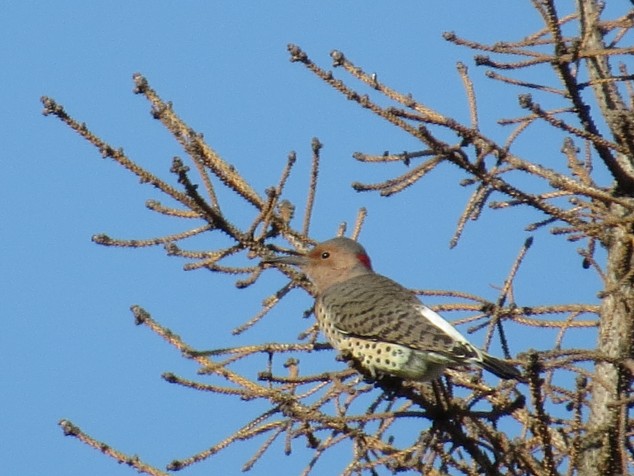
 Another visitor to the dead spruce was a Northern flicker, stout of body and bill with the red nape of its Woodpecker family. It’s one of the only woodpeckers to feed on the ground and to migrate from its northern areas.
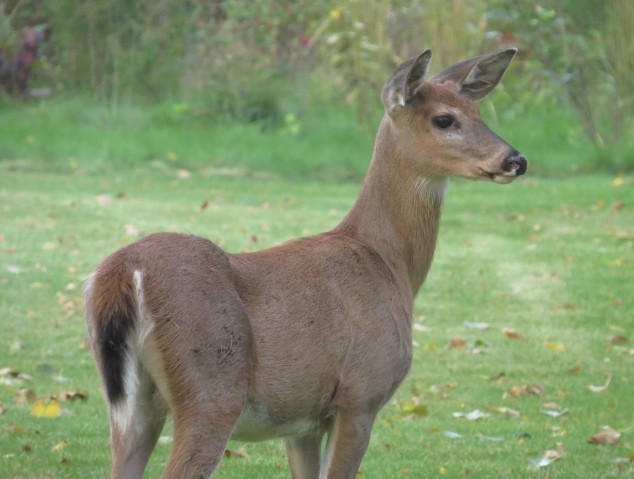
In September we saw some of our frequent yard visitors mature into young adulthood. The small, spotted, twin fawns now looked muscular with thick coats, and I had a feeling of sadness to think of them in the sight of a gun instead of my camera.
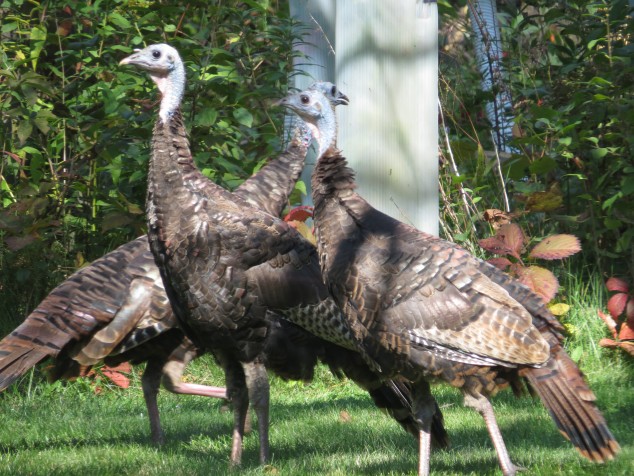
The young turkeys, once scurrying balls of feathers, were indistinguishable from the adult females who wrangled them around all summer. Their feathers shone in the sunlight with the diverse markings and rich copper, brown, and bronze colors of the adult bird.
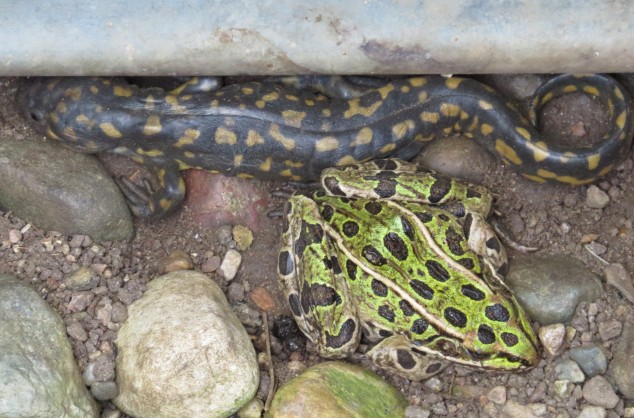
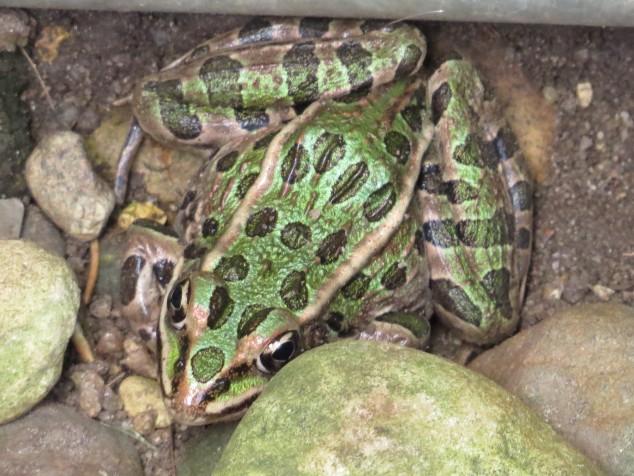
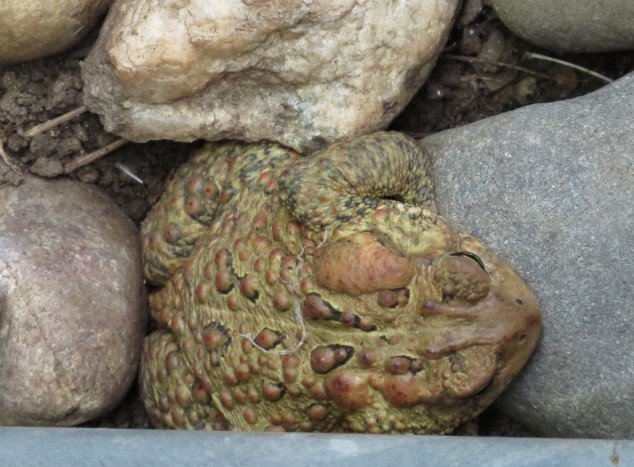
I carried out an amphibian rescue from the deep egress window well on the northeast side of our house after our Black lab would run to it and peer over the edge at the critters who had inadvertently fallen into the abyss. Three Tiger salamanders, two Leopard frogs and a Partridge in a…..no, I mean a chubby, bumpy, brown toad.
(This one is so shimmery and pretty!)
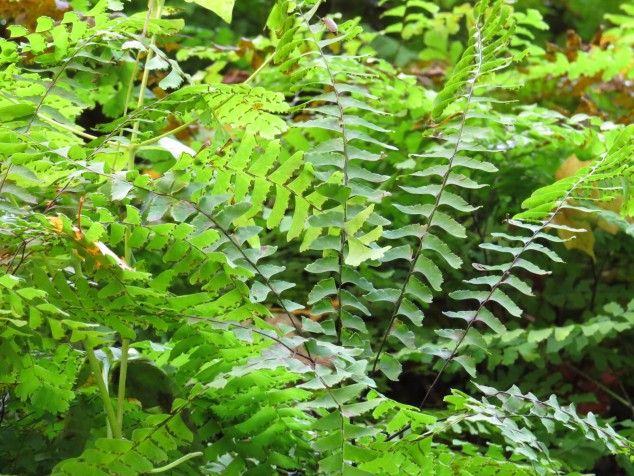
And finally, I wanted to show you my favorite fern–Northern Maidenhair–with a whorl of lighter green fronds floating on dark, wiry stems. They grow along the shady narrow road that climbs the bluff from the bank of the Mississippi River at Cassville, Wisconsin to the cemetery where Chris’ folks are buried. That’s the first place I remember seeing them. These grew where the woods and the wetlands merged at St. John’s Arboretum. My attempt to establish them at our place has met with disappointment, as our hilltop sandy soil drained away the moisture they require. But I’m not giving up yet–Chris has a project going that may be the solution to my problem….
It is human nature to not want to let go of the things in life we love or that give us pleasure. Summer is a pleasurable time in Minnesota, a time we do not take for granted. It is short and sweet, and we want to hold on to that sweetness. But the night temperatures fall into the thirties, the colorful, fallen leaves cover the green grass, the produce from the garden is mostly all harvested, and the denial of what’s coming is getting pried away by reality. We get out our warmer clothes that have been put aside, not even put away, and we start to make our mental list of things that need to be done before winter. We rescue what we can, and with loving appreciation we let go and give the other up to God. We move on to our October state of mind.
Gleanings from August
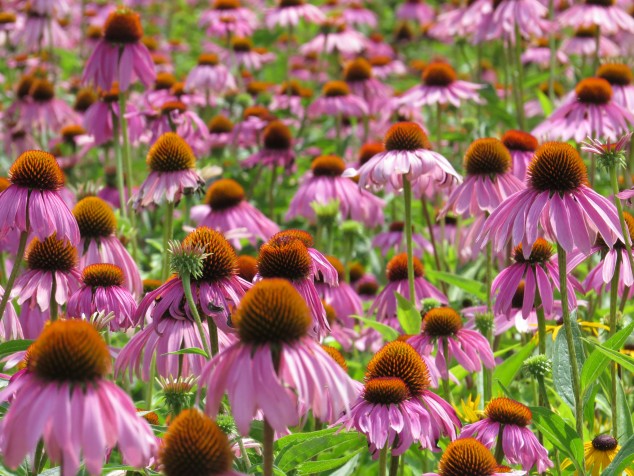
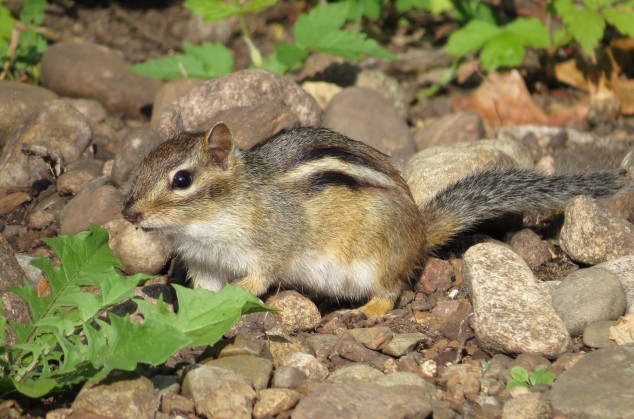
This impressive display of purple coneflowers Chris planted at the College of St. Benedict reminds me of a crowd of people at an outdoor concert–all shapes and sizes enjoying the sunshine and gathered for a common purpose. In the case of the coneflowers, their common purpose is Beauty! August and sunshine and purple coneflowers! Earlier that day while at St. John’s Arboretum, we saw flying sandhill cranes and a pudgy chipmunk who didn’t seem the least bit concerned that we were treading on his home territory.
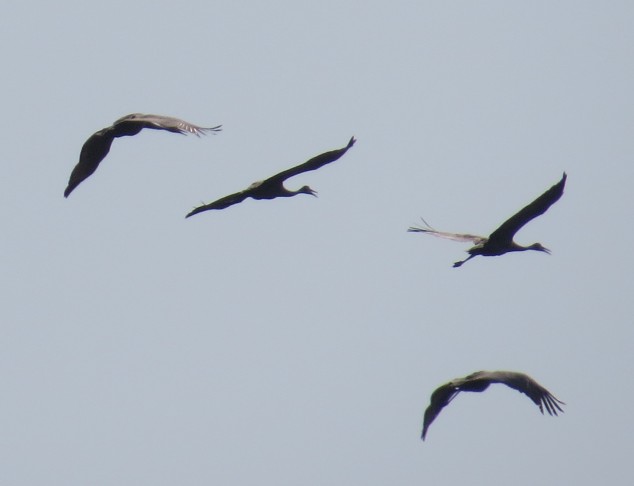
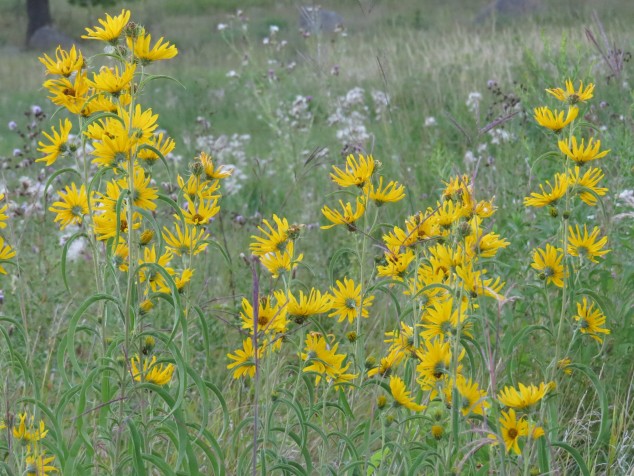
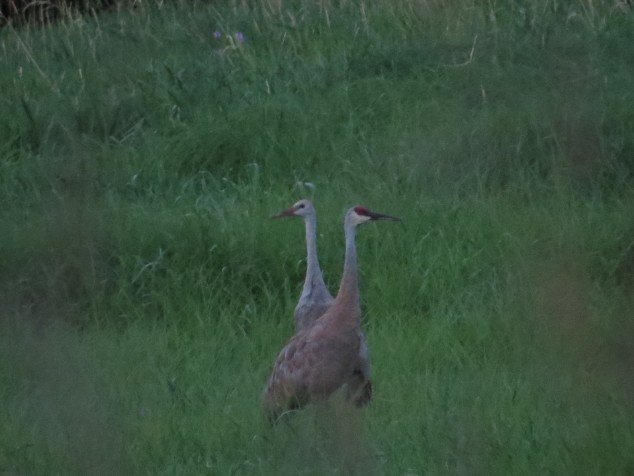
An evening August visit to Eagle Park revealed bursts of bright sunflowers amid the prairie grasses and a pair of sandhill cranes but no eagles.
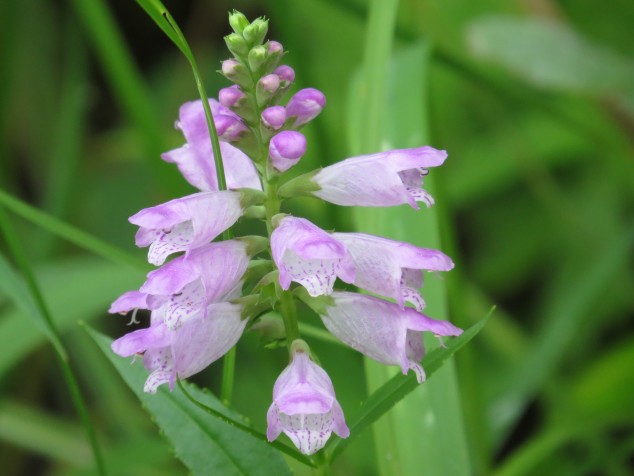
One of the most interesting flowers we saw on the banks of the Mississippi River was the Obedient Plant. It is so named because the individual flowers on the showy spikes can be moved around the stem and will stay where you put them!
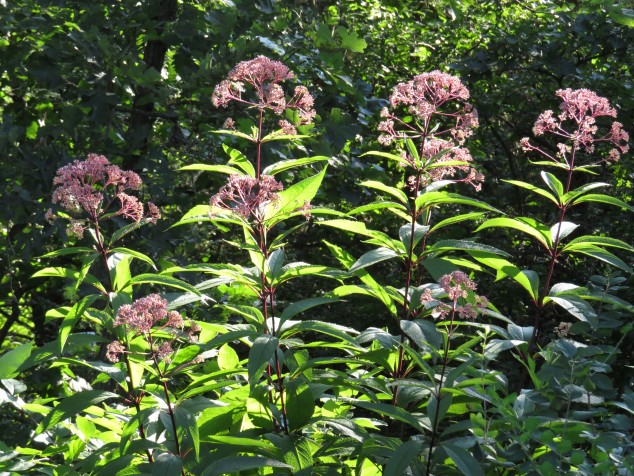
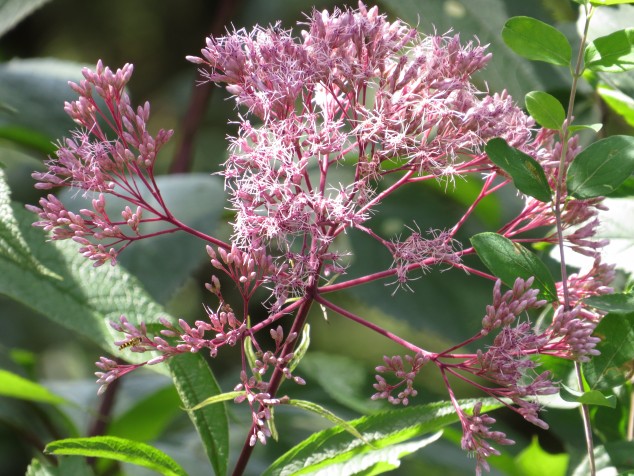
One of my favorite flowers we have at home is Joe Pye Weed. It is also a native plant to eastern and central United States, including Minnesota. It is close to six feet tall and has large pink-purple blossoms on dark red stems. We planted it in a relatively sunny clearing in the woods. And I love its common name–said to be named after a Native American healer who cured the settlers of typhus with the plant.
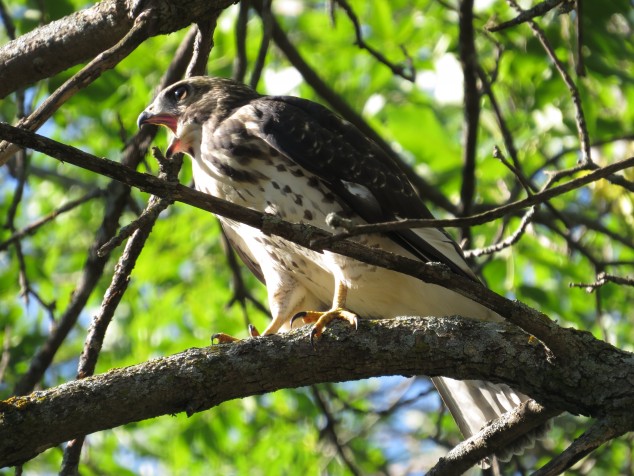
August brought many visitors to our yard–the doe and her spotted fawns, the wandering posse of turkeys, shy pileated woodpeckers, and the many wrens who hatched their young in the birdhouses. Another visitor announced his presence one morning with loud screeches. This young Cooper’s hawk was in an ash tree right outside our door.
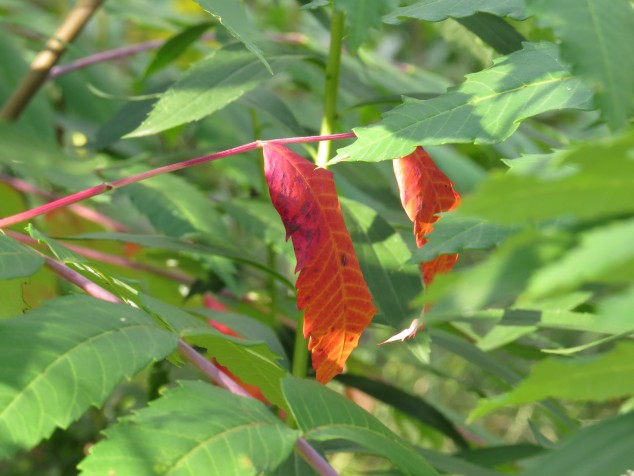
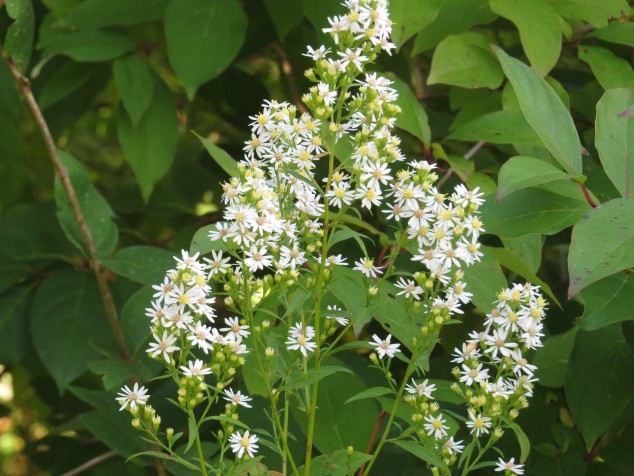
And we are getting hints of fall–red leaves on sumac, clusters of white asters, and white berries on red stems of the gray dogwood.
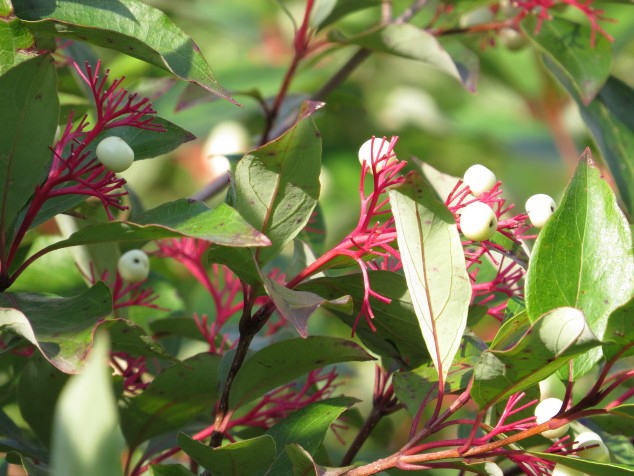
Whether we are one of many in a crowd or a solitary individual, we have a purpose at any given time. Whether we are flying through the sky or planted in a sunny spot, we are part of a larger community that needs our gifts. As summer winds down, may you find purpose, the voice to share it with your community, and time in each day for appreciating the Beauty of Nature.
A Good Day to Fly
Early Tuesday morning I heard a soft thump on our open window. Even before getting out of bed to look, I knew a bird had flown into the reflective glass. It happens often. Sometimes it is the demise of the little creature; other times they can shake off the shock and fly on. A tiny fledgling wren was crumpled in the river rock by the sedum. He had just left the nest in the wren house that was hanging from a maple branch about fifteen feet from our bedroom window. In a few minutes, he scurried under the hosta plant for cover–on his own in the big world. The morning mayhem had already begun with the parent wrens working hard to feed their hungry brood–a noisy time! Except this morning was different–it was a good day to fly!
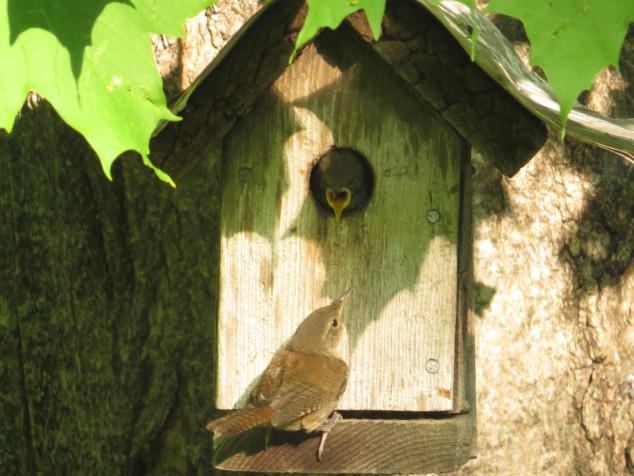
So instead of bringing food for the clamorous, hungry babies, the mama and papa wren flew to the house ‘talking’ encouragement to their young ones, then flying away again.
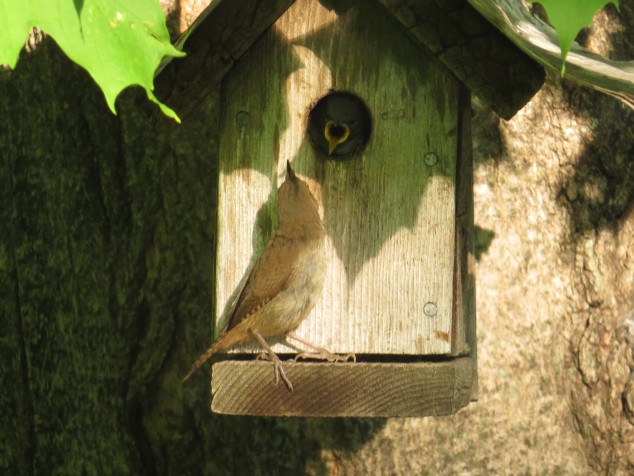
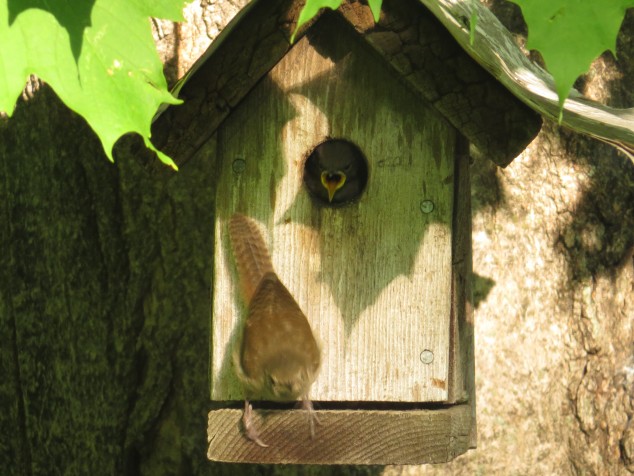
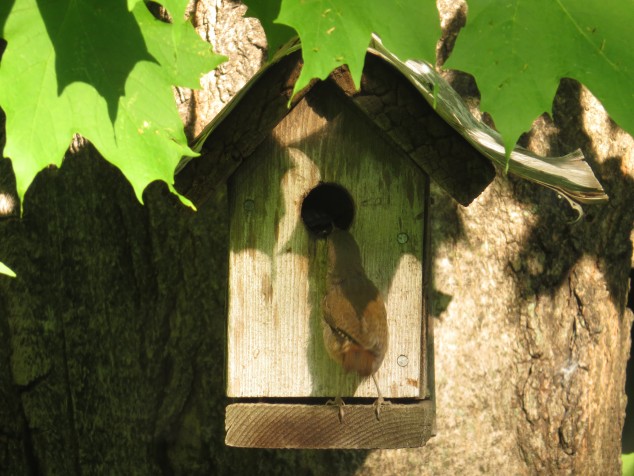
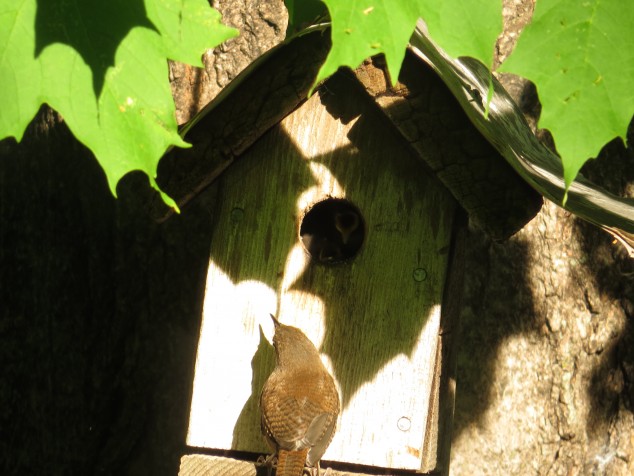
Mama wren would fly to the house, then to the roof, then to branches above the house, all the while chattering to her young ones. The baby at the opening was making just as much noise–constantly wondering why he wasn’t getting fed as usual.
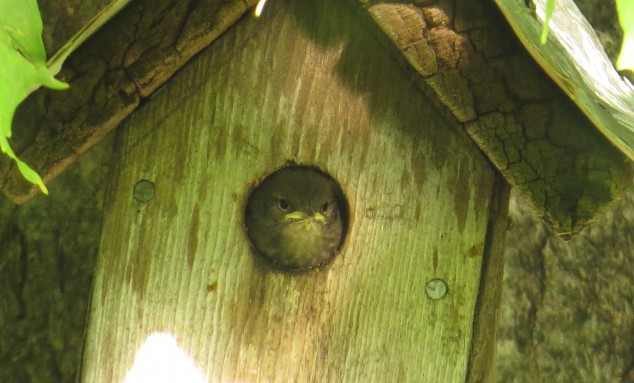
After more than two hours of this flying-day frenzy, I saw the mama bring food to the baby. Some food and rest were in store after all that hard work. They would try again another time.
At noon that day, I heard our black lab burst from inside the house onto the screened-in porch with an urgent bark–the kind that means something is out there! I looked out the back window and saw turkeys flying and running from the loud, startling threat. One adult sentry of the posse of turkeys calmly surveyed the scene, then walked into the woods, while the others looked down from their secure perches in the oak trees.
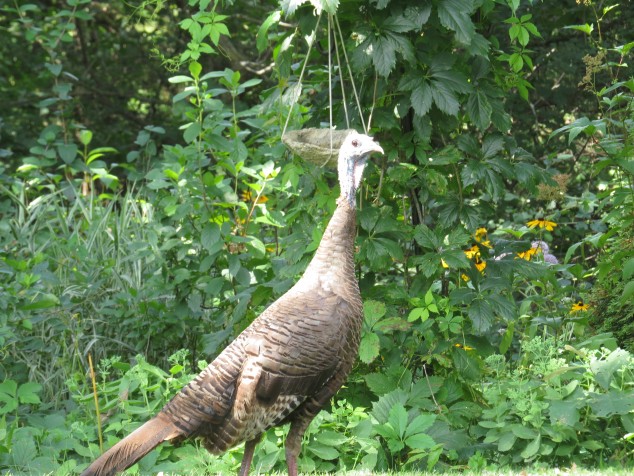
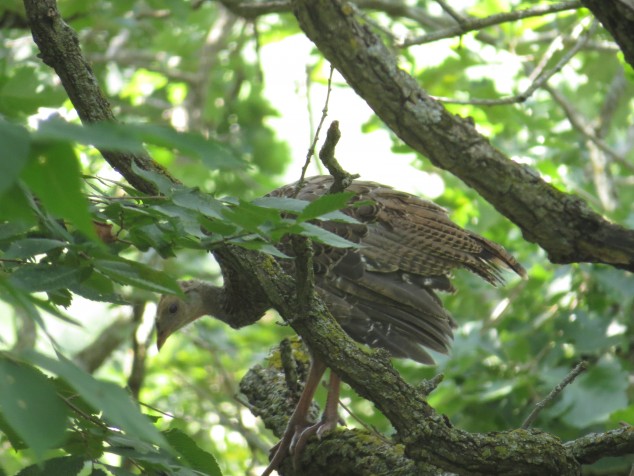
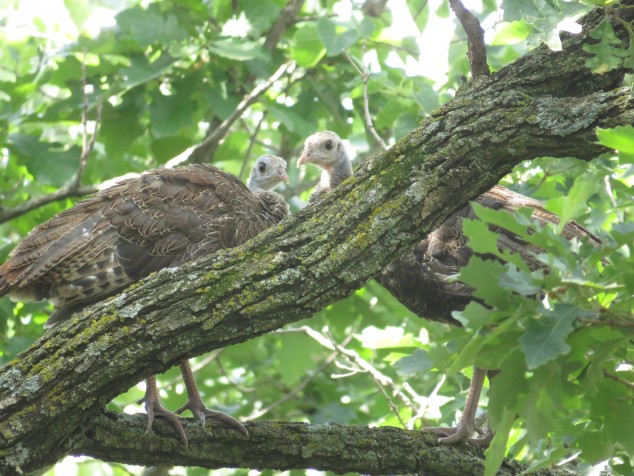 With the dog safely contained in the house and no longer barking, the turkeys cautiously left their perches, floating down to the ground like tiny brown parachutes.
Baby flyer training for the wrens began again early the next morning. The chatter was loud and nonstop. The fledgling was much more determined due to hunger or instinct or increased confidence. Though it took many tries and much prompting from mama wren, baby number two soon took the leap!
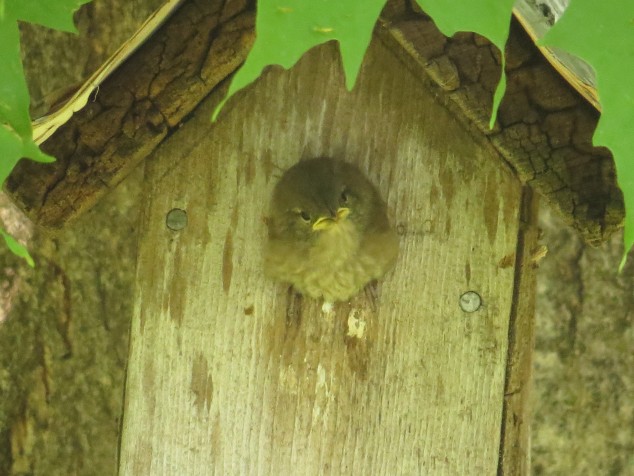
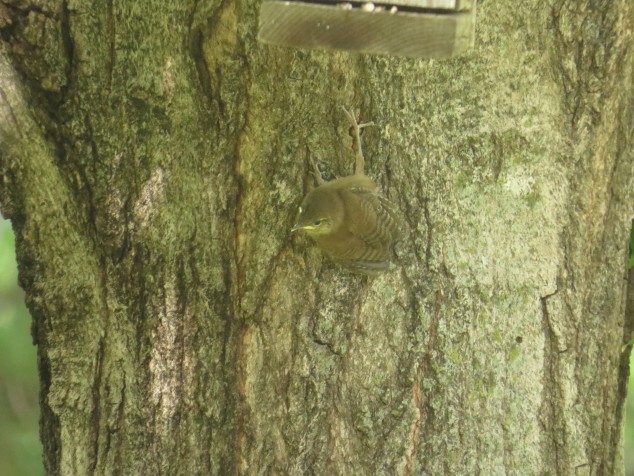
Next flyer on deck!
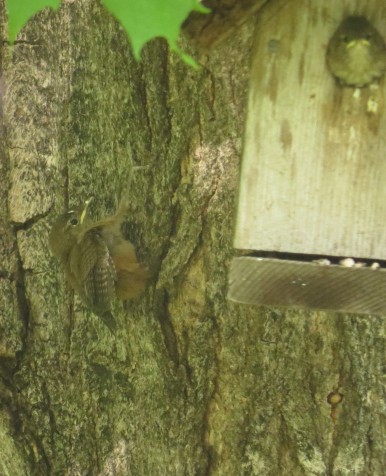
This time mama wren brought some enticement but flew away without feeding it to the baby.
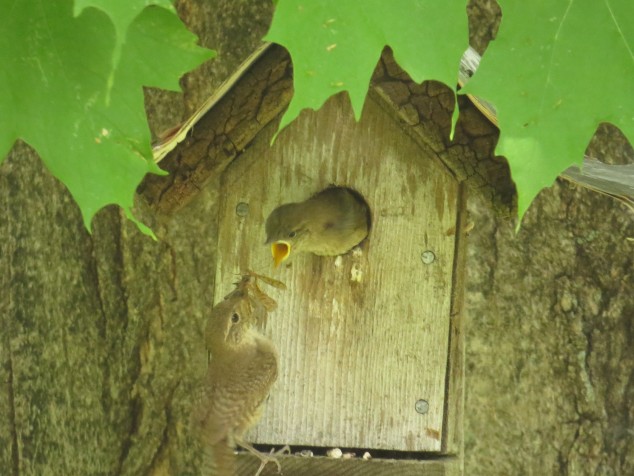
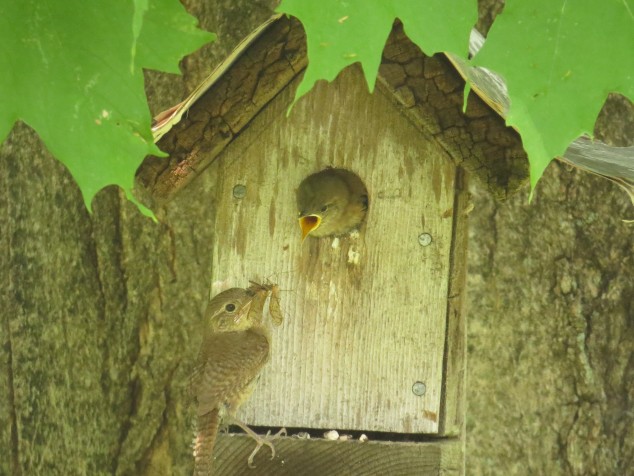
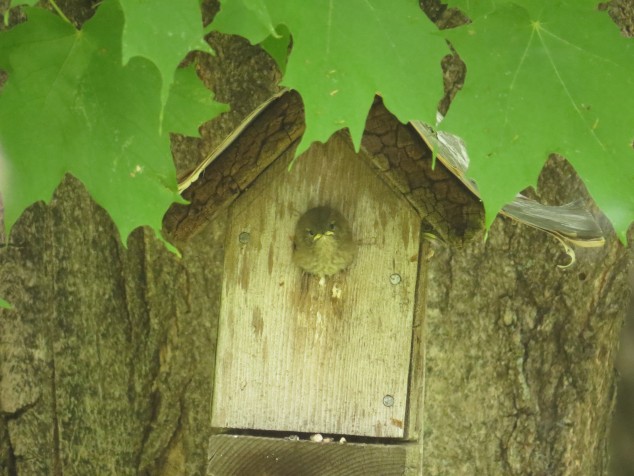
‘Dang! I guess I’ll have to get out of here to get that tasty morsel of food.’

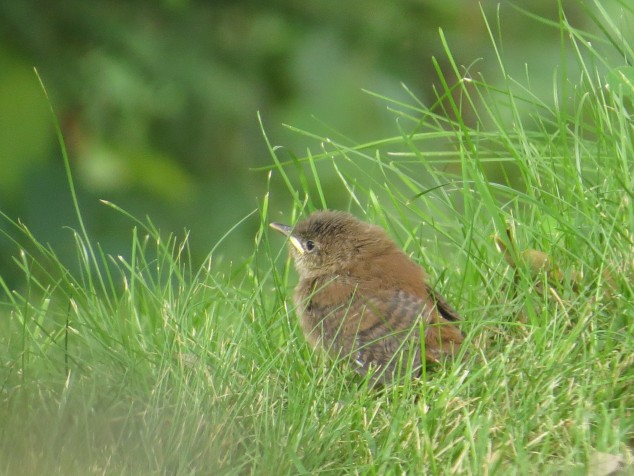
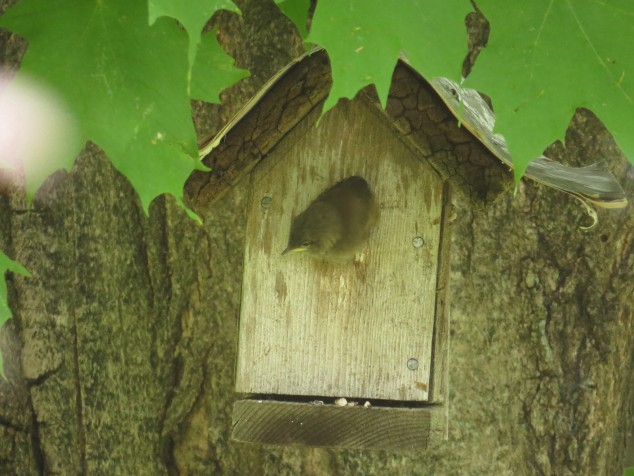
Baby wren number four followed suit and cautiously dropped to the ‘porch’ of the house.
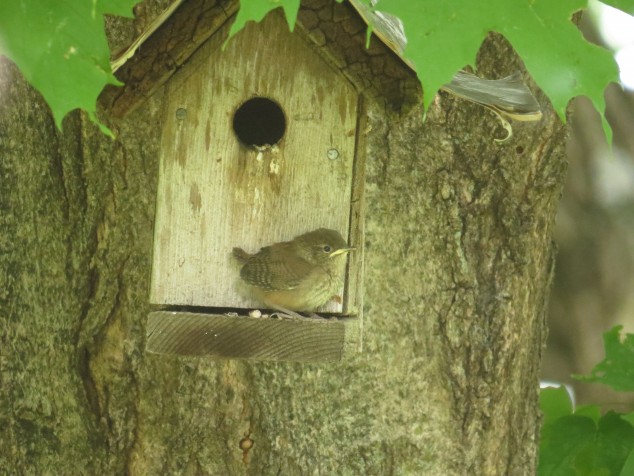
‘Your turn. If I can do it, you can do it, too!’
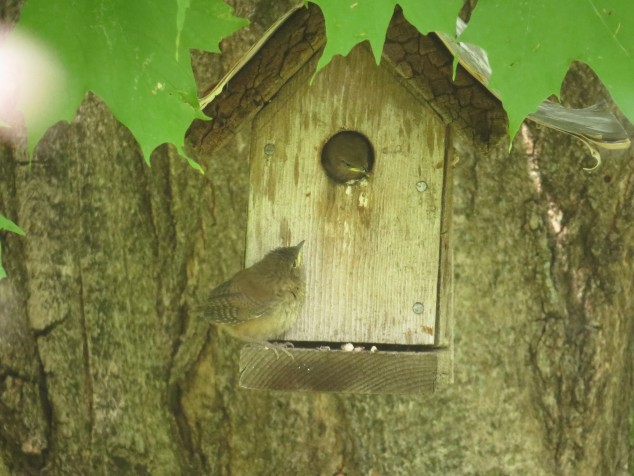
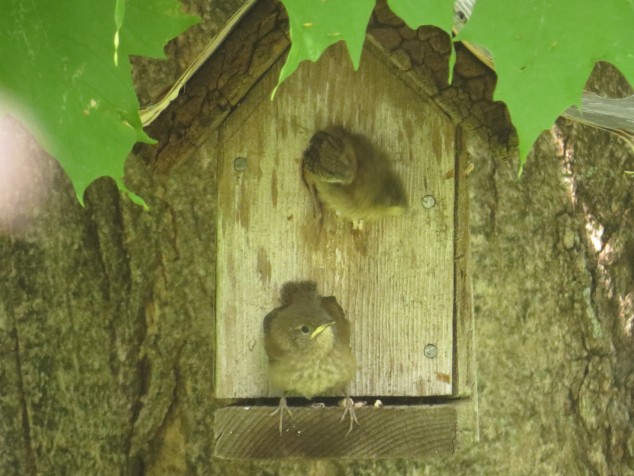
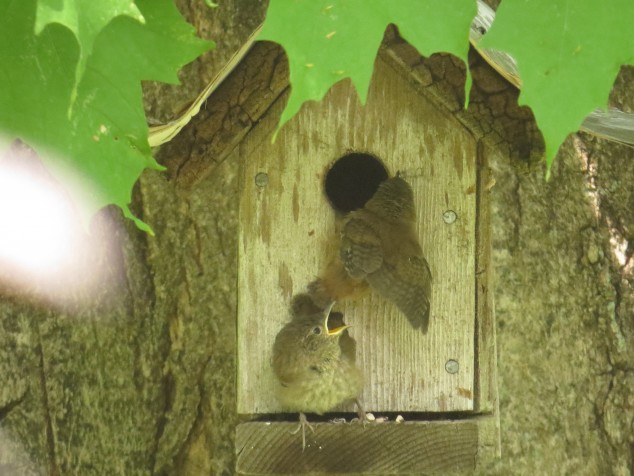
‘Where’d she go?’
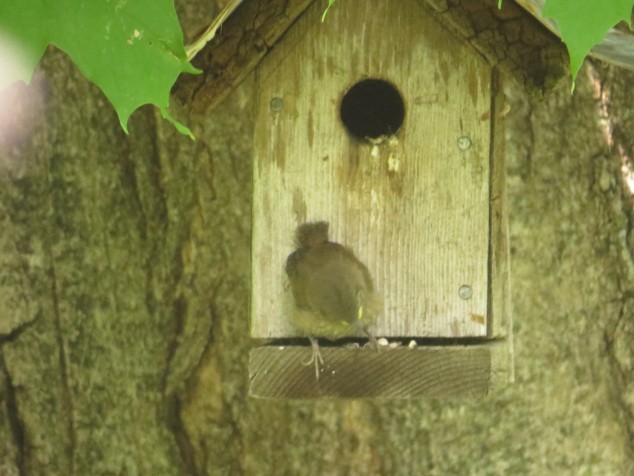
And finally, mama wren flew to the branch above the house, and the last baby followed her into the maple canopy.
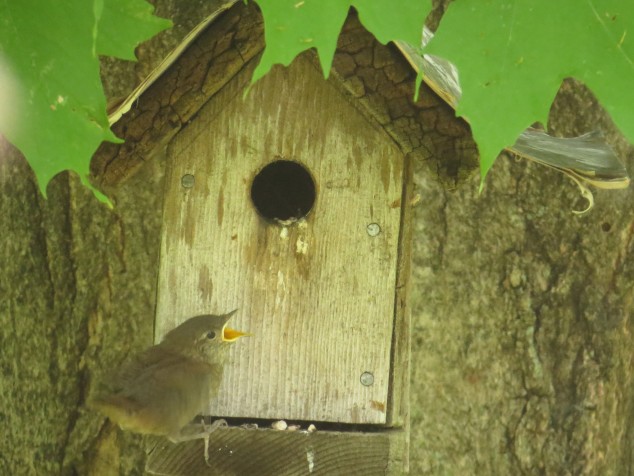
Empty nest. Empty house. Quiet.
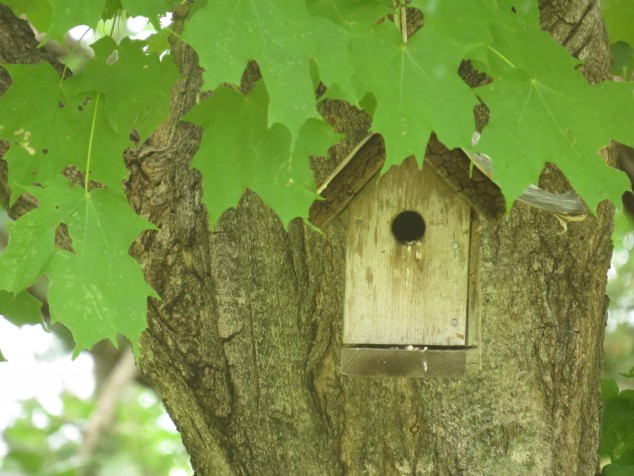
Sometimes with all the best intentions and timing and encouragement, we try new things but don’t succeed. We rest and re-group and try again. Sometimes, like the turkeys, we are forced to fly. Scary things happen, and we fly to save our lives. Hunger for a better life, frustration with the status quo, enticements that feed our body and soul, encouragement from others who have gone before us, and the positive peer pressure that makes us take the leap combine with our innate cycle of change and development to make it a good day to fly.
A Posse of Turkeys
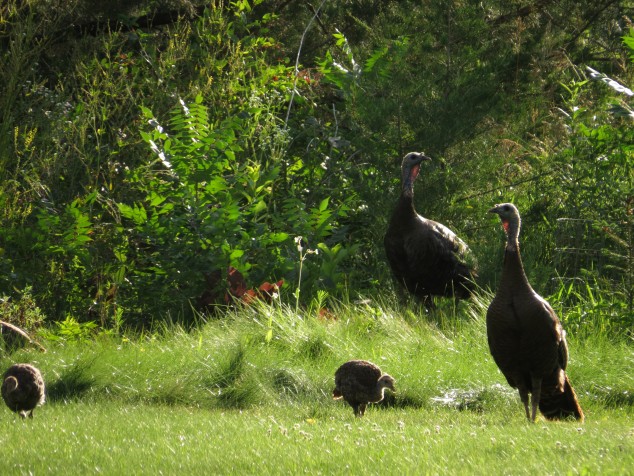
One bright morning while eating breakfast, I heard a car honk, so turned to look out the window. A posse of turkeys was walking up the driveway into our yard. Three adult females were herding countless young juveniles through the grass to a path by the blueberry patch that led into the cedar and oak woods. Turkeys have excellent day vision–three times better than that of humans–so I’m sure they saw me move to the window with the camera.
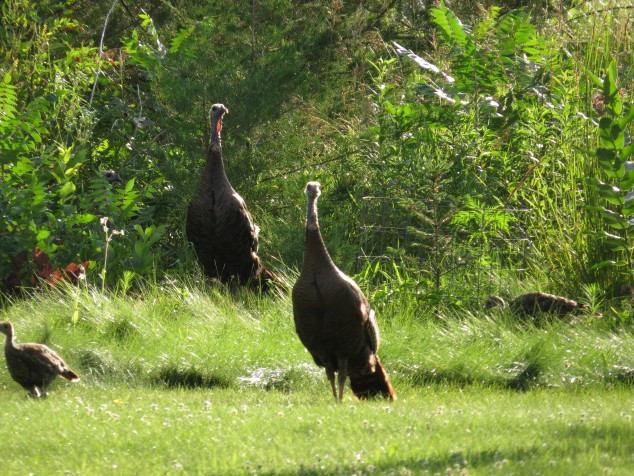
These mother/child groups of turkeys are known by many names–flock, raffle, gang, crop, and posse to name a few. After spring mating and laying a clutch of 10-12 eggs in a shallow dirt depression nest, they incubate the eggs for 28 days. The poults hatch and leave the nest within 24 hours, ready to travel with the posse and forage for food.
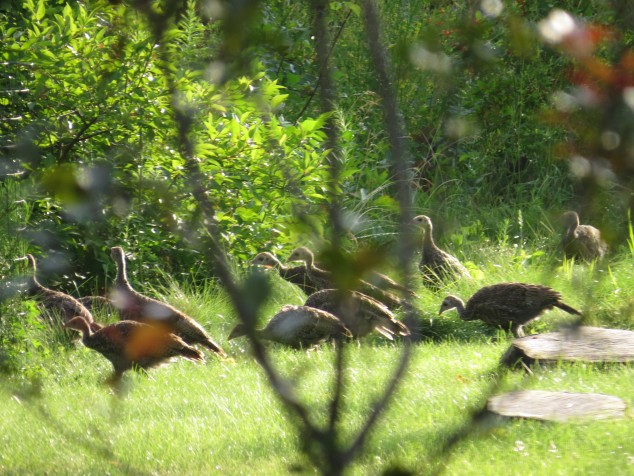
The young juveniles–male jakes and female jennies–eat grasses, seeds, nuts, insects, and fruit. Adults also eat small salamanders and snakes.
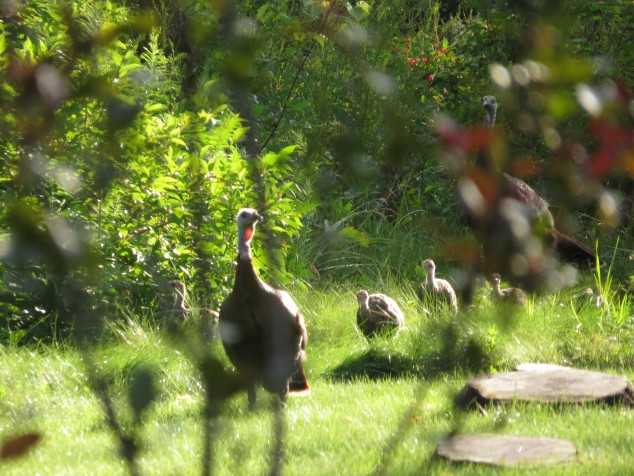
In the early 1930’s the wild turkey population was on the verge of extinction, but thanks to conservation efforts the range and numbers of turkeys are greater than ever.
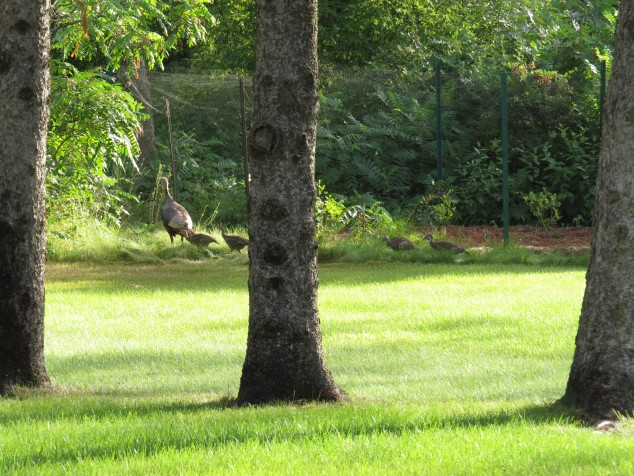
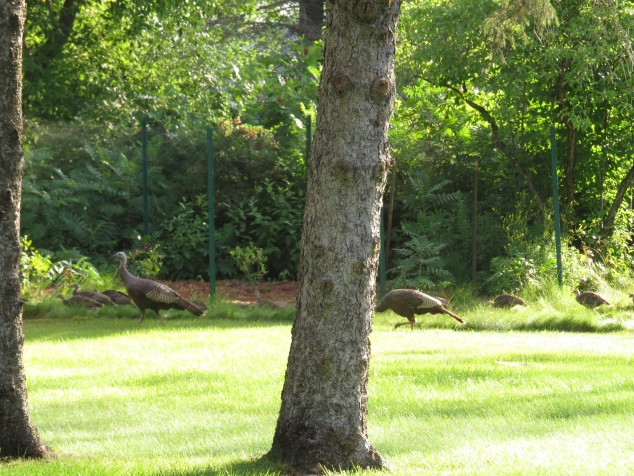
Turkeys can run up to 25 mph and can fly for short distances up to 55 mph. They roost in trees at night.
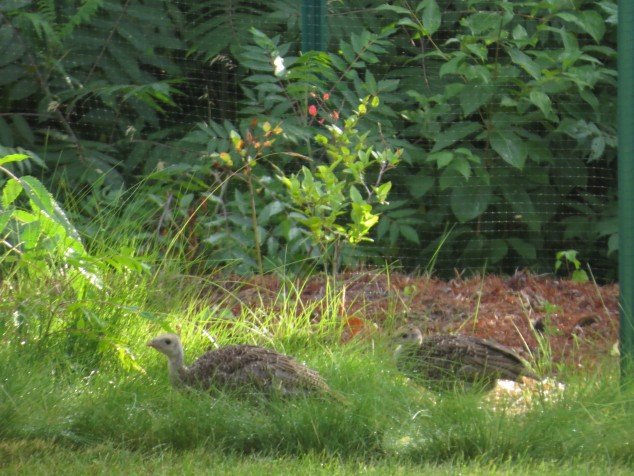
An adult tom or hen has between 5,000 and 6,000 feathers, many with an iridescent copper, gold, and bronze coloring. Both sexes have a wattle under the chin and have a bare head that can turn red, white or blue with excitement or emotion. Males have long spurs on their legs and a stiff beard growing from the chest.
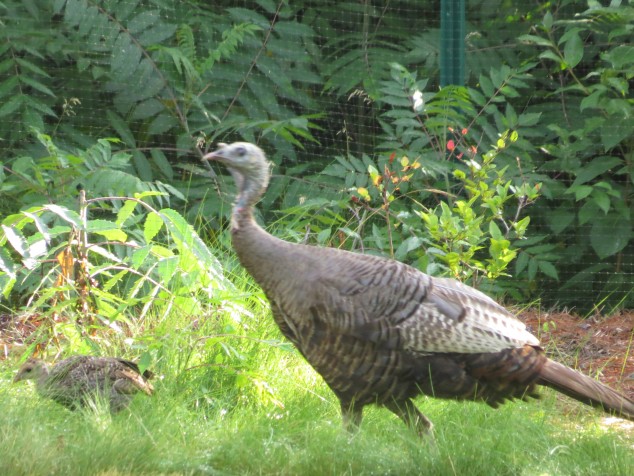
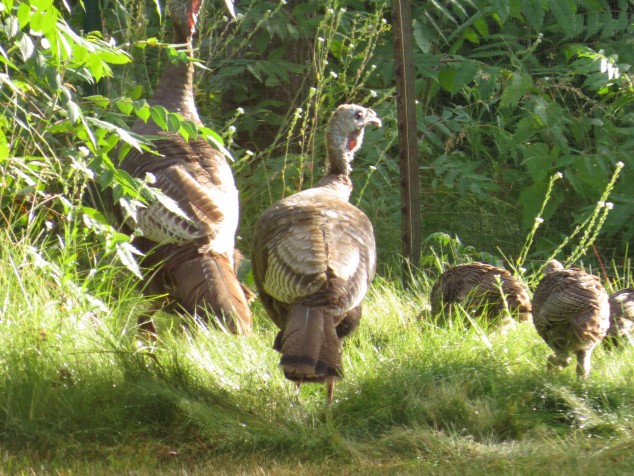
They walked into the woods, pecking at food as they went, with the females ever vigilant to protect their offspring. Benjamin Franklin wrote that the wild turkey was a ‘much more respectable bird’ than the bald eagle when discussing the choice for the National Bird. I feel privileged to have witnessed the families of both species in the last month. Both are beautiful and impressive with unique characteristics and a dedication to parenting. I’m glad this posse showed up at our home!
- « Previous Page
- 1
- …
- 4
- 5
- 6
- 7
- Next Page »