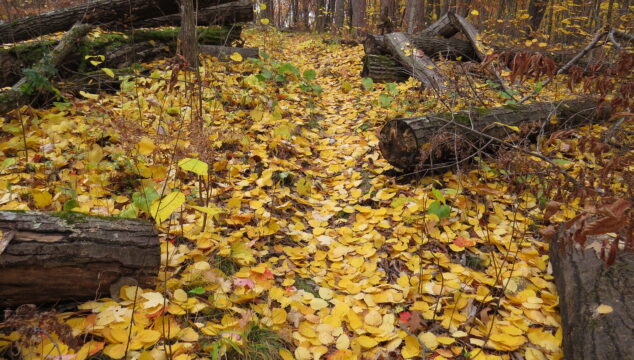
Come walk with me in the peak Autumn beauty of the Northwoods. To say that I love this time of year is an understatement. Most everyone can appreciate the colorful falling leaves---it reveals the 'true self' of a tree when its leaves are no longer producing chlorophyll. Their true colors are revealed, and there is something simple … [Read More...]
There is a Reason for Everything–NOT Everything Happens for a Reason
I like things to make sense. When things don’t make sense in my mind, I ask questions—of myself and others. Information helps a person make sense of a situation. There have been a lot of things happening that don’t make any sense—why would a young person plan and carry out a school shooting or multiple bombings? Finding a motive or reason for such action is paramount to the investigation. Information is gathered from multiple sources, in multiple ways in order to figure it out. Many times though, the answer to the question of why a person acted as they did is never fully known.
Science also asks questions in order to find answers—it is the foundation of the scientific method. Information is gathered, past research is perused, a pertinent hypothesis formulated, the methodology carefully planned out and followed to exactitude. Did the results confirm the hypothesis? What conclusions were learned from the experiment? Questions, answers, more questions. And so it goes.
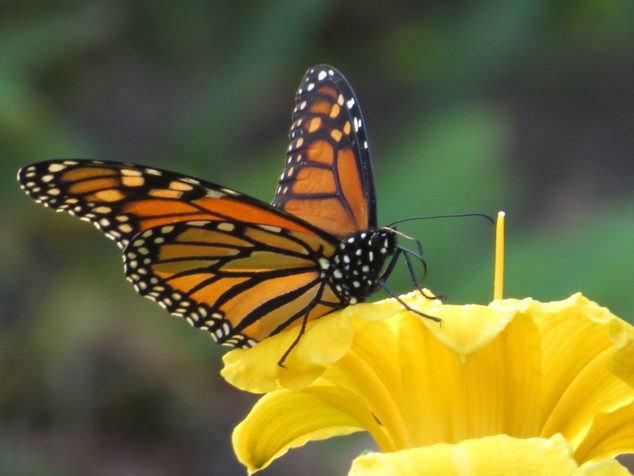
Questions about Nature have been studied by science for hundreds of years, and today the questions are just as important as ever. Why is the Monarch butterfly population in decline? https://www.annualreviews.org/doi/abs/10.1146/annurev-ento-020117-043241 http://www.eeb.cornell.edu/agrawal/documents/InamineetalAgrawal2016Oikosmonarchconservation_000.pdf
 Is our water safe? https://www.ncbi.nlm.nih.gov/pmc/articles/PMC1253773/
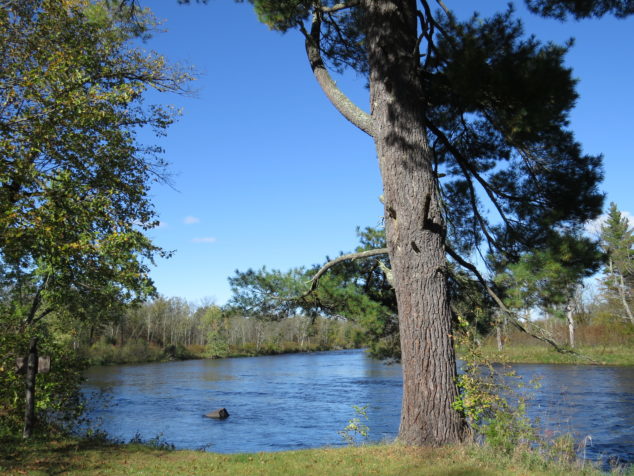
https://www.mprnews.org/story/2016/07/13/minnesota-adds-pollution-sources-impaired-waters-list
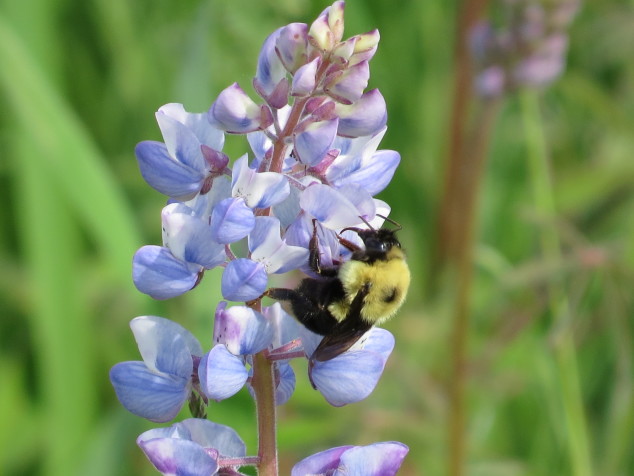
What is killing our bee populations, and what is the impact on agriculture? https://www.uky.edu/~jast239/reprints/Geography%20Compass%202016.pdf http://mjpa.umich.edu/files/2014/08/2014-BiancoCooperFournier-HoneyBee.pdf
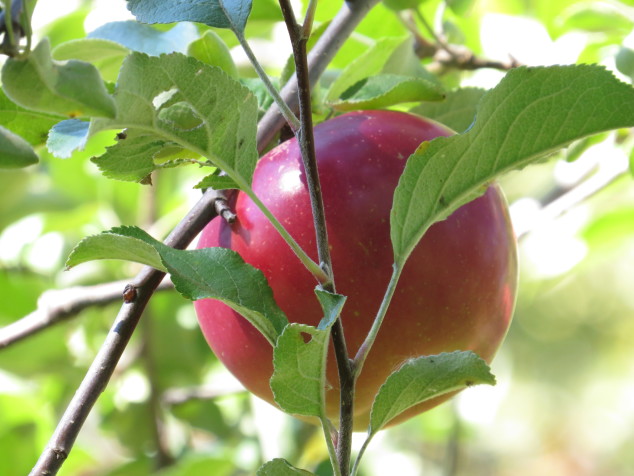
What happens when forests are clear-cut? https://www.youtube.com/watch?v=Un2yBgIAxYs https://www.sciencedaily.com/releases/2016/04/160415125925.htm
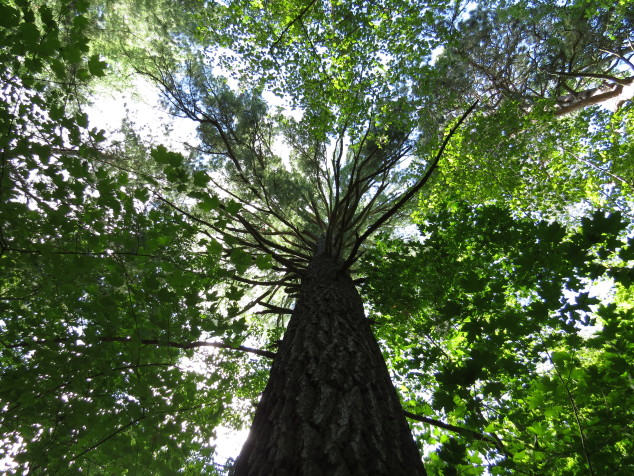
Scientific experiments seek to answer these complicated questions. Seldom is there a singular cut-and-dry reason; seldom is the answer an easy one. Mostly, answers lead to more questions. But each answer, each piece of information that is discovered about the situation, adds to the body of knowledge. It is a contribution to the big picture, and each piece shows a pathway to action that can be taken to solve the problem.
As for the things that don’t make sense in this world or in our lives, the same applies. Rarely is there just one reason; rarely is the reason a simple explanation. However, I hypothesize that there is always a reason for everything—not in the insensitive platitude ‘everything happens for a reason’ kind of way, but in the scientific ’cause and effect’ way. There was a reason why they gathered the guns and made the bombs, there was a reason they felt like this was an appropriate thing to do, there was a reason their thinking was so clouded and deluded, and there was a reason they fell through the cracks. As with everything, there is a long, complicated lineage of reasons why things occur. Answers lead to more questions. But information leads to understanding—that’s why questions are so important. That’s why multiple sources are important. That’s why experts are important. All help to configure the big picture, so we can take multiple pathways to solve these heart-breaking problems.
Wonder Will Be Yours
I remember staring with wonder at each of the tiny human beings we brought home from the hospital. I couldn’t get enough of looking into their eyes, holding their perfectly plump bodies with those tiny fingers and toes, and kissing their delightful cheeks while inhaling that ambrosial baby smell. Every good force of Nature and God was involved in bringing forth these new creations to occupy our family life for a time, and the awesomeness and privilege of that is not lost on me. Not even after all these years. Especially after all these years–when they have all gone on to living their own lives.
But still, when I see my cherished children, which is not often, I find myself staring at them, looking into their adult eyes, wanting to hold their hand or push back the hair from their forehead, and longing to kiss their cheeks. Their individual worlds are separate from ours now–the way of Nature–but the wonder is still there.
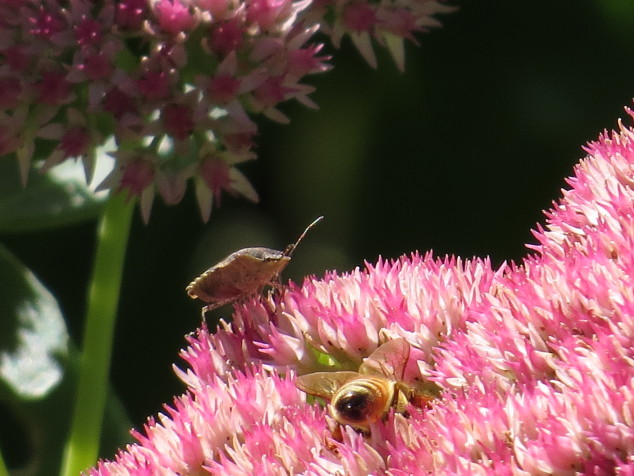
There are tiny, little worlds all around us. We catch glimpses of them from time to time and our understanding is expanded by information in books, nature films, and the encyclopedic internet. We can take a closer look at these tiny worlds at almost any time. Imagine the world of the honeybee–we see them working to gather nectar and pollen, but we don’t realize how much work goes on inside the hive. Sedum ‘Autumn Joy’ is an abundant source of nectar for honeybees at this time of year.
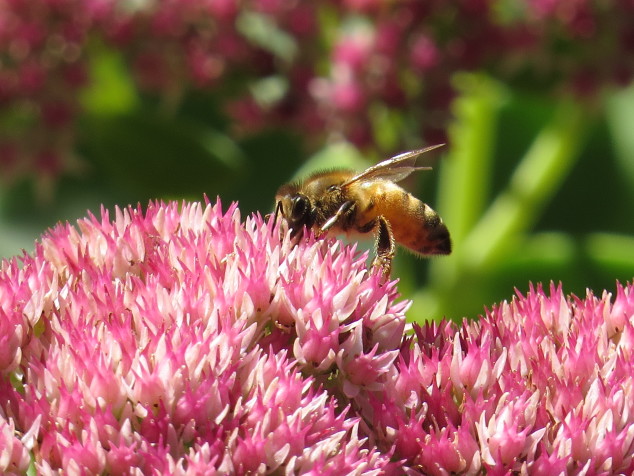
They share the joy with a pungent stink bug who raised his antennae in alarm when the honeybee flew near, but he determined that the bee was no threat to him. There was plenty of nectar to share.
Another little world lies hidden in a wild rosebush.
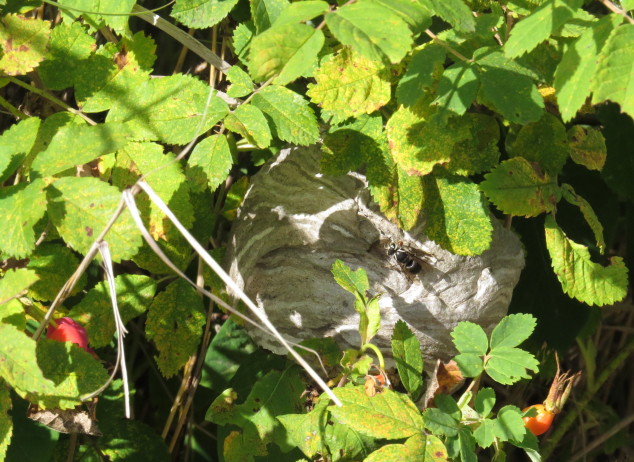
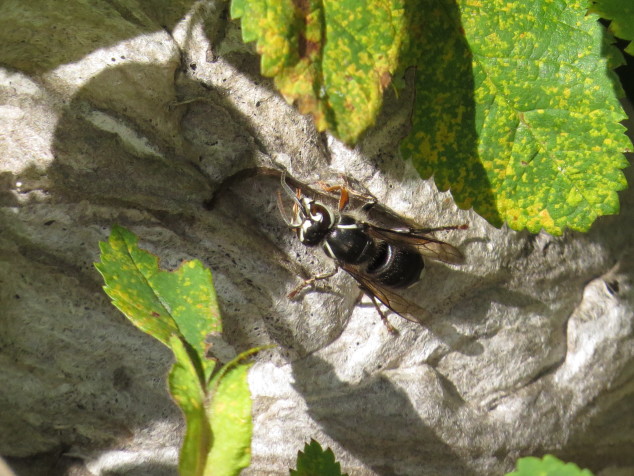
The bald-faced hornet, which is really a yellow jacket wasp, collects and chews wood, mixes the fibers with saliva to make pulp, and constructs a paper nest that houses comb-like nests of larvae and hundreds of worker bees.
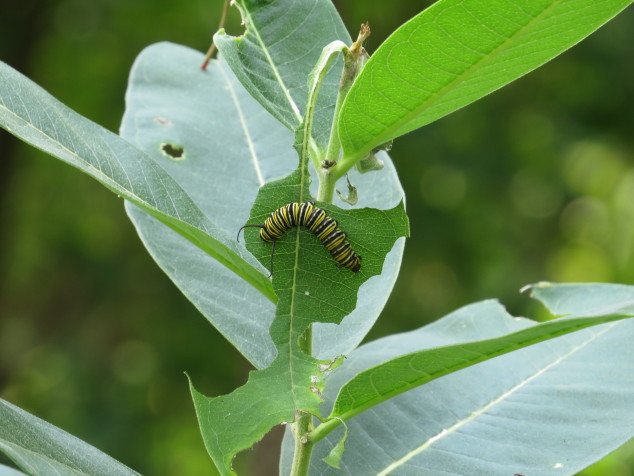
Most everyone knows the life cycle of the Monarch butterfly. Milkweed is the host plant for the Monarch caterpillar that hatches from eggs deposited by the butterfly. The caterpillar eats milkweed until mature, then forms a hanging chrysalis.
When the butterfly emerges from the chrysalis, he leaves the Milkweed world and flies into the vast, diverse Unknown full of dangers and delights. One of the delights is the formidable Joe Pye Weed that grows up to seven feet tall and produces huge mauve pink flower heads full of vanilla sweet nectar.
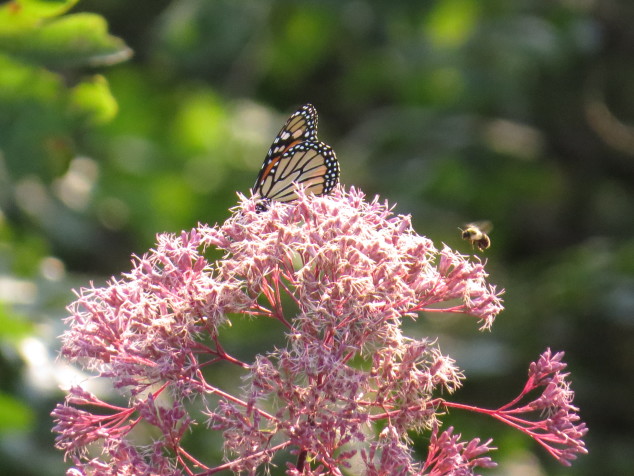 While watching the butterflies and bees swarm the Joe Pye Weed, I noticed a hummingbird at the nearby Summer Sweet bush. This small native shrub is another important source of nectar for butterflies and hummingbirds, and its fragrant, bottle-brush flowers will bloom in shade.
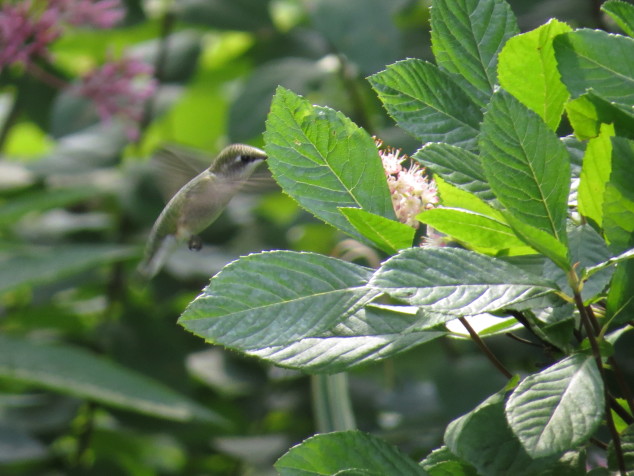
What a summer show! The enticing, sweet blossoms and the birds, bees, and butterflies!
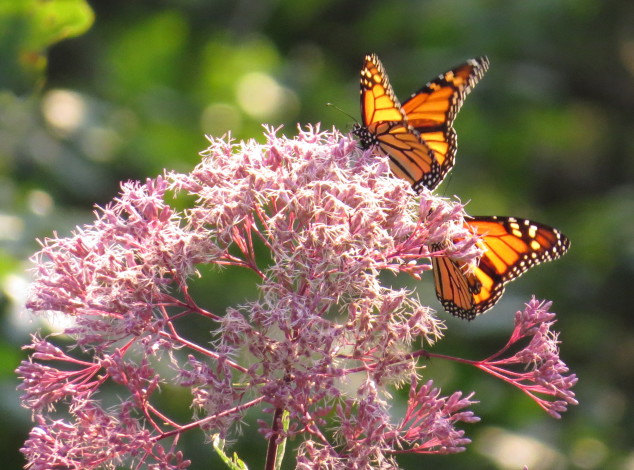
And then…Wonder! The Hummingbird flew over to the jeweled iridescence of the butterfly and hovered there!
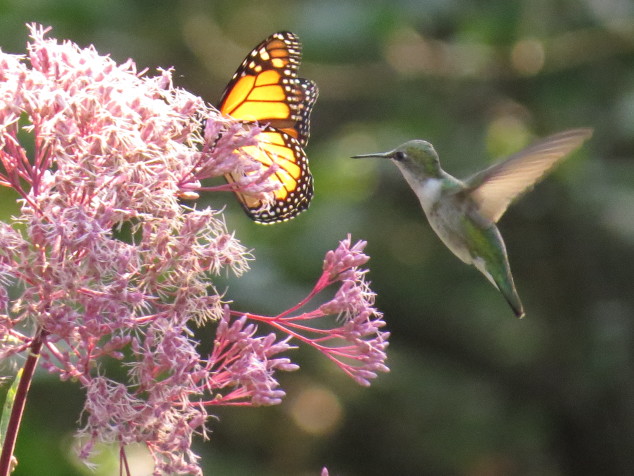 I am grateful and privileged to witness such a moment in the late summer world of Joe Pye. These tiny-world moments play out all around us, most of the time without our knowing. Take some time to notice the tiny world of some part of Nature and share the Autumn Joy!
I am no longer part of the daily world of my children, though daily they are in my thoughts, my whispered prayers, my silent sending of blessings upon their adult lives. I want to remind them, and all of you, that looking into another person’s eyes connects two souls, shares our tiny worlds, and reflects the face of God. Touching another person’s hand conveys interest and caring and does wonders for our physiology. Kissing a cheek bestows a gift to the one kissed and the giver alike. Let every good force of Nature and God inspire your life as you go through your life cycle and know that the nectar of love and joy is abundant–there’s enough for everybody! And Wonder will be yours.