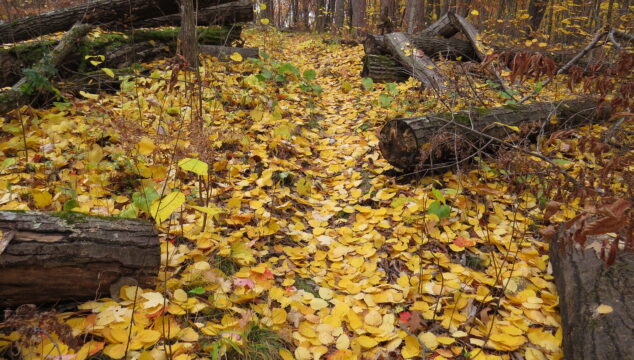
Come walk with me in the peak Autumn beauty of the Northwoods. To say that I love this time of year is an understatement. Most everyone can appreciate the colorful falling leaves---it reveals the 'true self' of a tree when its leaves are no longer producing chlorophyll. Their true colors are revealed, and there is something simple … [Read More...]
A Good Day to Fly
Early Tuesday morning I heard a soft thump on our open window. Even before getting out of bed to look, I knew a bird had flown into the reflective glass. It happens often. Sometimes it is the demise of the little creature; other times they can shake off the shock and fly on. A tiny fledgling wren was crumpled in the river rock by the sedum. He had just left the nest in the wren house that was hanging from a maple branch about fifteen feet from our bedroom window. In a few minutes, he scurried under the hosta plant for cover–on his own in the big world. The morning mayhem had already begun with the parent wrens working hard to feed their hungry brood–a noisy time! Except this morning was different–it was a good day to fly!
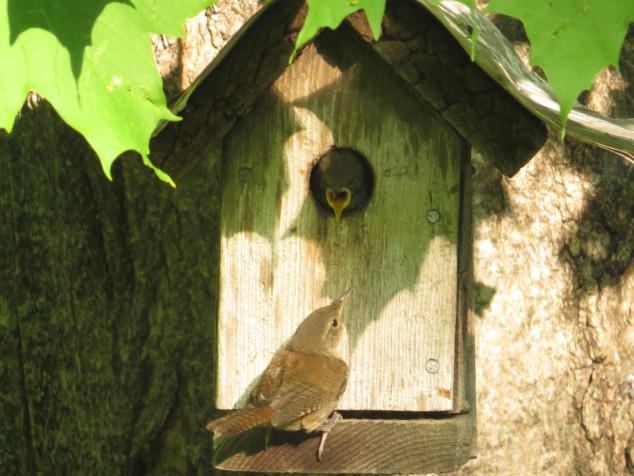
So instead of bringing food for the clamorous, hungry babies, the mama and papa wren flew to the house ‘talking’ encouragement to their young ones, then flying away again.
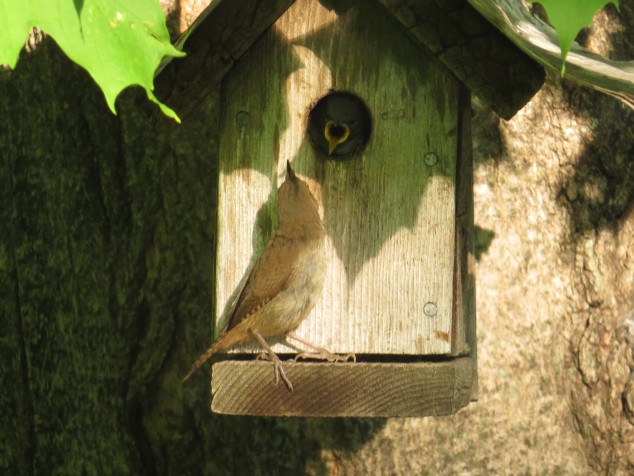
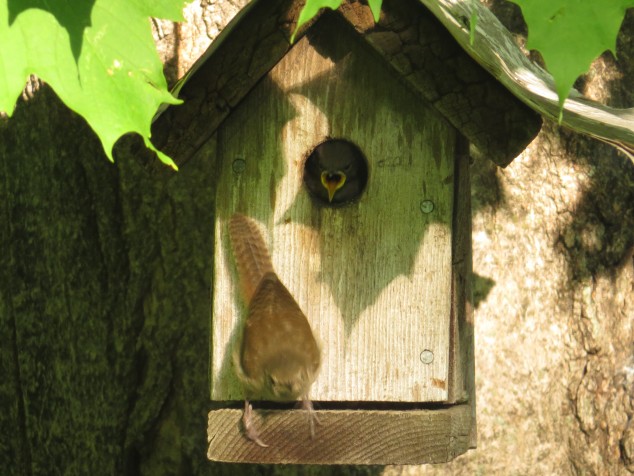
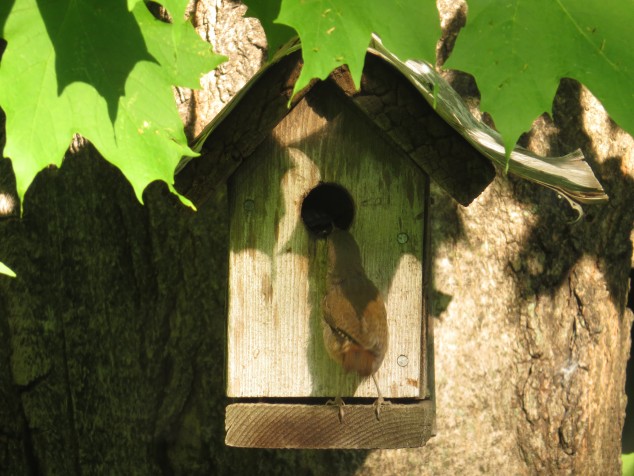
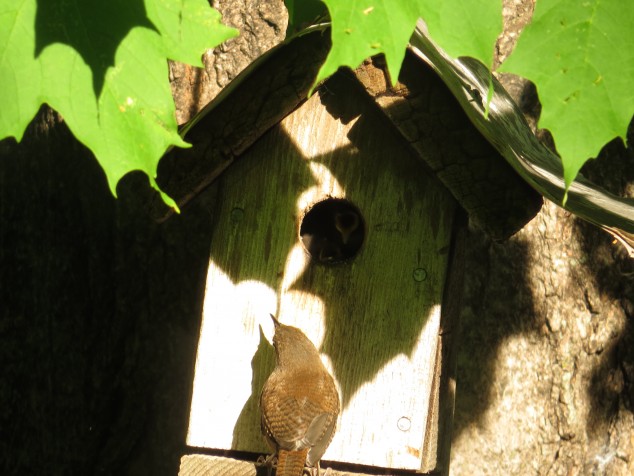
Mama wren would fly to the house, then to the roof, then to branches above the house, all the while chattering to her young ones. The baby at the opening was making just as much noise–constantly wondering why he wasn’t getting fed as usual.
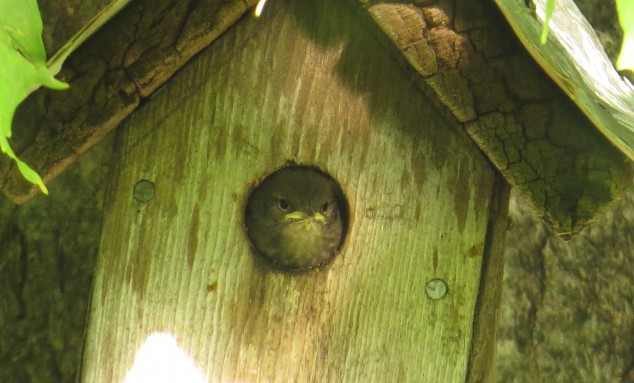
After more than two hours of this flying-day frenzy, I saw the mama bring food to the baby. Some food and rest were in store after all that hard work. They would try again another time.
At noon that day, I heard our black lab burst from inside the house onto the screened-in porch with an urgent bark–the kind that means something is out there! I looked out the back window and saw turkeys flying and running from the loud, startling threat. One adult sentry of the posse of turkeys calmly surveyed the scene, then walked into the woods, while the others looked down from their secure perches in the oak trees.
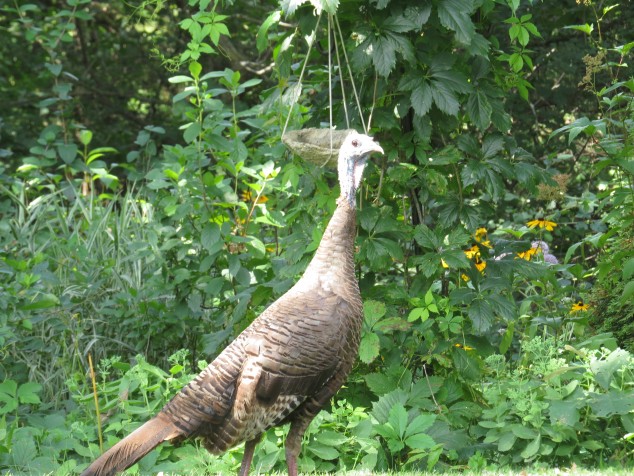
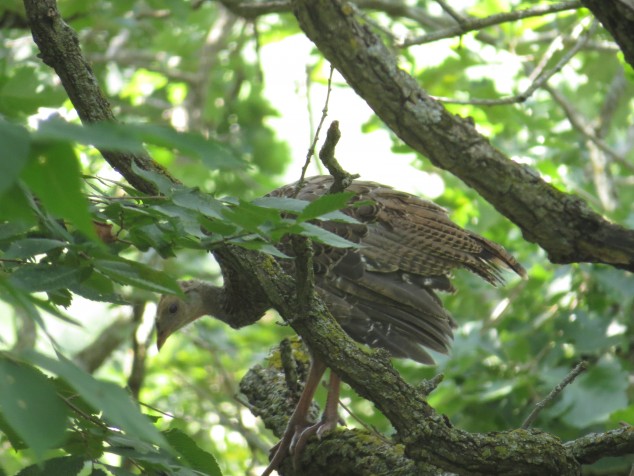
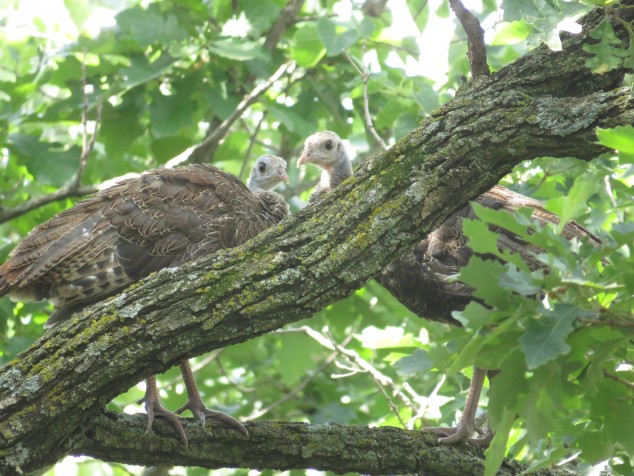 With the dog safely contained in the house and no longer barking, the turkeys cautiously left their perches, floating down to the ground like tiny brown parachutes.
Baby flyer training for the wrens began again early the next morning. The chatter was loud and nonstop. The fledgling was much more determined due to hunger or instinct or increased confidence. Though it took many tries and much prompting from mama wren, baby number two soon took the leap!
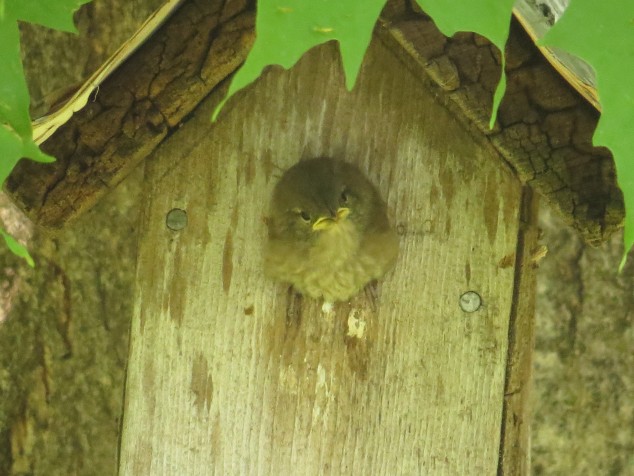
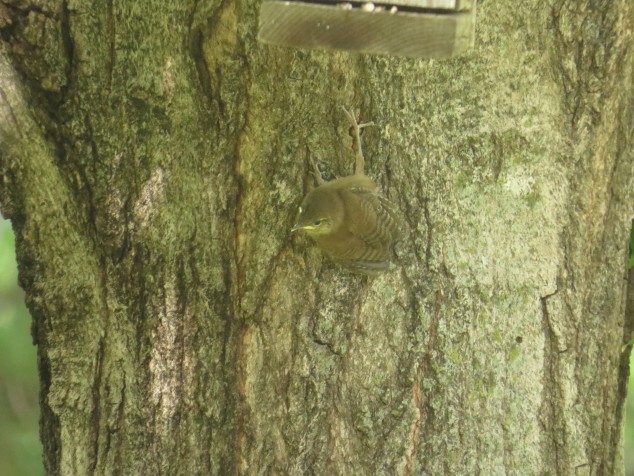
Next flyer on deck!
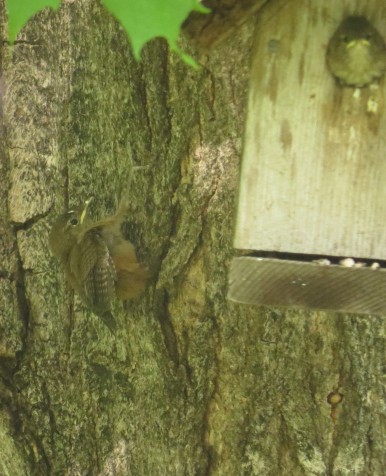
This time mama wren brought some enticement but flew away without feeding it to the baby.
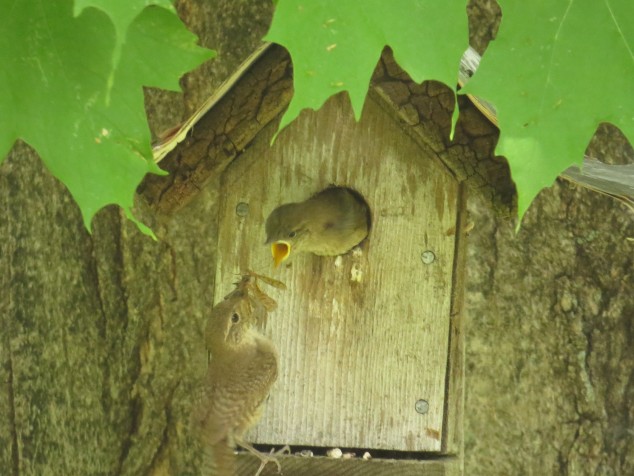
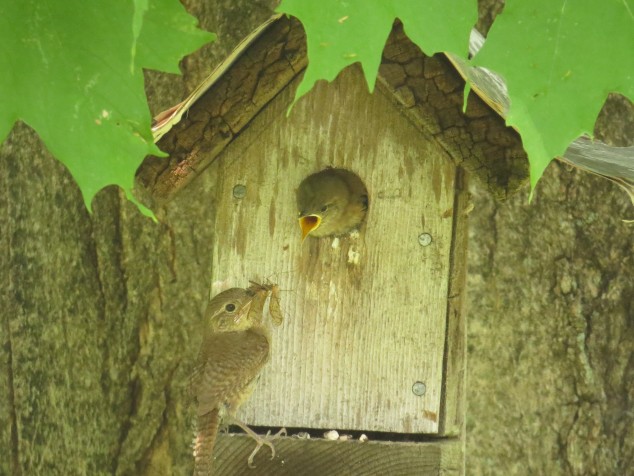
‘Dang! I guess I’ll have to get out of here to get that tasty morsel of food.’

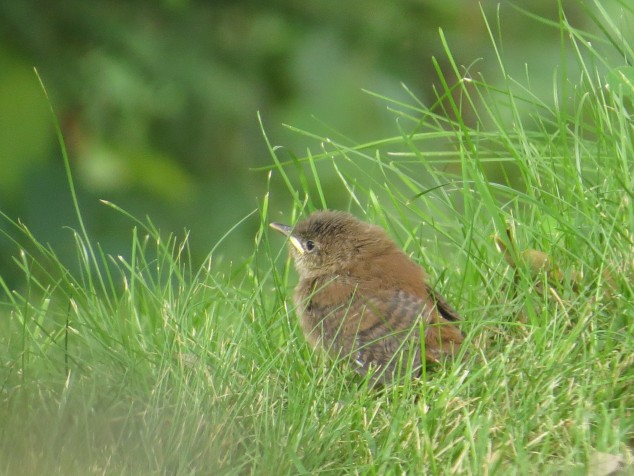
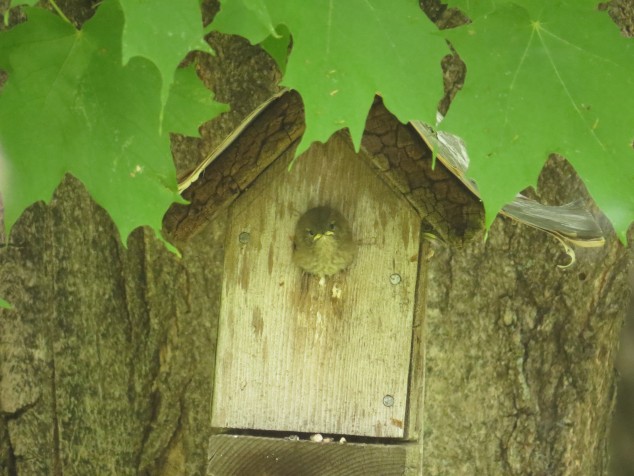
Baby wren number four followed suit and cautiously dropped to the ‘porch’ of the house.
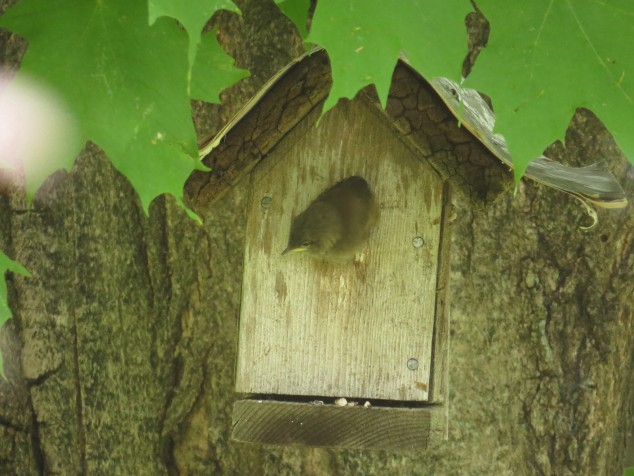
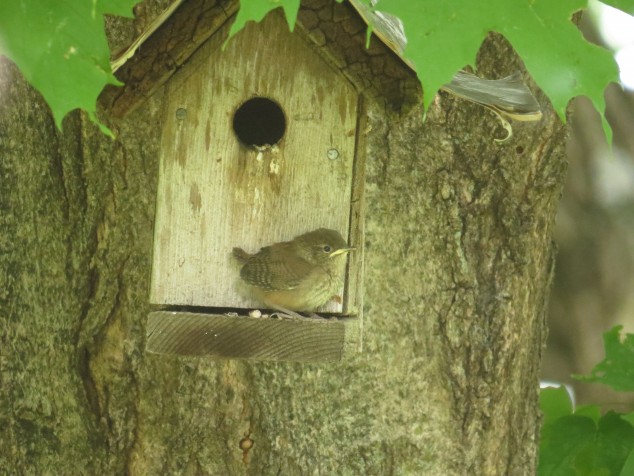
‘Your turn. If I can do it, you can do it, too!’
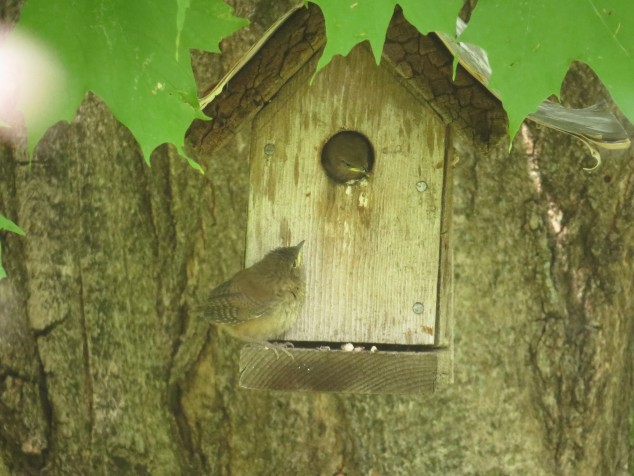
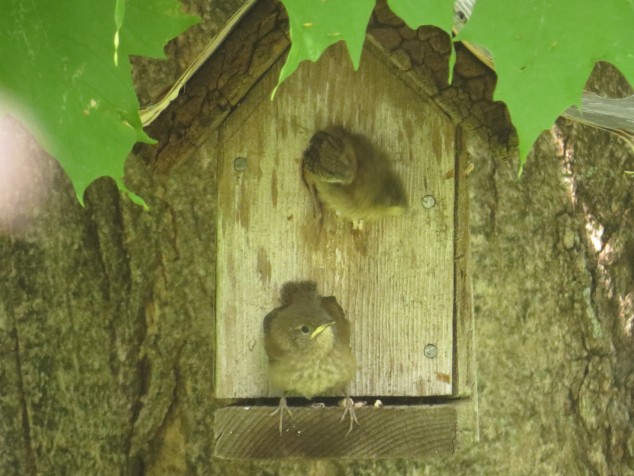
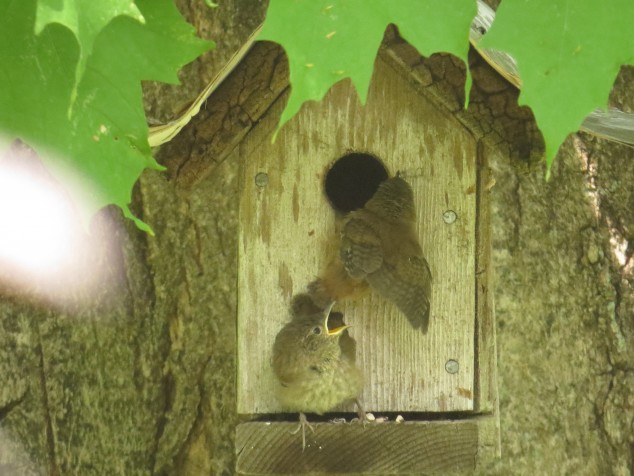
‘Where’d she go?’
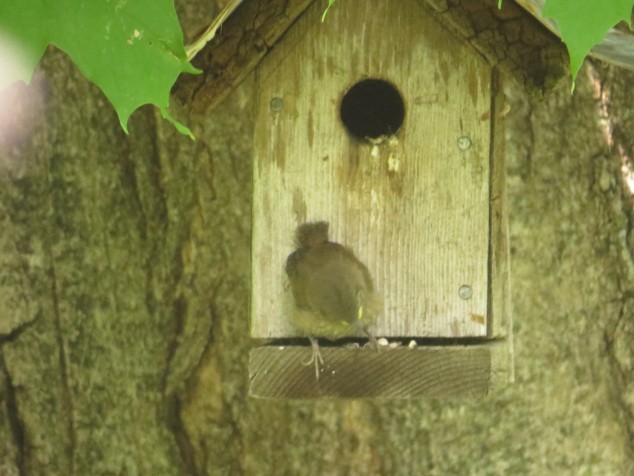
And finally, mama wren flew to the branch above the house, and the last baby followed her into the maple canopy.
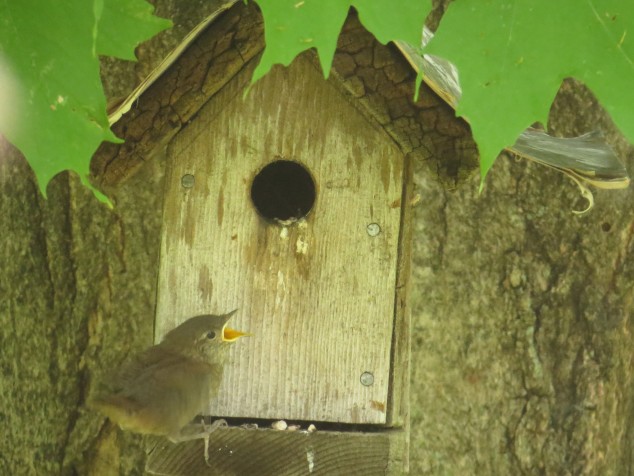
Empty nest. Empty house. Quiet.
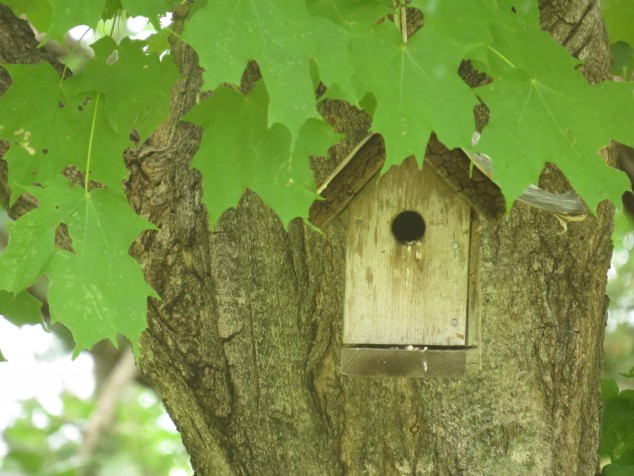
Sometimes with all the best intentions and timing and encouragement, we try new things but don’t succeed. We rest and re-group and try again. Sometimes, like the turkeys, we are forced to fly. Scary things happen, and we fly to save our lives. Hunger for a better life, frustration with the status quo, enticements that feed our body and soul, encouragement from others who have gone before us, and the positive peer pressure that makes us take the leap combine with our innate cycle of change and development to make it a good day to fly.
Up Close and Personal
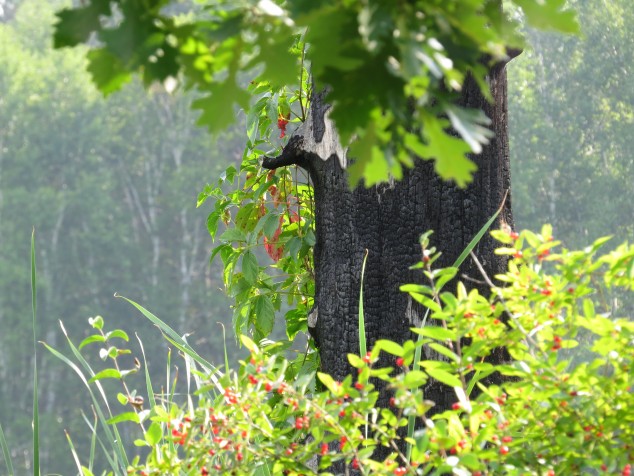
I’m not one to jump into things without thought…and contemplation…and risk assessment…and a list of pros and cons…and asking how does this fit into the Big Picture? Once I get the big picture though, I like to look at the details. When you examine things up close and personal, you can see what is not apparent from a distance. The details are intriguing–they are the puzzle pieces that fit together to make the whole what it is.
We hiked at Saint John’s Arboretum on Sunday. From a distance we could see a charred skeleton of a tree, stark and black against the summer colors. We traversed a marsh of cattails and green-black water on a winding boardwalk straight out of a Dr. Seuss book. The burnt tree stood beside two other long-dead trees where the shore of the marsh met the hill. Did high water kill them many years ago? Was the oak struck by lightning when the dead wood easily burned? Did a controlled burn get a little out of control? Virginia creeper snaked up one side of the trunk and was beginning to turn scarlet. Honeysuckle berries glowed red in the foreground while an oak branch hung down in vibrant green–all with a background of hazy gray-barked aspens. Let’s look a little closer.
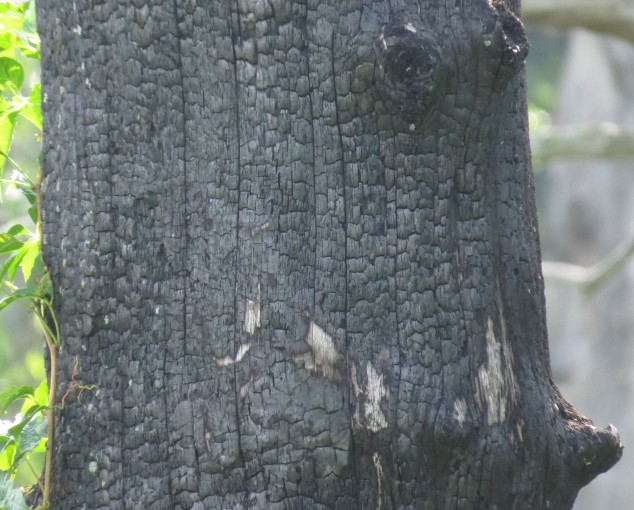
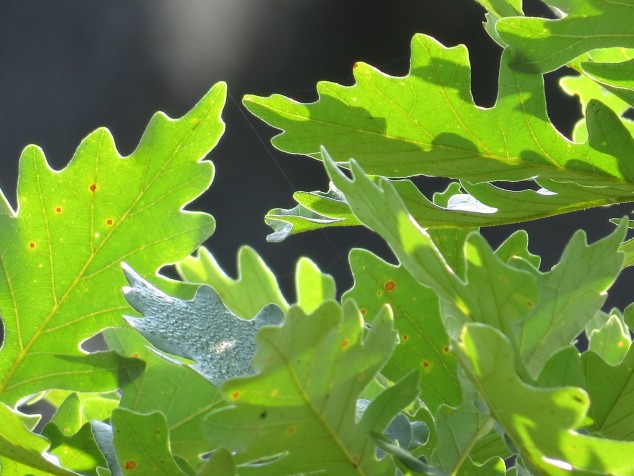
Gray places on the trunk where the fire skipped over. The tendrils of the Virginia creeper clutching to the scorched crevices. Rusty spots beside the veins on the oak. Dewdrops on the shaded leaf. A tiny black spider and a filament of web. Light and shadows.
Examine and enjoy the amazing details of plants from the arboretum and from our gardens…
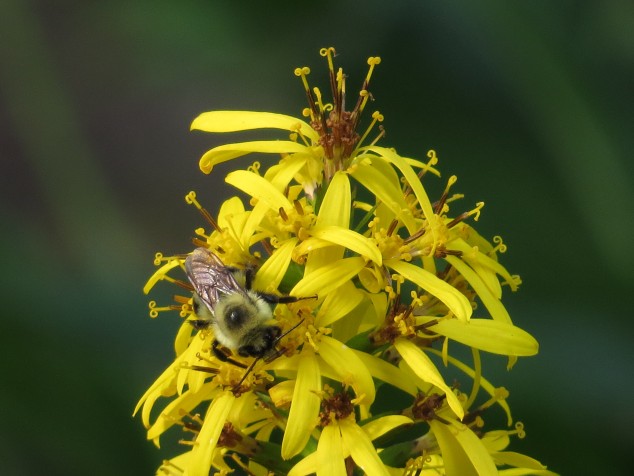
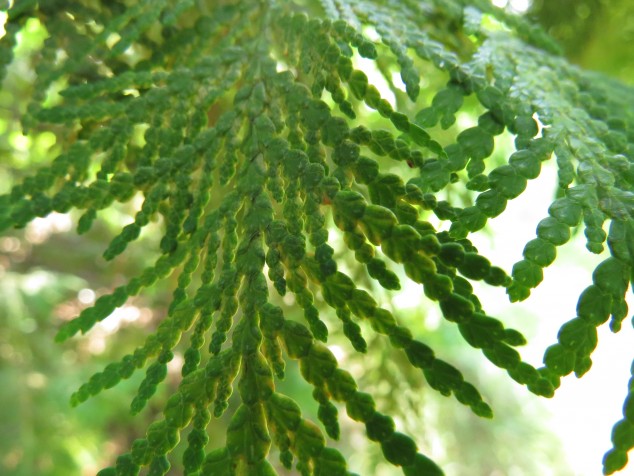
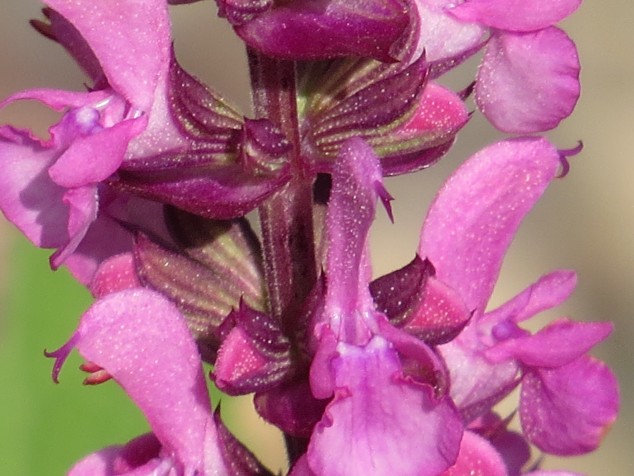
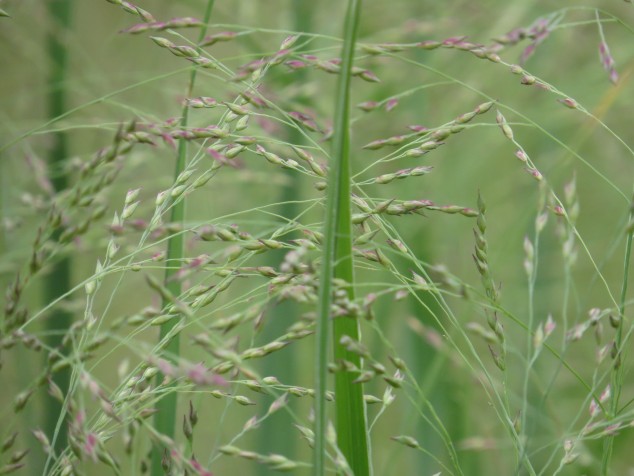
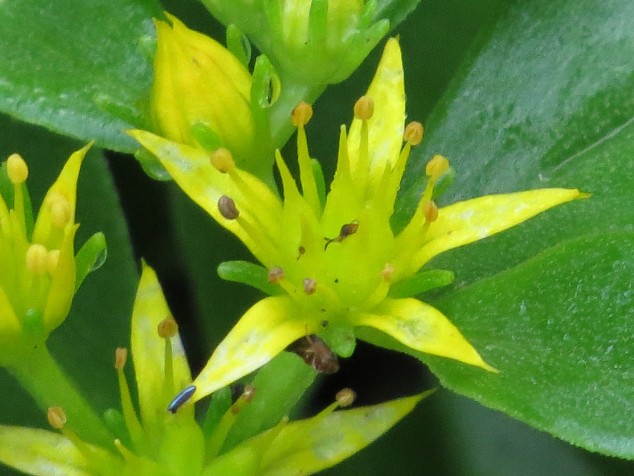
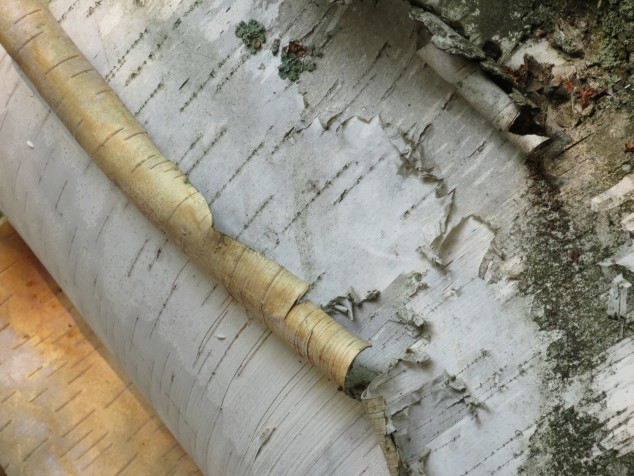
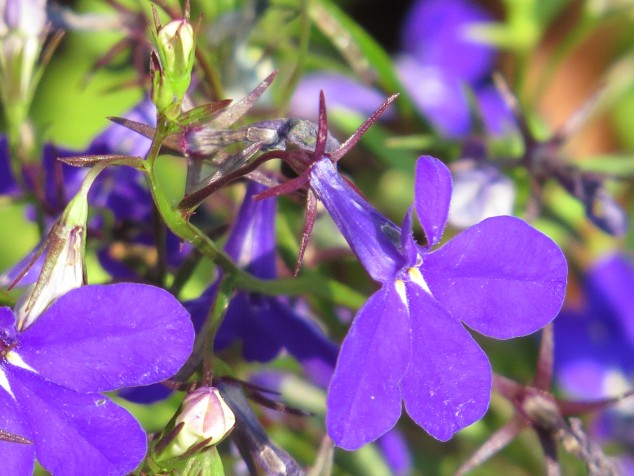
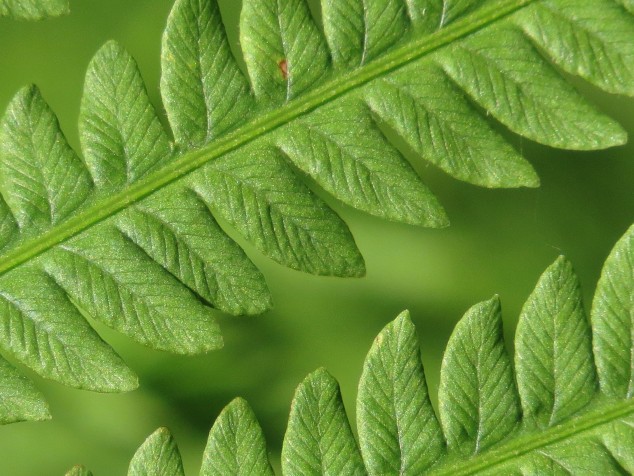
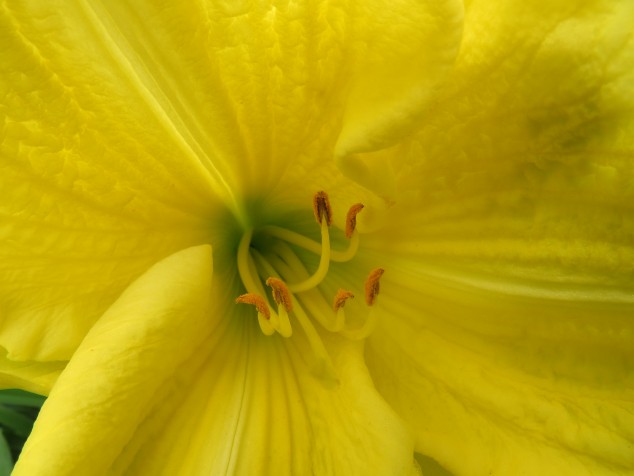
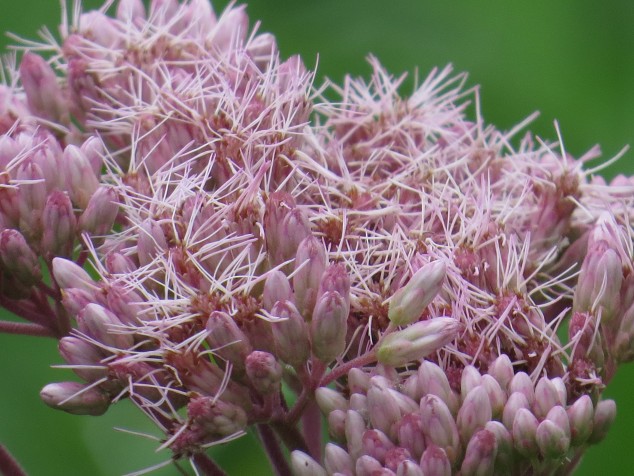
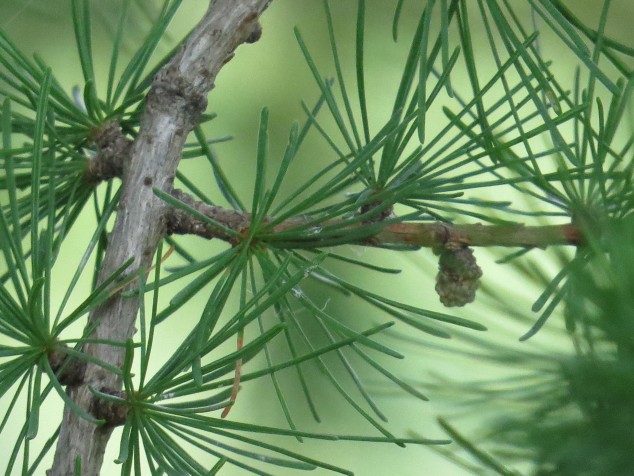
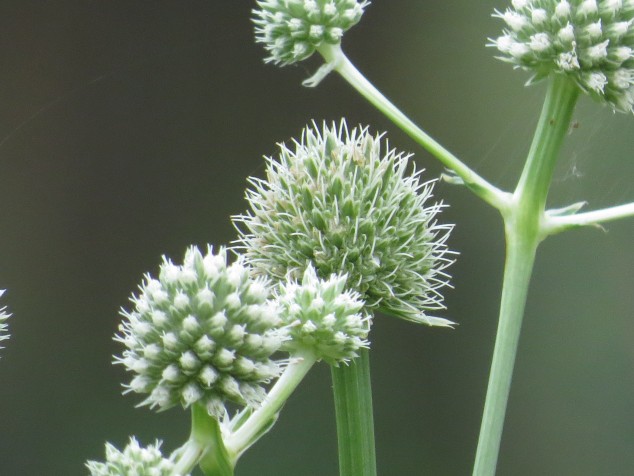
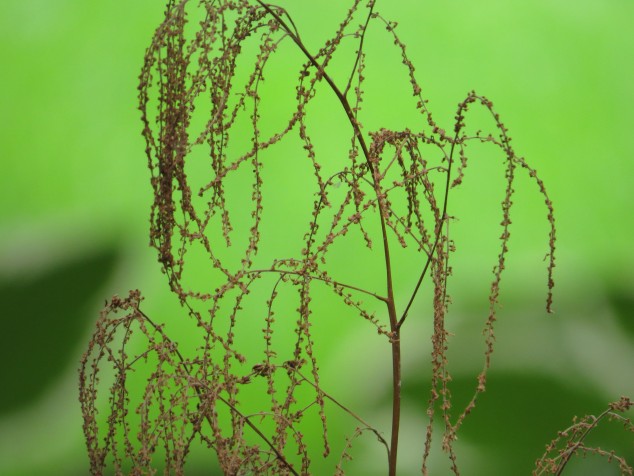
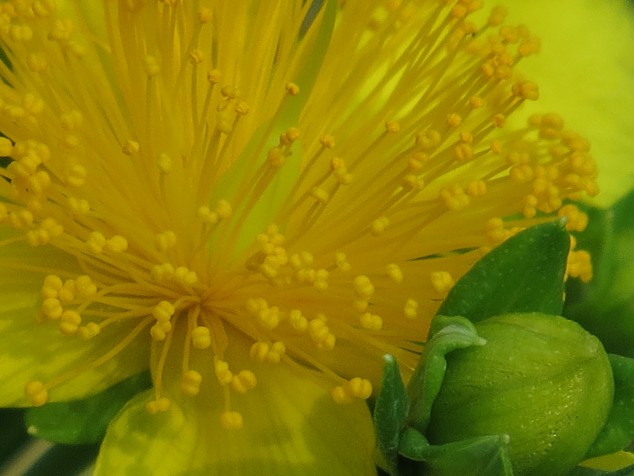
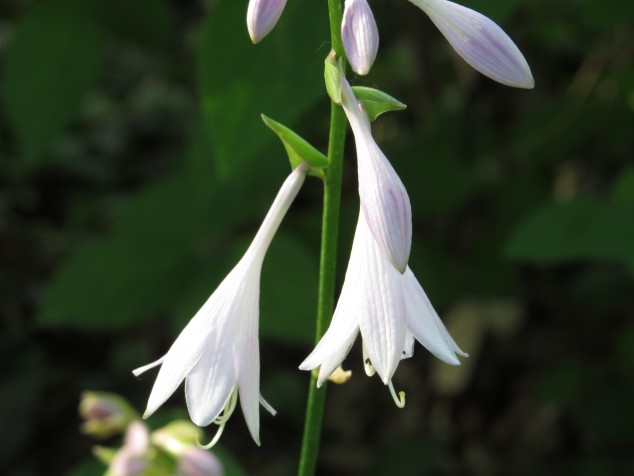
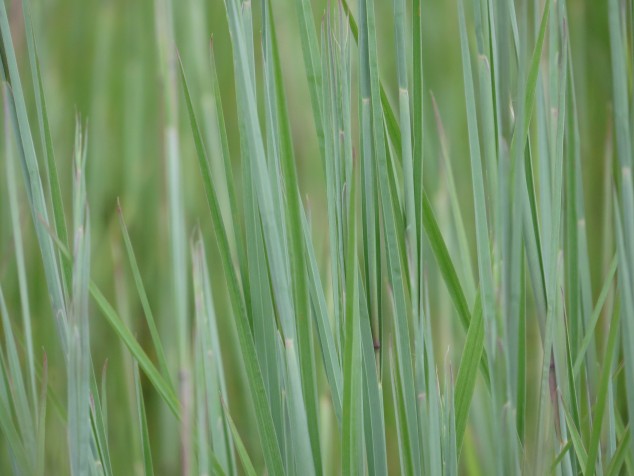
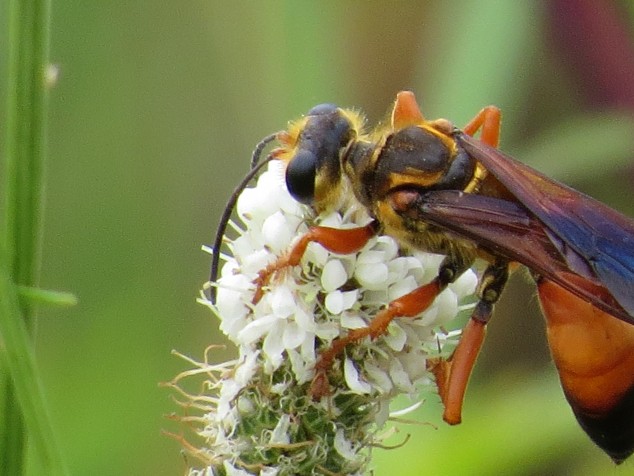
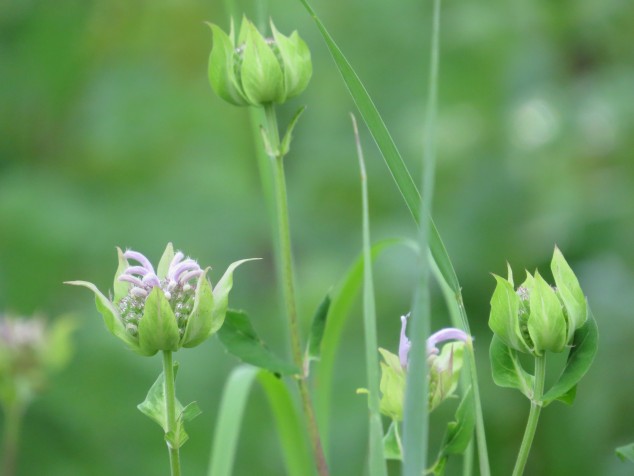
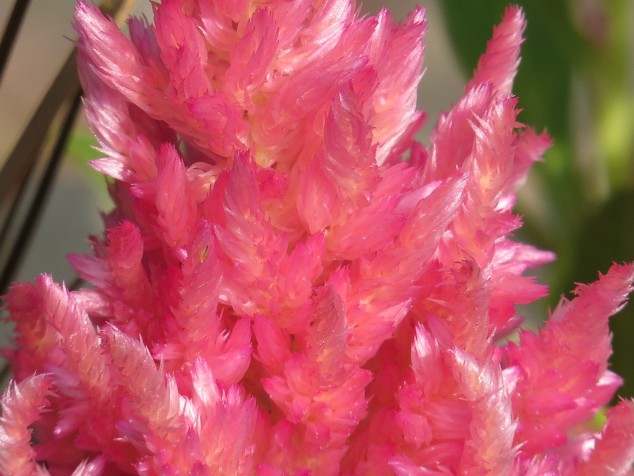
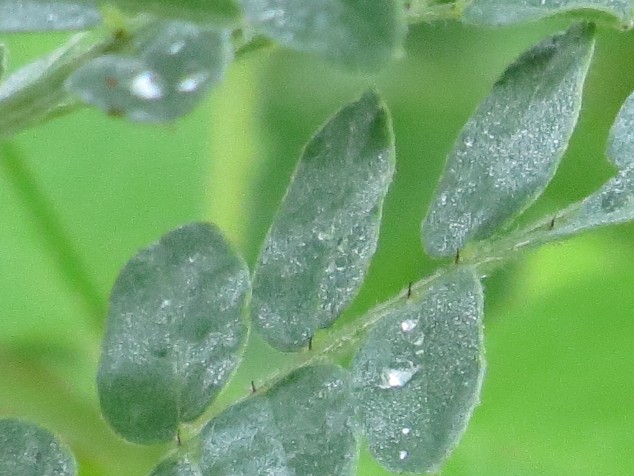
“There is a holiness to nature, in the intricacy of the system. Its secrets are open to all to learn, but it takes patience to develop the eyes and history necessary to see.”
Fr. Paul Schwietz, O.S.B., Founding Arboretum Director
Gleanings from July
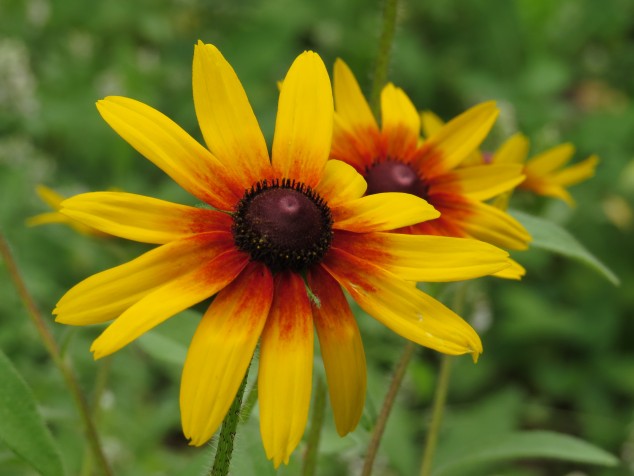
Rudbeckia or Black-eyed Susan
July is Summer in Minnesota. In June, we were still marveling at the fully leafed out trees and growing perennials as we walked the cool mornings in a fleece pullover. And August will already be showing us hints of fall as the sumac begins to turn scarlet. But July is warm and sunny, and the warm-season grasses, flowers, and vegetables grow wondrously, bloom extravagantly, and produce prodigiously.
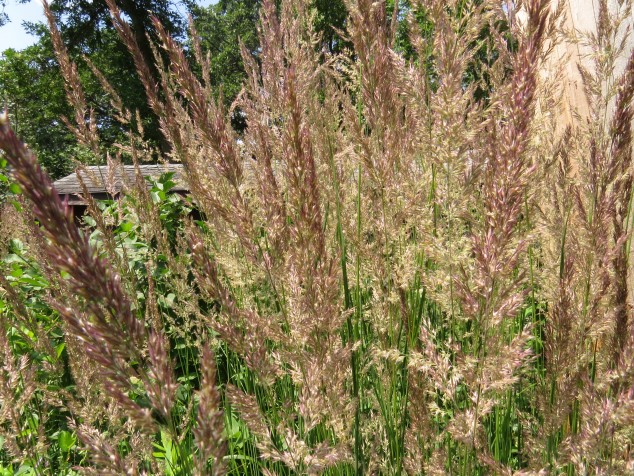
Miscanthus sinensis ‘Morning Light’
It is also Hosta month. You realize just how many hostas you have when they all bloom–or I should say, when you have to cut back all the spent bloom stalks! The bumblebees and hummingbirds love them.
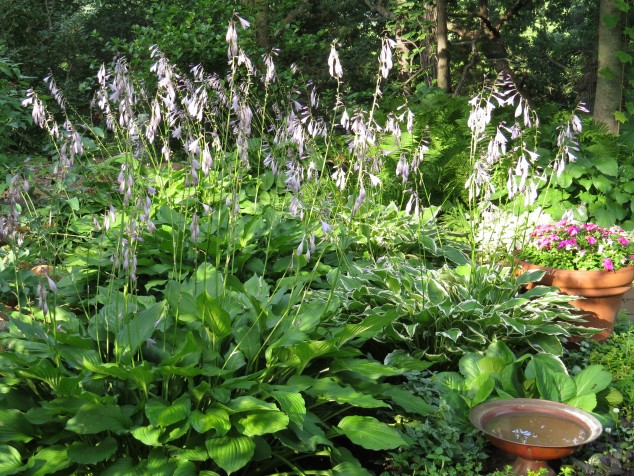
Hostas in bloom
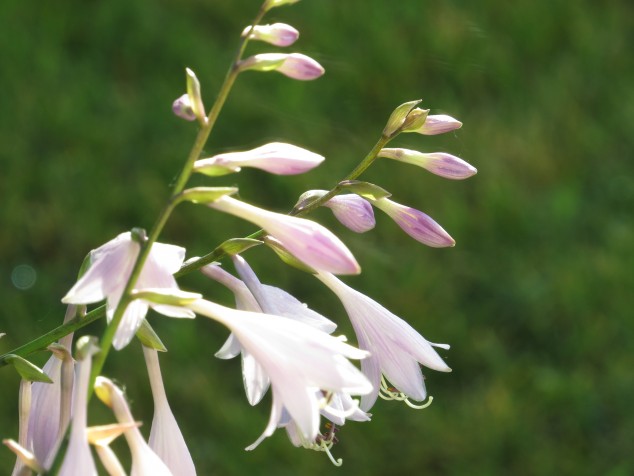
Hosta flowers
July is a great month for bike riding and taking in the lake and trail landscapes. We saw tall, woody Meadowsweet–a native Spiraea, bright Purple Prairie Clover, and spiky Culver’s Root. Grasses were top-heavy with seed heads that swayed as we swooshed by. It smelled sweet and earthy-warm.
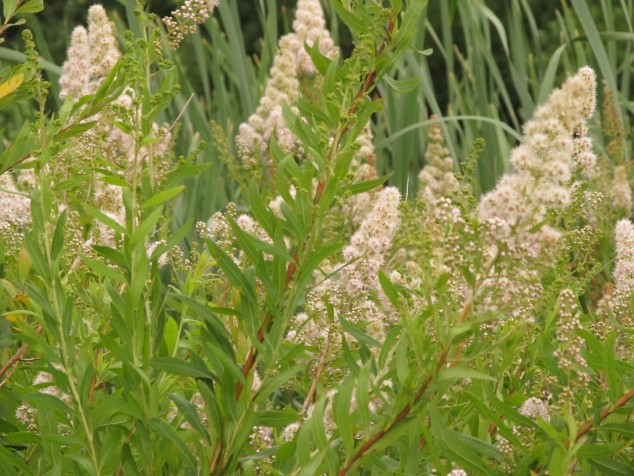
Meadowsweet
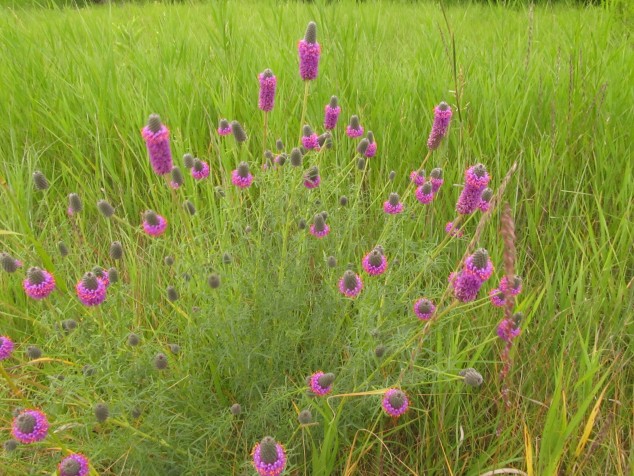
Purple Prairie Clover
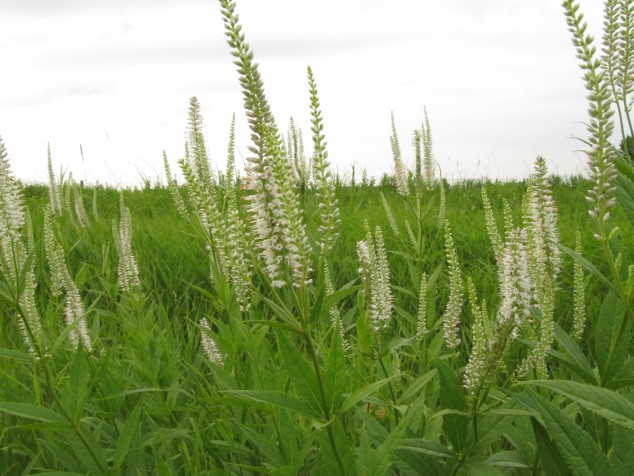
Culver’s Root
This interesting spider web was spun in a small, bare-branched tree. I didn’t stop to examine the center to see the catch or the catcher.
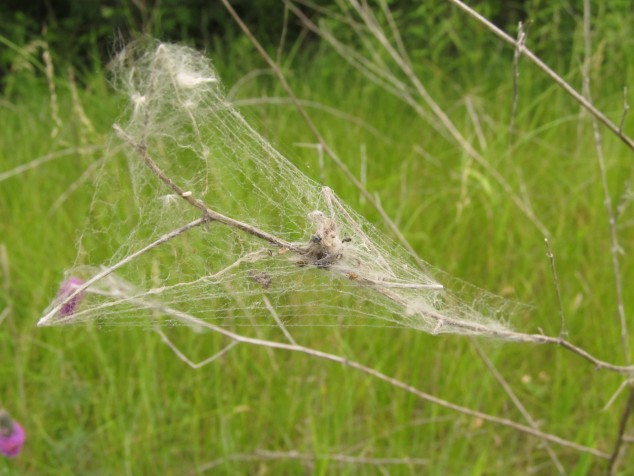
Spider web along the bike trail
At the lake we saw a turtle chowing down on something, while carrying extra cargo on his back.
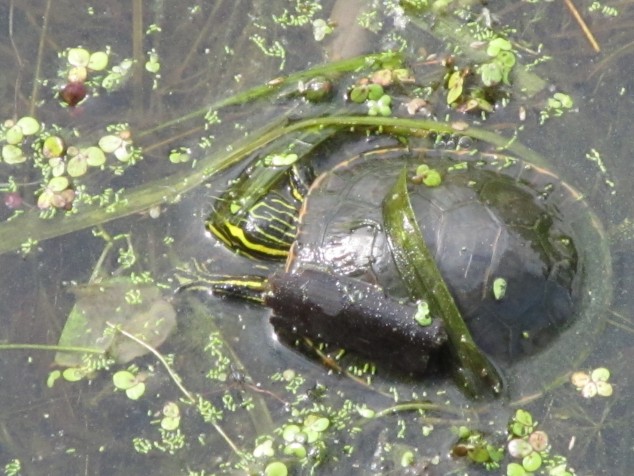
Turtle
This little chipmunk had a sturdy granite home on the lake inlet by a stand of cattails.
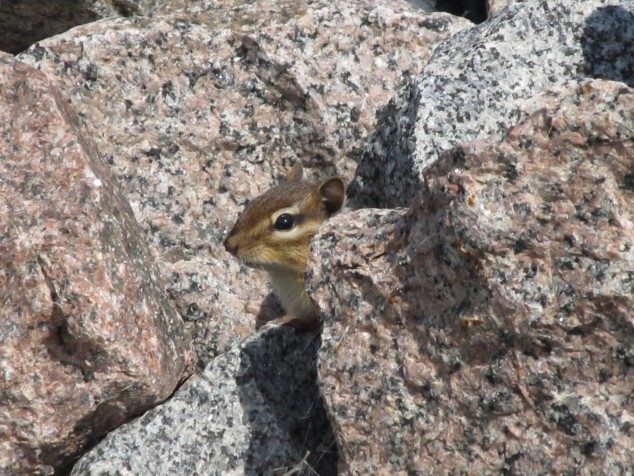
Chipmunk
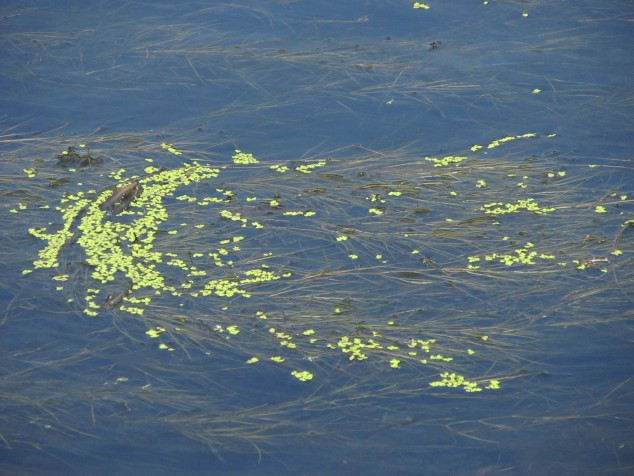
Duckweed on lake inlet
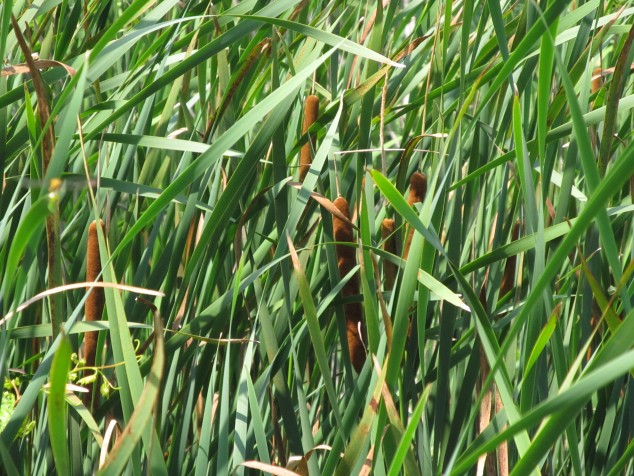
Cattails
Up north at the camp we visited earlier in July, Michaela captured a picture of a young raccoon sitting amidst the poison ivy by a pine tree. Young raccoons stay with their mothers until 13-14 months old, but this little guy has been seen wandering by himself.
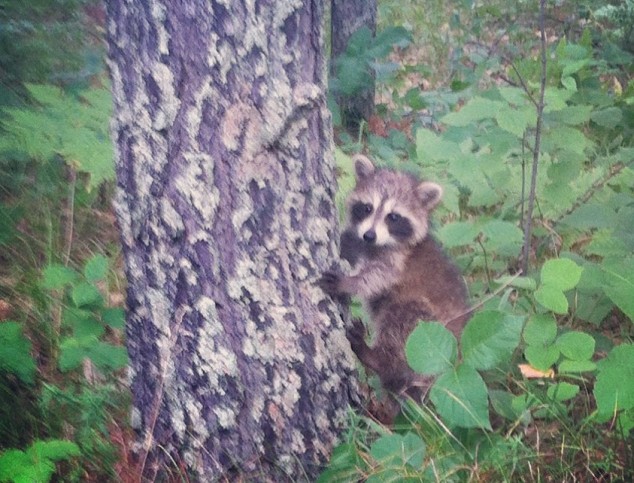
Young raccoon–photo by Michaela Demarais
A glittering spider web adorned the creeping phlox by our mailbox, catching the water droplets from the sprinkler.
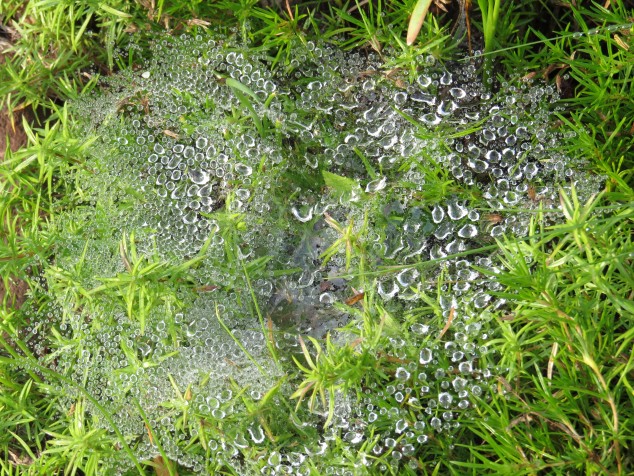
Water drops on a spider web
July is glorious–a month of growth and beauty. It’s a month of going with the flow, enjoying the warmth, and spinning a web for your life that will catch all the goodness the world has to offer. Take it in!
A Posse of Turkeys
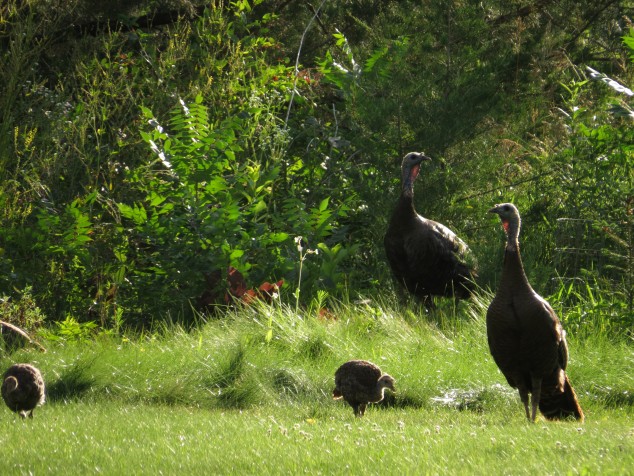
One bright morning while eating breakfast, I heard a car honk, so turned to look out the window. A posse of turkeys was walking up the driveway into our yard. Three adult females were herding countless young juveniles through the grass to a path by the blueberry patch that led into the cedar and oak woods. Turkeys have excellent day vision–three times better than that of humans–so I’m sure they saw me move to the window with the camera.
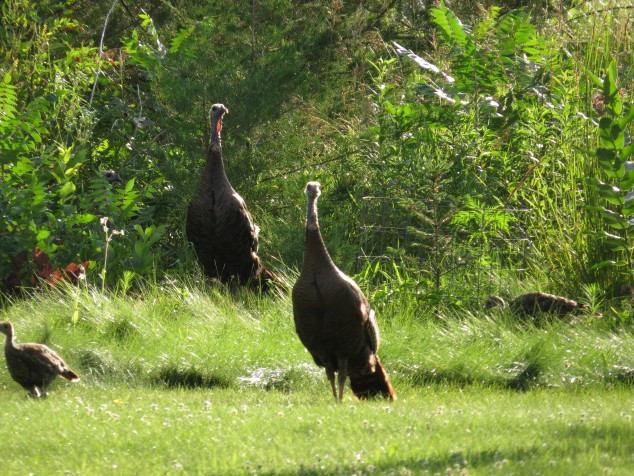
These mother/child groups of turkeys are known by many names–flock, raffle, gang, crop, and posse to name a few. After spring mating and laying a clutch of 10-12 eggs in a shallow dirt depression nest, they incubate the eggs for 28 days. The poults hatch and leave the nest within 24 hours, ready to travel with the posse and forage for food.
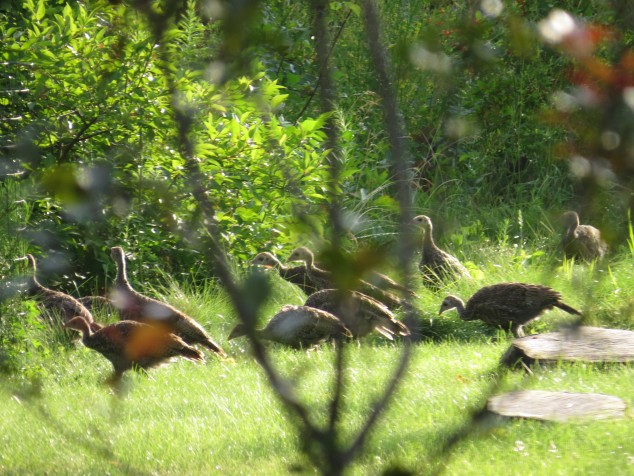
The young juveniles–male jakes and female jennies–eat grasses, seeds, nuts, insects, and fruit. Adults also eat small salamanders and snakes.
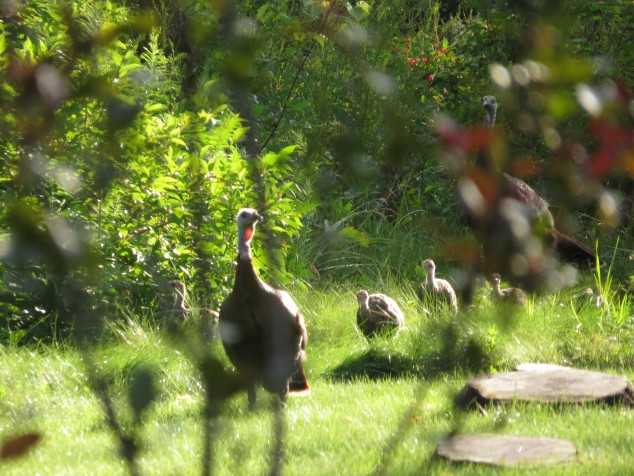
In the early 1930’s the wild turkey population was on the verge of extinction, but thanks to conservation efforts the range and numbers of turkeys are greater than ever.
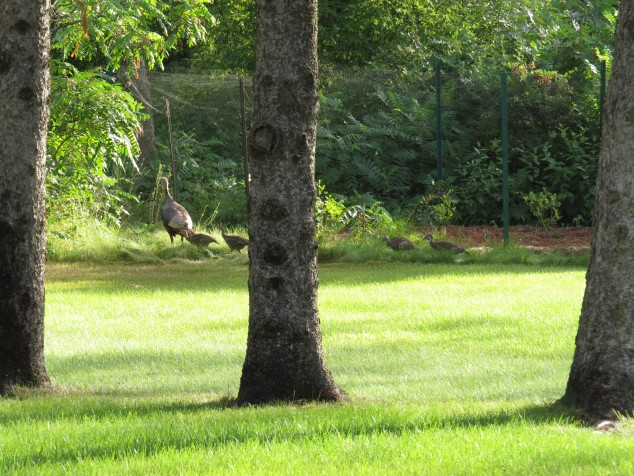
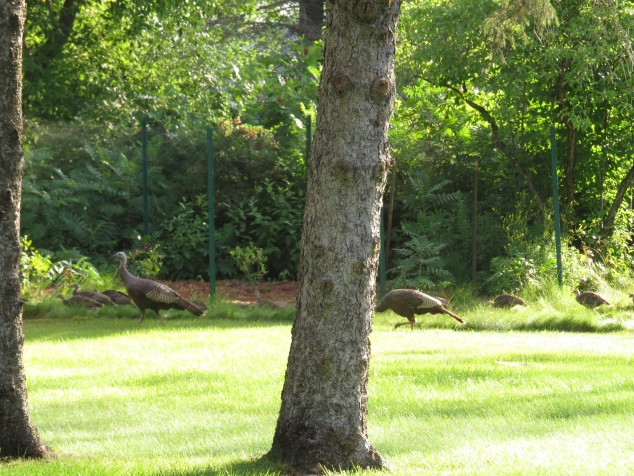
Turkeys can run up to 25 mph and can fly for short distances up to 55 mph. They roost in trees at night.
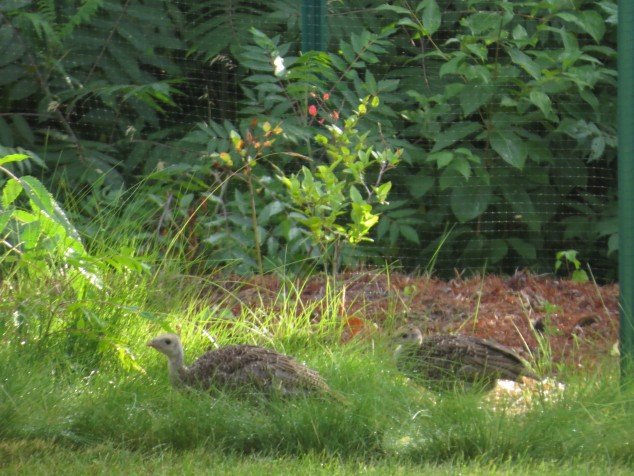
An adult tom or hen has between 5,000 and 6,000 feathers, many with an iridescent copper, gold, and bronze coloring. Both sexes have a wattle under the chin and have a bare head that can turn red, white or blue with excitement or emotion. Males have long spurs on their legs and a stiff beard growing from the chest.
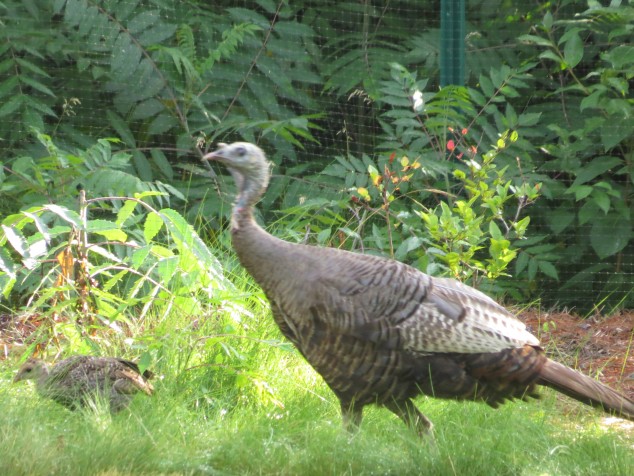
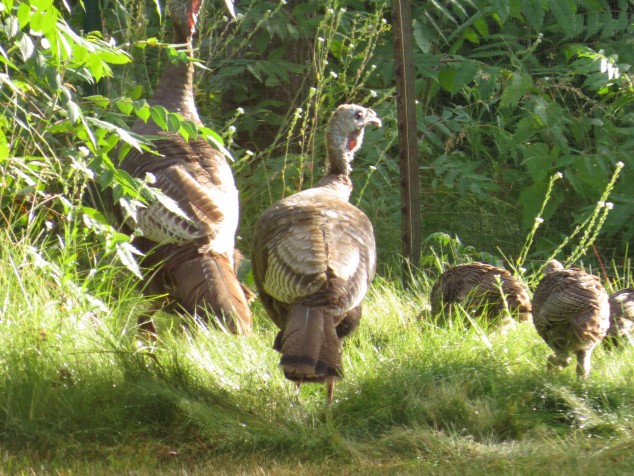
They walked into the woods, pecking at food as they went, with the females ever vigilant to protect their offspring. Benjamin Franklin wrote that the wild turkey was a ‘much more respectable bird’ than the bald eagle when discussing the choice for the National Bird. I feel privileged to have witnessed the families of both species in the last month. Both are beautiful and impressive with unique characteristics and a dedication to parenting. I’m glad this posse showed up at our home!
Leap of Faith
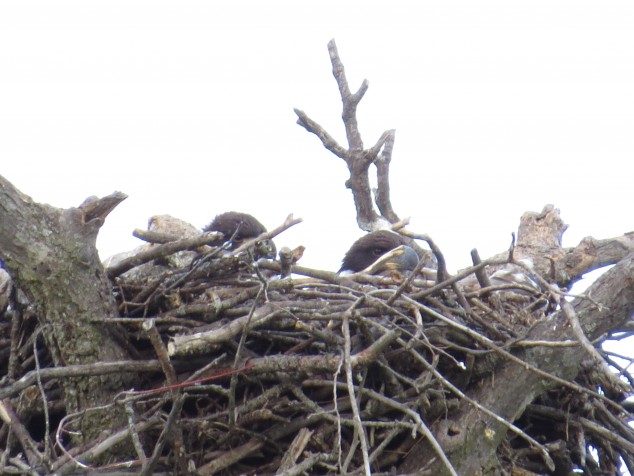
We checked in at Eagle Park to see if the young eaglets had ‘fledged’ or flown from the nest. At the beginning of last week, we went on a cool, windy day. The two eaglets were hunkered down in the nest with only their heads showing, and that’s where they stayed the entire time we were there. We didn’t see either of the parents.
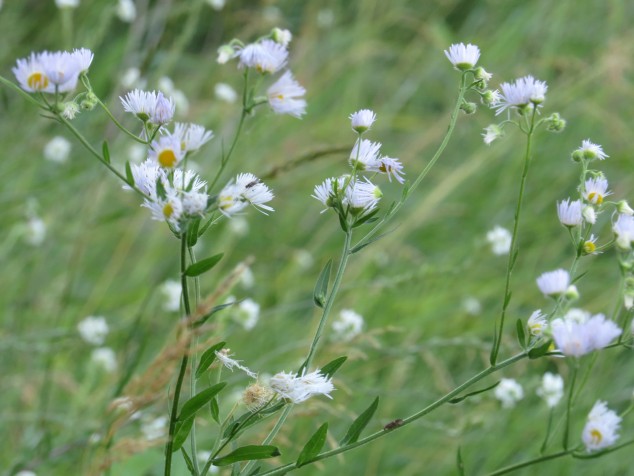
So we wandered around the park trail looking at wildflowers, grasses, and rocks. One of my favorite wildflowers is the delicate Daisy fleabane. This common, understated member of the Sunflower family is so named because of its use to repel fleas. I wonder if the eagles use it in their nest.
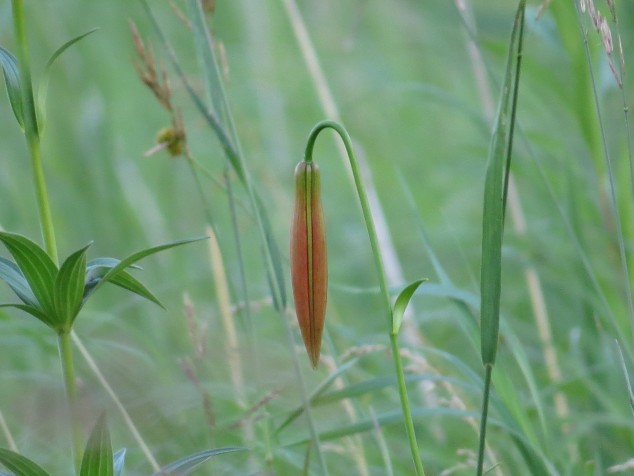
I love the ‘potential’ in a flower bud. The following photo is the bud of a Turk’s-cap lily. The petals unfold and curve back to showcase the extended stamens and showy anthers. Isn’t it amazing that the bud contains all of that!
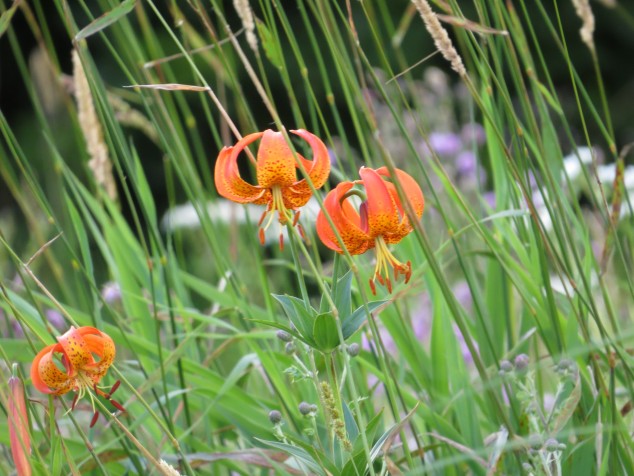
The Butterfly weed was still looking spectacular, also.

We returned to the park last evening. The Goldfinches were flying from the bare branches of a crabapple tree to the large sweeps of thistles that were going to seed.
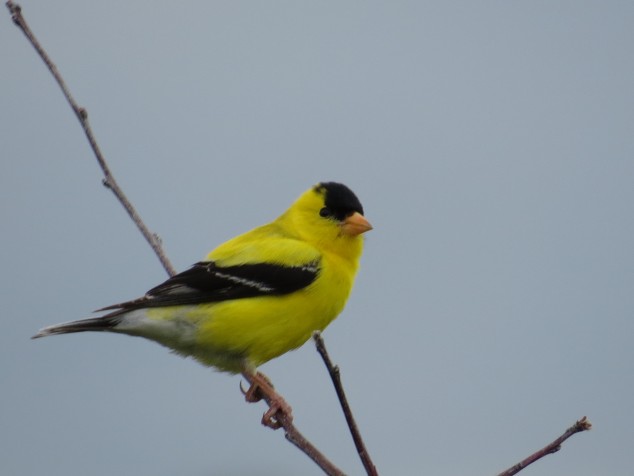
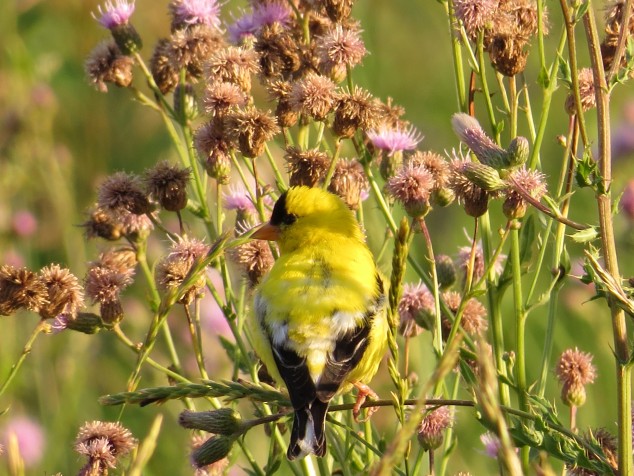
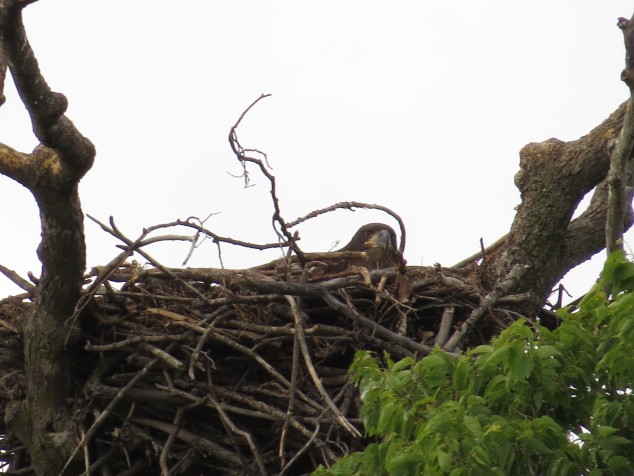
And who was in the nest this time?
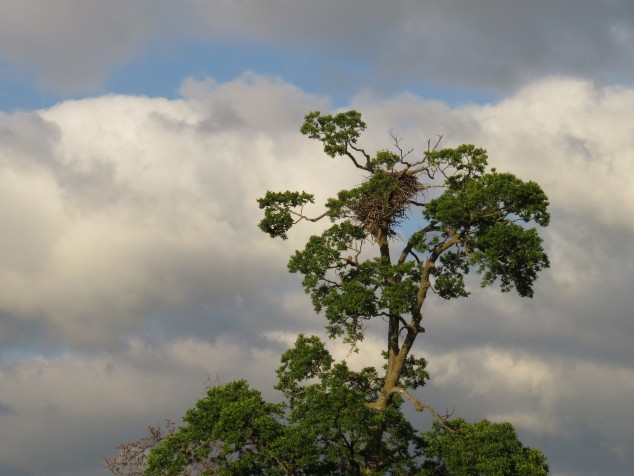
We found only one eaglet in the nest. He stayed there for most of the time we hiked around the trail.
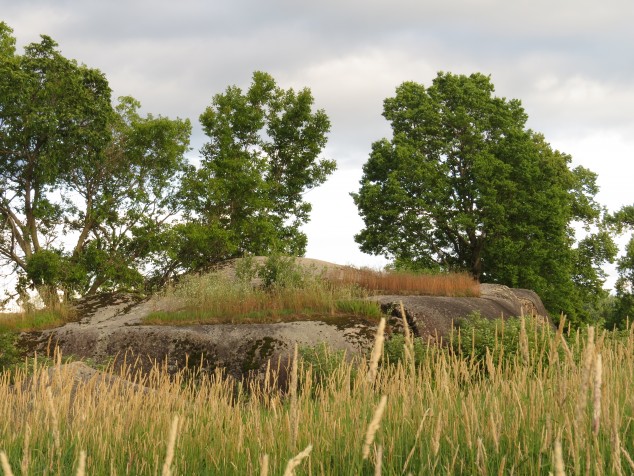
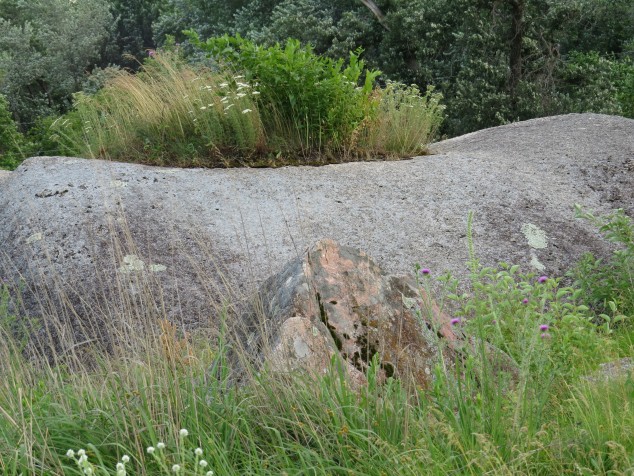
I like this pink granite boulder and the tuft of wildflowers and grasses that are growing on the top of it.
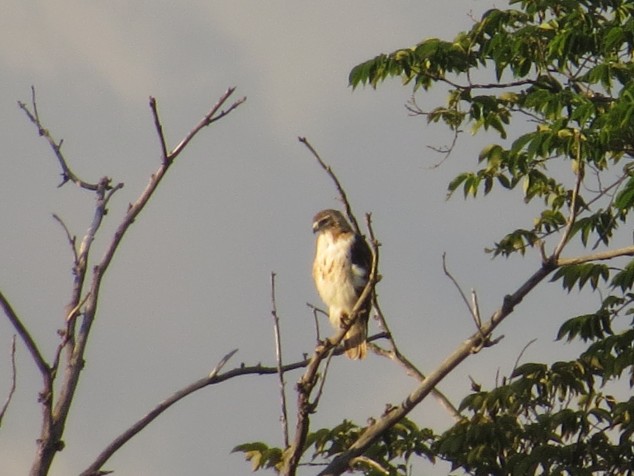
We saw a Red-tailed hawk scanning the ground for glimpses of movement that might mean a tasty meal.
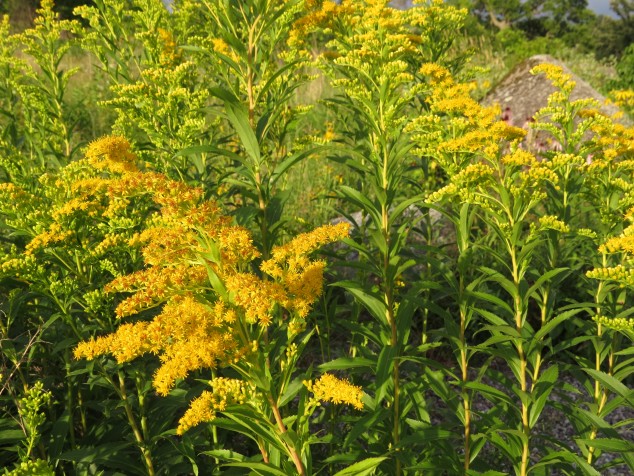
The goldenrod was blooming–is it trying to move us out of summer already?!
As we were talking about the flowers, I saw the young eagle jump out of the nest onto a branch.
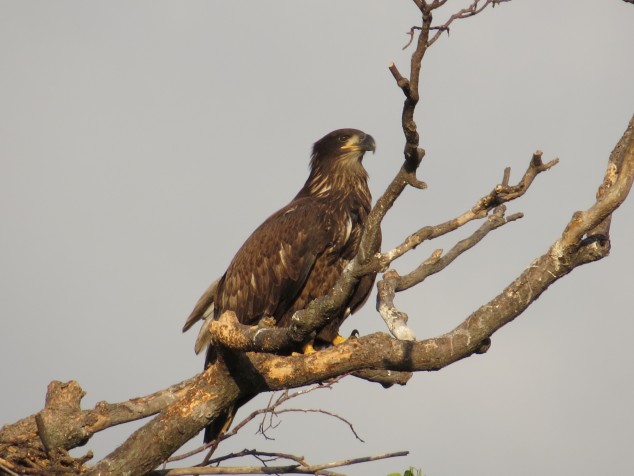
And then he lifted his wings, and with a leap of faith he flew away! Just like that!
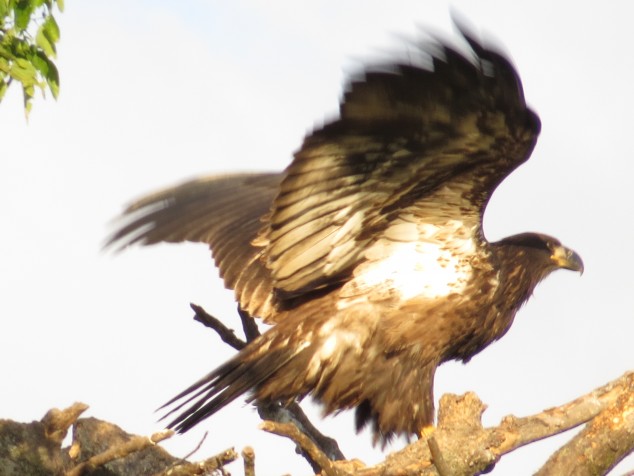
Not only is the goldenrod pointing us towards fall, but the eagles are also. They will all occupy the nest for a number of weeks more as the young eagles learn about hunting. The parents will continue to bring food back to the nest as the fledglings practice their hunting skills. Then they will begin their solitary life of four or five years to mature and change color before picking out a mate.
The Spring egg holding the potential young eagle. The lily bud holding the glorious Turk’s-cap flower. The flowering thistles holding hundreds of the favored seeds for the Goldfinches. Let’s all take our innate potential and fly!
A Boy Named Tree
When our son was three or four years old he started telling us and anybody who asked him that his middle name was Tree. Now in our family, trees are rather beloved things, so we didn’t object to his chosen name. His father is a modern-day Johnny Appleseed who can wield an A.M. Leonard spade like a surgeon’s knife and dig a hole and plant a tree with the same precision, so maybe he has trees in his blood. Our Tree Brake was a spirited nature person at a young age–he loved snakes, frogs, bugs, squirrels, mice, and just about any kind of critter. He caught snakes and brought them into the house. He took a live mouse from one of the outside cats and brought it inside where it hid behind the toy box until we let the cat in to finish her job. He and his sister would crawl under the corral fence and catch frogs in the muddy hollows of hoof prints. He agilely climbed trees, swung from trees, and played in the Lilac leafhouse and the tall treehouse in the spreading elm tree. He was a cute, fearless creature of nature.
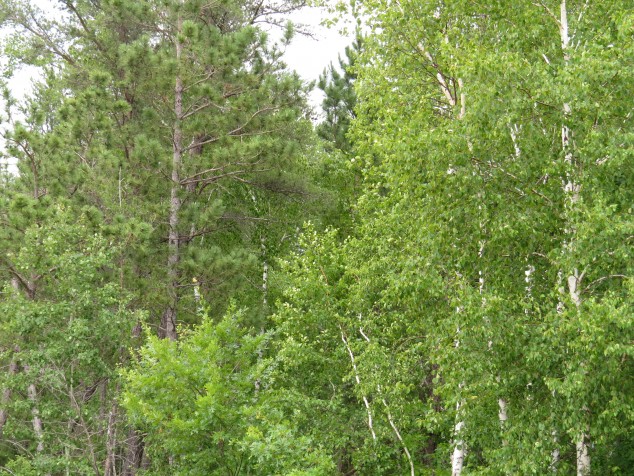
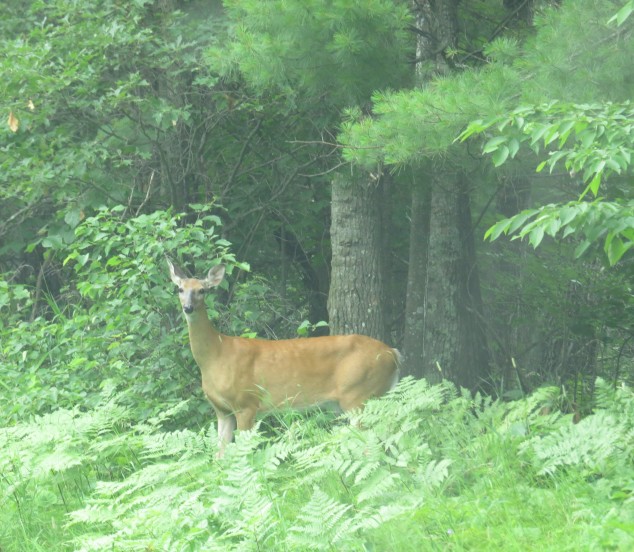
Trees and lakes dominate the landscape in northern Minnesota. Pines, birch, and aspen create the backdrop of beauty in the area around the Pelican Lake camp we visited. When we drove through the woods close to the camp, we saw a deer munching on foliage under a huge white pine.
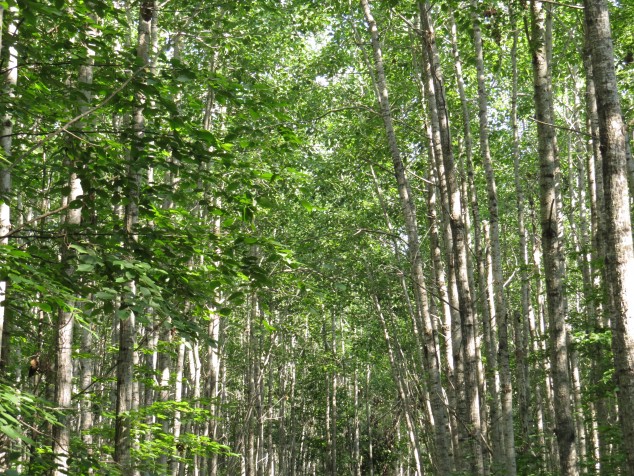
As we biked and wandered through the woods with our beautiful guide (who happens to be Tree’s girlfriend), we passed through an aspen cathedral. The light filtered through the dancing leaves and reflected off the gray-white bark of the trees. A feeling of reverence descended on me.
Further along the trail, we saw interesting fungi growing on fallen birch logs–another stage in nature’s cycle of tree life.
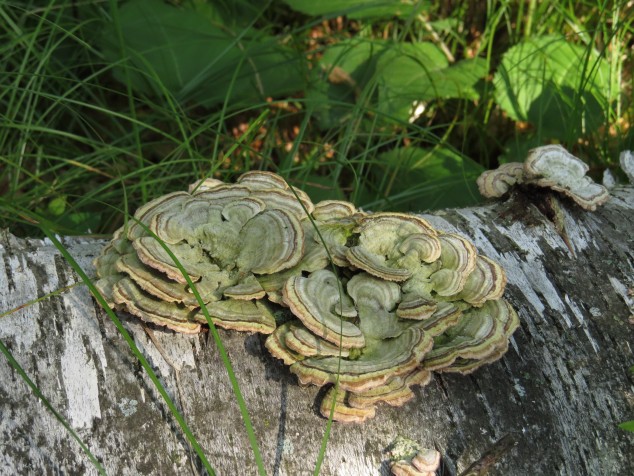
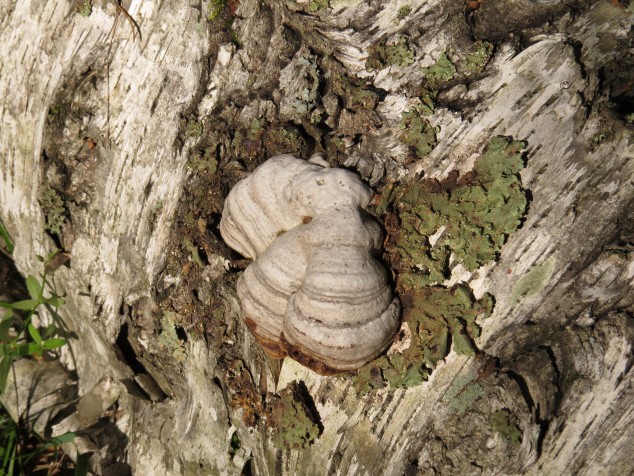
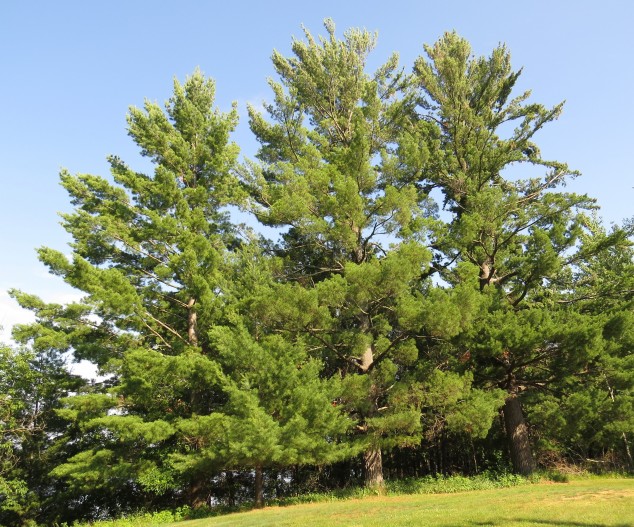
There are too many things to say about trees–they are so much more than their size, form, leaf description, bark texture, flower, seed, or fall color. I have been frustrated that I cannot capture in a photo the majesty of a pine or a cottonwood that has weathered decades of winters, storms, and droughts. Three pines at camp immediately caught my attention when we entered a clearing by the lake. They towered above the other trees, quietly demanding attention and respect. My photo does not do them justice.
As I returned to the clearing after getting some pictures of the lake, Chris and Michaela pointed down the mown path. A young fox was sitting there. It was clear that we were in his domain. He wasn’t old enough to be on his own yet, but he had obviously gotten permission to leave the den. Maybe he had wandered down to the lake to try to find a crayfish or perhaps he was tasting the sweet, ripe raspberries that lined the path.
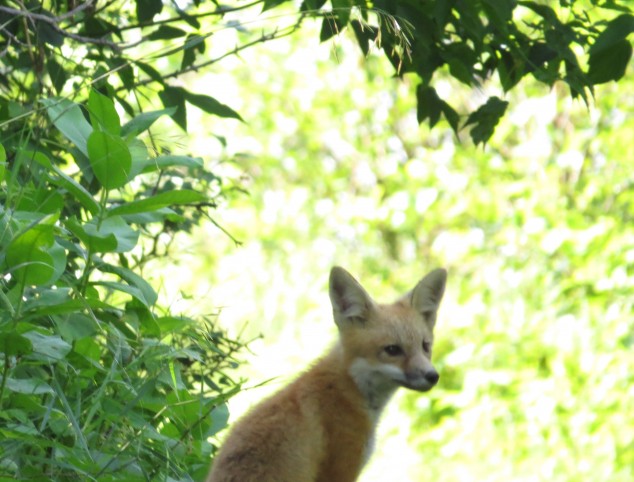
He was curious about us–‘Maybe those are the creatures my mom told me to stay away from–they don’t look so bad!’
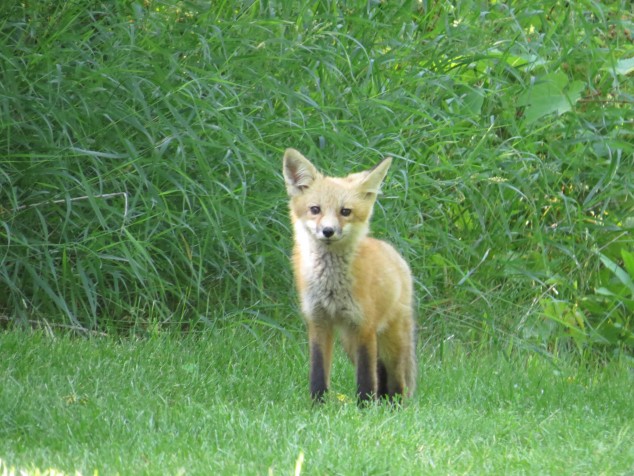
‘Is that my mom calling me?’
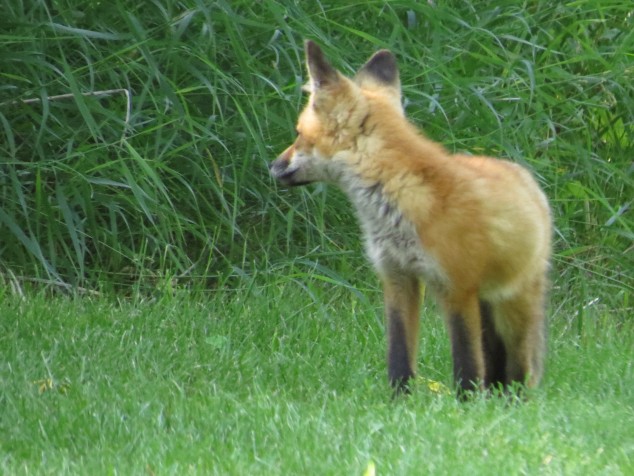
‘Still, they don’t seem too scary….’
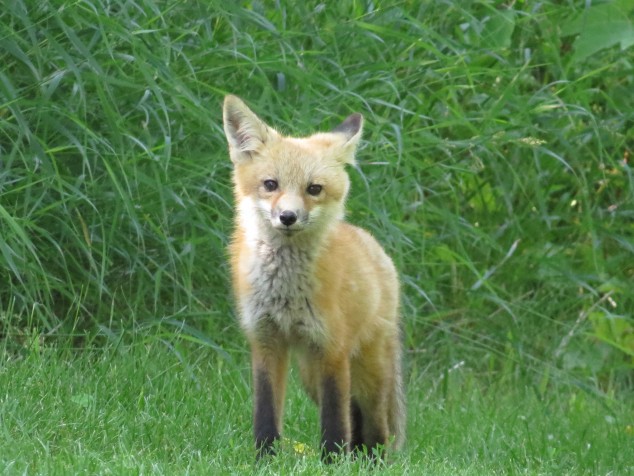
‘But I’d better get home anyway!’
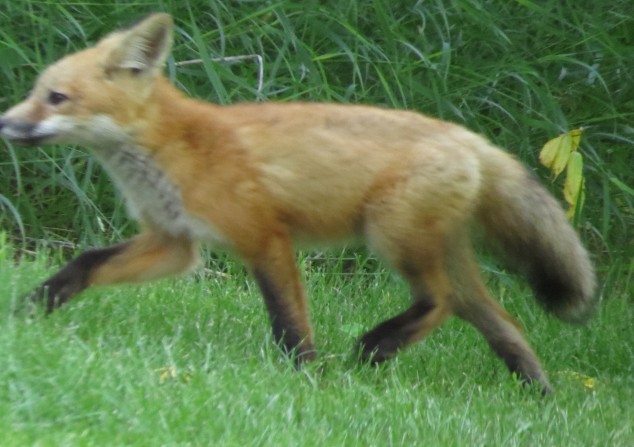
And he disappeared into the tall grass and trees. Trees and these woods–home to so many creatures. Often we claim the land and resources for our own without realizing how many living things call it home. The trio of white pines that watch over the fox family that eat the crayfish and raspberries–the web of life.
Aaron Tree Brake is now a senior in college at the beautiful and unique St. John’s University where he is surrounded by lakes, trees, and wildlife. Like Aaron, I believe we should all aspire to call ourselves something from Nature that stirs our soul, encourages our fearlessness, and inspires our life. As for the young fox, I think I will call him Tree.
Treasures of the Lakes
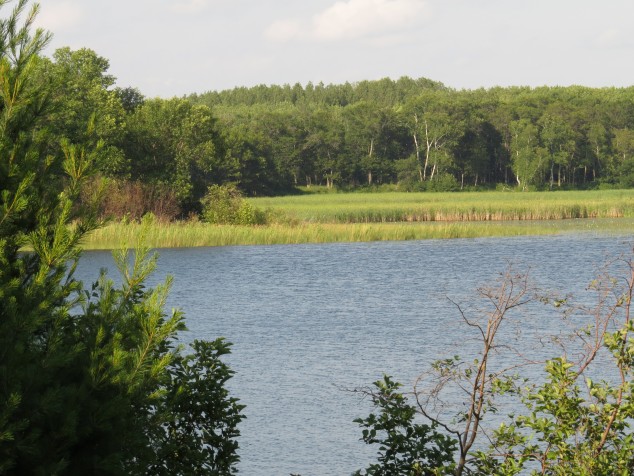
Minnesota is the “Land of 10,000 Lakes,” most of which are in the northern half of the state. Last weekend we visited a camp in the Brainerd Lakes area and explored three of those lakes by boat, bike, and on foot. We boated on Pelican Lake, which encompasses over 8,000 acres with miles of sandy beaches and cabins. As anybody who lives on a lake knows, the water reflects the sky and indicates the weather along with its overhead partner. The sky was cloudy and gray when we boated to Bird Island to entice the seagulls, and the lake water was dark and leaden. But later in the afternoon, the clouds moved out, the sun shone warm, and the lake glimmered blue.
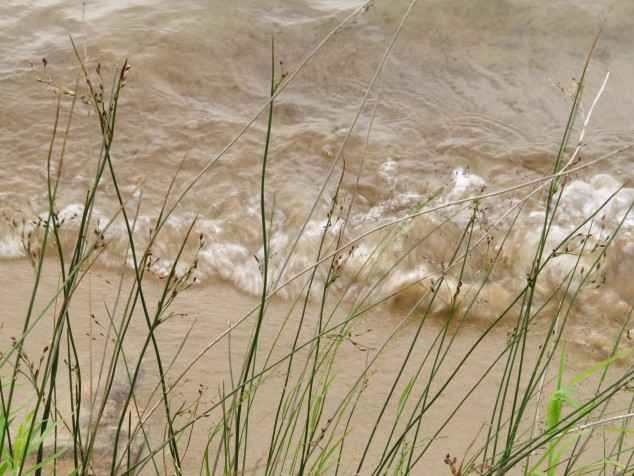
On shore, the lapping waves had pushed up sand, sticks and shells where the sedge grass and dazzling swamp milkweed grew.
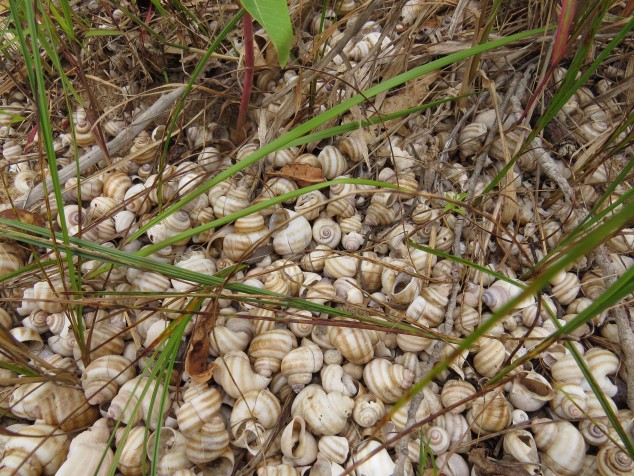
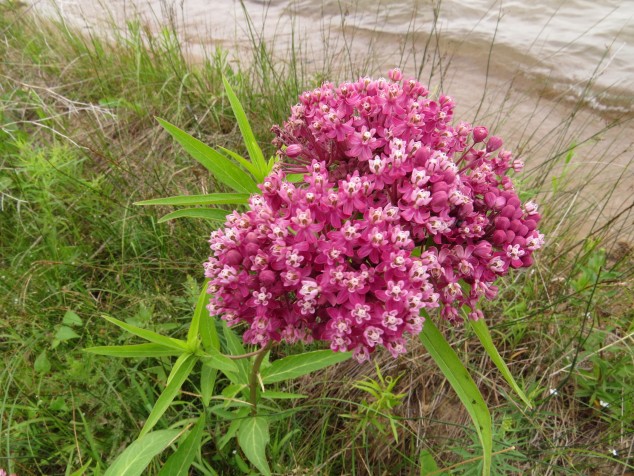
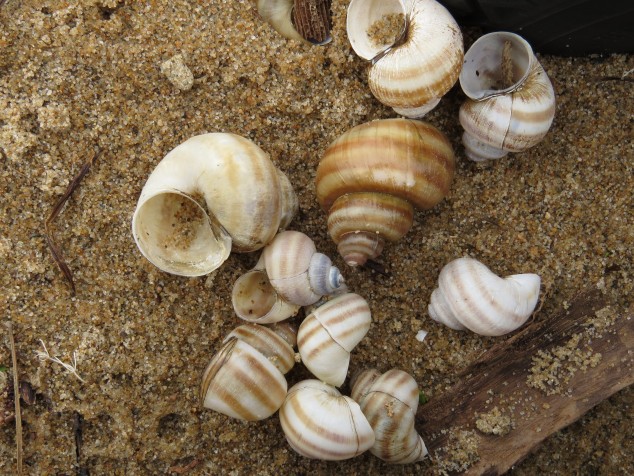
A delighted camper had collected a handful of striped shells, then left them in the sand by the dock as he hurried away to the next activity.
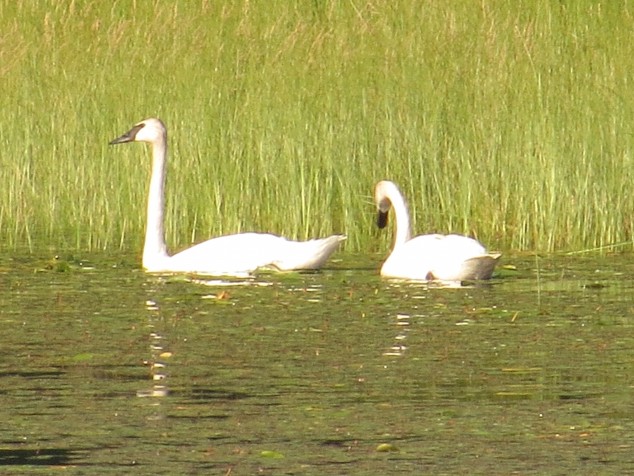
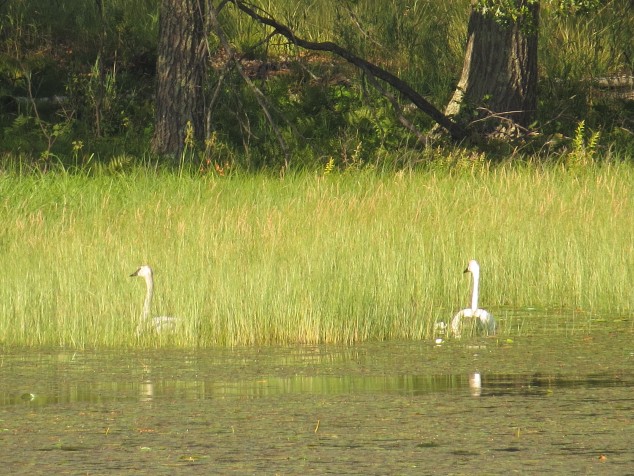
We biked to a nearby lake that was small and uninhabited by humans. From a viewing deck we watched a pair of courtly swans as they glided into the weedy cover across the lake. Their fine white feathers glowed in the sunlight and reflected off the smooth parts of the water.
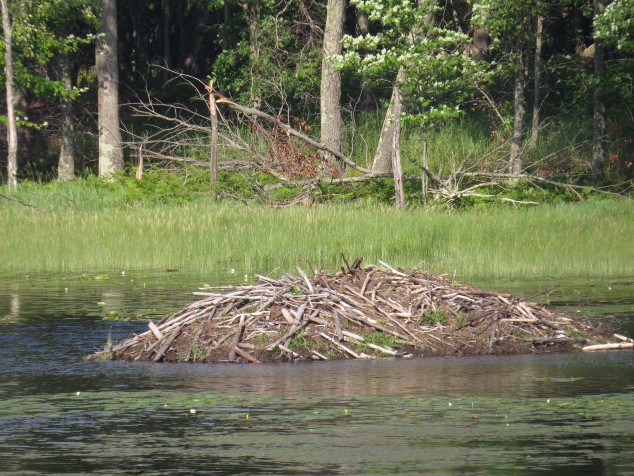
Beaver lodges covered in logs that the master builders had gnawed down seemed to erupt out of the water.
At the third lake we discovered a carpet of lily pads close to the shore in green, yellow, orange and red held up by the steel-blue water.
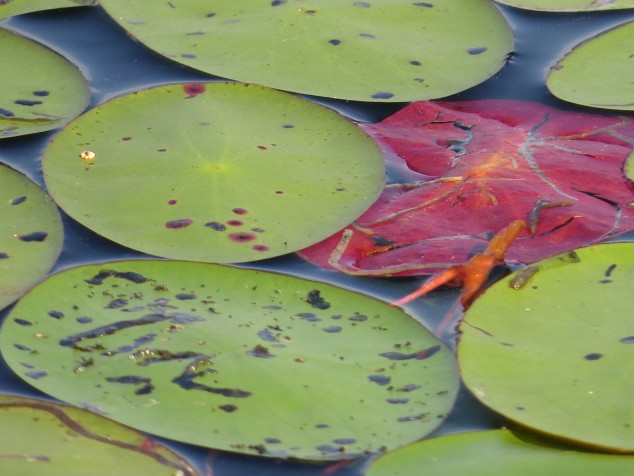
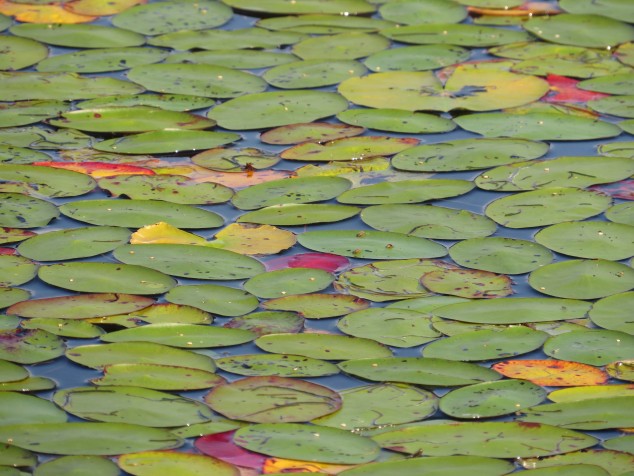
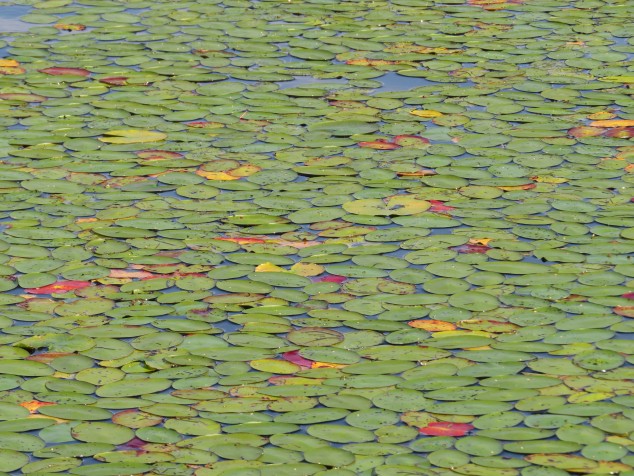
Partners in Beauty–the sky and the lake, the shells and the sand, the graceful swans, the beavers and their logs, the lily pads and the water. In this tiny piece of creation, the beauty is overflowing.
Flying Dreams
Have you ever dreamed of flying? Not the airplane kind of flying, but the bird kind–where you are actually flying like a bird? It’s a common dream, especially among men. Most flying dreams are also what is called a lucid dream–one where the dreamer takes control of part of the dream. They are an escape from the pressures of the real world and represent freedom and rising above the concerns of the ‘ground.’
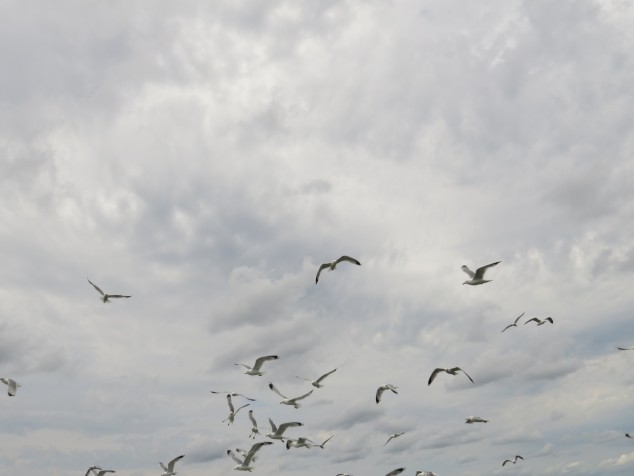
Over the weekend Chris and I visited a camp in the Brainerd Lakes area where a young woman friend of ours works for the summer. The camp was spread out under stately pines and birch trees and bordered a clear, large lake. Mid-afternoon we boarded the pontoon boat with family, friends and a loaf of bread. The sky was cloudy, and it was cool enough on the water that wearing a sweatshirt felt good. We toured around the lake looking at charming cabins, an impressive log mansion, and miles of sandy beaches. And then we cruised by Bird Island! Birds meaning seagulls. Seagulls who knew that certain pontoon boats–usually filled with kids–would throw chunks of bread up in the air for them! The people in the back of our boat started throwing the bread, and the seagulls gathered behind us like a flowing train as we sped through the water.
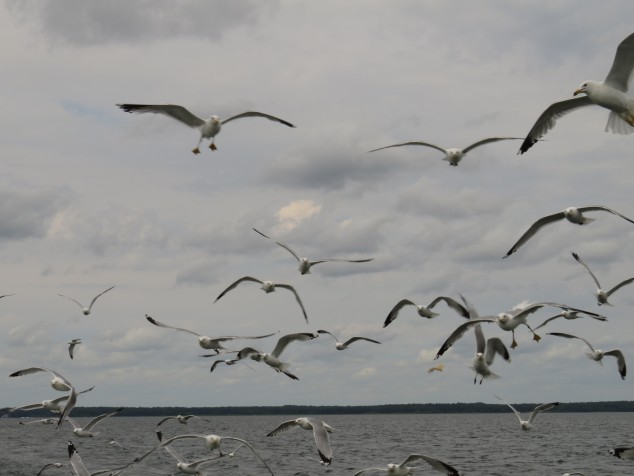
The gulls were like flying acrobats–each trying valiantly to get a piece of that yummy bread! They dipped and dived, swooped and turned, and glided right above our heads.
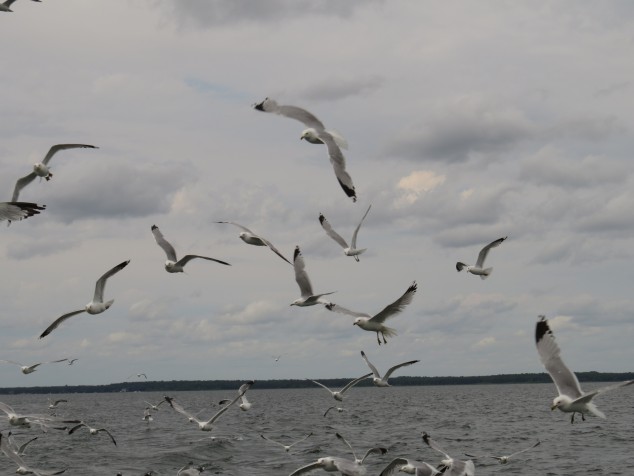
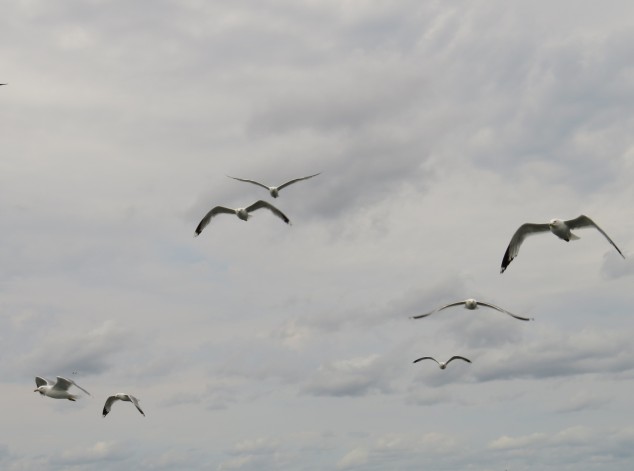
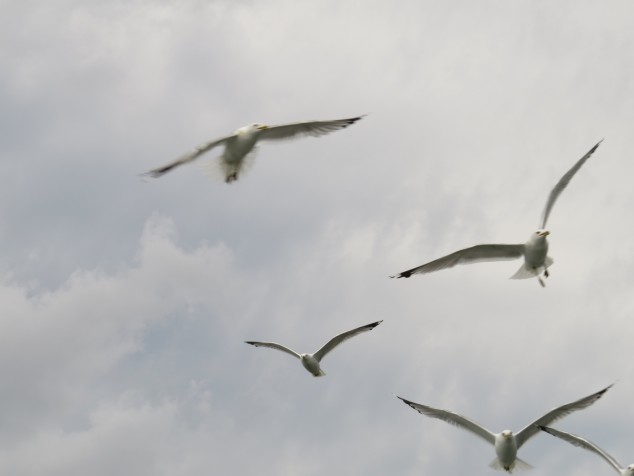
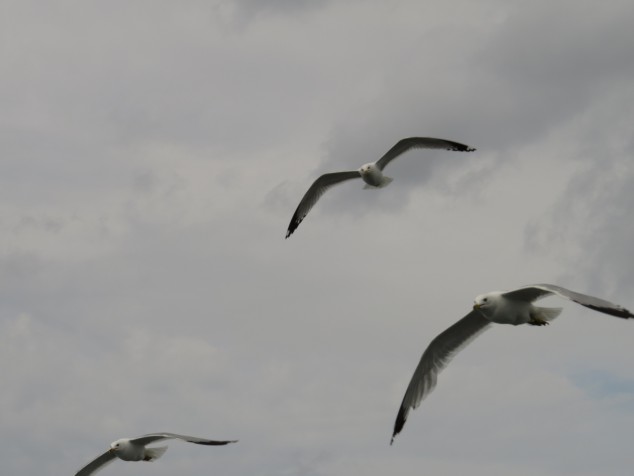
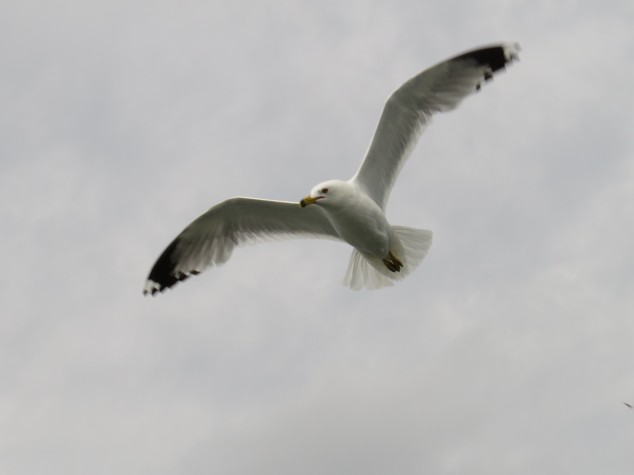
It was a surreal feeling speeding along the water with this flock of seagulls flying with us overhead! It was like time sort of stopped–I was so in the moment. It felt exhilarating and joyful and awesome–in every sense of the word. There was an interaction with us and them–like a playful game–that left us feeling happy and liberated from worries. I guess we just found ourselves in a flying dream!
The Rescue
One day after mowing the lawn, I walked past our egress window well and heard some insistent chirping. Peering into the four-foot deep hole, I saw a fledgling bluebird staring up at me. She repeatedly tried to fly out but was only able to get about halfway up the corrugated tin walls. Run, fly, fall, run, fly, fall.
I don’t know whether she had flown/fallen from her nest in the maple tree straight past the soft landing of green grass to the rocky bottom of the window well or if she was scampering on the ground trying to get away from the scary mower. At any rate, she was uninjured, quite feisty, and determined to get out of there. But it was plain to see that she wasn’t going to be able to do that without a little help.
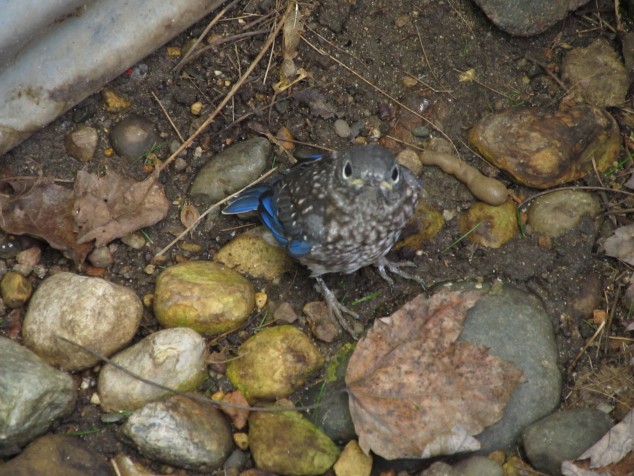
So I rummaged through the shed and found an old board and slowly slid it into the window well to make a ramp. She flew over it a few times, then landed on it and took a tentative step or two up the board. My presence at the topside was still too distracting for her, however, and she hopped back down to the rocks.
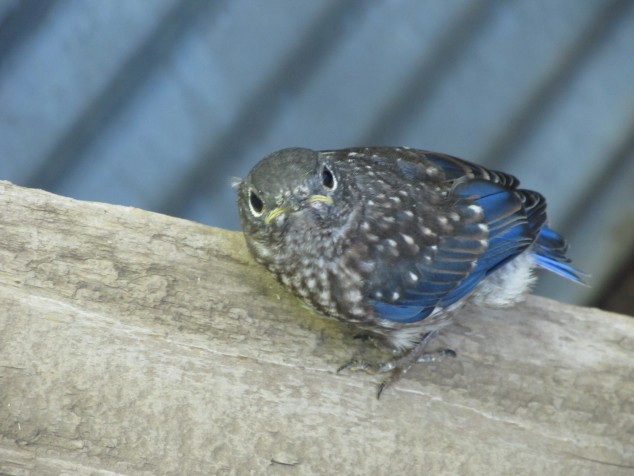
I decided I would watch her ascent through the window in the basement. She quickly turned to watch me watching her one more time! She clung to the board with her tiny claws but would go no further while the camera and I looked her way.

So I left. I walked into the laundry room to put something away. And she left. I didn’t see her walk up the board or fly from her open-aired prison. In less than thirty seconds, this determined little fledgling had made her way up and out to the place where she belonged–but she could not have done it without a little help from a friend.
Eagles Among the Granite and Wildflowers
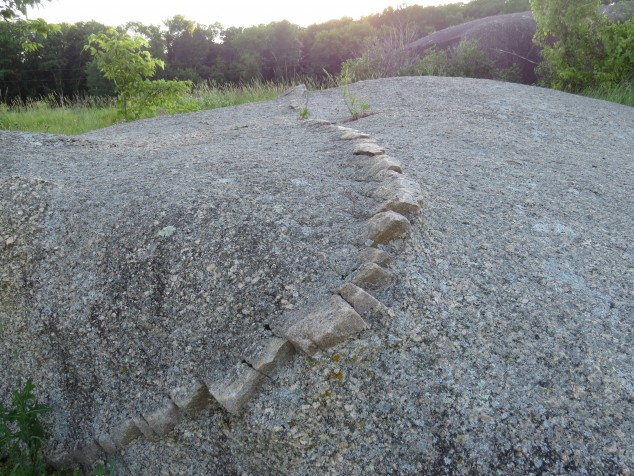
We live in granite country. Quarries–some old and some still productive–are everywhere, and there are a number of granite warehouses within miles of our place. Commercial buildings are sheathed in granite of different hues. Our garden walls and steps are granite, and everywhere a person may want to dig, there will be granite. Eagle Park is strewn with granite boulders called core stones that have surfaced from the granite bedrock. The igneous rock in this area is made up of clear to gray quartz, black mica, with pink and white feldspar crystals and is called Rockville Granite. I’ll walk you around the park of granite boulders, eagles and wildflowers.
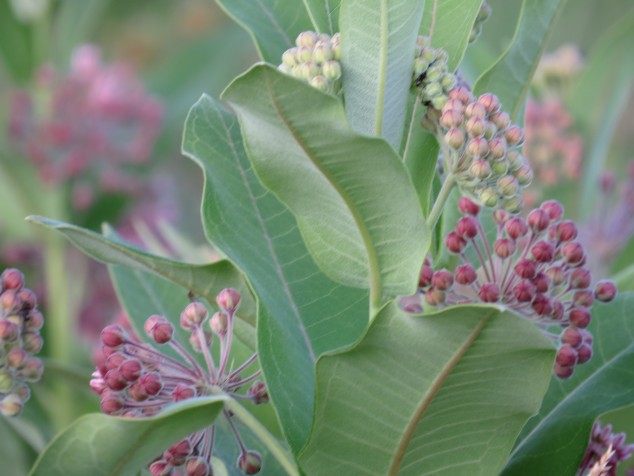
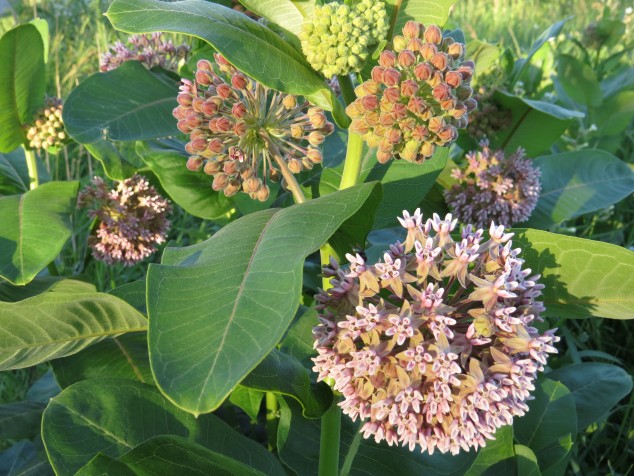
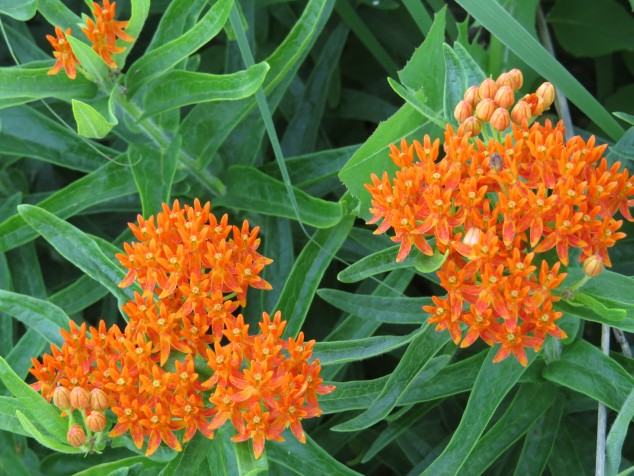
The milkweed was abundant, and each ball of buds or blooms was a shade of candy-confection pink. No wonder the monarch butterflies love this plant!
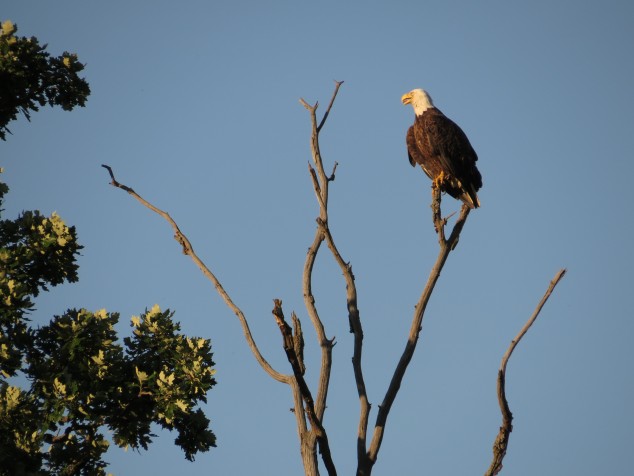
While I was looking at flowers, Chris spotted an eagle in the tree ahead of us. It is hard to differentiate the male and female bald eagle, especially when they are not side by side. The female is larger and has a deeper beak. The male generally has a sleeker head, so by comparing the pictures from the last post, I would say this is father eagle! He flew from this perch overlooking the floodplain back to the nest in the gnarled hackberry tree in the center of the park.
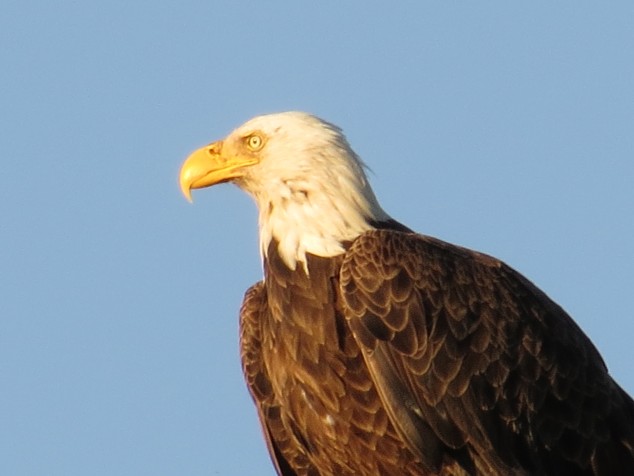
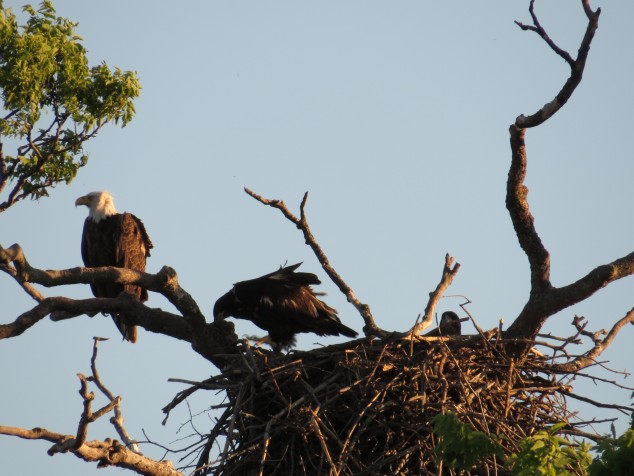
The path circles the park, skirting the immense granite boulders and winding past giant oak trees.
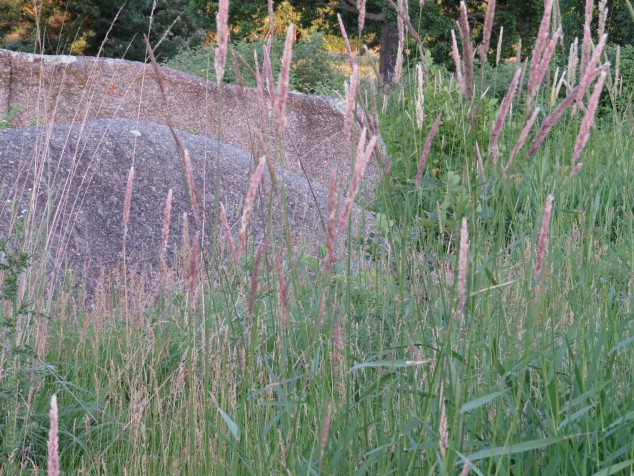
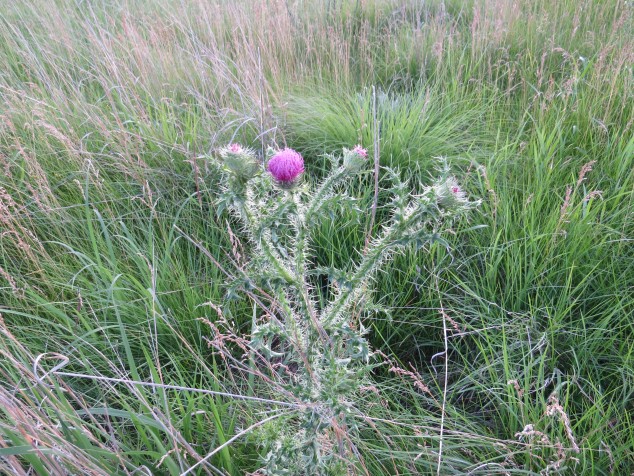
Thistles have encroached upon the park from an adjacent untended pasture, living side by side with the prairie grasses and wildflowers. The prolific seeders take over more ground year after year.
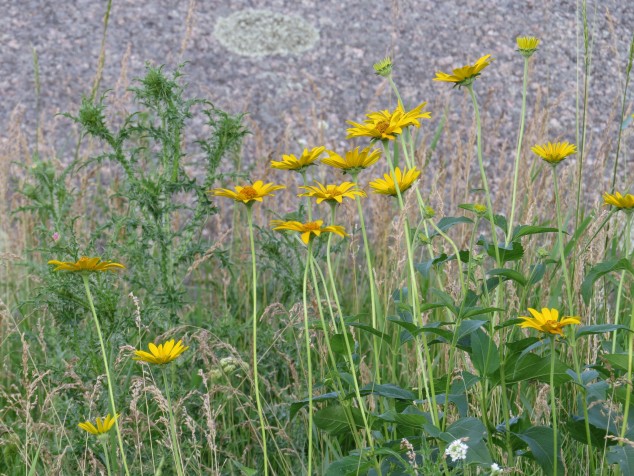
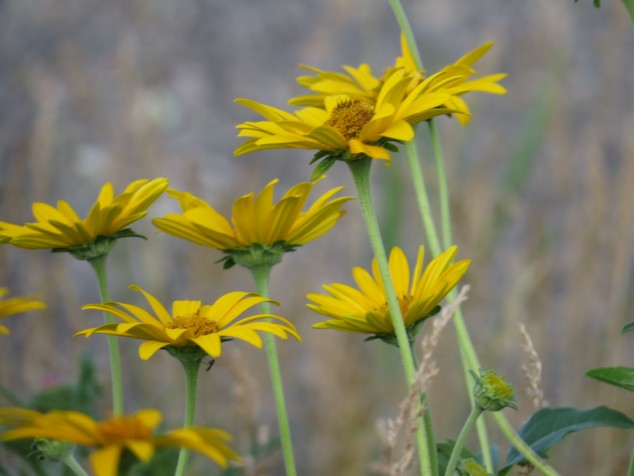
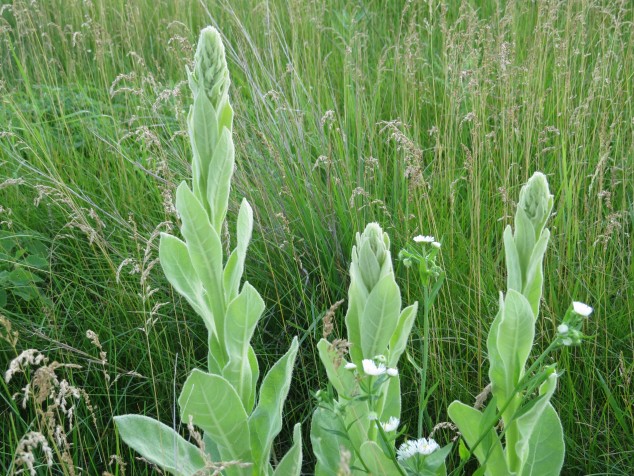
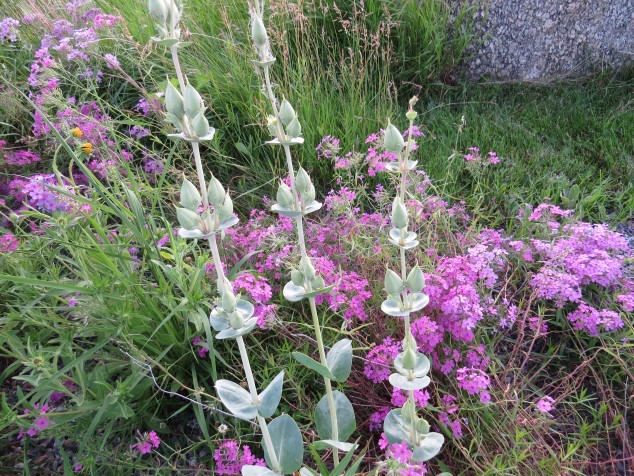
A trio of fuzzy-leaved mullein stands poised, ready to bloom.
Meadow rue and prairie phlox adorn the granite.
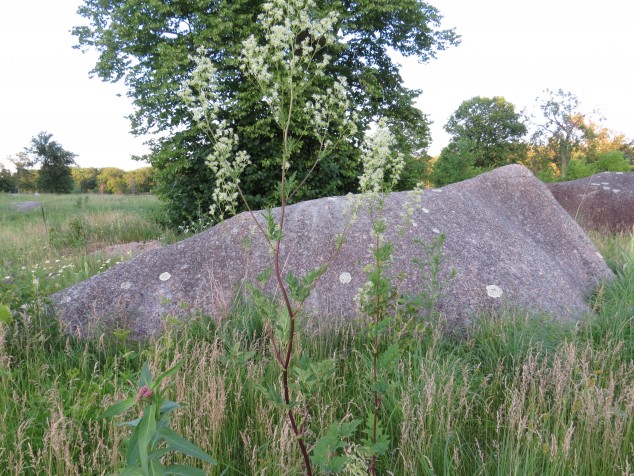
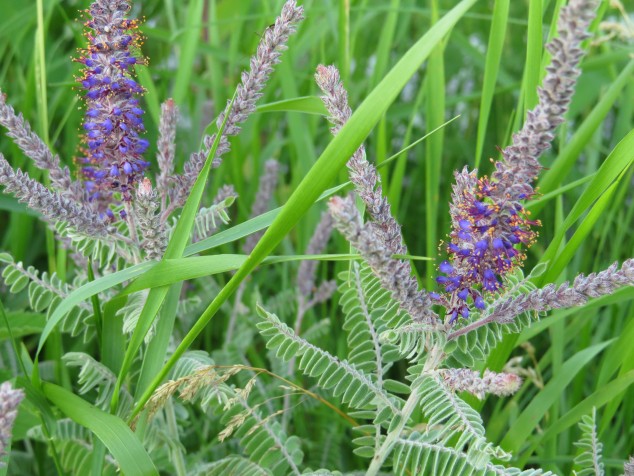
Leadplant and butterfly weed brighten the landscape.
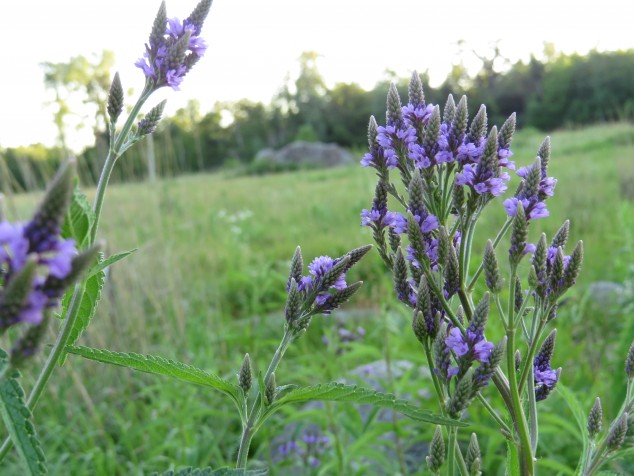
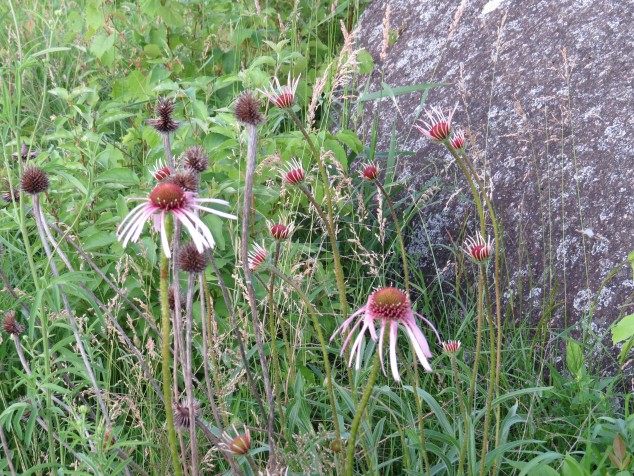
Blue vervain and purple coneflower have prominent seed heads, insuring the propagation of their kind for another year.
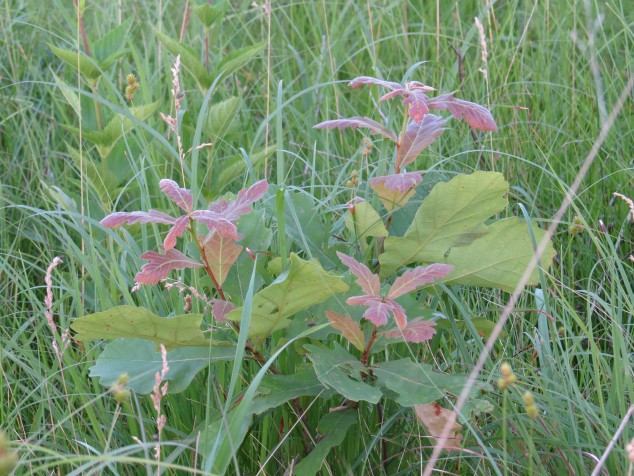
And a lovely young oak puts on its yearly coat of new growth.
The granite has been in this place for eons. This pair of eagles has been here for ten years now. They have adapted to the circling of curious spectators as they raise their eaglets in their home high above the grasses, thistles, and wildflowers. We all take our place in the history of the eons, adapting to the changes that come our way. We learn from the hard times and the thorny issues that invade the beauty of our lives. We need to feed upon the candy-confection beauty of the world and let the seeds of that beauty–love, compassion, kindness, faith and hope–spread beyond our own selves. We need to view the world from that high home in the sky.
- « Previous Page
- 1
- …
- 45
- 46
- 47
- 48
- 49
- 50
- Next Page »