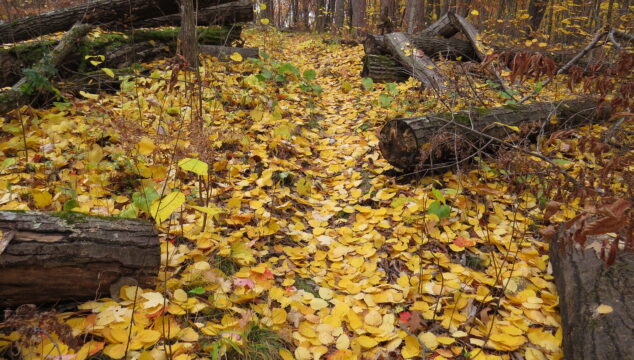
Come walk with me in the peak Autumn beauty of the Northwoods. To say that I love this time of year is an understatement. Most everyone can appreciate the colorful falling leaves---it reveals the 'true self' of a tree when its leaves are no longer producing chlorophyll. Their true colors are revealed, and there is something simple … [Read More...]
Walking Past Ginger, Jack, and May
When I was in college, there were two girls named Ginger who lived in my dorm. One Ginger was tall, dark-haired, and had a booming voice and personality. She walked with swag and tossed her head like a racehorse at the starting line. Wild Ginger majored in Physics or Engineering or something like that and would help guys with their homework, then go downtown and drink beer with them or anybody else who was up for it. She was colorful, energetic, and noticed. Quiet Ginger was also tall and smart, but I would say most people didn’t notice her. She didn’t talk much and just blended in with her surroundings. She seemed guarded, like something at one time had hurt her deeply, and so she hid herself for protection. But when you talked one-on-one with her, she was funny, strong, and very charming in her own way.
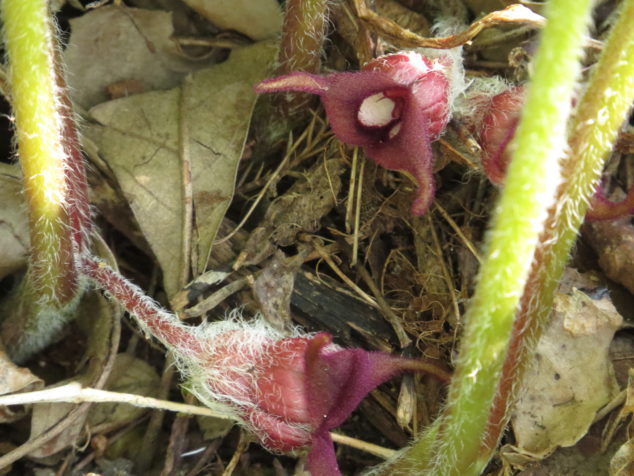
I think all flowers are cool. They are unique, intricate sculptures of petals, pistils, and stamens. Many are colorful, showy, fragrant, and well-known to most people. But there are a few Spring woodland flowers that one could easily walk past and not notice. I was on my hands and knees weeding around this small Wild Ginger plant on the hillside of our woods. Only after I had pulled some weeds away did I notice the small, dark red flower at the base of the plant! What a crazy, beautiful, strange flower!
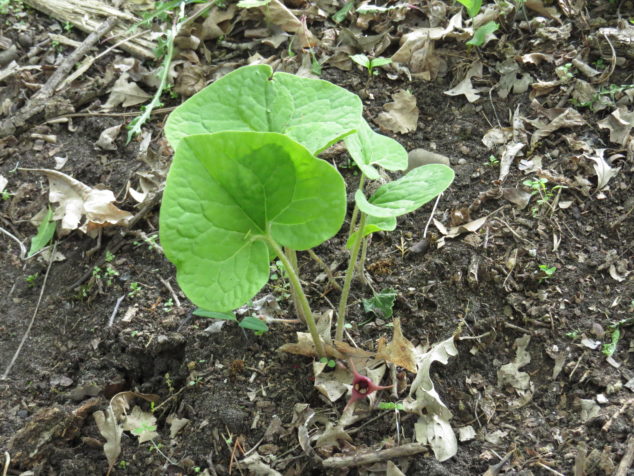
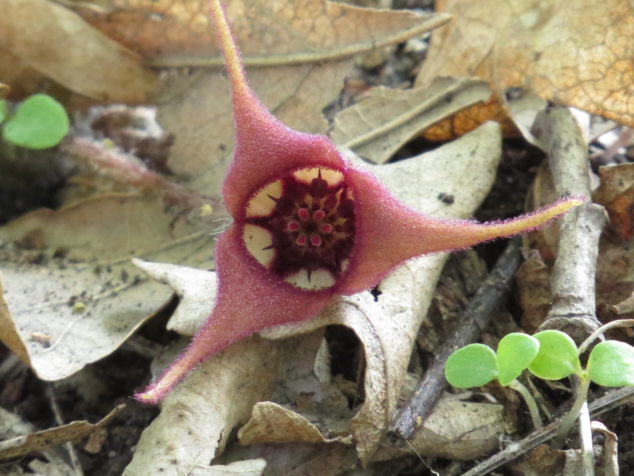
So I walked up the hill to where we had a larger, more established colony of Wild Ginger and pushed the dried leaves away from the base of the plants, and there were the hidden flowers! Wild Ginger (Asarum canadense) is no relation to culinary ginger, though the Native Americans and later the settlers used the root as a seasoning and to treat colds and fever. This low-growing, shade-loving ground cover with heart-shaped leaves is deer resistant, does not go dormant in the summer, and is an important food source for the Pipevine Swallowtail Butterfly.
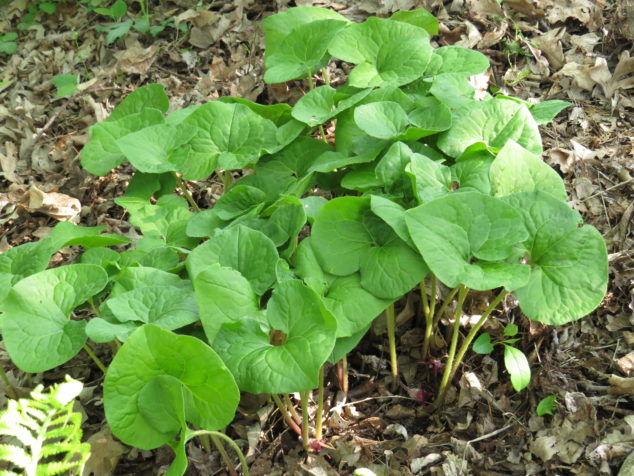
The flowers at the base of the plant attract small, pollinating flies that emerge from the ground in early spring. The flies crawl into the flower for protection and to feast on the pollen, which they carry with them to the next flower.
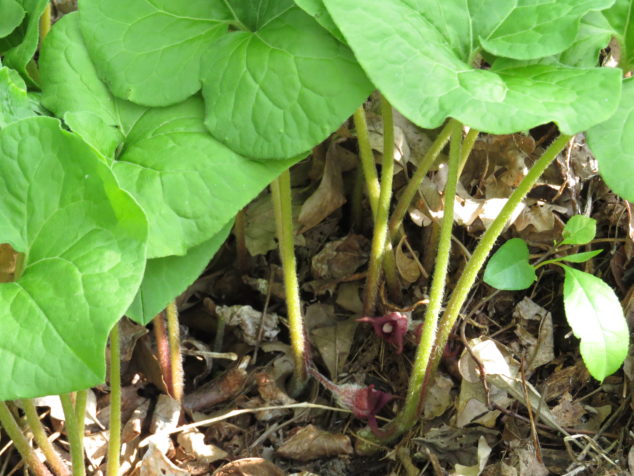
When the Wild Ginger seeds ripen, they have an oily appendage attached called an elaiosome, which attracts ants. The ants carry the seed to their homes, consume the ‘food’ and leave the seed to germinate. At least three different insects rely on the Wild Ginger plant with the quietly beautiful, hidden flower.
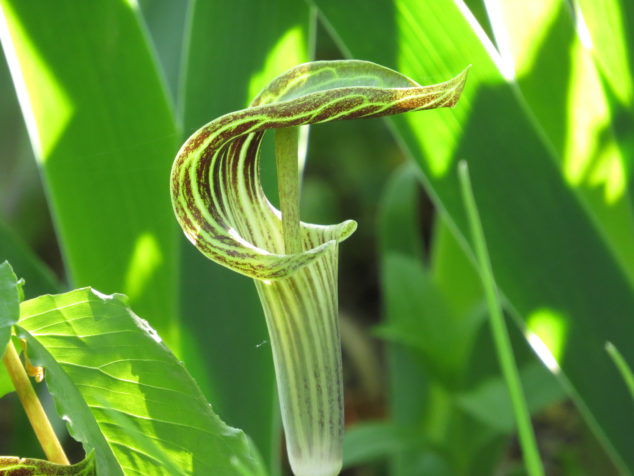
Another flower that is easy to walk past without noticing is the Jack-in-the-Pulpit (Arisaema triphyllum.) Tubular, hooded flowers rise on their own stalks to the level of the large leaves that are divided into three leaflets.
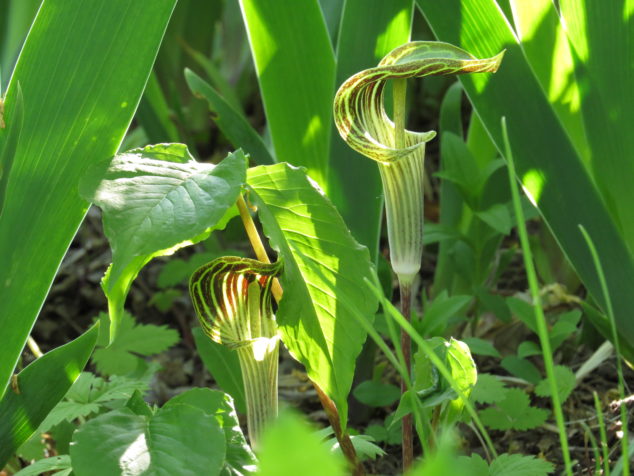
The flowers are green with brown stripes that blend in with the surrounding woodland foliage. Jack-in-the-Pulpits are most noticeable in late summer when clusters of bright red berries form.
A third woodland flower that is easy to walk past is the Mayapple (Podophyllum peltatum.) Mayapples are unique in that they only have two leaves and one flower which grows in the axil of the leaves. Lovely umbrella-shaped leaves hide the pale yellow flower that later forms a yellow, edible fruit that can be used in jellies. Mayapples die back in mid-summer in dormancy until the following spring.
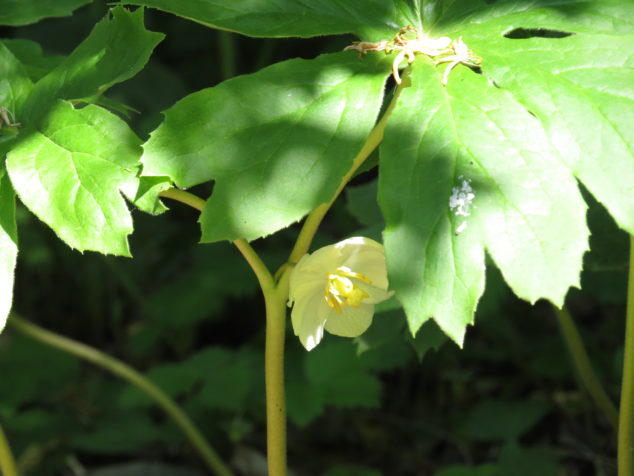
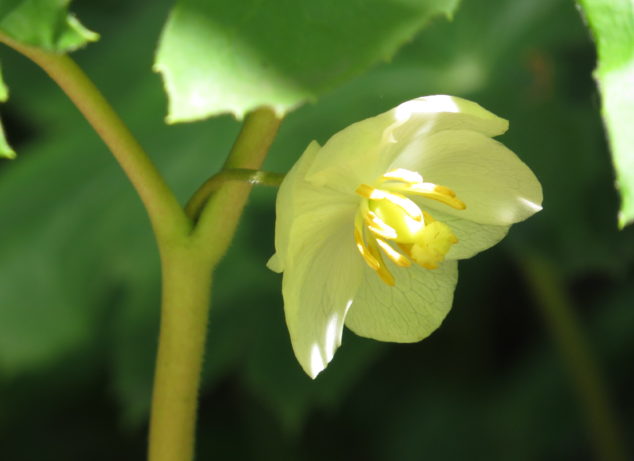
When we think of flowers, we most often bring to mind showy, colorful blossoms that attract attention and inspire awe. These three Spring woodland flowers are not easily seen when walking by, but all have beautiful and unique foliage that is to be appreciated. A closer look reveals the interesting, hidden flowers–a quiet splendor in the woodland world. Getting to know the hidden treasures–whether flower or human–is worth the extra time and effort. It will enrich your life with wonder and gratitude.
What’s in a Name?
When I met my husband oh so long ago, he said his name was Chris, and he gave me the slip of paper that was his nonresident short-term fishing license from the State of Minnesota, because it had his address on it–and he promised to write back if I wrote him a letter. He was headed back to Missouri from Minnesota with a stop in South Dakota for the night. I was in the right place at just the right time for him to ask me to dance. The brown-eyed handsome man named Chris captured my heart. Later I learned that his family and friends called him Mick. Many times over the years he asked me to call him Mick, and even though I tried, it felt awkward saying it to him.
A walk through our yard and woods at this time of year is an exploration of blooming flowers! I know most of them by their common names and often Chris will tell me their Scientific names. Both names give clues about the flowering plant or tell a story about its history.
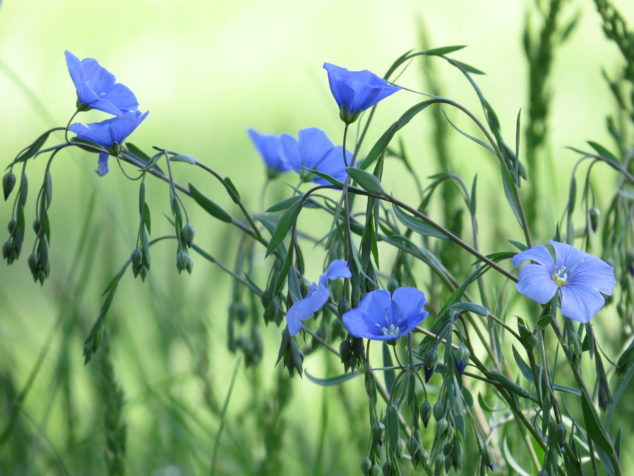
Perennial Blue Flax–Linum lewisii–named in honor of Meriwether Lewis of Lewis and Clark who discovered this blue beauty on their expedition across the Plains. (And speaking of names, Meriwether!)
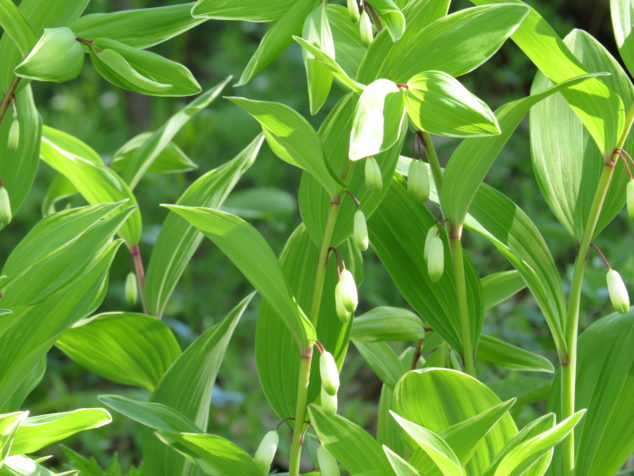
Variegated Solomon’s Seal–Polygonatum odoratum var. pluriflorum ‘Variegatum’–poly meaning ‘many’, gonu meaning ‘knee joints’ referring to the jointed plant rhizomes; pluriflorum meaning ‘many flowered’; Solomon’s Seal for the wound sealing properties of the plant.
Wild Geranium–Geranium maculatum–large flowering (relatively speaking, since this flower is 1 inch or more compared to others of under half an inch.)
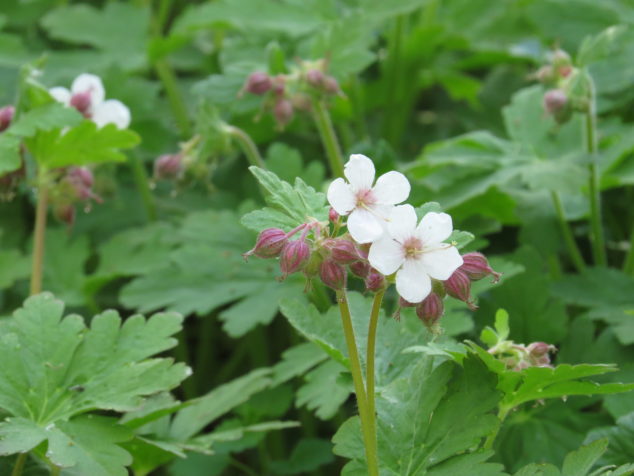
Leopard’s Bane–Doronicum orientale–all in this genus were once thought to be poisonous to animals.
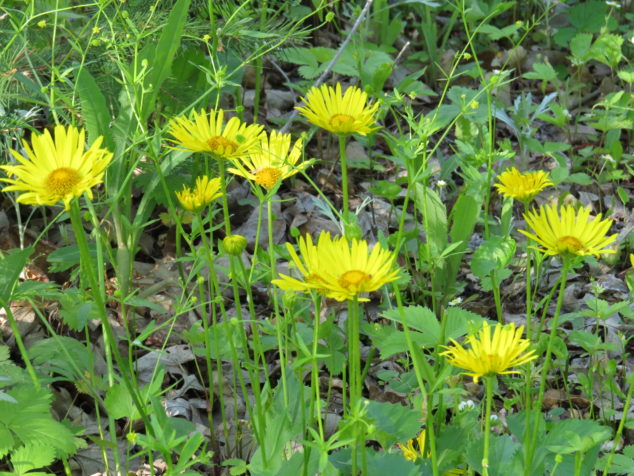
Carpet Bugle–Ajuga reptans–a groundcover that spreads across the ground like a carpet.
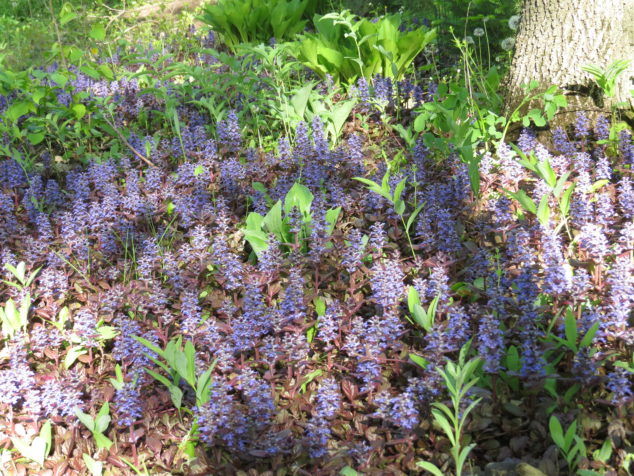
Foam Flower–Tiarella cordifolia–Tiarella meaning ‘small crown’ from the shape of the fruit; fluffy, airy flowers.
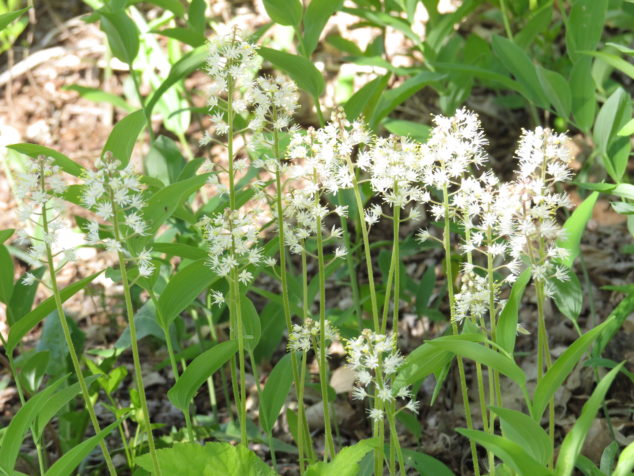
Bleeding Heart–Dicentra spectabilis–Dicentra meaning ‘two spurs’, spectabilis meaning ‘spectacular’; Bleeding Heart by the shape of the flower.
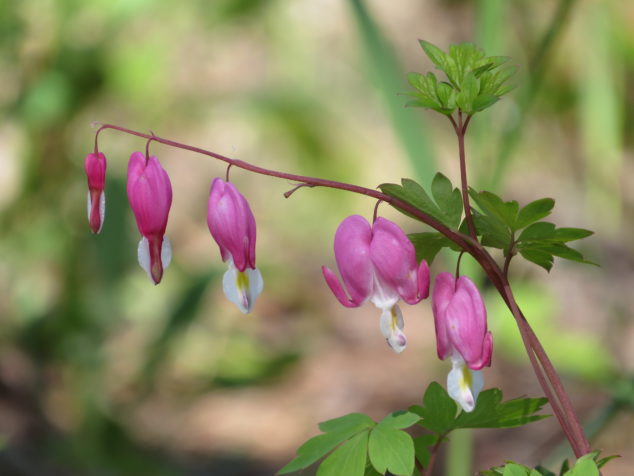
Lily of the Valley–Convallaria majalis–majalis meaning ‘that which belongs to May.’
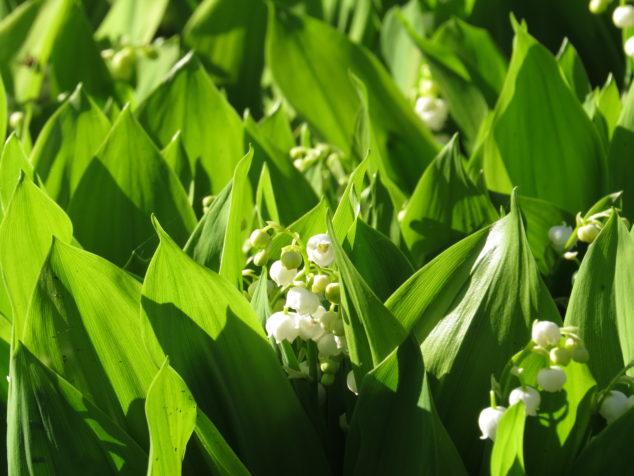
Lungwort–Pulmonaria spp.–herbalists long ago thought the spotted leaves looked like diseased lungs and used it to treat lung ailments; ‘wort’ meaning ‘to heal or cure.’
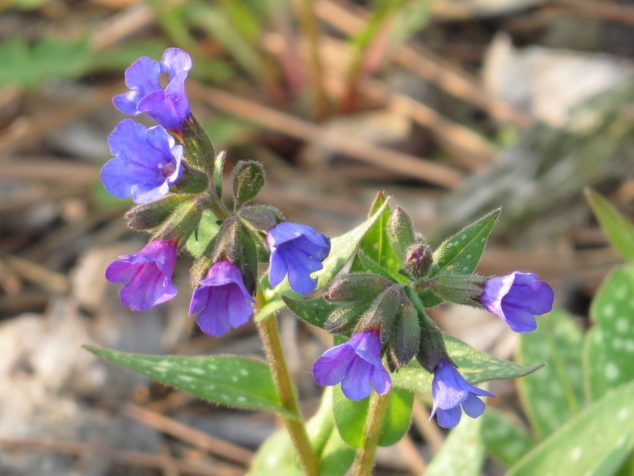
Sweet Woodruff–Galium odoratum–fragrant leaves and flowers; Woodruff is Old English for ‘wood that unravels’ meaning the creeping rootstock; another common name is Sweet Scented Bedstraw as the dried leaves were used to stuff mattresses.
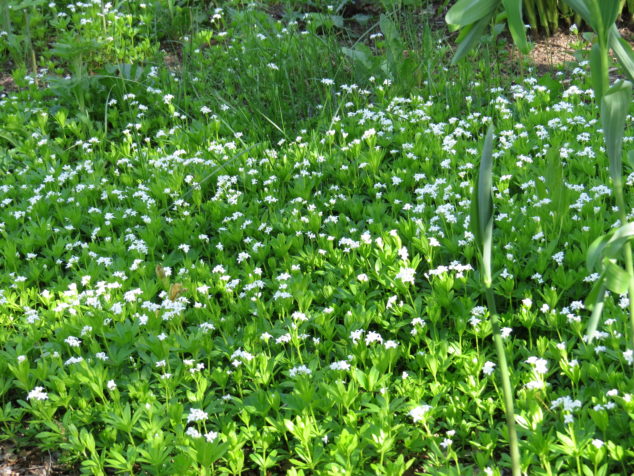
Flowering plant names, both Scientific and common, often describe or tell a story about the plant. Our given names are carefully chosen by our parents–name books are consulted and brainstorming with lists of names are ‘tried on’ and discarded or ‘liked’ by our mothers and fathers until the list of ‘likes’ is whittled down to the perfect name for that child. We can honor parents, grandparents and other relatives by giving their name to our child, and in the course of a lifetime, the child may come to know the honor of carrying that name. Nicknames usually have a story about how they came to be, and once a person is lovingly known by that name, it is difficult to say otherwise. I call my husband Mick when I talk to his family, though there is still a fraction of a hesitation before doing so. But the man I fell in love with is and will always be Chris on my tongue and in my heart. It is a particular and all-encompassing blessing when we are called by our name.
Journey into Nature and Parenthood
I go to nature to be soothed and healed, and to have my senses put in order. –John Burroughs
There is a connection between the generations, a sinew of code that we receive from our parents and ancestors and pass on to our offspring. Our chromosomes determine eye color, hair and skin color, and many other physical and personality characteristics–our Nature. When we celebrate Mother’s and Father’s Days, however, it is mainly about our Nurture–how we were raised and nurtured and how we raised and nurtured our children. The nine months of carrying and growing a child, the months and years of nursing them, caring for their every need, teaching them, guiding them, providing for them, cherishing them, and allowing them to become the persons they were meant to be. A difficult, joyous, incredible, honorable journey.
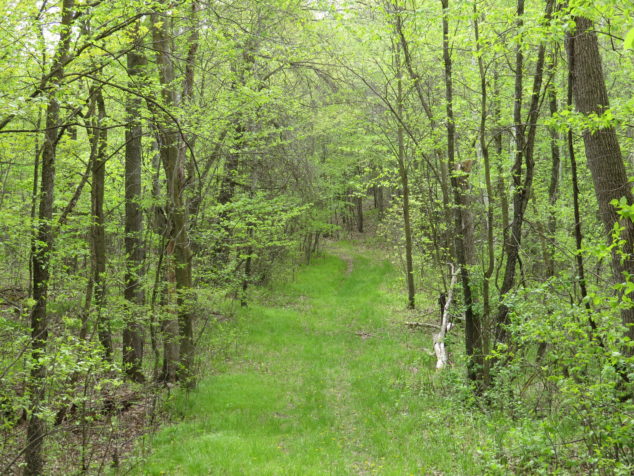
Our journey into nature this past weekend was to Birch Lakes State Forest, one of the smallest state forests in Minnesota, situated between two lakes on hilly, forested land created by glacial depositions. It is in the transition zone between the southwest prairie and northeast forested regions. It is mainly a deciduous forest with aspens, maples, basswoods, and oaks.
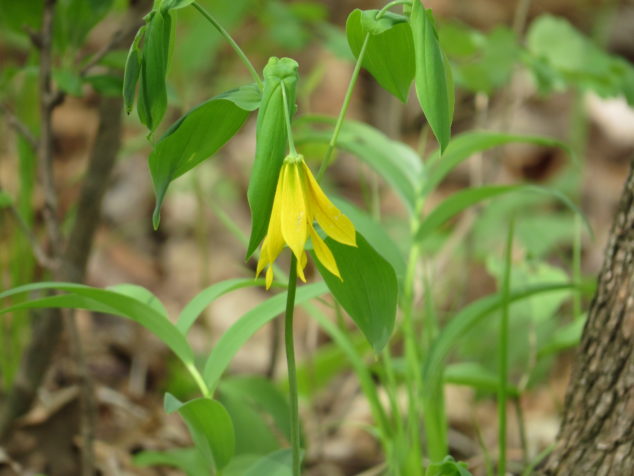
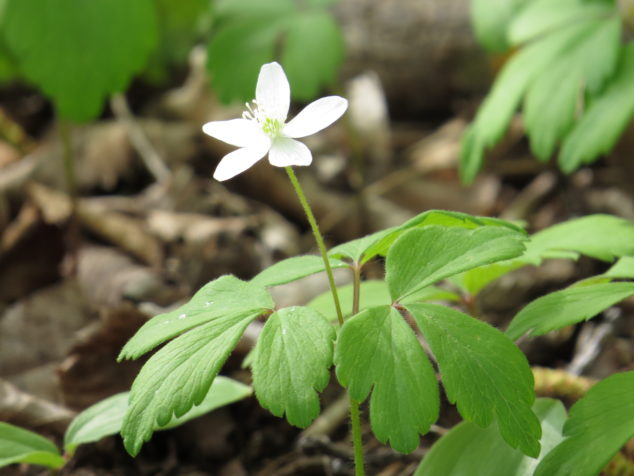
Spring wildflowers were blooming on the trail by the lake: Large-flowered Bellwort and Wood Anemone.
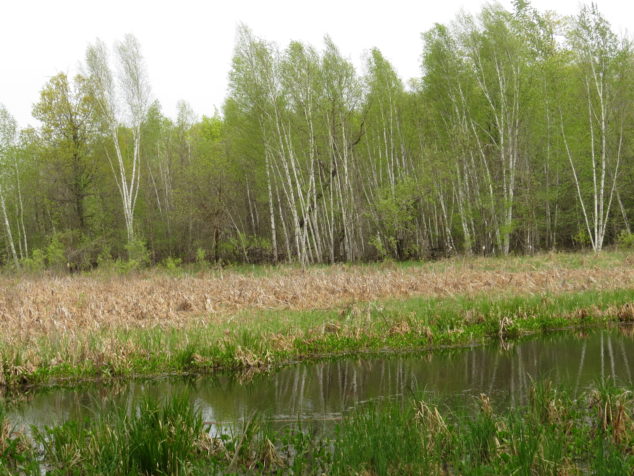
We hiked the trail with no map, not knowing where we were going, around shallow ponds filled with cattails and surrounded by white-barked birches.
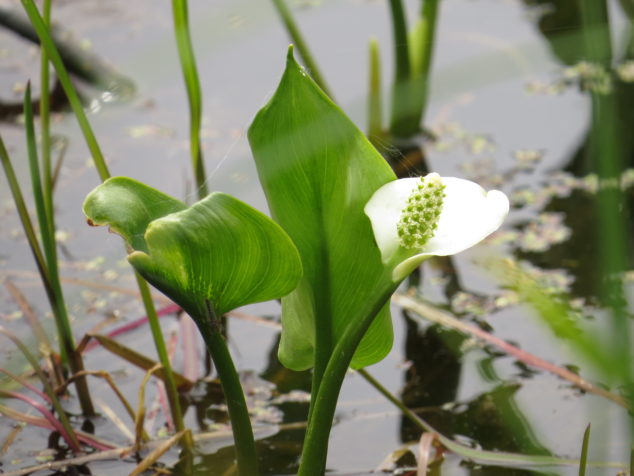
Wild Calla Lilies or Waterdragons bloomed in one of the shallow ponds.
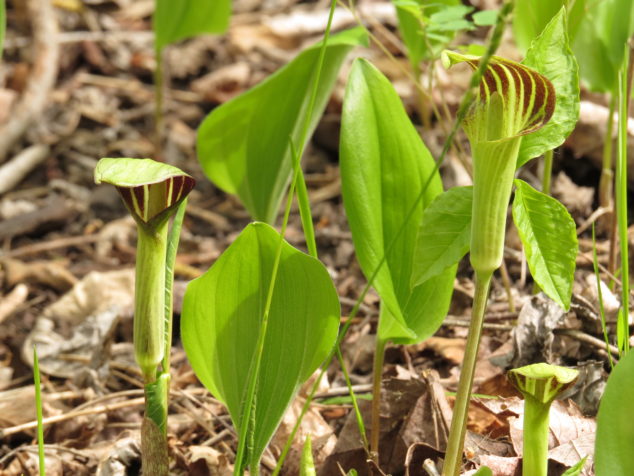
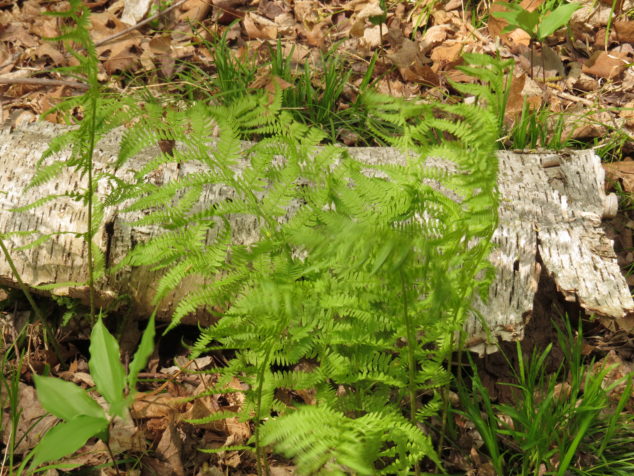
Jack-in-the-Pulpits and Ferns were abundant along the trail.
One of the most interesting plants in the forest was a small shrub. It was shaped like a petite tree with a singular trunk and symmetrical branches. The bark was smooth and brownish-gray, and the branches were pliable and bent without breaking.
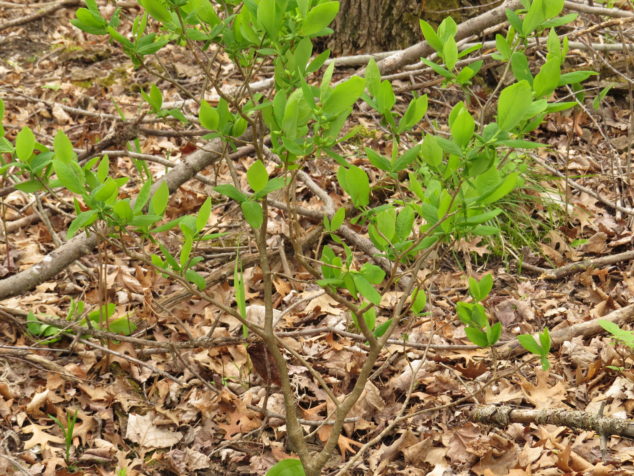
Neither of us knew what kind of shrub it was, and on closer inspection, we saw that it had already bloomed and was producing fruit.
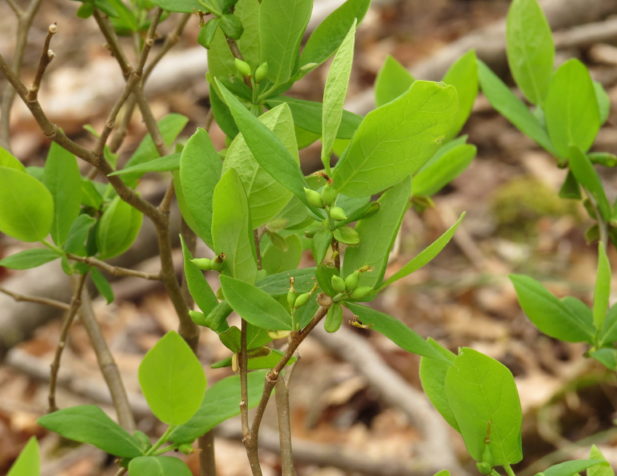
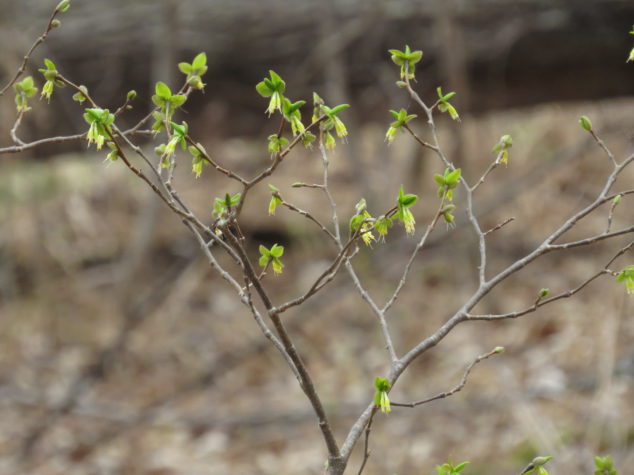
After a fairly long search when we returned home, I found the shrub on the Minnesota DNR field guide to native plants. ‘Dirca palustris’ or Leatherwood grows in part to full shade and likes a boggy habitat. It blooms in March or April, before its leaves emerge, with a bell-shaped pale yellow flower. The fruit will be red by fall, and the leaves have a yellow fall color. I remembered that I had taken a picture of a blooming shrub during our early spring hike at St. John’s Arboretum. It was the blooming Leatherwood! The Native Americans used the tough, leathery twigs and bark for bow strings, baskets, fishing line, and rope.
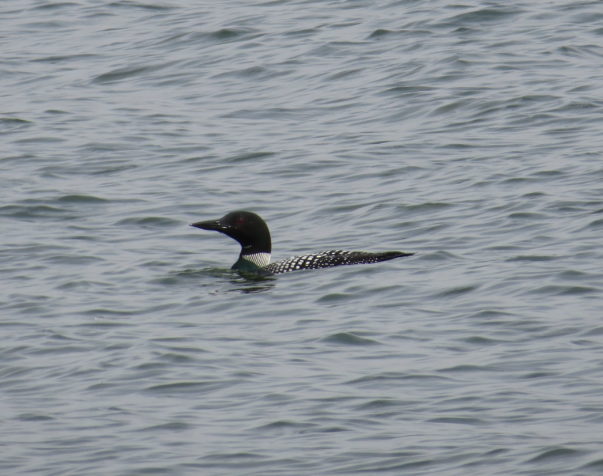
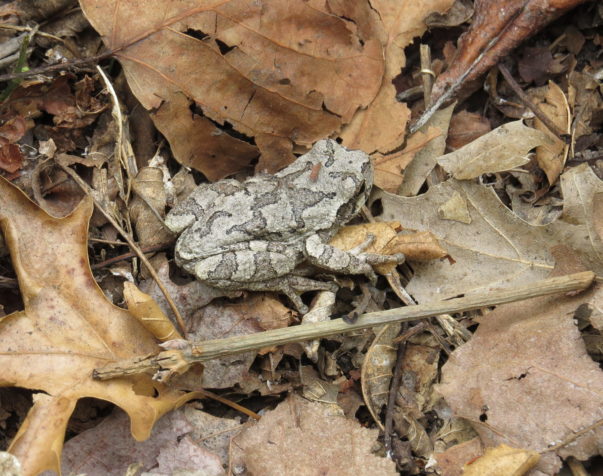
The only critters we saw were a loon on Birch Lake when we arrived and a camouflaged tree frog on the leafy trail towards the end of our hike.
Going to a place we had never been before and walking through Nature’s incredible gifts soothed my soul and got my senses in order. Connection with Nature–in all its glories–is something we nurtured and passed on to our children. The journey of parenthood takes a sharp turn when children are adults and living in places far from their parents, but the road never ends. Losing a parent of my own in these last months brings that reality home. Remember to whom we belong. That sinew of code–tough, flexible, unbreakable–that we receive from our parents, grandparents, and ancestors and the years of nurturing from resilient, flawed parents make us who we are. Follow the trail of life. We may not know where we’re going all the time, but we can find beauty and interesting things along the way. Find our own way. We choose our paths, sometimes turn around when we find we’re on the wrong trail, and at other times blaze our own trail with intuition and spirit. May Goodness and Mercy follow us all the days of our precious lives.
In Love with This Green Earth
I am in love with this green earth. –Charles Lamb
Do you remember the feelings you had when you first fell in love with your beloved? A euphoric happiness settled over me. I thought about him all the time. I couldn’t wait to see him again, though months would pass since we lived 400 miles from one another. I happily spoke about him, sharing stories of who he was as a person. I read and re-read the letters he sent and immediately answered them. I marveled at his handsomeness, his politeness, his kindness to family and friends. I felt lucky or blessed or pinch-me-I’m-dreaming that he felt the same way about me.
May turns a corner for us into the fullness of Spring, and I have to say, I am quite smitten. The green-ness and new-ness of this season should not come as any surprise–it happens every year! And yet, I find myself thinking, “Was last Spring this beautiful?!” I can’t get enough of looking out the window at the lush green grass and the emerging leaves.
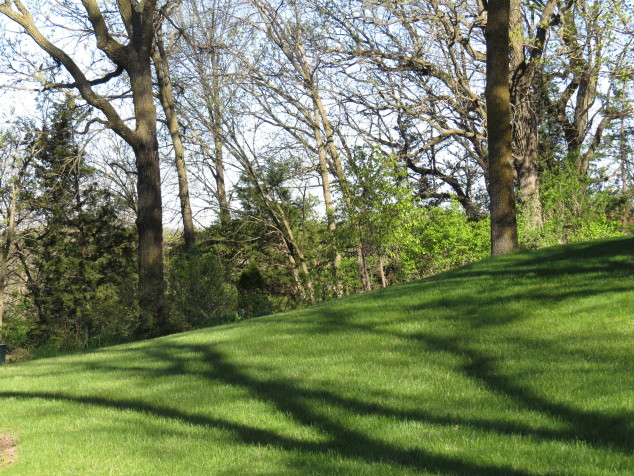
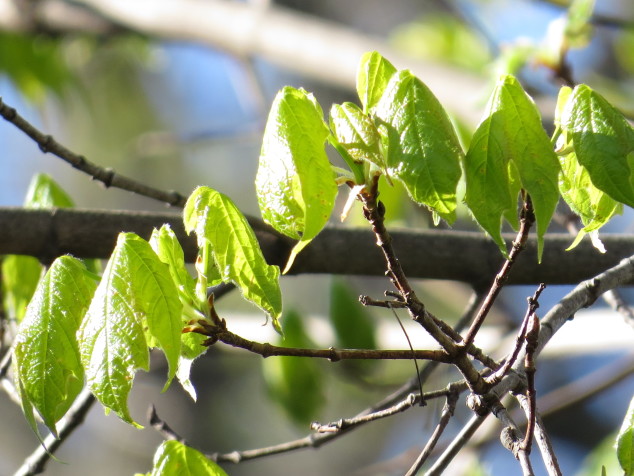
I happily wander through the yard and woods, delighting at the swiftly growing ferns and the spring-blooming perennials.
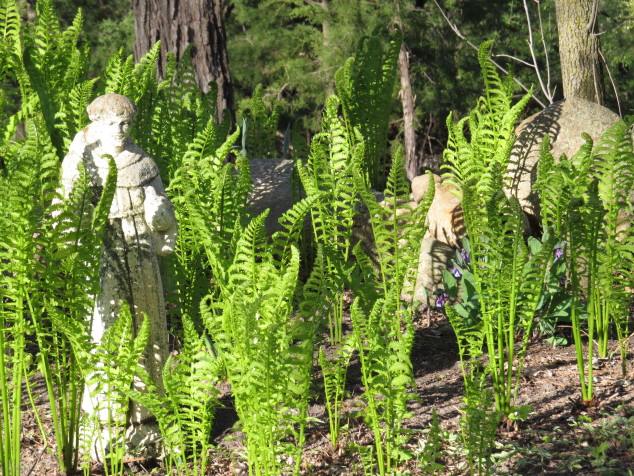

There is an overabundance of growth, a population explosion of buds, flowers, and plants coming back to life from the dormancy of winter. (Go to North Star Nature Facebook page to ‘Like’ and see more May flowers and photos of nature.)
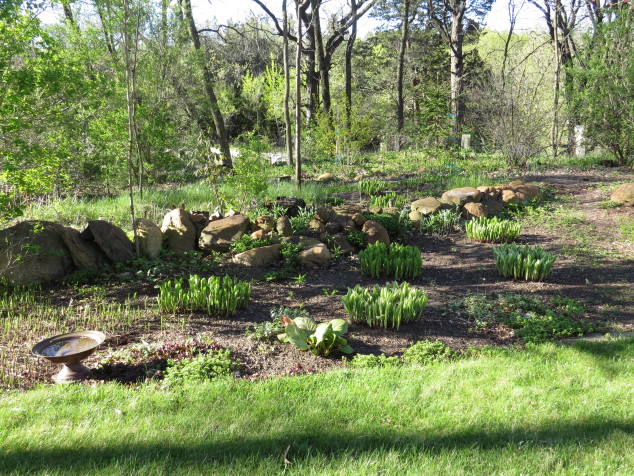
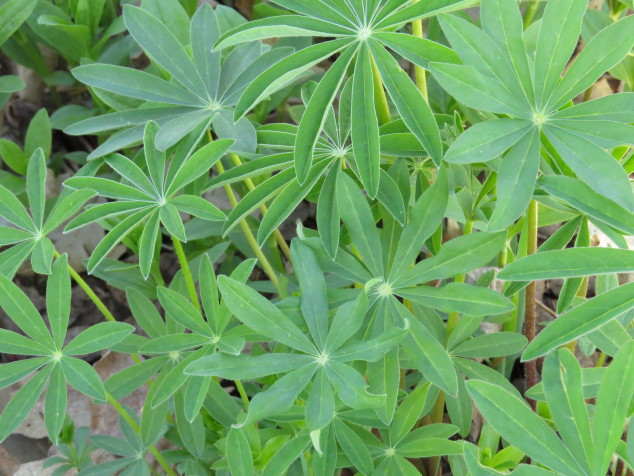
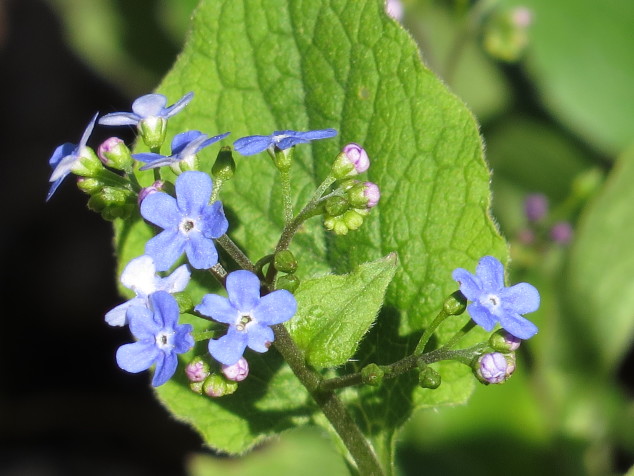
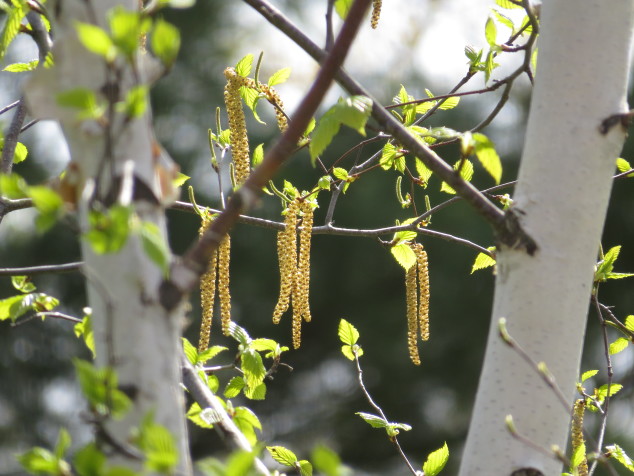
I am in love with this green earth. The changing seasons have a way of opening our minds to development and the cycles of Life–like falling in love with your beloved. Spring flushes the winter dormancy and old ideas from our minds and bodies to be replaced with possibilities and reliabilities–like having faith in Goodness. Renewal fills our souls with explosions of hope for the greener, growing, greater days ahead–like living in a Sanctuary. We are blessed to be living on this beautiful green earth!
Tree Stories of Our Lives
I’m planting a tree to teach me to gather strength from my deepest roots. –Andrea Koehle Jones from “The Wish Trees”
The weeping willow tree was a magical fort in the corner of our yard. The wispy walls hid us in the cool shade on hot summer days on the farm, and yet, with no trouble at all, we could burst through the ‘walls’ to the sunshine. It was one of my favorite things about the South Dakota farm (along with the animals) when I was a young child. Forty-five years later when I went back to see my first home, the magnificent weeping willow tree still stood in the corner of the yard.
Forests are the lungs of our land, purifying the air and giving fresh strength to our people. –Franklin D. Roosevelt
I spent my school-age years in the tree-populated foothills of the Blue Mountains in Pennsylvania. Our yard was scattered with old fruit trees–sour cherry, apple and pear. A tire swing hung from the apple tree where I would sit and ponder all the things a child needs to ponder. The woods behind our house was a wilderness of maple and sassafras trees, large boulders, a small creek, and plenty of poison ivy, but it was the perfect place for trails, forts, games, and pure air to fill our lungs and power our legs.
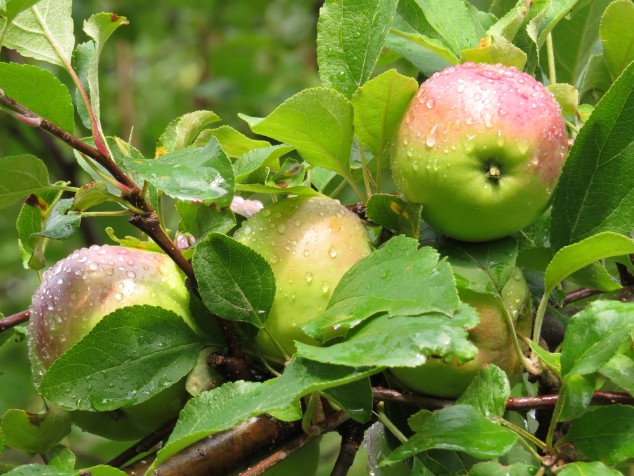
Then one day the boy came to the tree and the tree said, “Come, Boy, come and climb up my trunk and swing from my branches and eat apples and play in my shade and be happy.” –Shel Silverstein from “The Giving Tree”
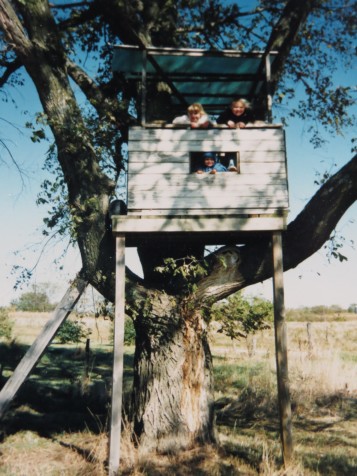
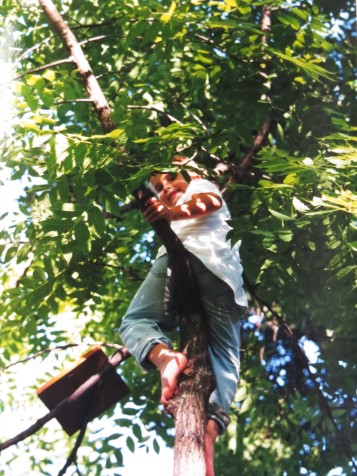
A huge, old Elm tree stood between our yard and hay-field on our Missouri acreage. It was the chosen spot, the perfect place for a tree house for our three young ones. It was large and secure, yet so high up that it felt like you could touch the sky, sing with the birds, and dance with the wind.
Trees are sanctuaries. –Hermann Hesse
Cottonwood trees are giants of the prairie. I was in graduate school back in South Dakota when I discovered an ancient old Cottonwood in a park where I would walk to clear my head. From the road it just looked like ‘one of the park trees,’ but when I stood beside it, underneath it, I felt like I was in the presence of the Great Spirit. The bark was deeply grooved and corky, and the roots that fanned out from the gigantic trunk, like spokes on a wheel, were as large as other trees. At a certain time of the year, the cotton, containing the seed, would fall and glide and float away on the wind. I would often stand with my back against the trunk thinking about all the history that had passed by this tree, all the storms that had pounded its branches, all the July festival-goers who had taken shelter under its shade, and all the seasons of harsh cold, gentle rains, singing summer leaves, and brilliant yellow foliage.
The creation of a thousand forests is in one acorn. –Ralph Waldo Emerson
Back to this time and this place to the Old Beauty of an Oak tree that rises tall outside our bedroom window. It is one of many oaks around us that produces acorns. With a little help from Chris to keep the rabbits at bay, the acorns sprout into seedlings, who grow ever so slowly into saplings and ever so slowly into young trees…one day to be a sprawling Old Beauty.
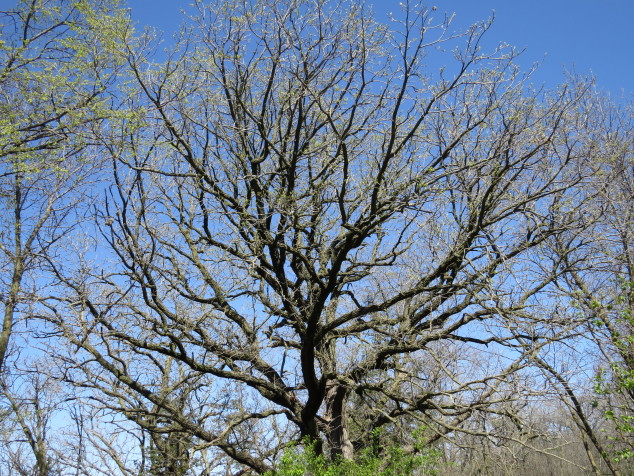
I would guess that most people have tree stories from their life’s journey. My childhood with trees brings back happy memories of play, imagination, and agility. We were living, breathing companions, sharing oxygen and carbon dioxide, stability and freedom, and growth. Then I married a ‘tree man,’ who even before I met him thirty-six years ago had already planted more trees than most people do in a lifetime. Together we love, care for, and appreciate trees. When our three children were growing up, trees were an integral part of their lives, and I know they have tree stories of their own. And that ancient Cottonwood in the park–it gave me strength, perspective, and wisdom at a time in my life when everything else seemed to be falling away. The seeds of our lives and the seeds of their lives–living together, not taking the gifts for granted, never underestimating the mutual need–all of us growing to become Old Beauty.
Our Spaceship Earth on Earth Day
Spaceship Earth is a term popularized in the 1960’s, particularly by architect-inventor-system theorist R. Buckminster Fuller when he wrote the book “Operating Manual for Spaceship Earth.” The inventor of the geodesic dome relates Earth to a spaceship that has finite resources that cannot be resupplied. He spent much of his life researching and developing designs and strategies to help us sustainably exist on Earth.
Another forward thinker Marshall McLuhan, who predicted the World Wide Web almost thirty years before it was invented, is quoted, “There are no passengers on spaceship earth. We are all crew.”
Last Sunday Chris and I checked on the eagle nests–yes, we have babies! One nest has three, fuzzy-feathered eaglets, and the other nest has at least one that I was able to see.
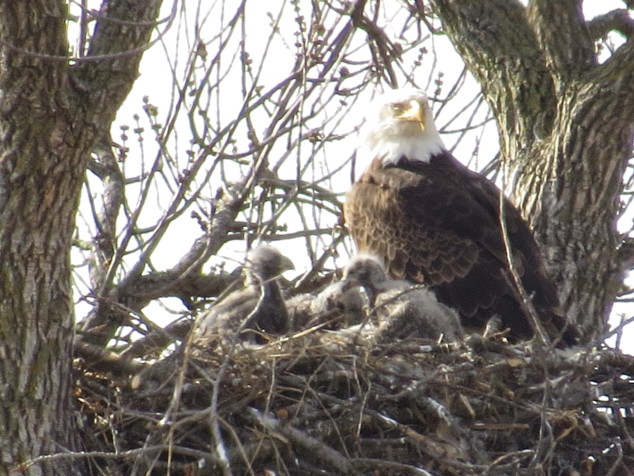
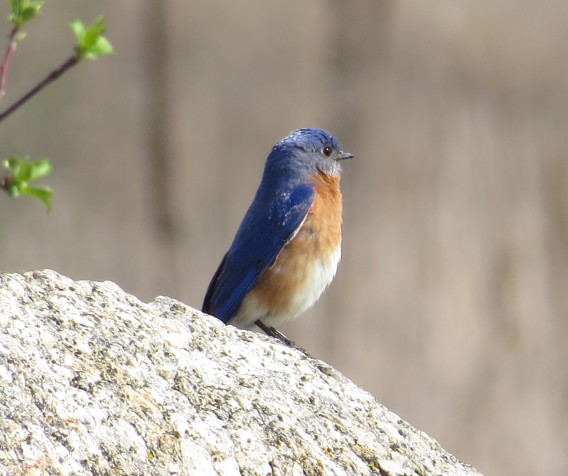
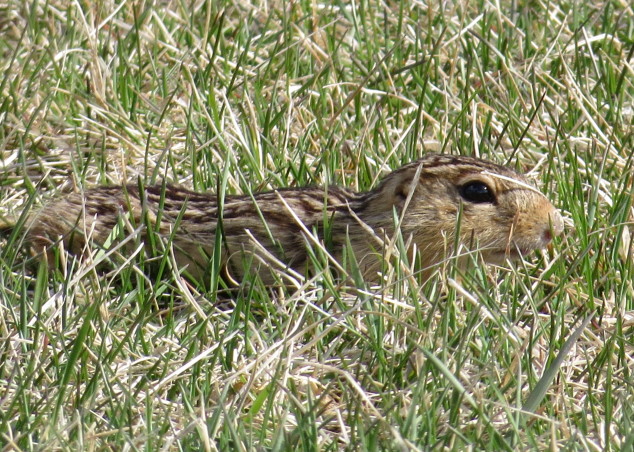
The bluebirds were nesting nearby, and a ground squirrel slunk through the grass trying not to be seen.
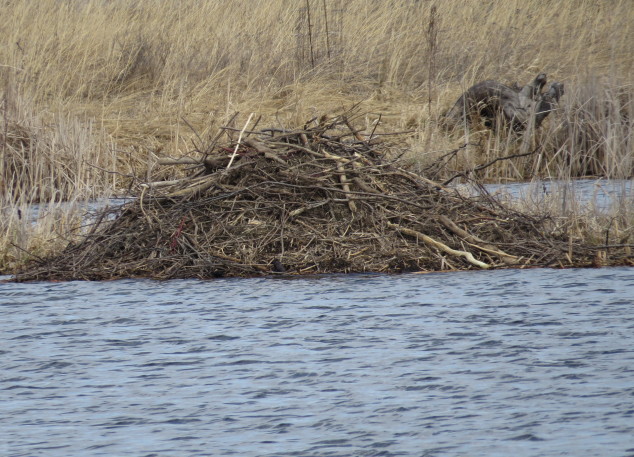
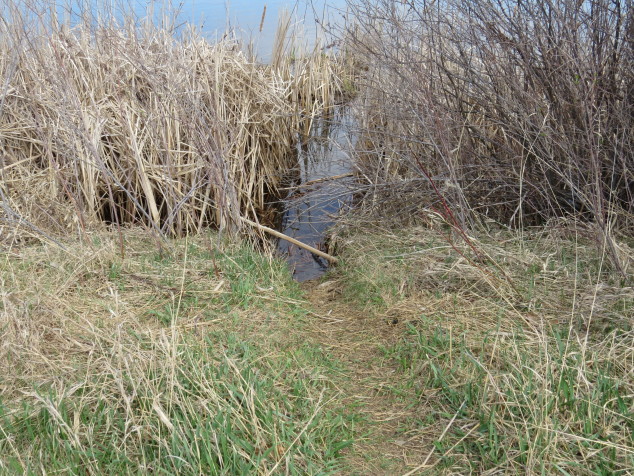
We then drove to St. John’s Arboretum and hiked the Boardwalk Loop through prairie, wetland, maple forest, oak savannah, and conifer forest. In a short 1.5 miles, it was a lesson in ecosystems and a glimpse into the diversity of animal and plant life in a tiny part of spaceship earth. A beaver lodge rose from a blue lake on one side of the road. There was a path through the cattails and up the bank for the beaver to get to the lake on the other side.
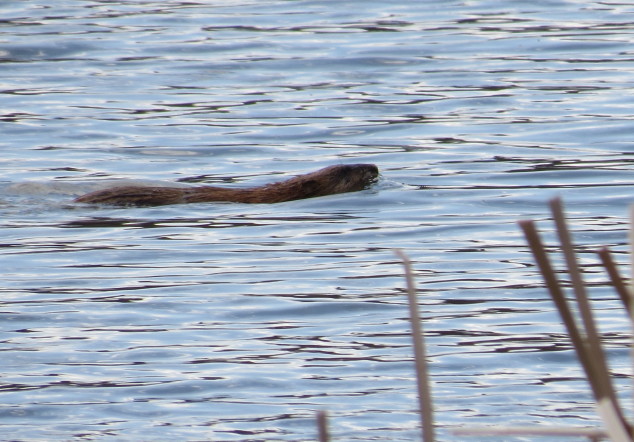
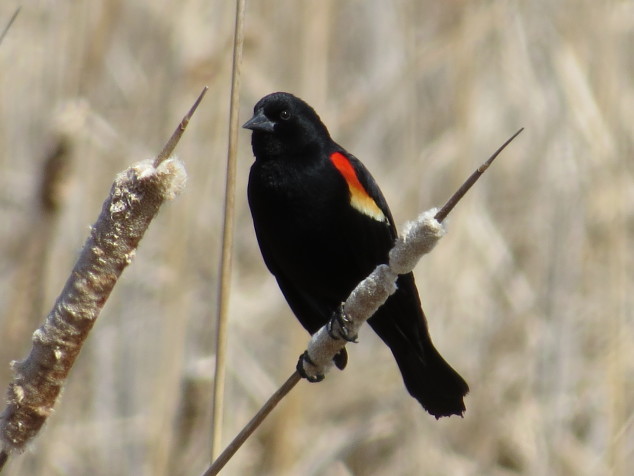
Red-winged blackbirds sang from their perches on cattails.
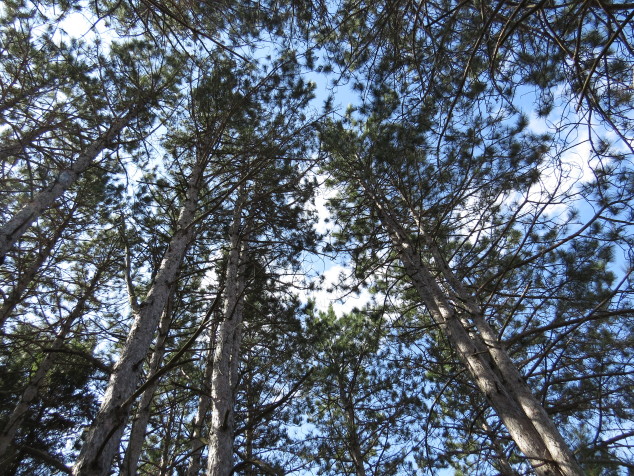
The delicious scent of the pine forest filled our noses with the smell of contentment.
We crossed the boardwalk over the wetland…
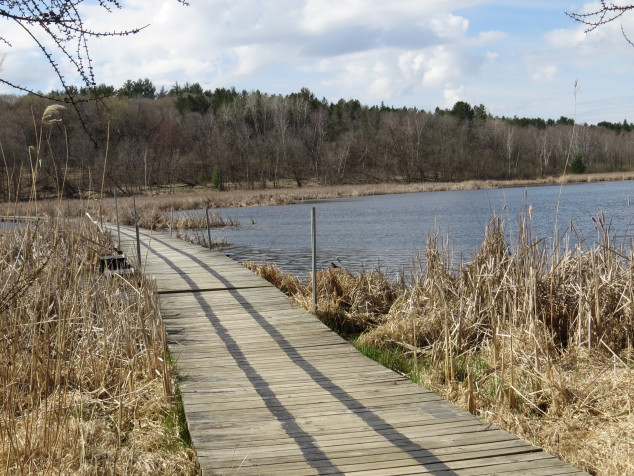
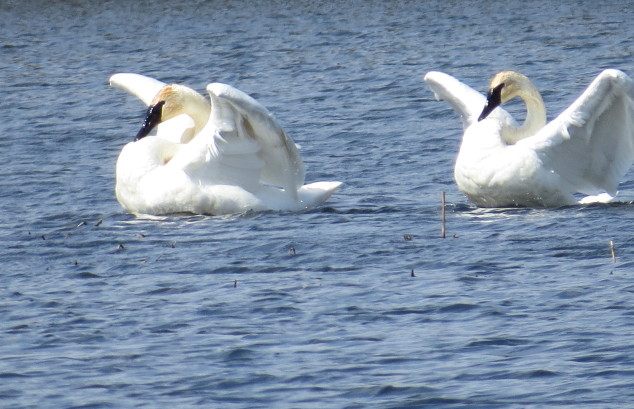
and saw geese, ducks, and a pair of Trumpeter swans.
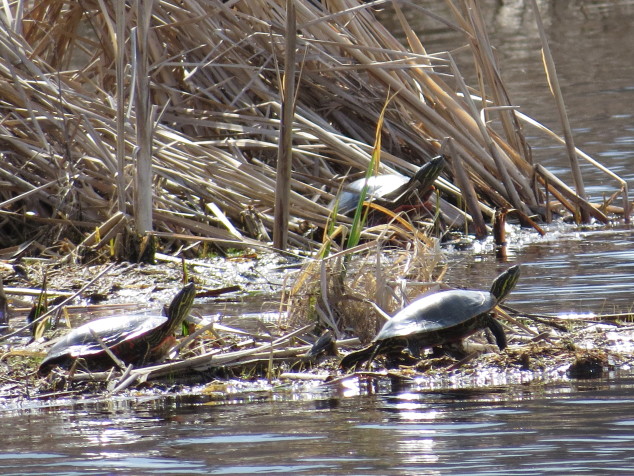
Painted turtles sunned themselves in the warm spring sunshine.
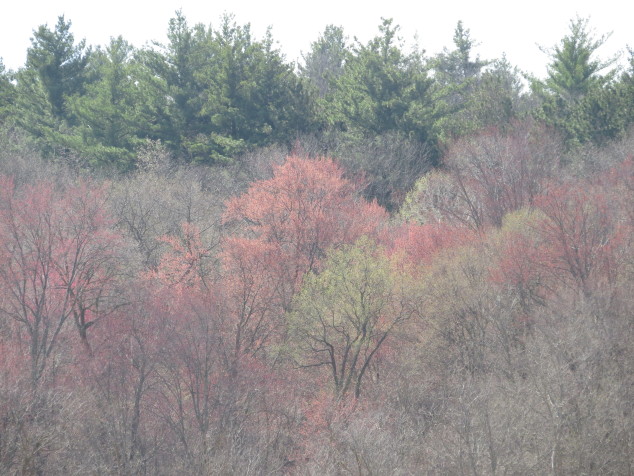
Maple trees with red and lime green blossoms contrasted with the deep green of the pines.
The woodland trail through the tall maples still looked like late winter…
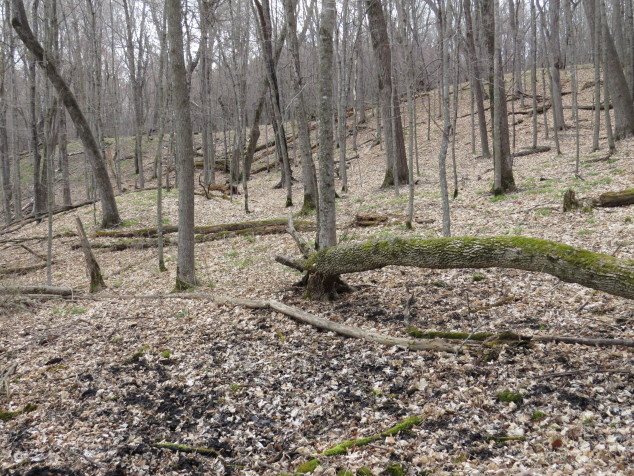
…until we saw the Spring Ephemerals! These early blooming flowers take advantage of the small window of sunshine between snow melt and when the trees have leafed out. They grow, flower, are pollinated, and produce seeds in a short period of time and often go dormant by summer. We found Spring Beauty…
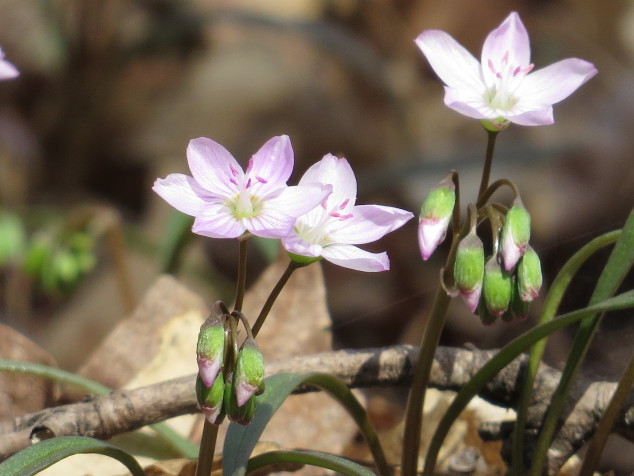
…False Rue Anemone…

…and Hepatica bursting through the leaf cover.
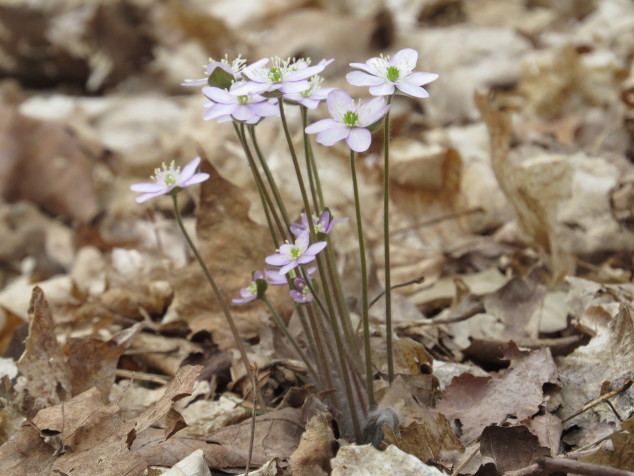
Two short walks less than ten miles from one another, and we were blessed to see such an array of plant and animal life that was once again coming to life in the Minnesota Spring. In honor of all these amazing creations, I would like to urge everyone to take good care of our Spaceship Earth. We are all crew members with tasks to do and responsibilities to carry out, even if it’s only in our tiny part of this big, blue planet. Happy Earth Day!
Crocuses–A Triad of Faith, Hope, and Love
Our first year of marriage was wonderful! We had had a long distance romance for two years–weekly phone calls at best, lots of letter writing, six to eight visits a year–so we were happy to be together! We rented a huge, old civil war-era house on a little acreage in Missouri, had a large garden and our two horses, and made some special friends. In year two or three of our marriage, I remember looking back on our first year and realizing, in hindsight, how difficult it had been! It had been a struggle to figure out who I was as a person, who he was as a person, and who we were as a couple.
There were many wonderful things that have happened in the last six months–especially the wedding of our daughter in October. We have had visits with family and friends and have skated through a mild winter weather-wise. But looking back on this late fall and winter, I realize that it has also been one of those difficult times. So when I walked out the driveway this morning and saw the crocuses blooming, I nearly wept for joy. They are so beautiful and colorful after a dull, lifeless, difficult season.
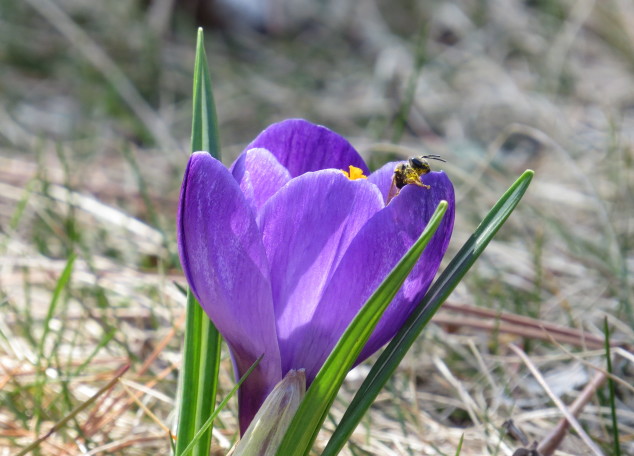
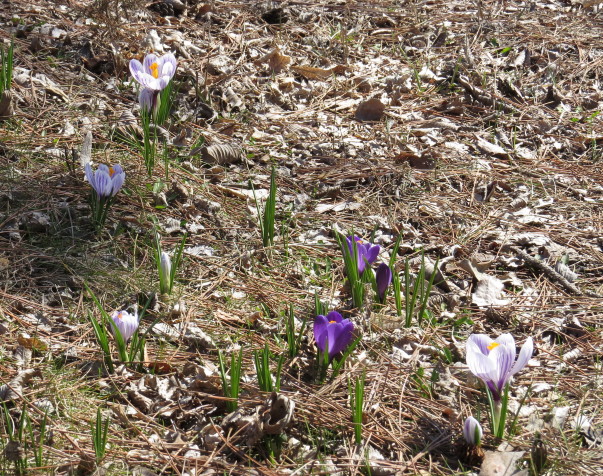
Somebody must have been equally delighted with the delicate crocuses, as this one had been munched on already.
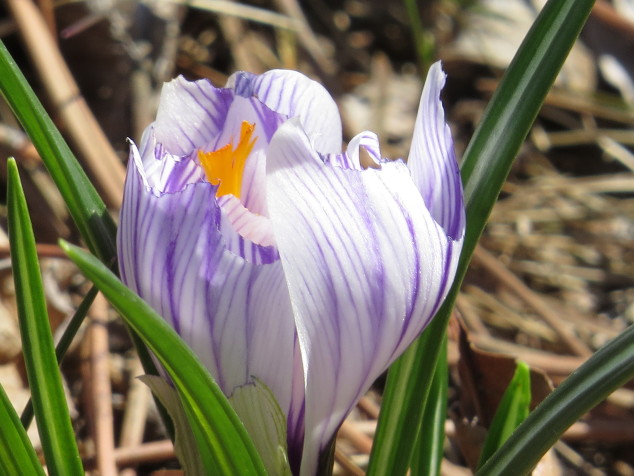
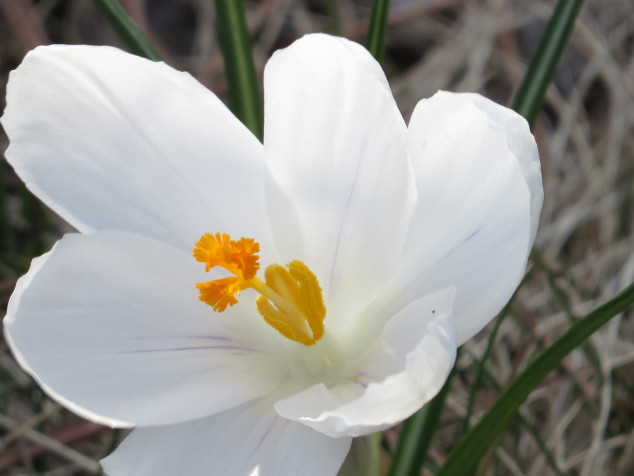
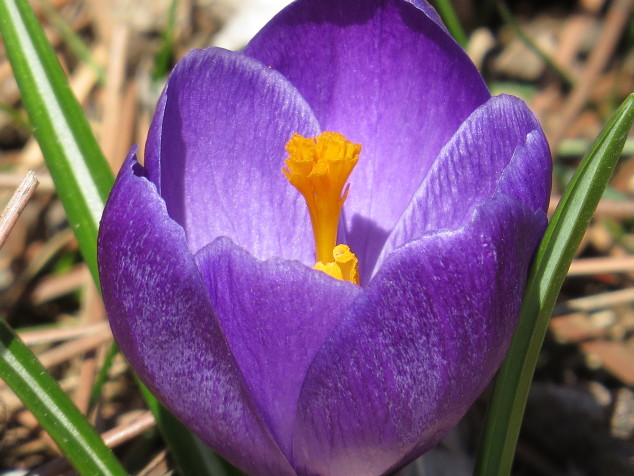
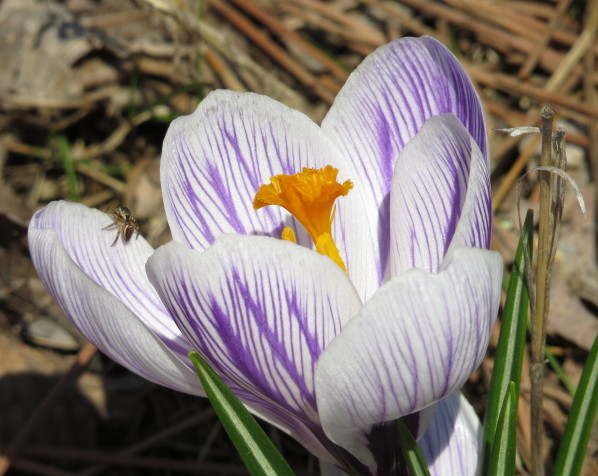
Crocuses are the first flower to bloom in the spring, often when snow is still on the ground. They are a symbol of the awakening of Nature, an uplifting sign of hope. They are also associated with the first Valentine’s Day when Valentinus, a third century Roman physician and devout Christian priest, gave a note wrapped with a yellow crocus containing the healing herb saffron to a blind patient of his. He had been jailed and sentenced to death because of his Christianity. Legend has it that her sight was restored upon receiving the flower and note signed ‘from your Valentine’ on February 14, 270 AD. A symbol of faith, hope, and love–the triad that helps us discover our true selves, guides couples through the struggles of life, walks with people when they bury a loved one, and soothes the pain of lost children and friends. I weep for Joy and send you Love.
Our Instagratification World
Take a photograph and instantly share it with your friends or the world. Give your opinion on politics, sports, or entertainment in the moment that it’s happening. Send a video that is ‘erased’ after the viewer sees it. Deposit or transfer money and pay bills with a few clicks on your phone. Look up anything you want to know. Welcome to the Instagratification world of smart phones. Instant gratification isn’t the reason for or result of smart phone technology–it has been part of the human psyche for eons. As infants and young children we want food, sleep, attention, toys, etc., and we want them now. Learning to delay gratification is a trait in human development that takes maturity, practice, willpower, patience, and the ability to see future consequences.
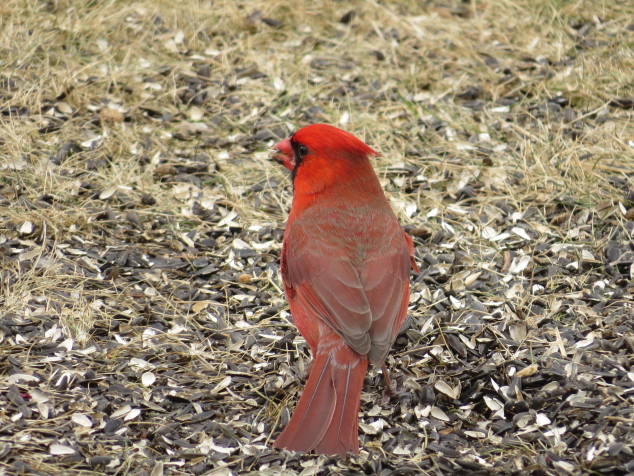
The calendar declared Spring was here over two weeks ago. With daylight savings time and longer days, evenings are light until nearly 8:00! Last weekend we had a day with temperatures in the 60’s! But since then, highs have been in the upper 30’s and low 40’s with below freezing nights and scatters of snow. Ice was on the birdbath we put out for the bluebirds. The weather man was talking wind chills. With the exception of some green grass, it doesn’t look much like Spring.
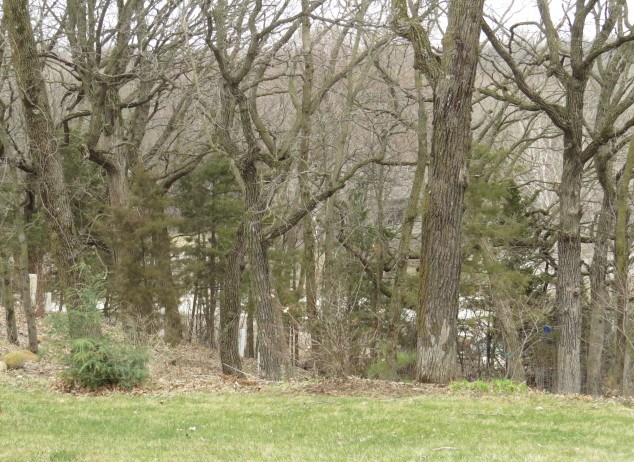
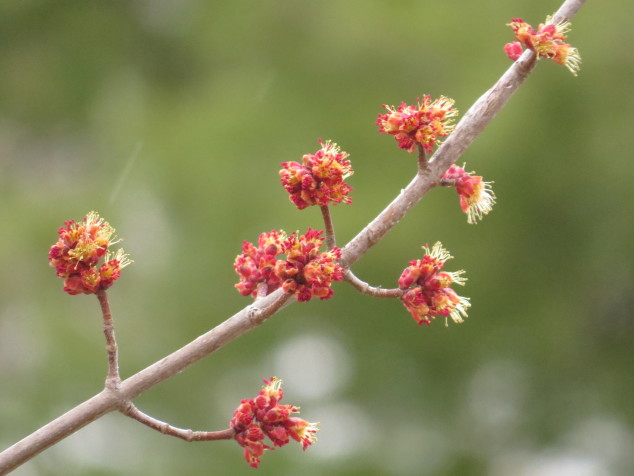
With hat and gloves warming me, I went out in search of the subtle signs of Spring. The maple tree right outside our window that had been forming flower buds for weeks, finally popped into bloom!
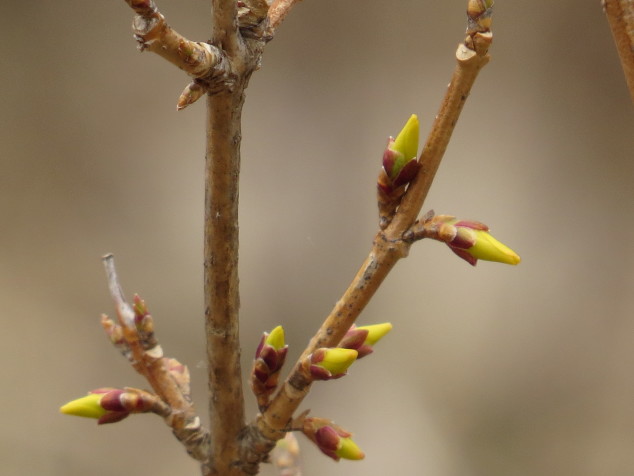
Our tiny forsythia bush, nearly lost in the long grass from last year, has bright yellow flower buds.
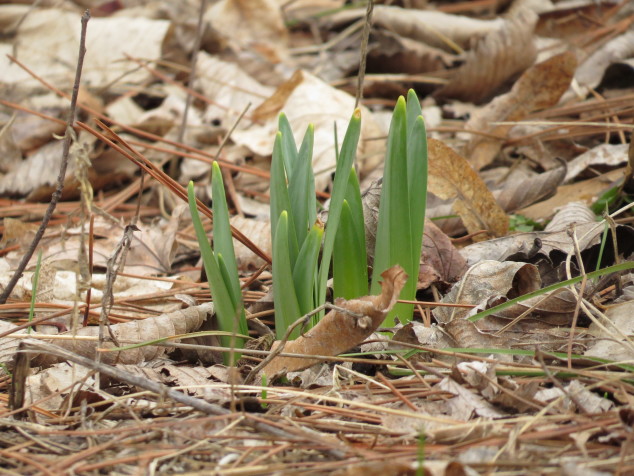
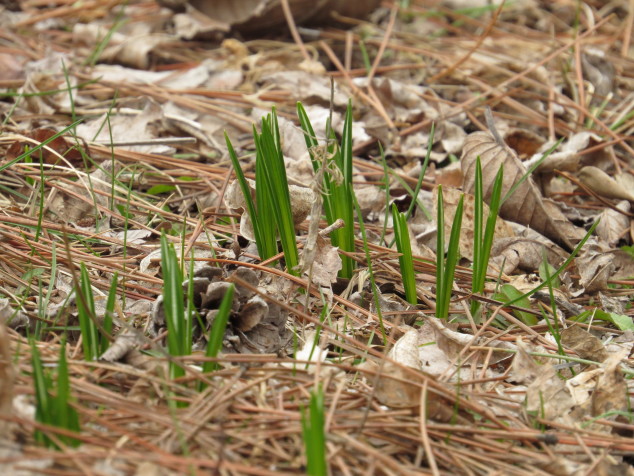
Daffodil and crocus leaves are pushing their way up out of the cold, brown ground. The yellowed, frozen tips of the daffodils are their crown of courage.
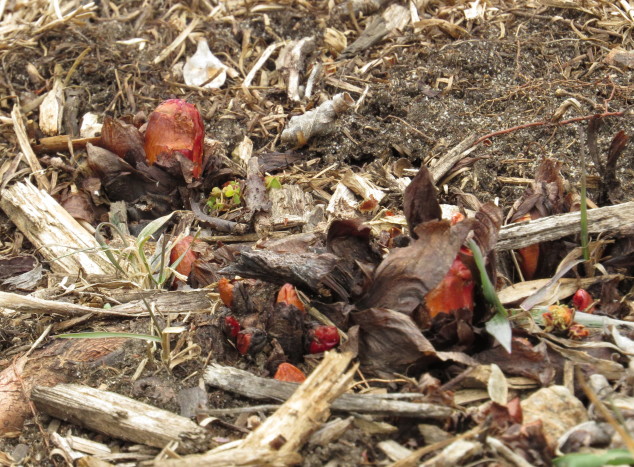
Rounded, red rhubarb buds emerge from the papery brown skins that hide them for the winter.
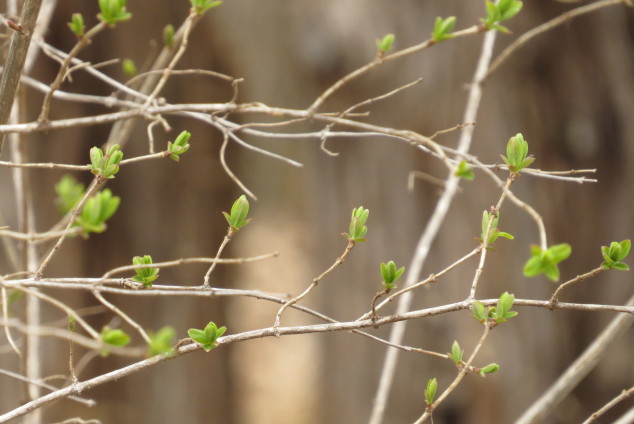
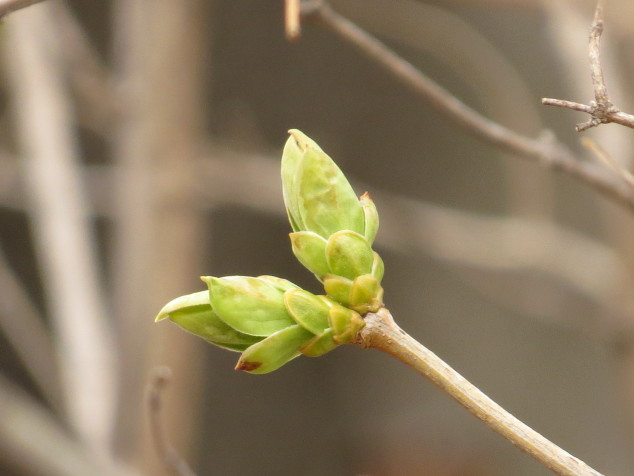
Honeysuckle and lilac shrubs will be the first to open their green leaves.
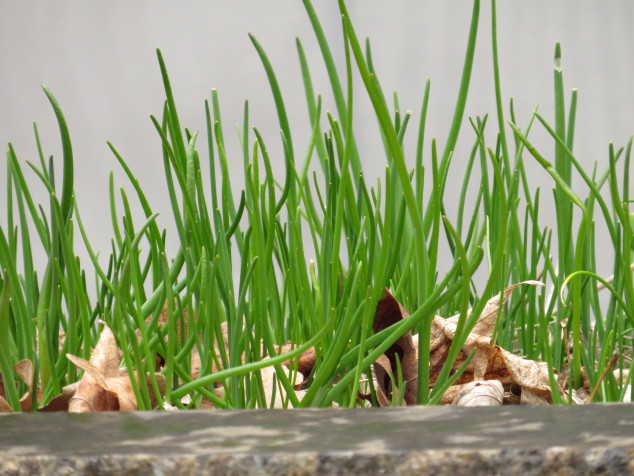
The hardy chives are growing fast, defiant to the snow flurries in their heralding of Spring.
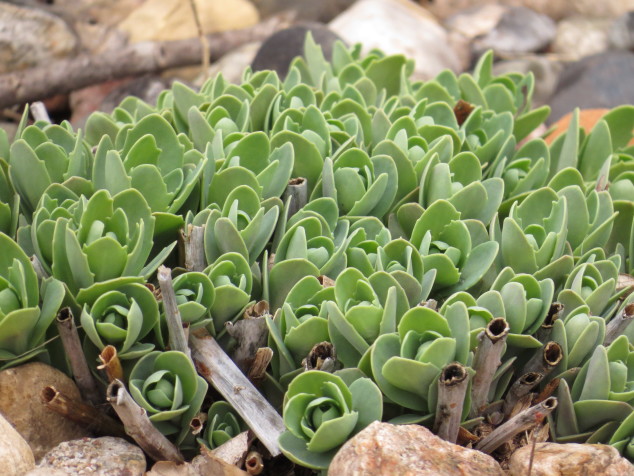
Rosettes of sedum buds begin their growing season early and will grow and mature all spring and summer until they finally bloom in fall.
Mother Nature is not in the business of Instagratification! Even though we want warm weather, flowering trees and shrubs, bright blooming bulbs of tulips, hyacinths, and daffodils–and we want them now, we must slow down and respect Nature’s time. She teaches us patience and that it’s not all about us. Richard Louv, author of ‘Last Child in the Woods’ and new book ‘Vitamin N’ says, “The more high-tech we become, the more nature we need.” We need to observe the subtleties of Nature in order to develop the skills for detailed work. We also need to look at the ‘big picture’ of us on this Earth in order to envision how we want the future generations to live. We need to appreciate the early and the late bloomers for their contributions. Nature teaches us there is Life beyond technology, and that our health and well-being are enhanced by our encounters with her. Let Nature be your crown of courage and feel the Instagratitude!
Gleanings from March–Spring Comes Gently
In a usual year, March is snowy and blustery, and most people wish away the remains of the piled up snow and freezing weather in the hope of Spring. But this March was different–we started the month with snowless ground and accumulated only an inch or two during a couple of flurried days. In between, we had above freezing temperatures with a record high of 58 degrees in the second week of the month–too warm! So this year, Spring comes gently and early to Central Minnesota.
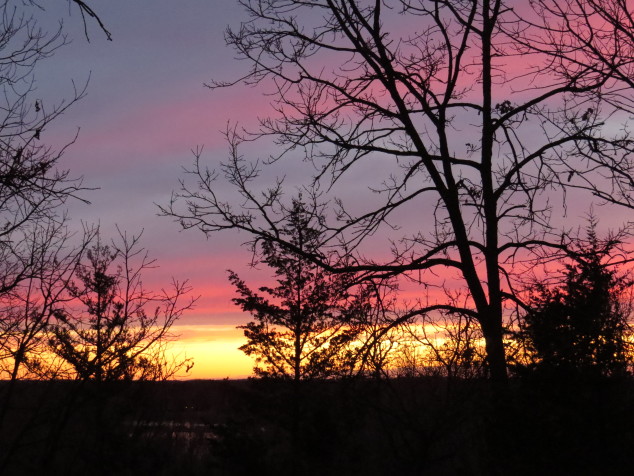
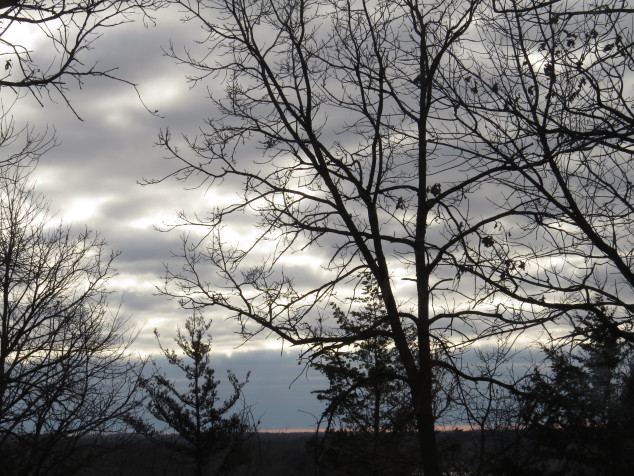
The setting sun is shifting to the northwest, but we still had some spectacular evening skies outside our living room window this month.
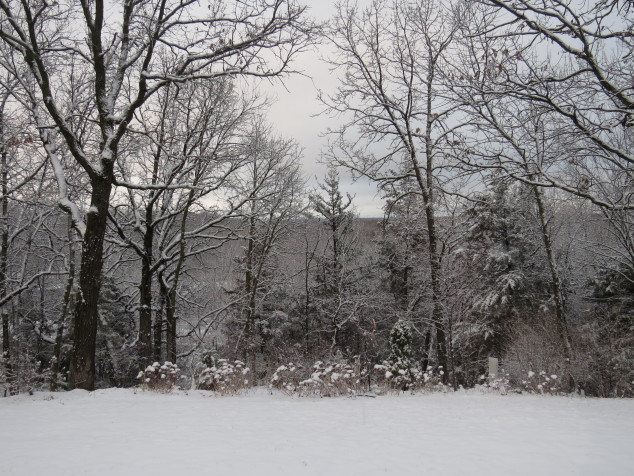
On Easter morning, we awoke to a beautiful covering of snow with frigid blue-gray skies.
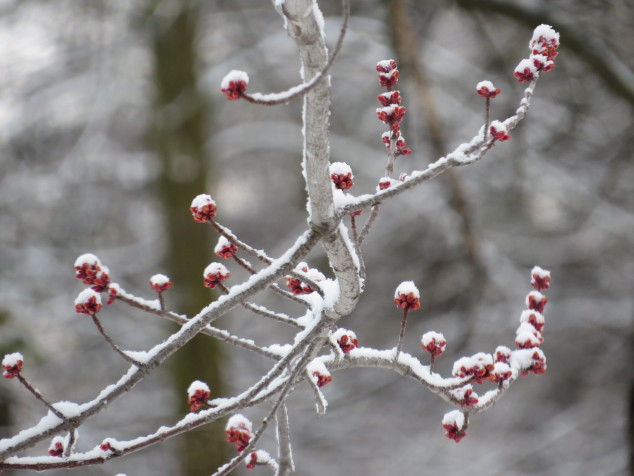
By afternoon the snow had melted, and Chris, my Mom and I hiked around the nearby County Park to check on the eagle nests.
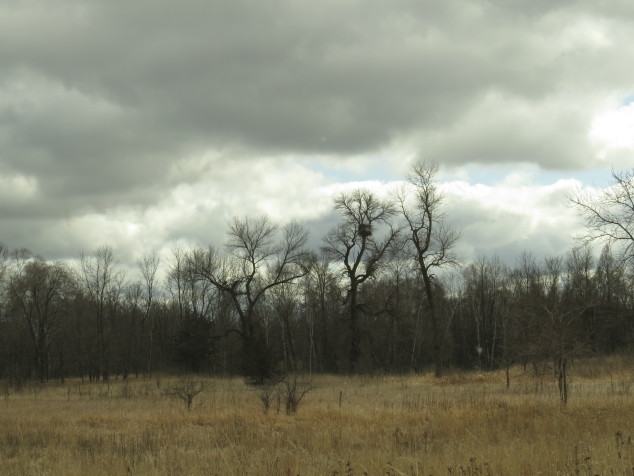
One of the pair in each nest was laying on eggs–content and calm before the storm of activity that comes with the hatching of the hungry eaglets.
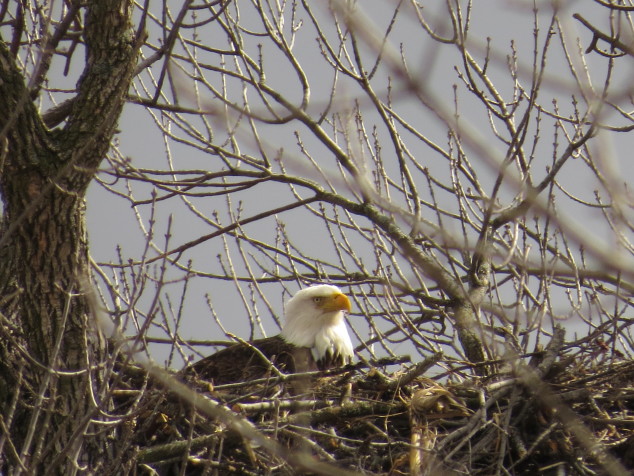
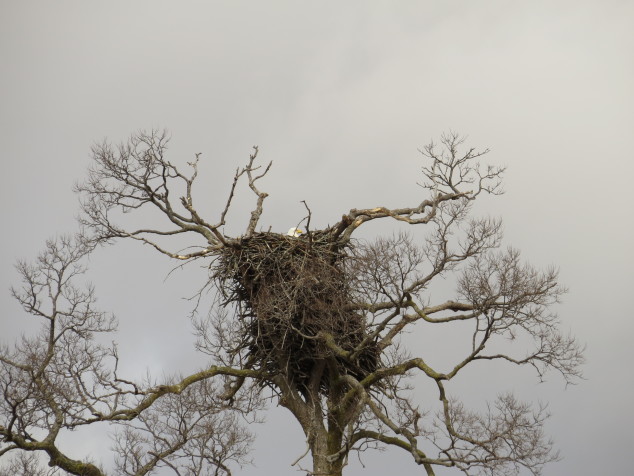
The trail around the eagle’s nest was winter bland until we saw bright red-twigged dogwood stems and fuzzy white flowers of pussy willows.
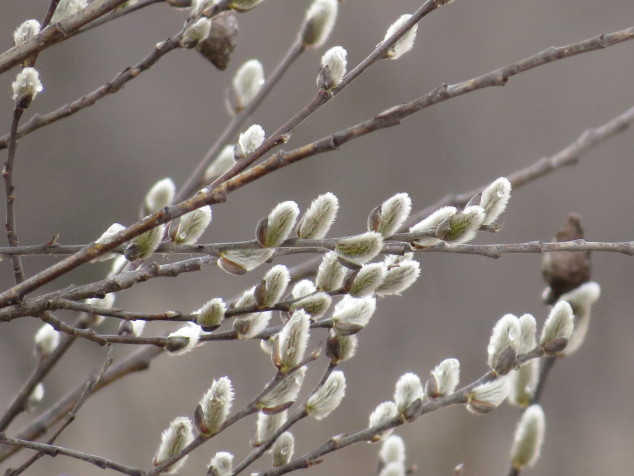
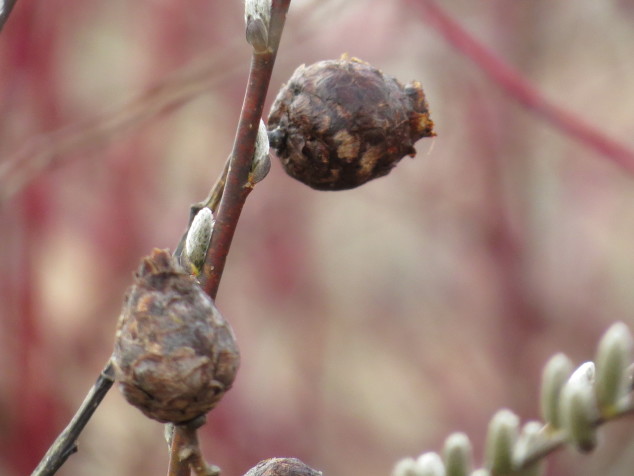
Along with the flowers of the large shrub-small tree pussy willow, there were numerous pine cone-looking objects at the end of branches. Willow Pine Cone Galls are formed when tiny fly-like gnats, called midge, lay their eggs in the swelling terminal buds. The larva secretes a substance that accelerates the growth of the would-be leaves into a mass of flattened scales that look like a pine cone. The larva produces its own anti-freeze, much like the Goldenrod Ball Gall larva, in order to survive the winter. The adult emerges from the gall in Spring.
Two days after Easter, I saw the first pair of returning bluebirds–such a lovely sign of Spring!
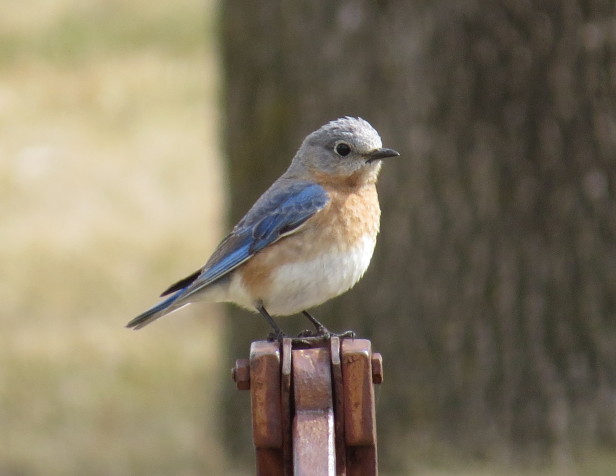
March is always a month of contrasts moving into Spring, and this year seemed to be all the more so. Record warmth and snowy mornings, winter bland and bright colors, nondescript skies and spectacular sunsets. And yet Spring makes its way regardless–Nature’s constant, gentle revival. My life this month seemed to mirror March–wonderful visits from family and difficult news, days of strength and days of weakness, calm gratitude and stormy unrest. And Life gently moves us forward–to learn from the galls, to see hope in new life, to appreciate a beautiful day and the flash of blue wings as Spring comes gently.
Monday marked the second anniversary of North Star Nature, and I wish to extend my gratitude and thanks to those of you who read and share my blog! A particular thank you for the thoughts, prayers, and comments after the death of my Dad–I very much appreciate your kindness.
Do You Believe in Miracles?
“Do you believe in MIRACLES?” was the cover and headline for the Sunday Parade magazine last weekend. It was the story of a Texas girl who had amazingly survived a 30-foot fall into a hollow cottonwood tree. Her head-first fall and subsequent hours inside the tree resulted in just some minor bumps and bruises and possible concussion. If that wasn’t amazing and relieving enough, her Mom noticed in the following days and weeks that her daughter’s serious digestive disorders, diagnosed four years earlier, had seemed to disappear! A Pew Research Center study found that 8 in 10 Americans believe in miracles, even more than half who are unaffiliated with any particular faith. Author Marianne Williamson and teacher of A Course in Miracles says, “People know there’s more going on in this life than just what the physical eyes can see.”
And yet, miracles are in front of our eyes wherever we look, if we really take the time to see.
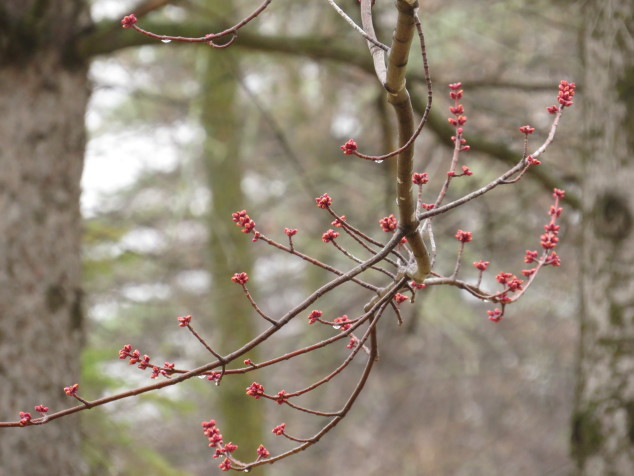
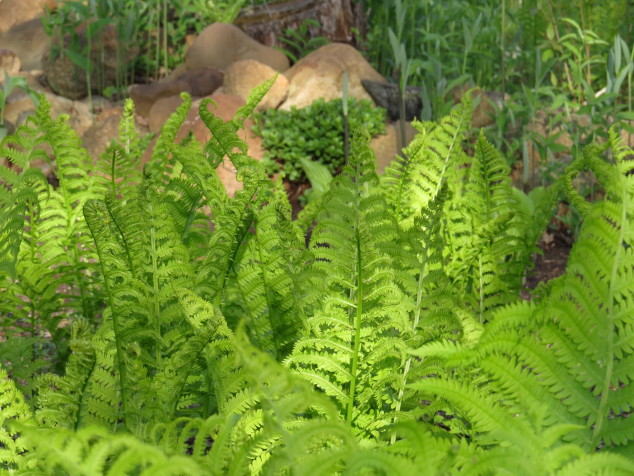
We are afforded this miracle every Spring as we leave the dormancy of Winter. In less than two months’ time, our fern garden will go from this…
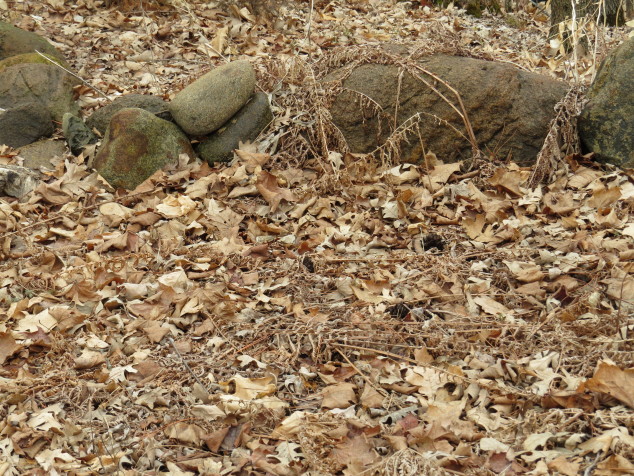
to this….
Purple raspberry canes will be producing raspberries in four months…
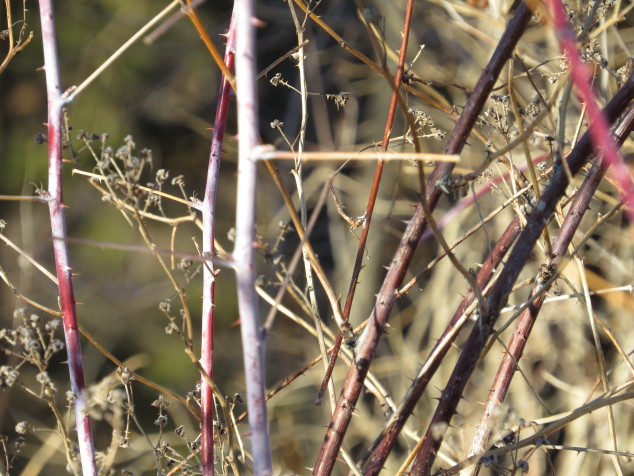
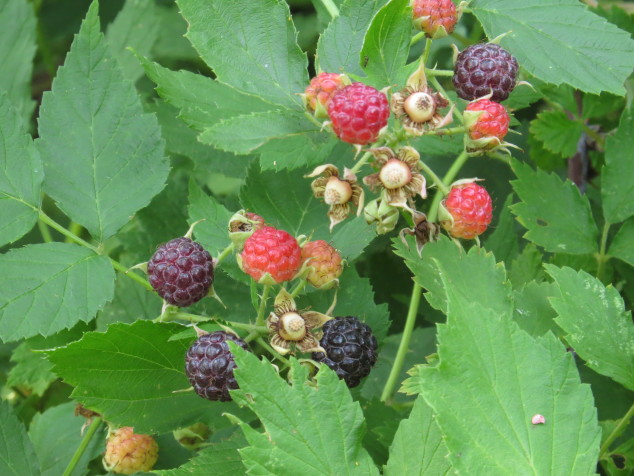
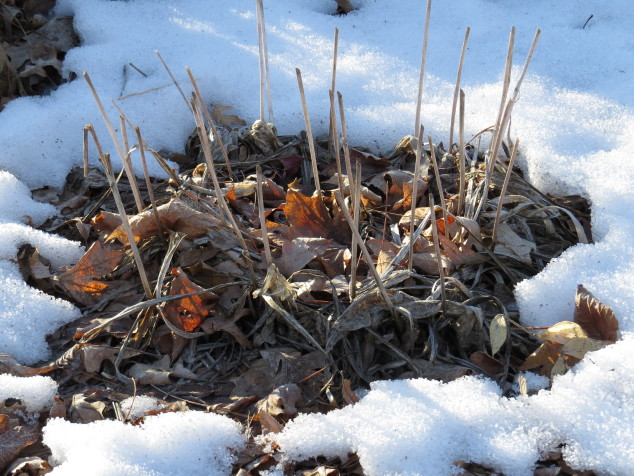
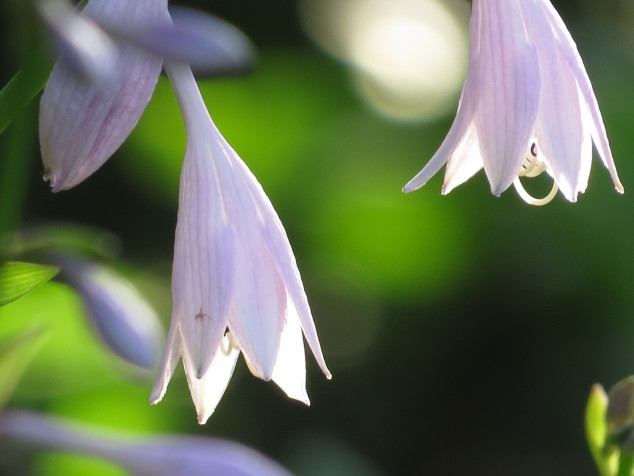
Hosta stalks in the snow will transform to huge green plants that flower at the peak of summer.
An empty nest may be re-used or re-built for a family of yellow warblers by the middle of summer…
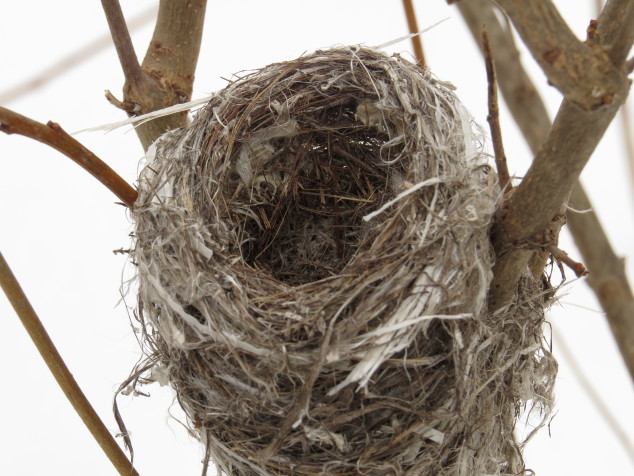
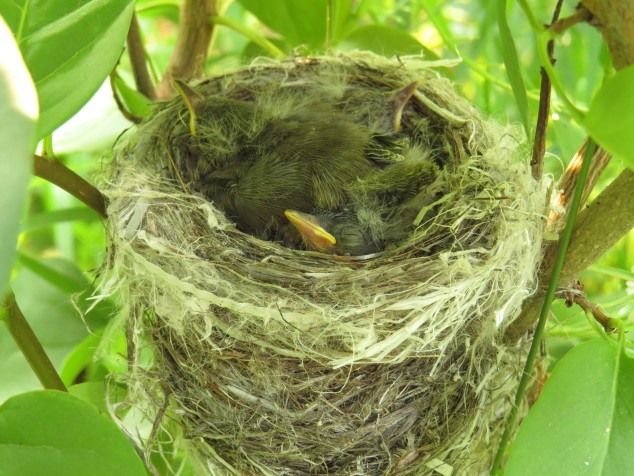
And all of this and so much more occurs without intervention of any kind!
Miracles do not, in fact, break the laws of Nature. —C. S. Lewis
Spring is a miracle! It is easy to see. Every aspect of Nature–in all seasons–is a miraculous occurrence. And in this busy, technical, seemingly money- and people-controlled world, Nature just does its own thing. It doesn’t need our help, or permission, or belief. The Texas Mom responds to naysayers who don’t believe her story, “I don’t feel like I have anything to prove. The proof is right there. We lived it.” So the question “Do you believe in miracles?” is rather a moot point. Miracles happen.
“Do you believe in Miracles?” in the March 13, 2016 Parade magazine by Katy Koontz
- « Previous Page
- 1
- …
- 33
- 34
- 35
- 36
- 37
- …
- 50
- Next Page »