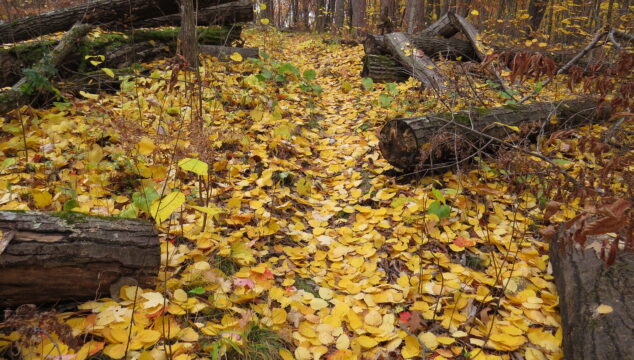
Come walk with me in the peak Autumn beauty of the Northwoods. To say that I love this time of year is an understatement. Most everyone can appreciate the colorful falling leaves---it reveals the 'true self' of a tree when its leaves are no longer producing chlorophyll. Their true colors are revealed, and there is something simple … [Read More...]
Wielding the Power of Love
There’s somebody out there wielding more power than they probably know they have. Their power is not evident at the time of delivery; in fact, it will be evident days to weeks later. The delivery, I’m sure, is taken lightly and seems relatively benign, and they may or may not see the consequences of their actions. That being said, their mission is noble and just—to rid our city or township of the noxious Spiny Plumeless Thistle.
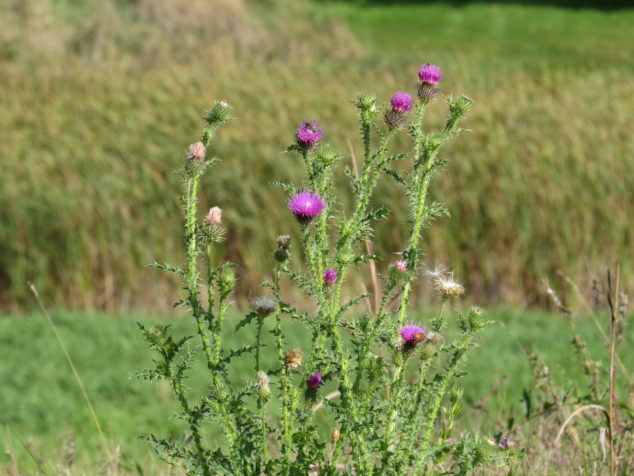
I don’t have anything against the intrinsic value of any plant in this creation of ours, but I have a strong dislike for Buckthorn and Thistles, two of the most tenacious invasive species of our area. Come June, I am scanning the ditch along our road for the opening of a pretty-if-it-was-on-another-plant purple flower. At that time, I get out Chris’ sharp digging spade and spend an hour or two doing my civic duty by walking up and down our road chopping every purple-flowered, prickly plant I see.
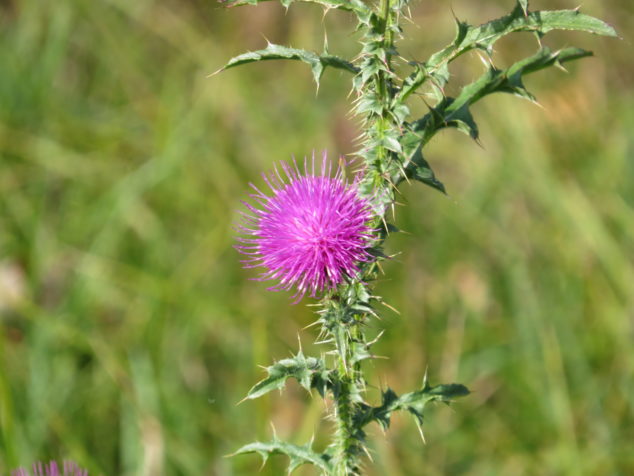
Seed dispersal by wind takes the opportunistic seeds to anywhere there is some degree of disturbance—an overgrazed pasture, vacant lots, field edges, or roadsides. Luckily, the plant is biennial, and with persistence, it can be eradicated over a number of years, especially if all neighbors are on the same page. As the summer wears on, my digging slips, and I notice a few spindly plants flowering across the road from our garden. Here is where the wielder of power comes into the picture—with a wand and a tank of herbicide. August is not a good time to spray weeds in a good management program. I’m not an expert on herbicides, but I live with a man who has used them every year of his horticultural career, and I know about drift and volatility. I first noticed a change in the color of a number of sumacs–they all turned orange while the others were green. And then I noticed my tomatoes—the growing tips were burned back, the leaves got spotty, and the tomatoes I was so looking forward to started turning off colors. Dang it! The city public works director denied that they were the ones responsible, but I was a little worried when he said my garden was too far from the road to be affected (not true) and didn’t know what dicamba was.
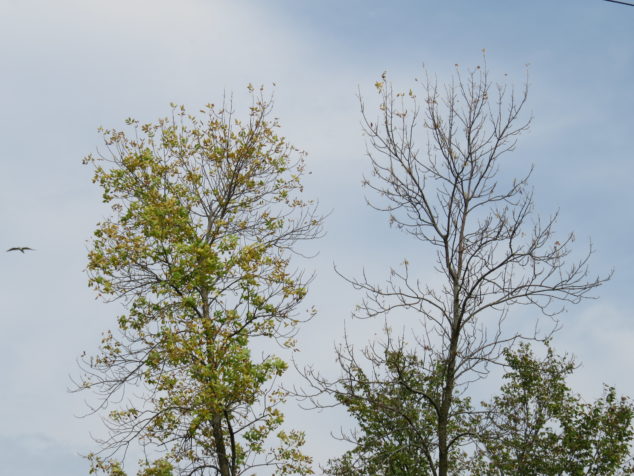
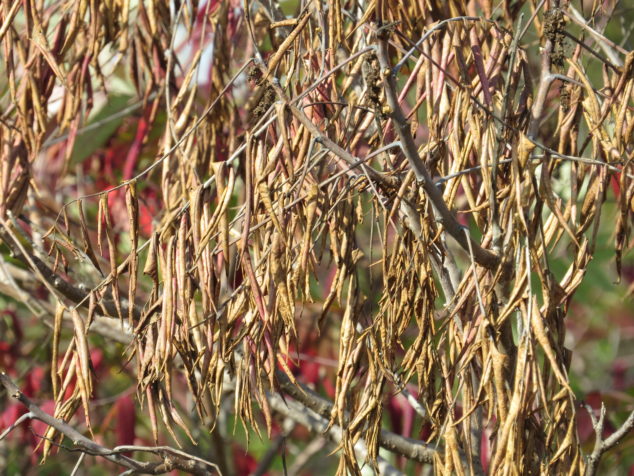 The wielder of the wand did more damage in the neighborhood. While spraying in a gravel parking lot down the road at a small park, the drift killed all but one branch on a 15-20 year old Accolade Elm, a hybrid tolerant of Dutch Elm disease. Its survival seems unlikely.
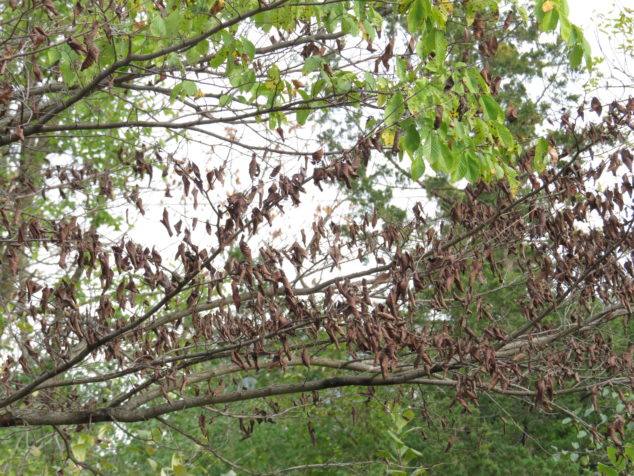
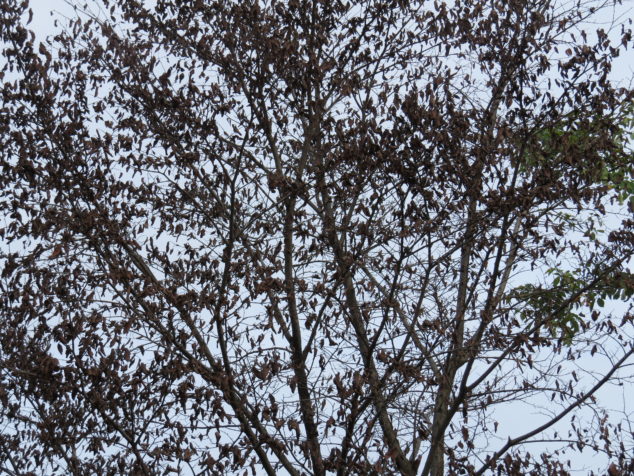
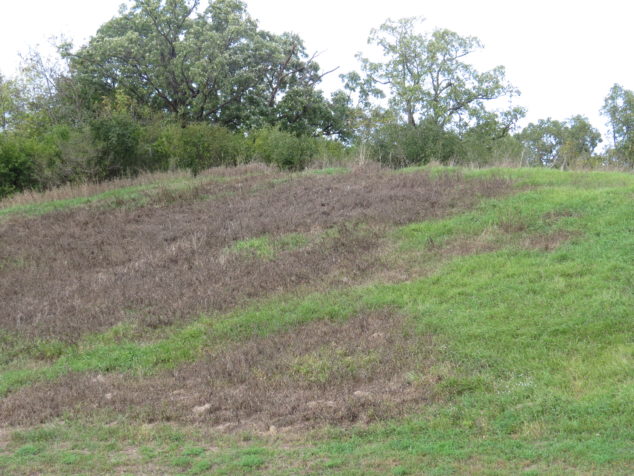
And the hill at the end of the road that used to be all grass a number of years ago will probably be filled with thistles again next year, as the herbicide concoction killed the grass along with the thistles.
So disappointing that my tomatoes were wrecked. Disgusting that a tree that took so many years to grow was wiped out. Frustrating that the people responsible don’t have a better management plan than ‘go spray thistles’ in the humid hot middle of summer. For some reason it all reminded me of the hate, injustice, and ignorance in the world that seems to be tenaciously invading all our lives. The prickly spines of hate are often hidden under the beauty and righteousness of a pretty idea. Seeds of discontent and harm are dispersed via the internet by opportunistic self-serving strangers looking for the grounds of unrest. And what are the wielders of power doing to manage it all?
It’s overwhelming at times. I find myself wondering in that ancient, yet 90’s sort of way—What Would Jesus Do? It helps me stay strong. I know that I will keep picking up my shovel to chop out hate and ignorance, and for all I am worth, I will wield the power of Love.
Shifting Gears
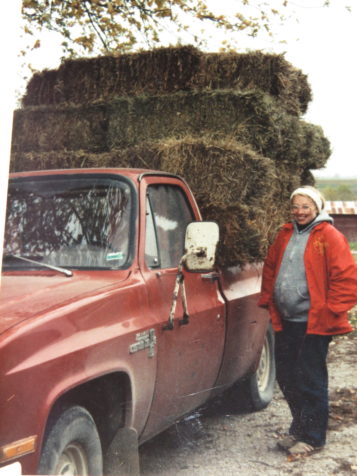
We were still newlyweds when Chris taught me to drive a vehicle with a manual transmission. We had just bought a used 1981 Chevy C-10 1/2 ton pick-up truck. It was a bold red color—the only choice for a truck, according to Chris. The single cab and long bed (the standard back then) looked sleek and utilitarian and housed a ‘three on the tree’—a manual three-speed shifter on the steering wheel column! He drove us to a way-out-yonder gravel road north of Bates City where no extraneous traffic would interfere with my concentration, and then we switched places. He was a patient, methodical teacher, and I tried to be the good student that had carried me through all my years of schooling. But studying books and operating clutches are two different things! I don’t care to remember how many times I killed the engine before I even got going. There was gear grinding, bucking action, nervous laughter, and many “I’m sorrys” when I thought I was wrecking it. Trying to get the hand-foot timing down—letting off the gas, pushing in the clutch, moving the gear shift to the right position, then letting out the clutch slowly and giving it gas—was hard and frustrating. And how do you even get braking in there, too?
Fall is a time for shifting gears—luckily Mother Nature has done it more times than we know and does it smoothly and seamlessly. The growing, producing season is in decline; the fruits of that season are gathered or hanging heavily on the vine, ready for harvest. Internal systems in trees take their cues from the external world—length of daylight and temperature—to stop production of chlorophyll, which unmasks the carotenoids and anthocyanins that give leaves their fall colors and eventually causes the leaves to drop off.
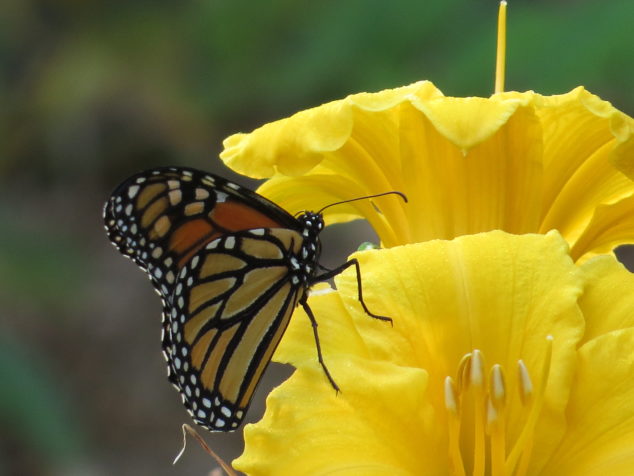
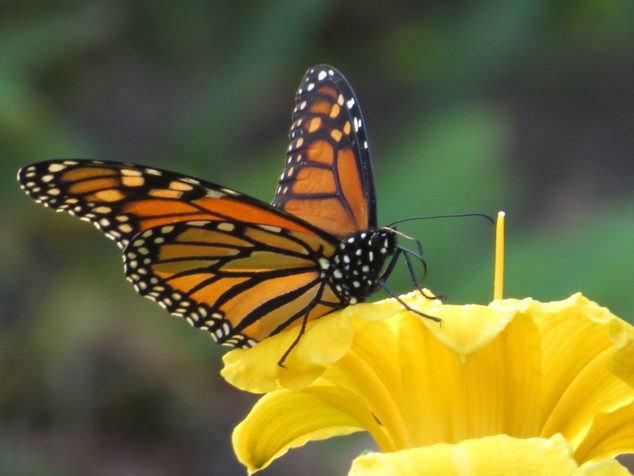
Fall flowers provide needed nectar to insects that may be migrating, hibernating, or laying eggs for the last cycle before winter. One last hurrah of the repeat bloomer Stella D’Oro Lily entices a Monarch butterfly to linger and feed.
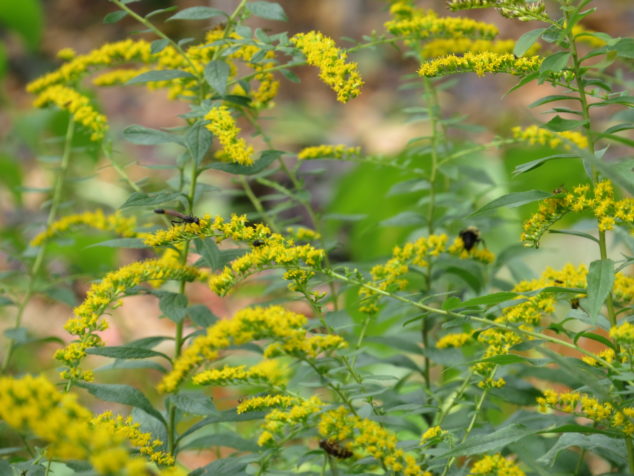
The beautiful ‘Fireworks’ Goldenrod attracts bees and wasps of all kinds.
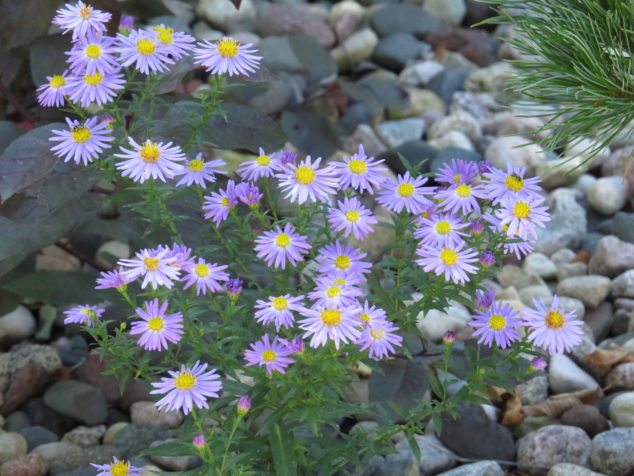
Showy purple Asters bloom vibrantly as one of the late season stars of the perennial world.
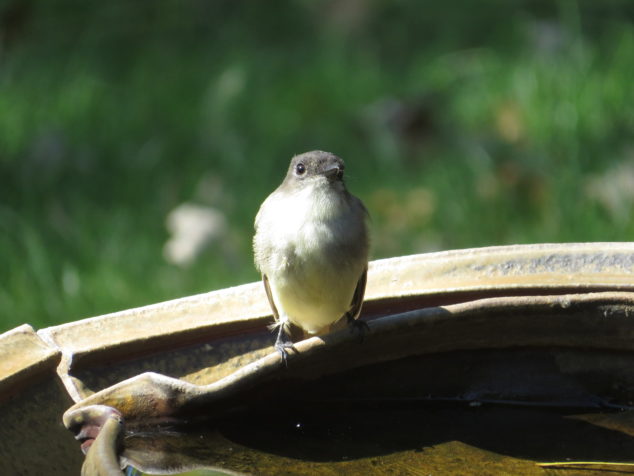
A shift happens with the bird population. The summer birds have mostly migrated away—we no longer see the graceful swoops of the bluebirds or hear the incessant chatter of the house wrens. It is rather quiet on the bird front, though we heard a flock of geese just this morning. A quiet little guy visited the bird bath recently and seemed to be wondering where everybody else was also!
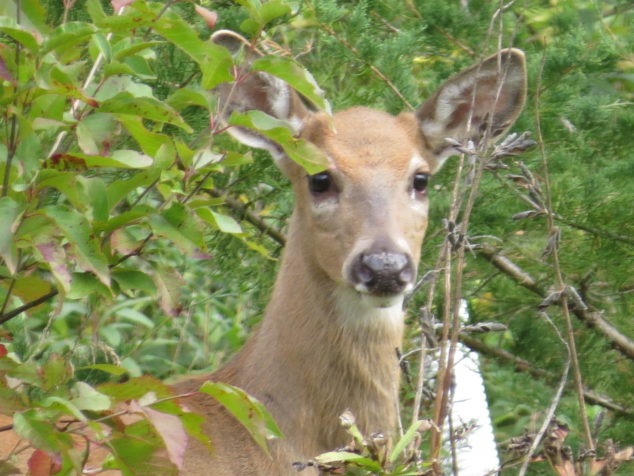
Spring fawns are losing their spots to a winter coat and are almost as big as their mothers. They are the reason we must be so diligent in guarding young trees and shrubs.
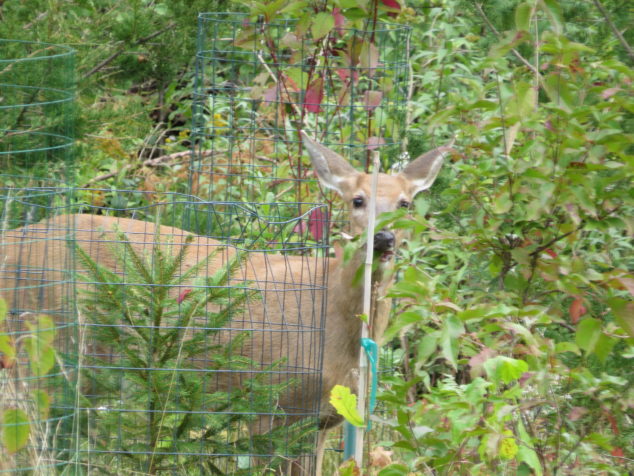
The male spotted fawn shifts to a ‘button buck’ as the pedicels form into small hair-covered bumps at 4-5 months of age that will grow into antlers next April or May.
With the patient tutelage of Chris and lots of practice, shifting gears with a manual transmission was soon second nature to me. The old ’81 Chevy was a stalwart worker for us for many years.
Fall not only shifts gears for plants and animals, but for us also. Some of us harvest and preserve food for winter. We start craving hot soups, pumpkin anything, and apple pie. We slowly and effortlessly morph from outside evening activities to reading or tv watching. Daylight and temperature influence our internal systems and our external choices, showing that we are an integral part of Nature that is often overlooked. Yet we also have a huge cortical brain that can override the more animal aspects of our existence. We can choose to shift gears! We can choose to migrate to a new place, choose to live in the way-out-yonder quietness or the busy bee metropolis. We can choose to be bold, choose our schooling, linger in darkness or seamlessly let our Light shine.
Checking Our (River) Bank Statements
One of the greatest lessons children can teach us is to hold two very divergent ideas in our mind and hearts at the same time. It may just be a matter of days after their birth before we are holding the most precious thing we have ever seen at arms length while contemplating the extreme mess of diaper, clothes, and blankets that needs to be cleaned up. Or there is non-stop crying that wears on our sleep-weary ears and nerves from the perfectly beautiful baby we brought home.
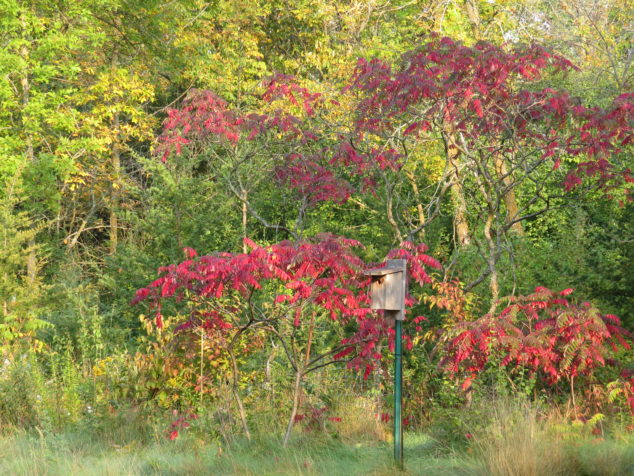
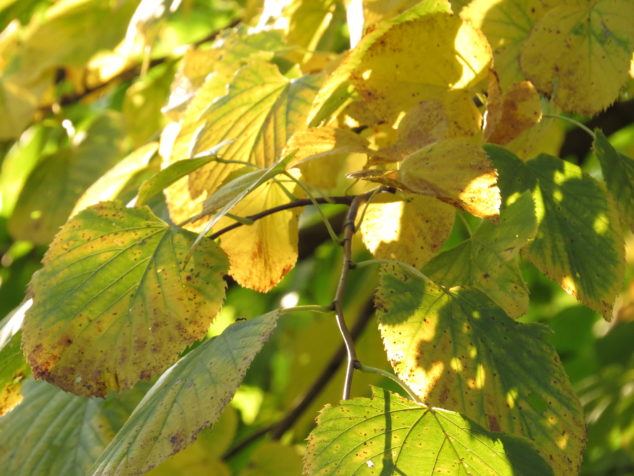
This past week was hot and muggy with uncomfortable nights and air quality alerts that tightened my airways with ozone. Summer’s bad qualities. But it looked like Fall. The Ash trees were mostly all yellow and dropping leaves. The Sumac trees had turned showstopping crimson and scarlet. The Linden trees were quickly turning lemon-colored with a circular blanket of leaves covering the green grass underneath them. So is it Fall or Summer?
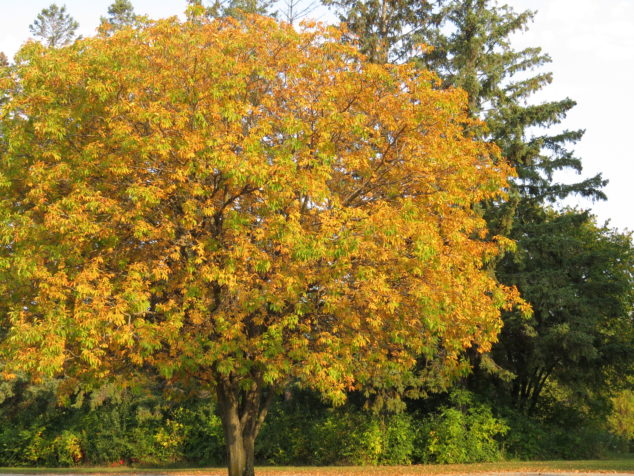
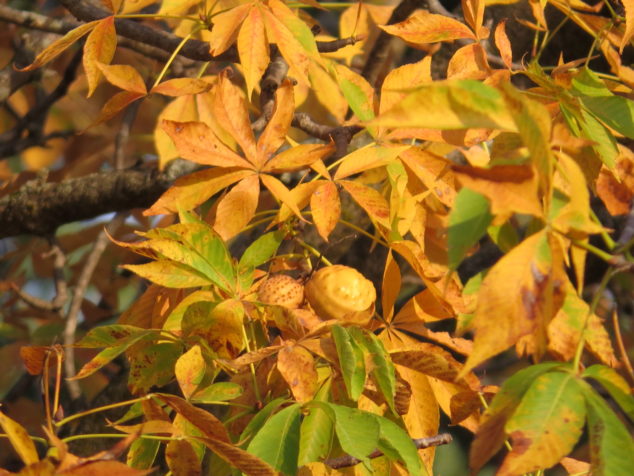
Our neighbor’s Buckeye trees glowed golden with leaves and spiny seed capsules that encase the ‘eyed’ dark brown seed.
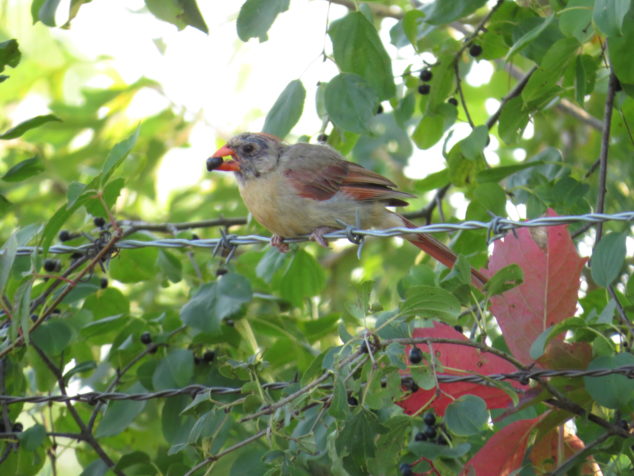
Fall harvesting by the birds has begun. A juvenile Cardinal plucked a seed from a nearby tree—unfortunately it was a seed from the dreadful Buckthorn! Is Buckthorn good for food or a worthless tree?
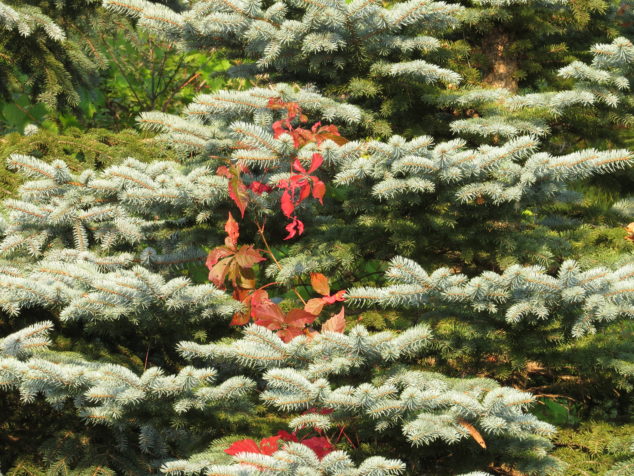
Virginia Creeper vines are turning red, going from camouflage to conspicuous.
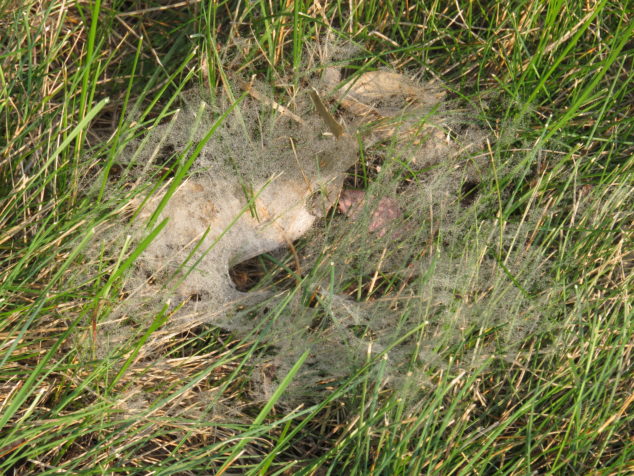
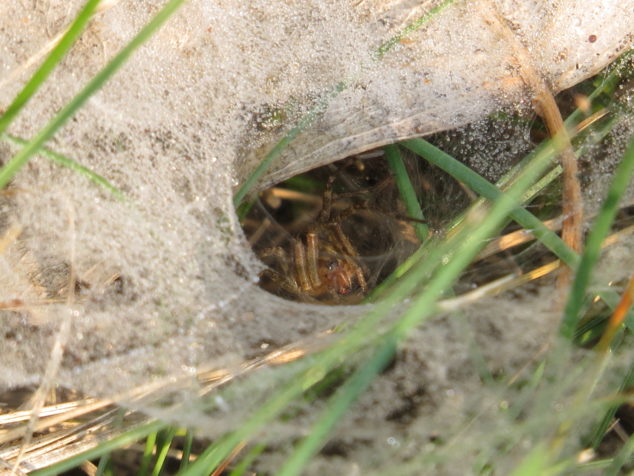
Also conspicuous in the morning dew was a funnel weaver spider’s sheet web. Most likely a grass spider, she hid herself in the entrance of the funnel to wait for a tasty insect to stumble upon her web. Are spiders terrible pests or architectural geniuses?
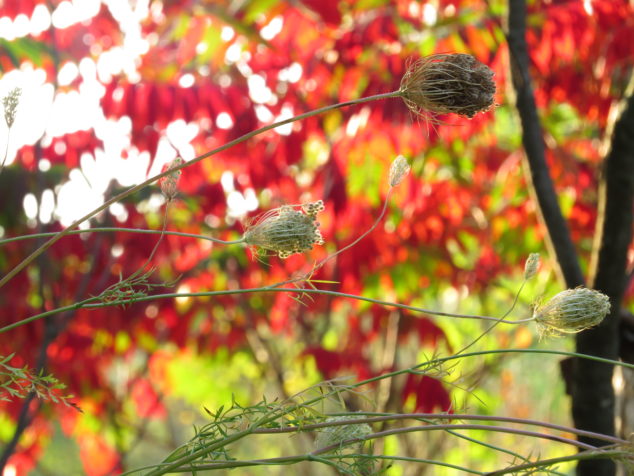
Drying seeds of Queen Anne’s Lace leaned over against the background of fall-colored Sumac.
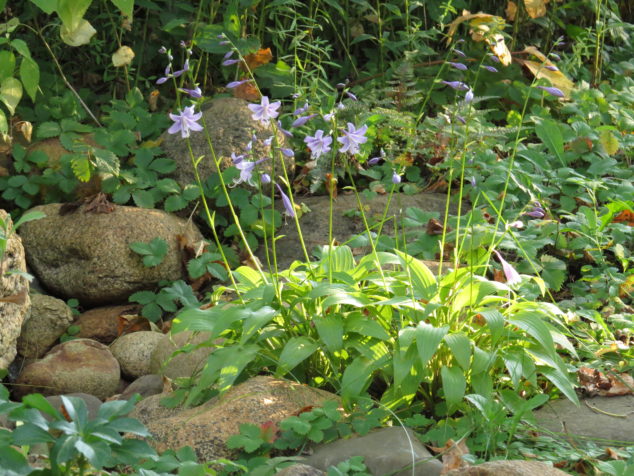
The smallest Hostas are just now blooming, fresh and summer-like…
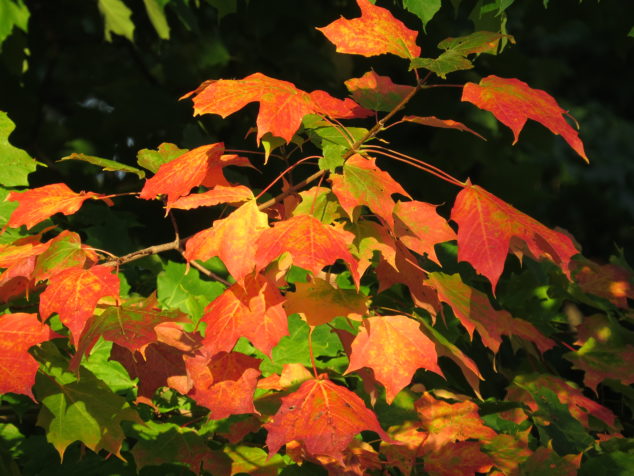
…while the sun-kissed Maple trees are beginning to show their colors.
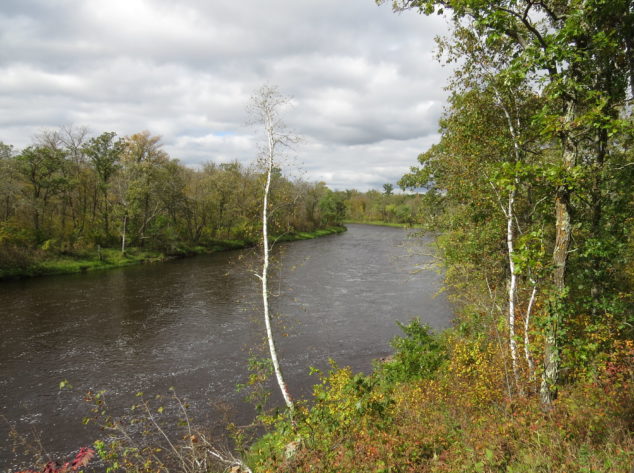
We are a society based on labeling. The calendar says it is still Summer and will be Fall on Friday; the meteorologists say it was Fall on September 1st. If we had no way of orderly keeping track of days, what would it be called? Perhaps it would not be named at all. Often labeling comes with black and white thinking, with opposite and extreme judgments—good or bad, right or wrong, all or nothing. We run into a web of tangled trouble when we try to determine who has the ‘right’ to decide what is right or wrong. Does the person who is deathly afraid of spiders get to determine a spider’s worth or does an entomologist? Does a person who is trying to eradicate Buckthorn from his property have the right to determine its value or does the person who loves it for a privacy hedge? I believe black and white thinking are like two banks of a river, and the river is the gray area. We can be the sturdy boats with thick ropes and strong oars and sails that navigate the River of Life. At times it is imperative for us to tie up to one of the two banks—for order in a society or for taking care of our personal space. But most of the time we are moving through life on the gray River, and we must hold two very divergent ideas in our thoughts and hearts with compassion. Our child who just made a huge mess is our beloved. The dreadful Buckthorn provides food for the birds. The scary spider or bat eats many destructive insects, and on and on it goes. Many people live on one of the two banks, like I used to—it is familiar and safe there, but Life passes by. We call out with disdain or hope to the people on the River—“We know the answer!” And while the River at times can be dangerous and fast-moving or stagnant and stale, most of the time it is life-giving, refreshing, cleansing, and invigorating. Through rough waters and smooth sailing, may we navigate well, anticipate the rocks and snags, learn what we need to learn, look to both horizons, and enjoy the unexpected treasures around the bend.
Butterfly Wings and Cowgirl Dreams
I have a printed meme on my refrigerator that says, ” Your time as a caterpillar has expired. Your wings are ready.” It has a photo of a horse on it with wise-looking eyes, a star on her forehead, and alert ears. I want to wrap my arms around her neck and smell the sweet goodness that only a horse lover so deeply appreciates. The quote is referenced to Unknown; the meme was posted by Cowgirl Dreams and was passed on to me by my sister. I look at it every day.
Last weekend when we were picnicking at Big Stone Lake State Park to celebrate my Mom’s birthday, Painted Lady butterflies filled the air and lit on wildflowers of all kinds to gather nectar. When I stood still, they landed on me. Painted Lady butterflies migrate in large numbers, so this ‘gathering up’ time occurs in late August into September. They migrate to southwestern United States and northern Mexico, traveling 100 miles a day and continuing to reproduce throughout their migration.
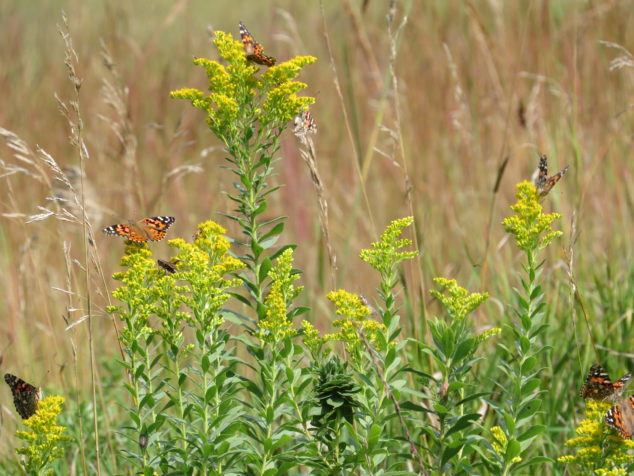
The Painted Lady is the most widely distributed butterfly in the world. They lay their eggs on asters, thistles, burdock, and legumes. (Vanessa cardui means ‘butterfly of thistle.’) The eggs are pale green and the size of a pin head.
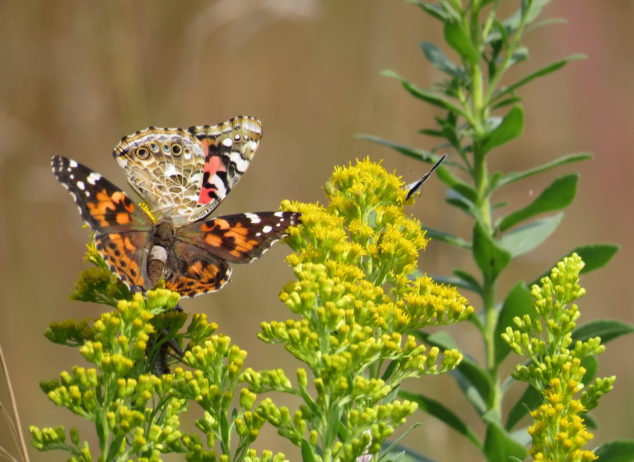
In 3-5 days, the tiny caterpillar hatches from the egg, constantly eats the host plant, and grows quickly. The caterpillar literally grows out of its skin four times before being fully grown (each phase between molts is called an instar.) The yellowish-green and black caterpillar makes a silk nest on the host plant to protect itself from predators.
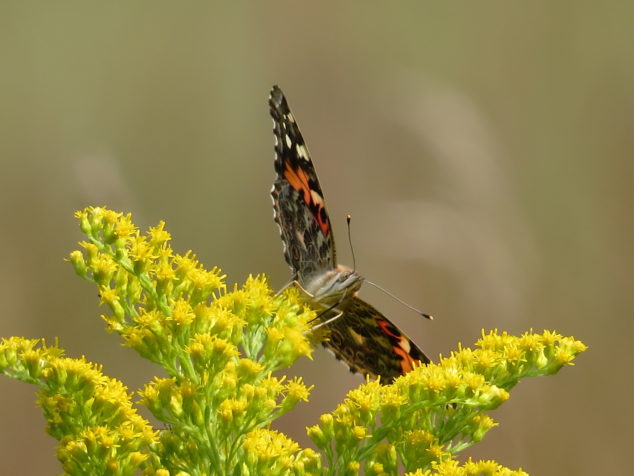
When fully grown, in 5-10 days, the caterpillar attaches itself with a silk button to the underside of a leaf. Its skin splits open to reveal a dull, brown case and becomes a pupa or chrysalis, and metamorphosis begins.
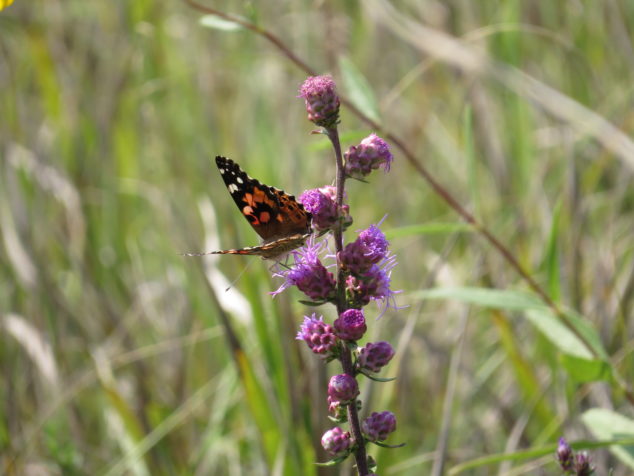
In the 7-10 days of metamorphosis, the caterpillar breaks down and becomes liquid and re-forms into a butterfly. The chrysalis splits open, and the Painted Lady butterfly emerges with crumpled wings that take a few hours to dry and straighten out. Then she/he flies away to drink nectar and mate to begin the cycle all over again.
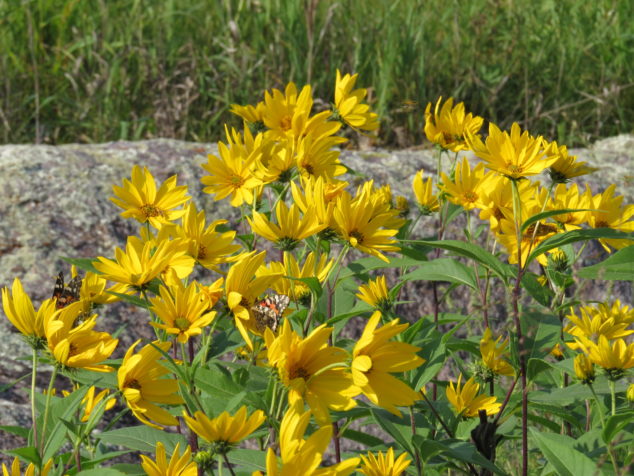
And what does that have to do with horses and cowgirls and all of us? Well, I think everyone wants to be a butterfly. Their bright colors attract attention, their delicate, velvety wings are marvels of flight and design, and they make even the most beautiful flowers more beautiful by their presence. But nobody gets to be a butterfly without the other steps. The tiny egg of an idea—the ‘imagineering’ of becoming a barrel racer, a nurse, or a composer—begins the process. Then comes the ingesting of information and the growth of practice—again and again and again. When maturation occurs, there is a period of stillness, a breaking down of the old to rebuild the new, the metamorphosis. Like Chris always says, “You can only get ready for so long; pretty soon you have to leave.” Your time as a caterpillar has expired. Your wings are ready. But in our all or nothing thinking, we believe we, as a whole person, are either a caterpillar or a butterfly, and if we’re not yet a butterfly, then we are somehow lacking, not good enough. I propose that we are all—at any given time—a compilation of all the stages in different areas of our lives. I am an aging tattered-winged butterfly of a Mom; I am a voracious student caterpillar in learning about trauma and attachment; I am a pupa in my spiritual life—breaking down old ideas and rebuilding new ones, and I have some tiny green eggs of ideas that I want to hatch out and grow. Cowgirl dreams…anybody dreams…dreams we can wrap our arms around. We are marvels of design, bright with the colors of creativity, and we can each make the world a more beautiful place by our presence.
My Mom, the Adventurer
My Mom is an adventurer. I’m not sure when I realized it. It was not when we were kids and she skirted around a barricade on a highway because she knew she wanted to get over to that other side. It wasn’t when she drove half way across the country by herself with three kids or when she and my Dad literally built our house and barn. I didn’t think it was out of the ordinary that she raised cattle by herself after the divorce. I did start to get an inkling when she went to India for a month, and I thought to myself that I would never do that! The older I got, the more adventurous my young Mom seemed to be! She went to France, drove to Montana, visited the Northwest, vacationed with us on a houseboat in Canada, hiked with her newlywed granddaughter in the Texas Hill country, and picked wild blueberries with us in the Northwoods even after we saw evidence of a bear. In just the last six months she has visited Minnesota three times, tent-camped for a week-long trip to Wyoming, and oh, did I mention she’s refurbishing an old camper?
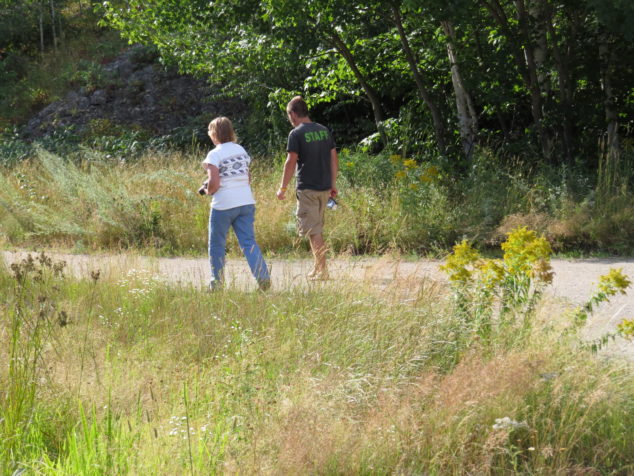
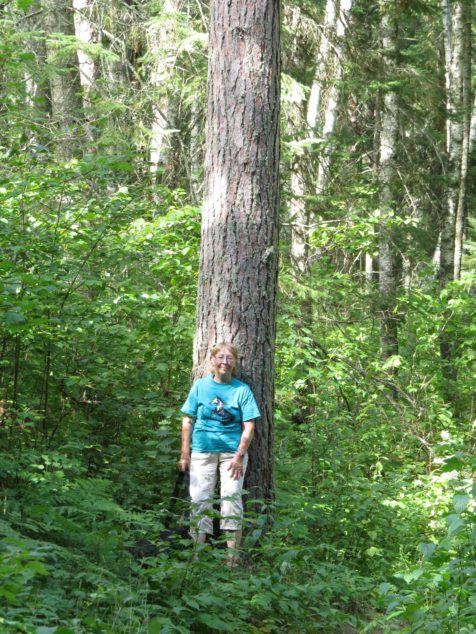
My Mom met us at Big Stone Lake State Park yesterday, where South Dakota meets Minnesota—at the Big Stone and the Big Lake.
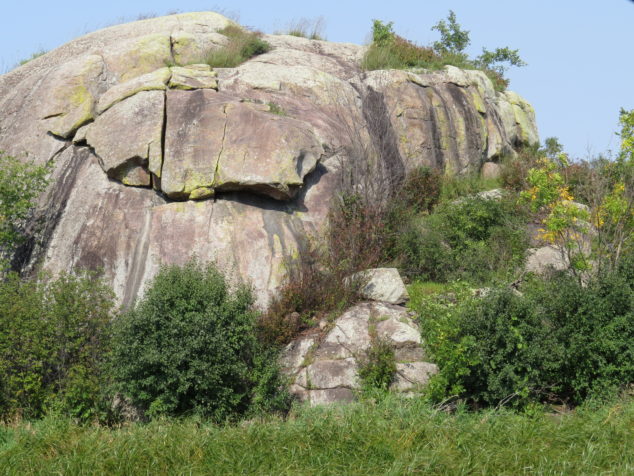
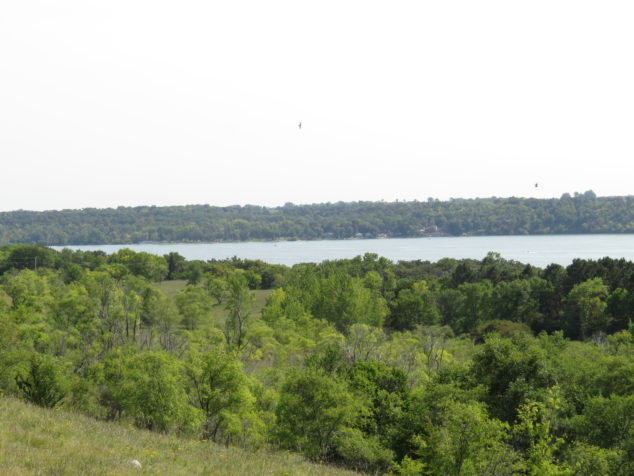
We met to celebrate my Mom and her eight decades of life. We picnicked, ate cake, hiked a little, drove through Big Stone National Wildlife Refuge, and took photos. It was a good day. My Mom and I share a love for Nature, and I am ever so grateful for that. I don’t think I’ll ever be as adventurous as my Mom—I think I’m too cautious and worry too much (that long plane ride over the ocean makes me shudder.) But I also realize that we can all be adventurous in our own way—my friend Lynda is a spiritual adventurer, graduate school is an intellectual adventure for our daughter Anna, climbing mountains and moving to a new state are two kinds of adventures for my friend Michaela, and so on down the list of family and friends. So here’s to my Mom, the adventurer, and to all you other adventurers out there, no matter what your horizons!
A Total Eclipse of the Eclipse
I had high expectations of Monday’s eclipse. The media had prepared us well with scientific information, beautiful illustrations and photos of previous celestial wonders, and Amazon had plenty of viewing glasses to purchase. The Great American Eclipse was to make its way across the heart of our country in its totality. Minnesota wouldn’t see complete darkness, but an almost total eclipse is exciting, nonetheless. The sun was shining on my Monday morning walk…then the clouds rolled in. As E-time approached, thunder rolled and rumbled, and rain fell, along with my high hopes.
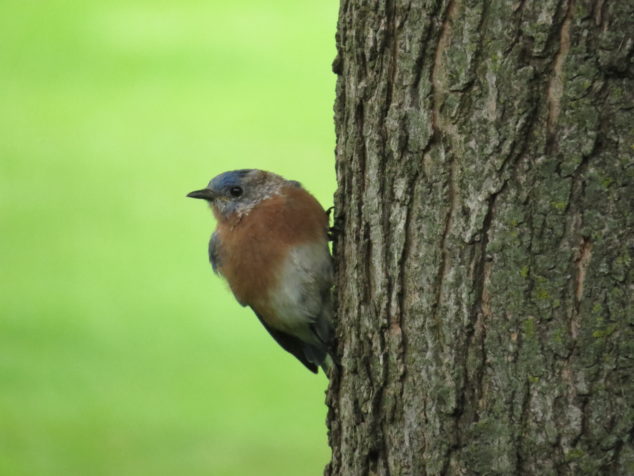
One of our Bluebirds of happiness flew to the Maple just outside the window, perching on the side of the tree, reminding me that blue skies would come again. (Tuesday’s sky was blue and cloudless.)
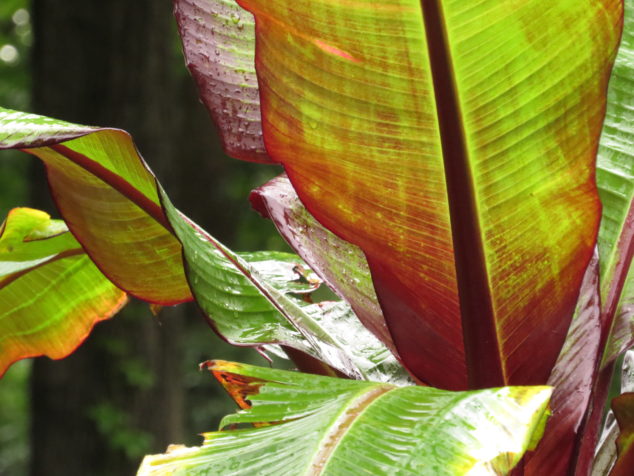
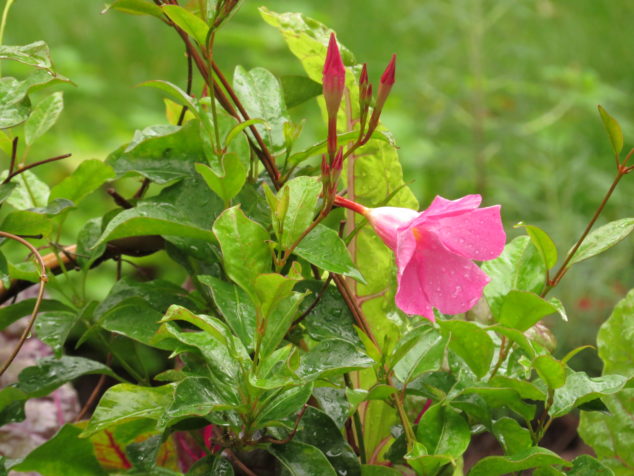
Even in the midst of my dashed eclipse expectations, there was tropical beauty right outside my door in the rain—a banana tree and the pretty pink flowers of Mandevilla.
Beyond the hype and excitement of the eclipse this week was the reality of the waning days of summer. First day of school pictures filled my Facebook feed. Cooler than normal temperatures necessitated bringing out the fleeces and sweatshirts. The tomatoes are finally ready to eat! The apples are turning red. Sumac leaves are beginning to turn crimson. Wild plums are ripening.
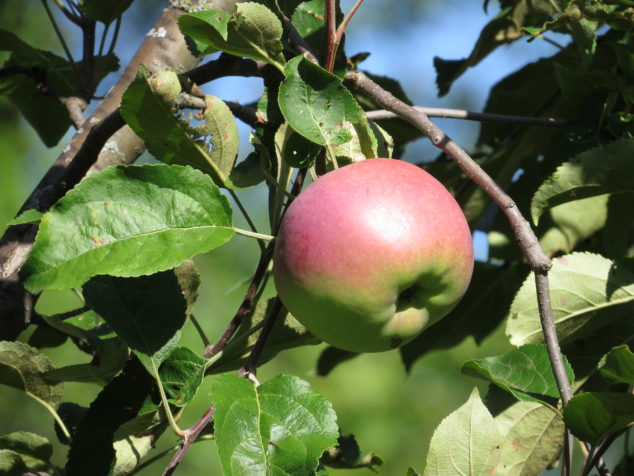
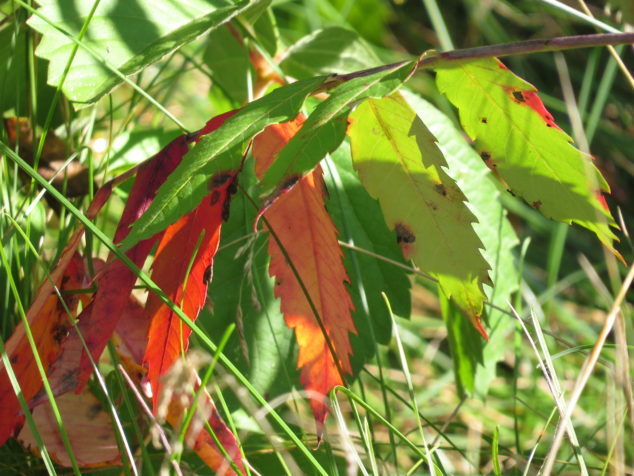
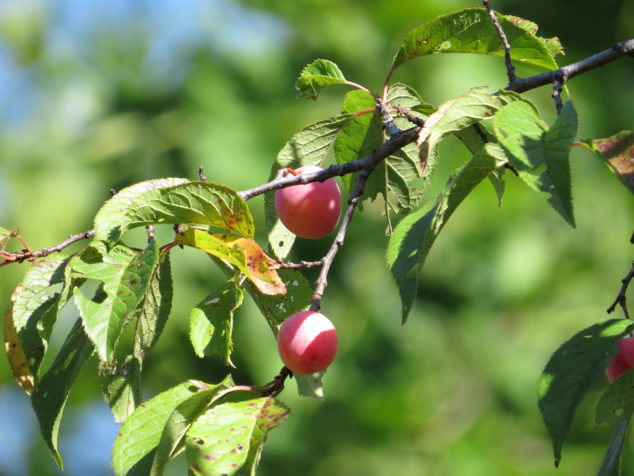
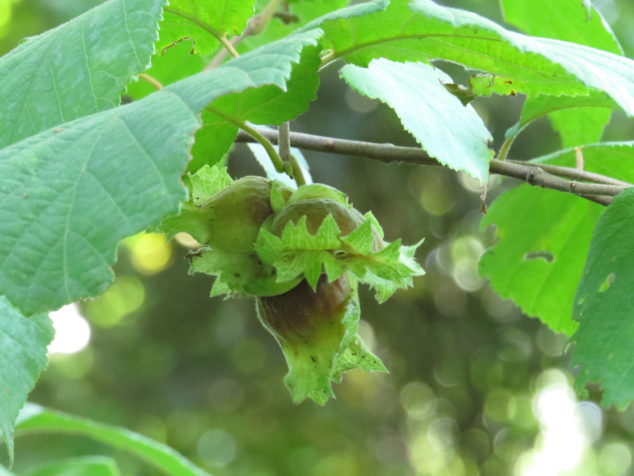
And our first ever hazel nuts are forming under the curved leaves and inside the fringed husks!
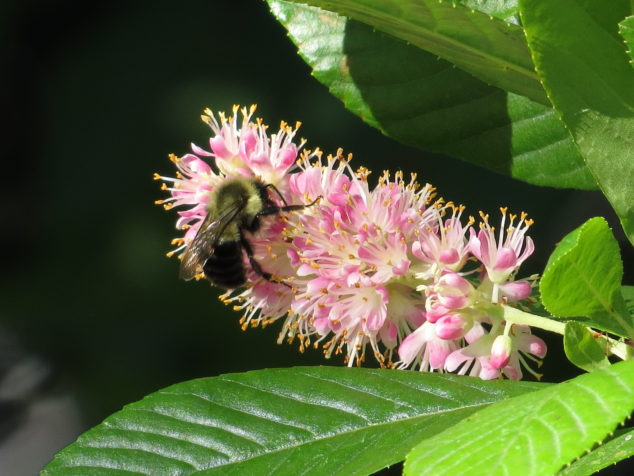
I never say summer is sweet on the humid, hot days (I mean, what do I expect?!), but as August winds down and Summer Sweet blooms and releases its fragrant scent, I am reminded that summer is indeed a sweet time of year.
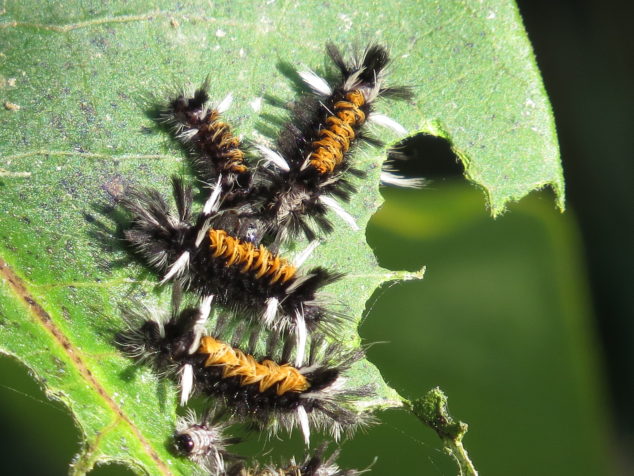
On the other side of dashed expectations and humid-drenched disappointments is surprise and possibility. What is eating our Milkweed? Monarch caterpillars, of course. Not this time! The hungry, similar-colored caterpillars are the larval stage of the Milkweed Tiger Moth (a very drab, gray-colored moth.)
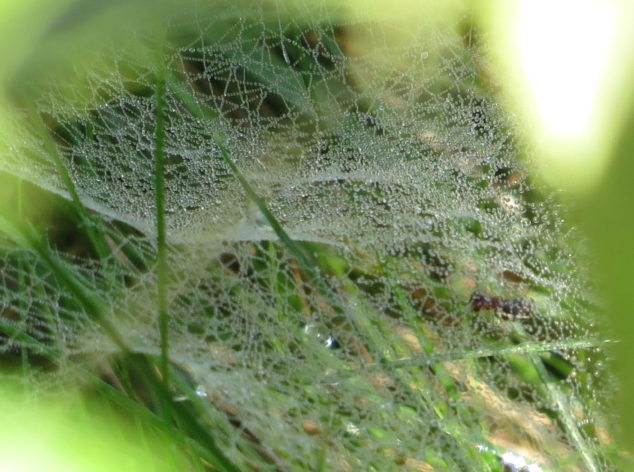
And look at this delicate web of water droplets I found in the grass below the milkweed!
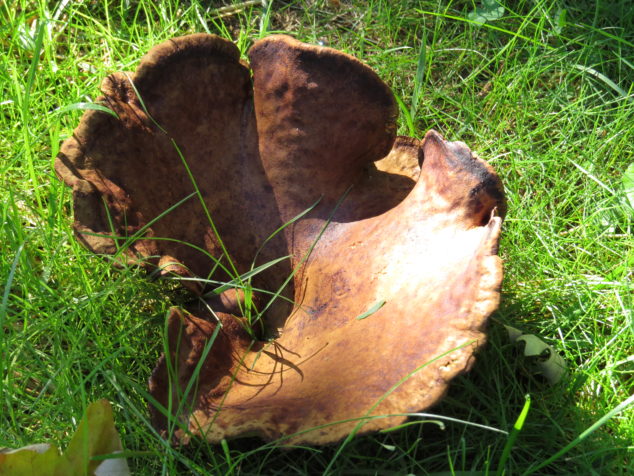
At the junction of old and new soil and grass around our patio, a fungus grew that looked like a worn, well-oiled leather catcher’s mitt. Where did that come from?
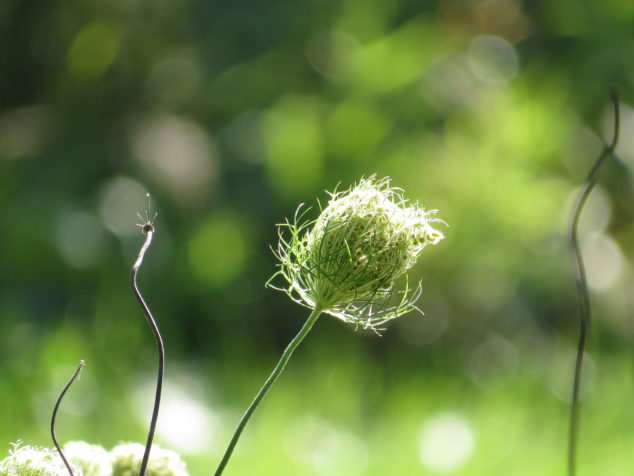
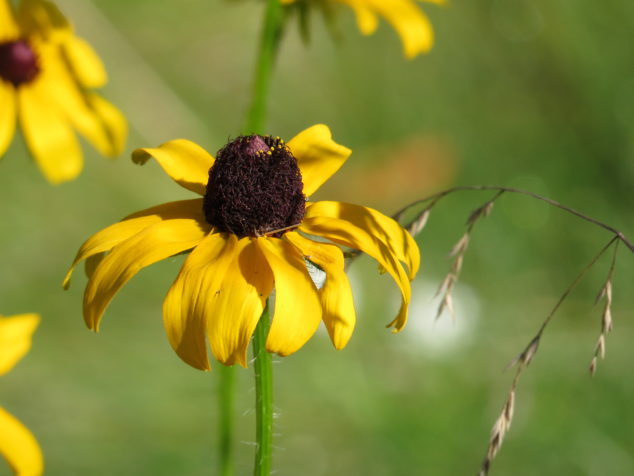
Then there is the delicate surprise of a common object seen in a different light—the bird’s nest bundle of seeds of Queen Anne’s lace and a pincushion center of Black-eyed Susan.
There’s a book titled Expectation Hangover by Christine Hassler. I haven’t read it, but she defines Expectation Hangover as “the myriad of undesirable feelings or thoughts present when one or a combination of the following things occur: a desired outcome does not occur; a desired outcome does occur but does not produce the feelings or results we expected; our personal and/or professional expectations are unmet by ourselves or another; an undesired, unexpected event occurs that is in conflict with what we want or planned.” I’ve had a few of those in my lifetime and know very well the toll it takes on time, energy, and self-worth. My high hopes of experiencing the eclipse were tempered by the meteorological predictions that didn’t favor clear skies on that day. It’s important to keep our expectations grounded in reality—what’s the science behind this or what does the history of this person show us or what can we really afford? I’m not sure it’s our expectations per se that get us into trouble, but our attachment to them. Those attachments can run deep and profound to the very soul of who we think we are. But Nature teaches us that even in the certainty of summer morphing into fall, we can discover new surprises and see things in a different light—like we’ve never seen them before. Expectations and possibilities with a grounding of reality—it’s a recipe for an awe-inspiring eclipse (or not), a sweet summer, and an authentic life.
Lead Into Gold
“Every human being has gone through a tragedy of sorts. And the idea is that you have two paths you can take. You can find that alchemy that turns lead into gold, find that magic where you can see the loss as an entry point for learning and grow from it and become wiser and stronger.” —Jillian Michaels
A small meadow that I walk by every day had been mowed a while ago. The grass was not growing back very fast as we had had dry weather until recently. But something caught my attention earlier this week—a Milkweed plant had grown knee-high above the shorn grass and stood out in stark relief from the dry, brown grass.
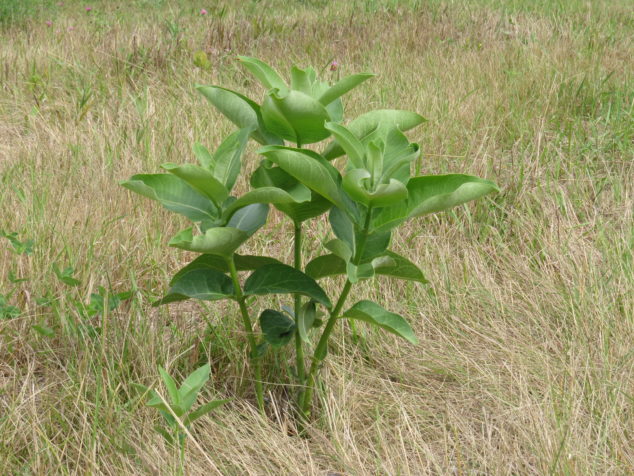
I was curious whether a plant had been cut down or if this was a new plant. When I looked closely, I saw that one stem of the Milkweed had been mowed off, and in its place, three new stems had grown.
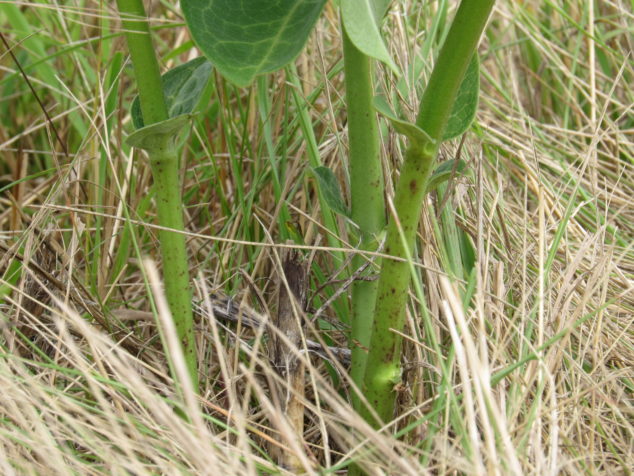
As I looked around the meadow, I saw other plants that had been mowed down that were now tall and blooming! Red Clover, Daisy Fleabane, the tough, persistent Canadian Thistle, and others.
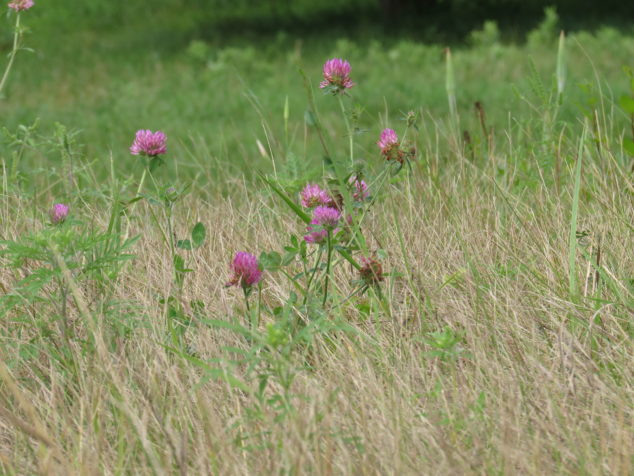
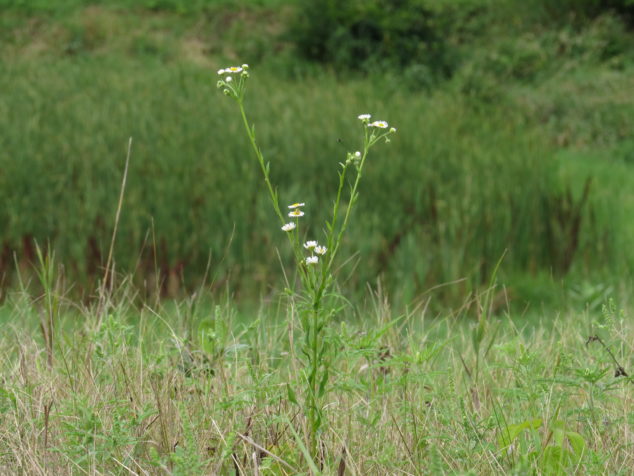
It was not the first time the meadow had been mowed, and I knew for sure the Milkweed had not had its chance to bloom yet. The Red Clover, like Alfalfa, grows fast and had probably bloomed before each mowing. The grass had already gone to seed before it was mowed the second time—its life cycle for the season was complete. But the Milkweed had still not bloomed or produced pods full of fluffy seeds. It seemed to have accelerated growth to compensate for the set-back of being mowed down.
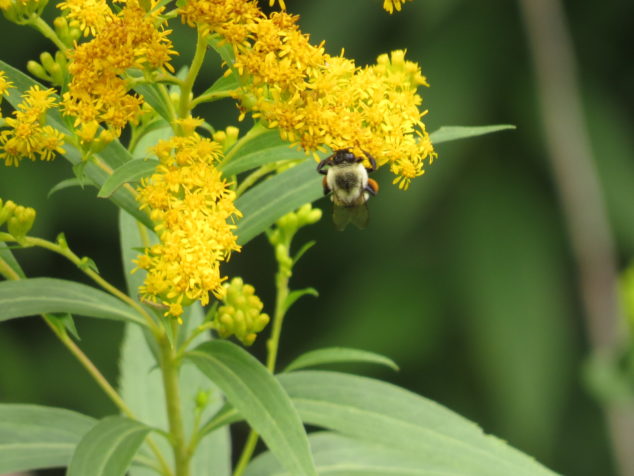
In 1995, Lawrence Calhoun, PhD, along with Richard Tedeschi, PhD, coined the term post-traumatic growth (PTG)—when our biggest life challenges can offer opportunities for meaning and growth. While the term ‘post-traumatic growth’ is relatively new, the theme of suffering, meaning, and growth has been prominent in ancient spiritual and religious traditions, literature, and philosophy for eons. Resilience is bouncing back to ‘normal’ after a tragedy or challenge, whereas with PTG, we bounce back higher, so to speak. We learn to make meaning of our suffering. We learn a new way of being. We grow, bloom, produce seeds and fruit, and complete our life cycle. We turn lead into gold.
Intentional Grounding
Do you remember how often you were on the ground when you were a kid? Our babies spent hours on blankets spread out on the grass while I worked in the garden or their older siblings played in the sandbox. There was usually a Black Lab dog named Licorice in the grass or on the blanket near them, taking seriously her self-proclaimed job as baby-sitter. When older, the kids played with kittens, watched the chickens, rolled down hills, caught frogs in the mud of the corral, made forts in the lilac bush, made snow angels and snow forts, and so many other things—all while sitting, crawling, or lying on the ground! When they entered teenage years, their ground time was reduced to sports, laying out in the sun to get a tan, or an occasional picnic on a blanket. All three had summers of their young adult years when they returned to living close to the earth at summer camps and outdoor jobs, when their bodies and spirits felt strong and empowered. And then, what happens to us when we become adults? How often are we in a building, in a car, in air conditioning, in good clothes, in a hurry?
My Mom recently returned from a week-long camping trip to Wyoming. She remarked about how well she slept each night on her cot in a tent—much better than her nights at home in her own bed! I told her about a quote from the Touch the Earth Trail pamphlet from Mille Lacs Kathio State Park that we had visited.
“The Dakota was a true naturist, a lover of nature. He loved the earth and all things of the earth, the attachment growing with age. The old people came literally to love the soil and they sat or reclined on the ground with a feeling of being close to a mothering power. It was good for the skin to touch the Earth and the old people liked to remove their moccasins and walk with bare feet on the sacred earth. The soil was soothing, strengthening, cleansing, and healing. That is why the old Indian still sits upon the earth instead of propping himself up and away from its life-giving forces. For him, to sit or lie upon the ground is to be able to think more deeply and feel more keenly; he can see more clearly into the mysteries of life and come closer in kinship to other lives about him.” —Luther Standing Bear, Lakota leader and author, 1868-1939
Looking back at thousands of years of human history, most humans had almost continuous contact with the Earth each day. This direct contact with the Earth is now called grounding or earthing; (also terms in electrical engineering to ensure safety of equipment and humans.) There have been studies that indicate grounding’s positive effect on blood viscosity, heart rate variability, cortisol levels, inflammation, sleep, and autonomic nervous system balance.
If a person has pets or kids, it’s easy to spend time on the ground with them and get a different perspective of the world.
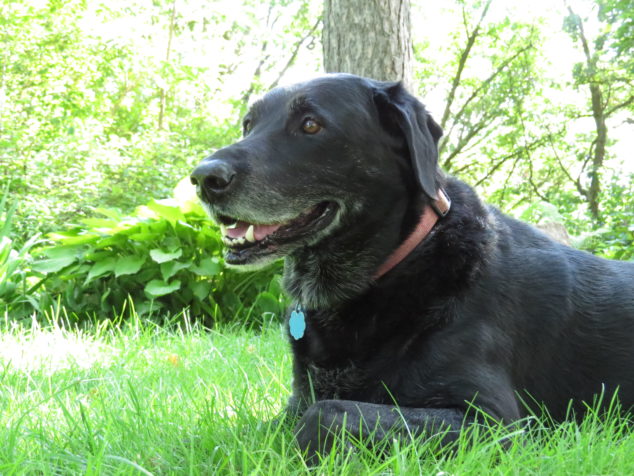
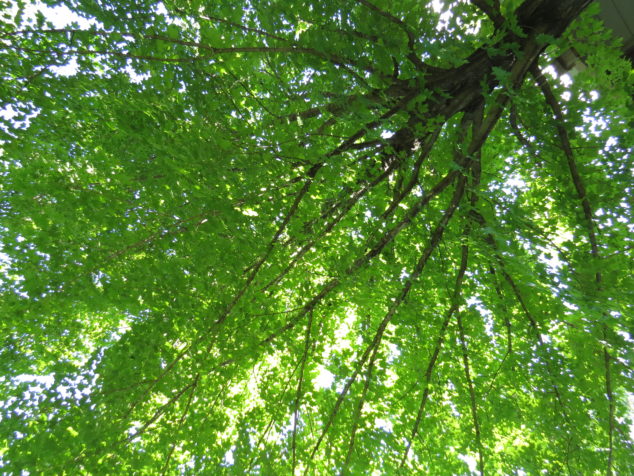
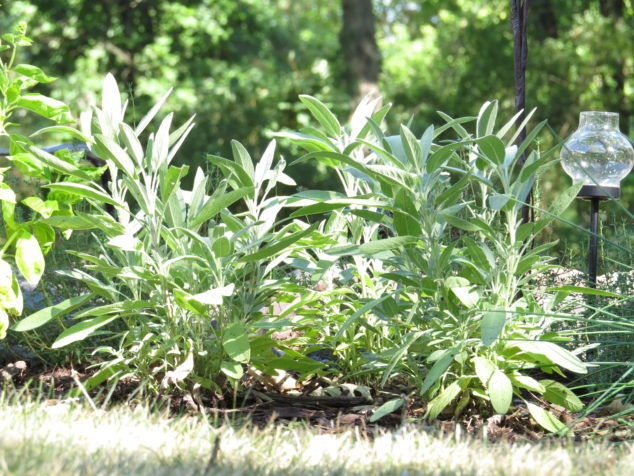
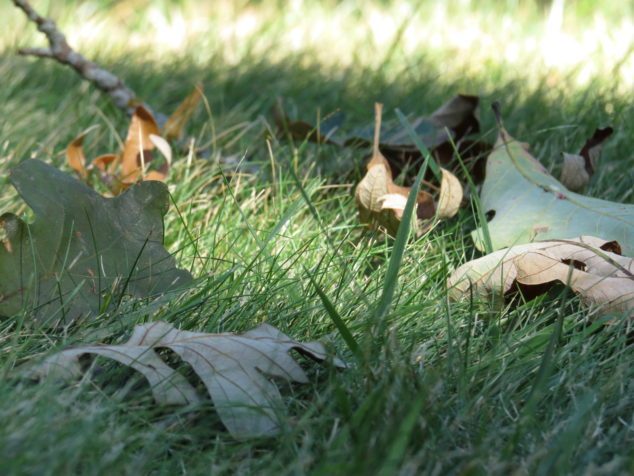
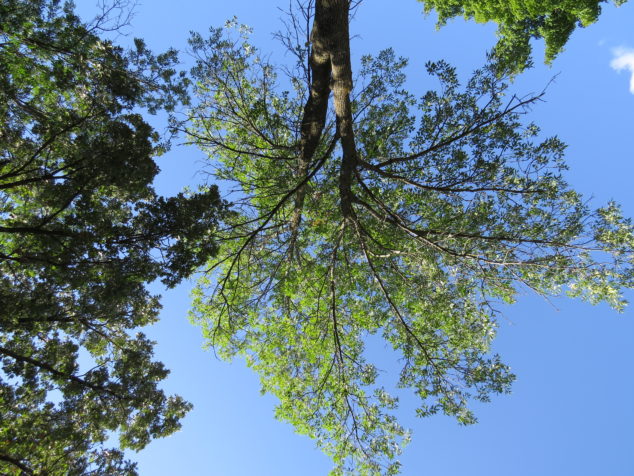
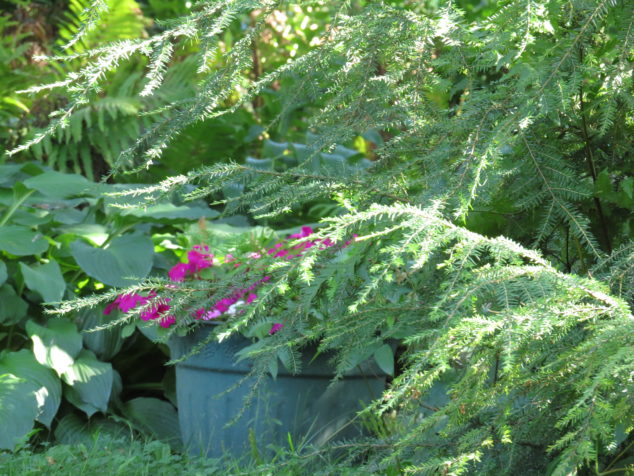
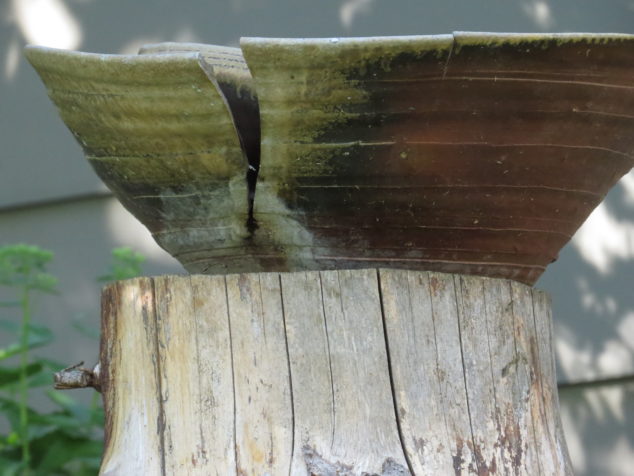

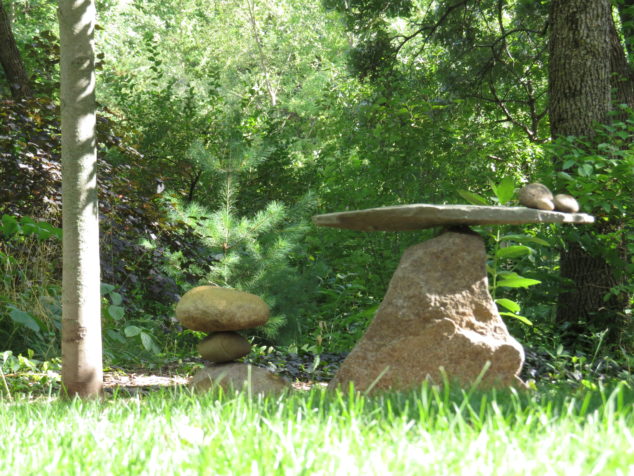

When do you feel grounded? How does one get to that ‘down-to-earth’ feeling? Luther Standing Bear, young kids, animals, well-being researchers, and yoga instructors know that you can literally just drop down to the earth. When I feel tired, achy and beat-up, like the weight of the world is on my shoulders, I like to lie down in the grass on my stomach, usually with a Black Lab dog named Tamba by my side. I am never too much or not enough for Mother Earth. I am just another one of her precious creatures. My body feels supported; I feel the warmth of the sun and the cool of the shade. My heartbeat becomes the heartbeat of the Earth, and with that awareness comes a calming, a grounding, and an appreciation for the life-giving forces inherent in Mother Earth and in each of us.
A Bog Blog
Has your mind, body, or spirit ever been stuck in a bog? Twenty years after graduating from college I returned to that same college with a husband, three kids, and a desire to learn. I took a molecular biology class in one of my first semesters of graduate school that amazed and inspired me with the information that had been discovered about DNA in the twenty years since I had taken science courses. One of the most mind-bog-gling things I needed to learn was PCR or polymerase chain reaction, a laboratory technique that multiplies thousands to millions of copies of a segment of DNA or RNA. This technique was so foreign to me that I just couldn’t wrap my head around the concept! My mind was in a bog of old information that couldn’t process the new information because of how radically different it was. It took months of reading, study, labs, talks with my professor, and plenty of frustration before I was finally able to grasp it. I went on to do a special topics class with that professor using PCR and fluorescent tags, and my understanding and appreciation for the technique grew and became routine.
In our trip to Mille Lacs Kathio State Park, we hiked a short trail behind the Interpretive Center called the “Touch the Earth” trail. We were equipped with a pamphlet that explained various trees and vegetation along the trail, most of which were very familiar to us. And then we came to site #7—“You are entering an unusual and fragile plant community known as a bog. There are trees in this area, so it is technically called a bog forest.”
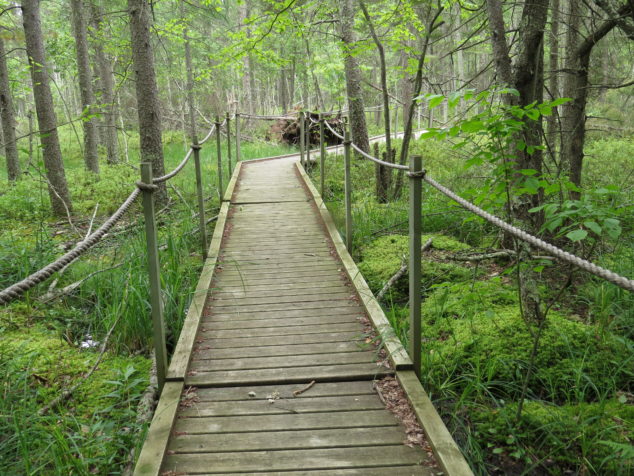
The boardwalk was constructed because the ground surface of this area is covered with moss with a wet area below it and could easily be damaged by people walking on it—damage that would take years to regenerate. It was like walking into another world! A tree had fallen and exposed the layer of water underneath the shallow ‘ground’ of sphagnum moss.
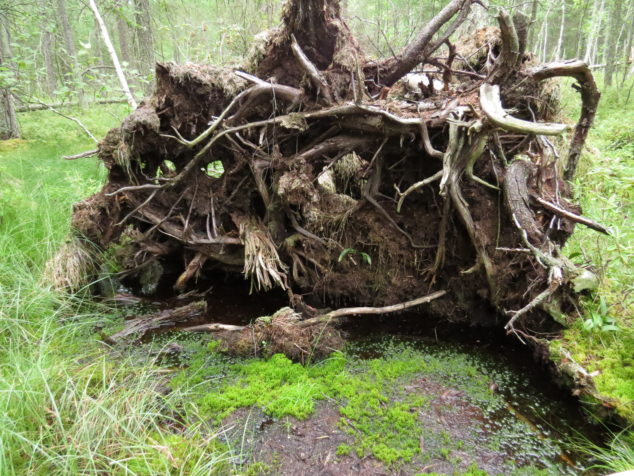
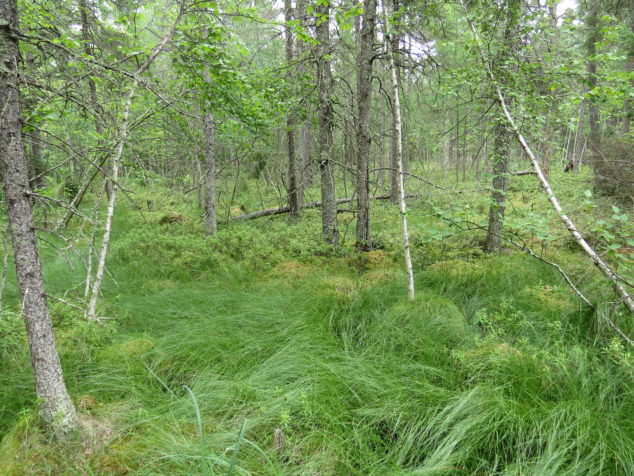
The trees in the bog forest are mainly Tamarack and Black Spruce with a number of young Birch trees. Birch trees don’t survive long in the bog—their roots grow downward, suitable for other forest soil, but they cannot support a taller tree in the floating soil of the bog. The wind blows them over. Black Spruce and Tamarack trees send out many horizontal roots that keep them more stable in the bog conditions.
Black spruce have scaly bark, short needles, and small rounded cones.
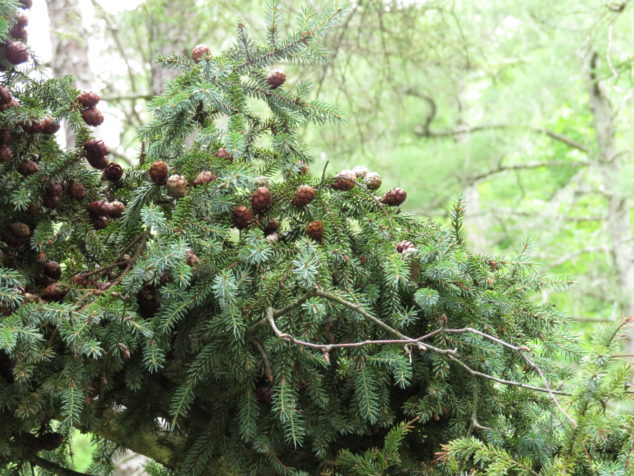
Tamarack or Eastern Larch are deciduous conifers—they turn a brilliant yellow in the fall then drop their needles for the winter. Tamarack is the Algonquian name for the tree, meaning ‘wood used for snowshoes,’ thus describing the tough and flexible characteristics of the wood. Tamaracks are very cold tolerant, often live in boggy areas, and have dense clusters of needles on woody spurs.
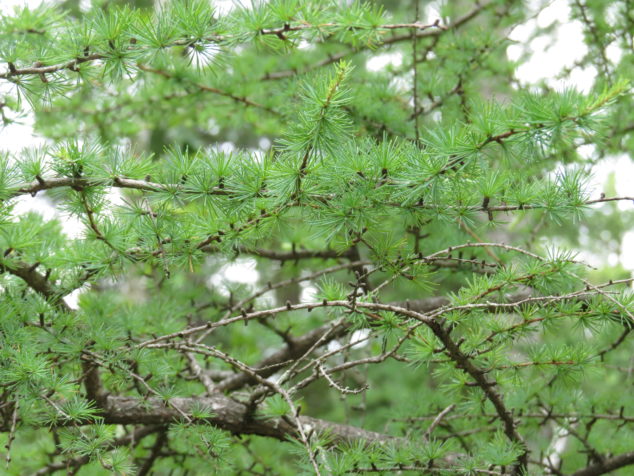
Long ago the Mille Lacs area had a higher water level, and this bog was a small lake. When water levels dropped, grass-like sedges grew in the shallow lake eventually making a mat of dead plant material where sphagnum moss grew. This mat of sedge and moss becomes a slowly decaying peat, a cold, acidic, and oxygen-poor environment that is only compatible for certain plants. One of the small shrubs that grows here is Labrador Tea, an evergreen Rhododendron.
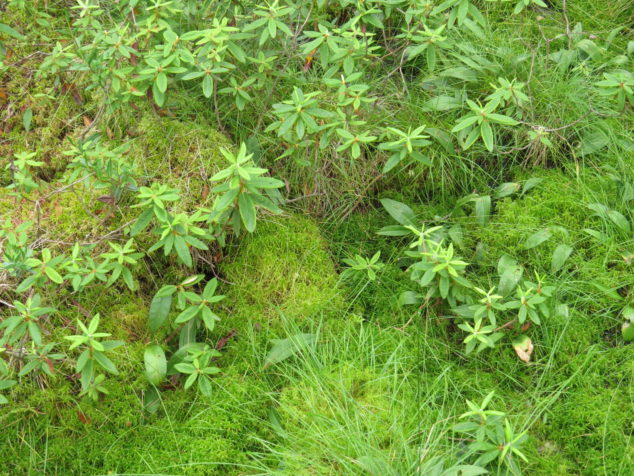
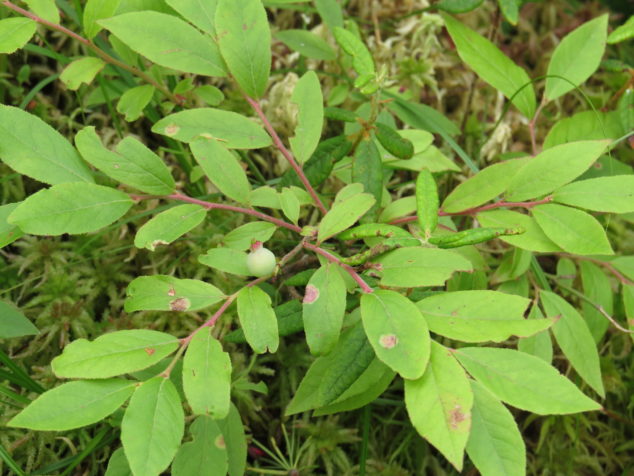
Blueberries also grow in the acidic soil, along with Bog Laurel, Leatherleaf, and Pink Lady’s Slippers, all of which bloom in April and June.
The unusual, almost eerie landscape of the bog is beautiful in its uniqueness. Moss, lichens, roots, and fallen trees create the floating ground above the tannin-stained dark water. It’s a graveyard of sorts of slowly decaying plant material that nourishes and sustains the next generation of bog-tolerant flora.
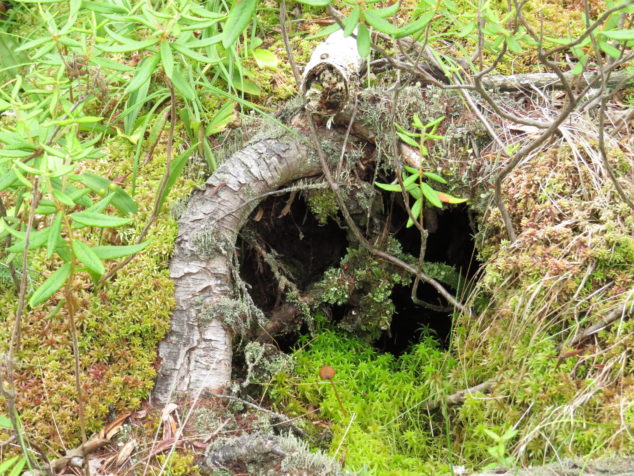
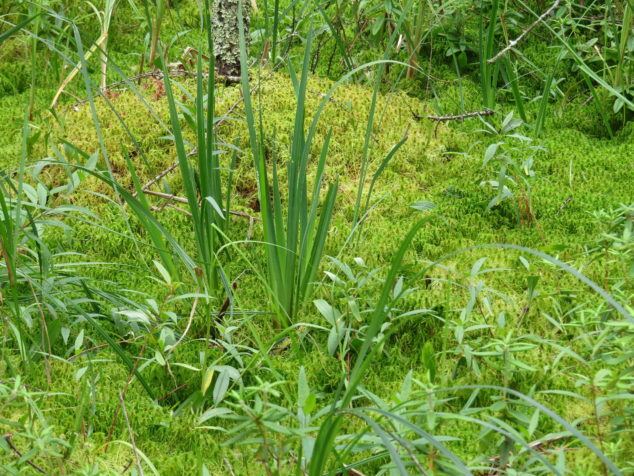
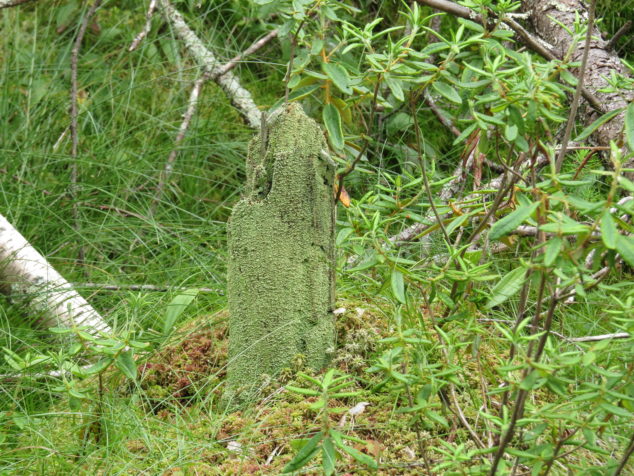
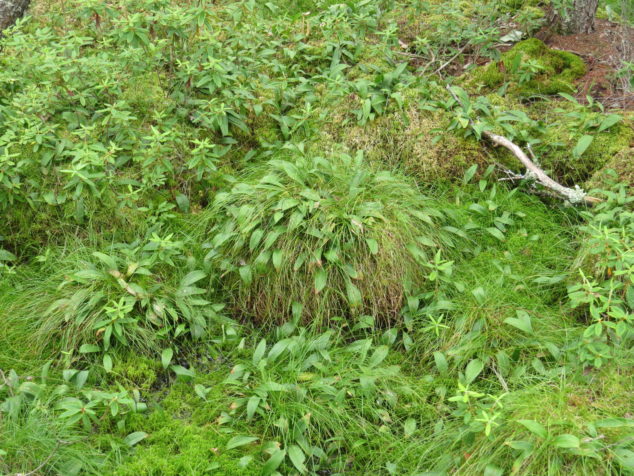
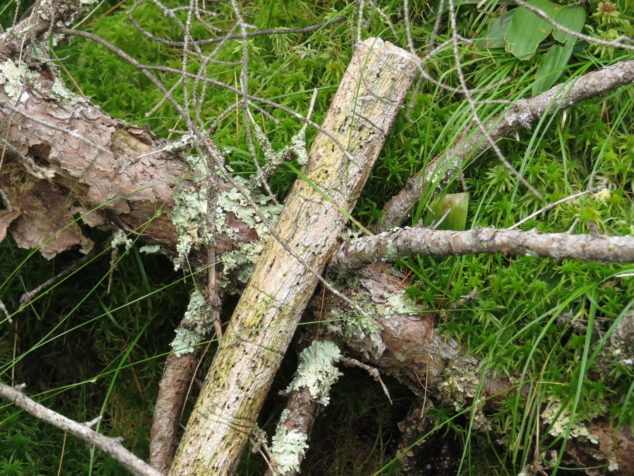
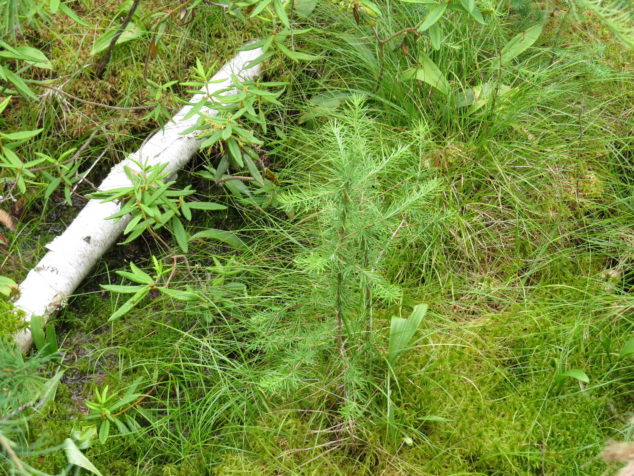
Life in the bog, the mire, the quagmire…I’ve been there in mind, body, and spirit at various times in my life. It’s when you can’t grasp a new way of thinking or doing things, try as you may. It’s when you are so burdened with pain or fatigue that all you can do is slowly lift your feet in the next step, pulling each foot out of the muck as it tries to suck you back in, willing yourself forward as time slows to a sloth’s crawl. It’s when your spirit feels so fragile, so exposed that normal life can easily damage it, when stalwart ideals are no longer stable and topple over in the wind of change. It’s when your heart is broken, and you cross a bridge into another world that you never, ever wanted to go to. And then what?! Well, you stay there for a while. The changing quality of time actually becomes your friend as it forces you to examine your inner ecosystem. You start to put out horizontal roots of awareness, courage, strength, and integrity that stabilize you—you become more tough and flexible. You begin to notice the ‘blueberries’—not only the things that sustain you, but those that are really good for you. Eventually, with God’s grace and days, months, or years of time, your mind, body, spirit, and heart regenerate. You realize you are no longer in the quagmire, and you can finally see the full beauty of the bog.
What Does Home Look Like to You?
What does home look like to you? How does it feel? How many generations of your family have lived in the place you call home or in the place where your soul feels at home? What is the history of your family? Is your home tied to the land? Or is home about the people you are with at any given place or time?
We visited Mille Lacs Kathio State Park last weekend—over 10,000 acres near the mammoth Mille Lacs Lake. The park is a National Historic Landmark District. The early French explorer known as Duluth was the first European to accurately record a visit to this area in 1679. He found permanent established villages of the greater Dakota nation band known as the Mdewakanon who lived near Mdewakan, the Spiritual or Sacred Lake, now known as Mille Lacs. This area known as Kathio has been home to the Dakota and later to the Ojibwe people for over 9,000 years. (Stone tools and spear points were found at a site that was radiocarbon tested.) 9,000 years—how many generations of Dakota and Ojibwe people have lived here?! It has been the site for archaeological digs for over a century with 30 separate sites identified thus far. It was the perfect place to call home with forests, lakes, rivers, plentiful food sources and other natural resources.
We began our day by climbing the observation tower to get a bird’s eye view of the park and surrounding lakes.
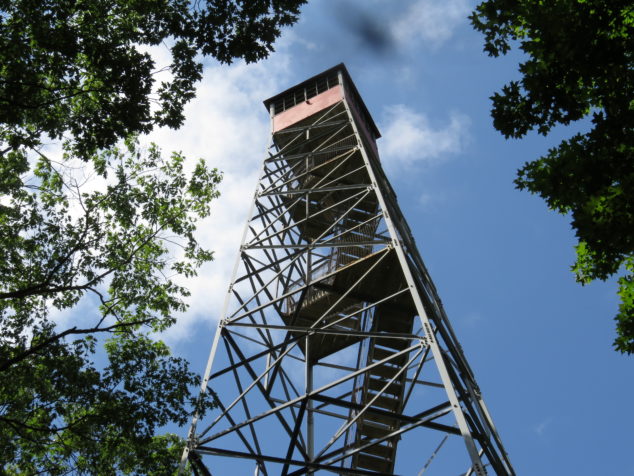
Loggers removed most of the red and white pine forest in the mid 1800’s, and now most of the trees are oaks, maples, aspen, and birch.
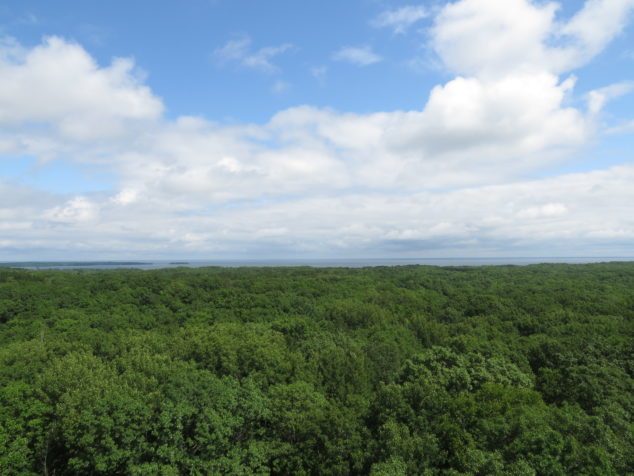
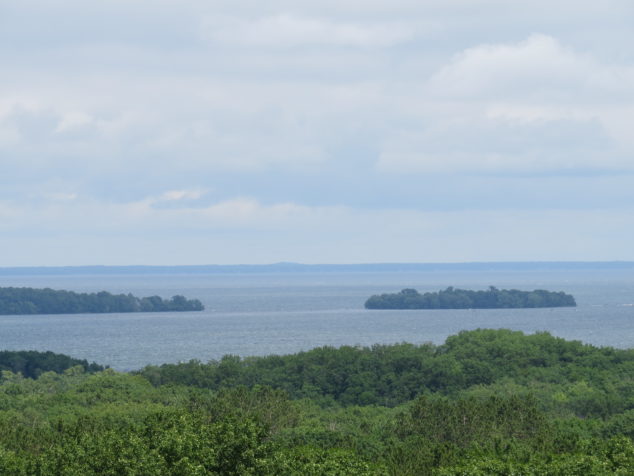
Three large lakes connected by the Rum River could be seen from the tower, the largest being Mille Lacs Lake.
It was a beautiful day for hiking—not too hot or buggy. We saw interesting fungi, five-foot-tall ferns, and delicate wildflowers.
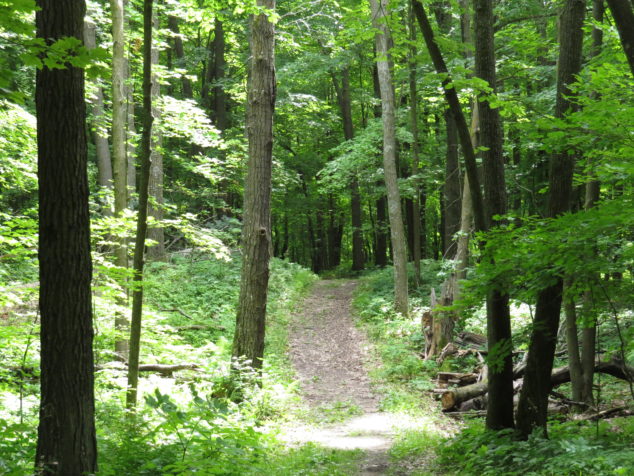
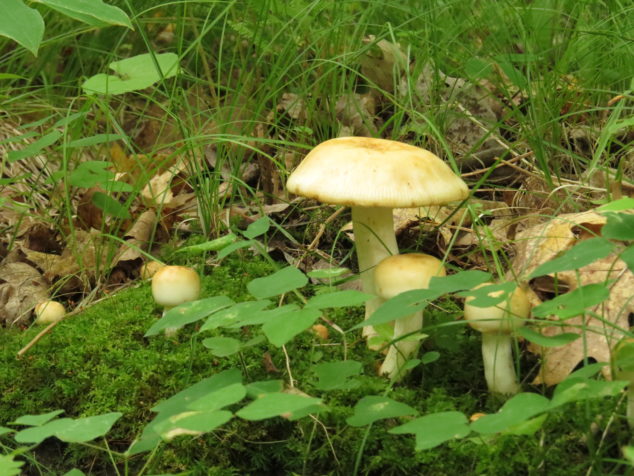
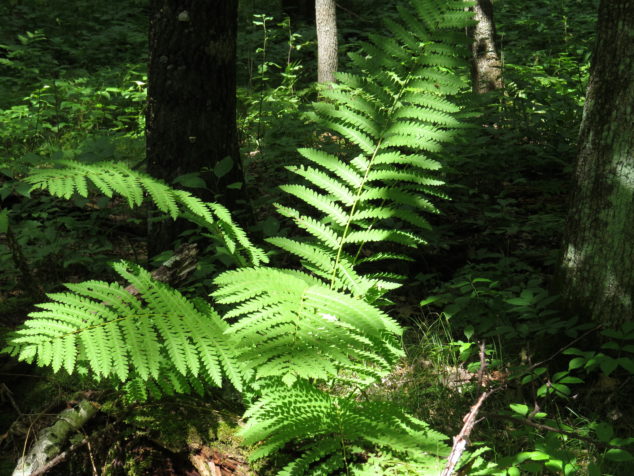
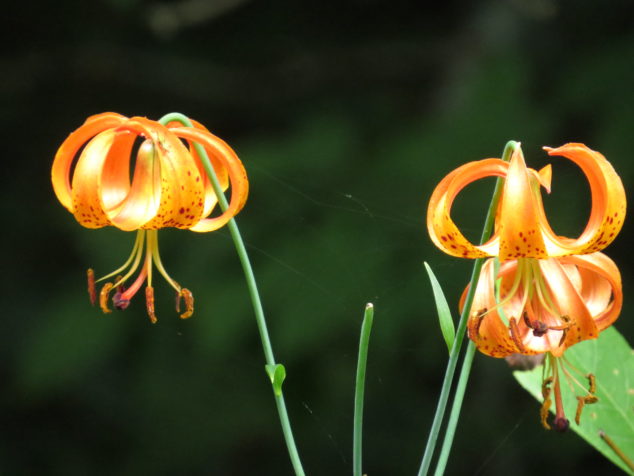
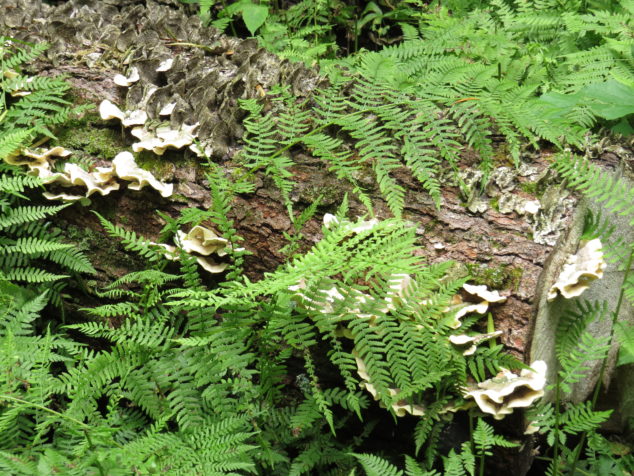
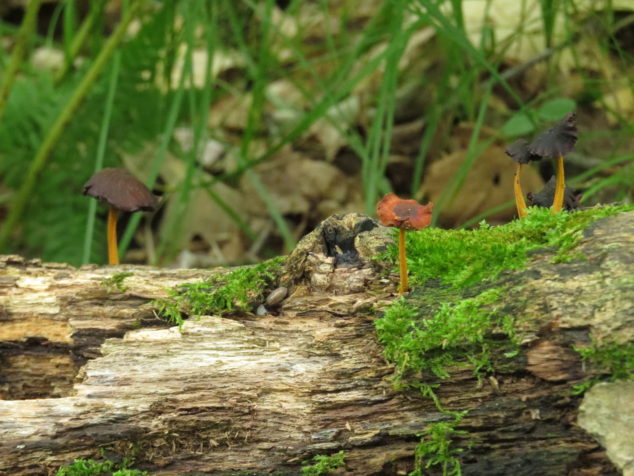
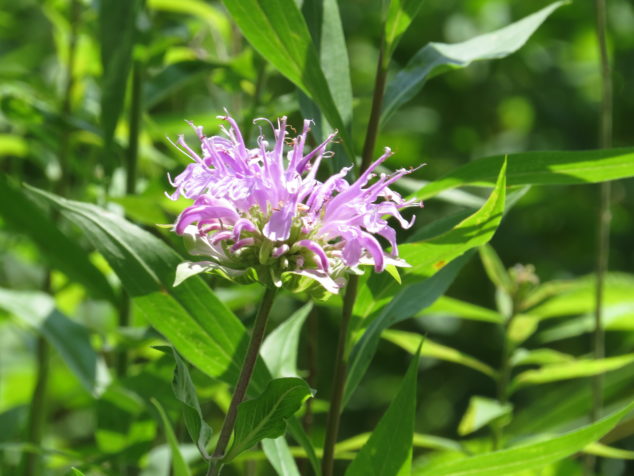
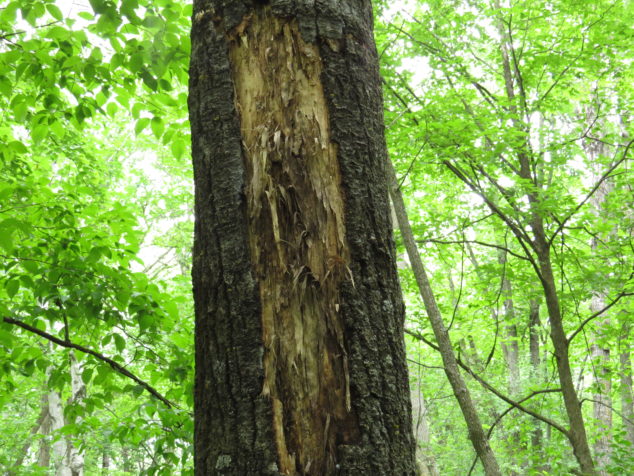
While driving through the park in all its wildness, I commented to Chris that it looks like a good home for bears, thinking we weren’t in bear territory. But when we walked through the interpretive center, one of the displays explained that indeed black bears live in the park! Then we came across this tree on one of the hiking trails—looks like bear activity to me!
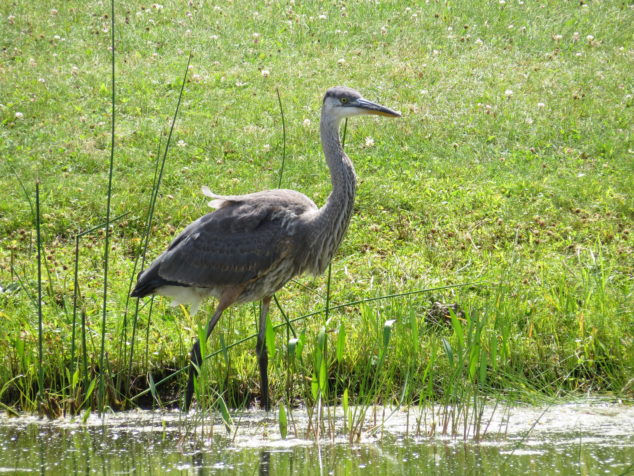
The swimming beach at the picnic area was a man-made pool not far from the banks of the Rum River. The only one wading in it was a Great Blue Heron!
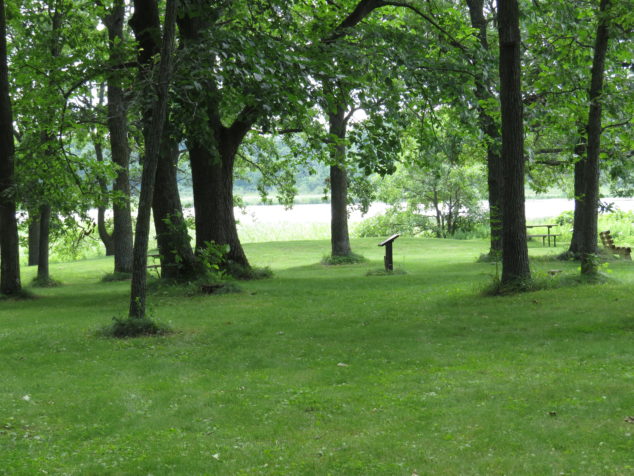
In 1965, Leland Cooper of Hamline Universary was sent to survey areas of Mille Lacs Kathio State Park. The site that was later named after him was excavated a year later by Elden Johnson of the University of Minnesota. The Cooper site showed that the ancient Native people lived there from about 500 to the 1700’s. Summer and winter homes, a log pallisade wall, and ricing pits were discovered along with arrow points, stone tools, pottery, and trade goods, including glass beads and Jesuit rings–metal finger rings that French missionaries of the late 1600’s gave to the villagers. This is what the Cooper site looks like today:
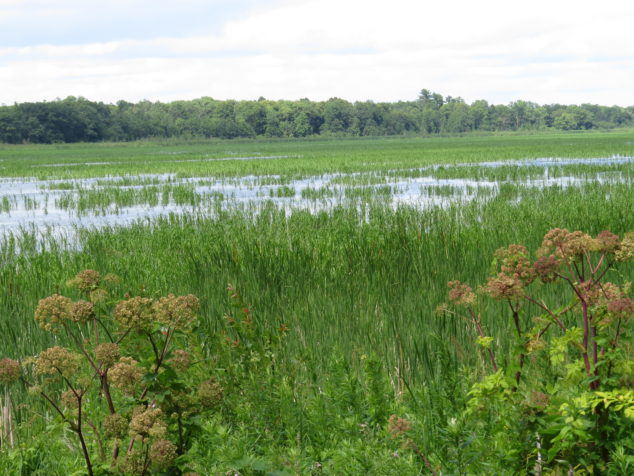
Ogechie Lake is a long, narrow, shallow lake that for thousands of years has produced wild rice for waterfowl and the people who made their home along its shores. In the mid 1950’s a dam was built at the south end of the lake to keep the water levels high in Mille Lacs Lake for fishermen. This basically flooded the Ogechie rice crop for decades with little to no production. Two years ago, a new, lower dam was built, and the wild rice or manoomin is coming back so the present day Ojibwe can once again harvest the ancient food.
The land my grandparents called home in South Dakota has been in the family for three and four generations now—it seems like such a long time. But consider the 360 or more generations of Dakota and Ojibwe who have called the Mille Lacs Kathio region home! Home to me is the prairie, rolling hills of pasture, sloughs full of geese, memories of my family. But there is also a connection to Scandinavia where all my ‘native’ ancestors lived. Home to the Ojibwe of Mille Lacs is ‘thousands of lakes’ with fish and wild rice, forests of hard woods and conifers, wild animals and birds, traditions and stories of their ancestors. When we look from a bird’s eye view at our own lives in the long history of our ancestors, what do we see? Were there huge changes to where or what home was? If we are the descendants of immigrants, refugees, or slaves, that would be true. What is the ‘river’ that runs through all those generations, connecting them and us? How do we wade through new waters to make our home? We each have our own definition of what home looks like to us, but this I know: The land matters. History matters. People matter.
- « Previous Page
- 1
- …
- 26
- 27
- 28
- 29
- 30
- …
- 50
- Next Page »