Come walk with me in the peak Autumn beauty of the Northwoods. To say that I love this time of year is an understatement. Most everyone can appreciate the colorful falling leaves---it reveals the 'true self' of a tree when its leaves are no longer producing chlorophyll. Their true colors are revealed, and there is something simple … [Read More...]
The Enchanted Rock
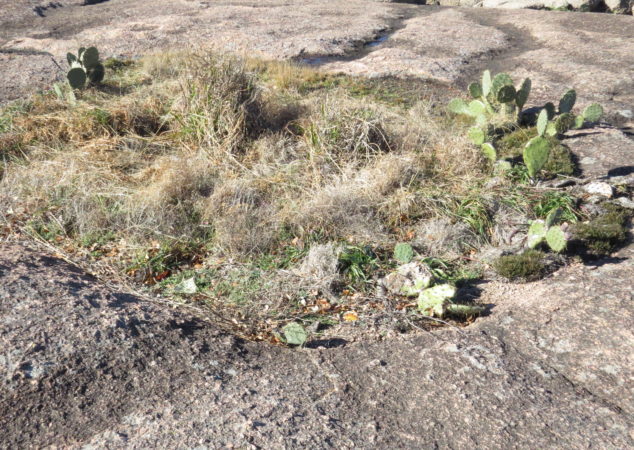
And so we climbed the Rock—the Enchanted, intriguing Rock. As we climbed, we left behind the sandy soil and evergreen Live Oak trees; the trail was a solid rock beneath our feet. We could pick our own path, like scampering mountain goats, exploring the rugged terrain. Island ecosystems of Prickly Pear and grasses defied the reality of growing on solid rock.
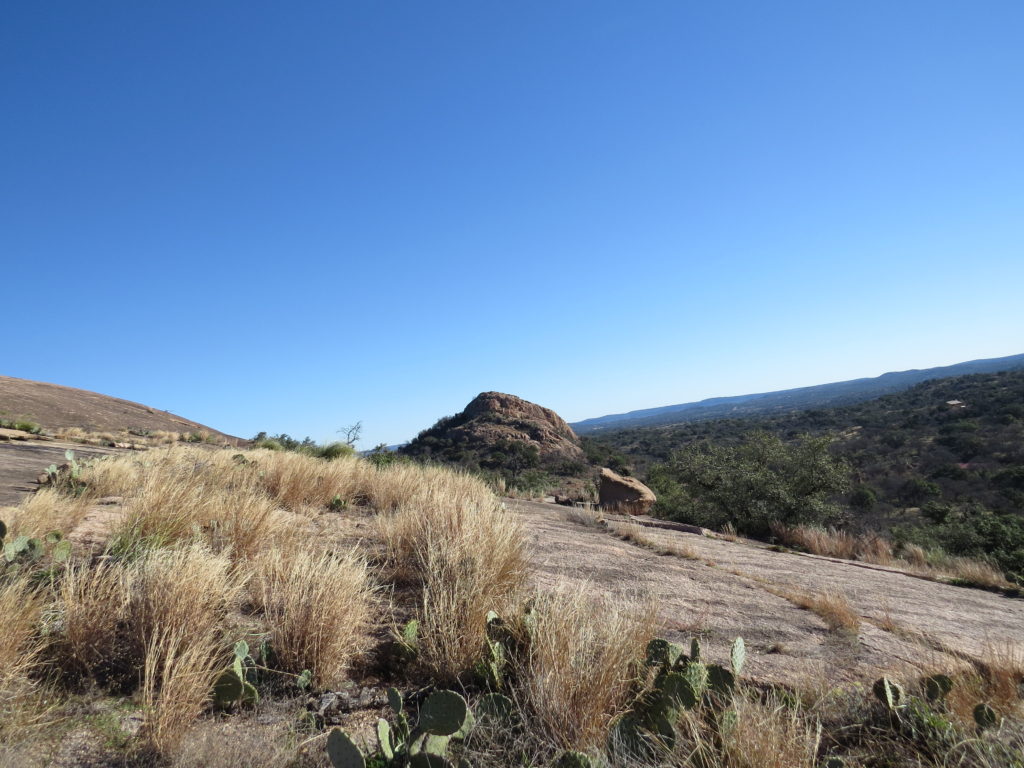
When we turned around, we could see how far we had already come, and the way to the top looked deceptively close in the bare expanse of rock.
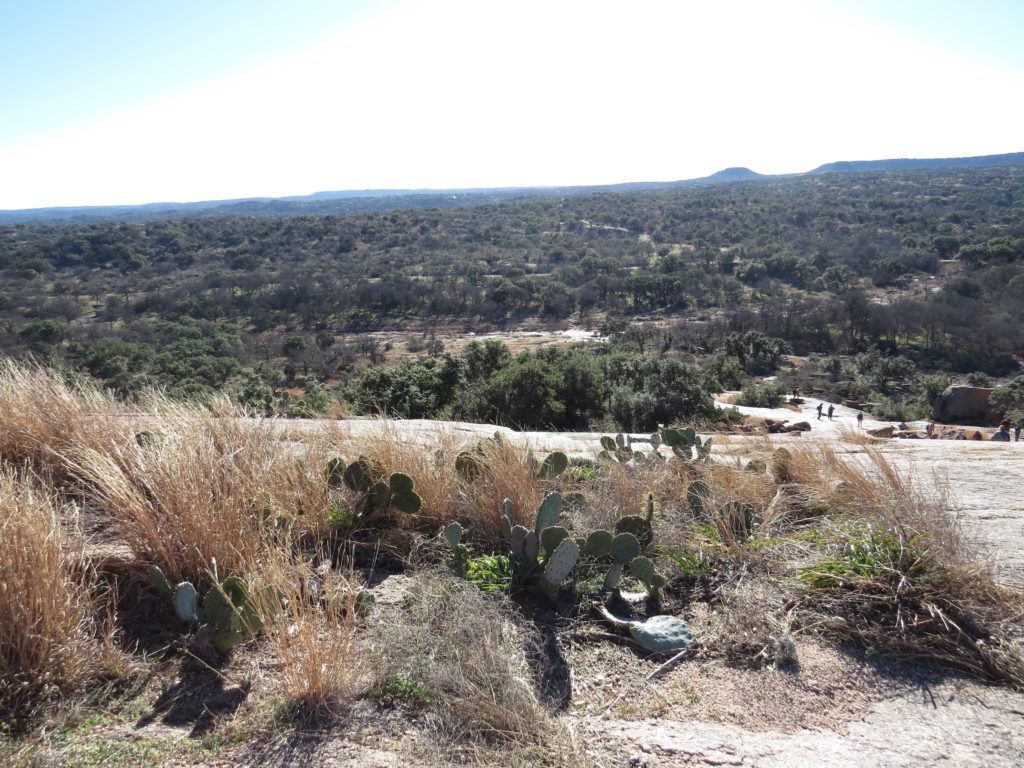
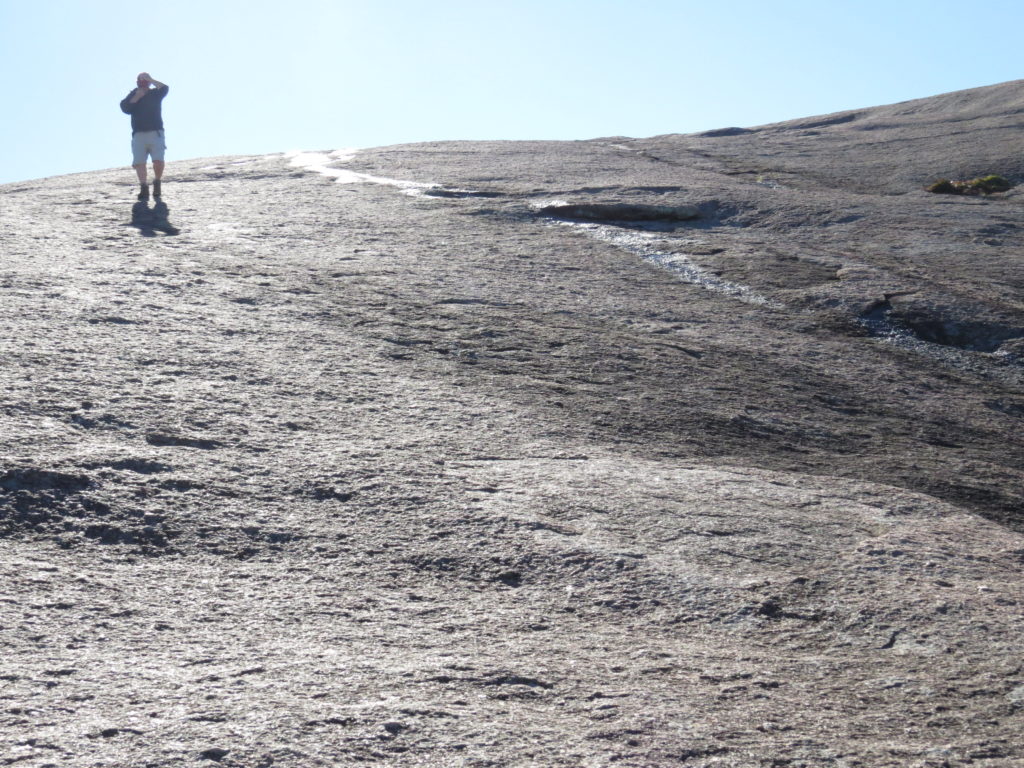
The wind became so strong it took our breath away. It was hard to hear anyone talking, and we used our heavy adult-sized bodies to anchor us to the rock with each footstep. We wondered how a child would even be able to walk without being blown away. The steep upward climb was made harder with the incessant push of the wind, and sometimes we sat or lay on the rock just to get a bit of relief from the gale.
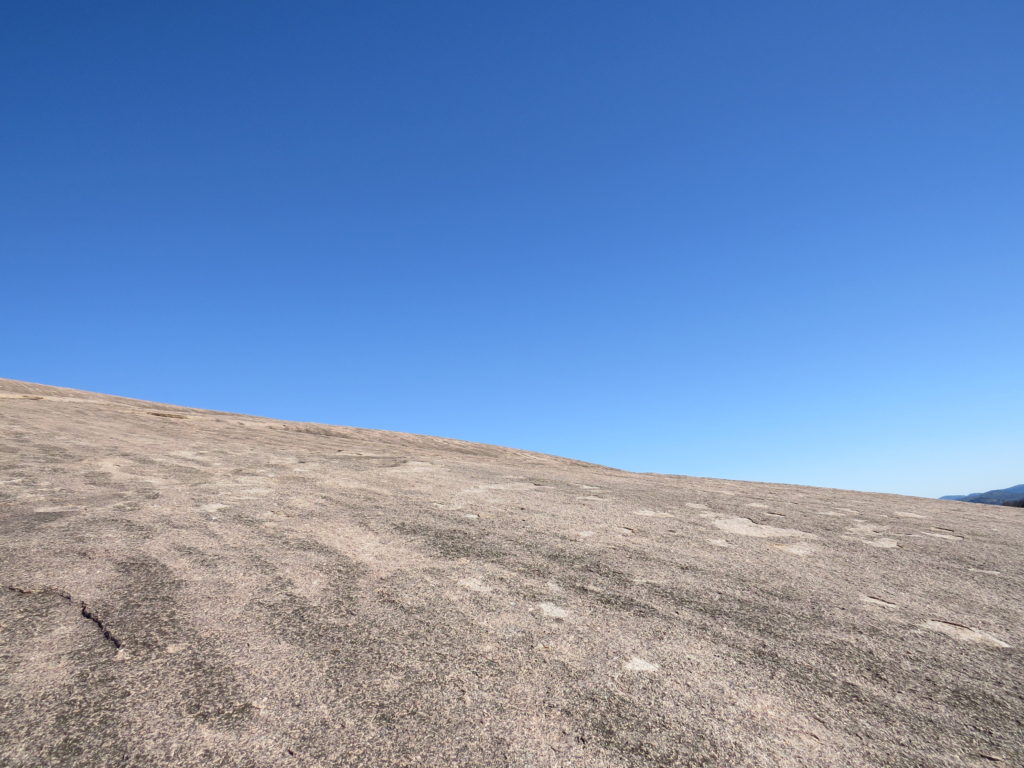
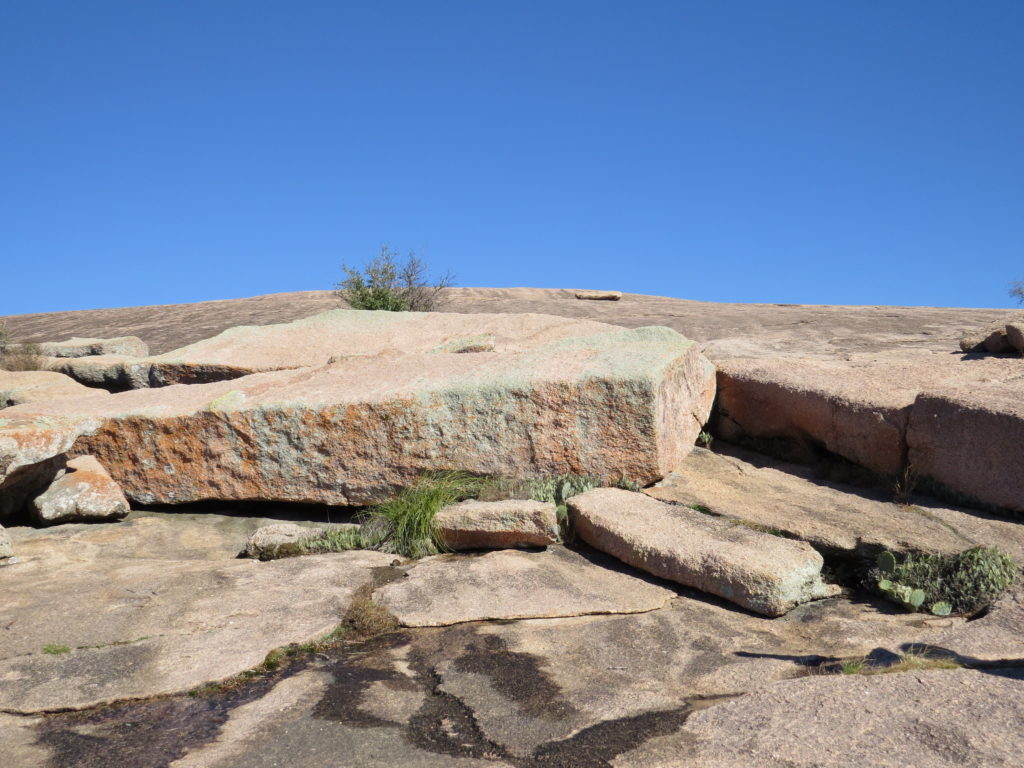
It was like a moonscape on the huge dome—craters and cracks and crevices, and there was a sense of just how ancient this rock-of-a-planet Earth is that we live on. Humbling.
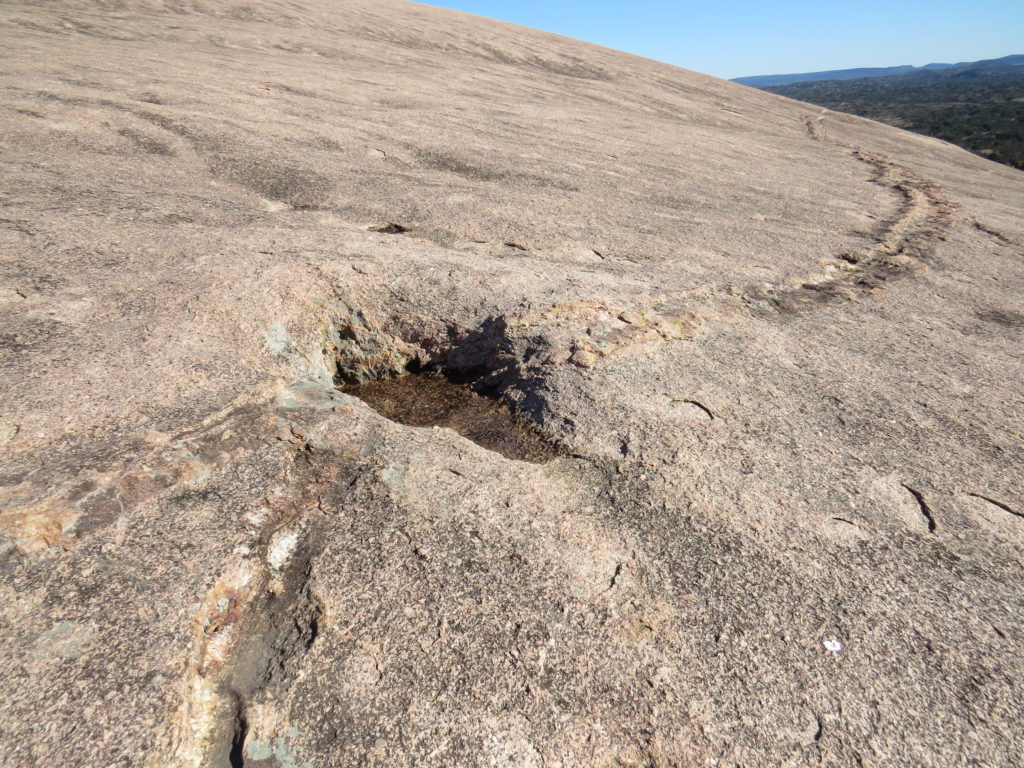
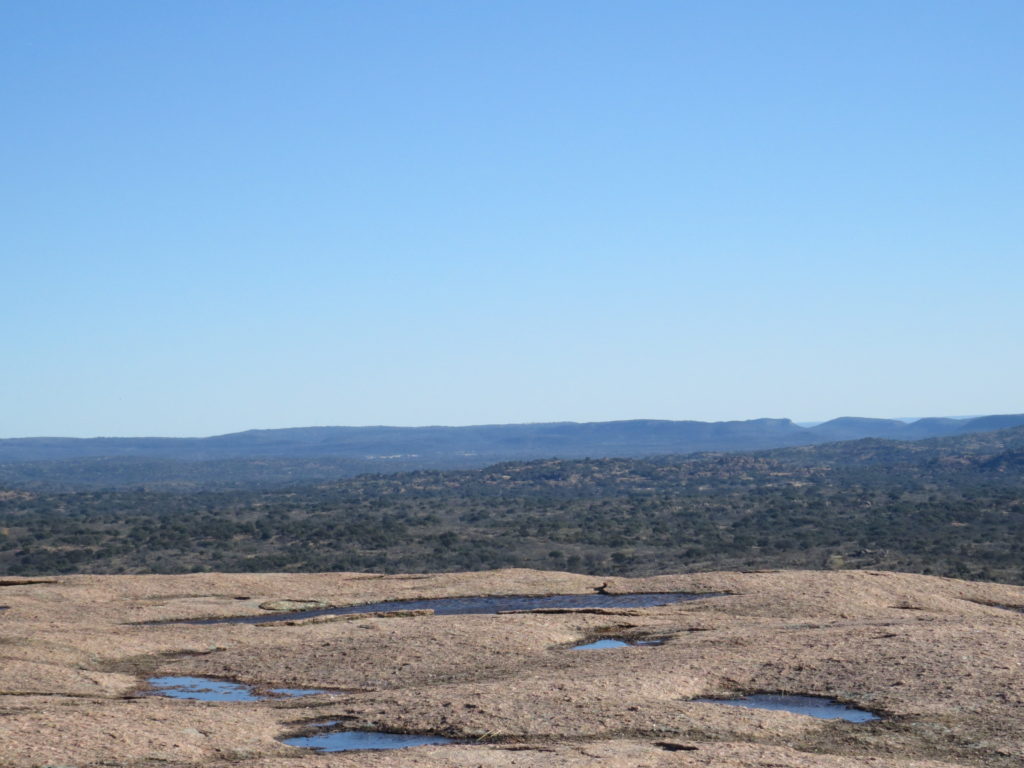
As we neared the top, weathering pits filled with the previous night’s rainfall glimmered in the sunlight. The footprint-like craters have spawned myths about eternally wandering ghosts, but in reality, they are the probable reason for the ethereal glow on a moonlit night, which induced someone to name it ‘Enchanted Rock.’
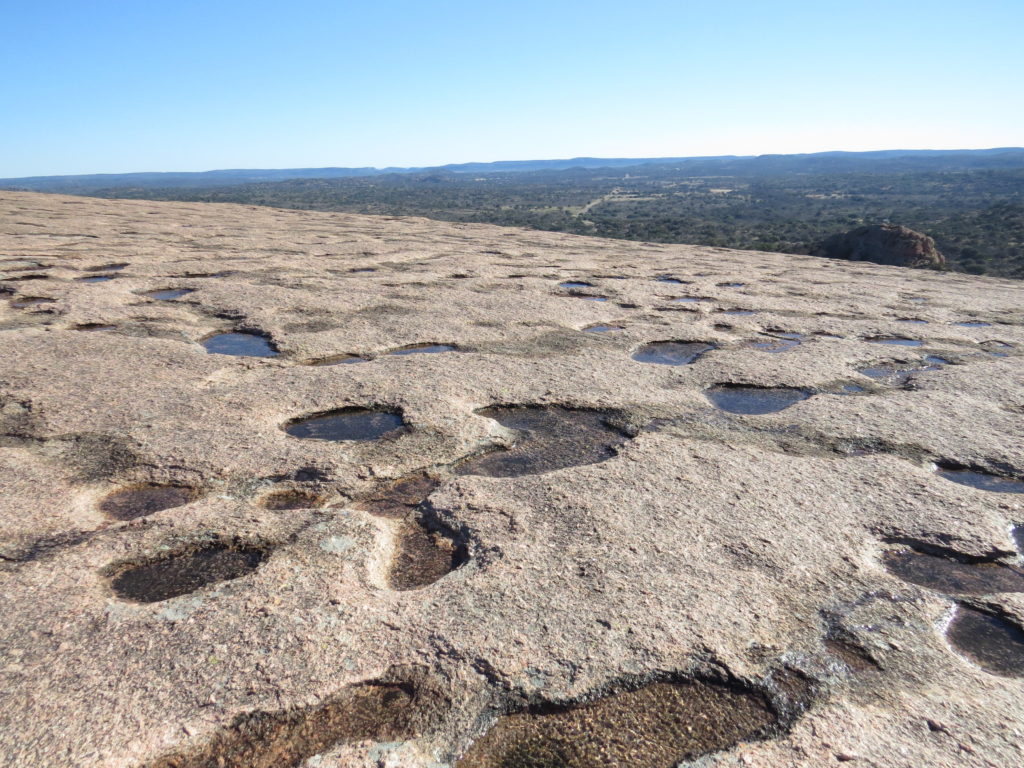
The larger weathering pits that retain water for weeks are called vernal pools. These delicate ecosystems are pioneer communities that contain minute plants and animals that will develop over time into an oasis of life. Tiny fairy shrimp are found and studied here, and a moss-like plant named rock quillwort is unique to this environment.
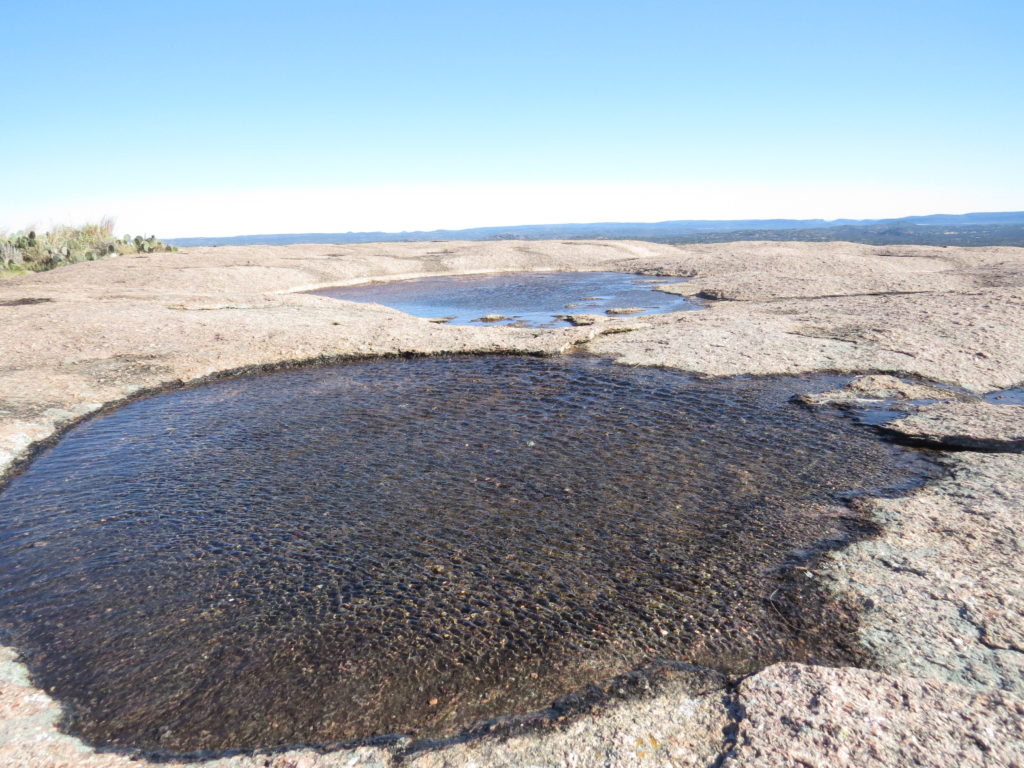
As bits of soil, seeds, and small creatures build up in the vernal pools, over time it transforms into a little island of life—willows, grasses, yucca, and prickly pear cactus—shelter and food for wildlife who live on the Rock.
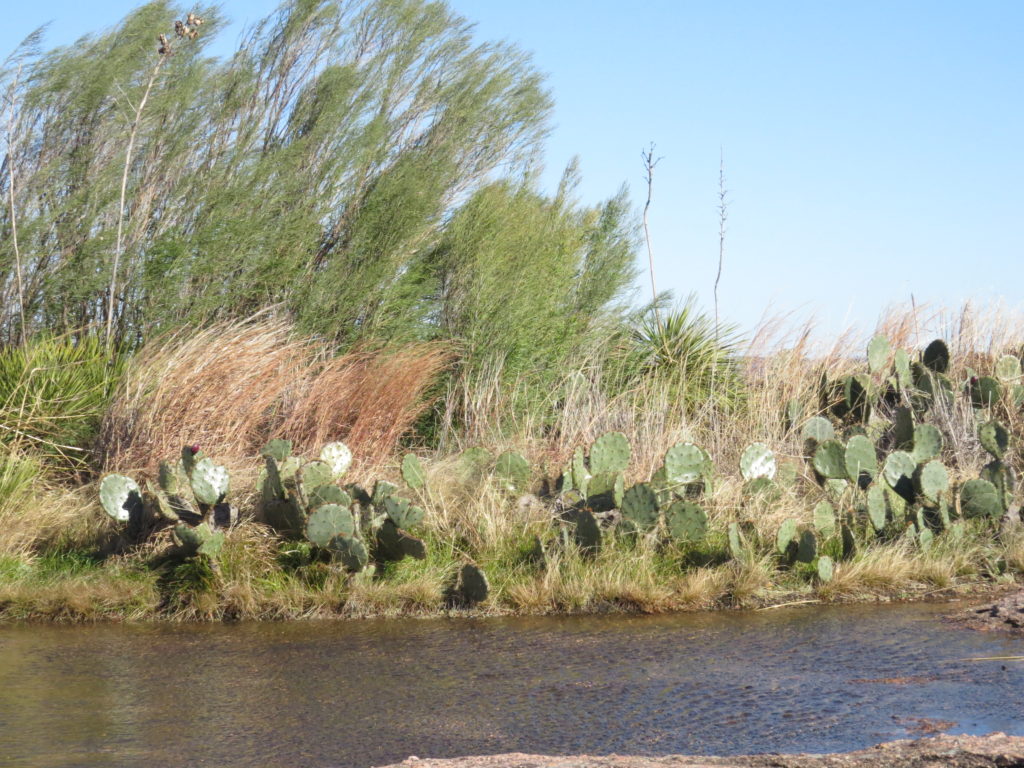
The view from the top of the Rock was stunning in all directions!
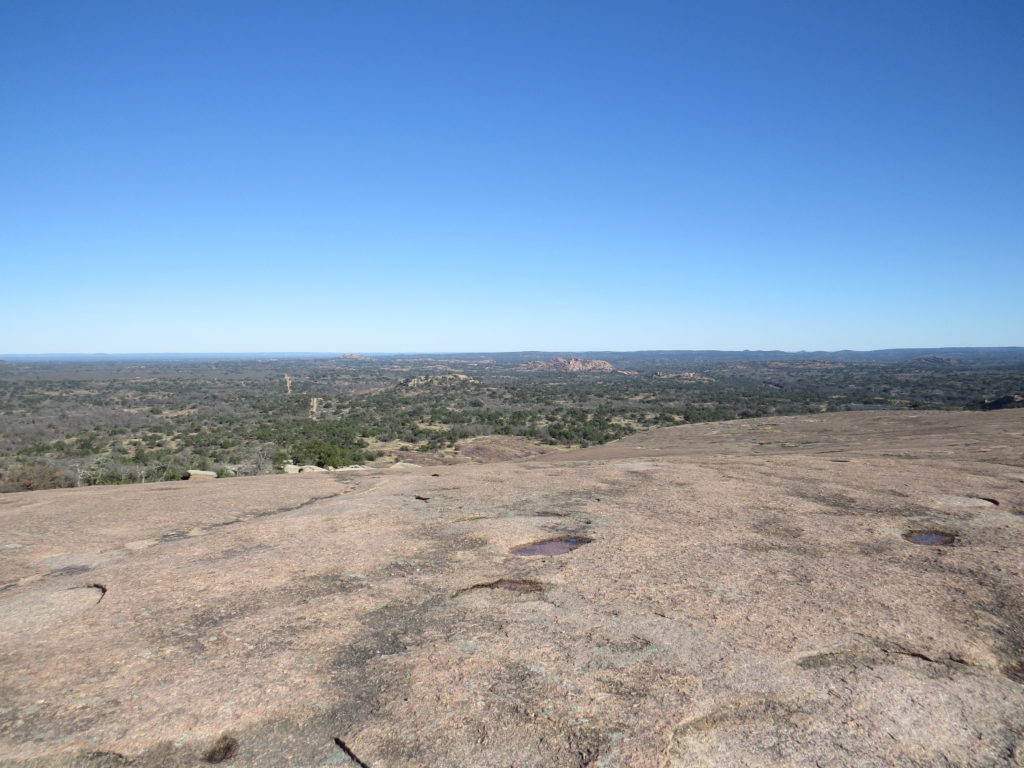
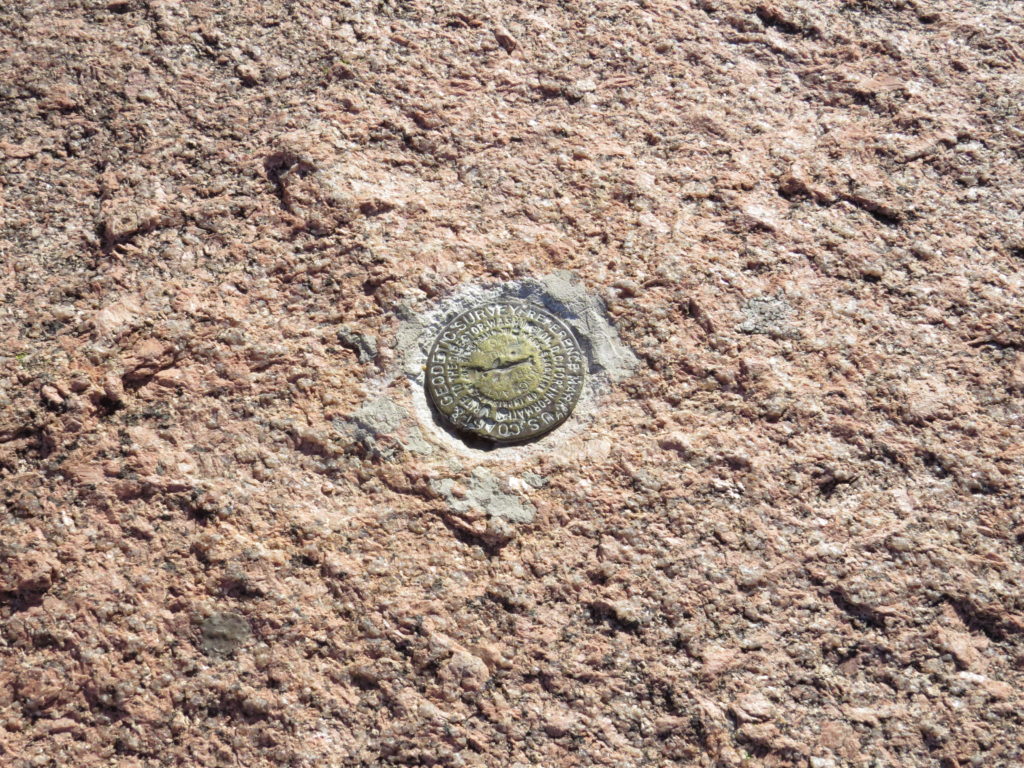
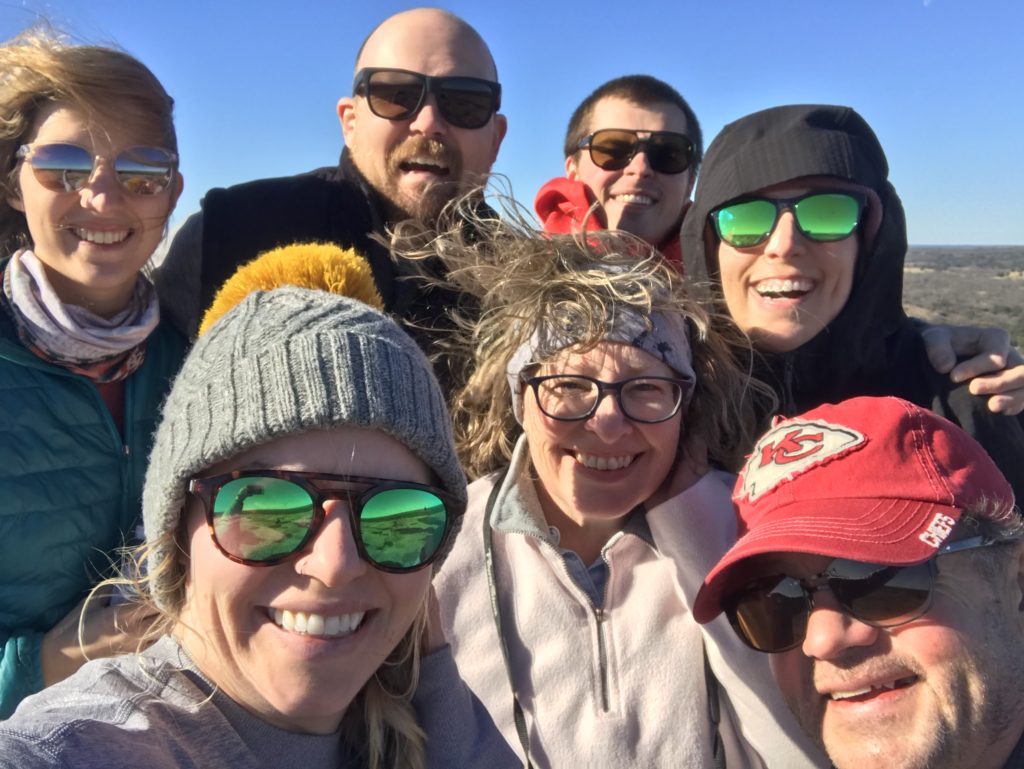
The geographical high point was marked by an official survey seal, and we marked our climb with an official high point selfie!
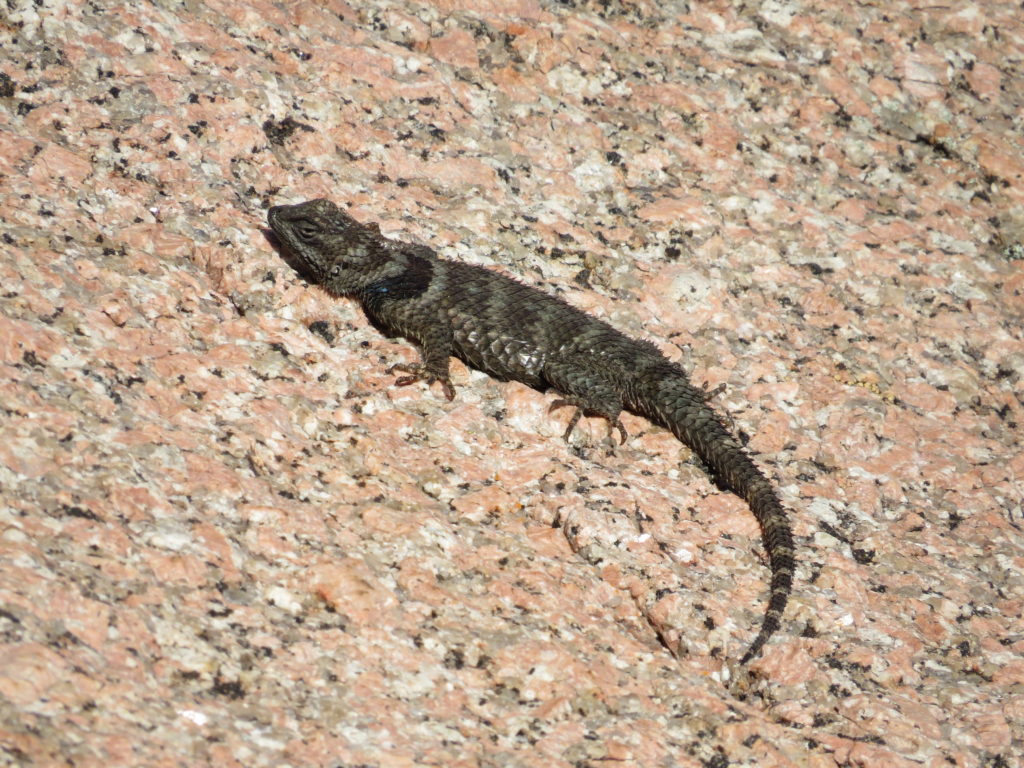
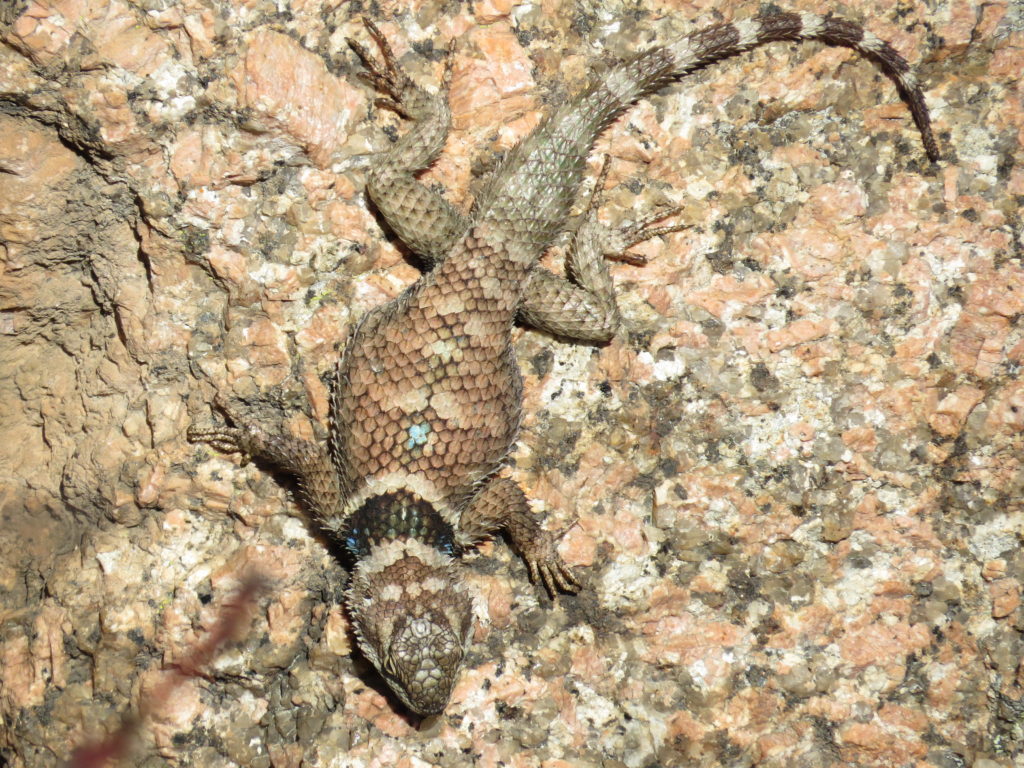
We walked toward a pile of huge boulders on the northeast side where there was a cave. We were below the summit enough to be out of the strongest wind. Two lizards were warming themselves on the south-facing rock—a Texas Spiny Lizard and a camouflaged Crevice Spiny Lizard. What cool creatures!
Some of us climbed into the cave—not to the crawl-on-your-hands-and-knees part—but through to a secret garden area where a couple of wind-swept, twisted-trunk trees grew.
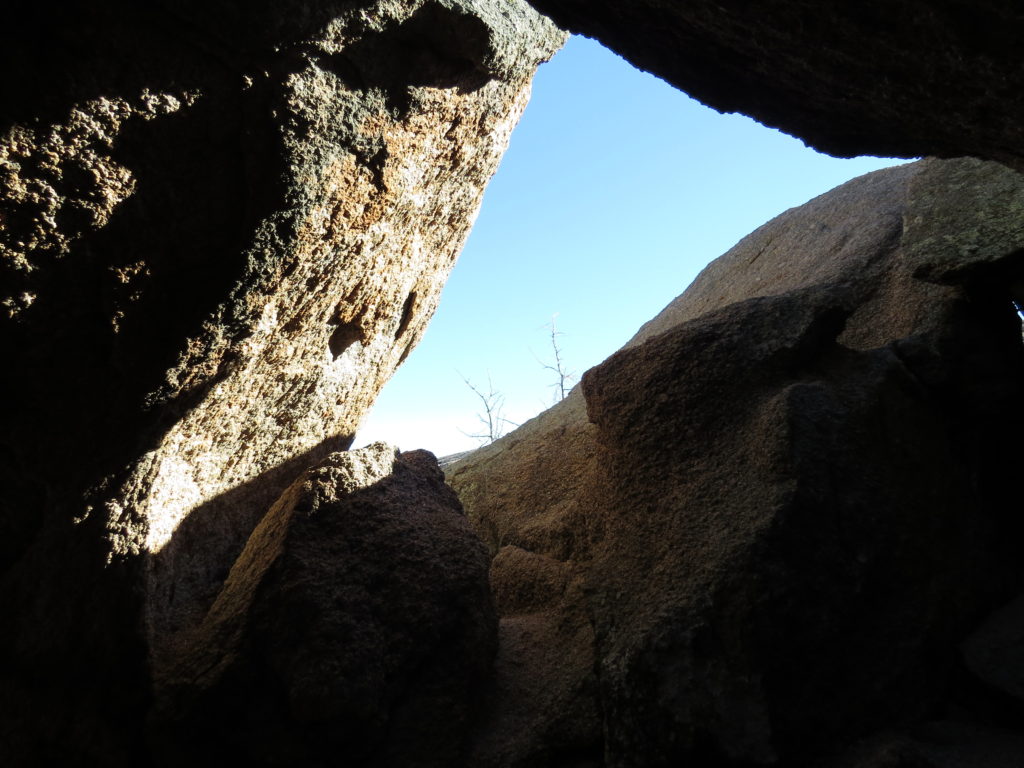
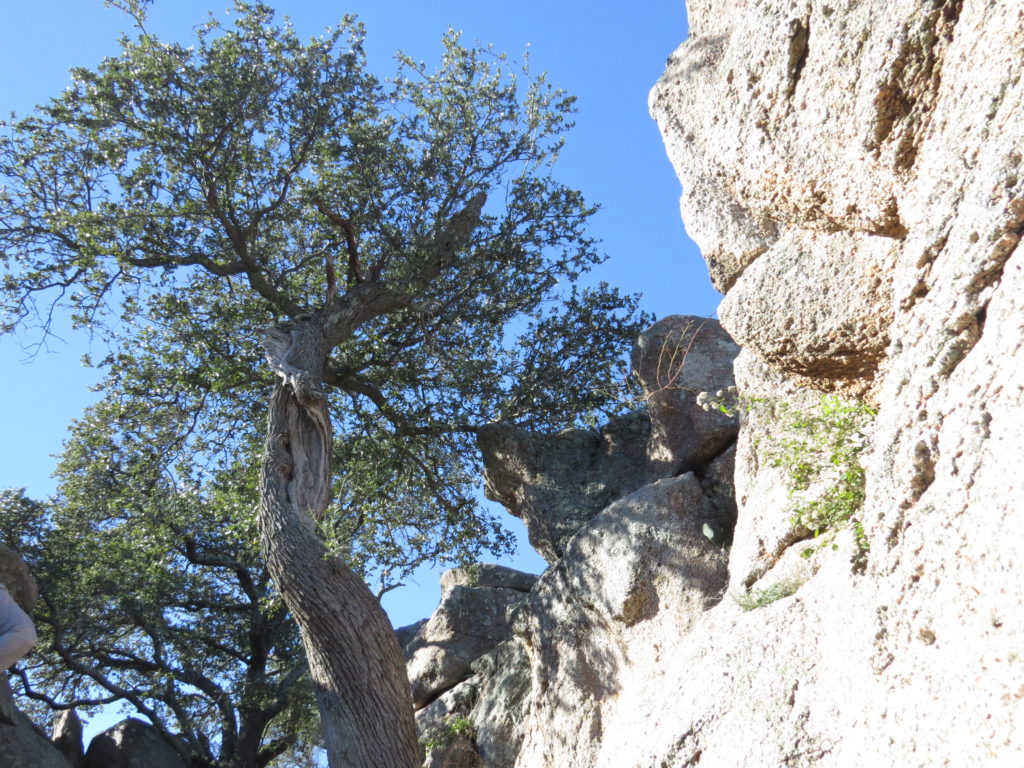
After climbing out of the secret garden—and a few moments when I thought I may be stuck on Enchanted Rock for eternity—we began our descent.
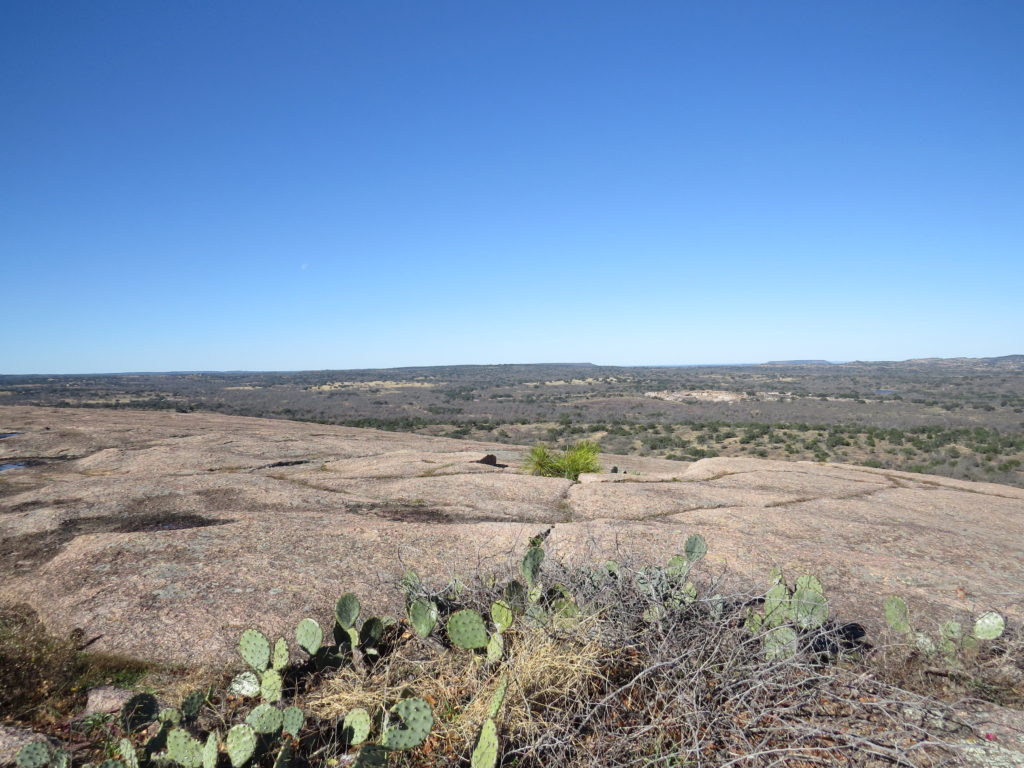

We chose a different side of the rock to hike down—an area with huge cracks and large boulders scattered in random spots.
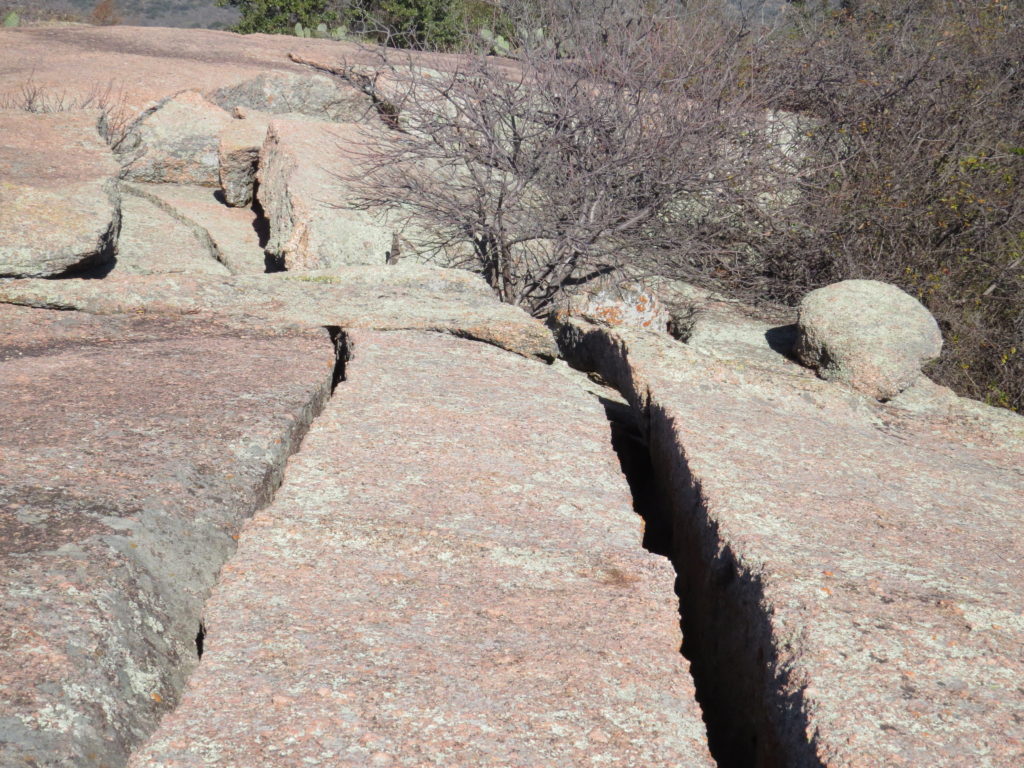
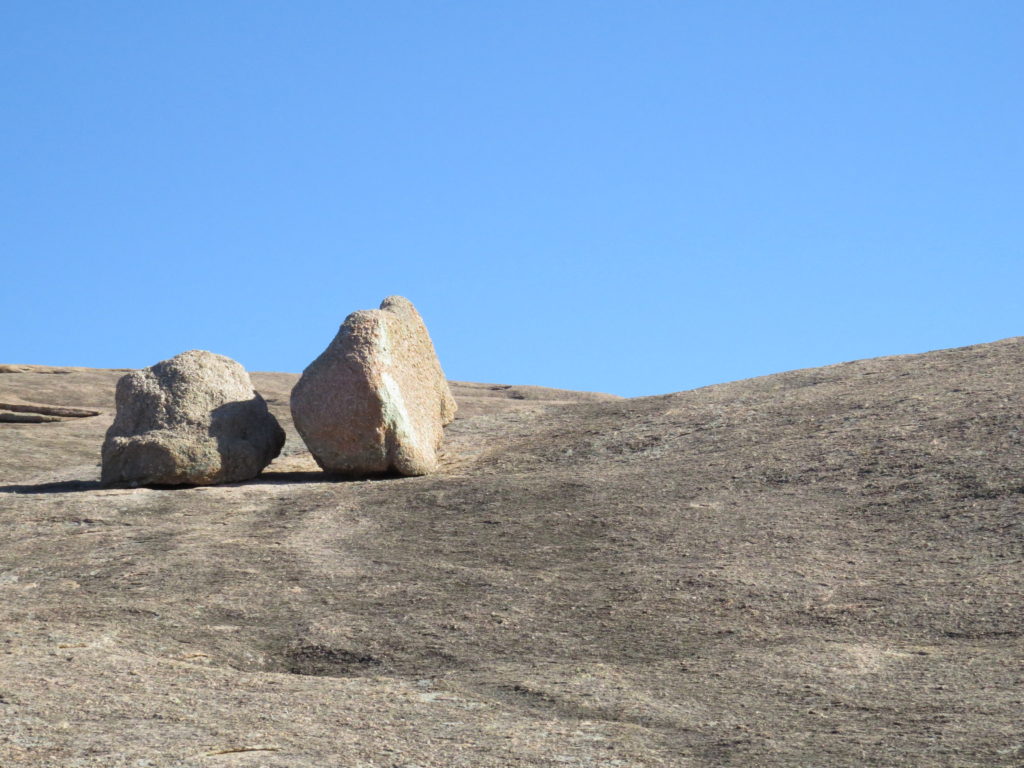
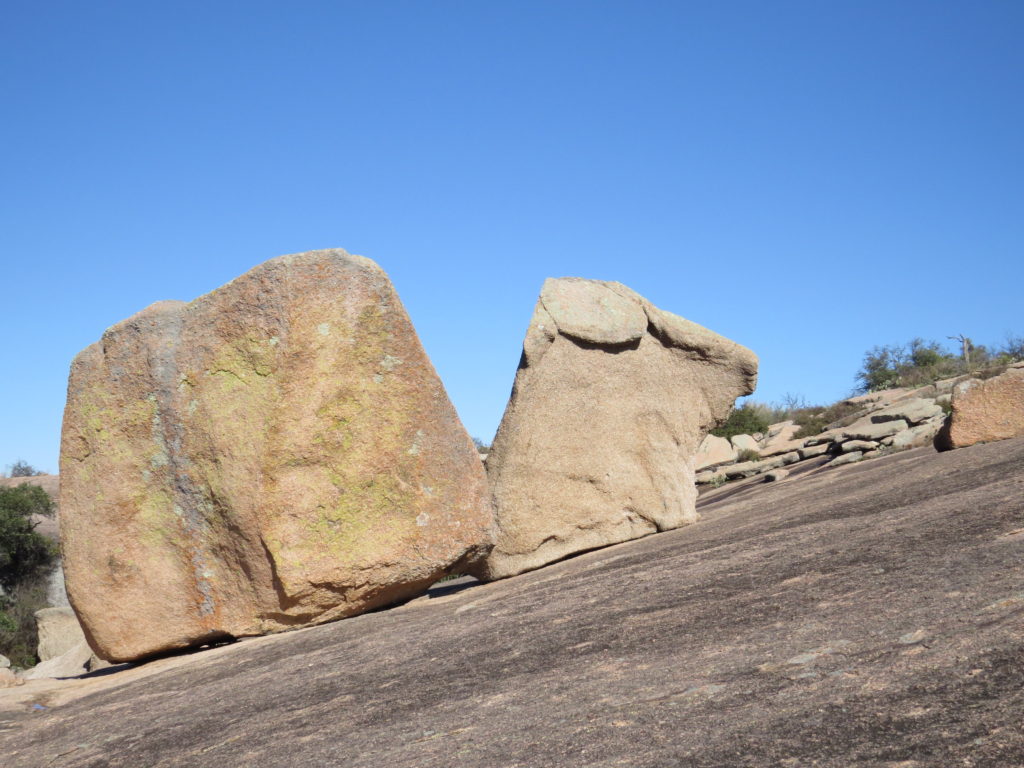
The dome of Little Rock shows the exfoliation caused by expansion and contraction of the rocks and how broken chunks of rocks slide down the side of the dome.
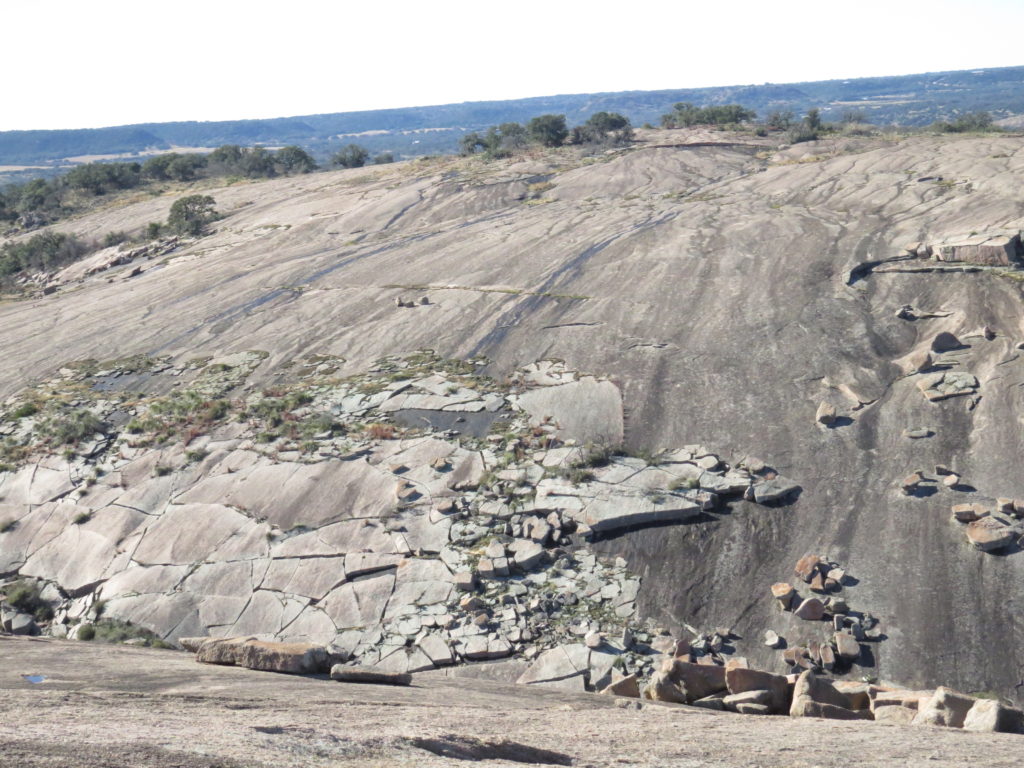
A rift of amber bluegrass and one of green, grew in the nearly vertical cracks as we climbed down Enchanted Rock.
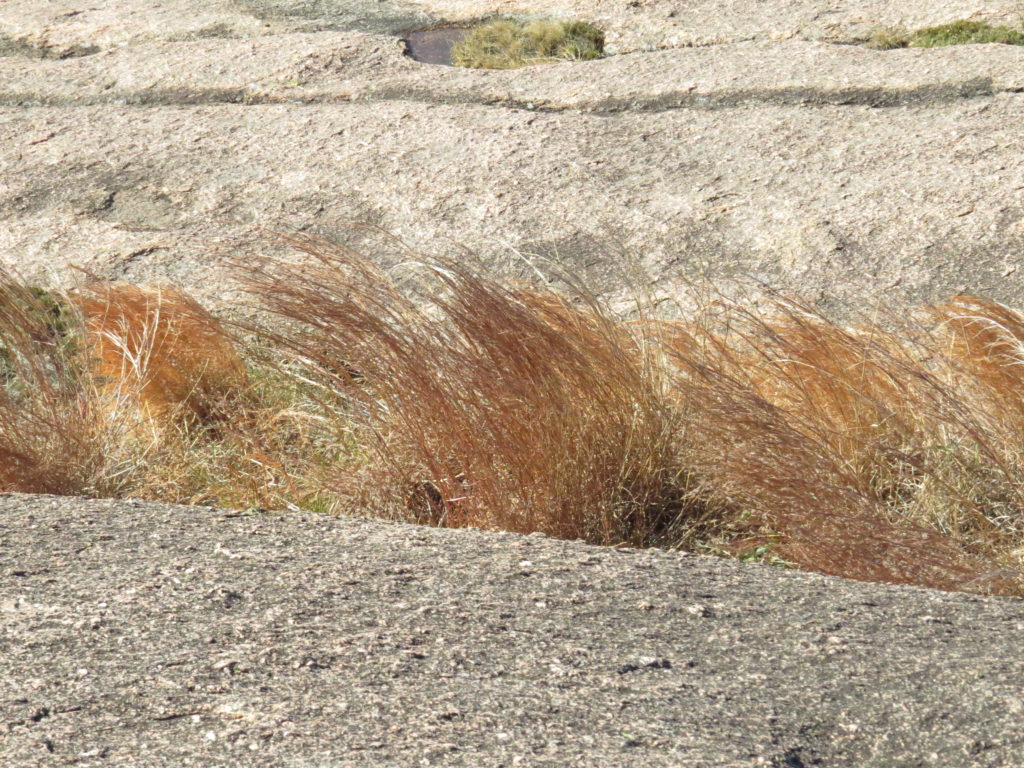
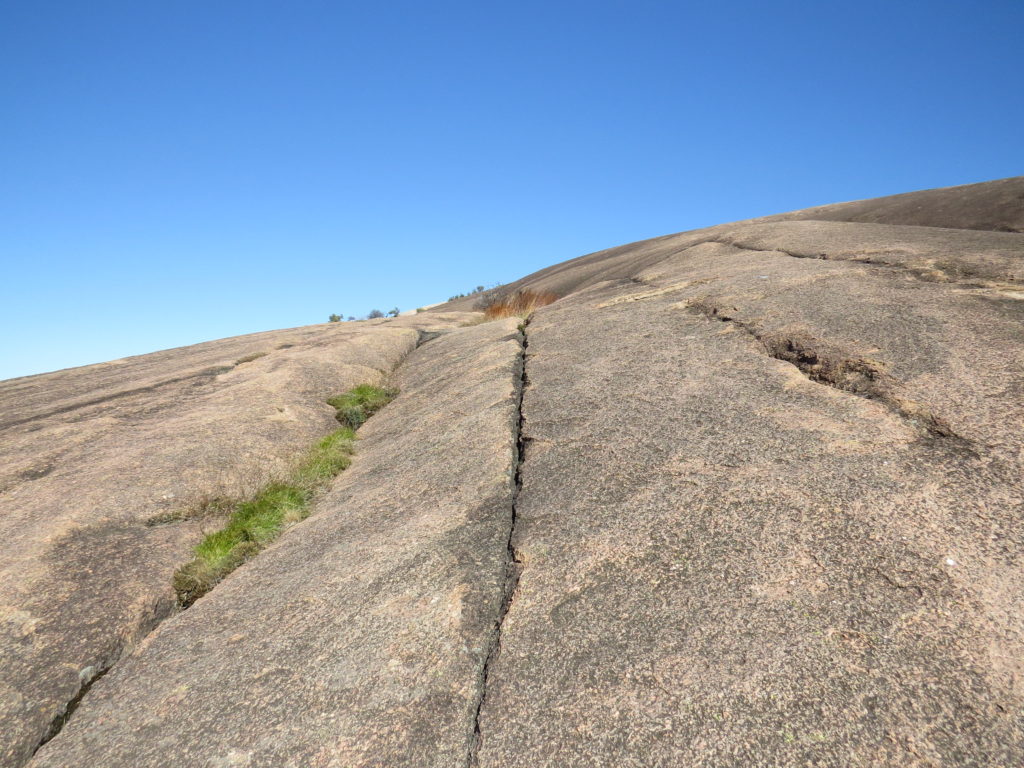
Down from the dome, down to foliage, down to Earth.
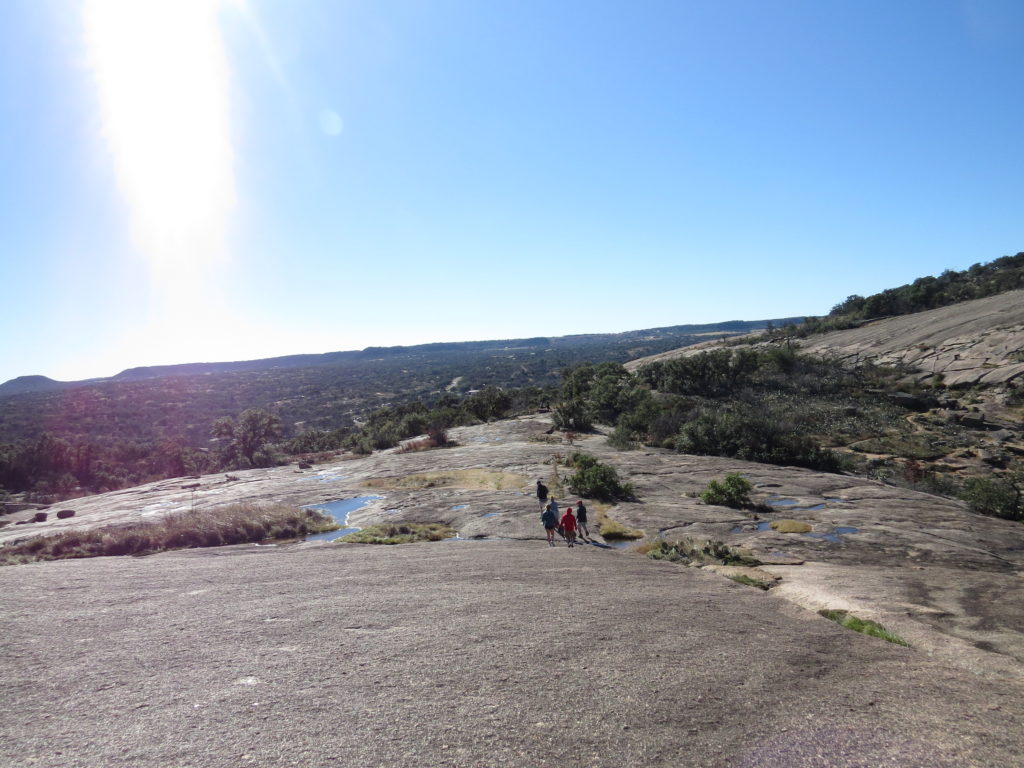
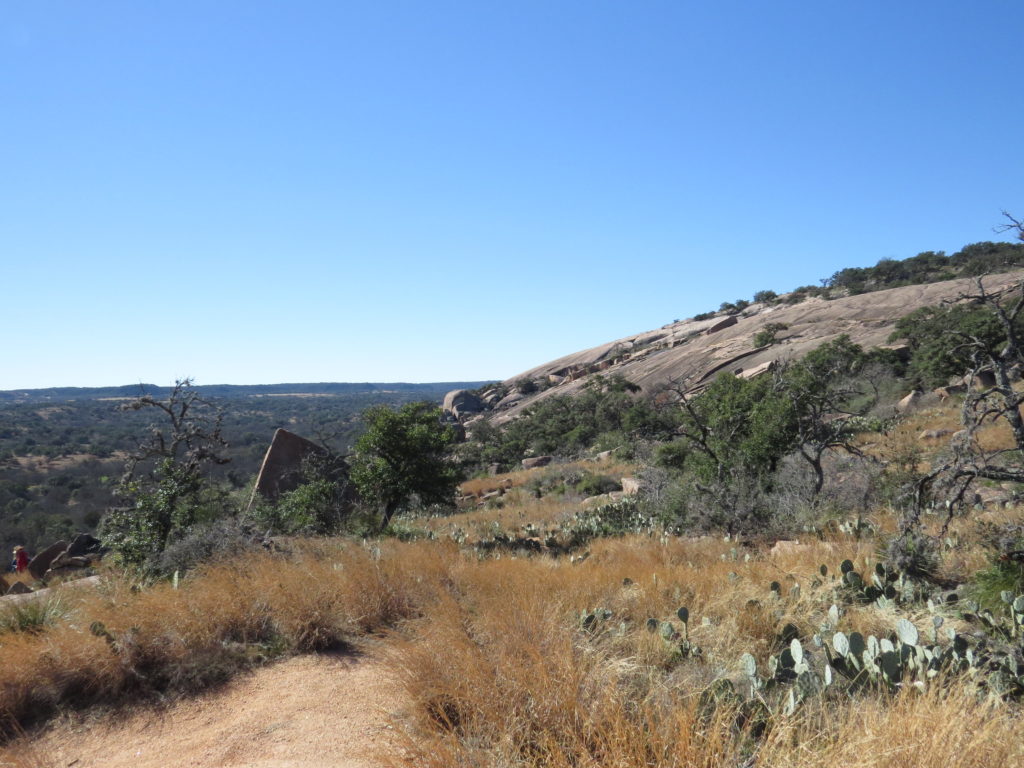
Even though we didn’t see the vernal pools of water glowing in the moonlight, I understand why this place is called Enchanted Rock. It was unlike any place I had ever been before; it had a grounded, solid feel of ancient wisdom at the same time as an other-worldly, ethereal feel of life-affirming Spirit. The wind with all its power was mesmerizing. The sunshine sublime. The patches of plants growing on rock, enthralling. It is a place to base our lives on—the quest for body-regulating grounding wisdom and for exquisite, joy-filled Spirit. The challenging trek to the top of the Rock was individually fulfilling and profoundly enhanced by our experiencing it together. The very real yin and yang of our lives—these opposite forces that are complementary and interdependent. Our interconnected earthly-divine lives living on an enchanted rock.
For the first part of our Enchanted Rock adventure, go to At the Foot of the Rock.
At the Foot of the Rock
I can see the light of a clear blue morning/ I can see the light of a brand new day/ I can see the light of a clear blue morning/ And everything’s gonna be all right/ It’s gonna be okay –Dolly Parton
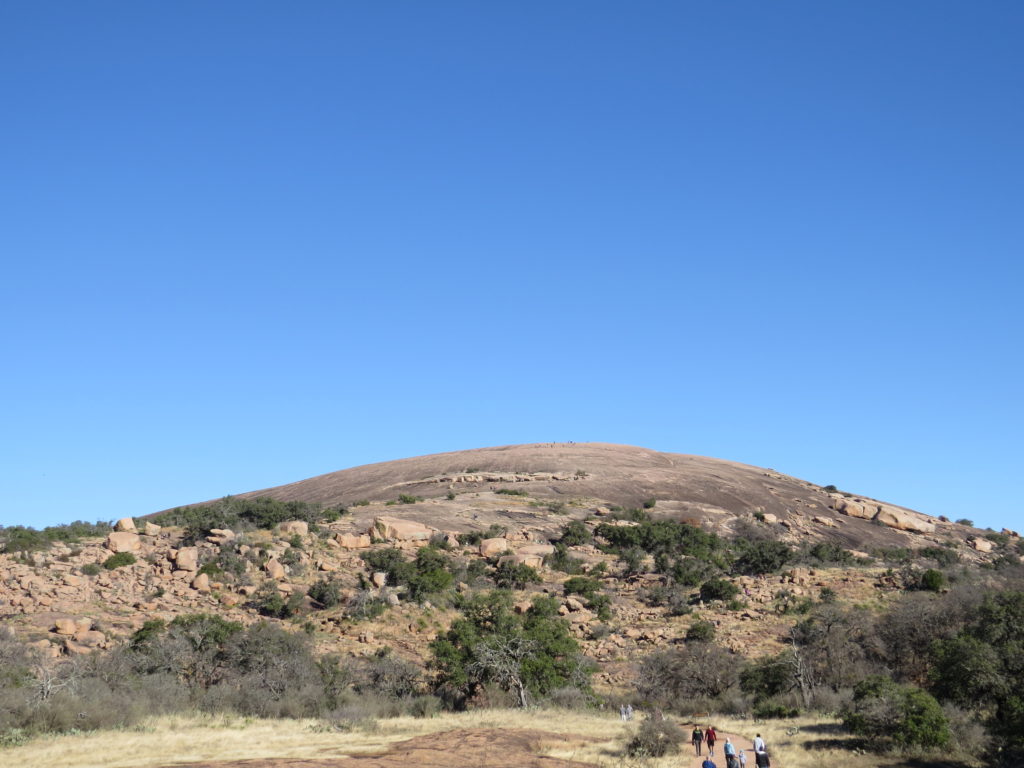
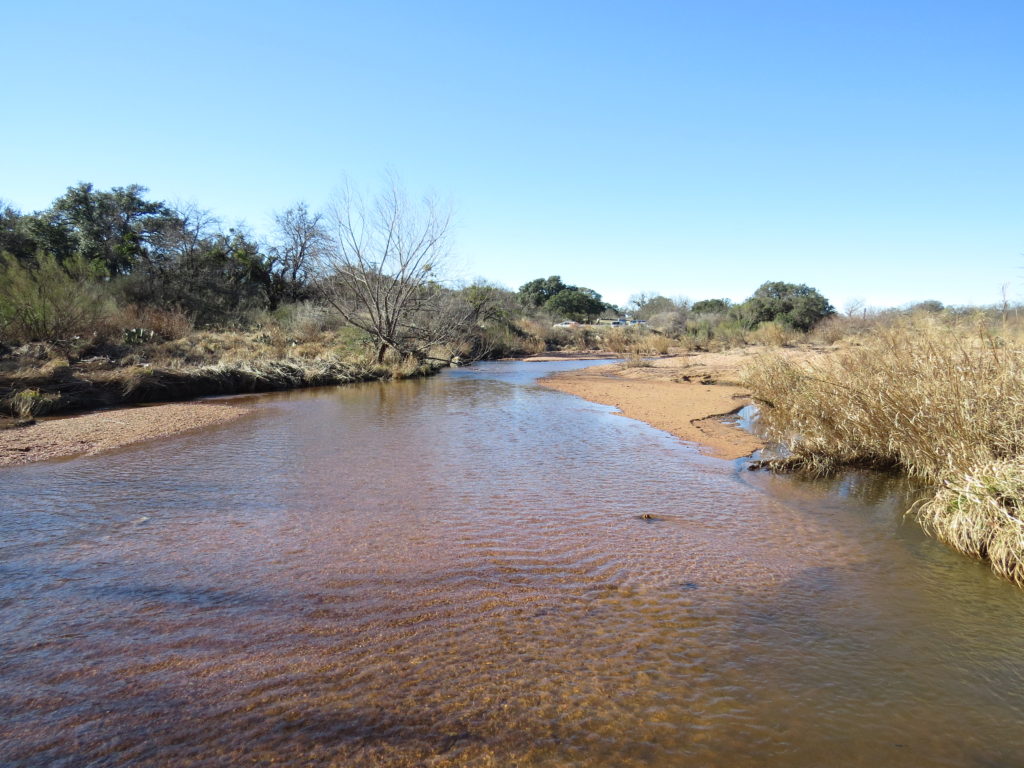
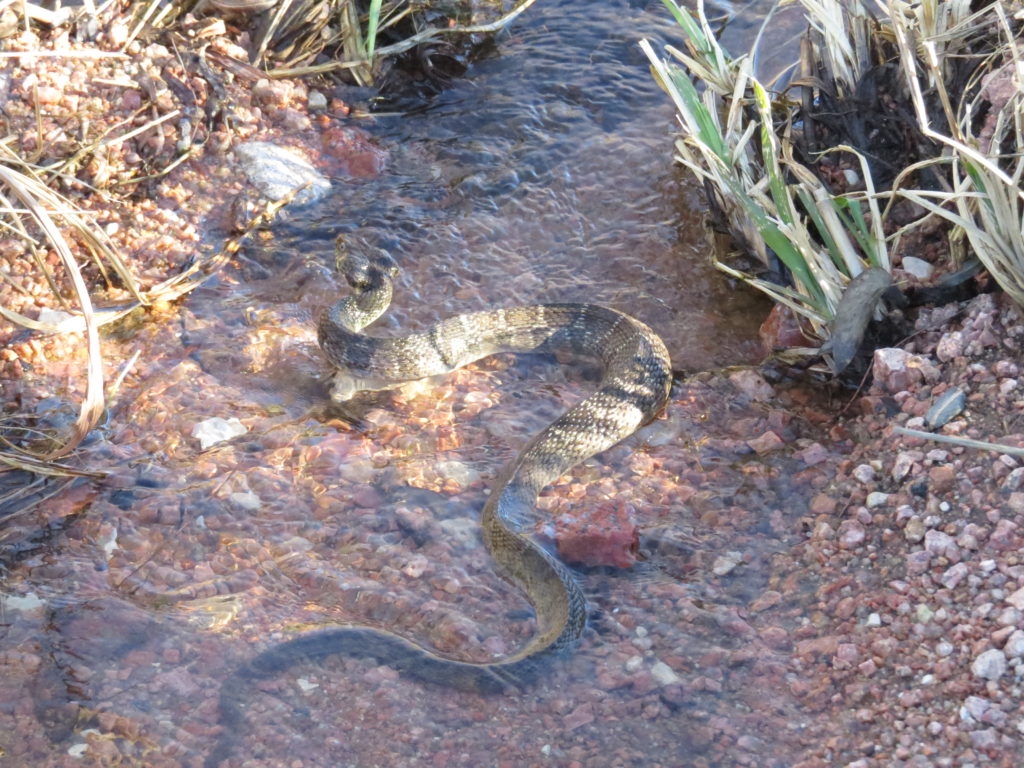
There’s something to be said for being able to clearly see what lies before you, what your task is, even what path you will choose. The first time I heard about Enchanted Rock in the Hill Country of Texas was when our daughter Emily worked at The Outdoor School in Marble Falls. It sounded, well, enchanting—a huge dome of granite rock that bubbled up as magma a billion years ago, then slowly began eroding. It is a place that humans have camped at and called home for more than 12,000 years. There are stories and legends of spirits and sacred spaces from explorers and Native Americans and of how the mammoth rock glitters on clear nights with ‘ghost fires.’ I wanted to see it, and I wanted to climb to the top. Enchanted Rock is a small visual part of a huge underground area of granite called a batholith that covers one hundred square miles, so even what is unbelievably large is small compared to what lies unseen below it. The pink granite dome rises 425 feet above the base elevation of the park—like climbing stairs of a thirty to forty story building, and the people at the top looked like ants from our vantage point. Before climbing the granite dome, we explored around the other environments at the base of the rock—the floodplain, Mesquite grassland, and Oak woodland. It had rained the night before, so the shallow creek-bed was flowing with clear water and home to a great-looking snake.
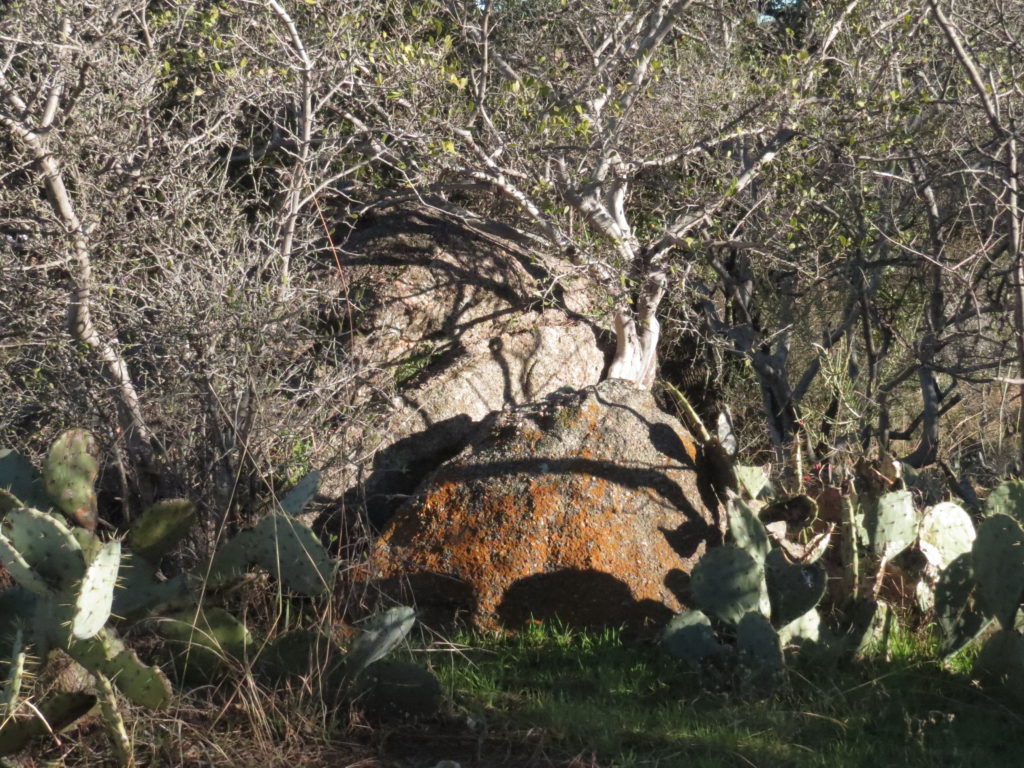
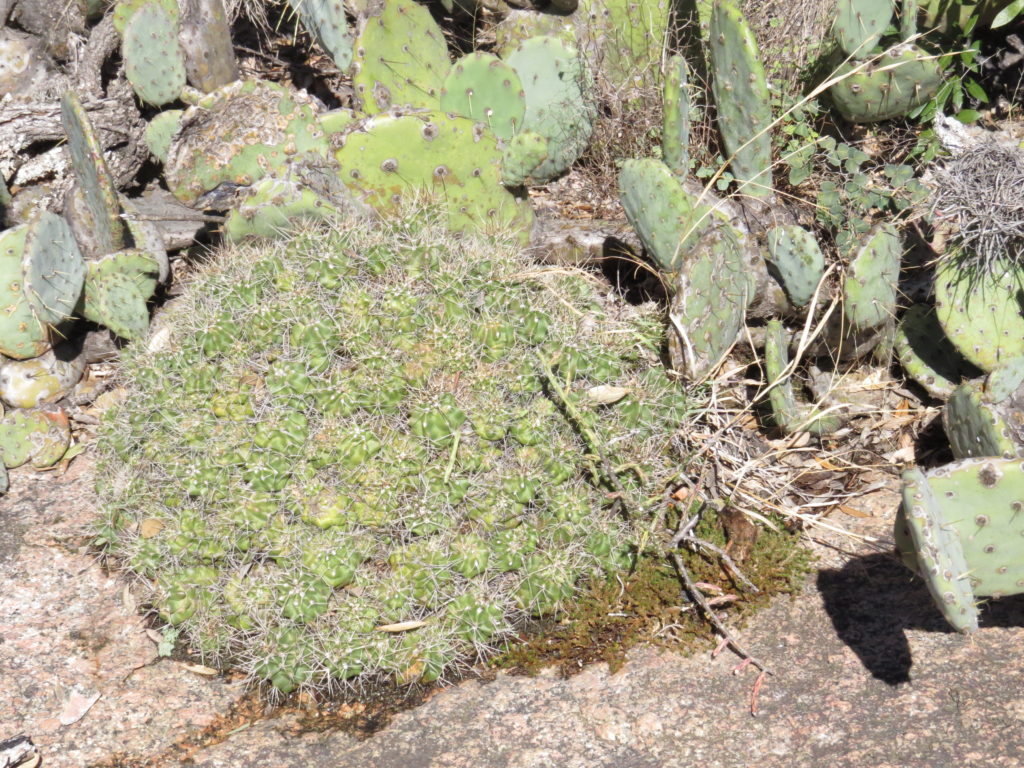
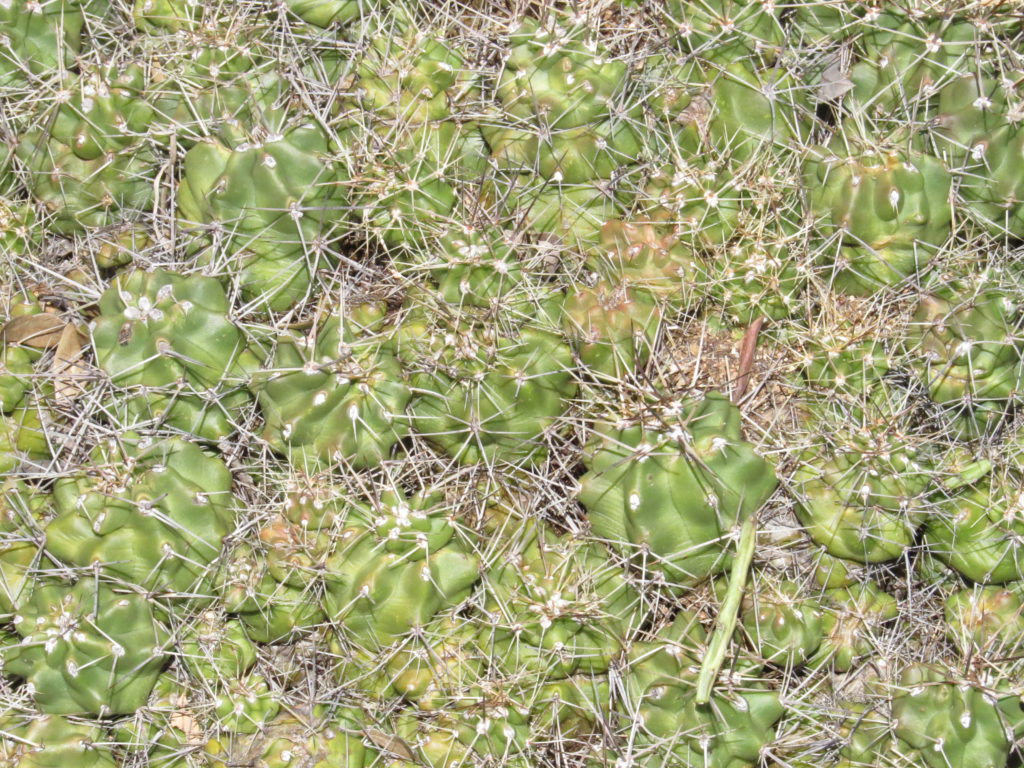
Like all the places we had visited in Texas, I was amazed at how the prickly pear cactus occupied such diverse environments and how some of the trees still wore their green leaves.
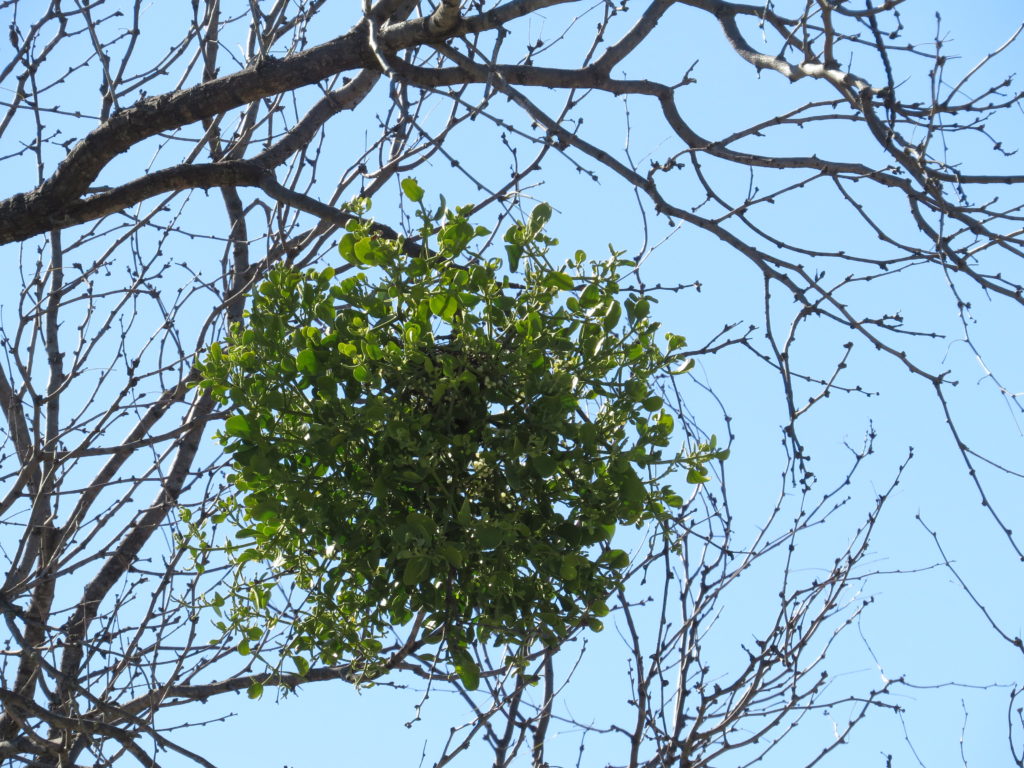
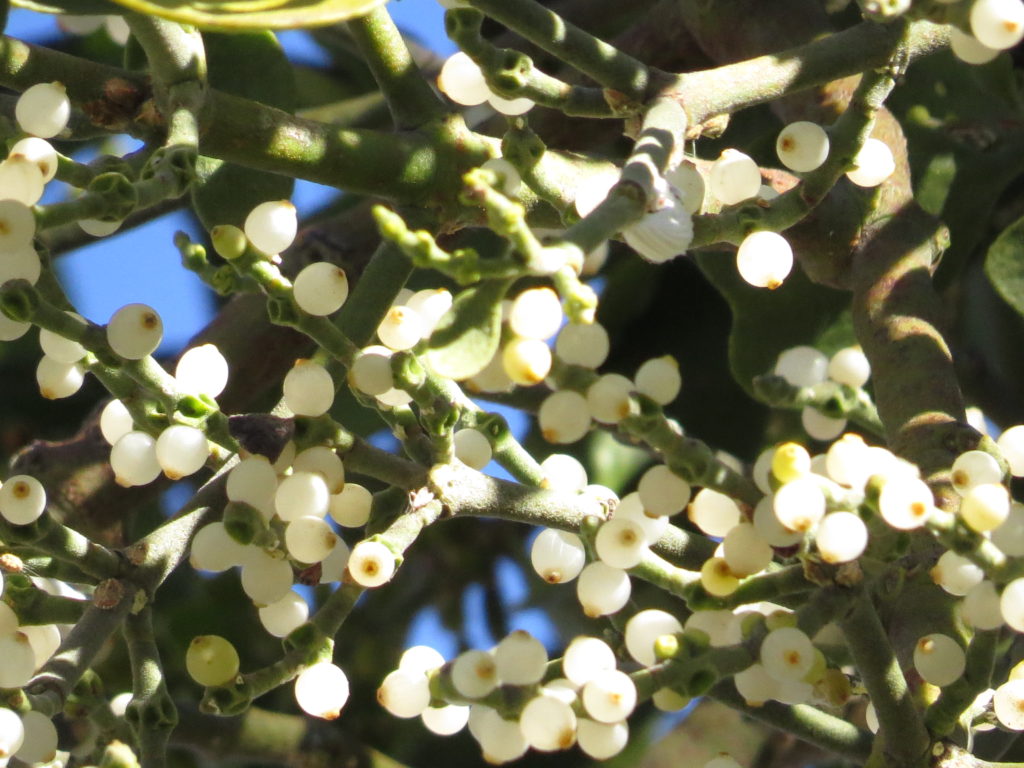
One of the unusual sights for me was a ball of green Mistletoe in a bare tree. The tradition of kissing under the Mistletoe began with the ancient Greeks, as the evergreen plant with its shining white berries symbolized fertility. Now it has become a tradition/decoration of the Christmas season. It is a parasitic plant that sends its roots into the wood of a branch and usurps water and nutrients from the tree. A heavy infestation of Mistletoe can cause dying of branches or death of a tree.
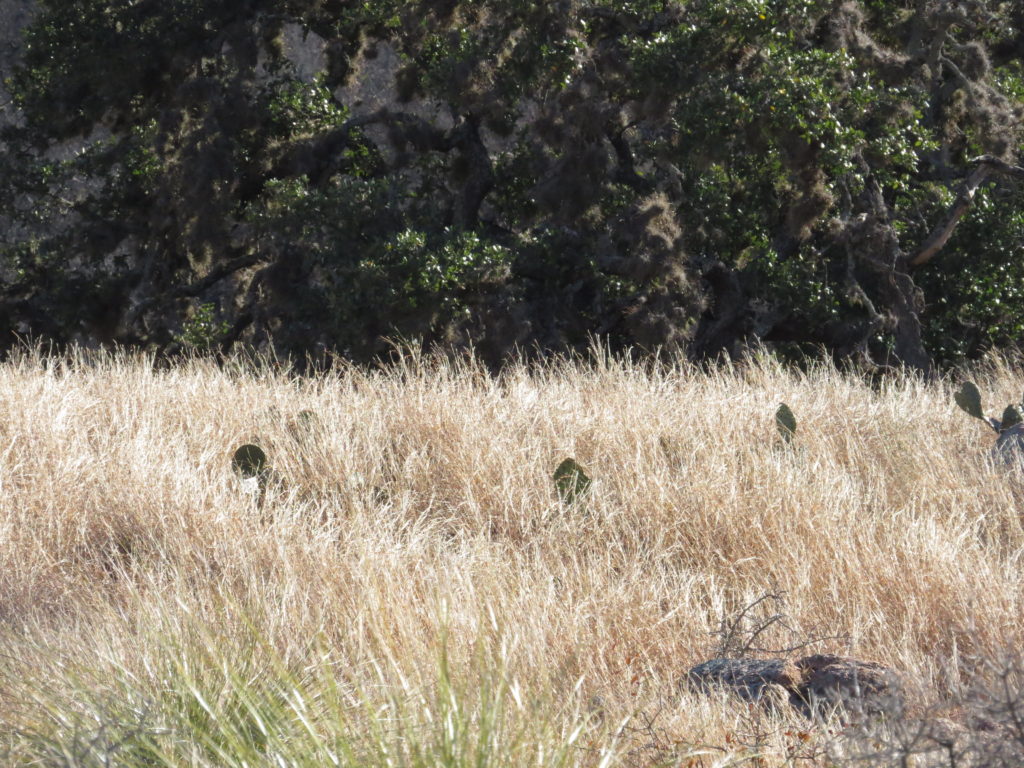
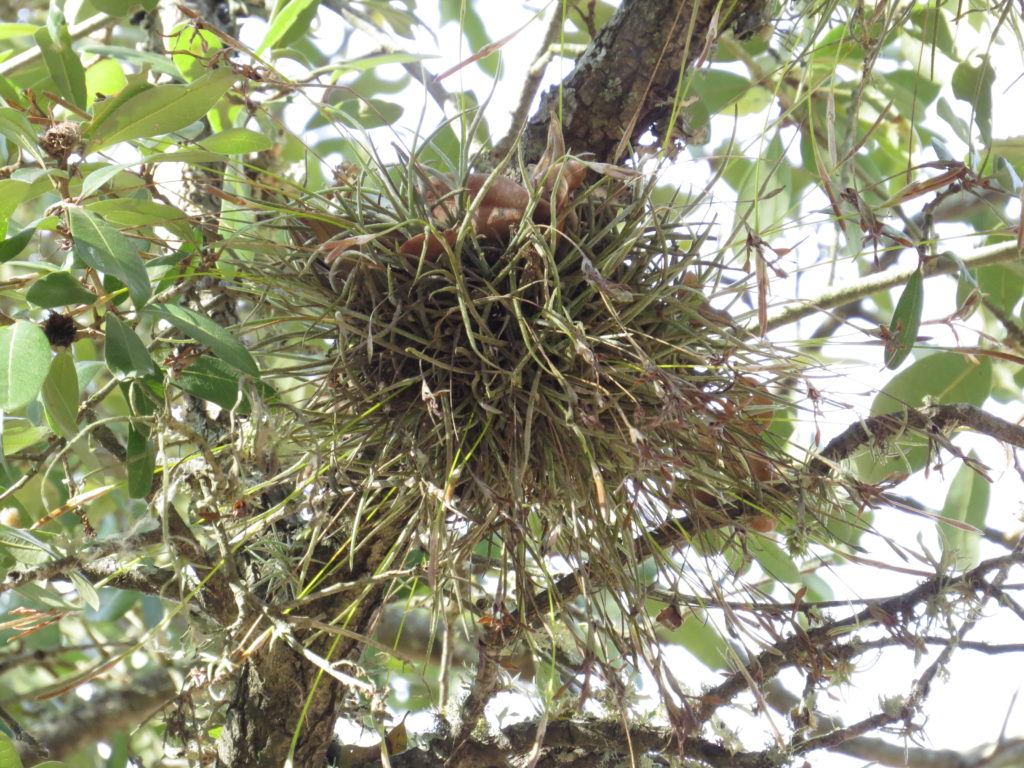
Another plant that is sometimes thought to be a parasite is Ball Moss, seen as the gray balls in the Oak trees below. They are actually epiphytes—plants that live on other plants, but absorb water and nutrients through their leaves from the air. These ‘air plants’ anchor themselves to the bark of a tree with tendrils. Some arborists believe the tendrils can strangle a branch, and eventually kill a tree, but it is very common to see a tree full of Ball Moss with their pokey seed pod stalks. ( I like how the Prickly Pears poked their ‘heads’ out of the grass in this picture.)
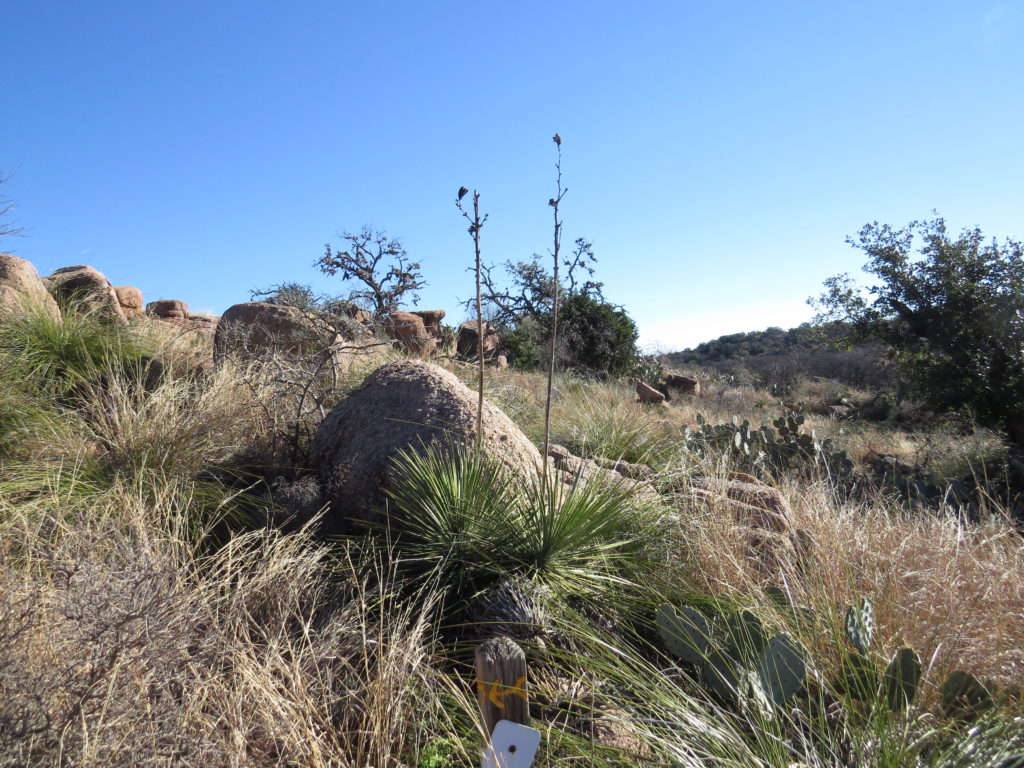
Yucca plants with their tall stalks of seed pods grow among the Prickly Pears, grasses, and rocks.
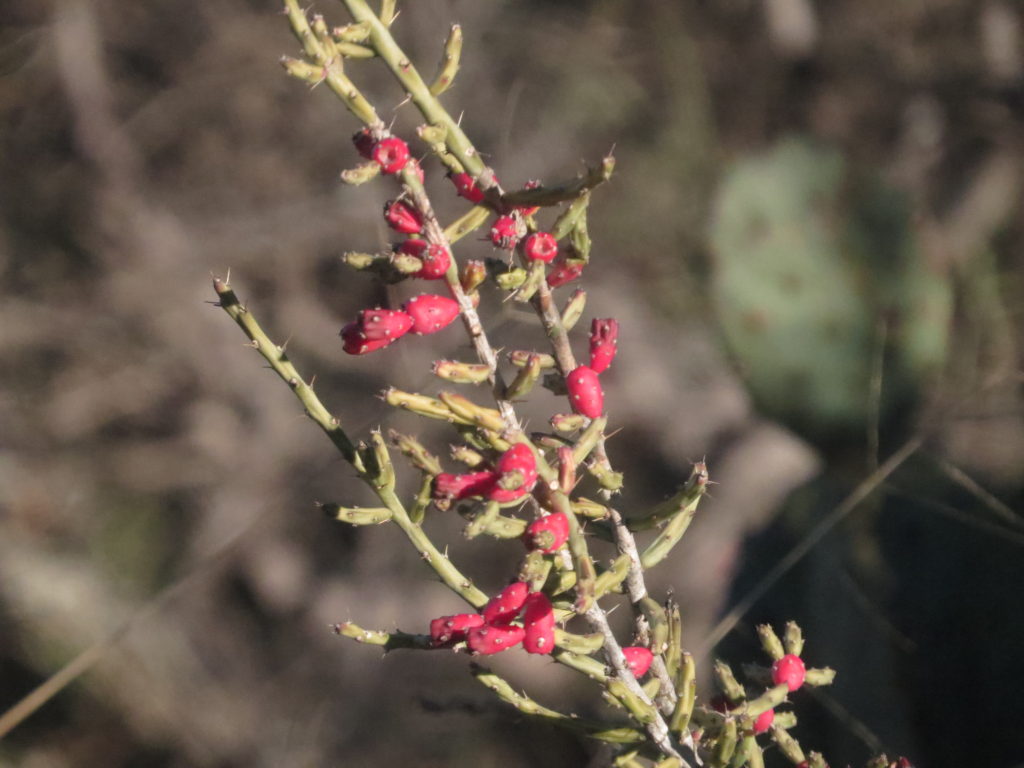
In fitting attire for our after-Christmas hike was the colorful fruit of the Desert Christmas Cactus, sometimes called Pencil Cactus because of the slender leaves.
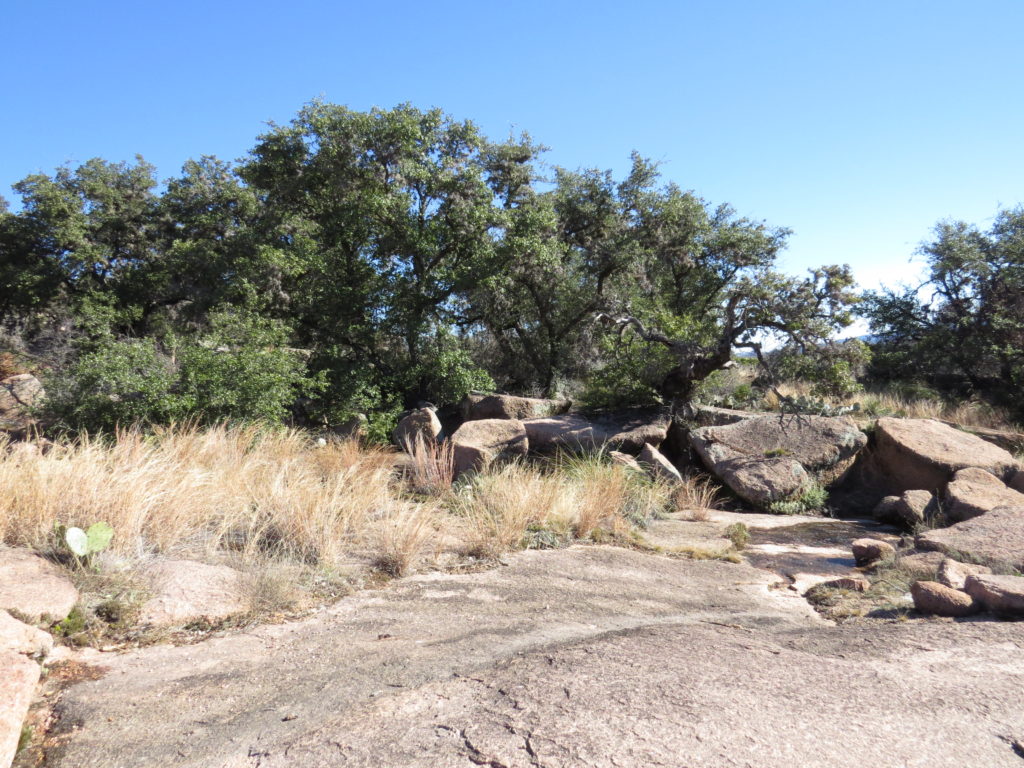
In the millions of years of erosion, exfoliation of layers of rocks has tumbled down the side of the dome into piles at the foot of Enchanted Rock.
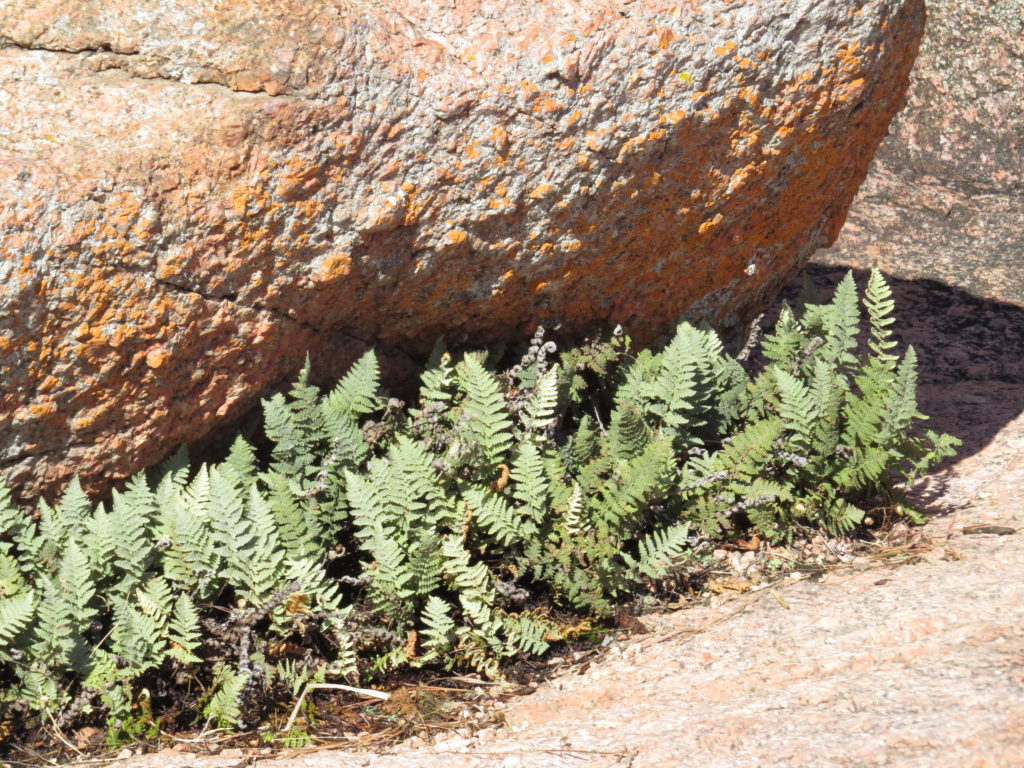
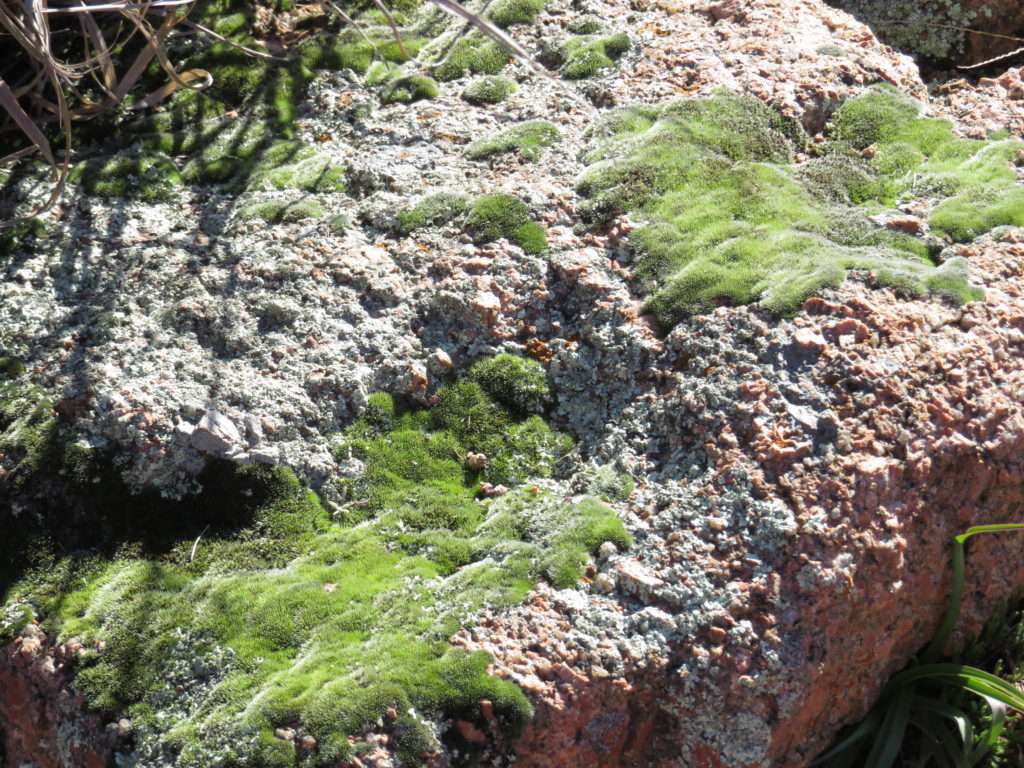
Miniature ecosystems form on and below the rocks where moisture is a bit more abundant…
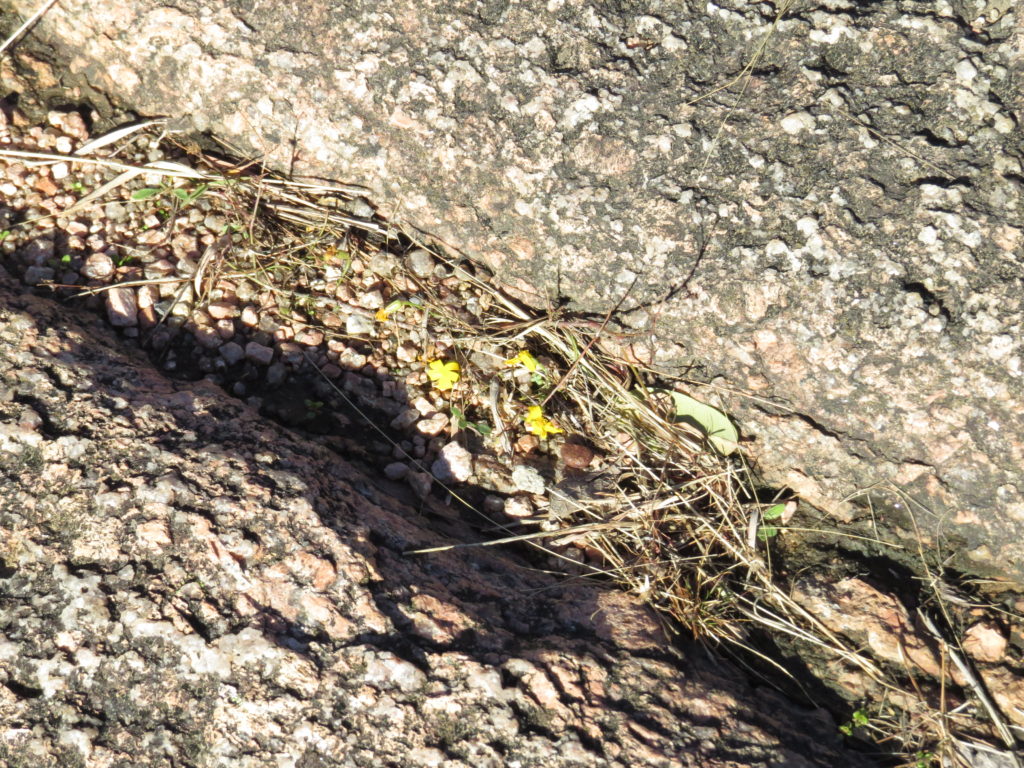
…and where tiny, viney yellow-flowering plants survive in a crack between rocks, perhaps blooming in response to the recent rain.
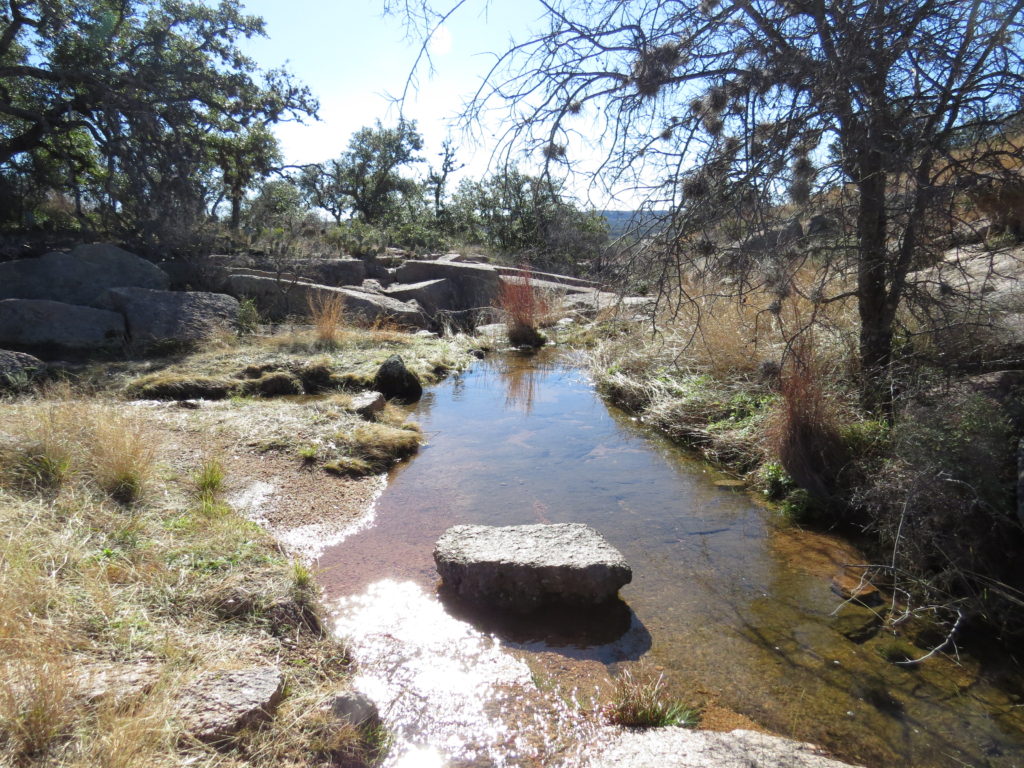
The ecosystem at the foot of E-Rock is hard and harsh with the masses of granite rocks and cacti, and yet at the same time, there is a softness and flexibility in the flowing water, the swaying grasses, and the carpets of delicate moss that cover the rocks in the floodplain.
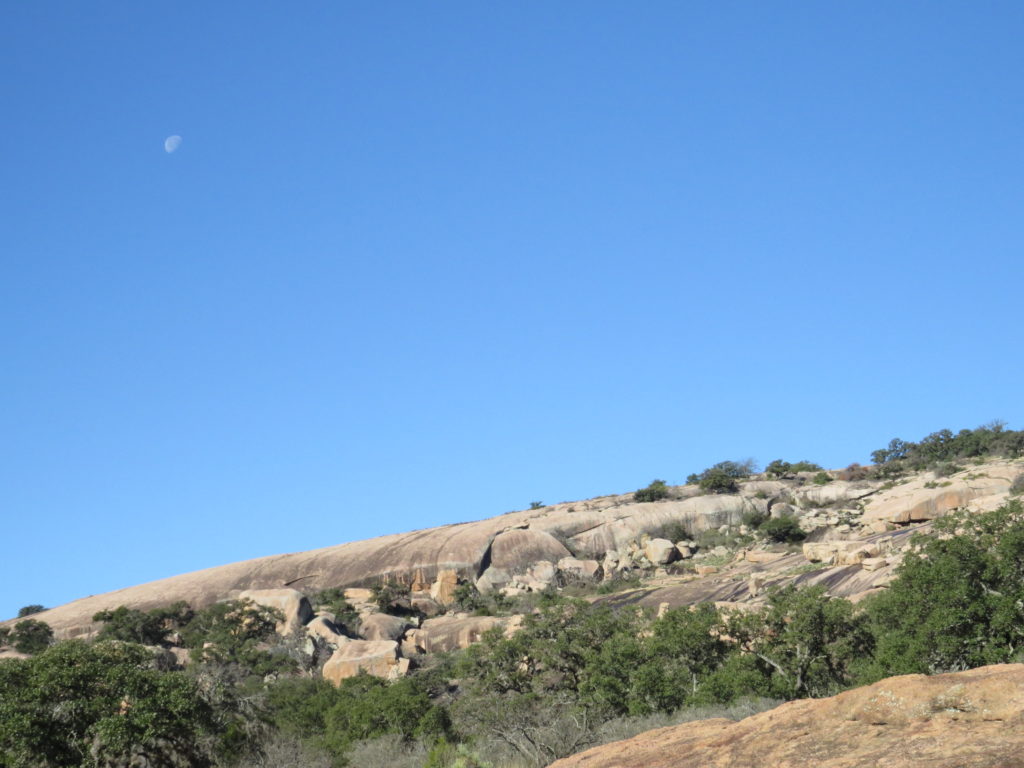
This impressive granite rock, with its long history of geological wonder and spiritual acclaim, attracts people to stand at the foot of the rock in awe of what lies before them. There are times in our lives when we stand in such awe looking forward in our lives—at graduations, at weddings, at funerals, at the births of children, and then again when those children leave the nest. What we see at those times is small compared to what lies unseen in the life-altering tasks before us. Perhaps naivete and enthusiasm are the glasses we need to look through in order to propel us through the droughts, the prickly places, and the hard times. Dolly sings about those long, hard nights, the long hard fights, and the “clinging vines that had me bound.” The largest and most enchanting rock that lies before us is not anything that happens in our external world, but that which happens within us. It’s time to explore. It’s time to face the daunting task of noticing the stories and legends we carry in our hearts. It’s time to eradicate the parasitic thoughts that are killing our souls. There’s something to be said for being able to clearly see what lies before you, what your task is, even what path you will choose. And through it all, we look forward to seeing the light of a clear blue morning and a brand new day. Everything’s gonna be all right. It’s gonna be okay.
Cultivated Nature–Olives and Beer
As I’m writing this, it is ten below zero in Minnesota, and we are still cleaning up seven inches of snow from the past couple of days. So, it is with a look to the past and a look towards the future that I bring you this post about a very warm, sunny December day in the Hill Country of Texas. The word ‘cultivate’ is derived from a Latin word meaning ‘to care for.’ It means preparing the land to raise crops, promoting growth of a plant or crop by labor and attention, producing a product by culture, and developing or improving by education or training. All of these definitions were incorporated into our day. Twenty-six miles west of Austin is the Texas Hill Country Olive Company! I didn’t know olives grew in Texas! When we showed up for our morning tour (of which we were uncharacteristically the only ones!) we learned about the history of olives, the trees, the land, the processing, and of course, olive oil. This family-owned business began in 2008 on seventeen acres of land with perfect conditions for growing olives: the land is sloped for good drainage, the soil is alkaline from the limestone rocks, the windy weather helps with pollinating, and the climate is warm.
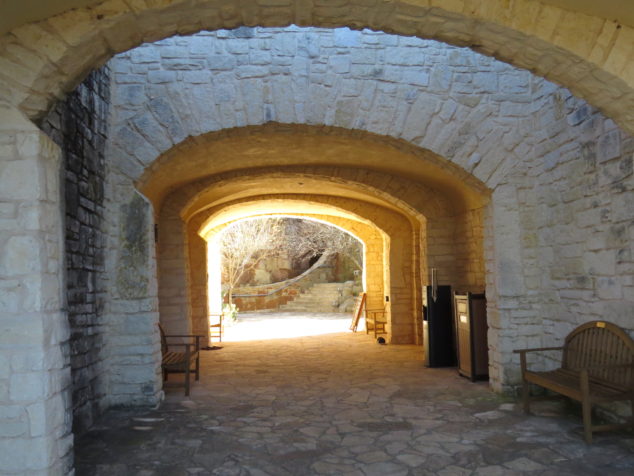
We entered the Italian villa-style building to friendly greetings and the delicious smell of freshly-baked bread. A small cafe occupied one side and a tasting room and gift shop the other. The manufacturing and bottling of the olive oil happens in the back of the building—a much smaller area than I would have guessed for processing all the olives from this orchard and a much larger orchard in southern Texas.
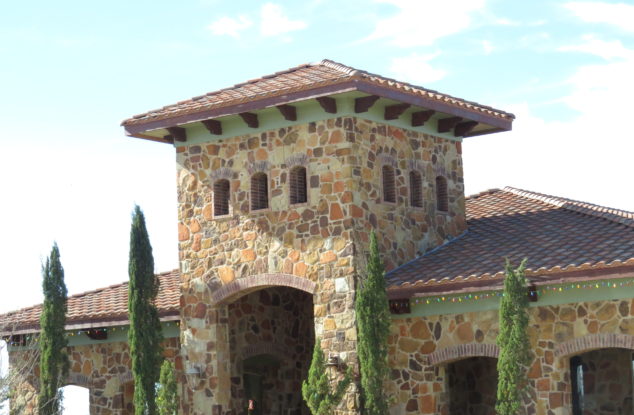
Table olives and oil olives come from different varieties of Olive trees, and olive oil has different tastes and notes depending on the variety and the processing. We were instructed to drink a small amount of five types of olive oil to discern the differences. Each gave me a tickle in the back of my throat and some made me cough—which I found out was a good thing in the world of quality olive oil! The most surprising one had an aftertaste of bananas! They also had an amazing array of balsamic vinegars that we tasted on chunks of bread—so good!
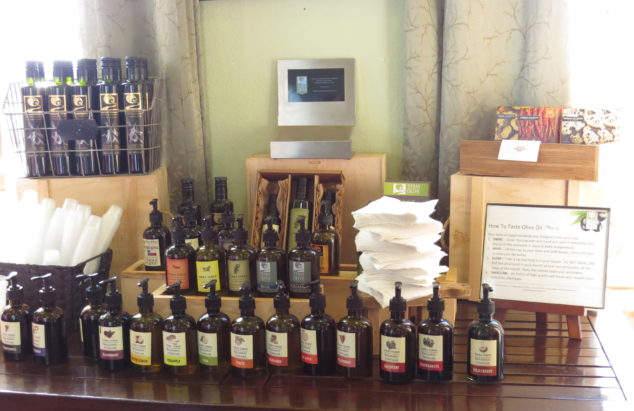
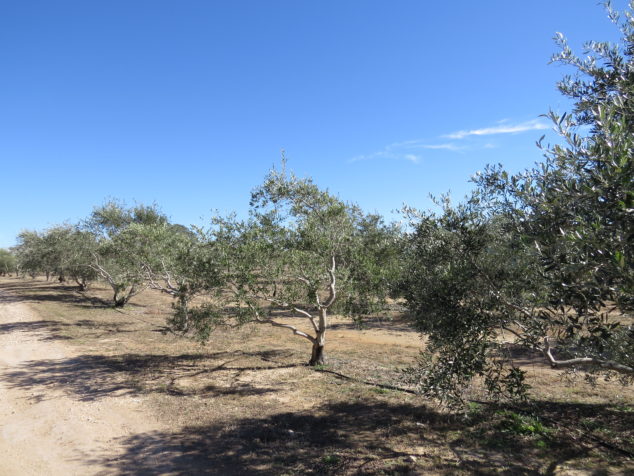
Olive trees, called the tree of eternity, grow slowly and have been cultivated for over 6,000 years. There are many sacred connotations of the Olive in the Bible, and victors of Olympic games in ancient Greece were awarded a crown of olive branches. The Olive branch is a symbol of peace and an offer of reconciliation.
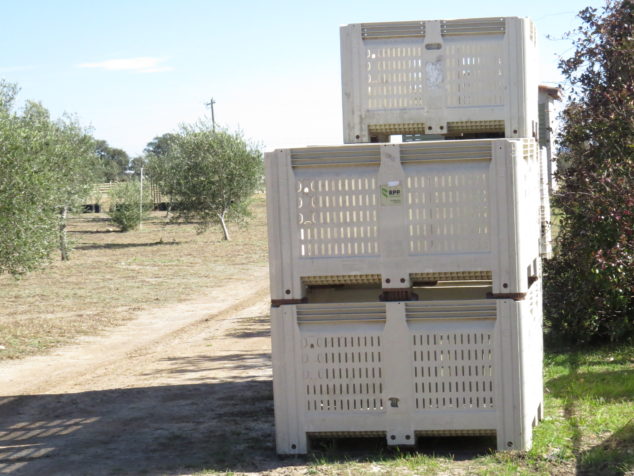
When the fruit is fully mature, nets are put under the tree, and the fruit is gently raked off the branches, then put into these crates. The fruit is too bitter to be eaten off the tree. Processing takes place quickly after harvest. Olives for oil and black table olives are dark purplish-black when mature and harvested, but table olives can be picked when immature, while they are still green. All have to be cured before eating.
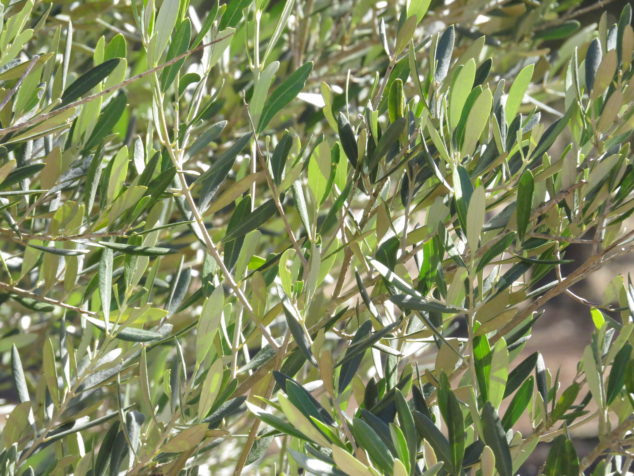
Olive trees are evergreen with leathery gray-green leaves, silvery on the underside, and can live for several hundred years. They bloom in late spring with small, white flower clusters. A tree must be fifteen to twenty years old to produce a worthwhile crop, and some will produce for hundreds of years.
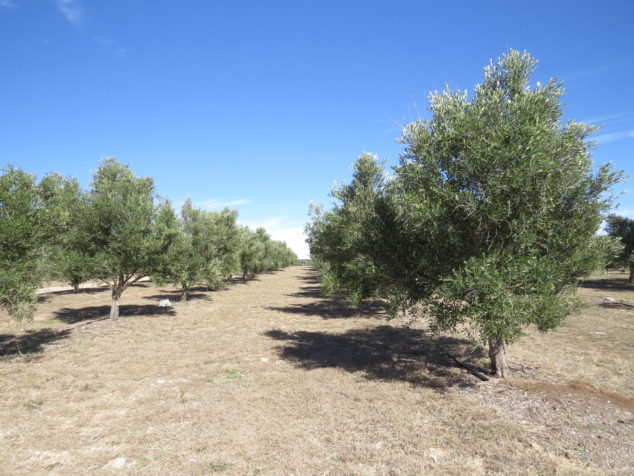
Peace puts forth her olive everywhere. –William Shakespeare
After our Olive Company tour and tasting, we rested on the veranda in the warm sun and breeze, watching the wispy clouds and talked about the next stop of our day—the brewery.

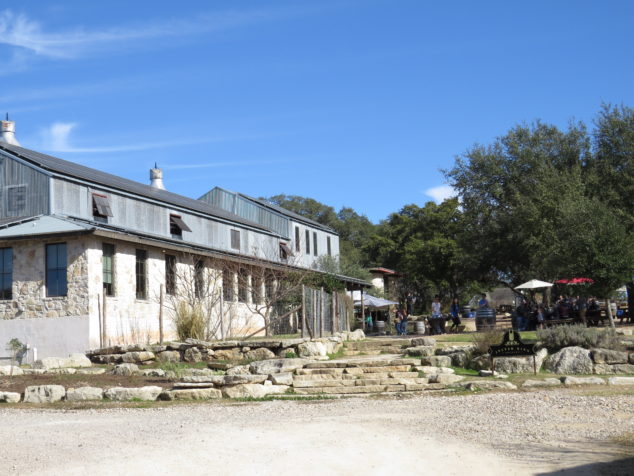
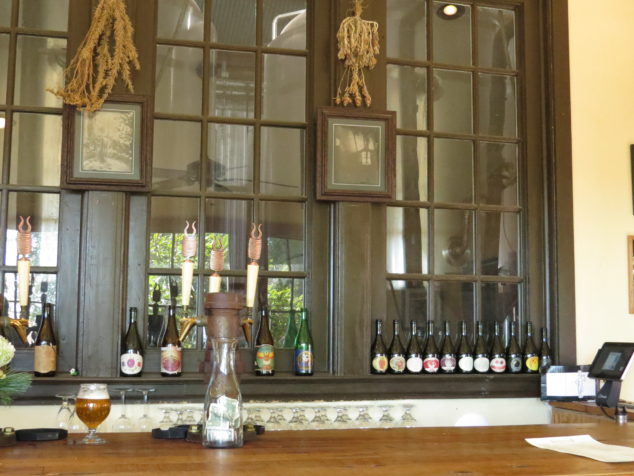
Just down the road from the Olive Company is Jester King Brewery. The limestone and tin buildings, the Live Oak trees, and the limestone walls and paths evoke a farmplace feel, and in fact, they call themselves a Farmhouse Brewery. Their farmhouse ales are a ‘product of the land,’ unique to the time of year, the plants used, and even the people who work there. They use foraged plants, local fruits and vegetables, native yeasts and bacteria, well water, and local grains. The setting at the Brewery was like we were at a backyard gathering—picnic tables under the Oak trees, yard games, live music, wood-fired pizzas and beer, kids, dogs, and grandmas.
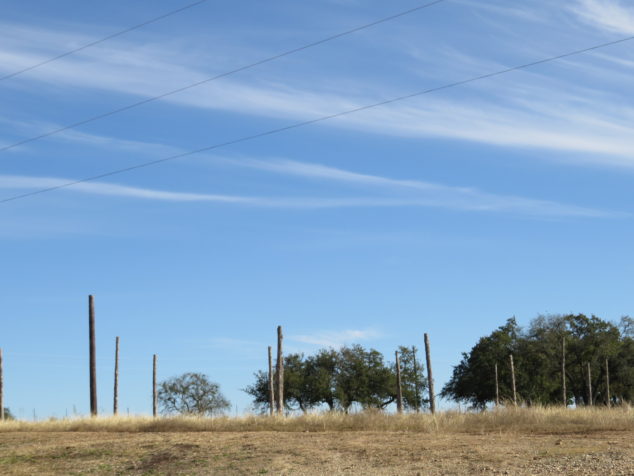
The people of Jester King Brewery embody the word ‘cultivate.’ On their 165 acres, they are working the land to grow raspberries, grapes, hops (the tall poles below is where the hops will grow), and other crops to use for their beers. They promote natural improvement of soil using cover crops and a fertilizer ‘tea’ made from old bones, aged molasses, goat manure, and beer. They culture their sour beers with airborne yeast and bacteria or cultured wild yeast and bacteria from local plants. They give brewery and farm tours to share their knowledge and passion for producing beer in an organic and unique way.
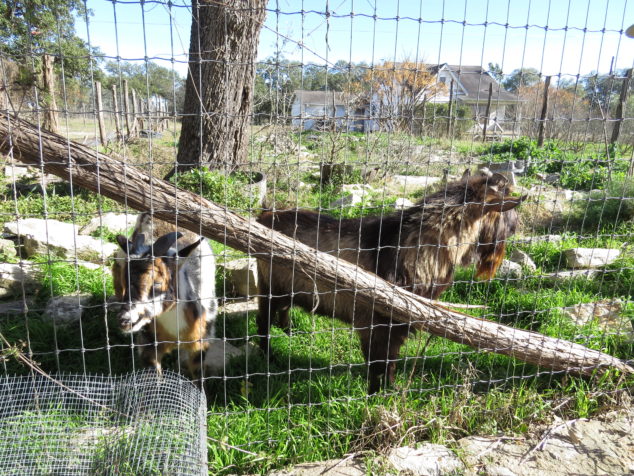
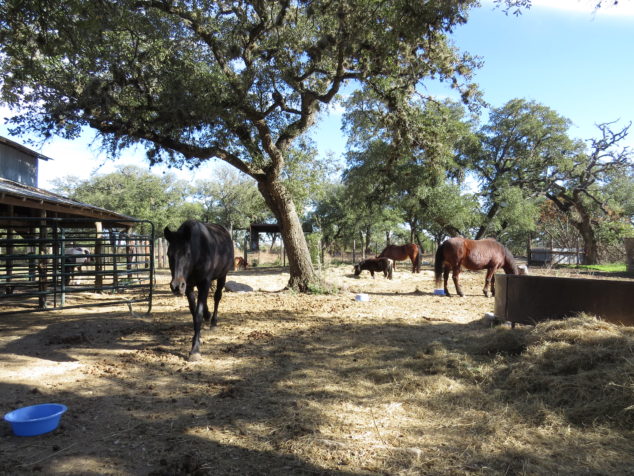
We had such an interesting day learning about the cultivation of olives and beer-making crops and the process of making olive oil and farmhouse ales. It was evident how both family-run businesses cared deeply for the land, the trees and crops, the process by which they produced their product, and the experience of the people who came to share in their livelihood. It was a labor of love and love of the labor and attention to their craft. Both places were peaceful, where we felt at home in their world, where time slowed and worries melted away. An oasis of sorts, where we were away from the news of the day, the rancor of them vs us, and the ever-present, pervasive pull of the screen. So what kind of place do we cultivate in our day-to-day lives? What do we care for? What do we give our labor and attention to? How do we promote growth and development of ourselves and others? What kind of culture is fermenting in our hearts? How do we promote peace? We each have the responsibility to cultivate our own lives and to be in community with those around us. What does the farmplace of your life look and feel like?
Hope and Renewal After the Fire
There have been more than a few times in my life when I felt like I was in a burning house—that feeling of helplessness, of betrayal, of feeling stuck in a room of flames. And even more times when I felt like I was sleepwalking, wandering too close to the fire without even knowing the danger. Perhaps that is life and what we are here to do—“to take what’s lost and broke and make it right.”*
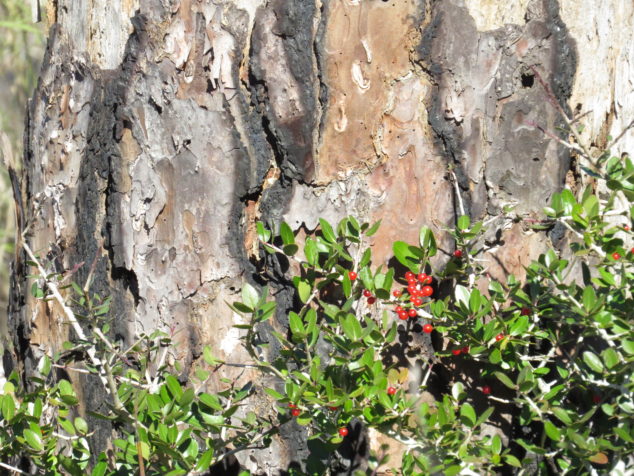
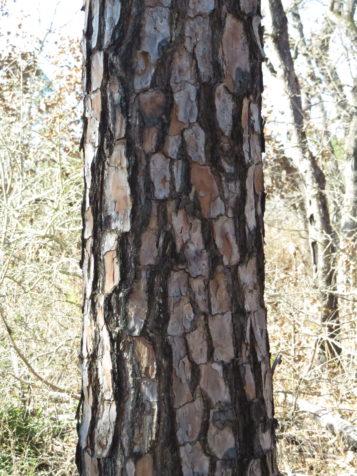
It was shocking to see the devastation from the Bastrop Complex Fire of 2011 at Bastrop State Park in Texas—I can’t imagine what it was like just after the fire. Yet, in the midst of the ruins from the fire were signs of resilience, new growth, and renewal. Cheery red yaupon berries nestled among shiny green leaves contrasted with the burnt black bark of a Loblolly Pine tree.
In one fertile area of our hike, the new Pines were swiftly growing under the tall ghost trees that hadn’t survived the fire and one that had. It was already looking ‘forest-like’ in this part of the park.
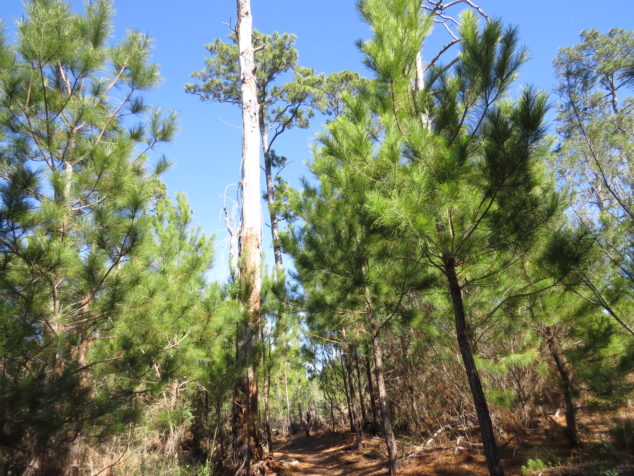
Along with the devastation was the hopeful new growth of Pines and Oaks.
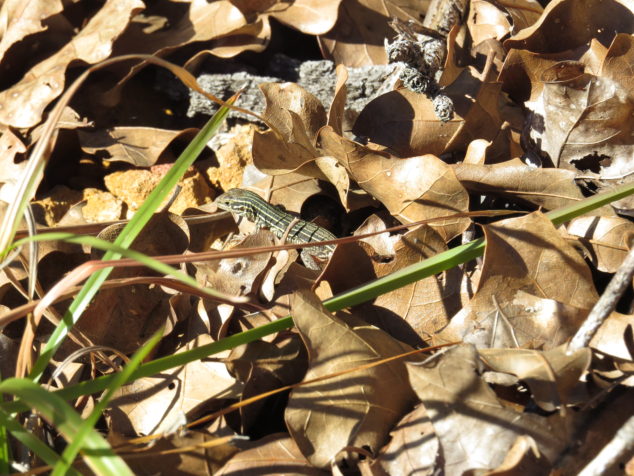
The December day was warm and sunny, perfect for hikers and a little lizard crawling through the fallen leaves.
Replanting of the drought-hardy Loblolly Pines began in January 2013. Volunteers and contractors have planted two million pine seedlings since that time and will continue to plant in order to get a “mosaic of tree ages” as the forest re-grows.
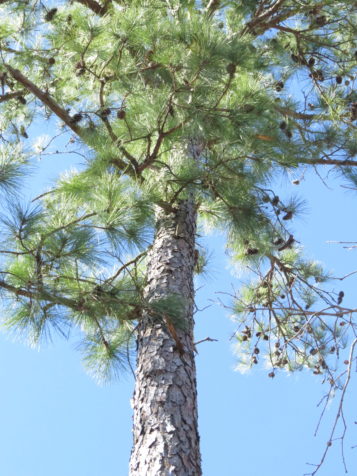
This bright, tight growth of young pines probably originated from the fallen cones (seeds) of these survivors. Often a threatened tree will produce an inordinate number of seeds to compensate for loss or potential loss of mature trees.
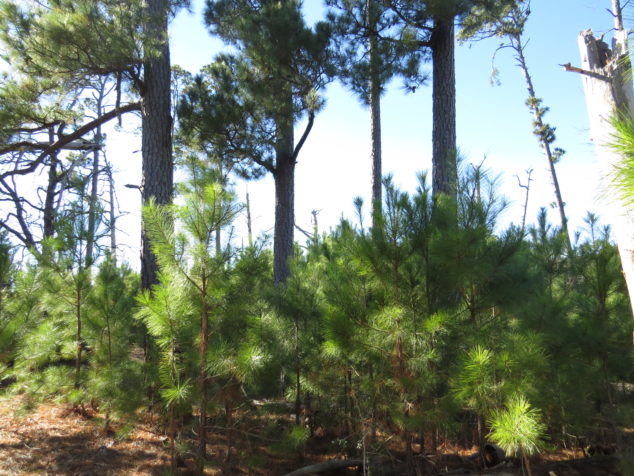
I admired these two survivors and wondered what had saved them from the mighty flames of the wildfire. How were they spared?
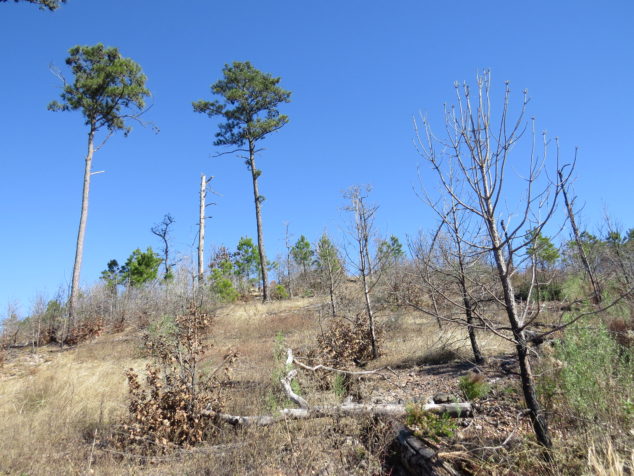
Another tall survivor obviously sustained damage, but had a crown full of healthy needles and seed-laden cones.
A striking visual in the flooded valley (four years after the wildfire) was the color of the winter grasses. One of the ongoing ways to curb erosion in the park after the fire was the application of a hydromulch—a slurry of straw, water, and native grass seed. Normally these grasses would not grow in the shade of a forest, but they will stabilize the soil while the trees and native understory grow to repopulate the forest.
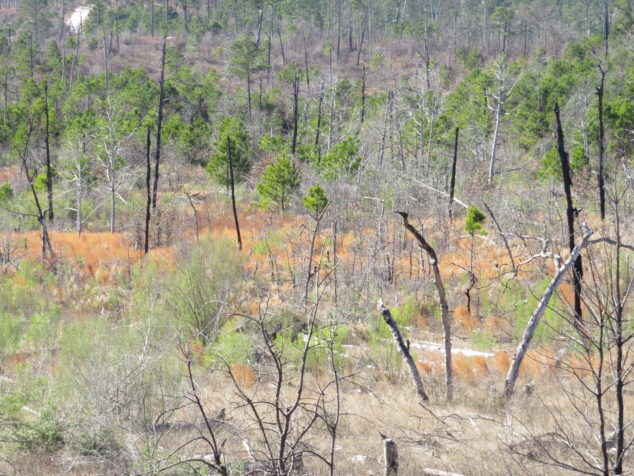
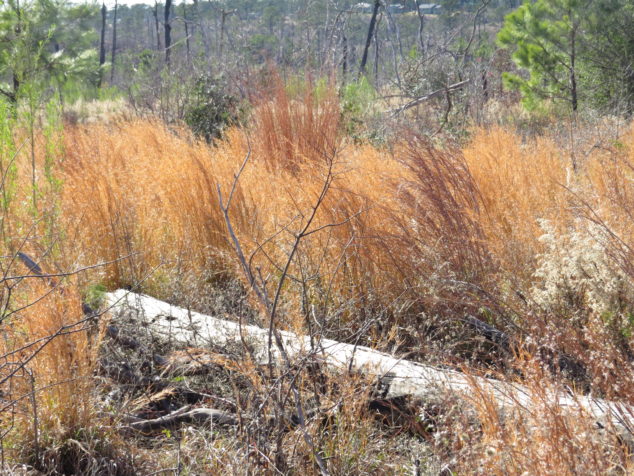
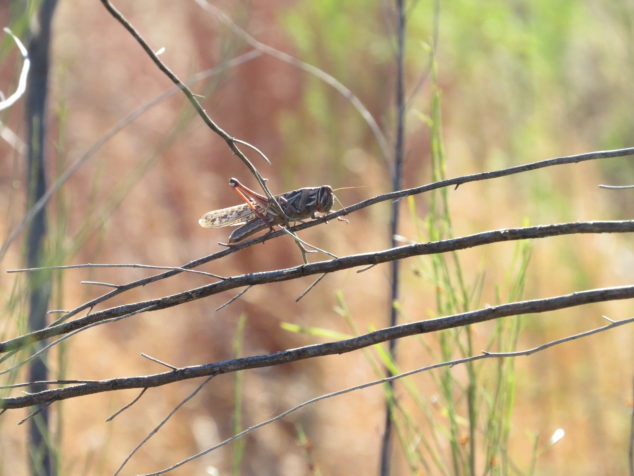
I caught a glimpse of a grasshopper in the grassy valley.
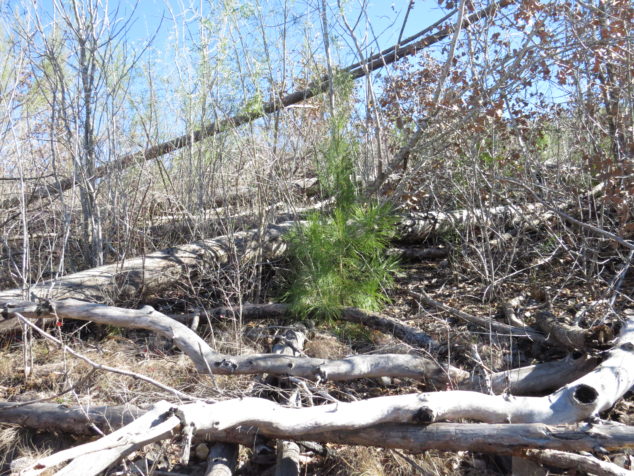
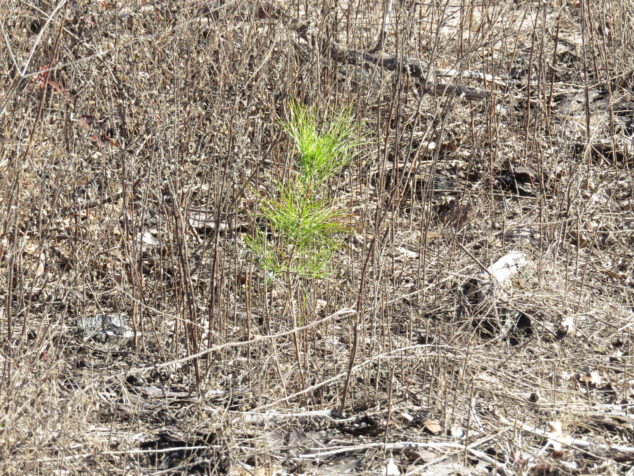
Even after the repeated devastation of fire and flood, pine seedlings were growing in the desolation.
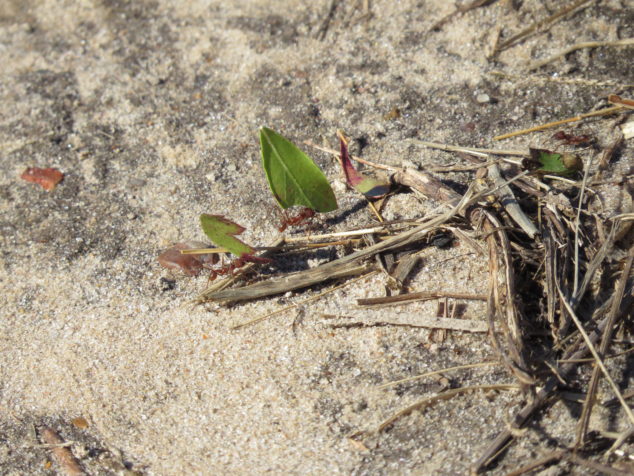
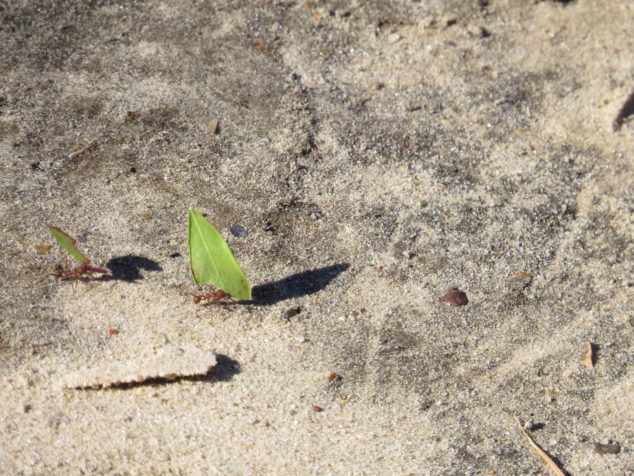
One of the most interesting things we saw on our hike—that could easily have been missed if I wasn’t looking down—was a trail of ants carrying yaupon leaves. The hiking trail was sandy and wide, so the line of green leaves, like sails on little red ships, readily stood out in the afternoon sun. These are Texas Leaf-cutting ants, native to East Texas. They collect plant material to bring back to their colony in order to build a fungi farm. This fungi is their only known source of food. Colonies house up to two million ants, so they can be extremely destructive to pine seedlings, citrus plants, agricultural crops, and landscape ornamentals. They can strip a small to medium tree overnight! The line of ants and leaves was as far as I could see on both sides of the trail.
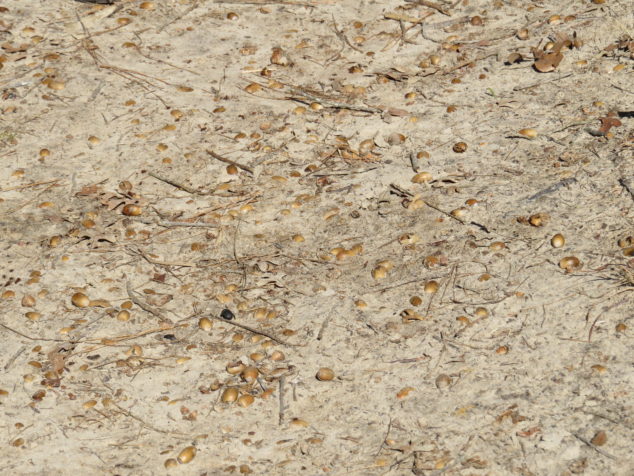
We hiked through an section of the park that was not so intensively damaged by the fire—many scorched trees were still alive. There were more Oak trees in this hillside area, and the path was strewn with acorns—food for the animals being re-established in the park and potential trees for the future.
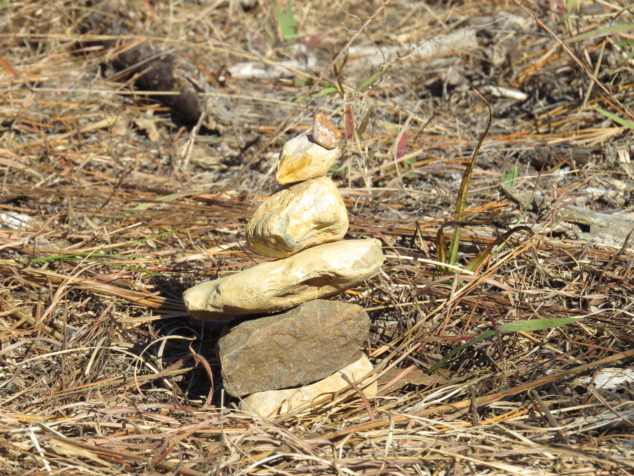
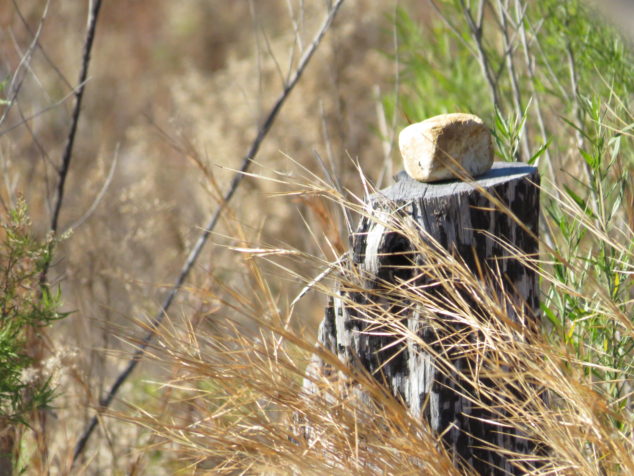
Someone had built a rock cairn along the trail. Many are used for ornamental purposes nowadays, but at one time, they were markers for navigation or memorial purposes. Many remote hiking trails rely on cairns to mark which way the hiker should go, and many indigenous, sacred sites are marked with cairns. Rock balancing art has its place, but many agree that it goes against the principle of Leave No Trace.
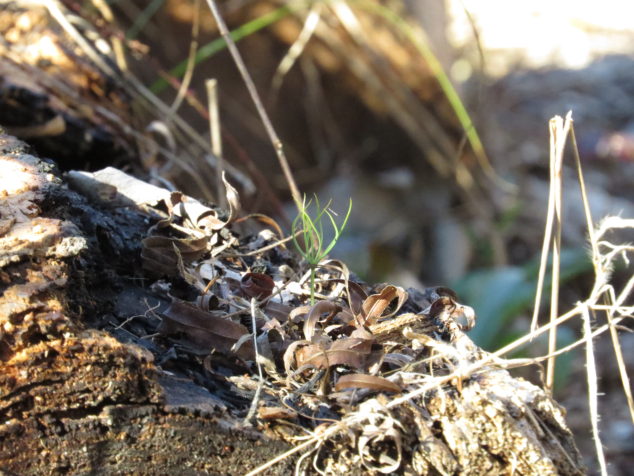
One of the loveliest signs of hope was a teeny tiny pine seedling growing in the debris of a fallen log. Nature is the master of re-birth.
In the burning houses of our lives, how do we take the lost parts, the broken parts, the parts that keep us up at night and make them right? How do we stop walking so close to the dangerous flames, even when it feels like the only thing we know how to do? The aftermath can be devastating. In the midst of the ruins, we are in shock, in disbelief. How in God’s name did this happen? In our disorientation, we may notice the survivors, the ones still standing. The survivors sustained damage, too, but for some reason they are more resilient, and they are the beacons of hope. It is the survivors and the empathetic helpers and the paid professionals who can work together to hold back the erosion of despair and plant the new seeds necessary for renewal. We need a helping hand while we re-group and gather our wits and our strength. We need cairns of caring people to honor what we have been through and show us the way to new growth and new life. Nature (and Nature in us) is the master of re-birth, and we (and Mother Nature) need a helping hand in the aftermath of devastation—that’s how we make it right.
*from ‘Burning House’ by Jeff Bhasker, Tyler Johnson, and Cameron Ochs
The Burning Houses of Our Lives
I was mindlessly mowing on the John Deere a couple summers ago, listening to subpar country music on the headphones, when a song came on that instantly caught my attention. It was haunting and beautiful, so unlike everything I had been listening to. The song was ‘Burning House,’ and the singer was Camaron Ochs, known simply as Cam. The song was written based on a dream she had had about a former boyfriend and how guilty she felt by the way she had treated him.
“I had a dream about a burning house/ you were stuck inside/ I couldn’t get you out/ I lay beside you and pulled you close/ And the two of us went up in smoke”
During our December trip to Texas, we hiked through Bastrop State Park which had gone up in smoke on September 4, 2011, after months of drought and excessive heat. It was the most destructive wildfire in state history, burning 32,400 acres, killing two people, and destroying 1,696 homes and businesses. Ninety-six percent of Bastrop State Park was affected by the wildfire with thirty percent being intensely burned.
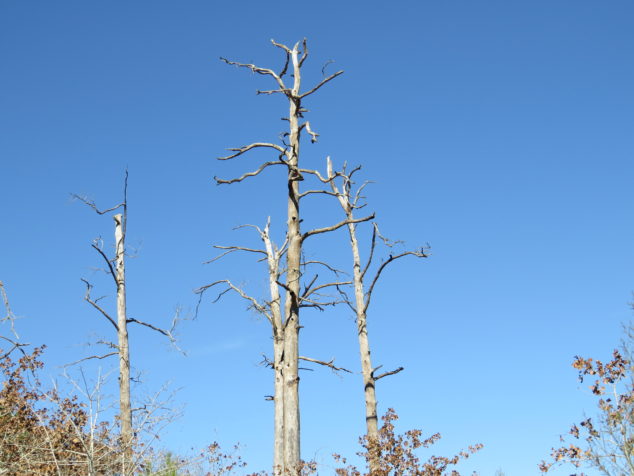
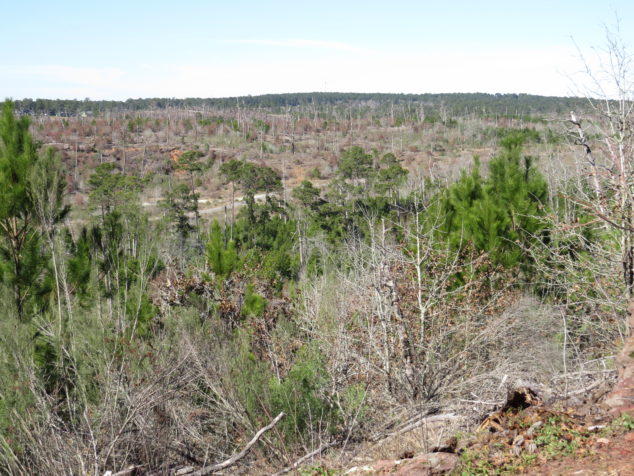
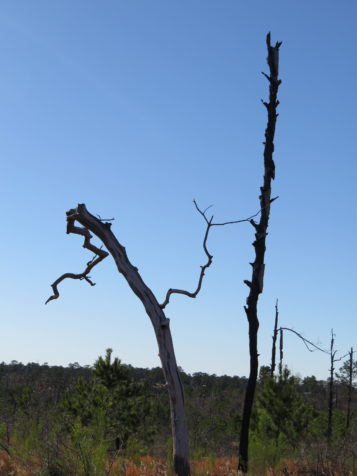
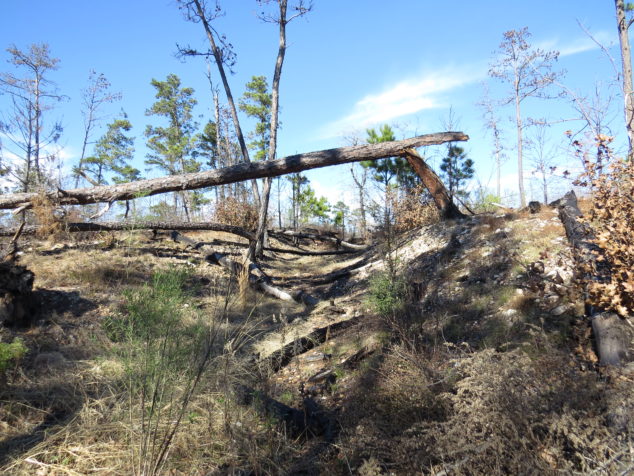
The Bastrop area is part of the Lost Pines ecosystem, the western most area of the United States where Loblolly Pines have grown for over 18,000 years. Seven years after the fire, the destruction was still so evident—the missing trees, the standing ‘ghost’ trees, the charred wood, and the fallen logs.
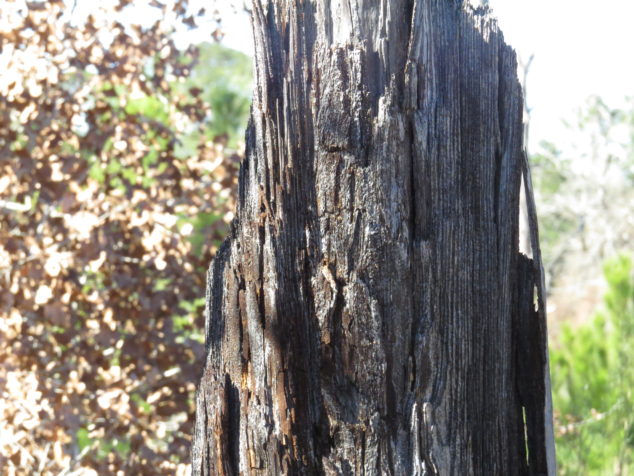
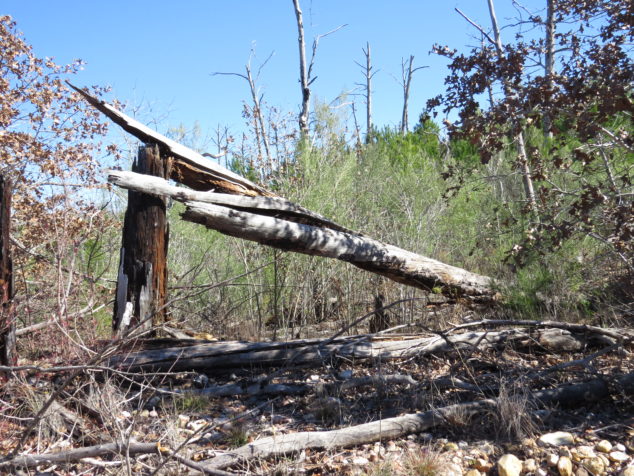
Fire kills trees in two ways: by destroying the cambium or living tissue layer that is under the protective bark or by consuming or damaging the needles, leaves, or buds. Ponderosa Pines and Western Larch are the most hardy trees when it comes to surviving a wildfire, which is dependent on the speed and intensity of the fire.
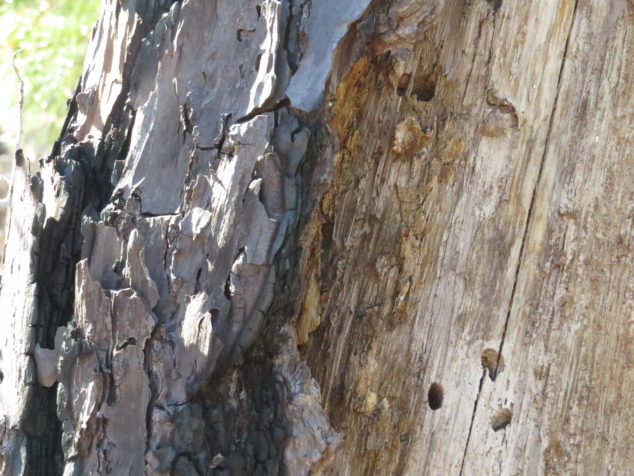
The 2011 Bastrop Complex Wildfire burned for 55 days.
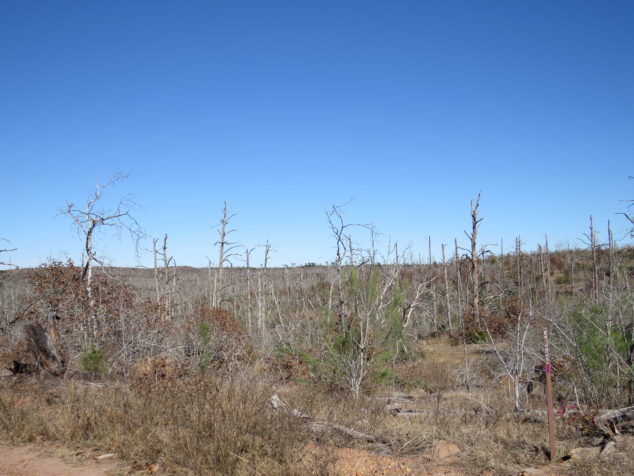
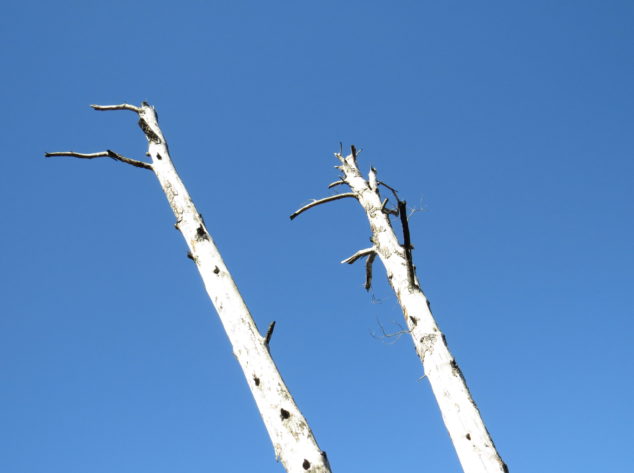
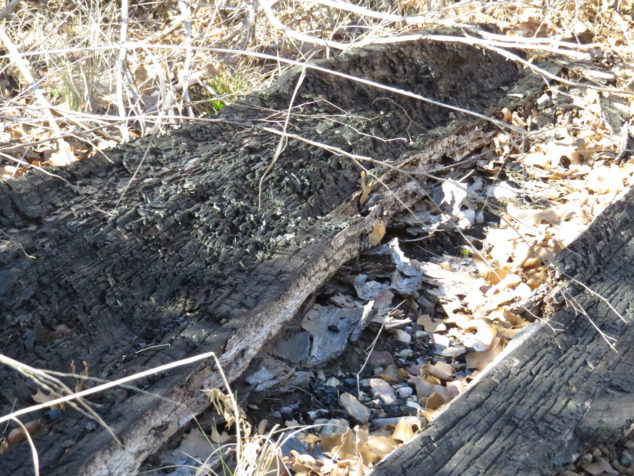
This photo shows the various levels of damage, and the ridge gives us a visual of what the area previously looked like before the fire.
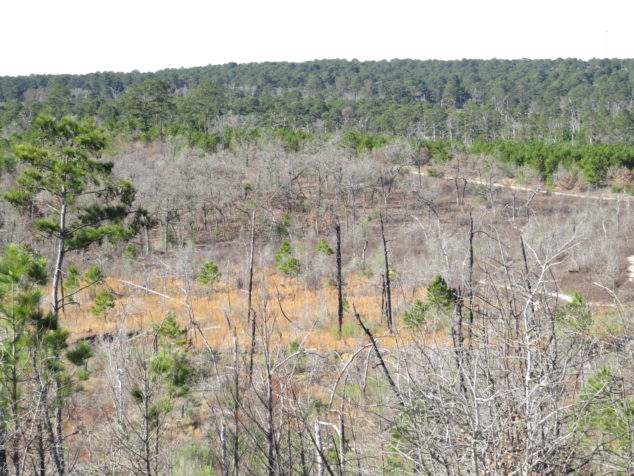
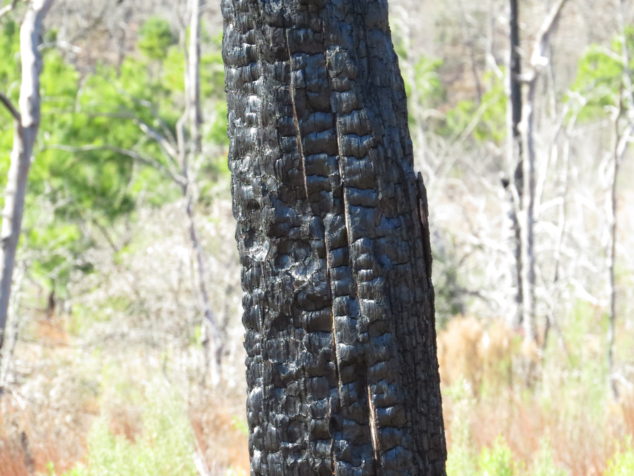
Another fire swept through the area in the fall of 2015—the Hidden Pines Fire. We drove through that smoke-filled air when we went to Austin for our daughter’s wedding that October. Eyeliner-black tree trunks define the destruction.
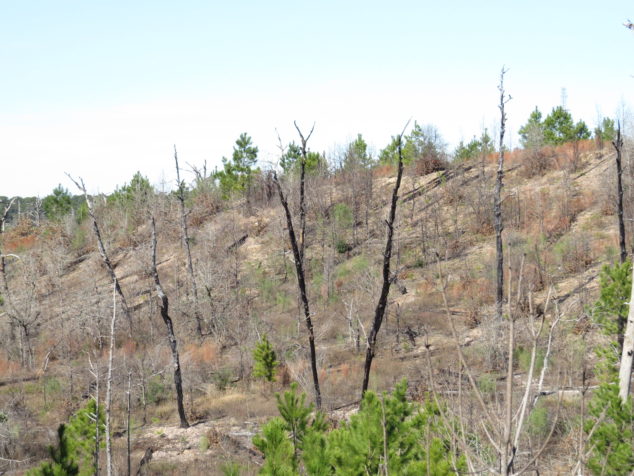
“I’ve been sleep walking/ Been wondering all night/ Trying to take what’s lost and broke/ And make it right”
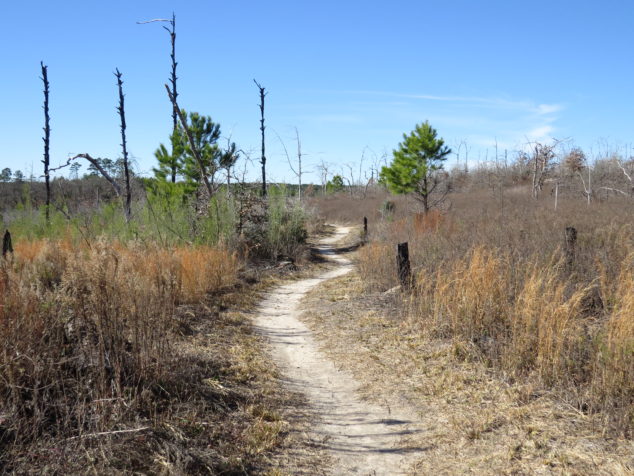
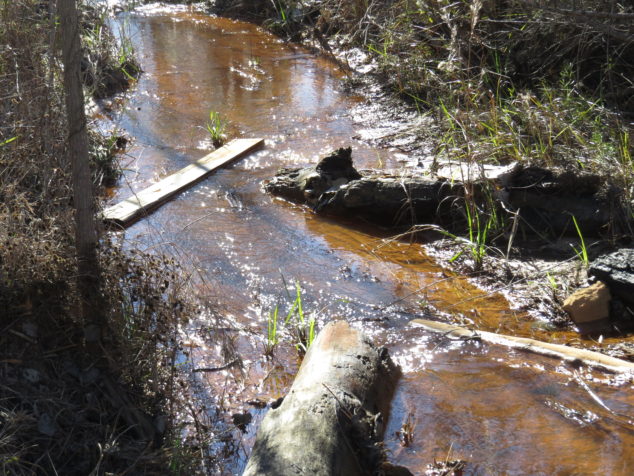
To add insult to injury, on Memorial Day, 2015, after excessive rains, a dam on a 10-acre lake in the park failed and flooded this low-lying area.
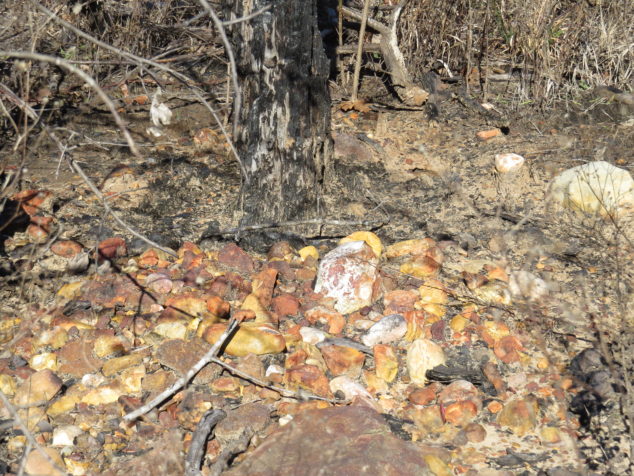
We saw burnt trees that had acted like a snow fence, causing the roaring flood waters to dump the rocks on the downside of the tree. (Erosion is an ongoing problem in the park as it tries to reestablish the lost forest.)
“Wish that we could go back in time/ I’d be the one you thought you’d find”
The Bastrop Fire of 2011 and the preceding drought was devastating for the park and surrounding community. Trees that had taken multiple decades to grow were gone in a flash of fire. Homes and businesses—gone. Like the wildfires in California and other places around the world. Hiking through the park on that warm December day was a bit haunting—the evidence of what once was stood stark against the blue sky, and the loss was a reality hard to grasp. Even after seven years. Just like the burning houses of our lives. We find ourselves, or put ourselves, in a place that is going up in flames—guilt licks at our ankles, confusion fuels the fire, indifference smothers the air from our lungs. “I’ve been sleepwalking/ Too close to the fire” Our protective bark is breached, and the fire gets to our living tissue and causes us pain and death of what once was. We wish we could go back in time, but everything has changed.
On Friday, sixteen-year-old Greta Thunberg spoke at the World Economic Forum in Davos, Switzerland about Climate Change. She said, “But I don’t want your hope….I want you to act as you would in a crisis. I want you to act as if the house is on fire, because it is.”
We’ve been sleepwalking—in the living emotional areas of our lives, in the political and financial arenas of the world, and in the very real existential crisis that we face with climate change. How do we take what’s lost and broke and make it right?
‘Burning House’ lyrics written by Jeff Bhasker, Tyler Johnson, and Camaron Ochs
The Influencer and Her Dreams
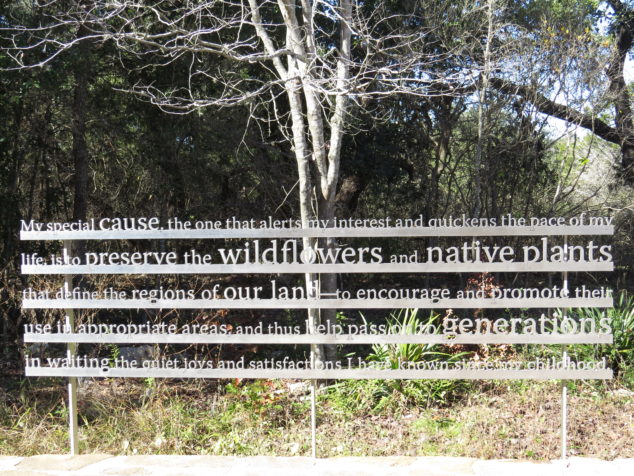
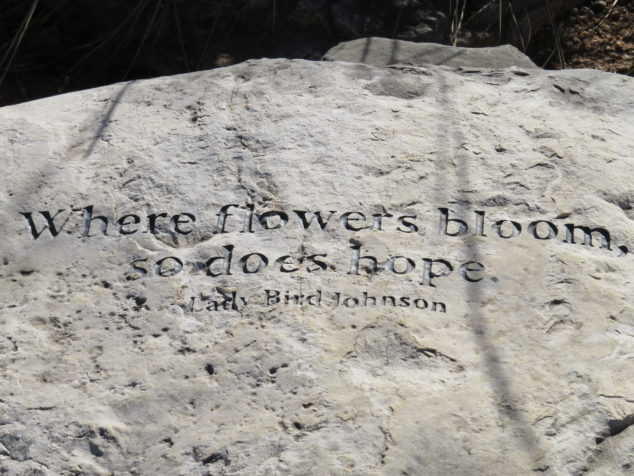
My special cause, the one that alerts my interest and quickens the pace of my life, is to preserve the wildflowers and native plants that define the regions of our land—to encourage and promote their use in appropriate areas, and thus help pass on to generations in waiting the quiet joys and satisfactions I have known since my childhood. –Lady Bird Johnson
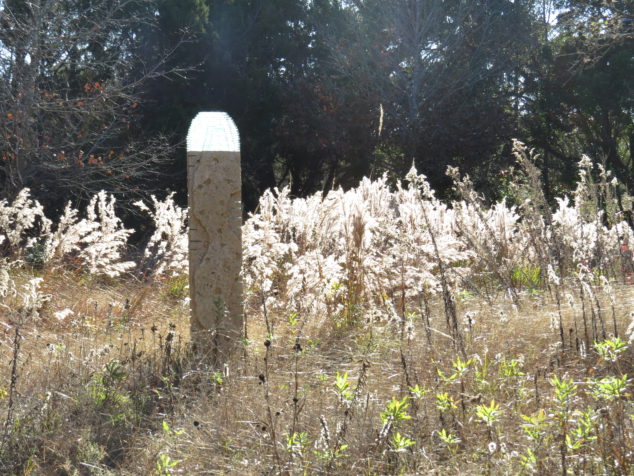
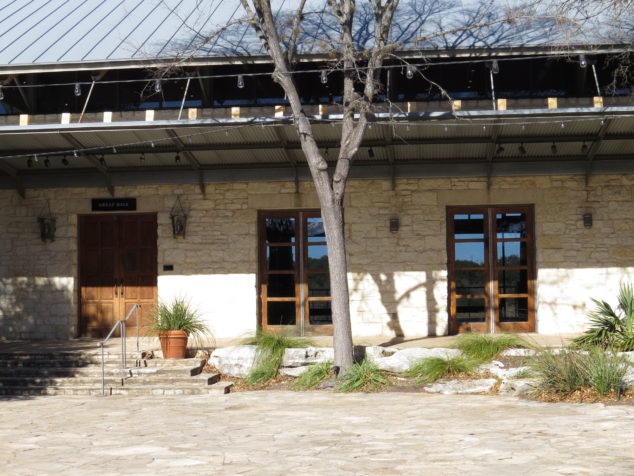
Lady Bird Johnson, wife of our 36th President Lyndon B. Johnson, along with actress Helen Hayes founded the National Wildflower Research Center in 1982 on 60 acres of land in East Austin, Texas. It moved to its present location in southwest Austin in 1995 and now includes 284 acres of native trees and plants, Texas architecture, a family garden dedicated to nature play for children, and thousands of species of insects, butterflies, birds, and mammals. It also has numerous art installations like this rock and glass sculpture glowing in the sunlight in front of luminous grasses.
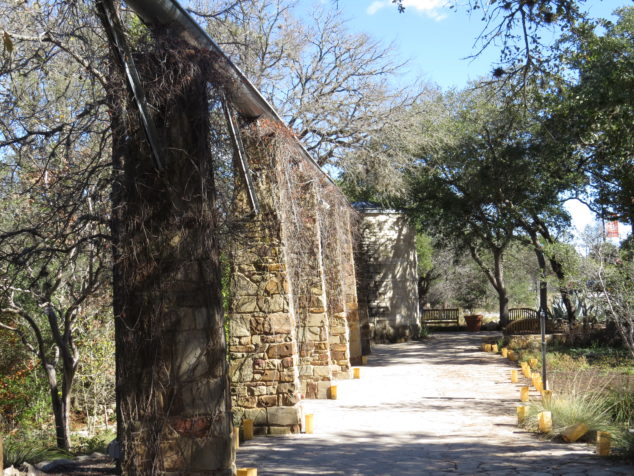
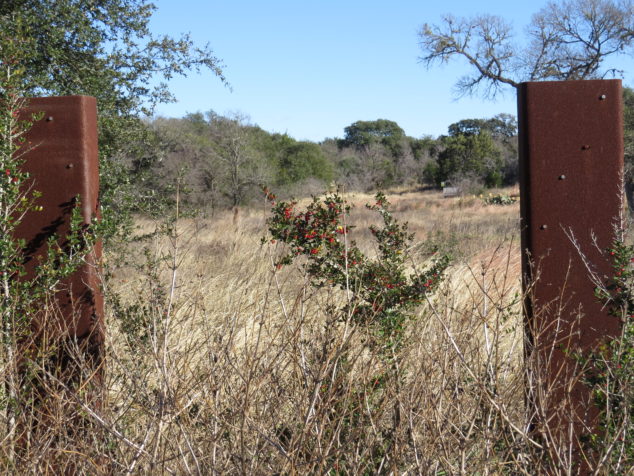
The Wildflower Center has a rain collection system that is capable of storing 68,500 gallons of water! Rock pillars have an aqueduct on top to bring rainwater to the round cistern at the entrance.
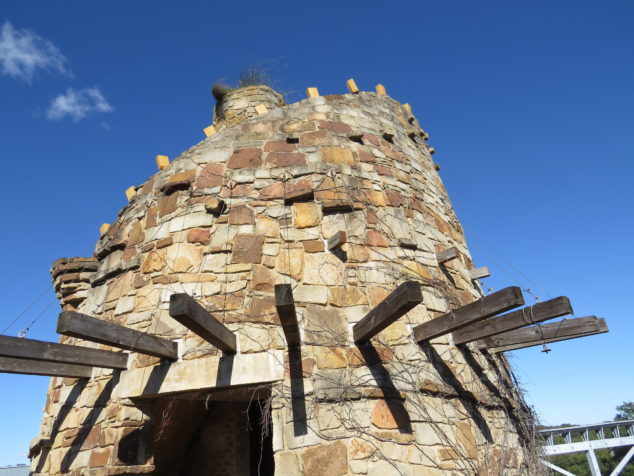
We climbed the Observation Tower, a brown sandstone landmark that offers spectacular views from the top, a seating area midway up with green roof, and is itself a 5,000-gallon rainwater cistern.
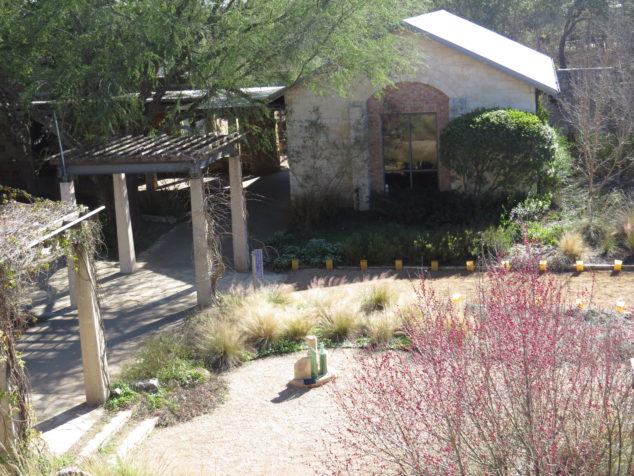
The Woodland Garden—and many other areas of the Center—was lined with luminaries for their winter light festival.
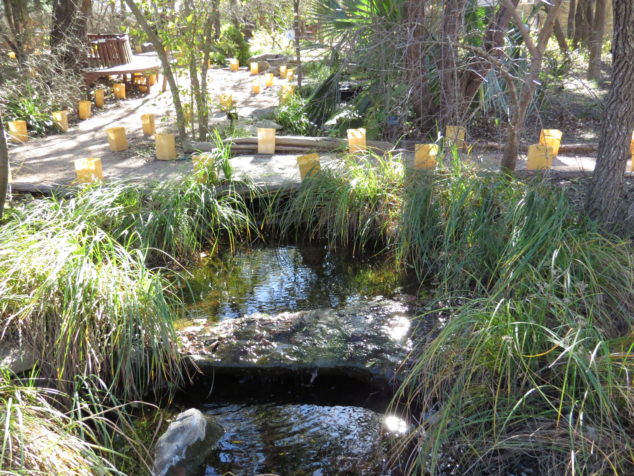
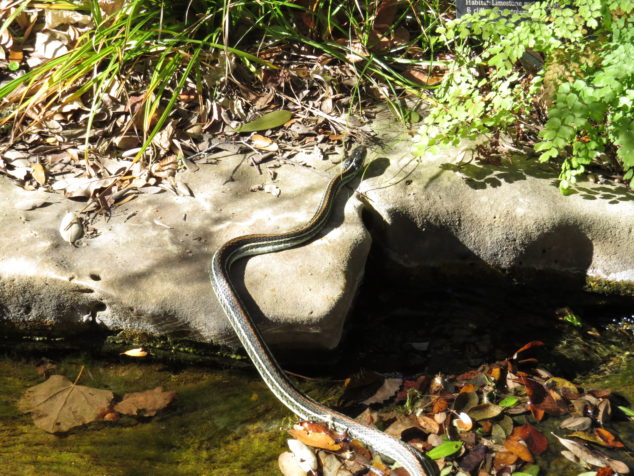
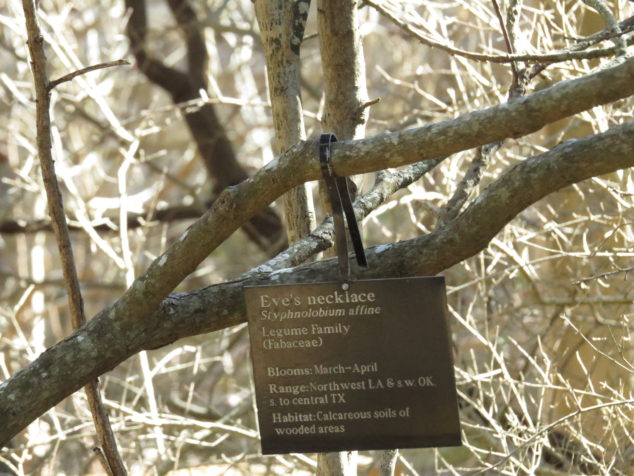
As we followed the stream, Emily noticed a snake slithering alongside of us. He crossed the stream to the other side, and then I noticed the name of the tree he crawled under: Eve’s Necklace, a small tree with compound leaves, clusters of pink pea-like flowers, and fruits of a slender string of shiny, black beads that contain the seeds.
The environment is where we all meet; where we all have a mutual interest; it is the one thing all of us share. It is not only a mirror of ourselves, but a focusing lens on what we can become. –Lady Bird Johnson
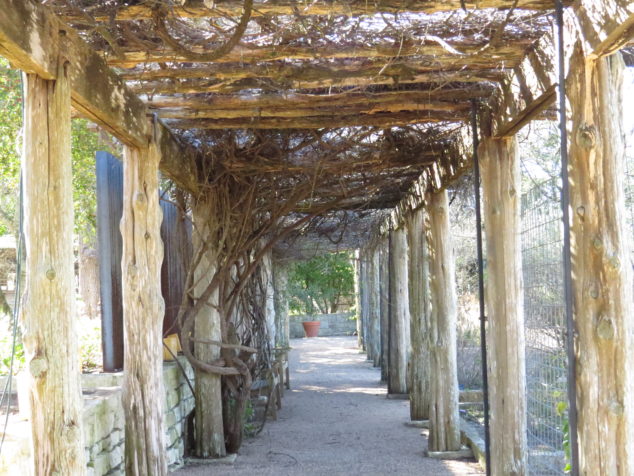
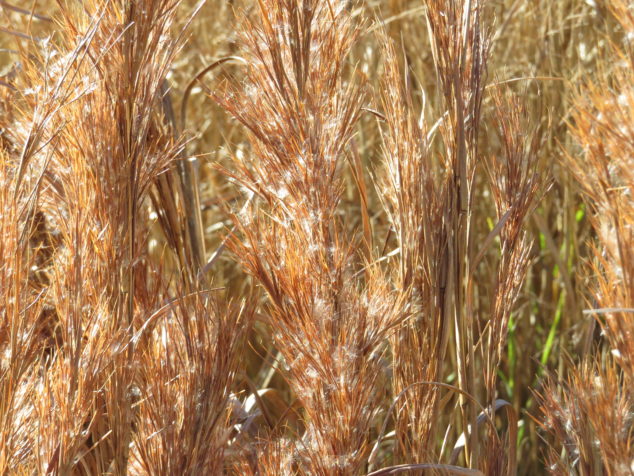
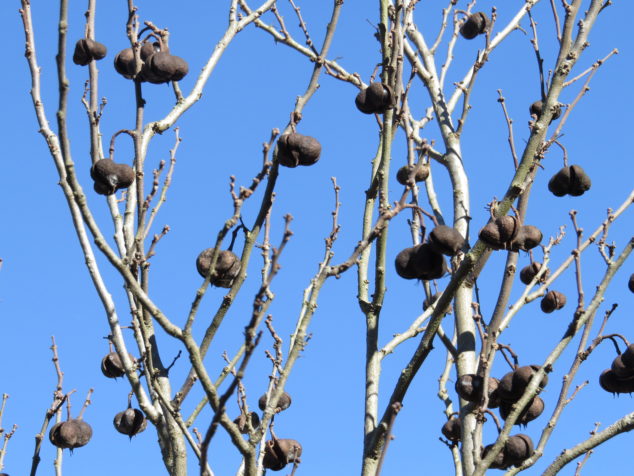
We marveled at all the structures and fences that were made from cedar posts and poles and at the trees and plants that were so unfamiliar to us. We came across some Texas versions of familiar species—Bushy Bluestem and Mexican Buckeye.
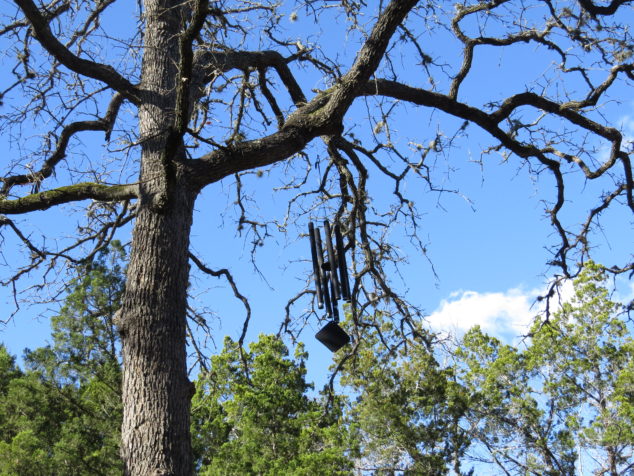
As we entered the Woodland Trail, we heard chimes long before we saw where the sound was coming from. It was a windy day, so the music in the woods was loud and boisterous! Three or four trees along the trail had the large wind chimes dangling from their bare branches.
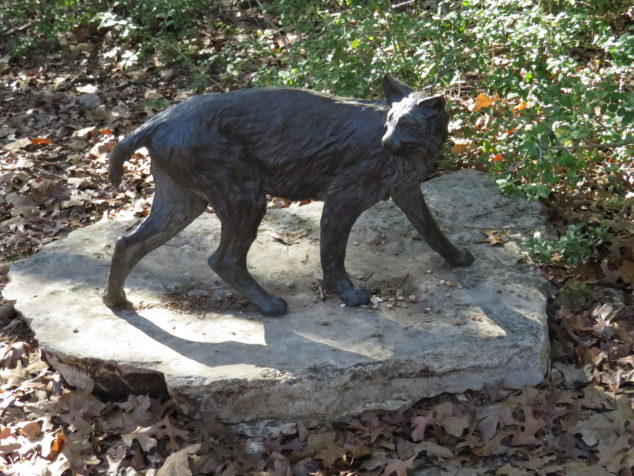
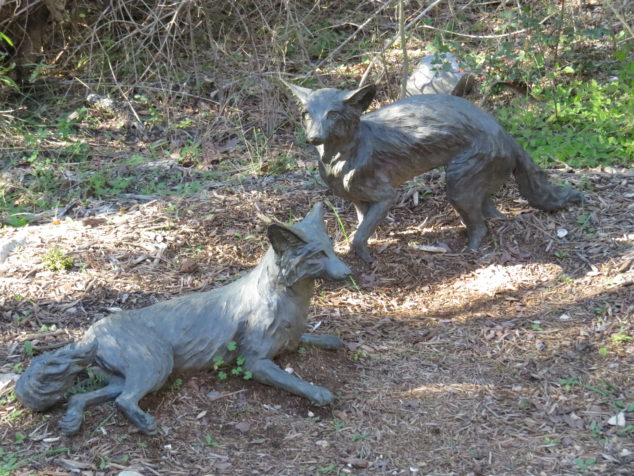
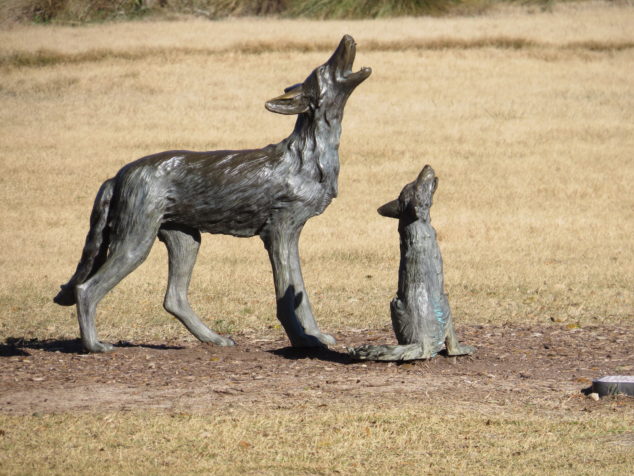
Sculptures of woodland creatures lined the trail, almost as surprising as if we had met a live one.
My heart found its home long ago in the beauty, mystery, order and disorder of the flowering earth. –Lady Bird Johnson
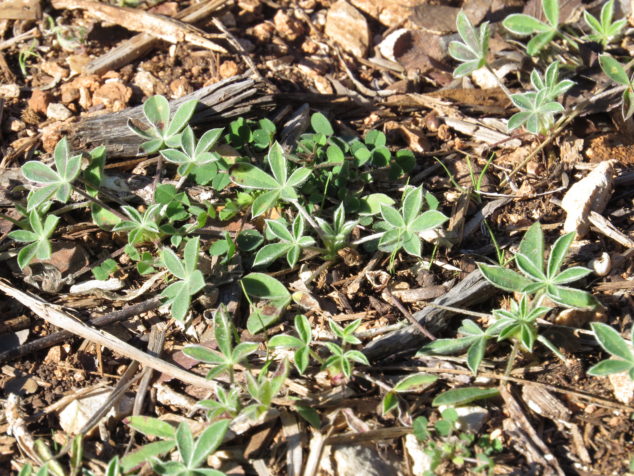
Lady Bird Johnson grew up in East Texas but was captivated by the fields of Bluebonnets she saw when she flew to Austin in 1930—and by the tall Texan named Lyndon Johnson. Seedling Bluebonnets grew all along the trail—what a spectacular sight they must be in the spring!
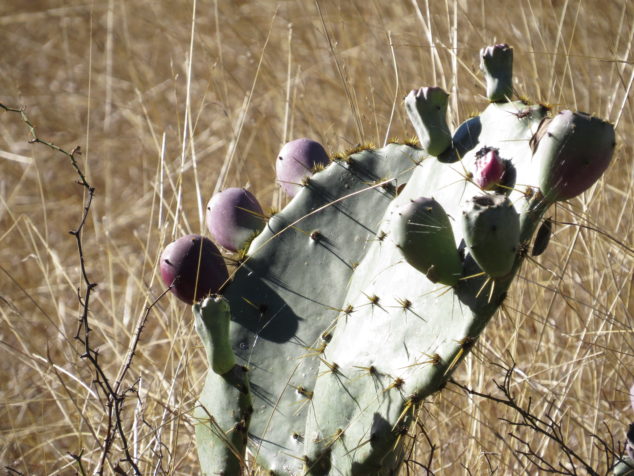
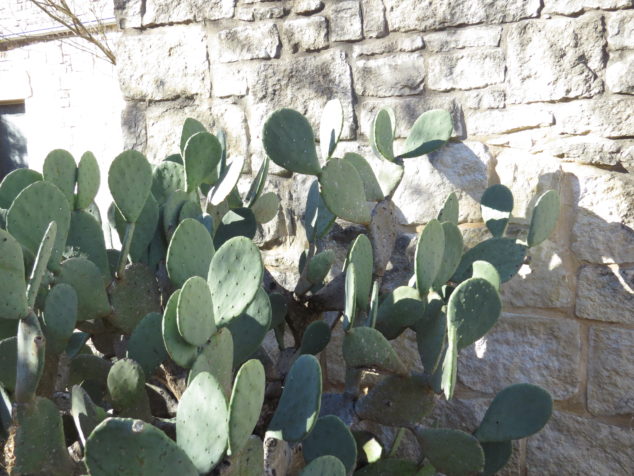
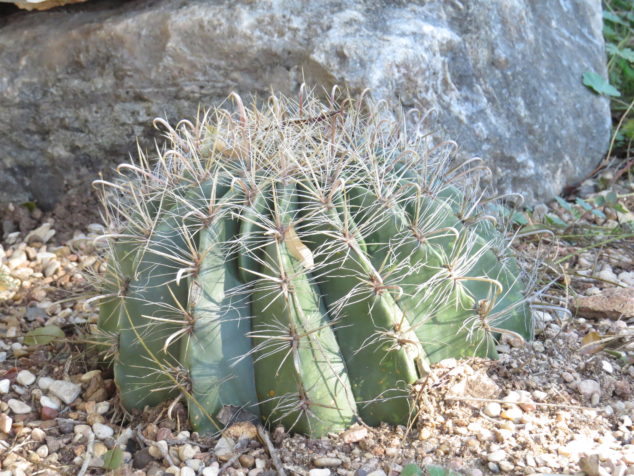
Prickly Pear cactus is everywhere in and around Austin—the wild, spiny kind with bulbous red fruits and the spineless, landscape varieties.
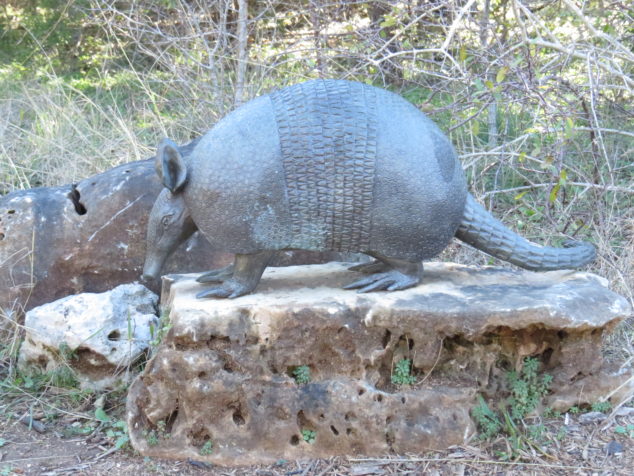
Hello, Armadillo! (Would love to see one ‘in person.’)
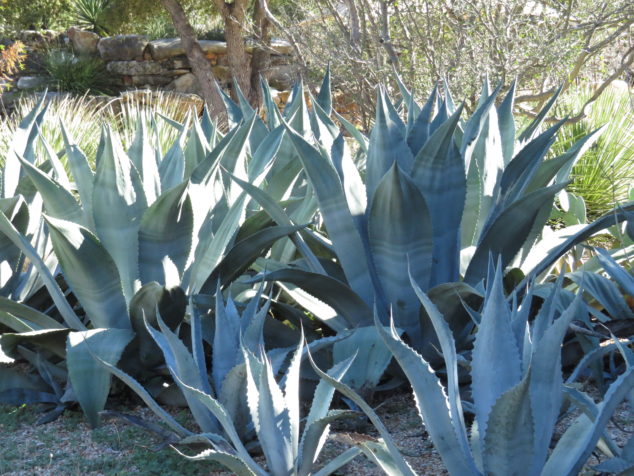
I loved the Century Plants!
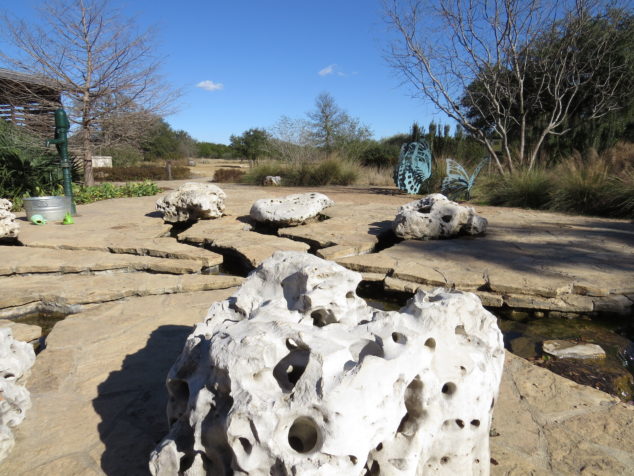
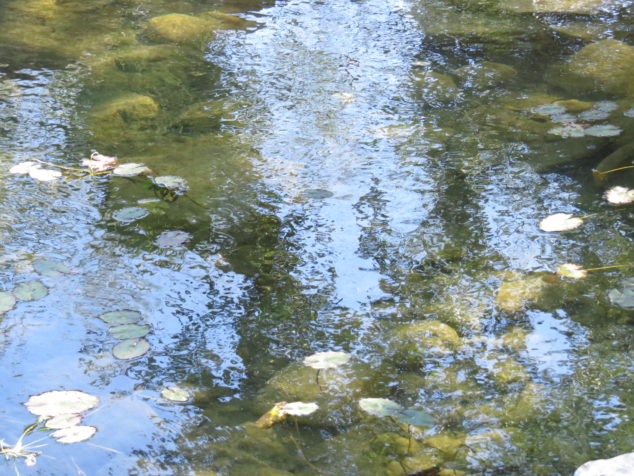
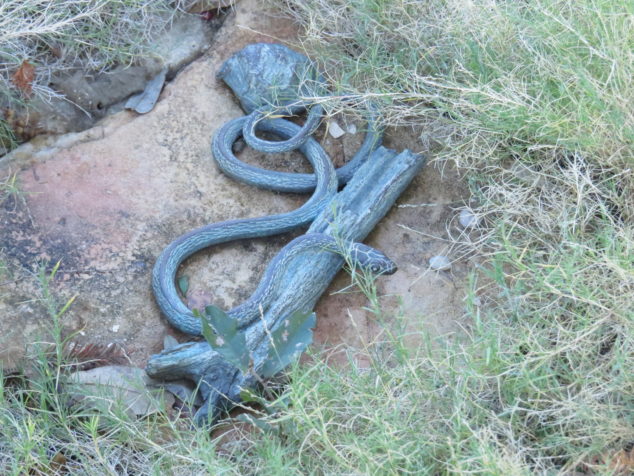
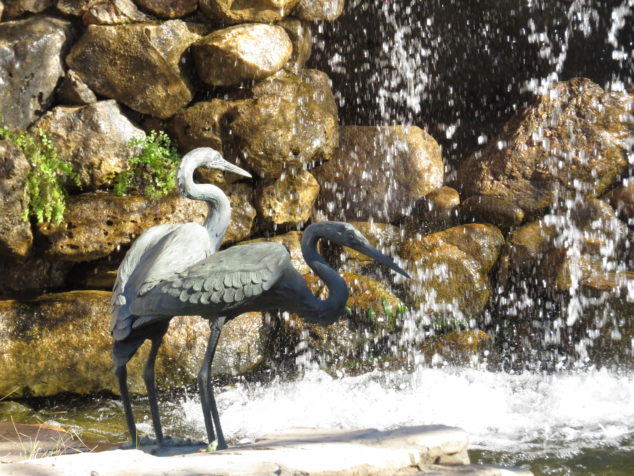
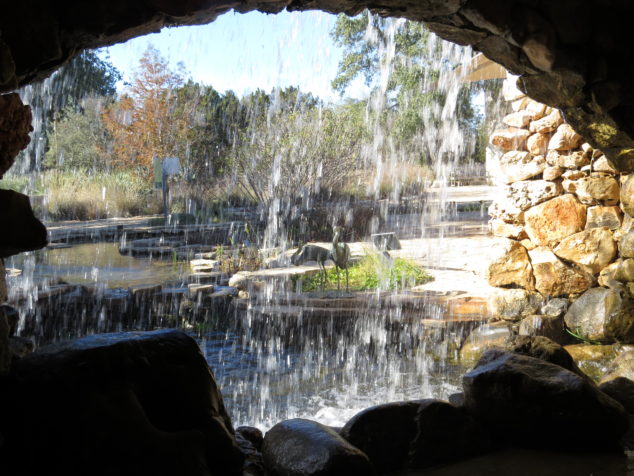
Dinosaur Creek flowed from a waterfall and pond to these tributaries.
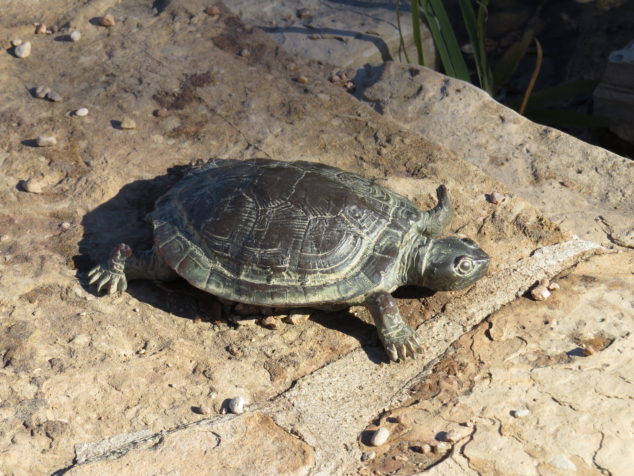
Children are likely to live up to what you believe of them. –Lady Bird Johnson
The children’s nature play area was fun and adventurous—we didn’t see many children since it was a school day, so we explored by our adult selves.
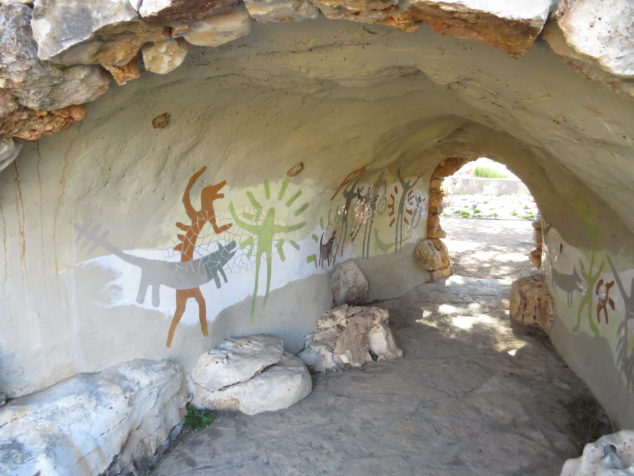
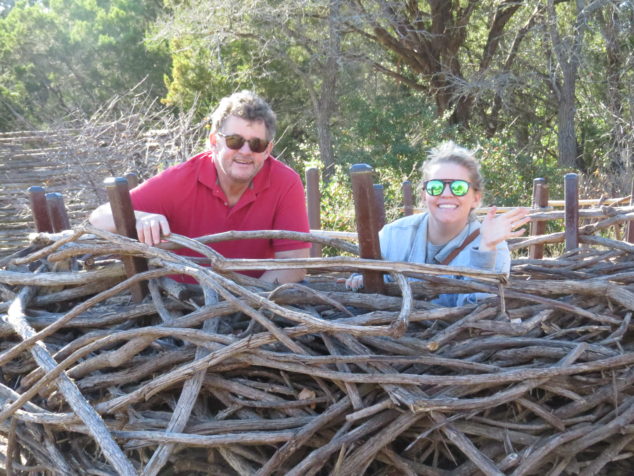
I first heard the word stumpery just this year when we watched a British garden show—apparently they are popular and originated in England. This stumpery at the Wildflower Center is for children to climb on.
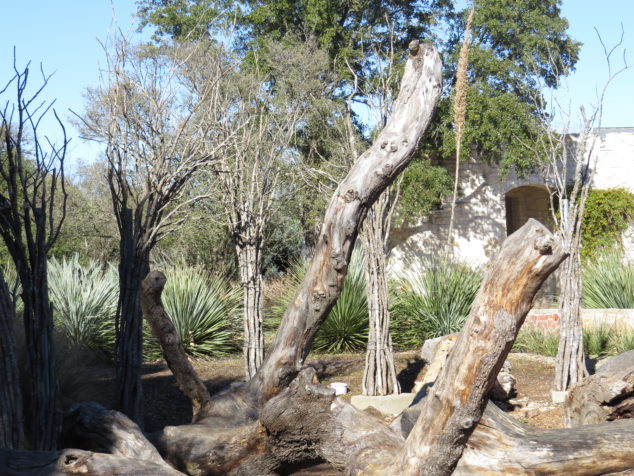
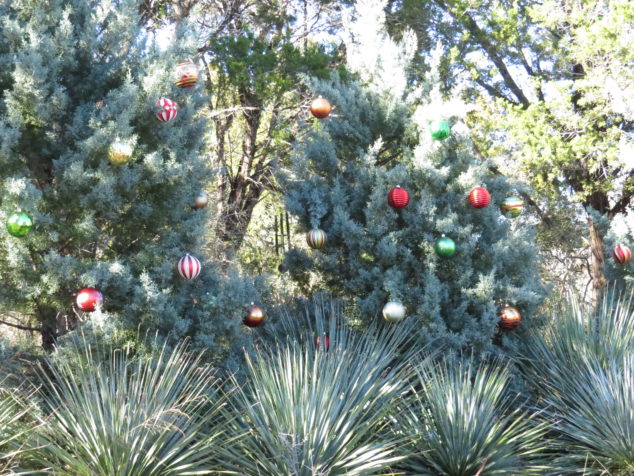
A line of Arizona Cypress trees were covered with colorful Christmas balls with a tree skirt of yuccas.
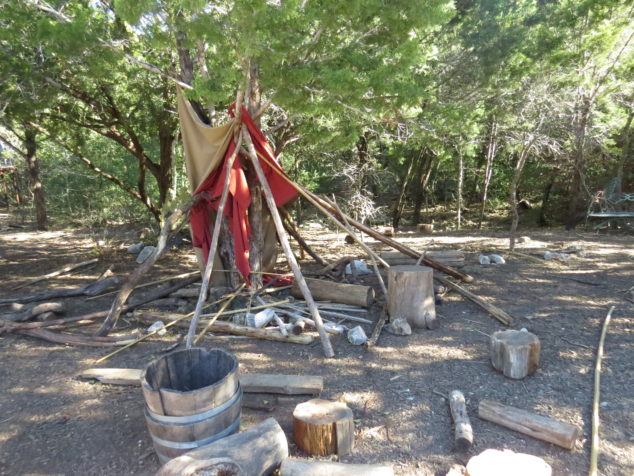
A rendezvous-like fort area was missing just one thing—the kids!
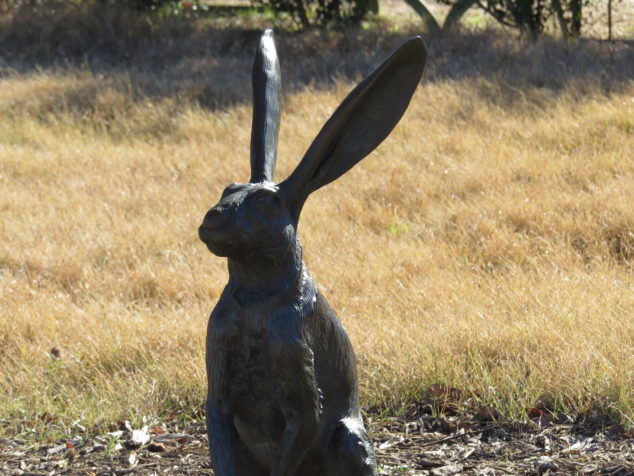
Beautification is far more than a matter of cosmetics. For me, it describes the whole effort to bring the natural world and the man-made world into harmony; to bring order, usefulness — delight — to our whole environment, and that of course only begins with trees and flowers and landscaping. –Lady Bird Johnson
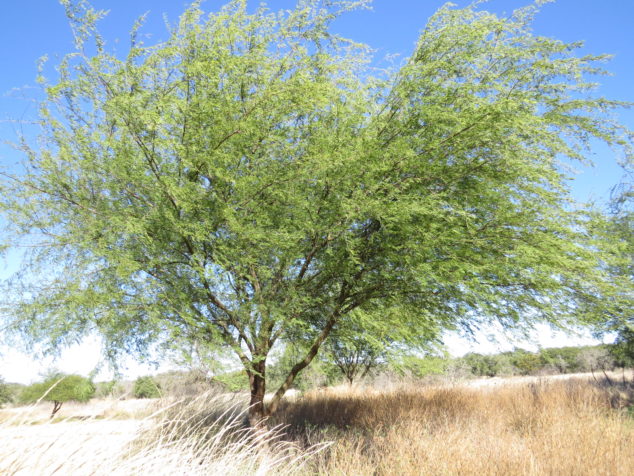
This beautiful little tree is called Huisache or Sweet Acacia. It’s often multi-stemmed, has feather-like leaves, fragrant bright orange flowers in spherical clusters, and small, brown seedpods. They categorize it as semi-evergreen, which is new to me. It was strange to come to Austin in December and see some of the trees still holding on to their green leaves while others had dropped their leaves.
Two seasonally festive trees and shrubs with red berries dotted the landscape of the gardens—one, the Possumhaw tree and the other, Yaupon, shown below. Both are types of holly. The Yaupon shrub is evergreen, and the leaves were used by Native Americans as a drink in purging rituals, thus its name Ilex vomitoria. It is now known that the tea made from the leaves does not cause vomiting. Good thing! I have some in my cupboard! It is the only native North American plant that contains caffeine, and it is rich in polyphenols just like tea and coffee.
For the bounty of nature is also one of the deep needs of man. –Lady Bird Johnson
Long before Instagram there was a shy, young Texas girl who became a powerful influencer. Her dream and intention of conservation and beautification took her from Karnack, Texas, to Austin, to the White House, and back to Austin. She was the major influence for the 1965 Highway Beautification Act and many other environmental bills during her husband’s administration. She joined the President’s War on Poverty by founding Head Start with Sargent Shriver. She was the business owner of an Austin broadcasting company. She was a major influencer in the development of the Town Lake Trail in Austin, and urged The Nature Conservancy to buy Enchanted Rock so it would be preserved for all to see. She dreamed of a research center for conservation, native plants, and wildflowers and made it happen! The environment—the land, the people we surround ourselves with, the things we say and do—is where we all meet and greatly influences who and what we become. As Lady Bird said of children, so it is with all people—we are likely to live up (or down) to what is believed of us by leaders, influencers, authorities, and loved ones. Lady Bird Johnson’s website says of her: She was bold. She was compassionate. She was visionary. She was an adventurer. She was generous. She believed in the power of healthy landscapes to transform lives. #BELIKELADYBIRD
The Partnership of Art Between Kelly and Nature
The true work of art is but a shadow of the divine perfection. –Michelangelo
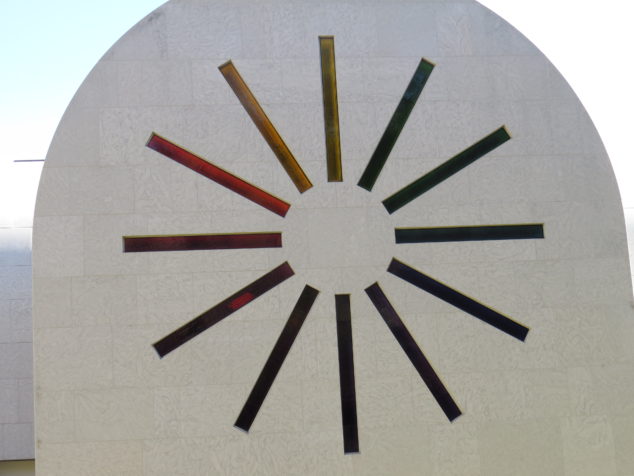
From Kansas City we flew to Austin, Texas, home to our first-born and her husband. It had been three years since we were there for their wedding, and we were all excited to do more exploring of this city and landscape that had captured their hearts. One bright, sunny morning we drove to the University of Texas campus where the Blanton Museum of Art stands in grand Texas style. Our destination was the recently completed standing work of art and architecture by Ellsworth Kelly, appropriately entitled ‘Austin.’ The artist gifted the design concept to the Blanton in 2015 before his death, and it was completed in 2018. Kelly was enamored by the architecture of cathedrals in Paris when stationed there in World War II. The structure is shaped like a cross, igloo-like with curved roof lines and brilliant white exterior.
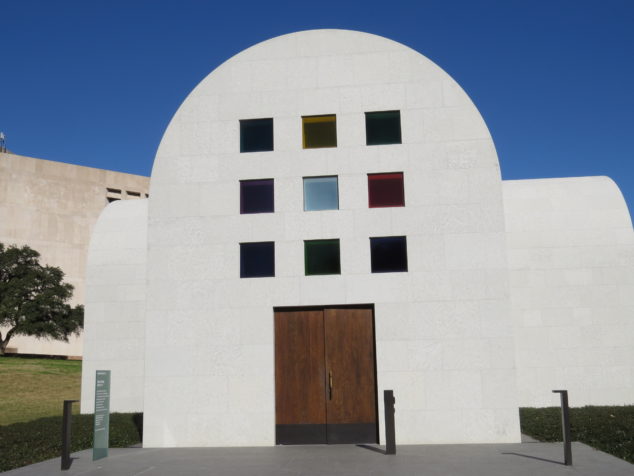
The south, east, and west sides of the building are adorned with colored glass windows—the ‘color grid’ at the entrance, ‘tumbling squares’ on the east face…
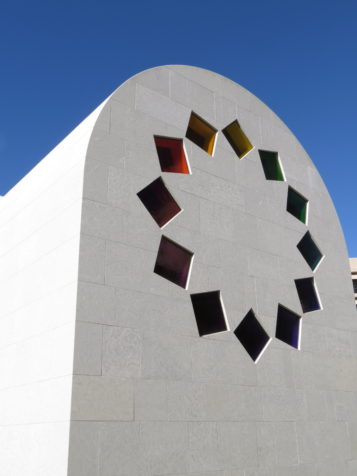
…and ‘starburst’ on the west.
The shining white exterior is covered in 1,569 limestone panels from Alicante, Spain—each block a story and work of art in and of itself.

The entrance door is made from native Texas Live Oak, repurposed from some other life. I like how the metal handle is burnished from expectant hands reaching for entry.

Once inside, I was shocked by how empty it was, though I don’t really know what I was expecting. Straight ahead was the fourth, north-facing arm of the cross, and nestled in the curve of that arm rose a totem made of Redwood logged in the nineteenth century and reclaimed from the bottom of a riverbed. New life and rich patina from a century-old, forgotten log of a beautiful Redwood tree!

The colored glass windows were made from handblown glass by Franz Mayer of Munich. The ‘color grid’ was a theme used by Ellsworth Kelly in much of his other art…

…as was the spectrum of colors used in the east and west windows, reminiscent of refracted light through a glass prism or millions of drops of water that creates a rainbow. The outside light directed the colors onto the interior ceiling and walls…

…and even reached over to its opposite window to reflect yellow on purple, blue on red, and pink on blue.

The ‘starburst’ was my favorite, here along with two of my favorite people.

The real partnership of art between Kelly and Nature morphed into being when the sun shone directly through the ‘color grid’ windows onto the walls, onto the floor, and onto the black and white relief panels that line the walls. The panels are made from marble—the white marble sourced from Carrara, Italy where Michelangelo chose his stone and the black from a quarry in Belgium. Kelly, a life-long atheist, conceived the fourteen panels as abstract versions of the Catholic Stations of the Cross.

The black and white non-colors represent something basic and elemental and often oppositional, such as light and dark or good and evil.

The floor of ‘Austin’ is black granite from the state of Georgia. The sun-shining colors illuminate the dark stone with a rich, almost neon effect. Whatever the time of day, the art, the picture of color on granite or marble, changes, morphs, and becomes new again.


Artists and Nature have been partnering for eons—from cave dwellers with pigments made from minerals, charcoal, and limestone mixed with spit or animal fats to Native people with dyes made from barks, leaves, and flowers to Michelangelo with his huge blocks of marble. (“I saw the angel in the marble and carved until I set him free.”) Nature has been the inspiration, the means, or the medium for practically every artist. Ellsworth Kelly’s ‘Austin’ displays the rocks, wood, and rainbow colors in a simple, naturally elegant, and compelling way. He envisioned his work of art as a site for joy and contemplation—the same qualities that Nature or a chapel offers to all of us. What happens to us when we immerse ourselves in art of some form or in Nature? What parts of ourselves do we consciously disown yet display in full sight through our art? I think art offers us a reflection of the rich patina of our lives, complete with the building blocks that have pieced us together—each a story and work of art, in and of itself. Each one of us is a refracted ray of light from divine perfection that shatters into some unique color, and together we partner to create a true work of art.
Art in Nature
There are two people in my life that know Art (with a capital A) in a way that my ignorant and scientific mind will never be able to fathom. I don’t ‘know’ it or ‘get’ it, but I try, by association, to appreciate it at some level. One of those people is my sister-in-law Julie. She has worked as a docent at the Nelson Art Museum in Kansas City for decades, and her home is full of amazing art that is strange and foreign to my untraveled, untrained mind and eye. But there is something that links me to her taste and ability in the arts—Nature. She is also a skillful gardener, talented designer, and Nature-lover. Her whole backyard is a garden of delights with unique plant material, beautiful design, interesting sculptures and urns, and unprecedented plant pairings, yet looks natural and artfully wild all at the same time. We were fortunate to spend a couple of days with Chris’ brother and Julie, and they took us to the Overland Park Arboretum and Botanical Gardens on the western outskirts of Kansas City. The day was warm with a crisp breeze—warm compared to the snow we had left in Minnesota, and crisp enough to need a jacket and hat.
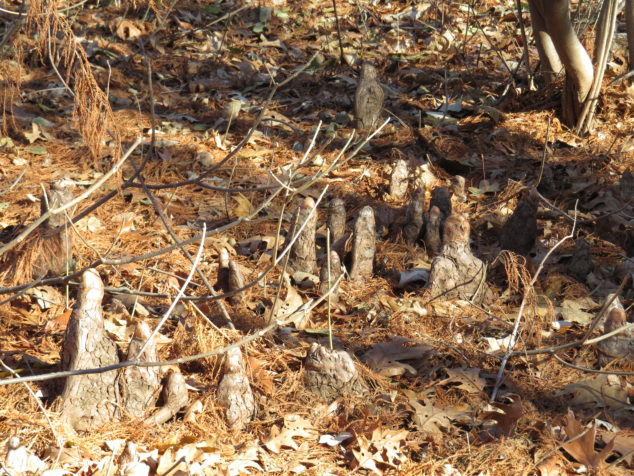
The first wonder that greeted us was the strange, unique protuberances under a Bald Cypress tree. Thanks to Chris, our intrepid tree man, we learned these were cypress knees. The knees grow up from the roots of the Bald Cypress tree and have been the wonder of botanists for centuries. Bald Cypress trees are deciduous conifers (like our Northern Larch or Tamarack) that typically grow in swamps where the roots are waterlogged for at least part of the year. Some have theorized the knees provide the roots with air for gas exchange; others proclaim them to be structural to keep the shallow root system strong, and the tree upright. They are one of Nature’s wondrous mysteries!
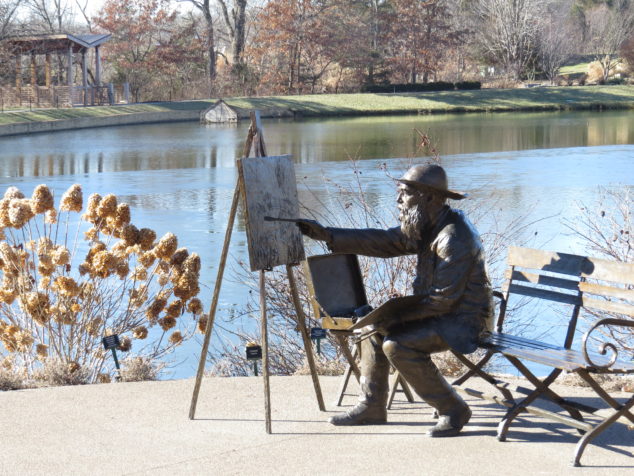
Our next surprise was Monet painting at the edge of the pond! The French Impressionist painter Claude Monet was an advocate for plein air painting—in the open air—in order to capture the lighting at different times of the day and the colors during different seasons of the year.
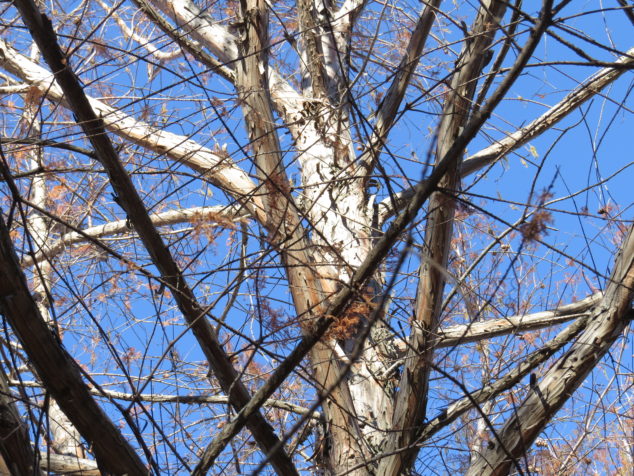
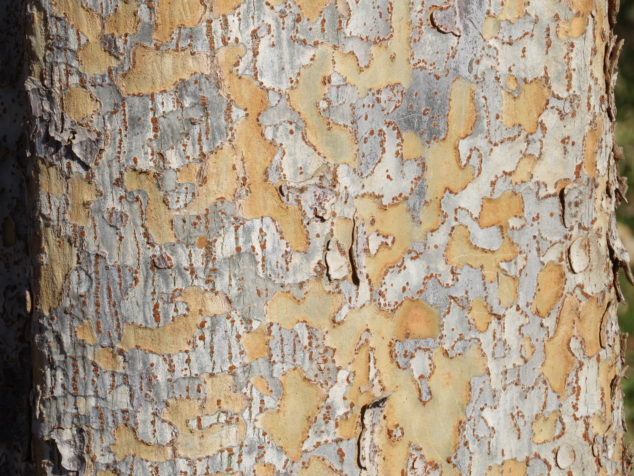
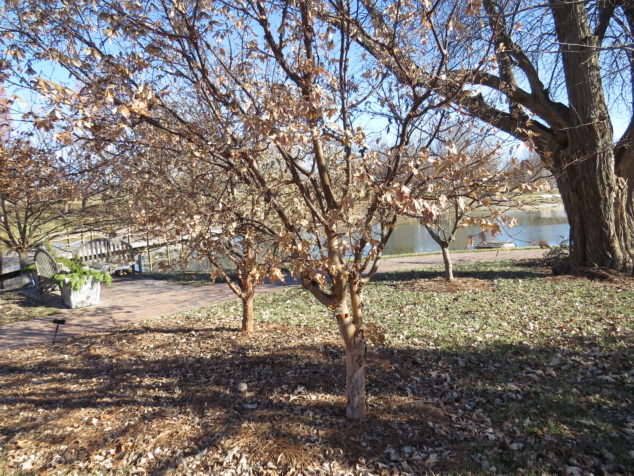
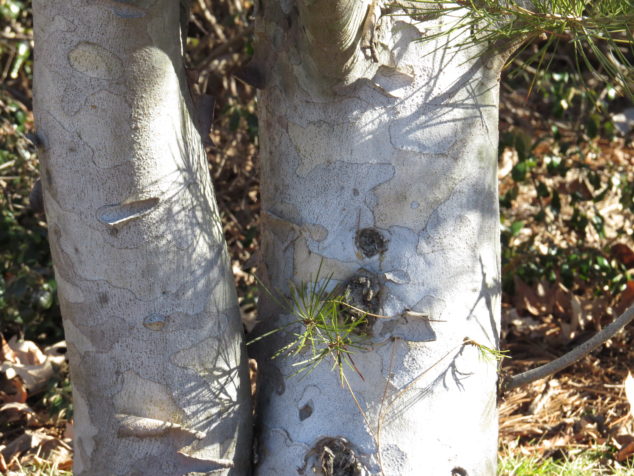
We encountered a trio of Lacebarks as we strolled along the winter paths—Lacebark Elm, Lacebark Oak, and Lacebark Pine—all with interesting, exfoliating works-of-art bark.
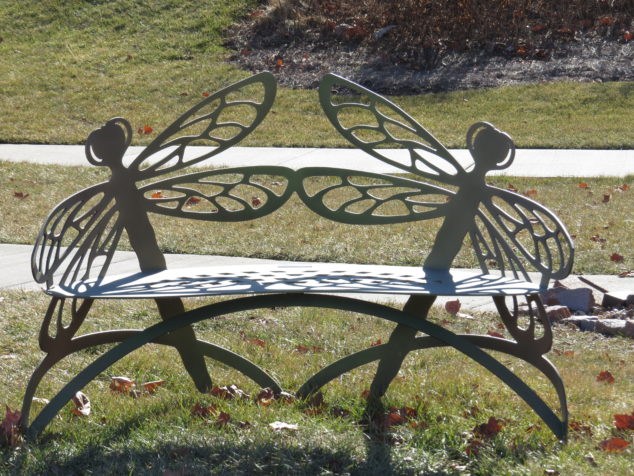
Alight and rest for a moment on a dragonfly bench!
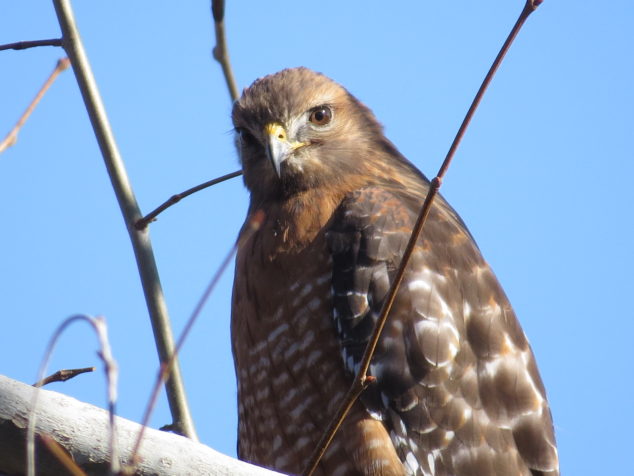
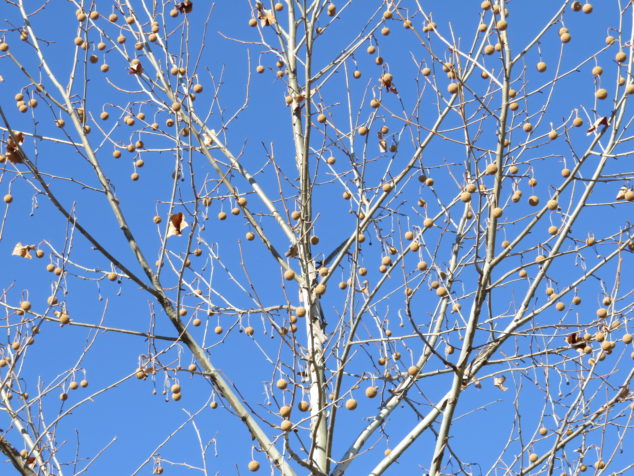
High in a Sycamore tree sat a hawk who seemed unconcerned with the passersby below. The American Sycamore grows stately and tall and holds its seed clusters most of the winter, like tiny balls decorating the bare tree for the holidays.
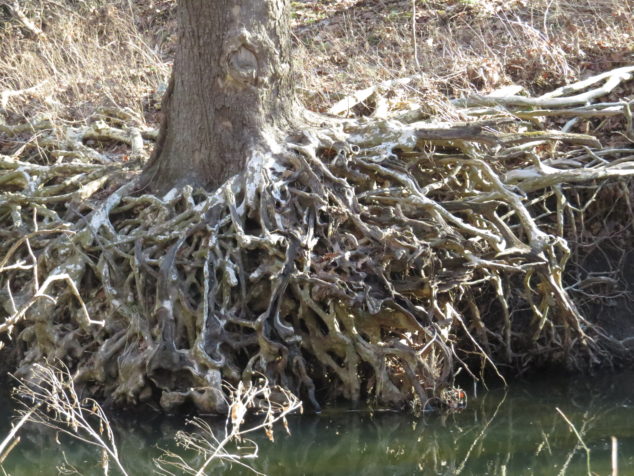
We walked through a tall, metal gate that fenced the deer out of the Gardens and entered the dry, wooded swales, a low-lying area by Wolf Creek where Cottonwood and Sycamore trees grew into giants. Flooded creek waters had washed the soil away from the roots of nearby trees creating tangled works of art.
One common workhorse of a tree in the mid-plains is the Osage Orange or Hedge Apple tree. The Osage Indians made superior bows from the tough, flexible wood. The yellow wood resists rot, burns hot, and is used for fence posts and railroad ties. The trees themselves were used for living fences before barbed wire was widely available and less expensive—the low branching trees with strong, sharp thorns grew ‘horse-high, bull-strong, and pig-tight’ as a hedge. The yellow wood extends into the roots…
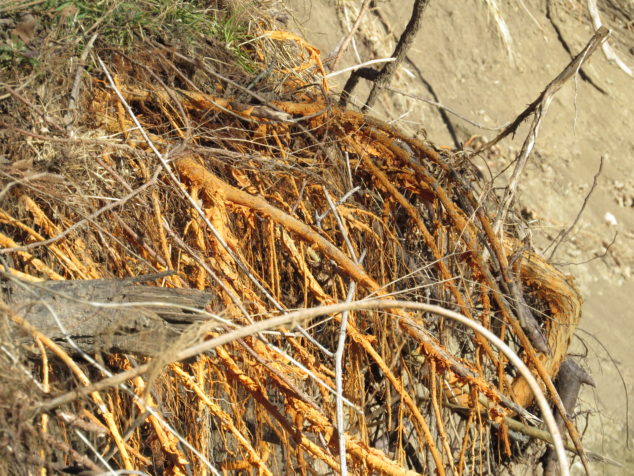
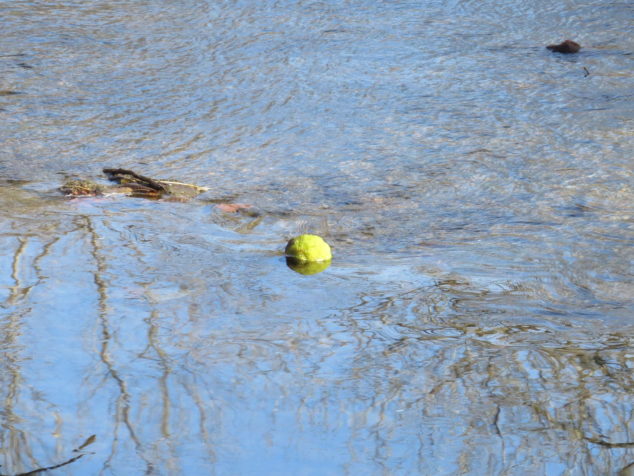
…and the large yellow-green hedge ball or fruit ball contains a messy, milky sap that is supposed to repel insects and spiders.
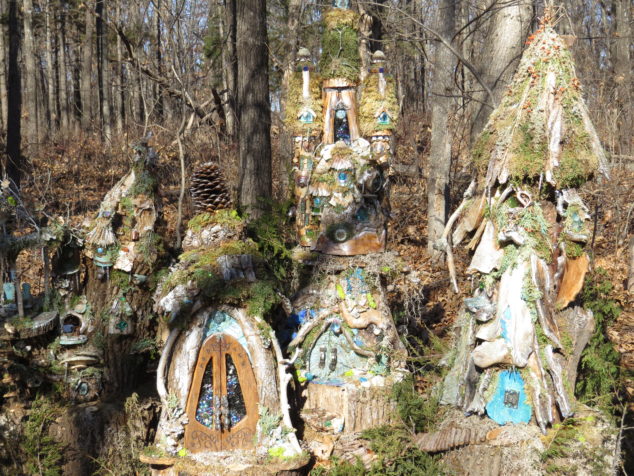
We returned to the Gardens through another high gate after our hike through the woods and found ourselves on the Sculpture Garden trail. Elaborately pieced fairy houses—miniature natural architecture with colorful trinkets and stones—were placed at intervals along the trail.
Beautiful sculptures were tucked into the trees along the paved path, a melding of Art and Nature.
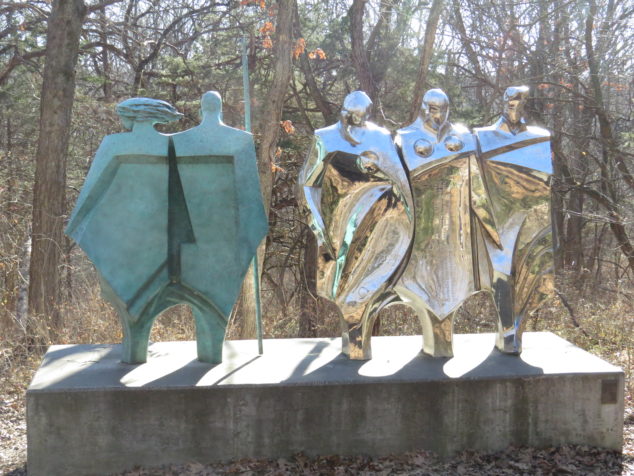
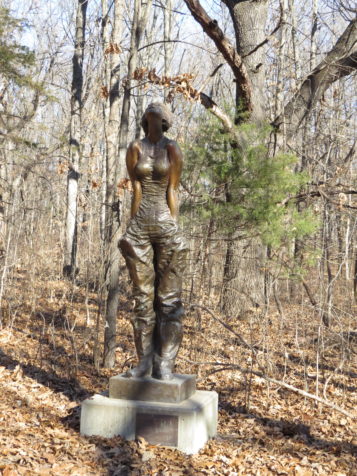
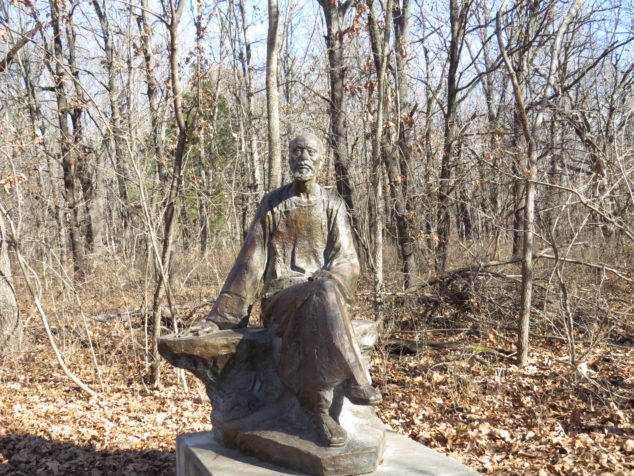
Like Monet, I appreciated the colors of the winter season at the Arboretum and Botanical Gardens—the muted green grass, the rusty oak leaves, the ice-blue sky and water, and the honey-colored hydrangea blooms. A painting in the making. I love how Mother Nature is the ultimate artist—the color and form in the feathers of a bird, the patterns and designs in the bark of a tree, the making and dispersal of seeds, and the color and contour of the inner characteristics of a tree. I liked the juxtaposition of whimsical, woodsy fairy houses made from the materials that surrounded them with the bold concrete and metal sculptures that had found their new homes among the trees. I am thankful for the time we had with family and friends on our trip south. There is something sacred and life-giving in sharing space, time, food, laughter, perspective, ideas, and talents. It’s what links us together on the wondrous, mysterious journey of Life.
New Year’s Day—Not in Texas Anymore
As I awoke on this New Year’s Day, it was very apparent that we weren’t in Texas anymore! The temperature was six degrees below zero, and snow, beautiful snow, covered the ground with a nice, thick blanket! We had been gone for seventeen days visiting family and friends in Kansas City and Austin. Seventeen days of real social time—no digital social media needed or wanted. You know, just like the ‘old days.’
In the upcoming weeks, I will write about some of our outdoor adventures in the warmth of Kansas and Texas—so many amazing things to see, even in winter! Until then, I want to wish you beautiful mornings and beginnings…
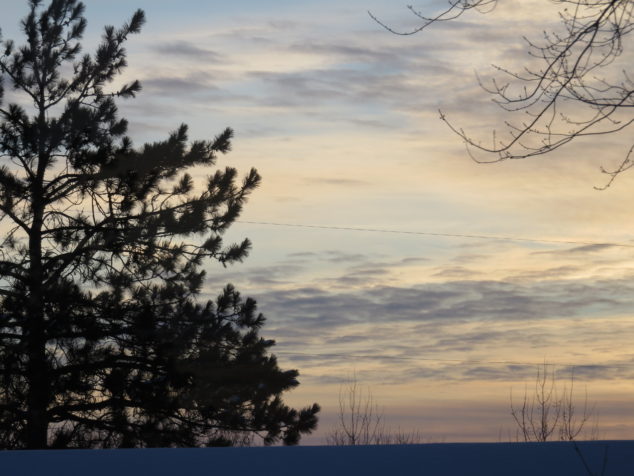
…abundance in all areas of your lives…
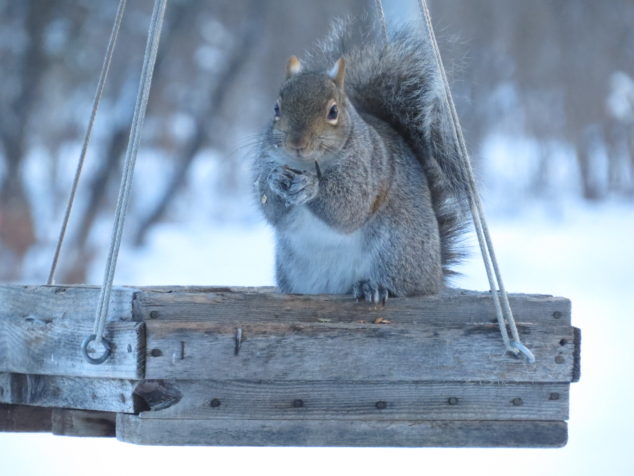
…and time with friends and loved ones around the campfire, around the dinner table, and out in Nature! Happy New Year!

The Gift of a Paper Birch Tree
In all things of nature there is something of the marvelous. –Aristotle
One of the most marvelous trees in Nature is the Paper Birch. It thrives in colder-climate regions, is one of the first species to grow after a wildfire in these northern climates, provides food for moose, deer, birds, and porcupines, and the bark is an excellent fire-starter, even when wet, because of its high oil content. The leaves have been used for centuries by herbalists as a topical for skin problems as well as infusions for a wide array of internal problems.
These beautiful trees have been designated National Memorial Trees for Mothers with one planted at Arlington National Cemetery named the National Mothers’ Tree. We are fortunate to have one right outside our front door.
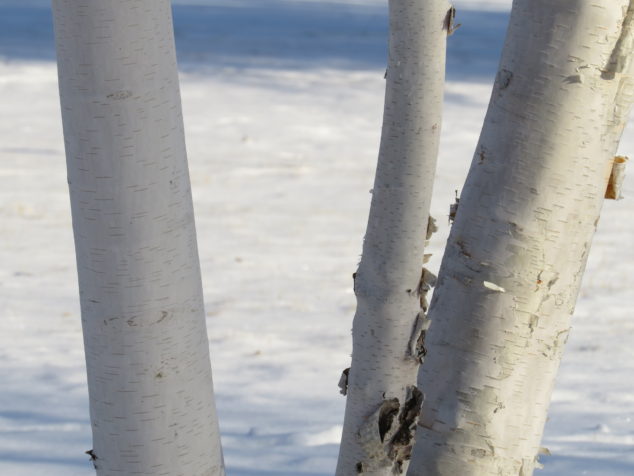
The shiny white bark has characteristic ‘dashes’ in light gray, and as the tree grows, the older bark peels off in large curls.
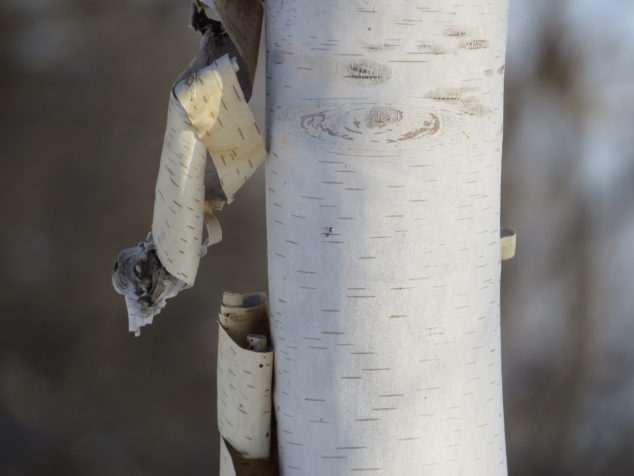
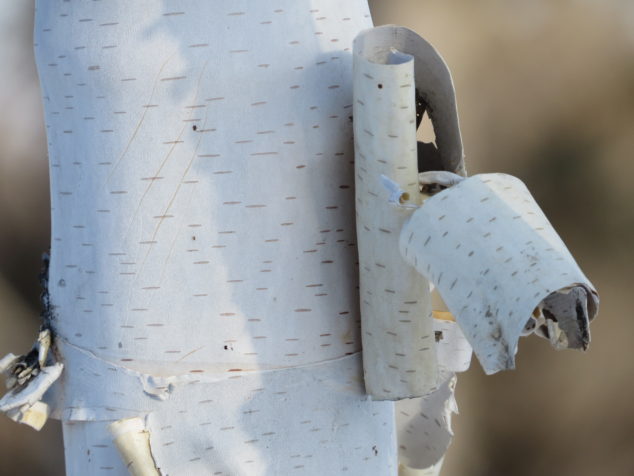
The curls of peeling bark get stuck on the knots where the branches grow and hang on until it gets worked loose.
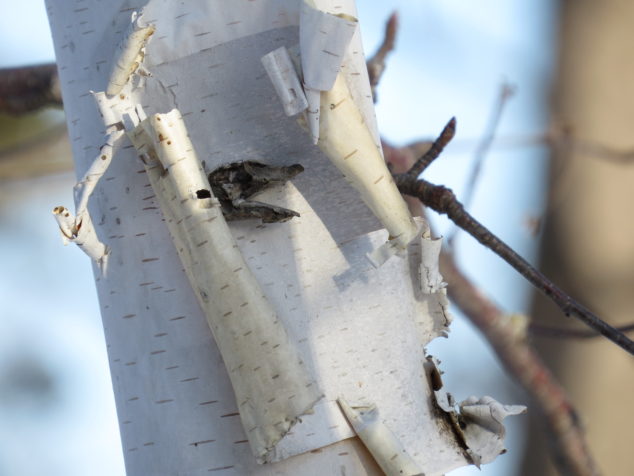
We also have a pile of logs from an old Birch that had to come down. The rotting process has begun. Often the inside wood will rot away leaving an empty shell of tough birch bark.
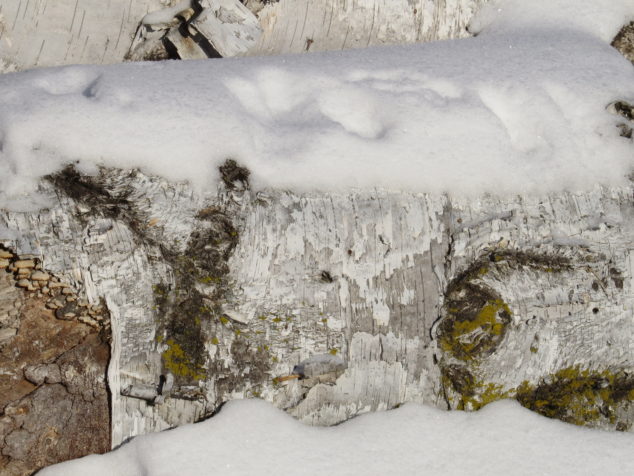
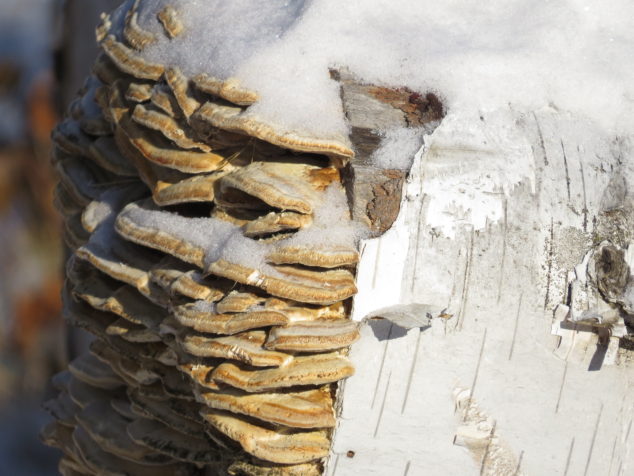
Fungi, like a stack of morning pancakes with frosty white syrup of snow, grows from one end of a log.
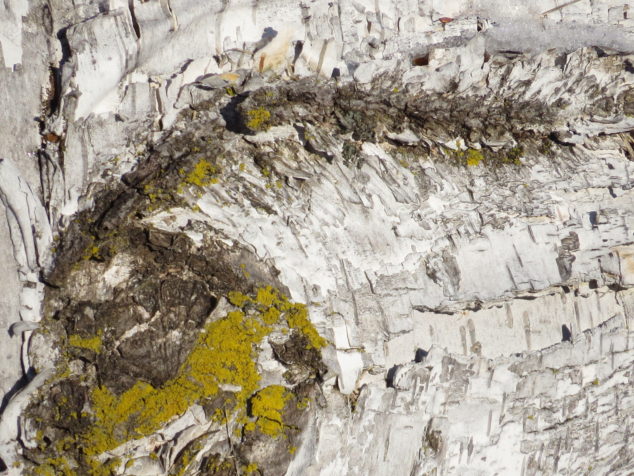
Colorful lichens decorate the ‘eye’ of the log where a branch was cut from the trunk.
There is something almost magical in the bark of a Paper Birch, with its strength, resiliency, and weather-proof properties.
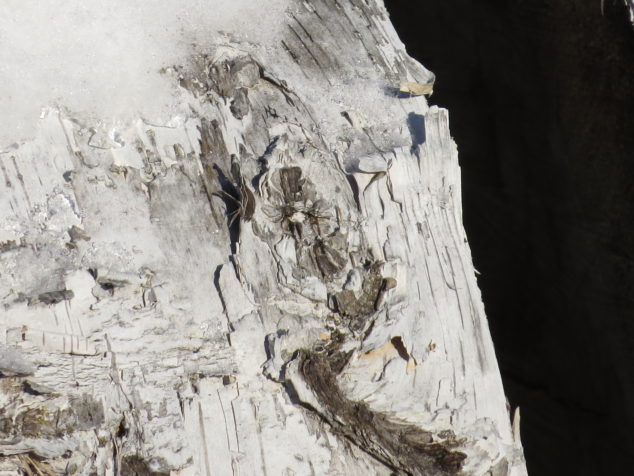
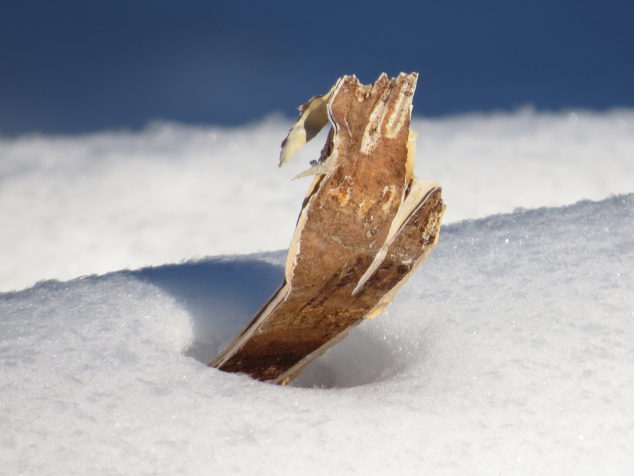
From downed trees, the bark can be peeled off in thick layers. The Native Americans used the bark for making containers and canoes, and for the shells of wigwams.
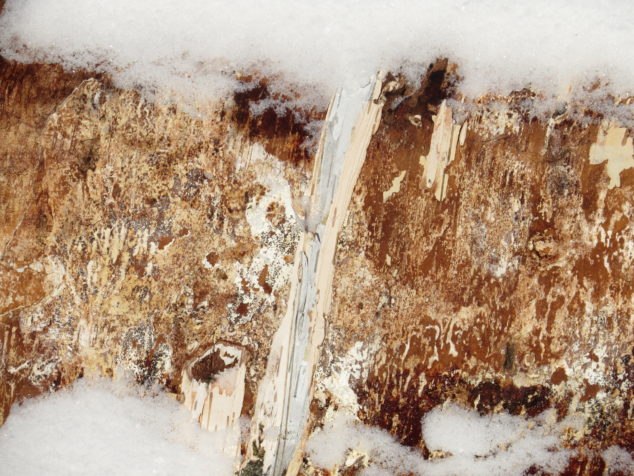
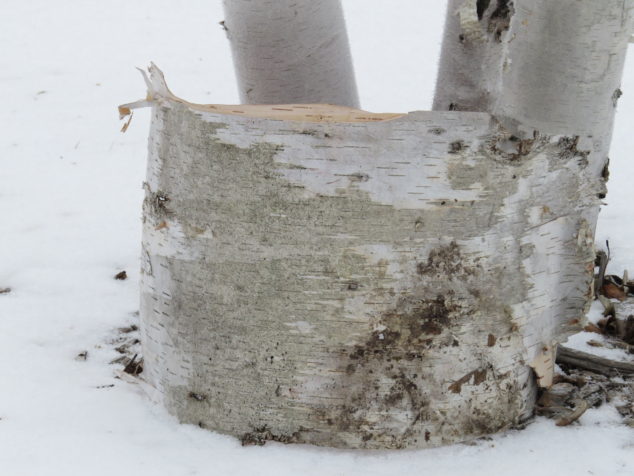
But in our household, Chris uses the bark to make ornaments for our Christmas tree and for gifts!


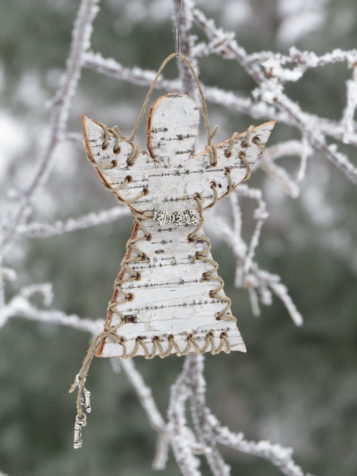

A marvelous tree—from beautiful live Mothers’ tree to downed logs to handmade gifts of Nature and Love. In this season of advent, the ‘old’ is peeling away in anticipation of what’s to come—we make room for the new. We may get hung up on knots of uncertainty, of doubts and fears, but whether we are ready or not, the Child is born to the Mother of God, the new year greets us, Joy is made available—do we embrace it? Life is a magical, miraculous gift, and we are the strong, resilient participants, the givers, the receivers, and the gifts themselves. From our household to yours, we wish you Love, Protection, and Peace!
- « Previous Page
- 1
- …
- 19
- 20
- 21
- 22
- 23
- …
- 50
- Next Page »