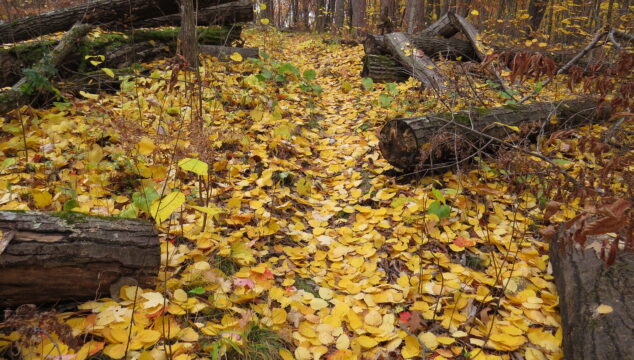
Come walk with me in the peak Autumn beauty of the Northwoods. To say that I love this time of year is an understatement. Most everyone can appreciate the colorful falling leaves---it reveals the 'true self' of a tree when its leaves are no longer producing chlorophyll. Their true colors are revealed, and there is something simple … [Read More...]
Gleanings from July 2015
July is our true summer month here in Central Minnesota. We have our warmest temperatures that team up with high humidity, making me pine for air conditioning–for a week or so! While looking through my photos from July, I realized two things–I didn’t get out much (‘out’ meaning beyond our place), and July is the month of flowers! So my gleanings post will be about flowers–all of which have bloomed in July here on the home place.
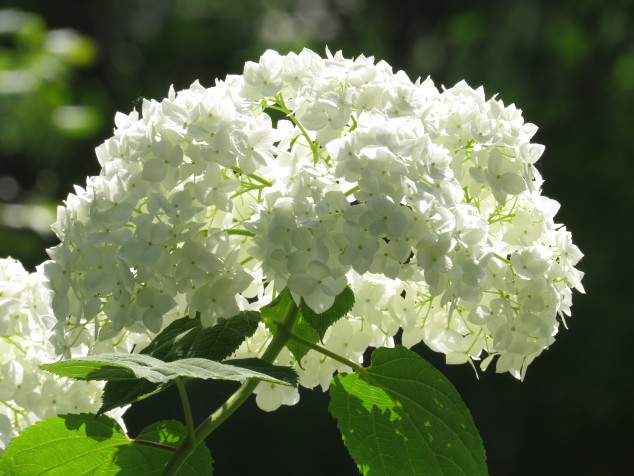
We have a number of shrubs that bloom in the heart of summer, the most spectacular being the hydrangeas. Annabelle hydrangeas are tough, cold-tolerant shrubs that have huge, showy white flowers every year, even after severe pruning.
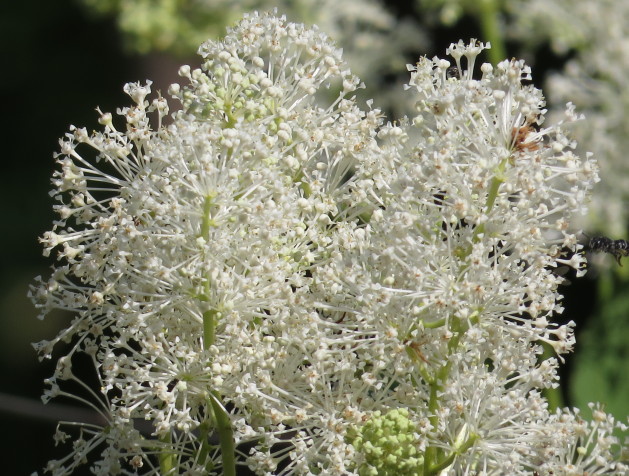
A small native shrub that attracts butterflies, bees, and hummingbirds is New Jersey Tea. The dried leaves were used as a tea substitute during the American Revolutionary War. The flowers look like fireworks!
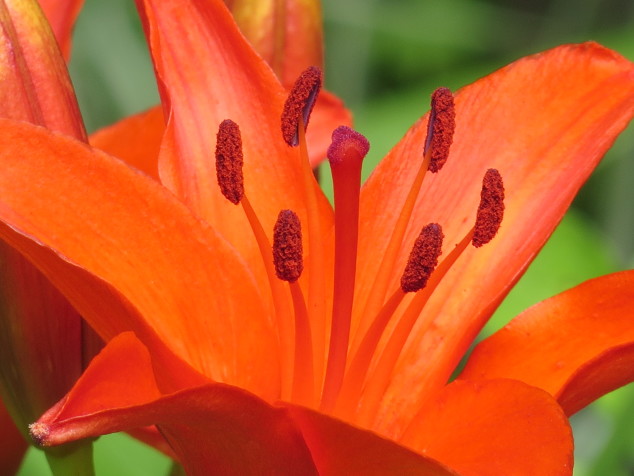
Extravagant, colorful Lilies celebrate summer in bold style: fragrant Oriental lilies…
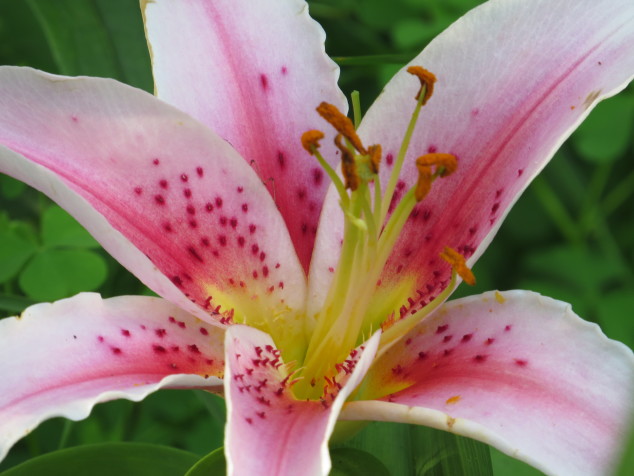
elegant Asiatic lilies…
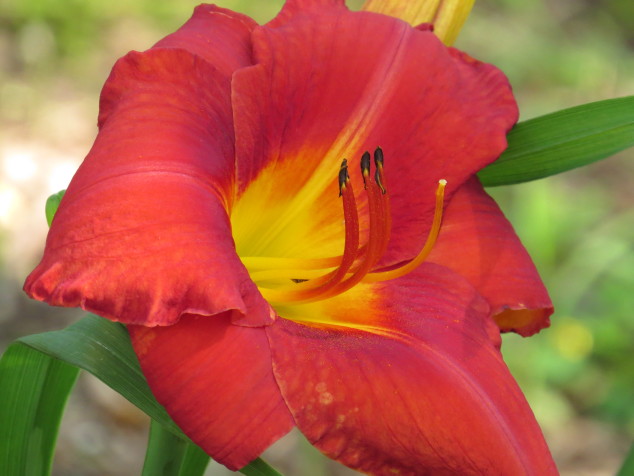
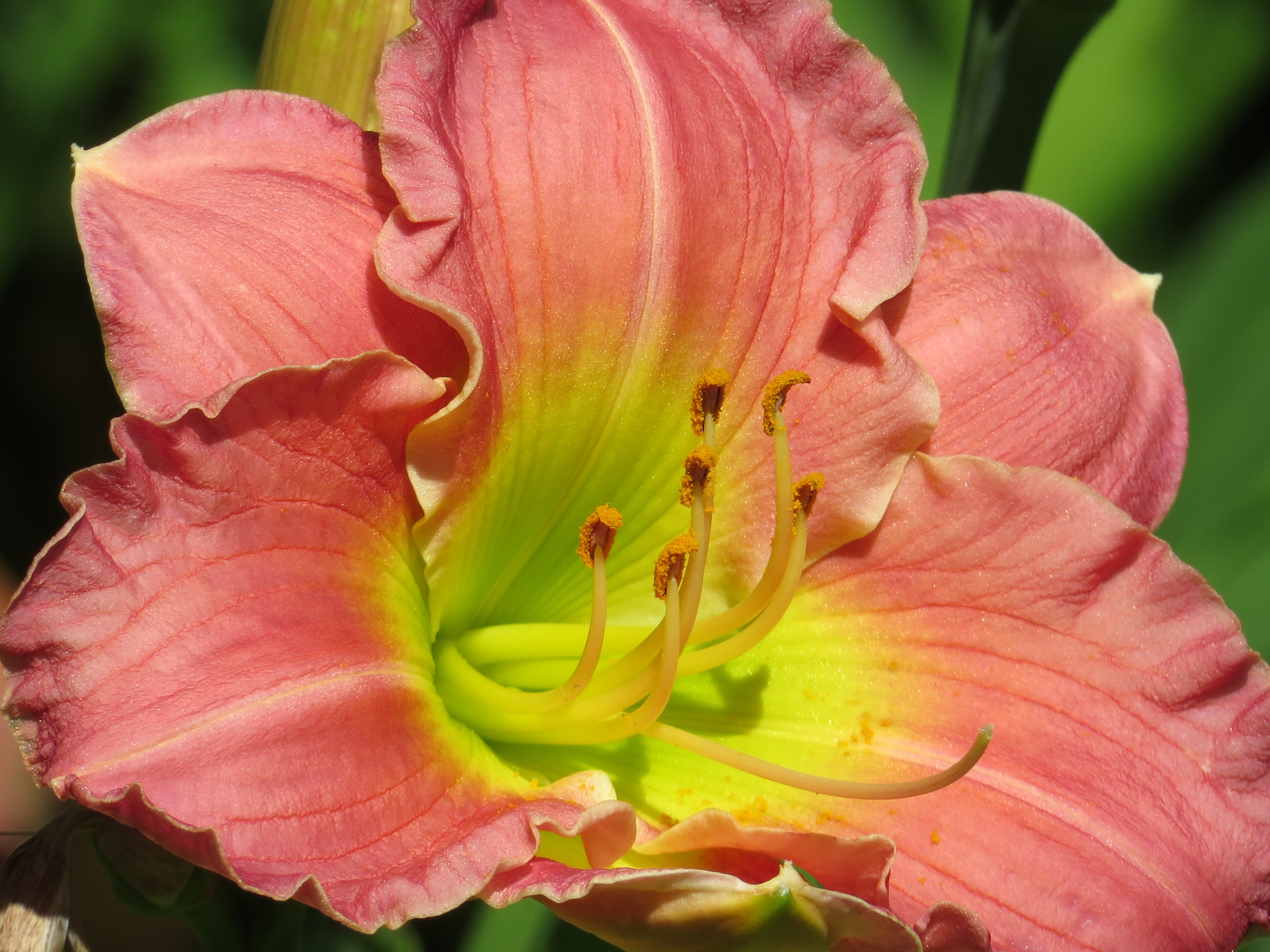
and the fleeting beauty of a Daylily.
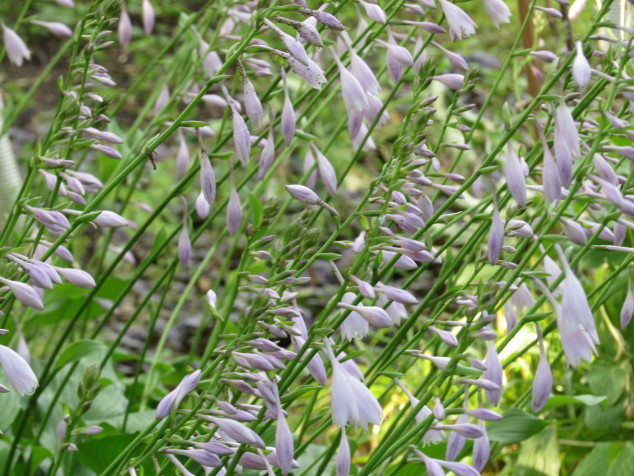
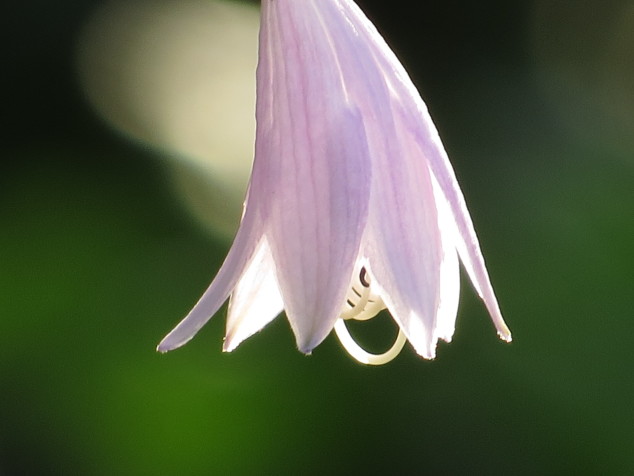
Mature Hosta plants produce an abundance of tall flower stalks covered with light purple, bell-shaped blooms which open from the bottom up. The overwhelming number of blossoms masks the beauty of the individual flower…
…until you look at it closely.
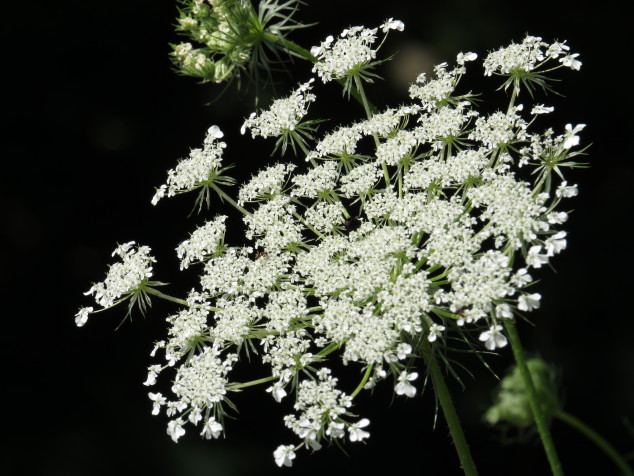
 July is the month for royalty–Queen Anne’s Lace and Queen of the Prairie! Queen Anne’s lace is a biennial. The tender first-year leaves can be used in salads. The root of this ‘wild carrot’ has a high sugar content, second only to the beet among root vegetables, and has been used to sweeten foods. Use extreme caution before harvesting, as the leaves of this edible plant resemble the leaves of poison hemlock, fool’s parsley, and water hemlock, which are all poisonous.
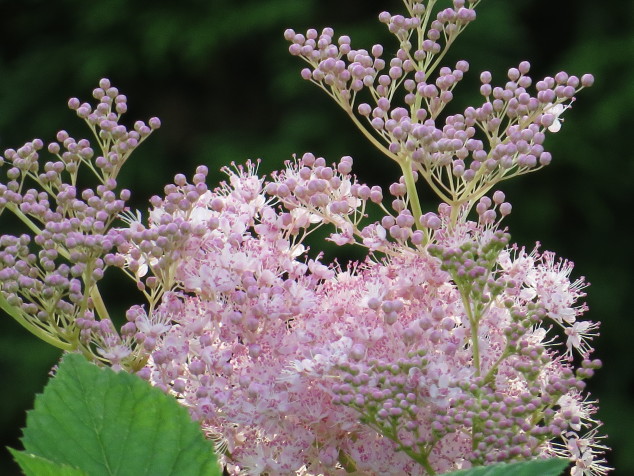
Queen of the Prairie has frothy clusters of pink flowers on three to six-foot tall stems. It is a native perennial of northeastern and north central United States.
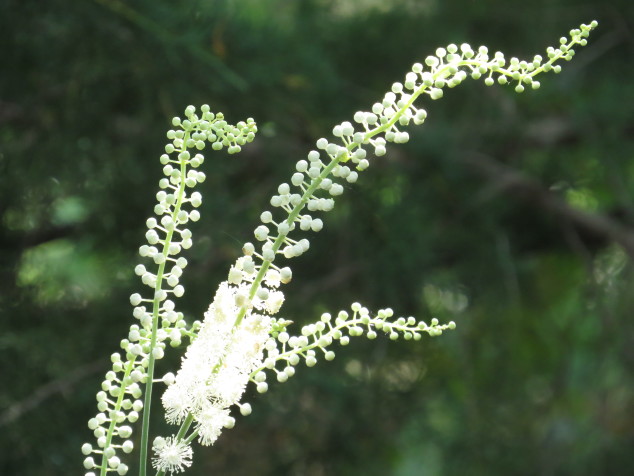
Black snakeroot (Cimicifuga Racemosa) is a tall, shade-loving plant with spikes of bottle-brush flowers.
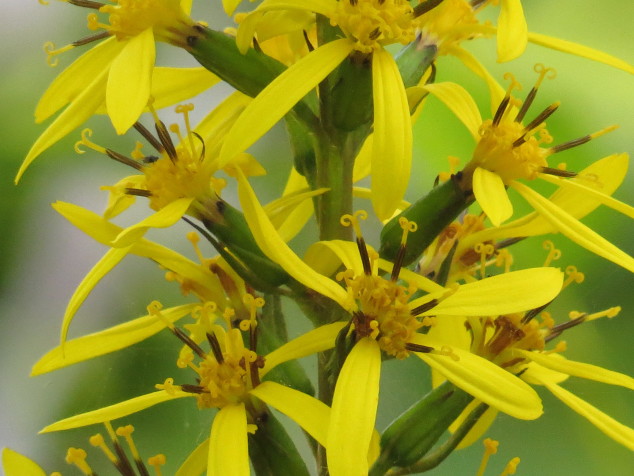
Ligularia ‘ The Rocket’ loves moist shady areas. It is a clumping perennial with toothed foliage and tall spikes of yellow flowers.
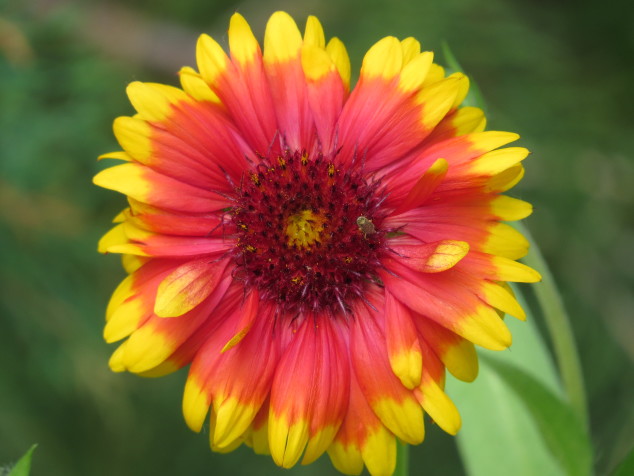
Blanket flowers or Gaillardia are bright, sun-loving perennials that are easy to grow.
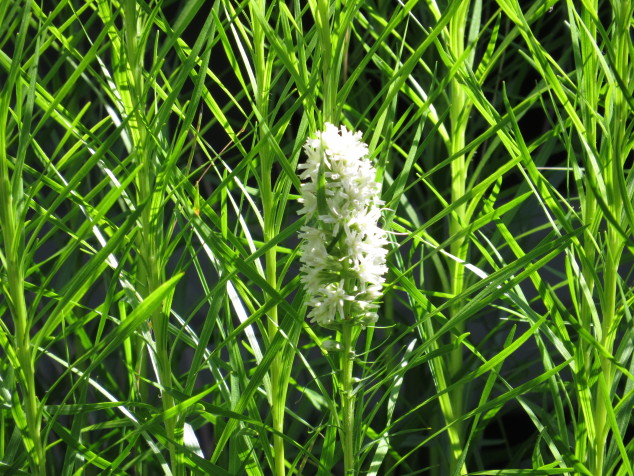
 Liatris or blazing star is commonly purple in color, and we have many of them, but I think my favorite is the ‘Alba’ or white cultivar. The grass-like leaves create a beautiful background to these spiky flowers that, unlike most flowers, bloom from the top down.
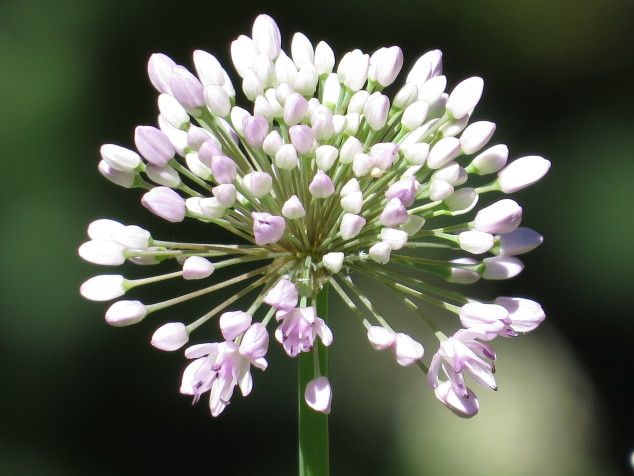
Onions and garlic are Alliums for the vegetable garden, but there are many ornamental Alliums. They are grown from bulbs that need to be planted in the fall. These oniony-smelling plants are deer and rodent resistant and need very little care.
Flowers have an expression of countenance as much as men or animals. Some seem to smile; some have a sad expression; some are pensive and diffident; others again are plain, honest and upright, like the broadfaced sunflower and the hollyhock. Henry Ward Beecher
Perhaps we have more in common with flowers–and vice versa–than we thought! Some of us are bold and stand out in a crowd. Others are understated and may get lost in a crowd. Some have a calm and regal air about them. We are all different sizes and colors and smells. But one thing is for sure–each one of us is a valued member in the Garden of Life.
P.S. The three eaglets that we have been following have fledged! Another empty nest!
Bluebird of Happiness
The BLUE-BIRD carries the sky on his back. –Henry David Thoreau
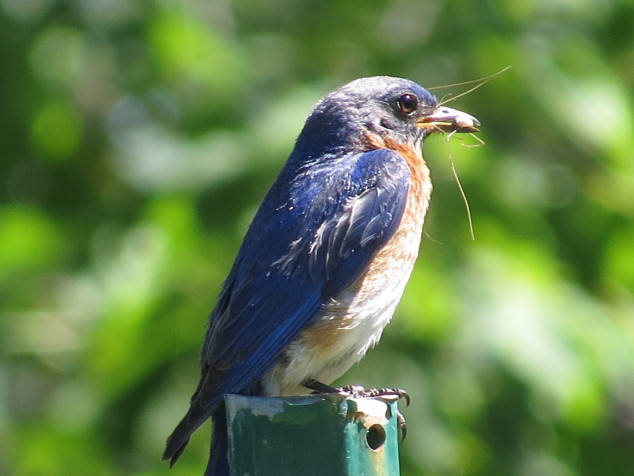
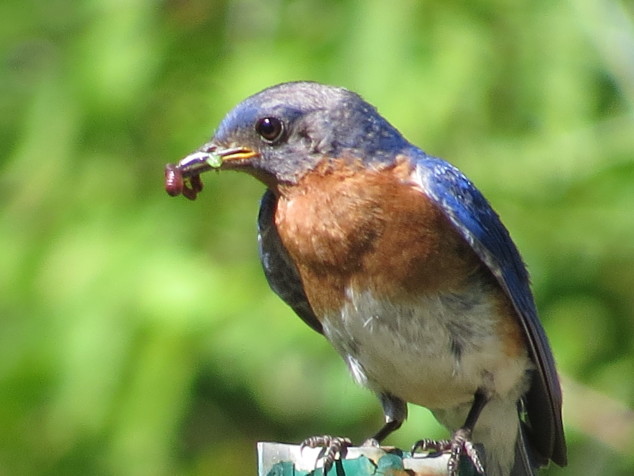
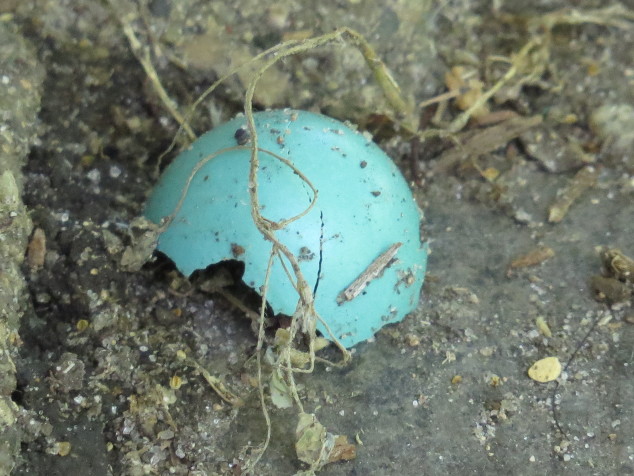
Flashes of blue can be seen in our yard at any time of the day. This is the first year a pair of Eastern Bluebirds has used one of our bluebird houses for their grassy nest. We have four houses placed around the yard, but the location has to be just right for bluebirds. The house wrens are not so picky so have usurped a number of the bluebird houses, even though they have their own petite abodes in the maple trees. Bluebirds can have more than one successful brood each year, so this one in mid-July may be their second brood.
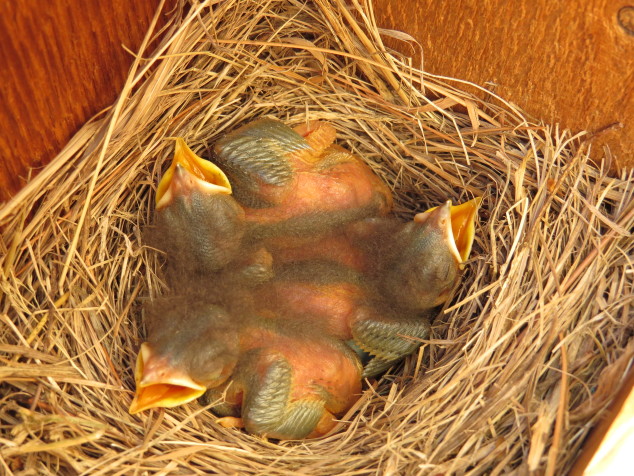
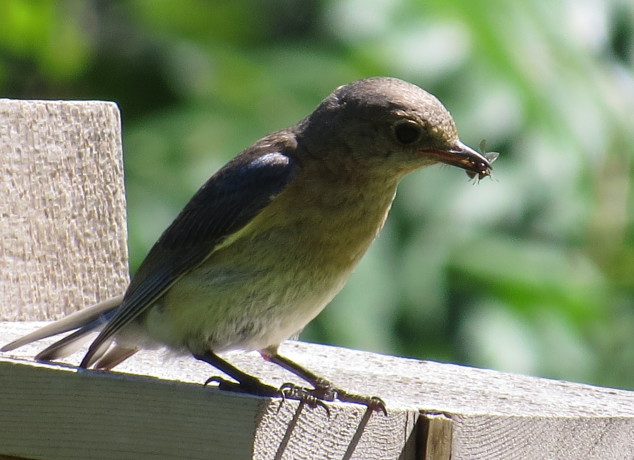
Both the brightly colored male and the more subdued female hunt for insects to feed their young. They perch high on electric lines, in trees, or on posts. They spy their prey from sixty or more feet away, then swoop to the ground to grab the unsuspecting insect and quickly fly back to their perch. Most of the time, the parents alight on their house or on a nearby post right before flying into the nest with the food.
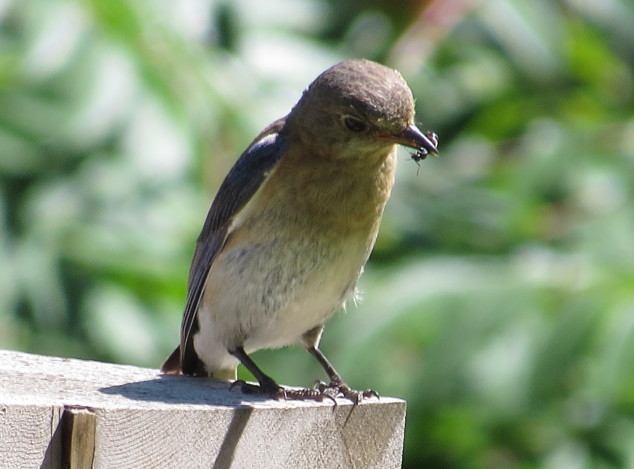
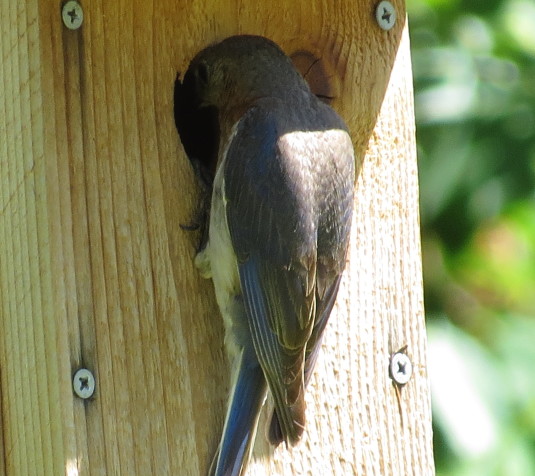
Countless insects of all sorts are delivered to the babies’ gaping mouths…
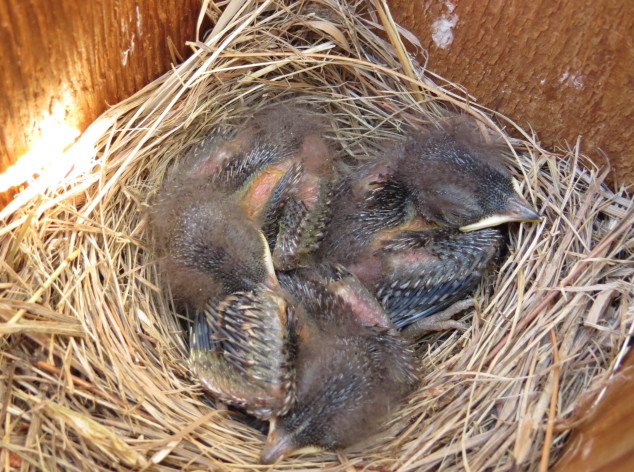
…and just three days later, they have opened their eyes and developed more feathers. Sixteen to twenty-one days after hatching, these helpless chicks will fly from the nest.
Bluebirds have long been a symbol of happiness, hope, and renewal. Legends, poems, plays, songs, and stories have been written about the inspiring bluebird. What is it about these beautiful little thrushes that have aroused such appeal and even have prompted a National Bluebird of Happiness Day on September 24th? They are a welcome harbinger of spring after a long, cold winter. Their brilliant azure color is uncommon in the natural world, so the flashes of blue are noticeable against the green. The population of bluebirds severely declined up to the late 1970’s due to loss of nesting habitat and nest competition from starlings and sparrows. The North American Bluebird Society was formed in 1978 to place bluebird nesting boxes across the country, and since then the bluebird population has recovered. Do we appreciate something even more once it was almost lost? Or is it the feeling of a blue-sky day, when the air is crisp and clear and the sun warm upon our faces, that is evoked when we look at the sky the bluebird carries on his back? When I see the flash of blue, I feel a deep happiness to have such beautiful birds living in our yard. When I see the parents working so hard to provide food for their babies, I feel hope that another generation will populate our natural world. And I carry that happiness and hope to you so that we may all experience soul-filling renewal. What do you carry on your back for the whole world to see?
Splish Splashing in the Water
His name was Apples, and he loved water. My little strawberry roan horse never shied away from crossing a creek and would dawdle in the water, sipping it through his bit, letting it dribble down his chin. The creek seemed much more interesting to him than the dusty trail on the other side where the rest of the horses had gone.
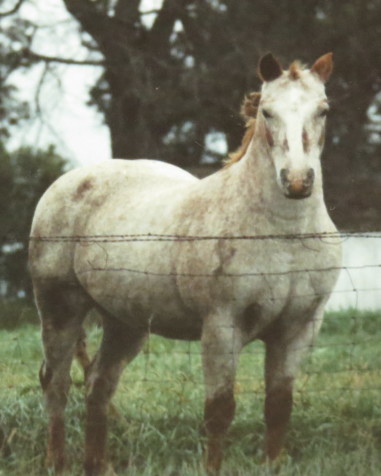
One hot summer day in South Dakota, I was riding with my sister. We had had a large amount of rainfall that pooled into a low spot in the pasture. As we were riding by the clear water, Apples had different plans! He walked into the knee deep water and started pawing–the water splashed up onto his belly, onto my legs, and all around us! He dipped his head down, stuck his nose into the water, took sips, and blew the water out of his nostrils. I remember laughing at how much fun he was having in the cool water on that hot day! Then I felt him gathering his legs, taking small steps inward, and I knew that he was going to lay down! His legs folded, we went down, I kicked my feet out of the stirrups and stepped off of him into the water, all in one smooth, slow-motion movement. As my boots filled up with water, my sister and I laughed at how my little water-loving horse had changed the course of our ride!
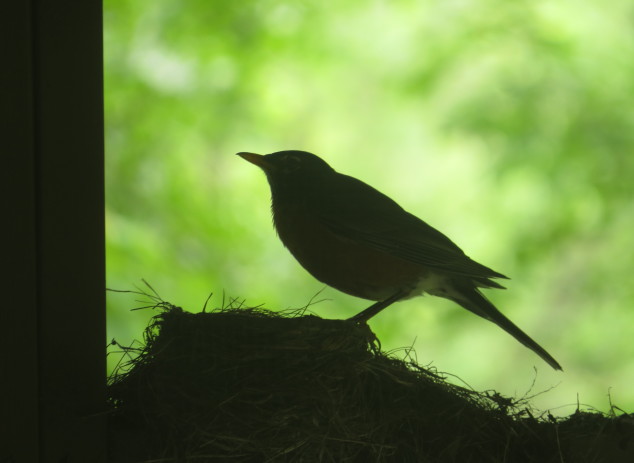
That ride was over thirty years ago, but the memory of it was brought back to me when I saw a robin taking a bath in one of our bird baths. She flailed her wings in the water, lowering her head, shaking her tail, quivering her body, as the water droplets flew around her. Then she stopped for a few seconds, turned a bit, and started over again.

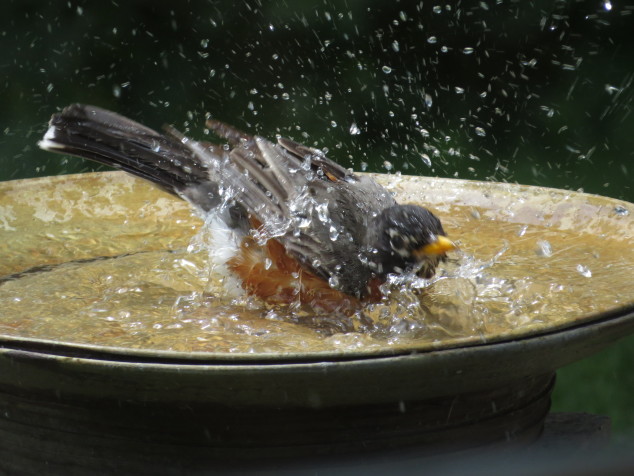
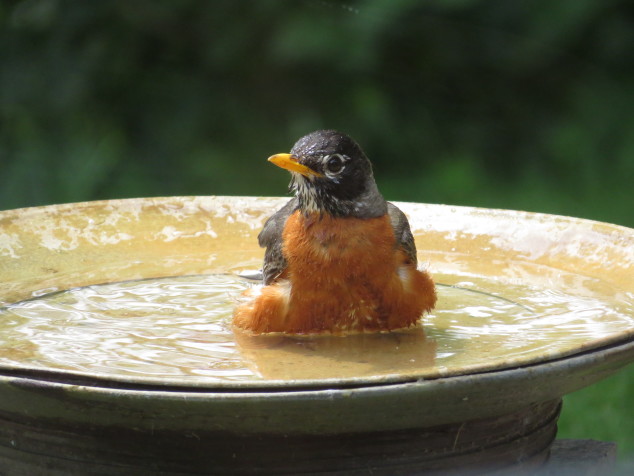
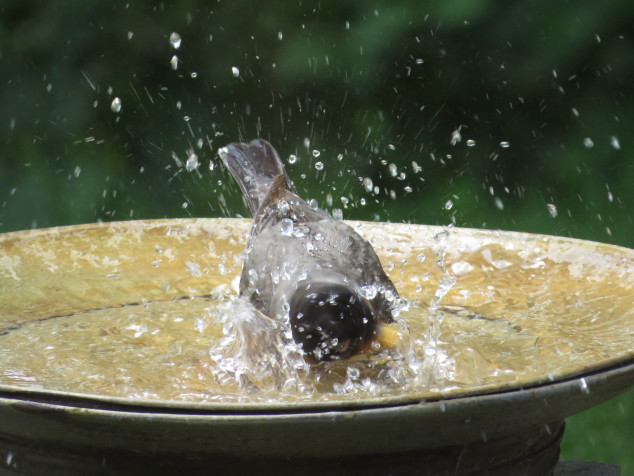
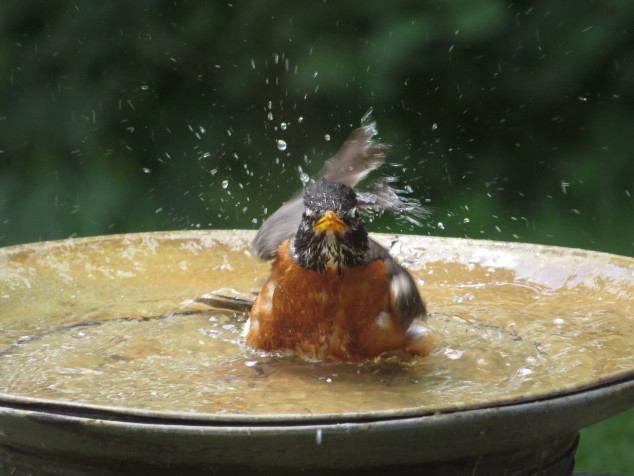
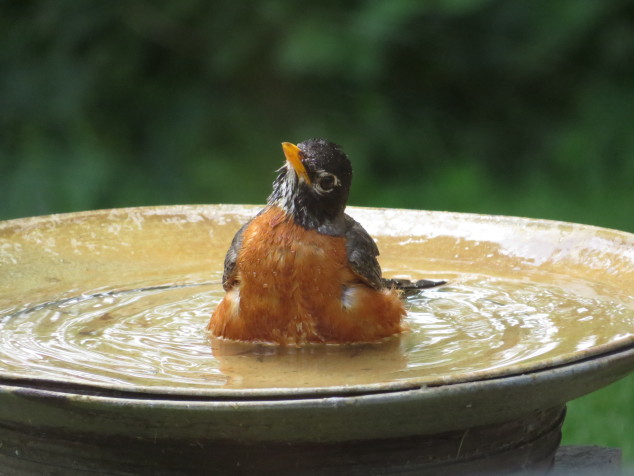
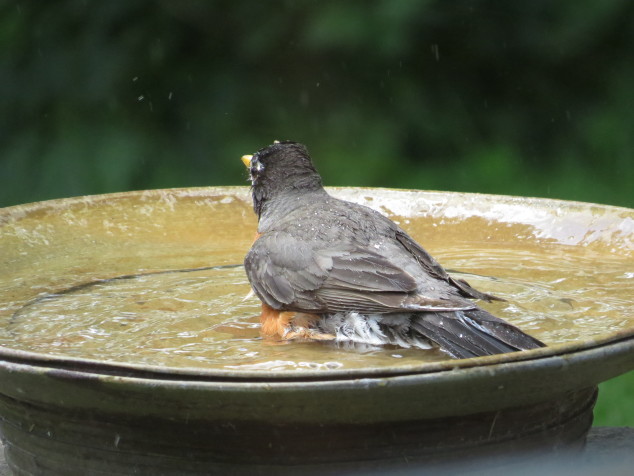
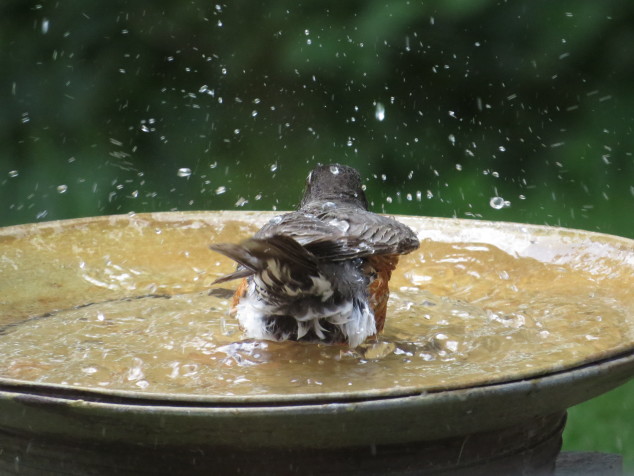
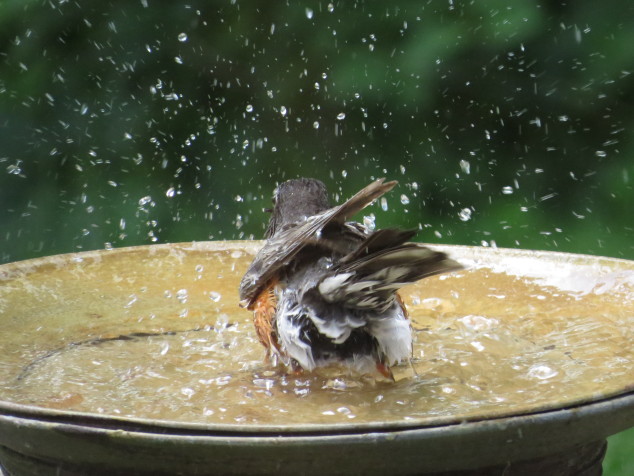
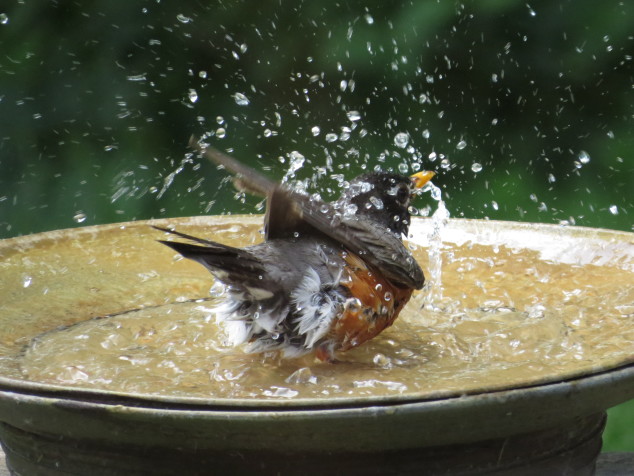
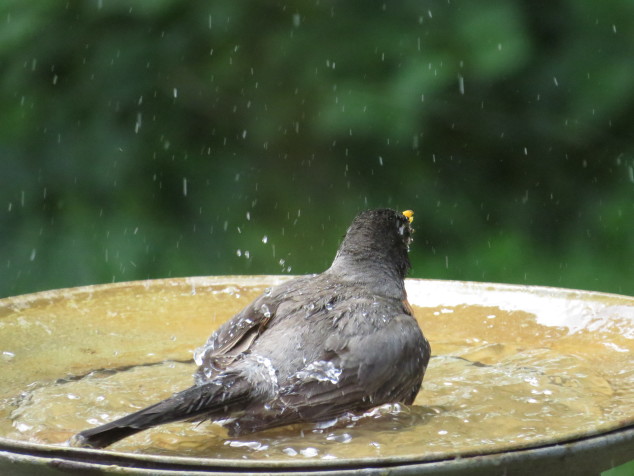
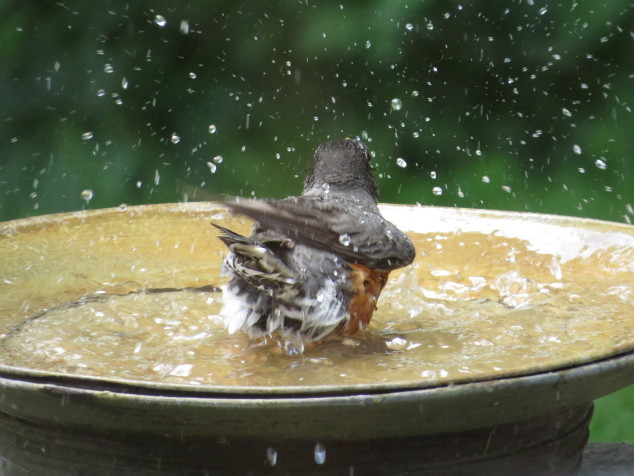
We sometimes forget that all the living creatures around us need, use, and enjoy water–just like us. The robin reminded me. The memory of Apples reminded me. On these hot, summer days as you enjoy the lakes, rivers, fountains and pools, remember to provide water for the animals–for sustenance, cooling, cleaning, and fun! Happy Summer!
Happy Independence Day!
Among my flowers and trees, Nature takes me into her own hands, and I breathe freely as the first man. –Alexander Smith
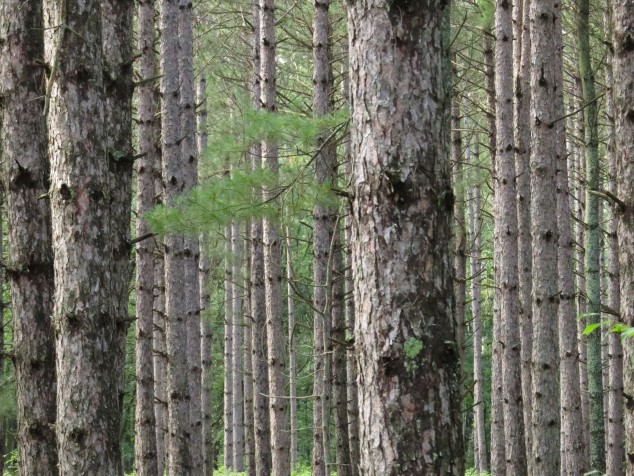
Yesterday was a good day for flying! The Robin babies in the nest on the screened-in porch were getting crowded.
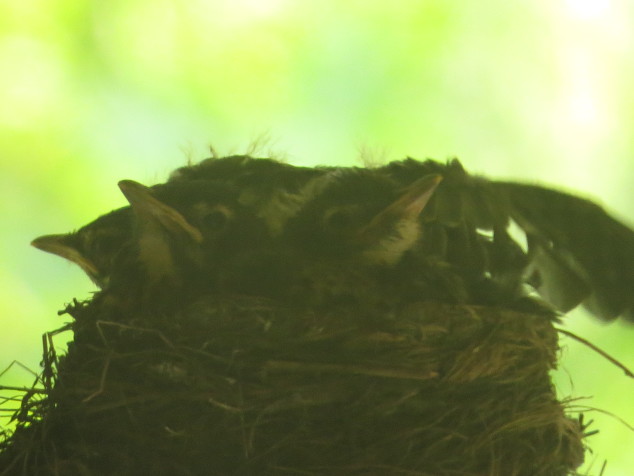
Some time yesterday they fledged the nest! It was empty. They were gone. So much activity, then stillness.
This morning, I saw one of the babies in the maple tree close to the house.
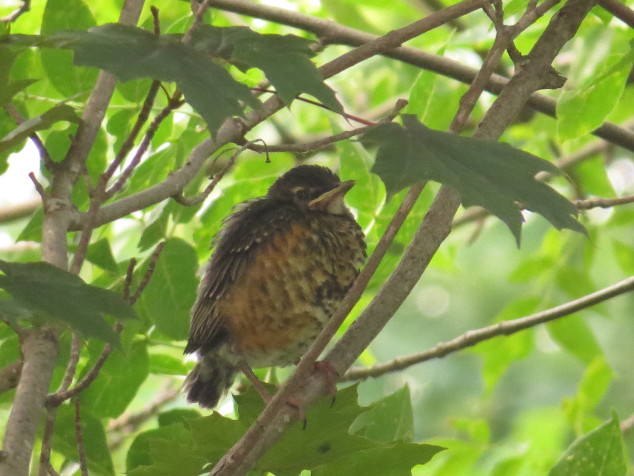
Independence Day!
But one still needs a little help from Mom even after leaving the nest!
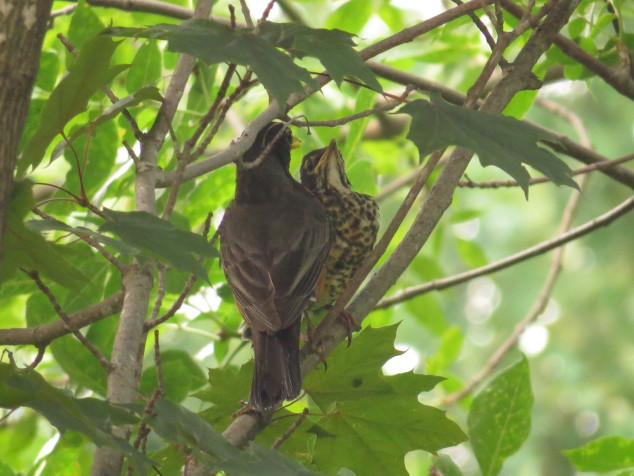
Hope your day is Happy and Safe. Hope you spend some time with Nature and breathe freely. Hope you enjoy your Independence while maintaining the connections that feed your body and soul.
Gleanings from June 2015
And what is so rare as a day in June? Then, if ever come perfect days….Whether we look, or whether we listen, We hear life murmur, or see it glisten. James Russell Lowell
The long, light days of June have slipped by, and we really have had some perfect days! The combination late Spring/early Summer brings warm, wonderful weather, incredible plant growth, exquisite flowers, and animals intent on nesting and raising their young. Life murmurs and glistens all around us, subtle yet extravagant, common yet miraculous.
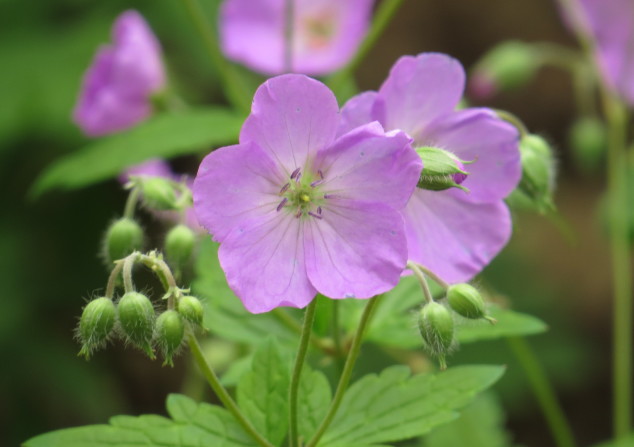
Wild Geranium is a delicate woodland flower that graces the paths through our woods.
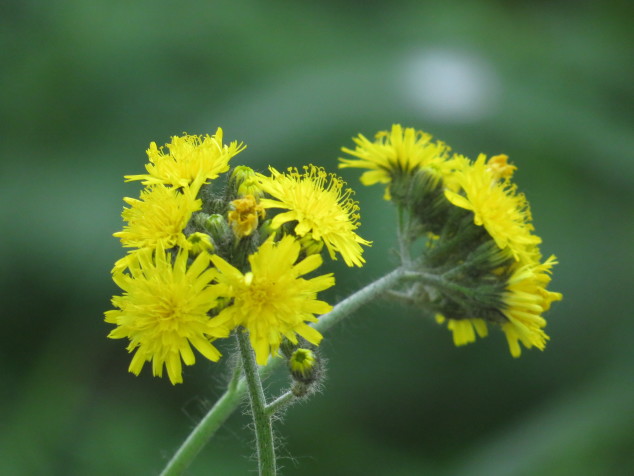
False dandelion grows in our woods, though I have also seen it in full sun along the road ditches. A cluster of small, dandelion-like flowers sways atop a two-foot stalk.
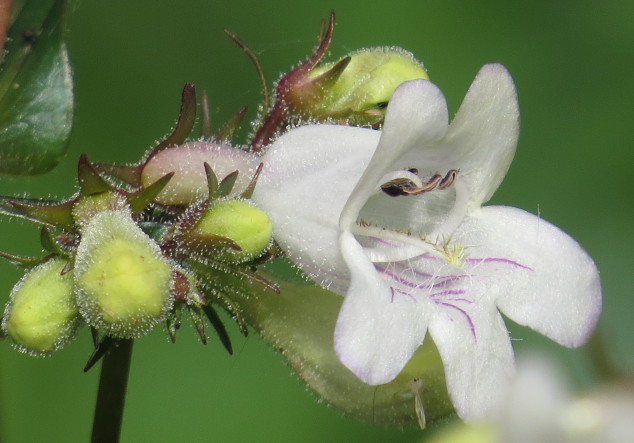
Our sun garden displays the glorious Penstemon digitalis ‘Husker Red’. It has dark maroon foliage and shining white flowers on tall stems. You can see why its common name is Beard tongue; the sterile stamen (one of five stamens) is lined with tufts of small hairs.
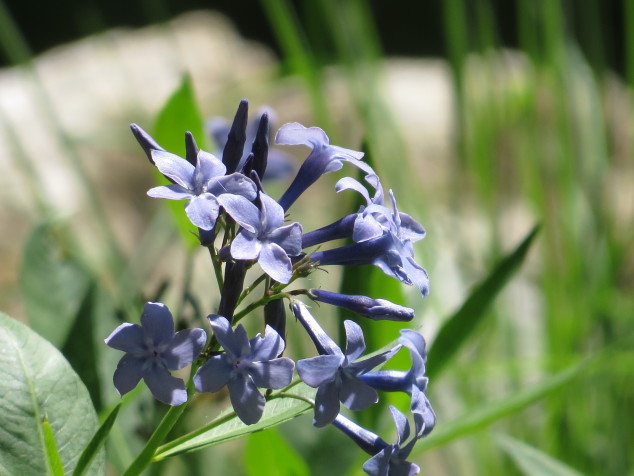
One of my prairie garden flowers–Amsonia or Bluestar–looks perfect in front of the wispy prairie grasses and the Western South Dakota petrified wood.
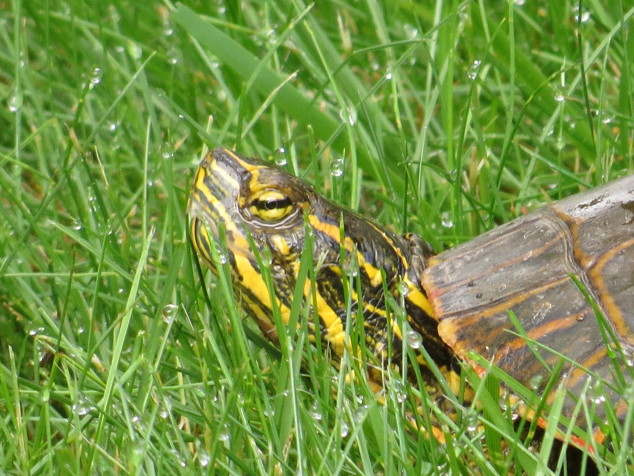
One of the critters that walked through our June yard was a Western Painted Turtle. She quickly ambled through the dewy grass until she saw me–then she stopped as I got pictures of her. She was likely on her way to her nesting place where she digs a hole with her hind feet and deposits her clutch of leathery white eggs. Incubation time is 72-80 days, and since we live so far north, the hatchlings stay in the nest until the following spring!
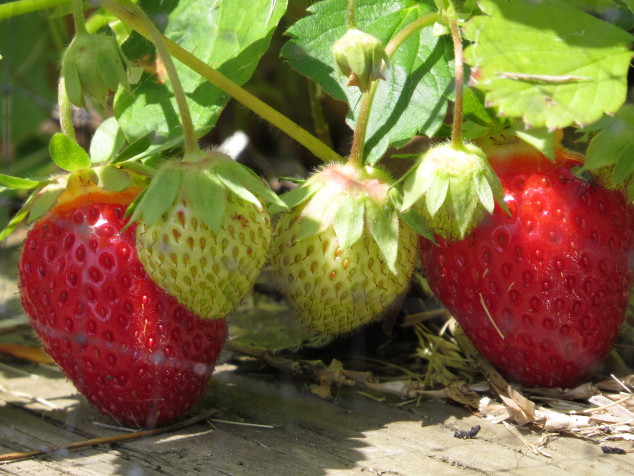
 Tiny wild strawberries and our larger cultivated ones turn a shiny red in ripeness–a sweet treat for whoever finds them first.
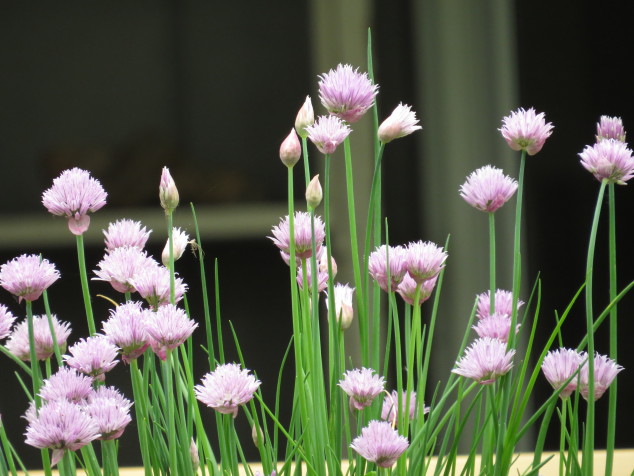
Outside the screened-in porch, the chive blossoms line up like children at the schoolyard.
And speaking of the screened-in porch, my re-do project is on bird delay! A robin thought the unscreened cross beam would be a perfect place for her grass and mud nest. There are three hungry baby birds in the nest in spite of the sawing and hammering going on below. Staining and re-screening will have to wait until the young ones fly from the nest!
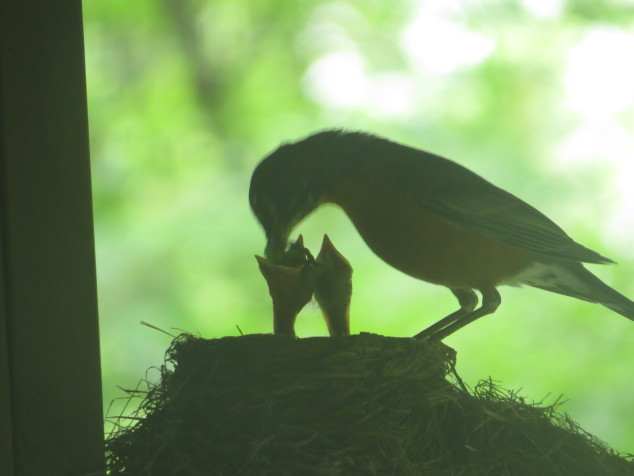
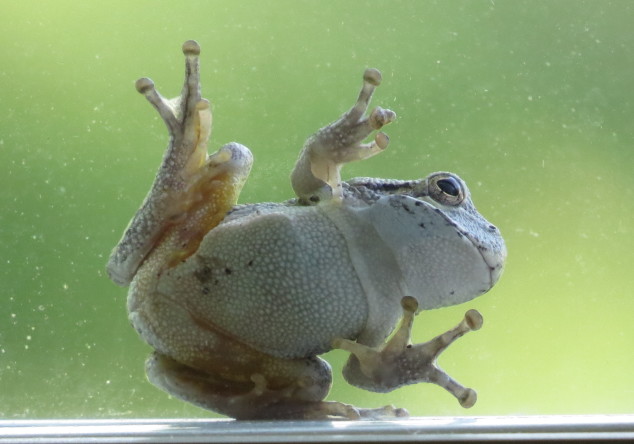
A couple of other creatures seemed to want a glimpse of human life inside the big wooden box with windows. I observe Nature every day–do we ever think about the creatures observing us?
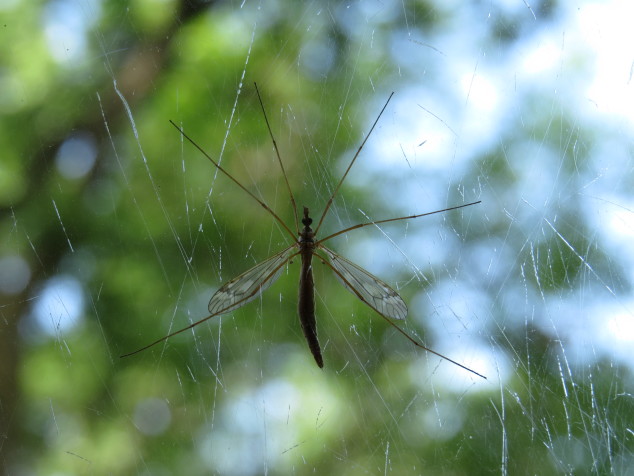
All I can say to the little critters is that I definitely need to wash windows!
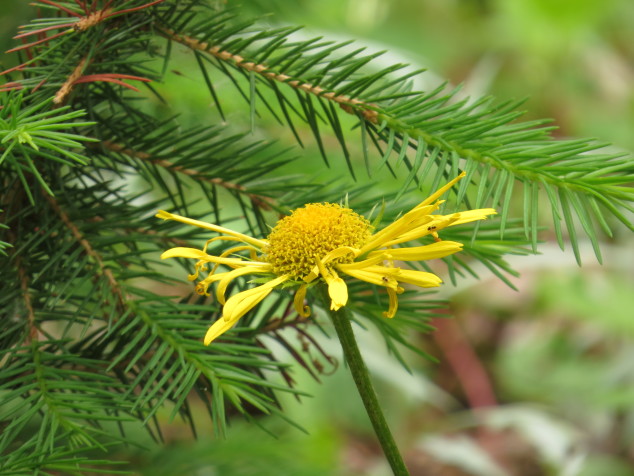
I liked this photo of Leopard’s Bane against the Norway Spruce tree. The flower is spent, on its way to decay with petals drying and falling off and with ants crawling on it. It is up against the supple new, green growth of the spruce tree. A study in contrasts.
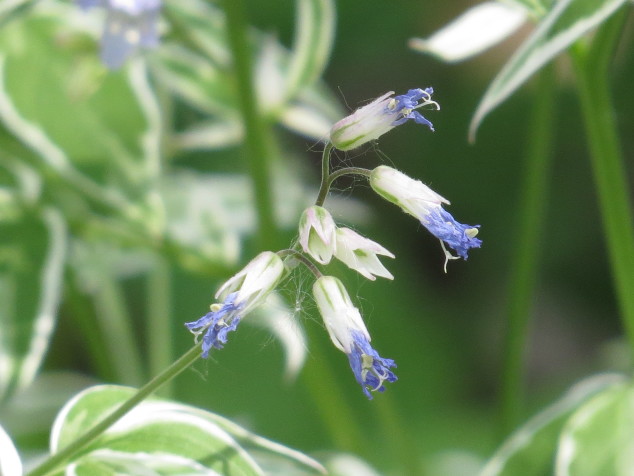
But there is beauty in the ‘spentness’ of flowers, too. Dried blue blossoms of the pretty variegated Jacob’s Ladder reminds us that the bridge between heaven and earth includes the worn out and expended of us who are just a little farther along on our journey.
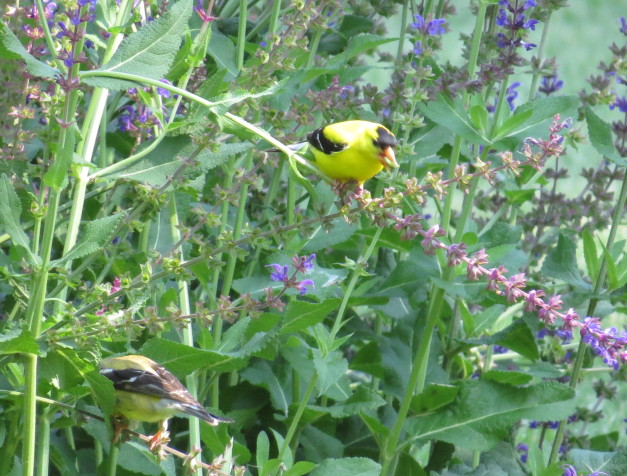
Perennial Blue Salvia in its ‘spent’ state provides food for a pair of American Goldfinches. It is in its prime time of nourishment for others, though its peak visual beauty is past.
So June encompasses the fresh, invigorated newness of plants, flowers, and creatures and also those in decline. Like all the seasons of Nature and of Life, change is always happening, whether barely discernible or a drastic metamorphosis.
Perhaps the rarity of a perfect day in June is not so rare after all. Perhaps every common day holds miracles waiting to be seen and heard. Where ever we are on our journey, whether ready to fly from the nest, in the perfect place, or in a spent state, we have gifts to offer the world and one another. As the murmur of angels ascending and descending beside us, escorts us on our journey, it is our faces that glisten on each perfect day.
Shade at Night
Imagine you’ve been playing or working hard in the summer sun for hours…can you feel the heat? Then imagine sitting under the shade of a maple tree…ahhh…that feels better! The shade offers relief from the intense sunlight, and you feel cooler and more refreshed.
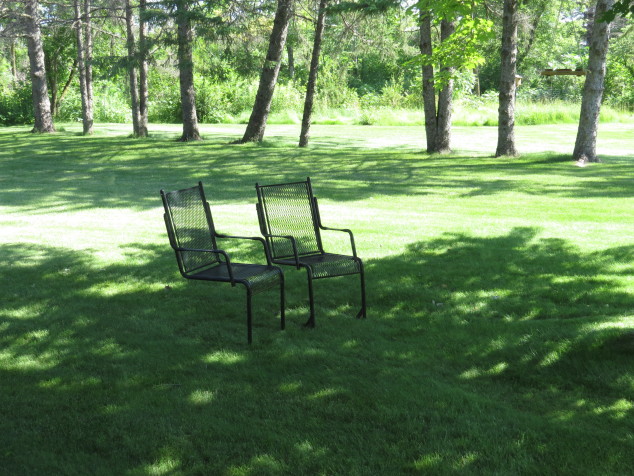
A year ago at the end of May, we were on vacation for nine days, traveling to South Dakota and Missouri. When we left home, the leaves were just beginning to unfold after an extremely late spring. When we returned home, it was rather shocking to see the lawn grass going to seed and the trees fully leaved out. That first night back, I remember I turned off all the lights before bed and was startled by the blackness. Why was it so dark? I thought to myself. At first I thought something was wrong–it took me a few seconds to realize the darkness was from the shade at night!
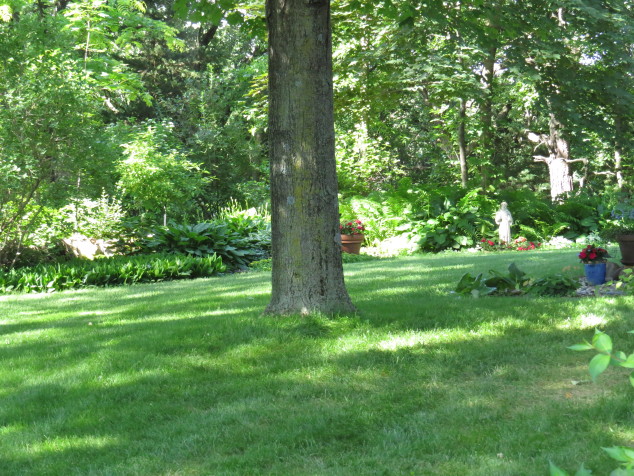
For half the year, we don’t have leaves on the trees, and for many of those months we also have the bright reflection of light off snow. Starlight, moonlight, and lights from town down the hill shine and reflect into our numerous windows during those months. When late spring and summer arrive, the three maple trees around our house and the trees in the surrounding woods block the light, creating shade at night and during the day.
Last week a darkness fell upon a young couple as their newborn baby could not be resuscitated after an emergency c-section. My heart sank when I saw the tragic news about their firstborn son. I flashed back to my own emergency c-section with our firstborn, and I sighed another prayer of thankfulness that our daughter made it through that scary time. But this young couple, who tends the land and a menagerie of animals, who dreamed of and planned for and carried this baby for nine months, came home empty-handed and broken-hearted.
There are many ways to lose a child, none of which is any easier than the other. The heartbreak is profound and deep, and it seems like nothing will ever fill the hole of despair. For all those in a dark night of the soul, sit in the cool Shade at night. Let the glaring distractions of the outside world be filtered out by the Protection overhead. Let it envelop you with everything you need. Let it bring comfort for your aching heart and hope to your weary mind. Let it refresh you, replenish you, restore you.
Listening to the Silence
My middle growing-up years were in Pennsylvania on our little acre of hilly land, out of sight from everything, but within earshot of the Pennsylvania Turnpike. Most every summer, we would pack up the Mercury wood-sided station wagon with us four kids, our little brown suitcase of ‘things to do’, and a Johnny Cash eight track tape and head west on that turnpike. Most often we would leave on Friday night after my Dad got home from working at the shop, and my parents would take turns driving, straight through, to my Grandparent’s place in South Dakota. We would arrive early Sunday morning before my Grandpa headed off to church and my Grandma put a large beef roast in the oven. It was always good to be back Home!
One evening–maybe that very first one after our long drive–my Dad was sitting on the porch stoop. I opened the door, walked out onto the porch, and asked him what he was doing. He said, “I’m listening to the Silence.” I can’t remember how old I was at the time, but I remember thinking that was a crazy thing to say! How can you listen to Silence?! He patted the cement beside him for me to sit down. He told me about hearing the crickets and frogs, the cows lowing in the paddock as they came up from the pasture to the round, wooden water tank, how the windmill squeaked as the breeze moved the blades, and how the geese chattered in the slough over the hill. We sat there together for a while, and I really started to listen for all the different sounds of the Silence on the farm.
Today is Father’s Day and the First Day of Summer! I smile when I realize it’s 10 o’clock in the evening, and there’s still a hint of light outside. I love it when I can go outside with no coat and no shoes! I laugh at our dog when we go out to get the mail, and she rolls in the warm grass and watches me walk to the mailbox. I marvel at all the bird mamas and daddys who are flying, hunting, and taking care of their babies.
Summer is…my most favorite flower–perennial Blue Flax…
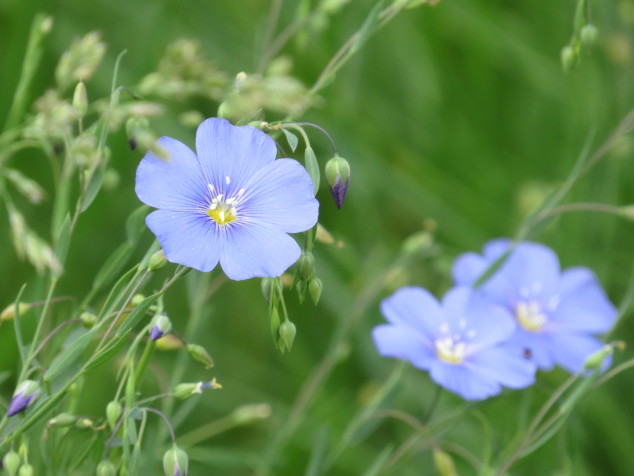
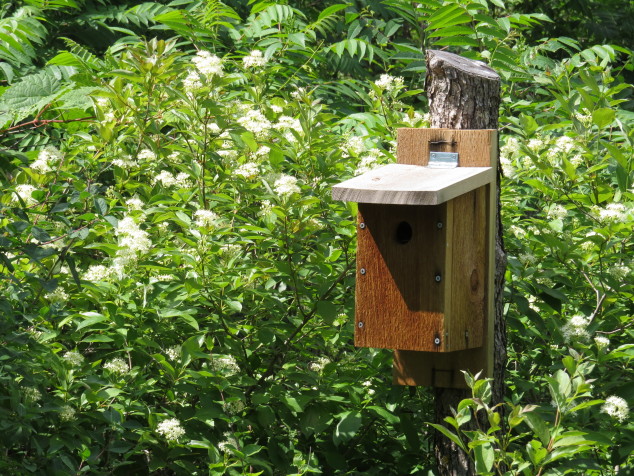
blooms and birdhouses…
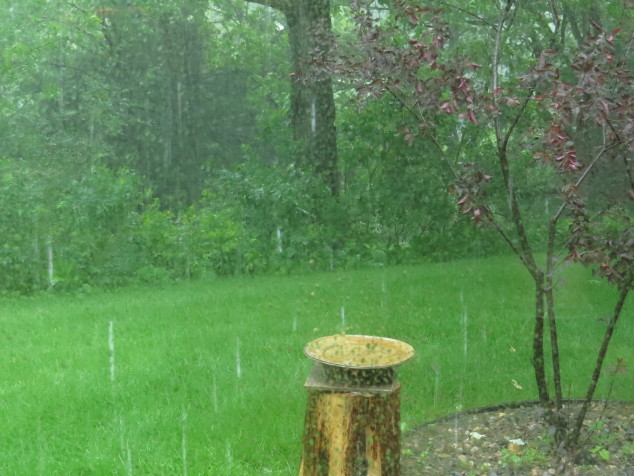
rain…
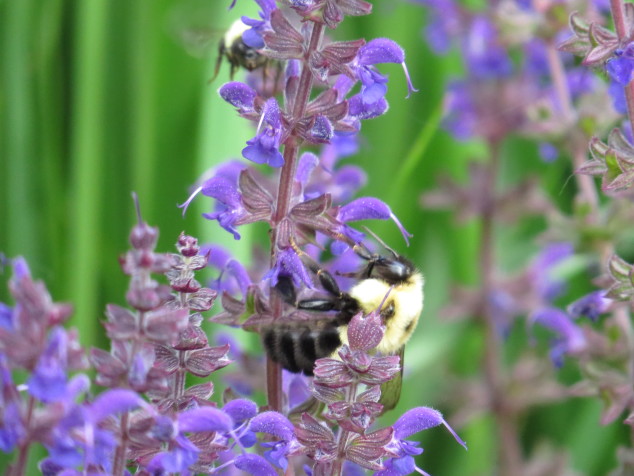
bumblebees…
and birds.
Summer is being outside with Nature, toes in the grass, head under the stars, fish on the line, sun on skin, and listening to the Silence.
Thinking back on those 1500 mile trips with four kids in the car, the constant buzz of turnpike traffic at our house, and the din of diesel engines working as a truck mechanic, it’s no wonder my Dad wanted the calm and quiet of an evening on the farm in South Dakota. That special memory of me and my Dad has stayed in my mind and heart for decades, and I continue to appreciate the quiet sounds of Nature. Happy Summer to all of you, and if you can’t be with your Dad today, I hope you can call to mind a special memory of him while listening to the Silence of Nature.
Caterpillars, Cocoons, and Butterflies
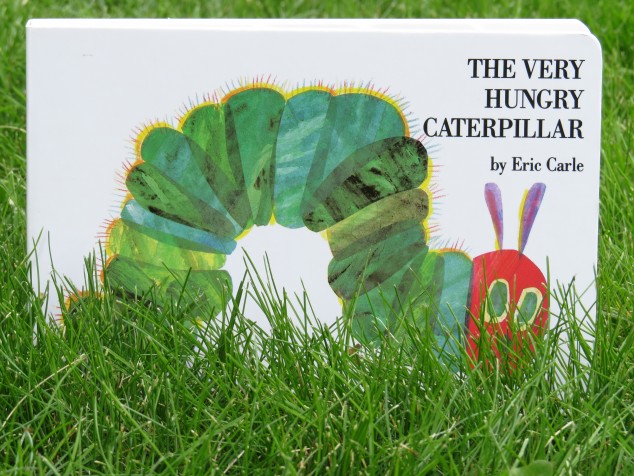
I love a good picture book! And Eric Carle is one of the best authors/illustrators for Nature picture books for young children. It is important to teach children about Nature, to introduce them to the natural world, and to instill in them an appreciation for all creation. If you teach children to love Nature, they will respect and care for our Earth.
The winners of Eric Carle’s The Very Hungry Caterpillar board books are:
Maggie and Lynda–two of the most beautiful butterflies I know! You both have so much to offer to all the people around you! Maggie, your energy, humor, and goodness reach out and touch people deeply. Lynda, what wisdom and love-in-action you model to those lucky enough to be in your presence. So glad I have spent many years in the company of both of you! I will get your books to you next week!
The other butterfly–Emily–who indeed has migrated far from home–you inspire me every day with your energy, your insight, your compassion, and your love. I still have our Very Hungry Caterpillar book in a box somewhere!
Amy, you are so right that this northern climate going into fall and winter makes one want to spin a cocoon! It’s a good place to be when it’s cold and dark outside. It can be a time of rest, reflection, and rejuvenation–you of all people know the benefit of such a time. And when you spread your wings and your talent and love, we are all blessed by knowing you.
And to my fellow caterpillars, my sisters Brenda and Sam, we all find ourselves in this empty nest struggle–the end of all the years of caring for our kids on a daily basis to the beginning of the years of relating with our adult children. How do we do this?!? No manual for that either. It makes me want to eat chocolate–when I know I should be eating green leaves! And so we work on our next transformation…. Love to you both!
Eric Carle is best known for his children’s books, but when our daughter Emily was in an old bookstore in Ely, MN, she found the book Nature Thoughts–A Selection that was illustrated by Eric Carle! The copyright was 1965 and the original cover price was $1.00!
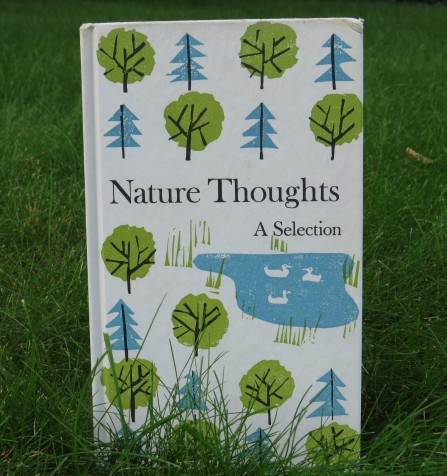
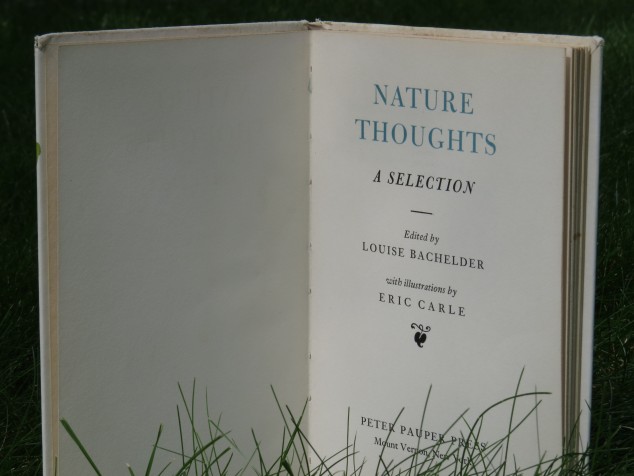
One of the quotes from this book talks about the changes in Nature–how we are given ‘some beauties’ in every season. My wish for you is to recognize the ‘beauties’ in your life, no matter the season, so you can cherish them, appreciate them, and take good care of them.
Nature gives to every time and season some beauties of its own; and from morning to night, as from the cradle to the grave, is but a succession of changes so gentle and easy that we can scarcely mark their progress.
Charles Dickens
From Hungry Caterpillar to Beautiful Butterfly
We lived in Missouri when the kids were little, and we had black walnut trees on our acreage. Messy as they are in autumn when the green nuts fall from the trees and turn tarry black, they are the host tree for the eggs of a magnificent moth. The kids and I found a silken wrapped cocoon among the leaves one day in late summer and brought it into the house. The cocoon resided on the end table under the brass lamp, and for months we didn’t give it much thought. One day I heard a noise–a rattling, shaking noise–coming from the cocoon! And it was moving! In a number of days, the activity inside the cocoon increased until one morning, a wet-looking, bedraggled moth emerged and crawled up the lamp to hang on the lampshade to rest and fill its wings. The wings were bright green with eyespots and long tails on the hind wings. It was a big, beautiful Luna Moth! The kids were so excited that their cocoon had ‘hatched!’ The moth flew around in the house for a few days, then laid rows of brownish eggs on the lampshade. The adult moths do not eat–they mate, lay eggs, and die within a week of emerging from the cocoon.
The whole transforming process of butterflies and moths–from eggs to hungry caterpillars to flying adults–is intriguing and inspiring. It is the iconic metaphor of changes in life–beginnings, development, growth, rest time, transformation and struggle, and the beauty of the emerging self.
I have collected a few photos of butterflies and caterpillars over the summer–others, like the Yellow Swallowtail, teased me with their frequent visits to the flowers, but I just wasn’t able to get their pictures.
The familiar Woolly Bear caterpillar, known for the folklore of predicting the severity of the upcoming winter, is also called the Hedgehog caterpillar because it curls up and ‘plays dead’ when disturbed.
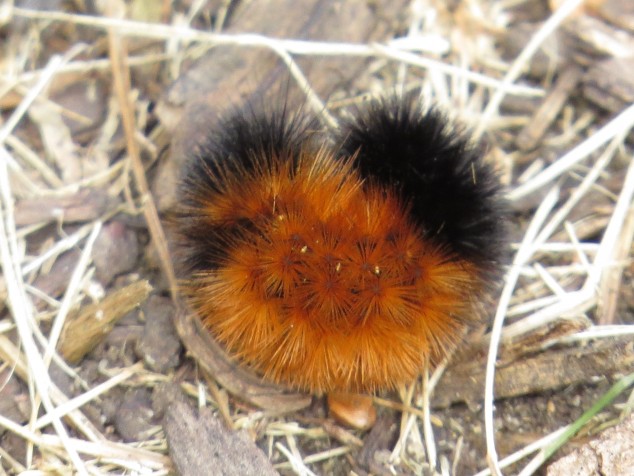
The more interesting fact about this caterpillar is that it overwinters in its caterpillar form, producing a cryoprotectant or natural antifreeze in its tissues that allows it to live frozen all winter. The Woolly Bear caterpillar thaws in the spring and pupates to become the little known but beautifully named Isabella Tiger Moth.
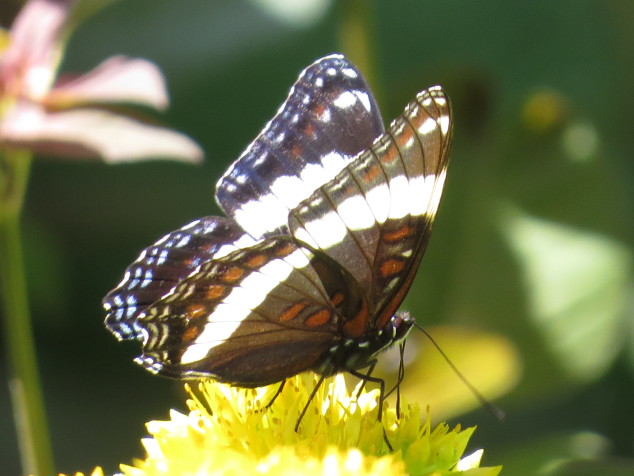
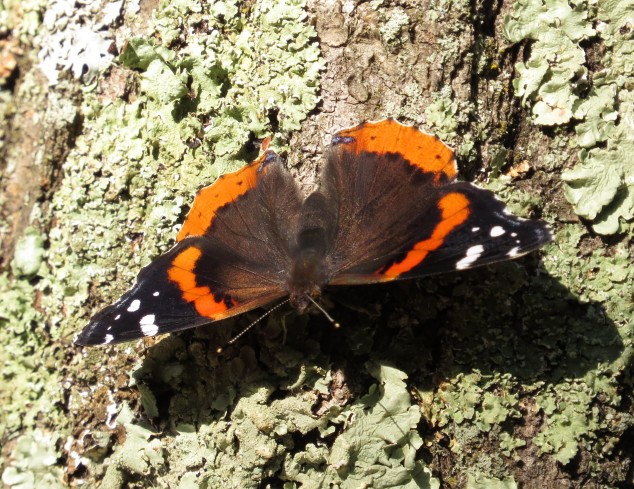
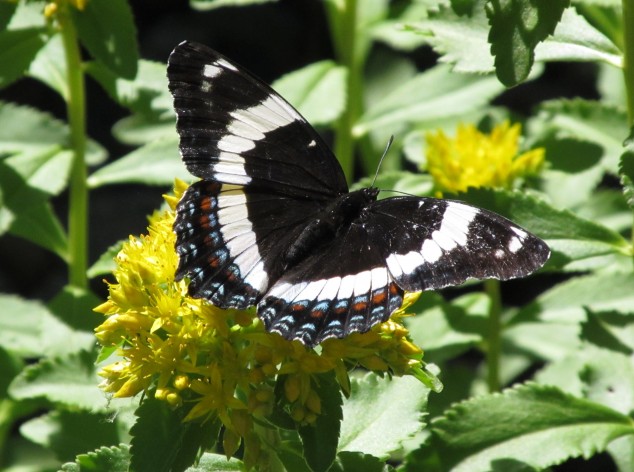
I found a Red Admiral butterfly on a tree up in the Brainerd Lakes Area and a White Admiral right outside our front door.
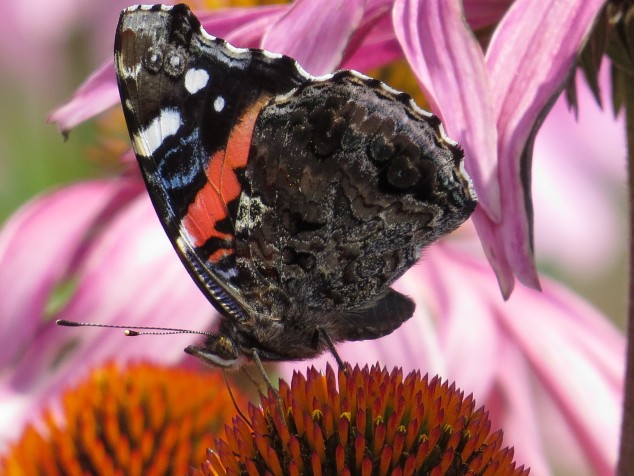
 A Painted Lady graced the Purple Coneflowers at the College of St. Benedict, complementing one another in their colorful beauty.
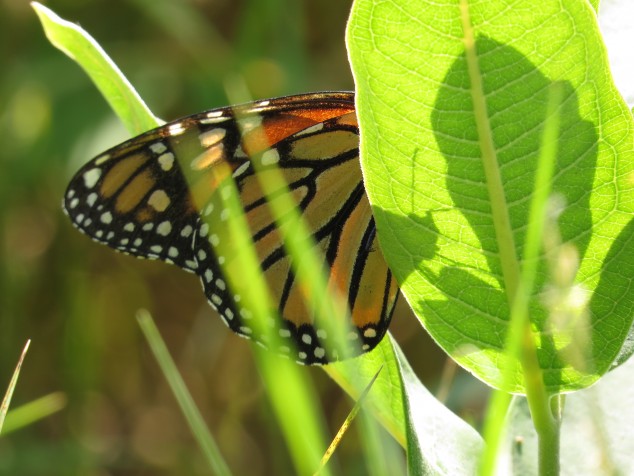
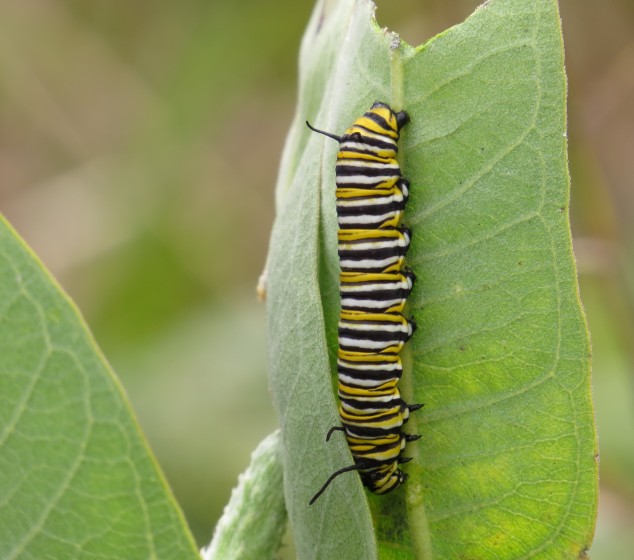
On a Milkweed plant along the road by our house, a hungry, striped, Monarch caterpillar munched on its food of choice.
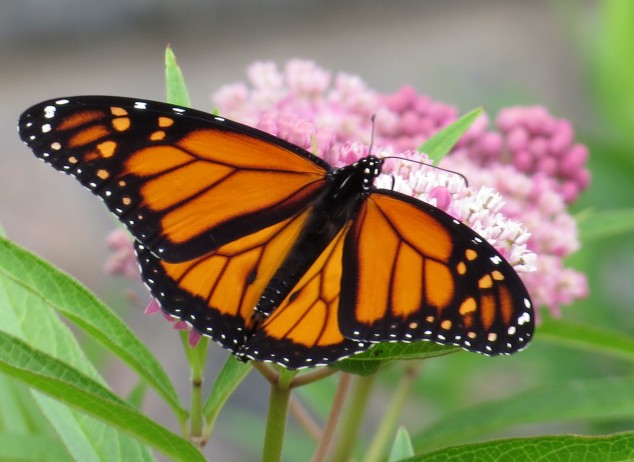
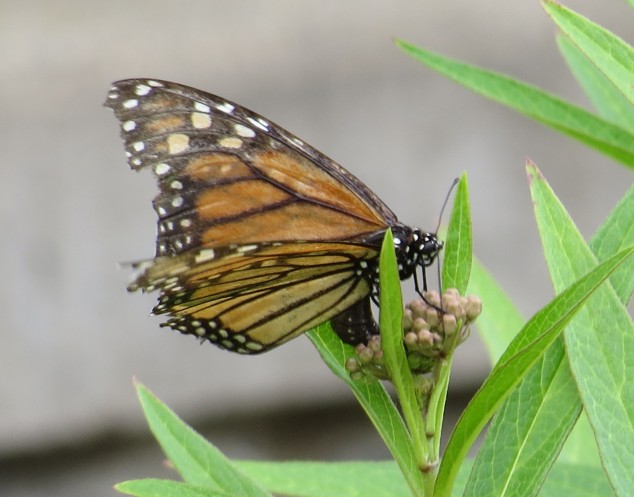
At the Butterfly Garden at the College of St. Benedict, a brilliantly colored Monarch in pristine condition alighted on a milkweed flower, while nearby a tattered, pale-colored one rested on buds that were not yet open. What storms and struggles had this faded beauty been through? It must have been close to the end of its 6-week adult life. Only the adults who emerge from the chrysalis in late summer migrate en masse up to 3000 miles to warmer climates.
The transformation of caterpillar to butterfly is illustrated in Eric Carle’s classic children’s book The Very Hungry Caterpillar.
In celebration of two seasons of blogging, I am giving away new 5″ x 7″ board books of The Very Hungry Caterpillar to two readers. ‘Like’ my NorthStarNature Facebook page if you haven’t already, share this post on Facebook or with someone you know, and tell me in your comment if you feel like a caterpillar, chrysalis (cocoon), or butterfly at this time in your life! I will randomly choose two names and let you know the winners on Friday. Thanks to all of you for reading my blog!
A Chilly Morning to See
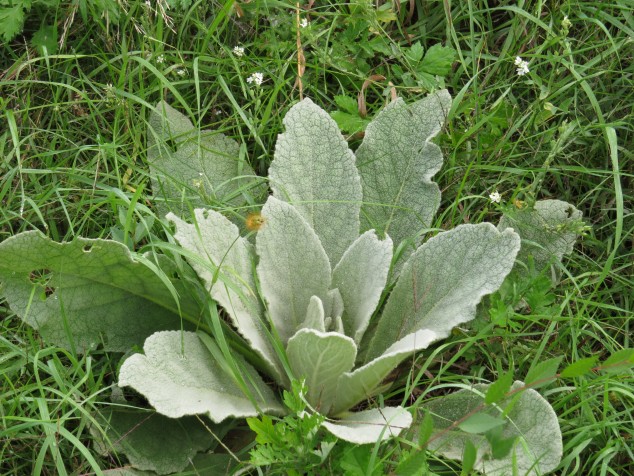
It was a chilly morning this morning–cool enough to wear long pants, a fleece, and a windbreaker. The dog and I walked our usual morning route. I noticed how the new mullein plants were growing alongside the road. Mullein or Flannel Plant is an introduced biennial from Europe. The first year the plant grows only the soft gray basal leaves. The woolly leaves have been used as wicks for torches, lining for socks and moccasins to insulate from the cold, as diapers, as a balm to soothe sunburn, and as a tea to treat colds. The plant will overwinter in this state.
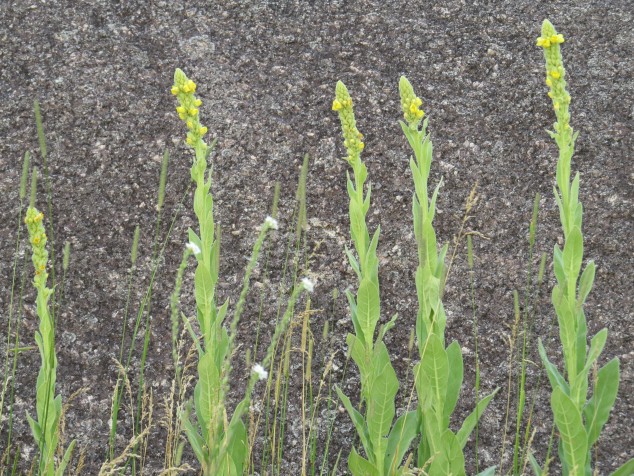
The second year, the flower stalk grows two to six feet tall with a spike of yellow flowers.
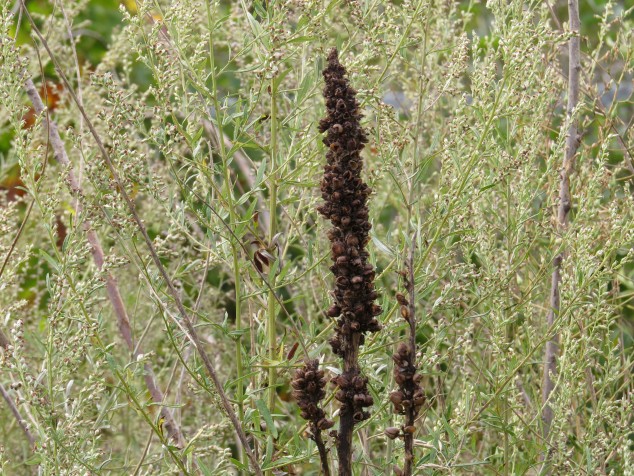
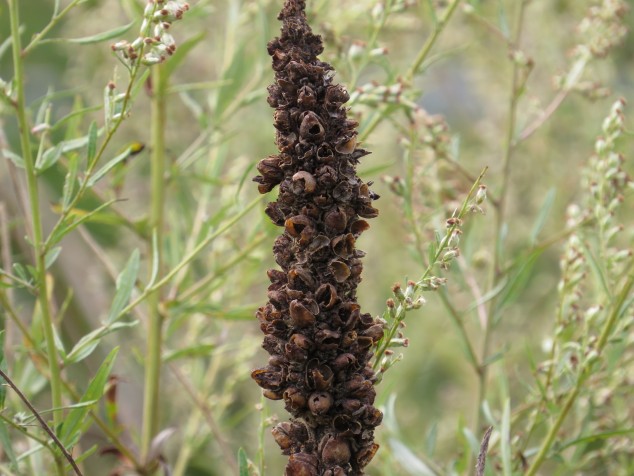
It then dries to a dark brown at this time of year so the seeds can disperse for the next year’s crop of velvet-leaved, first-year plants.
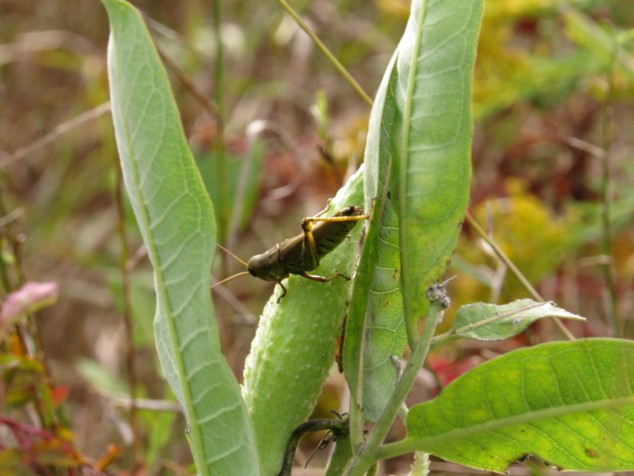
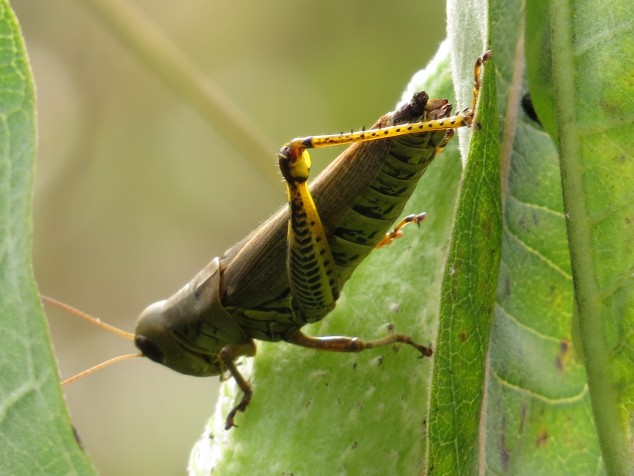
I saw a grasshopper on a milkweed plant, sluggish and slow moving in the cool air. I noticed he was missing a leg. Perhaps the dog had grabbed at the hopper on a previous walk and caused the mishap, since catching grasshoppers seems to be her new preoccupation.
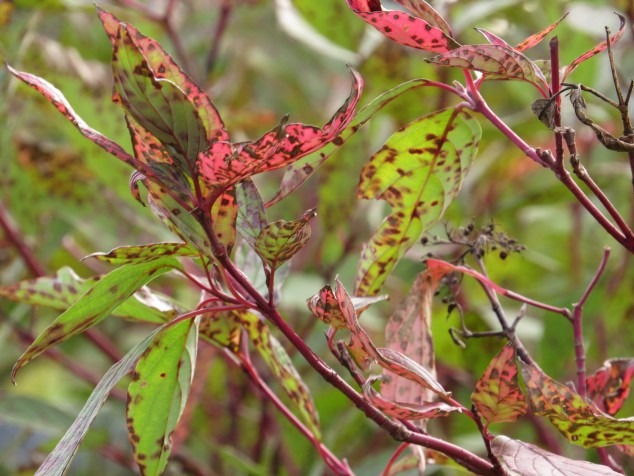
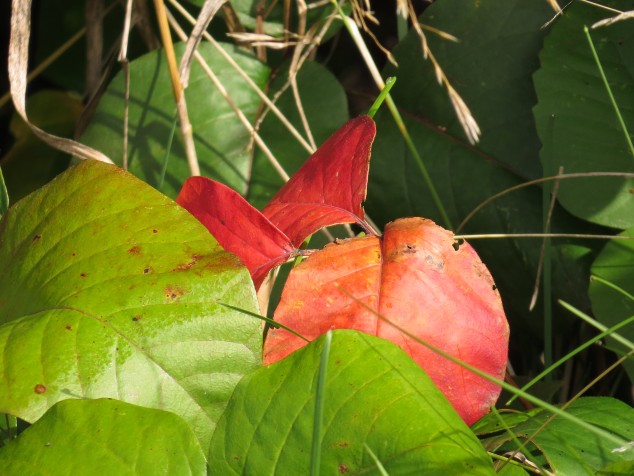
 The spotty-leaved red twig dogwood was beginning to show its color, as was the poison ivy.
Then as I looked past the clover patch that I walk by every day, I thought, “What the heck–is that a boat in the grass down there?!” Through the camera lens I could see an old rowboat.
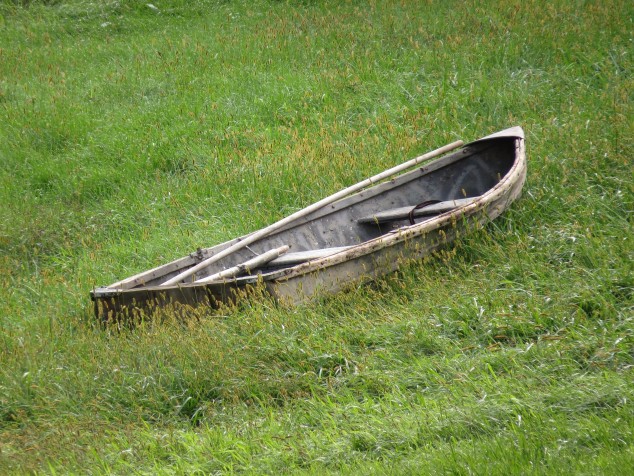
Why had I not noticed that before? It was on the bank of a small drainage pond that was now filled with cattails.
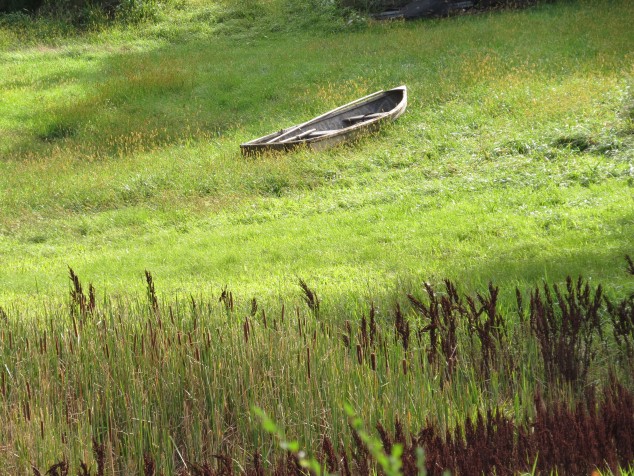
I realized that someone had probably been able to float it in June when we had so much rain and before the cattails grew tall, but it certainly looked out of place now. Out of place in a lovely kind of way.
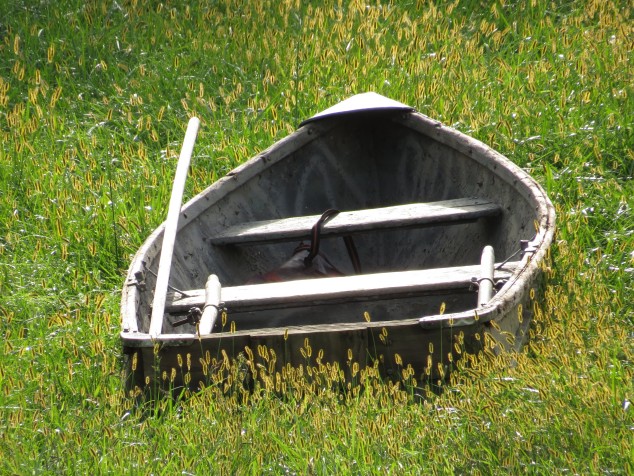
I consider myself an observant person, but I realize that we often see only what we want to see. I ‘see’ nature everywhere I go–tiny details to movement to the big picture, but I couldn’t care less about ‘seeing’ fashion. When my oldest daughter was in kindergarten, she would come home and tell me exactly what the teacher wore to school that day–and she still ‘sees’ and loves fashion details!
Sometimes we don’t see things that are in plain sight. Now granted, our brains have to filter out many things that are right before our eyes or within hearing distance or touching our skin just because we would be overwhelmed by stimuli if it did not. But often we put our own filters or blinders on what we see and know. And that can be a deterrent to living a full and wonderful life.
So I’m going to be open to ‘see’ more things in my life. Maybe seeing the boat this morning did that for me. And now that I think about it, I did see a pair of brown leather boots that I liked in the latest Eddie Bauer catalog!
“One way to open your eyes to unnoticed beauty is to ask yourself, ‘What if I had never seen this before? What if I knew I would never see it again?’ ” –Rachel Carson
- « Previous Page
- 1
- …
- 9
- 10
- 11
- 12
- 13
- 14
- Next Page »