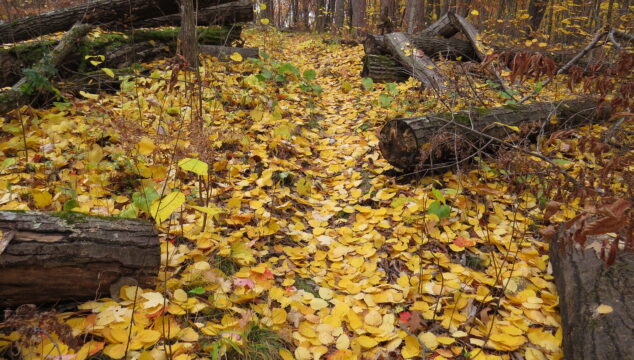
Come walk with me in the peak Autumn beauty of the Northwoods. To say that I love this time of year is an understatement. Most everyone can appreciate the colorful falling leaves---it reveals the 'true self' of a tree when its leaves are no longer producing chlorophyll. Their true colors are revealed, and there is something simple … [Read More...]
Archives for 2020
A River of Trees
It’s a topsy-turvy world right now—too much confusion and disorder—not only around the corona virus pandemic, which is overwhelming, to be sure, but in so many other ways. Some safely-isolated people wonder what all the fuss is about, while those on the ‘front lines,’ amid the illness and death, wonder how some people can be so cavalier. Certain states and populations are suffering with great numbers of death and job losses, while others are living their lives without much disruption at all. The political fighting is like a bad divorce—both sides think they’re right and blame the other for all the things gone wrong. Nobody wins.
In the midst of the chaos, as states were beginning to find their way to ‘opening,’ we quietly kept a heart-promise made when Chris’ brother died late last summer. We followed the Great River that flows near our house down to Cassville, Wisconsin, the tiny river town where Chris’ folks grew up and where the boys spent their summer vacations. A homecoming of sorts. We spent part of the day high above the Mississippi River at Nelson Dewey State Park. The park’s 756 acres were once part of Nelson Dewey’s large 2,000 acre agricultural estate. As a young man (age 35), he was elected as Wisconsin’s first governor when the state formed in 1848. But long before him, it was home to Native Americans. Two village sites and three groups of burial mounds have been found in the park. Holy ground.
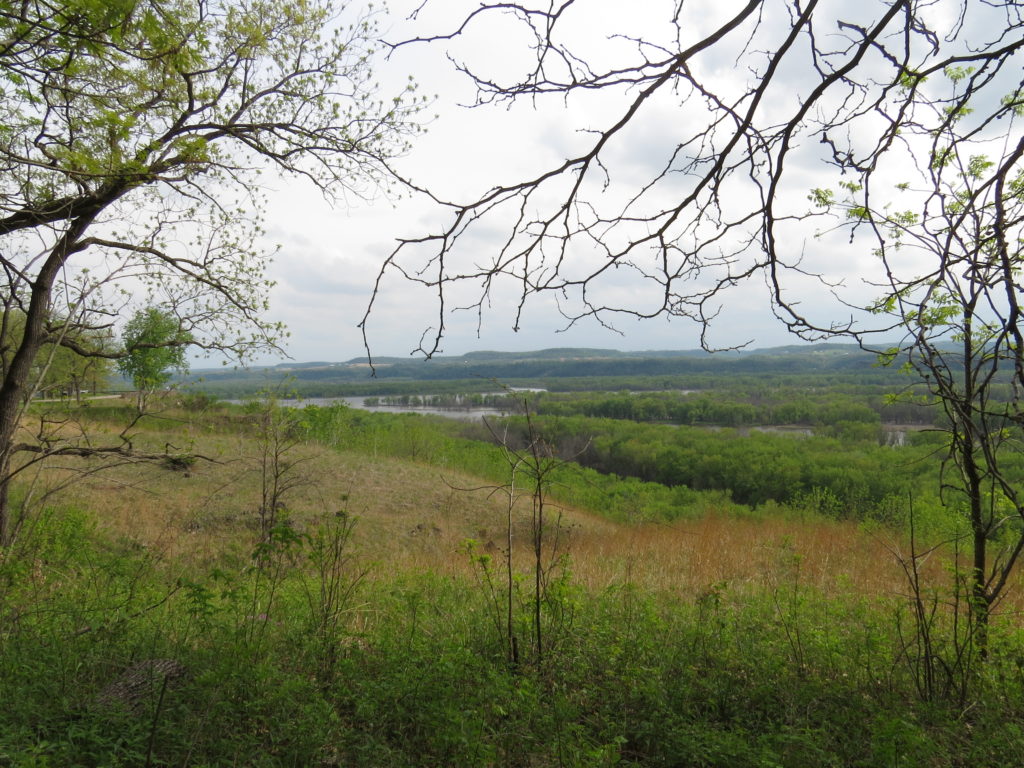
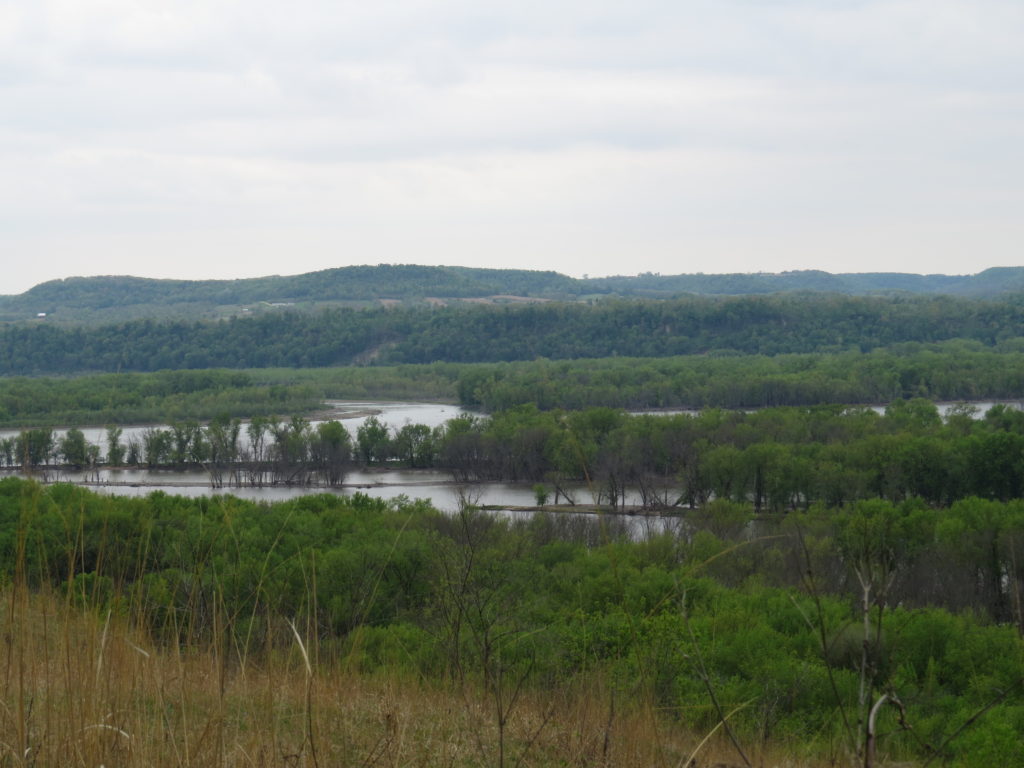
Looking out over the Mississippi from the bluffs, I remarked it was like a river of trees. Long sandbar islands of trees with their newly sprouted leaves made for a topsy-turvy river. It was difficult to tell where the main channel flowed in the maze of water and trees.
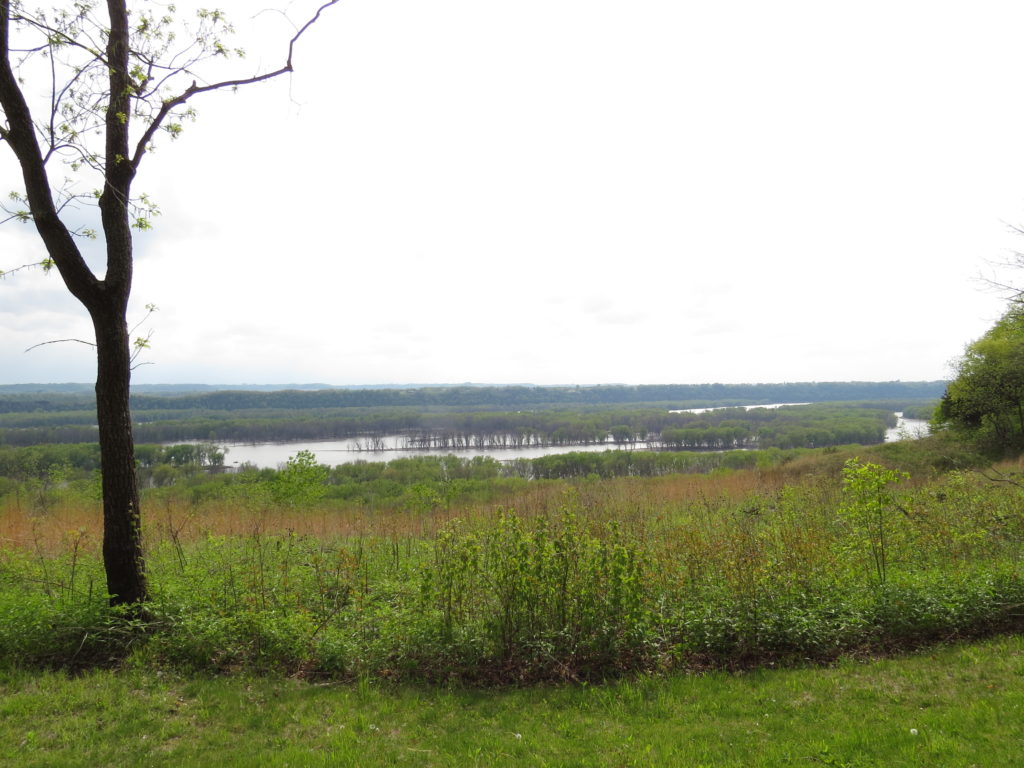
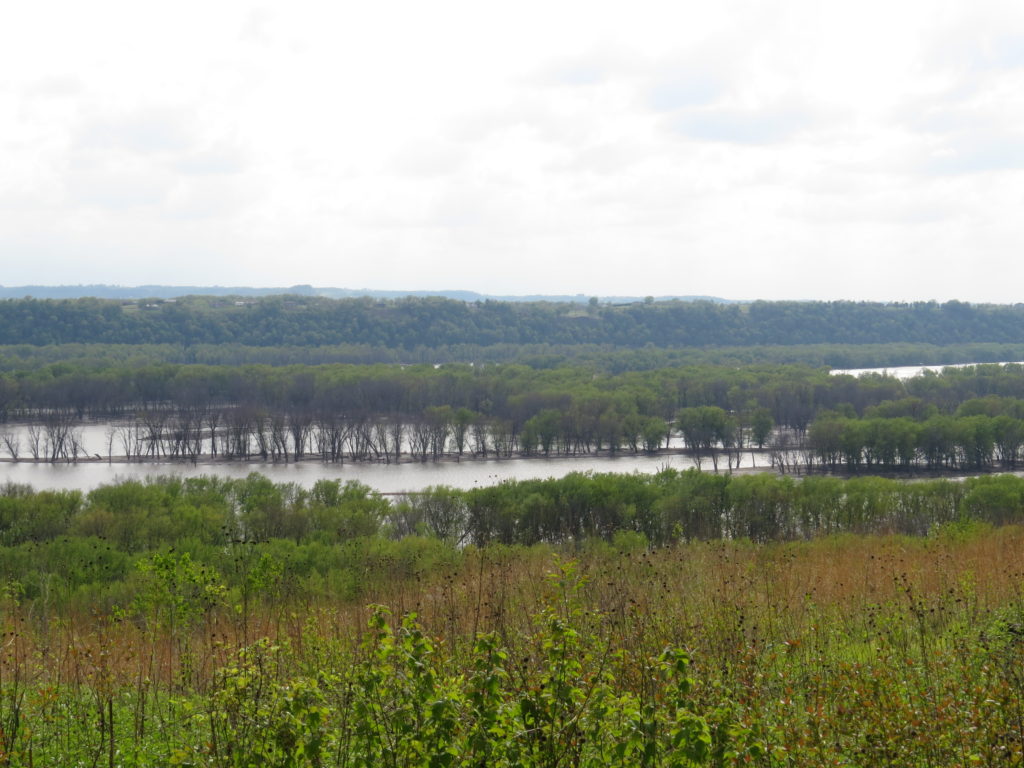
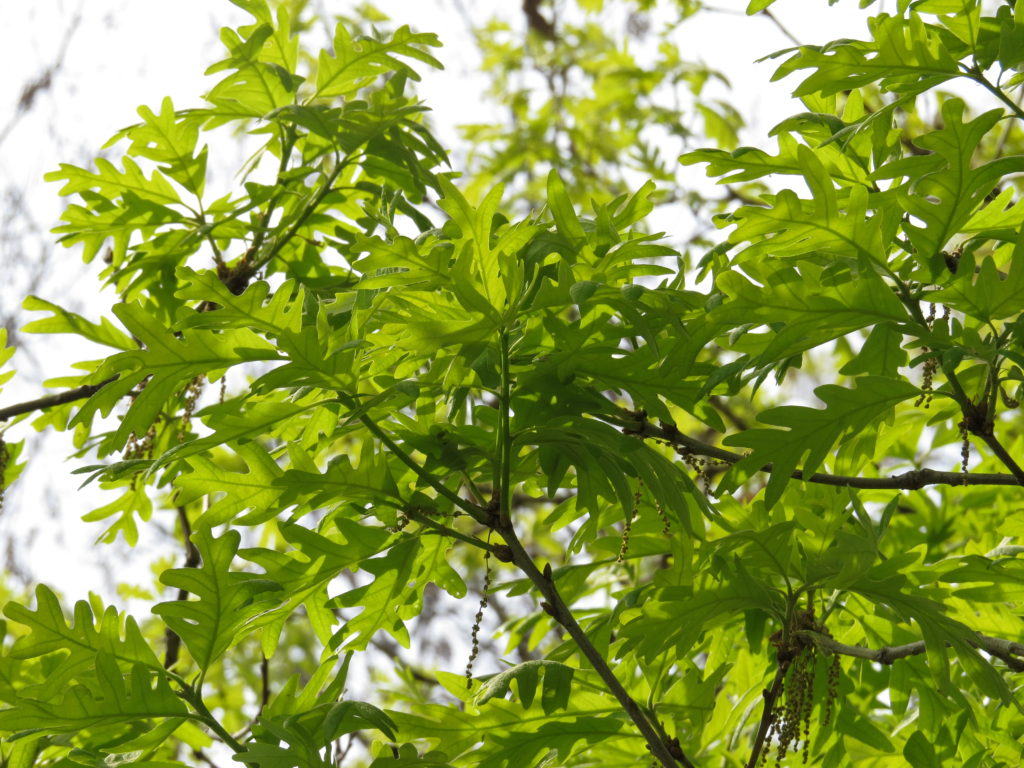
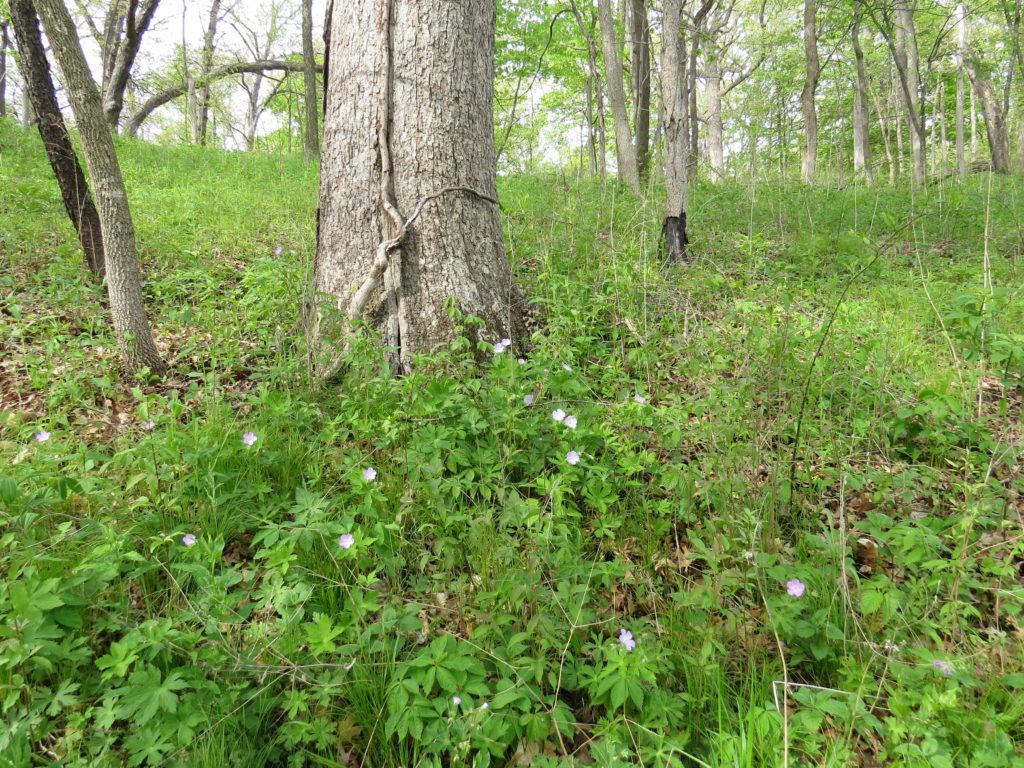
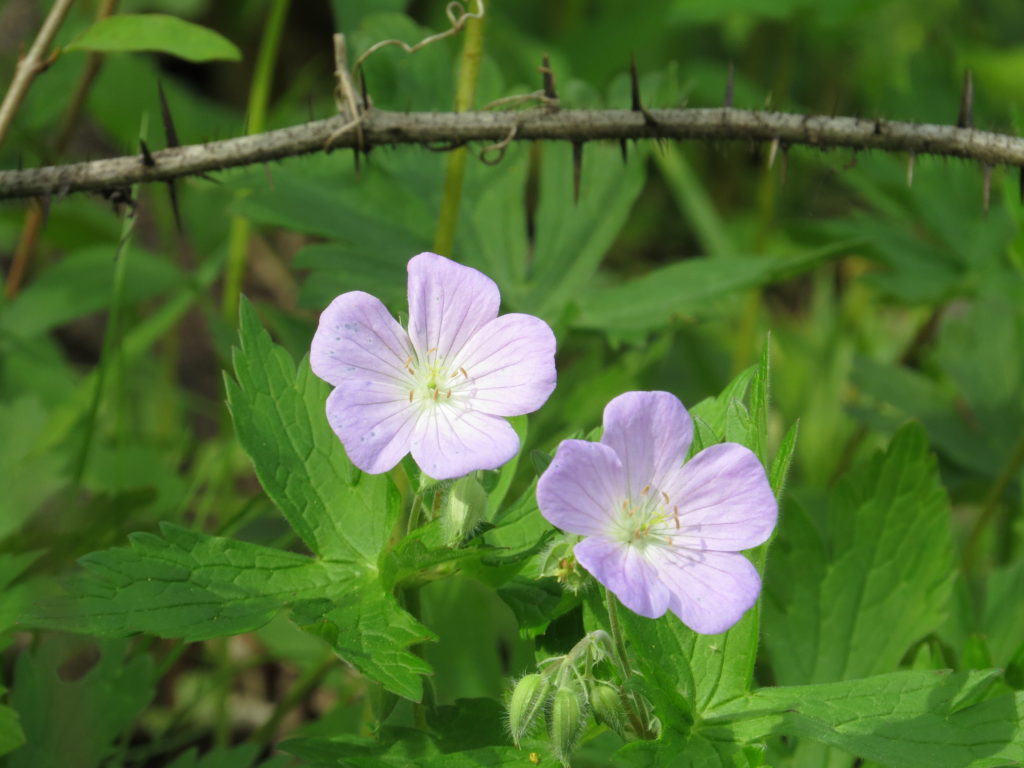
We hiked along the bluff trail among Oak and Hickory trees. Wild Geraniums bloomed with their delicate lavender flowers.
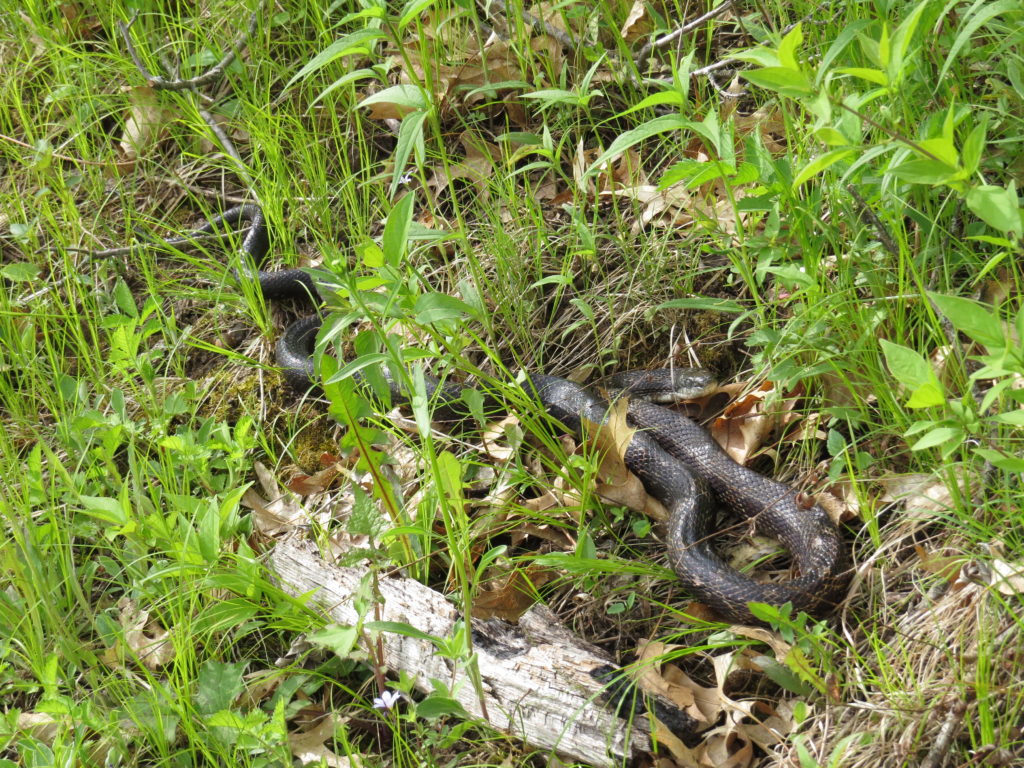
We saw a surprise that may turn your stomach upside down—a very large Black Rat Snake! Chris had been thinking about snakes since this area has Timber Rattlesnakes (one of which he has the skin of from when he was a boy), and it was a perfect day for ‘sunning’ on the southwest-facing bluff. I wasn’t even thinking about snakes and was delighted to see such a beauty!
A restored prairie area along the bluff still had the fall remains of amber grasses and wildflower seedheads…
…though one prairie hilltop pushed aside the old for a new Spring sweep of Bird’s Foot Violets.
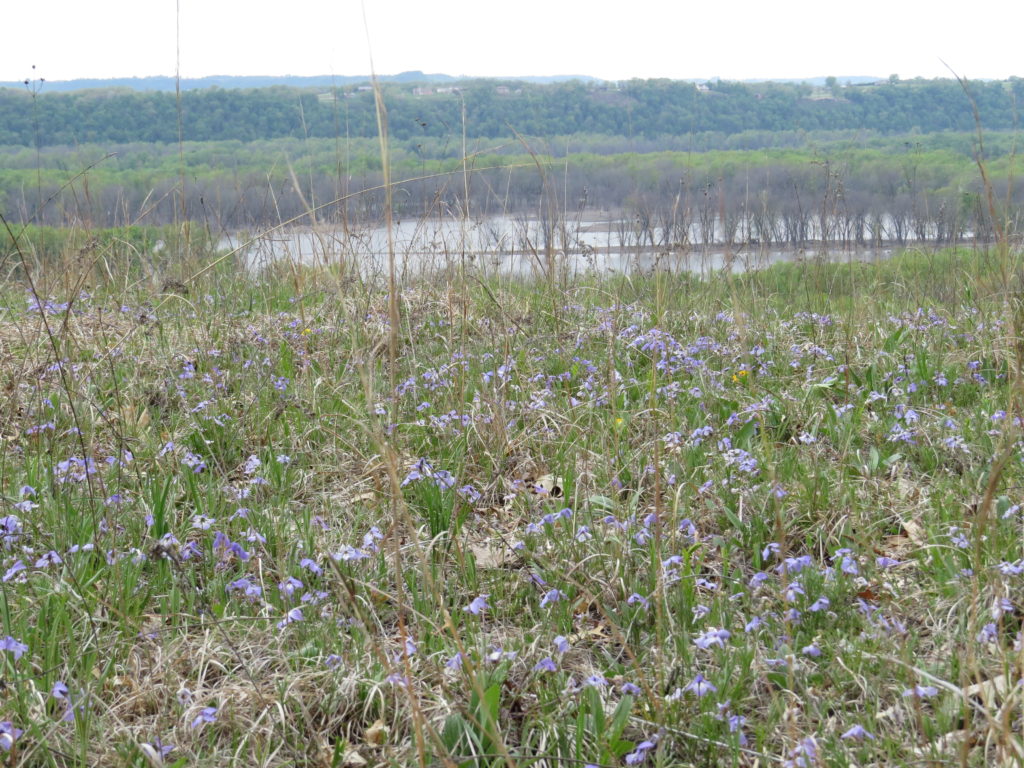
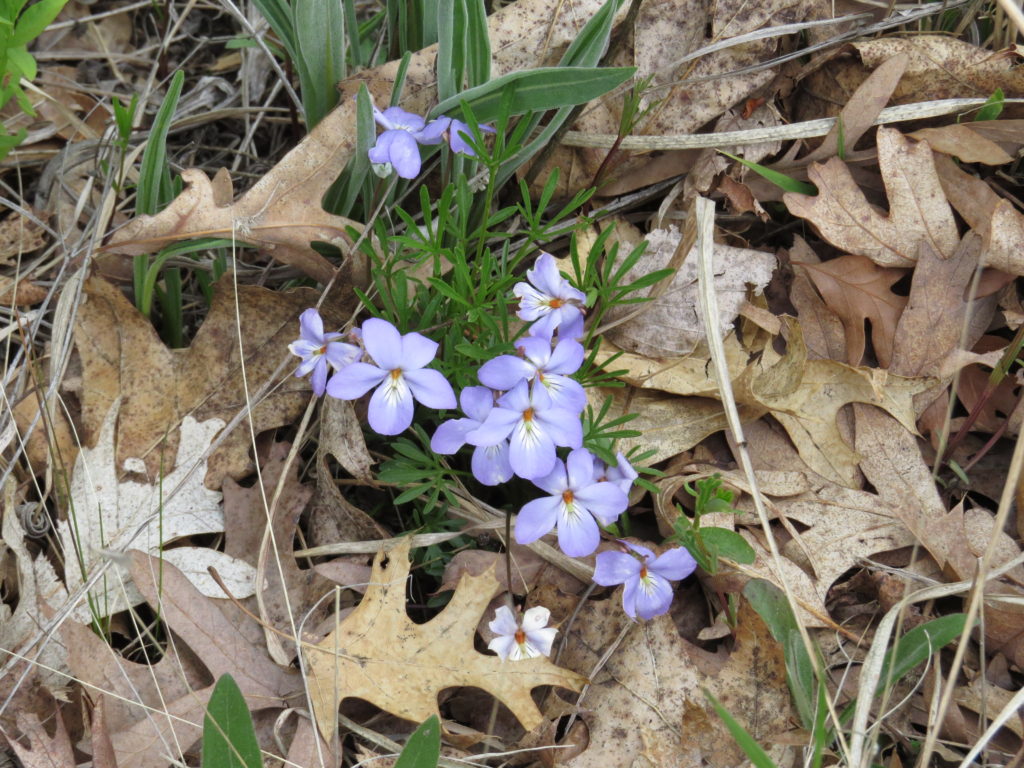
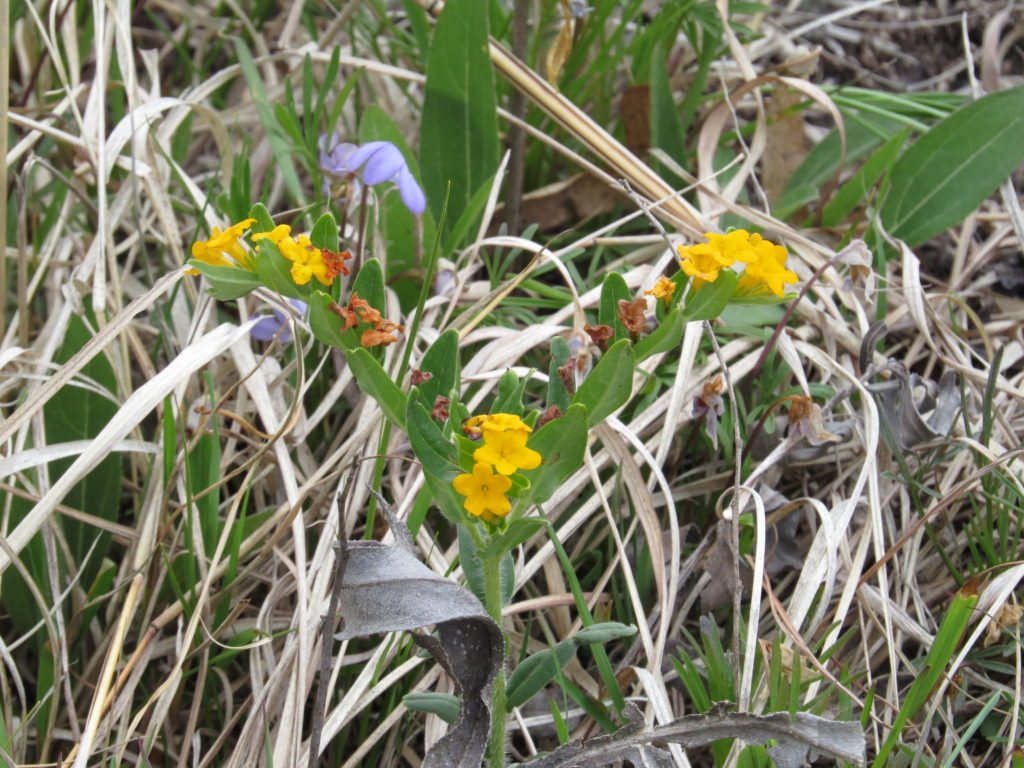
What’s in a name? Among the Bird’s Foot Violets were bright Hoary Puccoons.
From the hilltop prairie we veered away from the River…
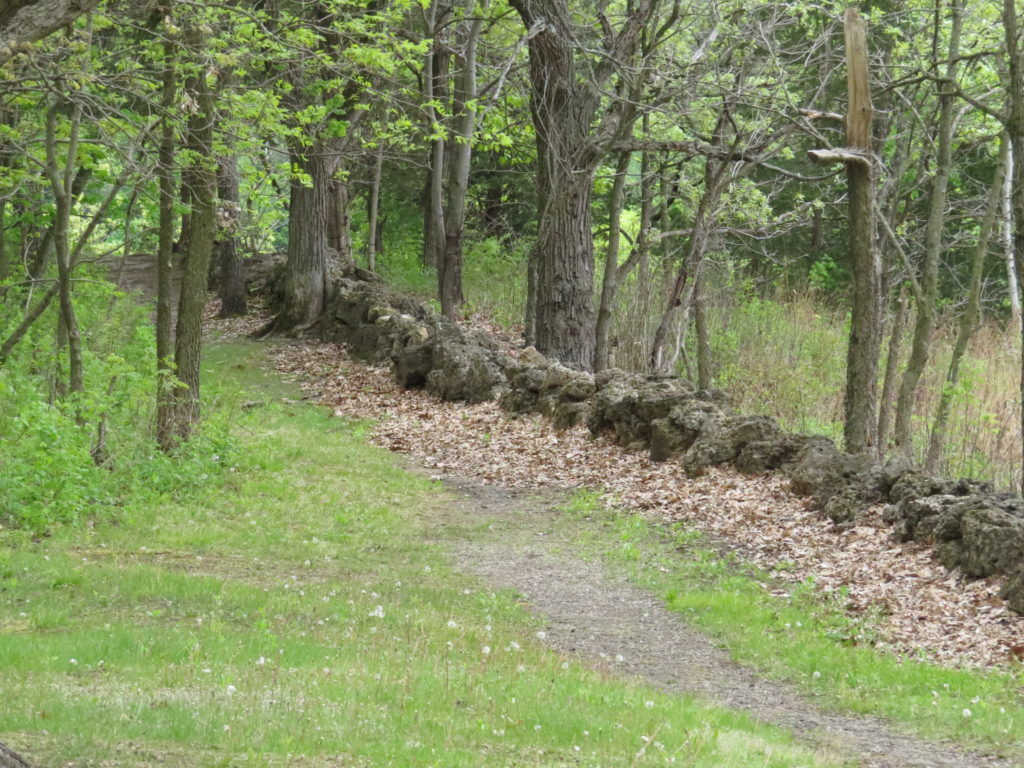
and followed the old stone wall that had been built in the 1860’s around the Stonefield farm that Dewey planned and moved his family to in 1868.
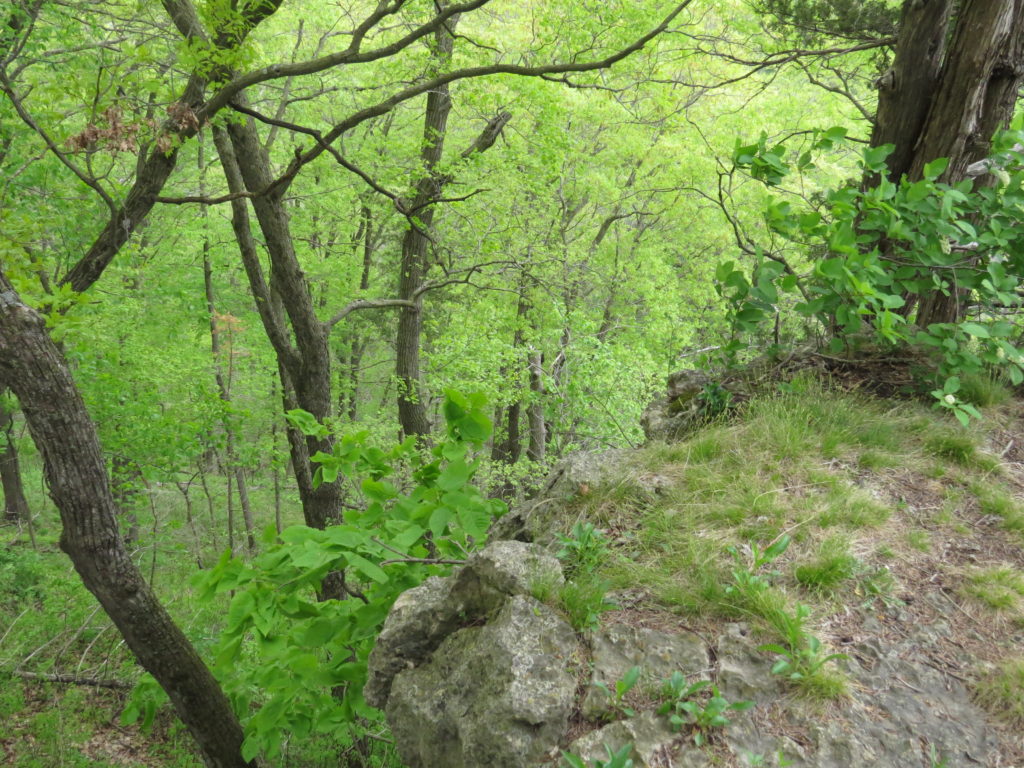
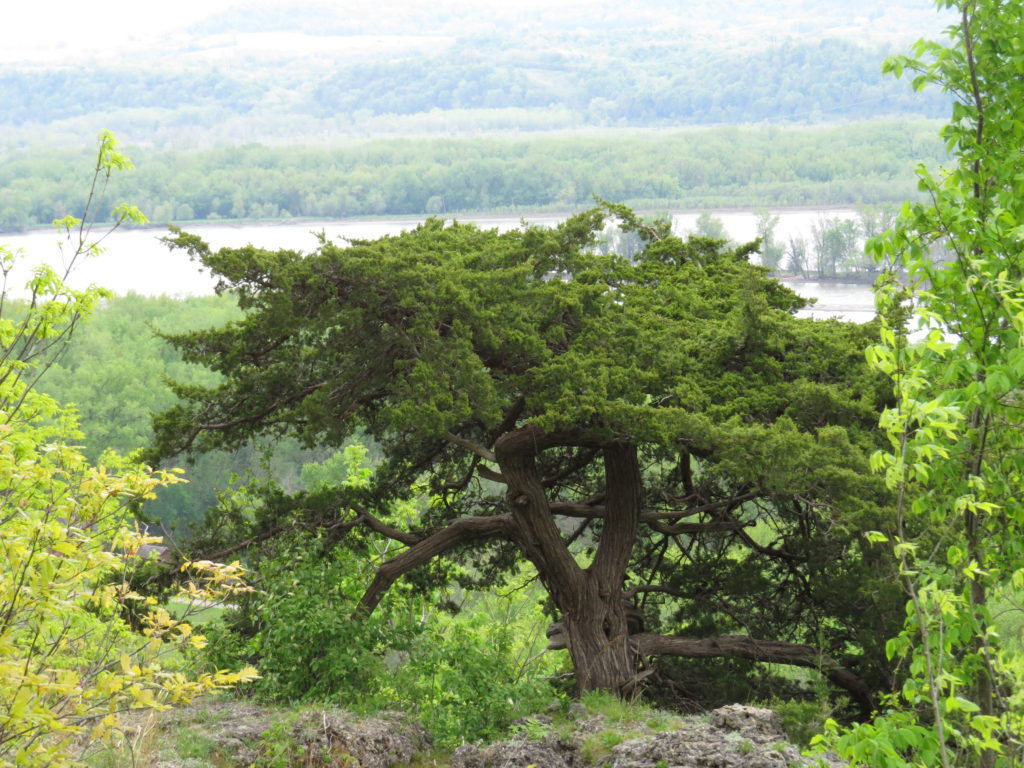
Limestone outcroppings looked out over the deep valley of forest and River. Tough, windswept Cedar trees grew on the points…
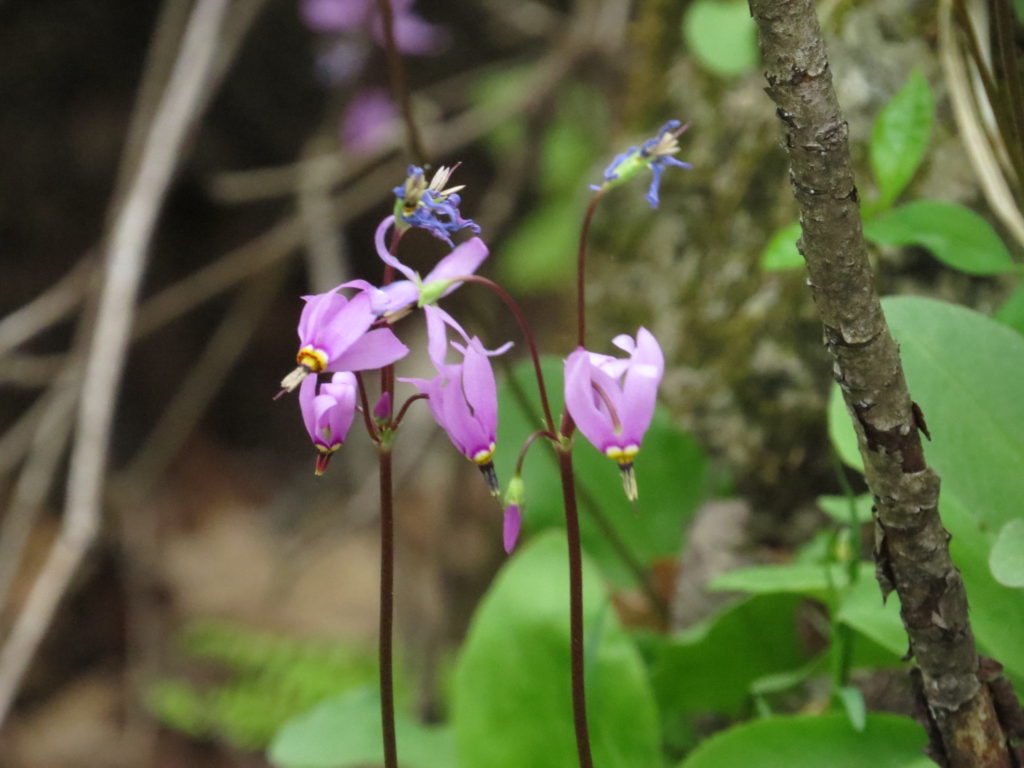
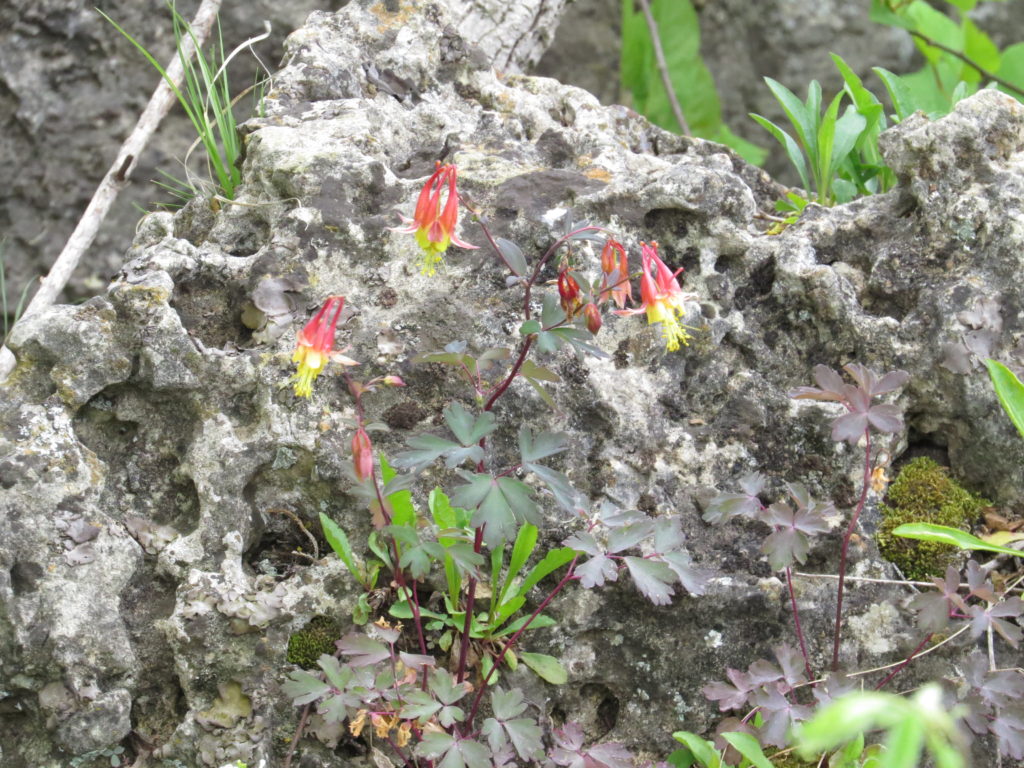
and exquisite flowers clung to the rock edges and burst into bloom from a bed of stone.
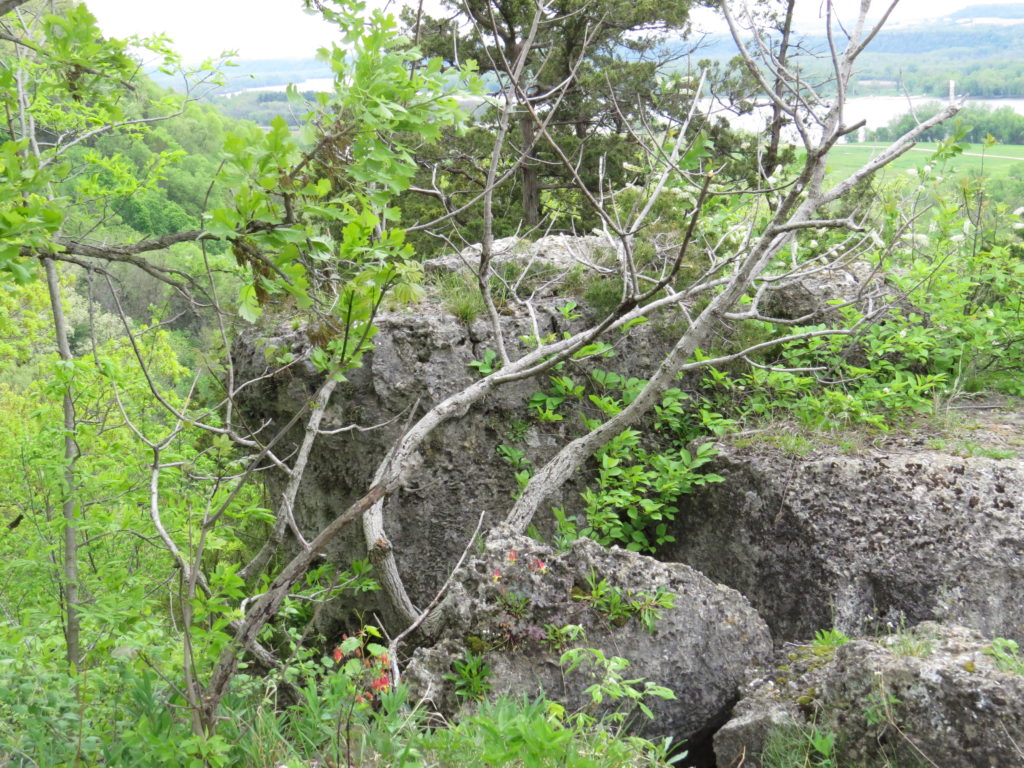
An old Cedar, overlooking the River, looked like a Bonsai tree—it had been trimmed and pruned, bent and stunted, by the wind and weather over the decades. The stories it could tell.
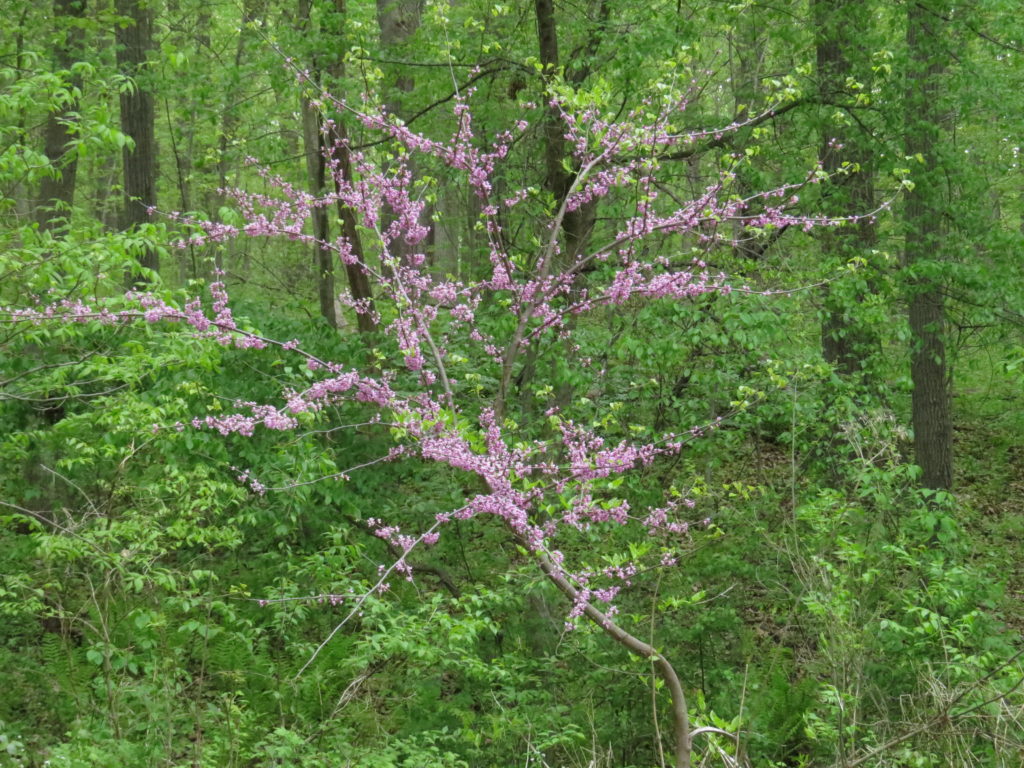
A tree we don’t see in the wild as far north as we live, was in full bloom—the gorgeous Redbud tree. Spring is synonymous with Redbud trees for Chris—another homecoming of sorts for his tree-loving soul.
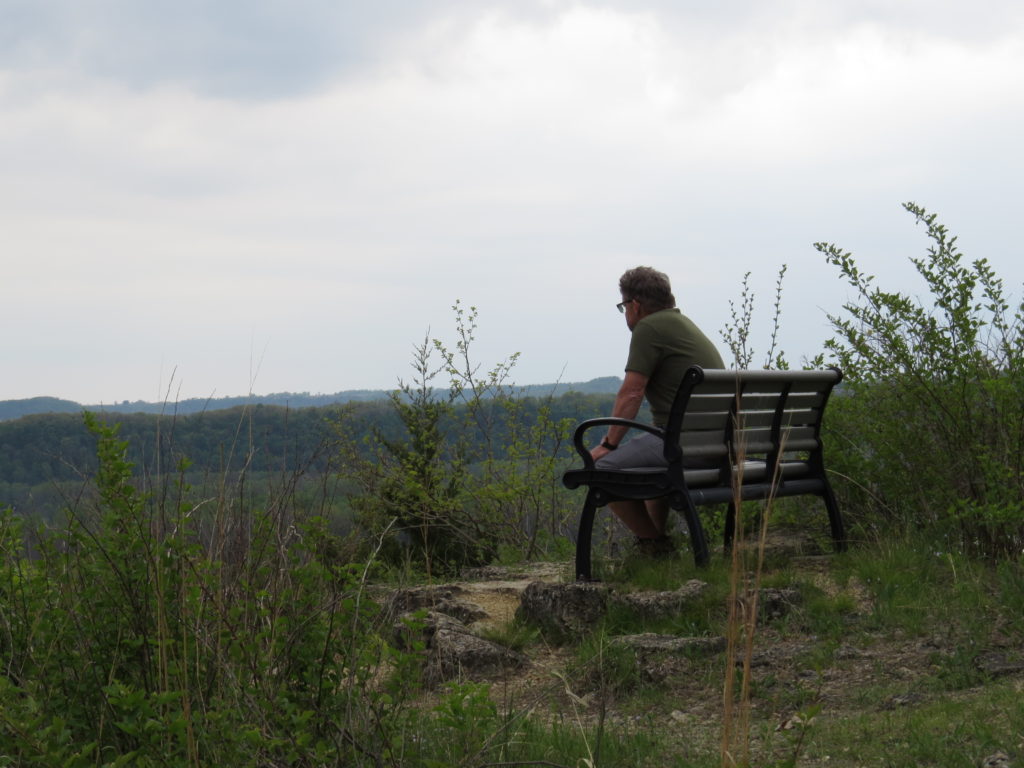
Going to Cassville for the weekend was a reminder that the topsy-turvy time we find ourselves in is nothing new or special. The history of the place tells the stories. Governor Dewey and his family lived on a spectacular farm overlooking the Great Mississippi River. But disaster struck in 1873 when their house burned down and later that year a nationwide financial panic affected his investments, and he lost Stonefield in 1878 to foreclosure. He also lost his marriage during those years. On a more personal note, when we looked at the graves of Chris’ Mom and Dad, we realized they were toddlers when the 1918 Spanish Flu pandemic interrupted the lives of Americans and the world. Their families had weathered the pandemic with small children and much more primitive ways of living. The Veterans Memorial reminded us of all the men and women who had fought in wars over the centuries, many losing their lives by doing so. Chris’ Dad’s name carved in the black granite is a lasting memory of the sacrifices he and others endured to protect the world from the evils of fascism. And mostly we were reminded, as we close in on the incredible milestone of 100,000 deaths from Covid-19, that every death is personal and ripples out in waves to a myriad of people who were touched by that one, special person. Grief is as deep and wide and long as the Mississippi River. If I were to wish upon a shooting star, I would wish for each of us in this upside-down world to be a tree in this river of grief—to have strong roots embedded in holy ground, to have strong branches to hold the pain of others as it bends and stunts their lives, and to have a new growth of leaves that hold hope and renewal as a way forward. To be a homecoming of sorts.
Path of Redemption
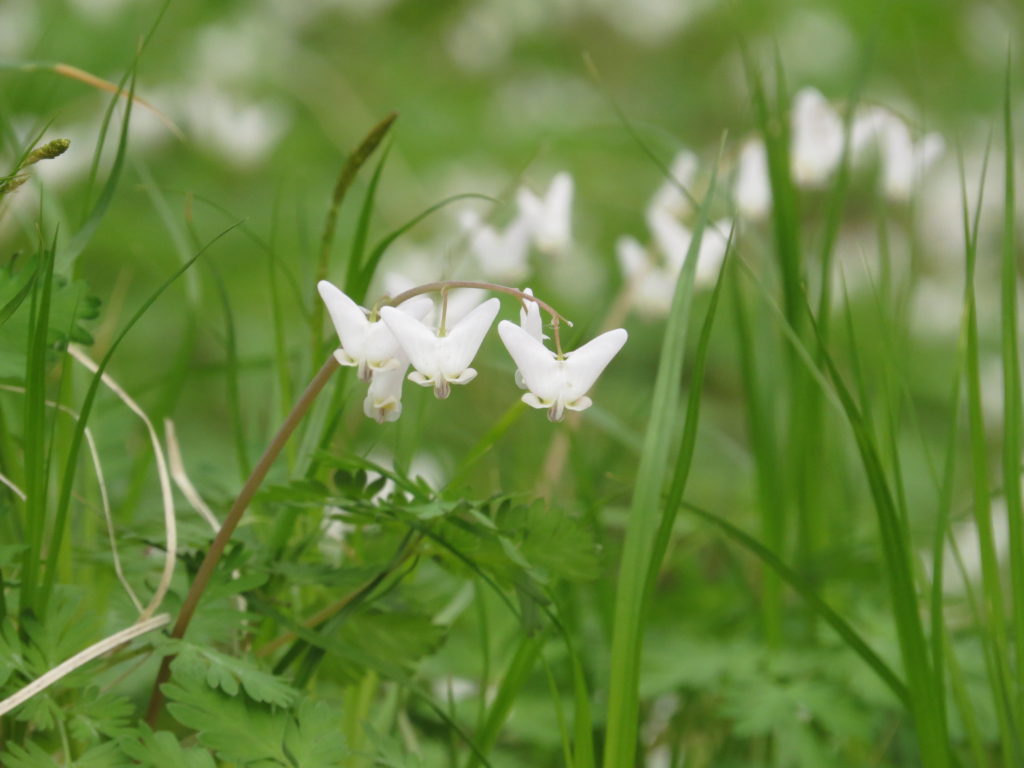
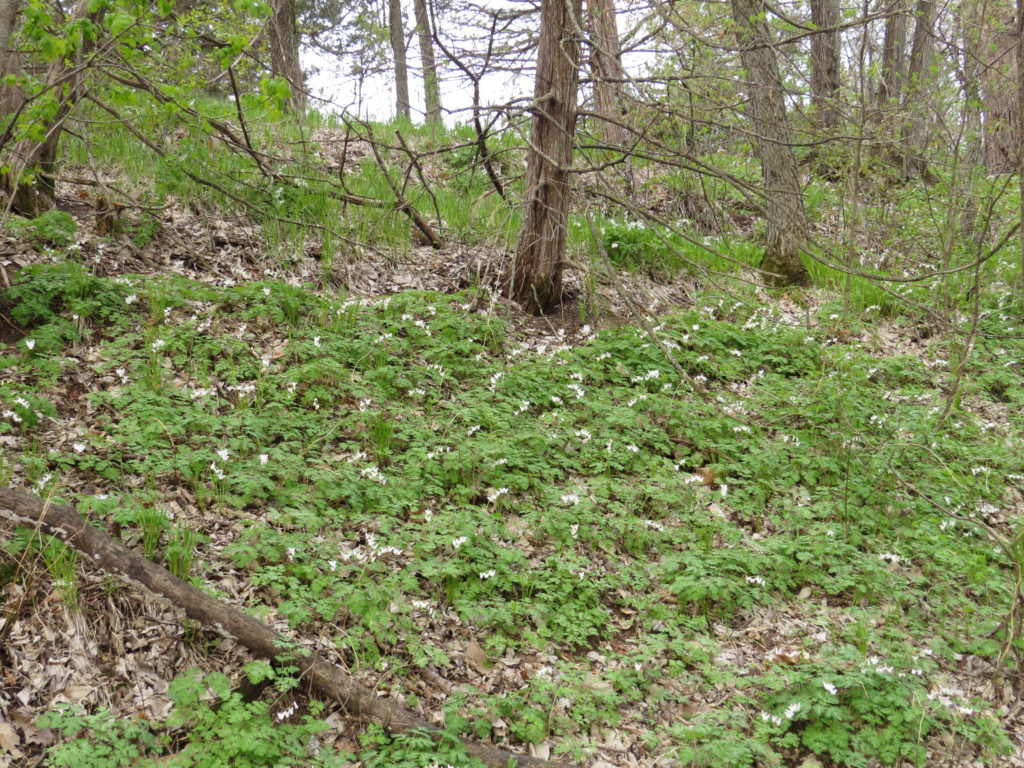
This is a story about devastation and beauty, inspired and patient change, art and surprises, and redemption. On Mother’s Day weekend, we skipped our usual morning routine in order to ‘beat the crowd’ at a nearby park—the park that was flooded by the Mississippi River just a month ago. We were curious as to whether the trails were open, if the water had receded, if things were ‘back to normal.’ We walked down the steep trail towards the River, but before we even got to the bottom land, a beautiful sight met us at the path—uniquely-shaped Dutchman’s Breeches wildflowers. The delicate white flowers covered the hillside as far as we could see!
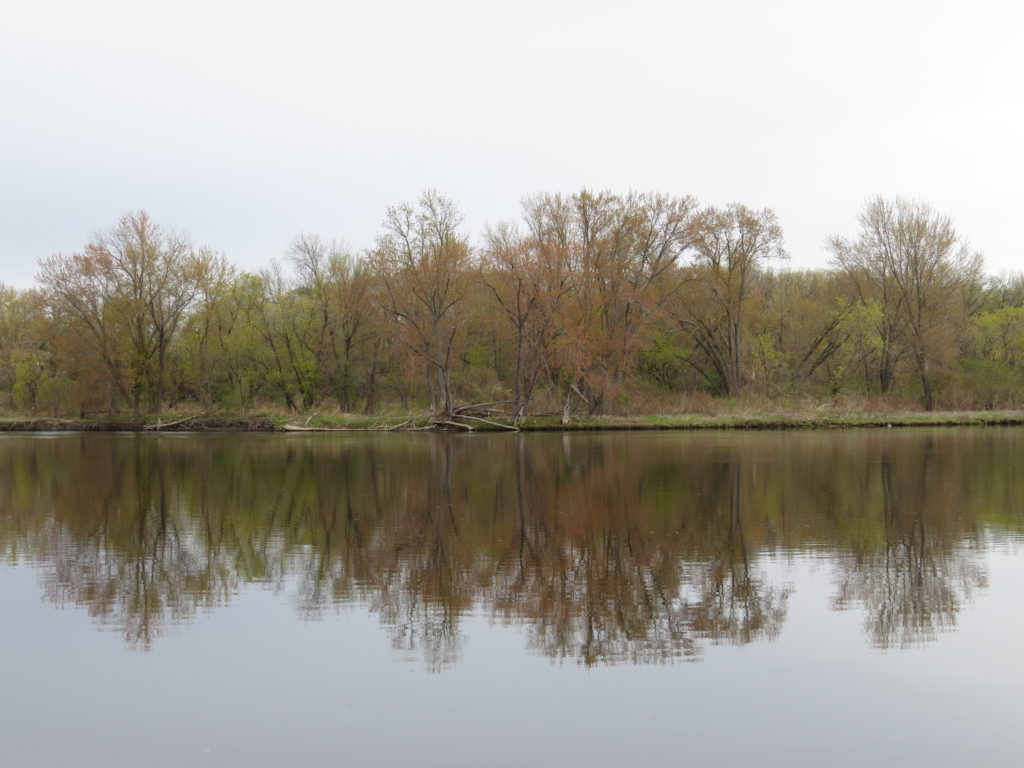
The River was morning quiet, like softly rippled glass, back in the low restraints of its banks. The trees on the other side blushed with pinkish-red and Spring lime green and saw their reflections in the Mighty Mississippi. A few boats quietly trolled the morning water for the anticipated fishing opener weekend. Occasionally, a goose harshly honked a greeting that split the quiet air like a foghorn.
We walked through the woods that had morphed from flood waters to greenery. A small path led us back to the River, to a canoe camp with fire circle, picnic tables, and an outhouse without the house.
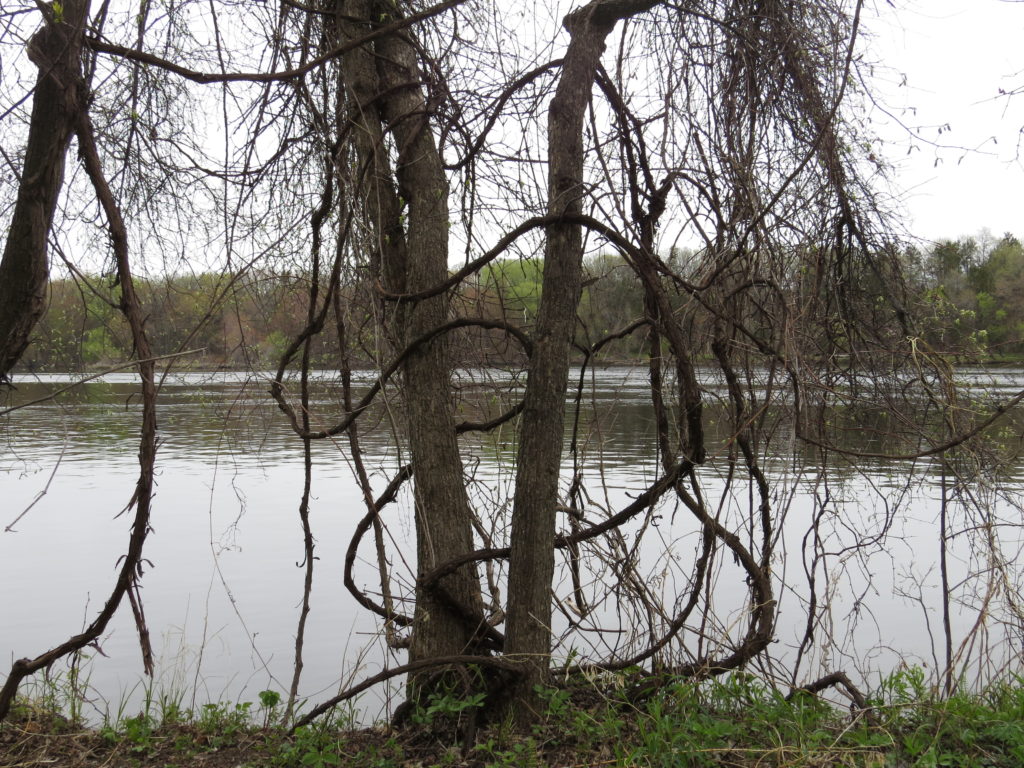
A messy tangle of Wild Grape vines that for years have been winding their way in and among a couple of trees, stood out on the leafless bank. It would be near impossible to make this happen, yet here it was. It looked like a piece of art, a sculpture of time and growth.
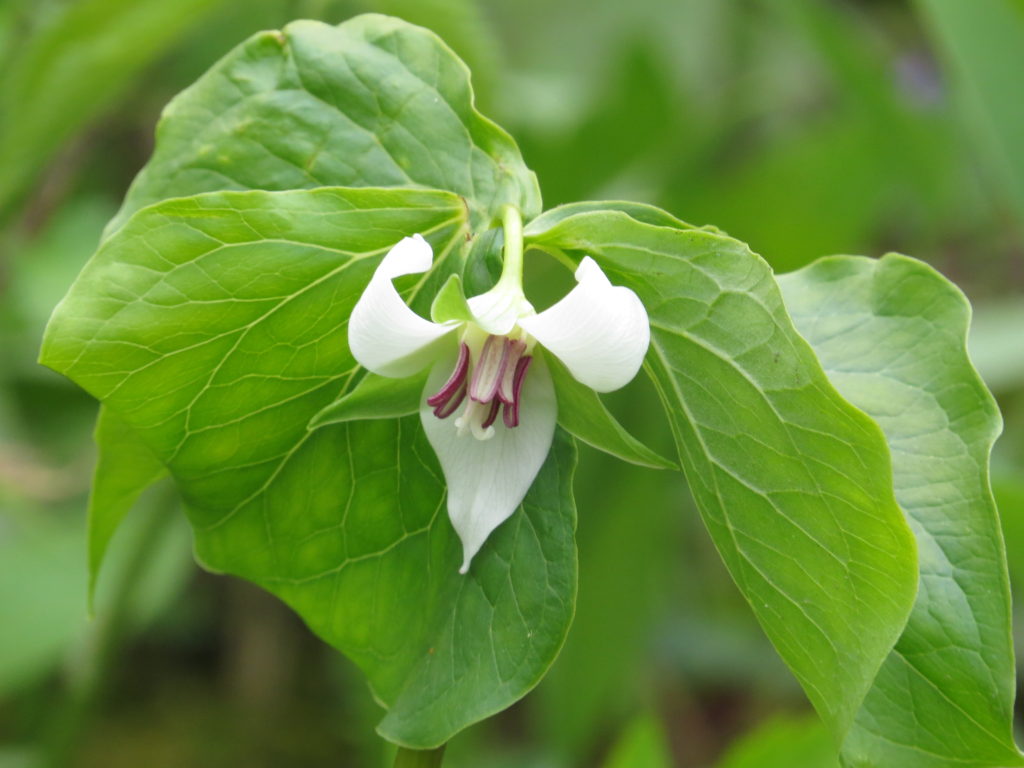
We backtracked to the main path. The exquisite beauty of a Nodding Trillium—large white curling petals, snowy white pistil, and purplish-pink-lined stamens surrounded by delicate green sepals and large, veined leaves—rose with certainty from the ground, from the ground that had been covered with water and debris just weeks ago.
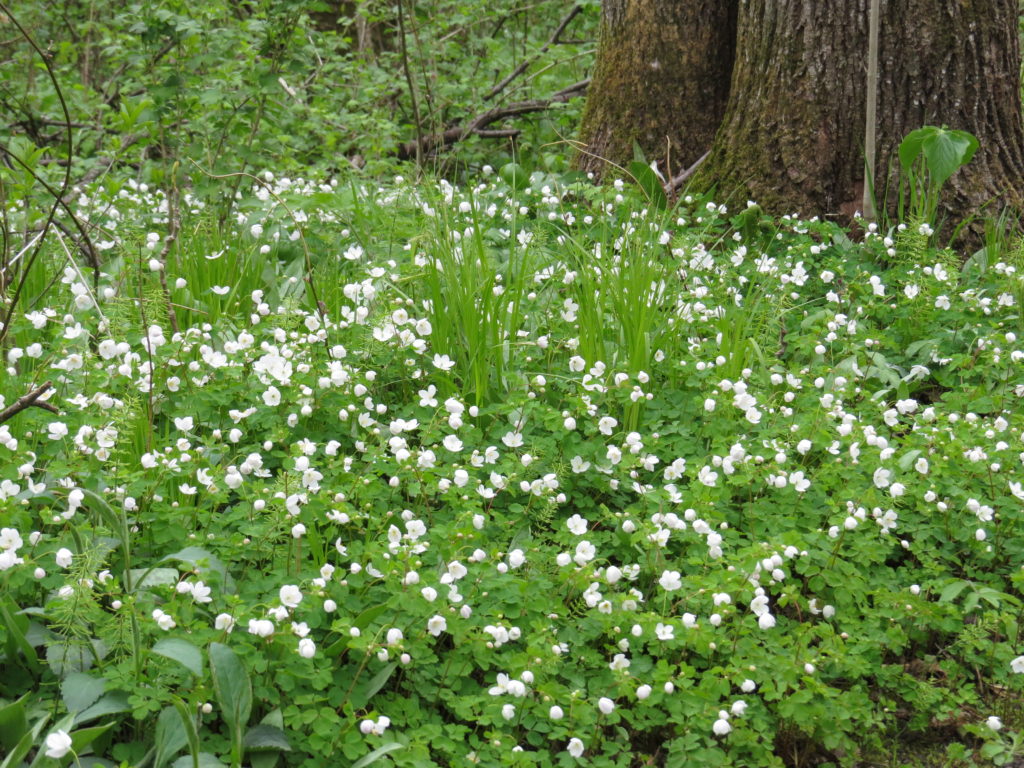
The abundance of greenery and white flowers continued with large swaths of Wood Anemones interspersed with sedge grass.
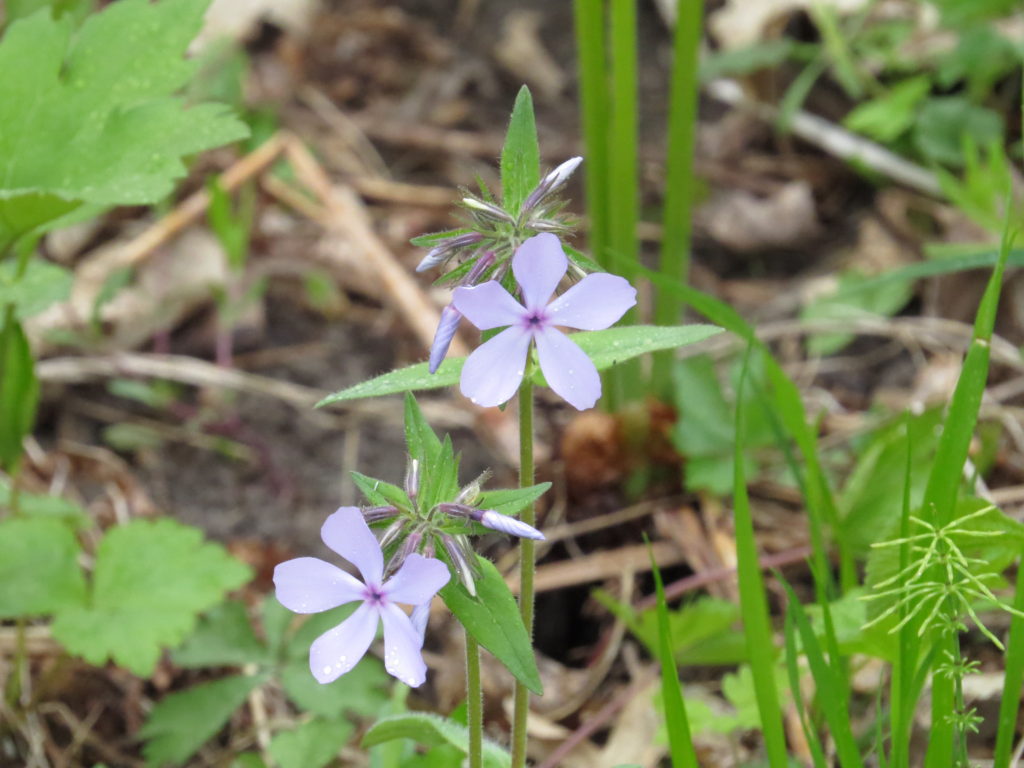
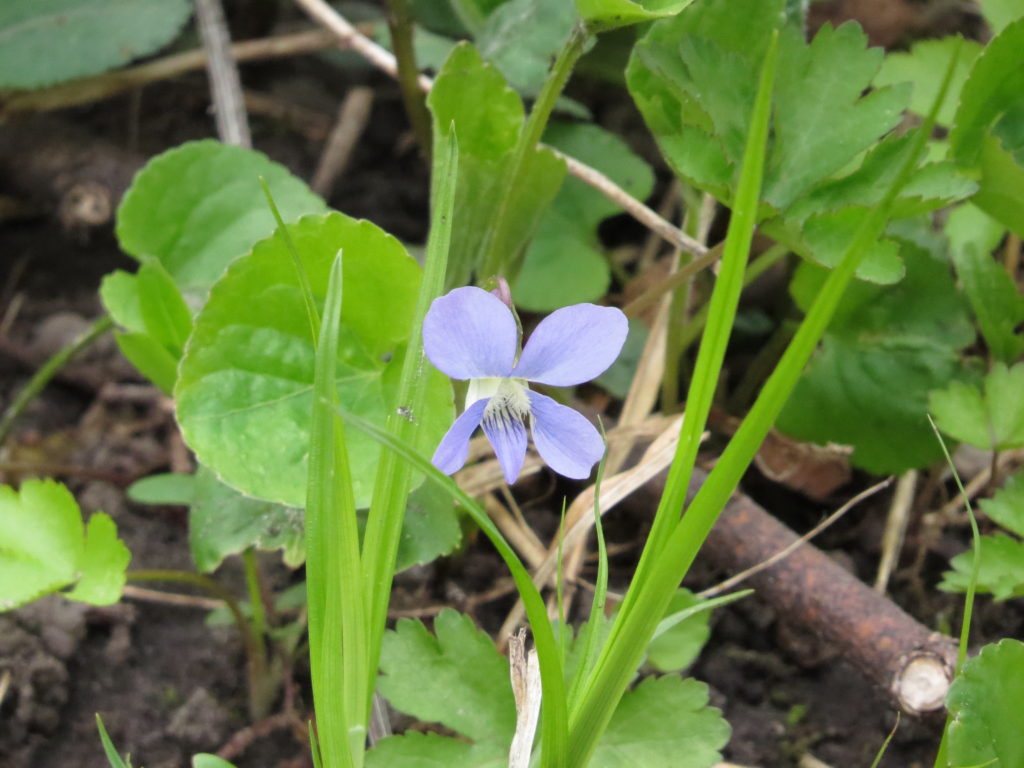
Wild Blue Phlox and Wild Violets, in their delicate blue colors, were welcomed outliers in the sea of white blossoms.
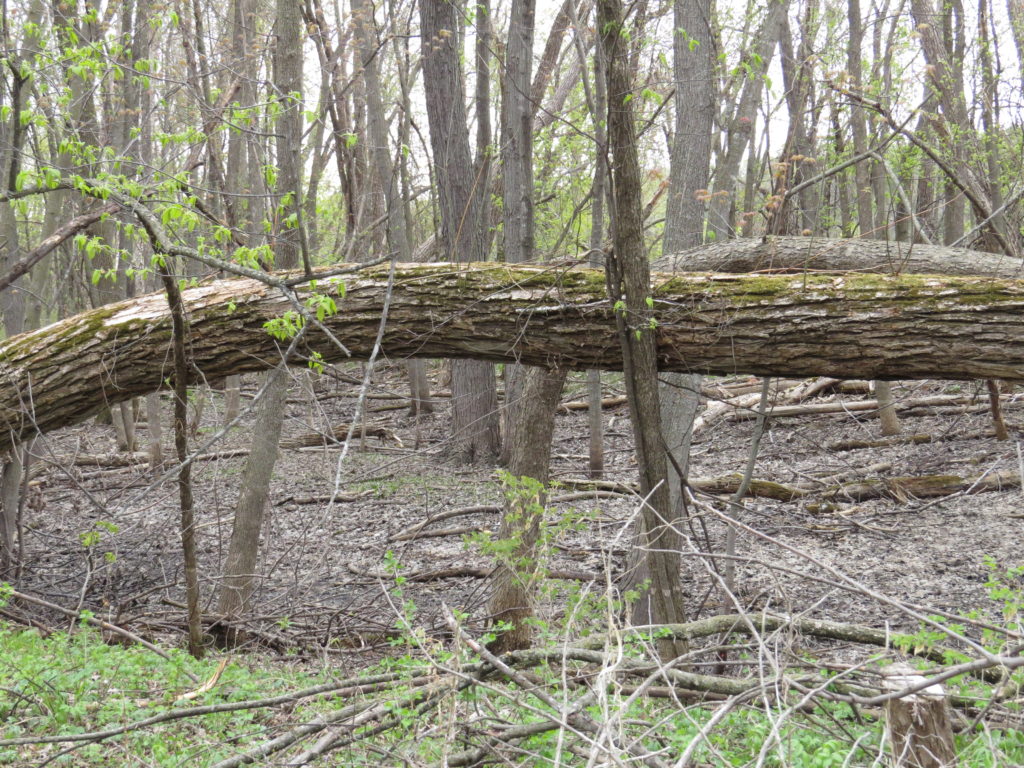
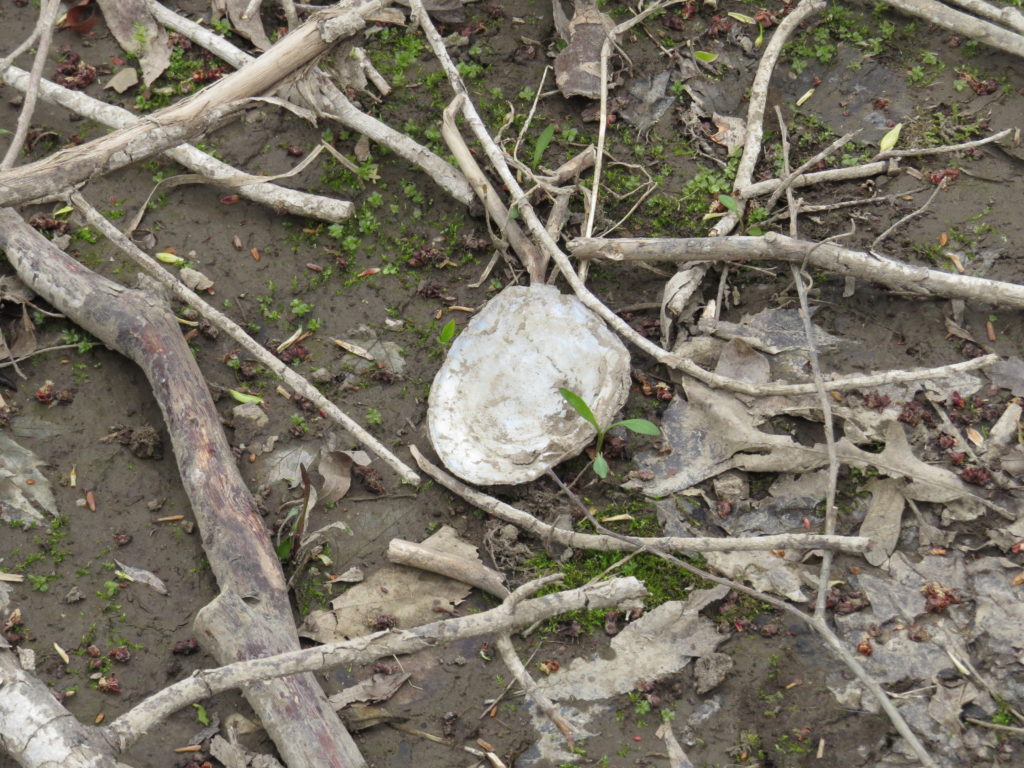
Where the last of the flood waters had remained, the ground was still barren and gray, a stark reminder of the devastation of the flooding.
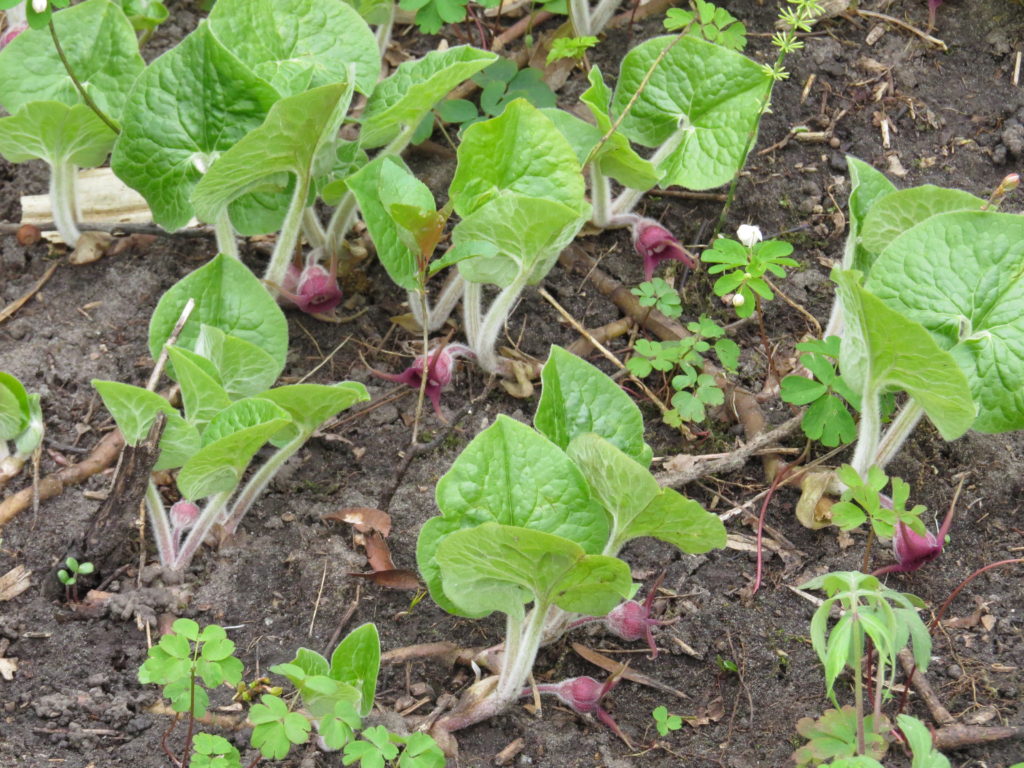
The flood water had washed away the soil around the rhizomes and roots of the Wild Ginger plants, showcasing the ground-level flowers that are usually hidden from view.
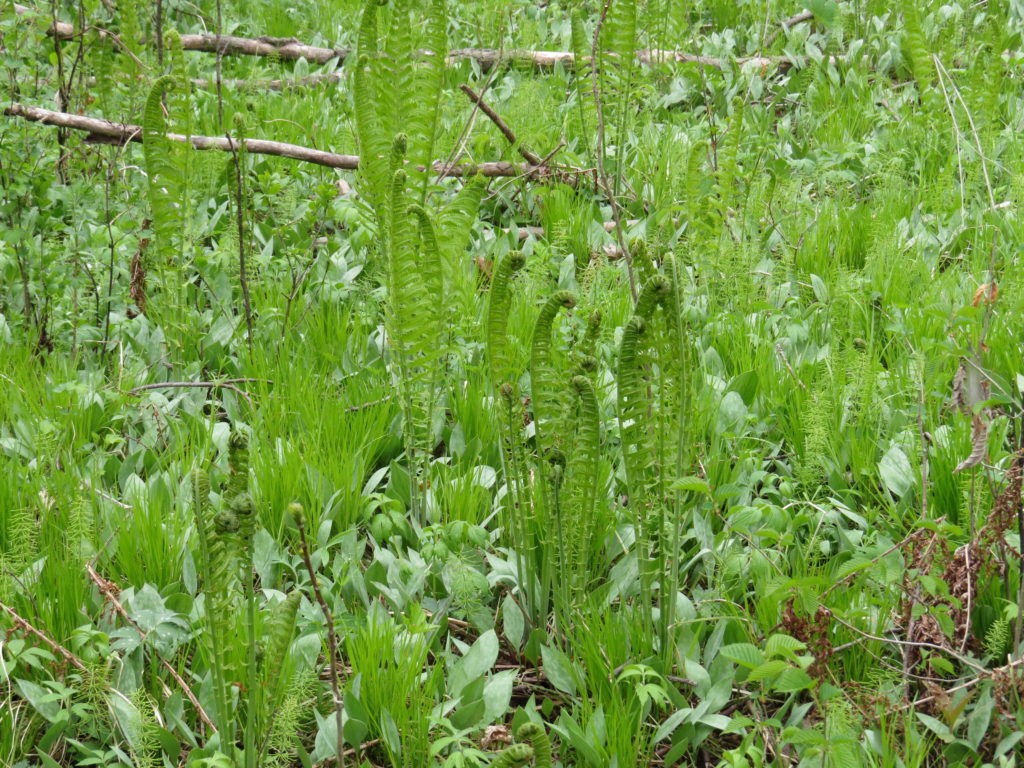
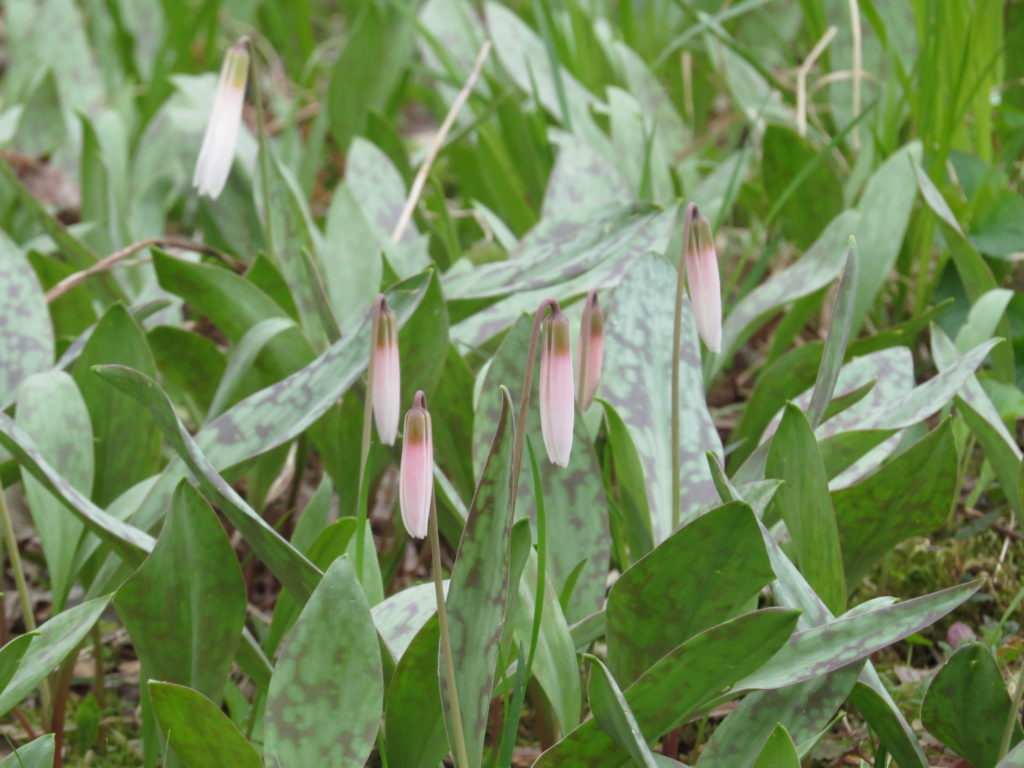
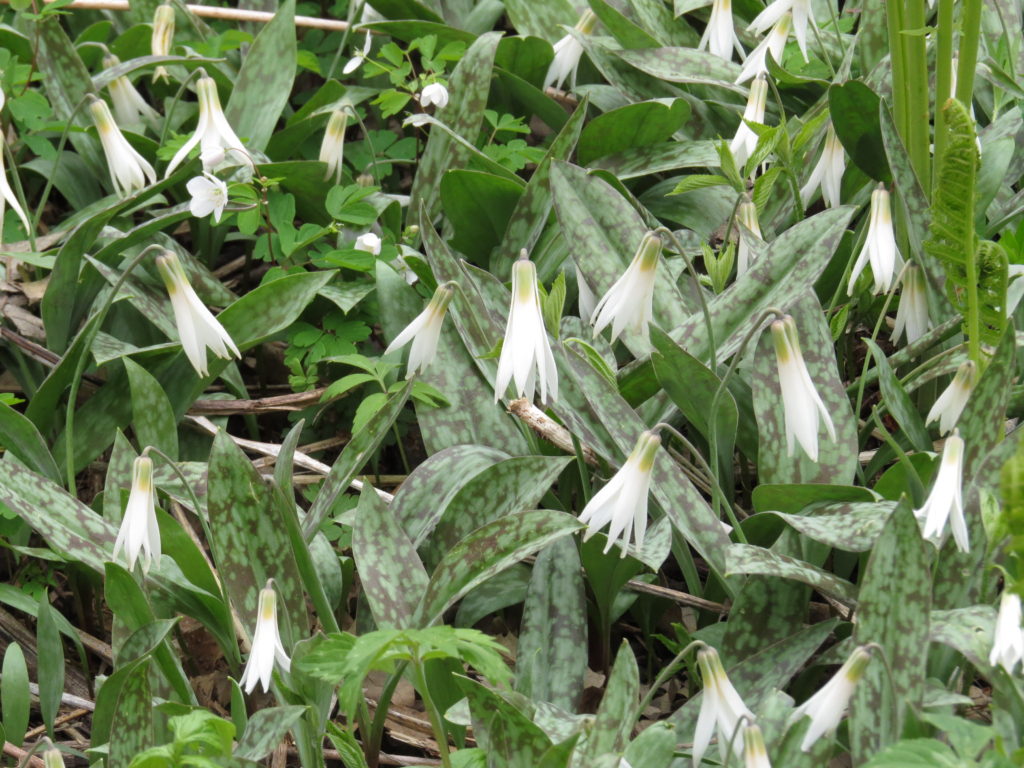
And despite the deluge of water, the flood plain was blooming! Growing and blooming in abundance! White Trout Lilies (don’t you love their name?) covered the woodland ground, fields of them among the trees. Ferns grew up like meerkats amid the Trout Lilies, their fiddleheads unfurling in orchestrated movement.
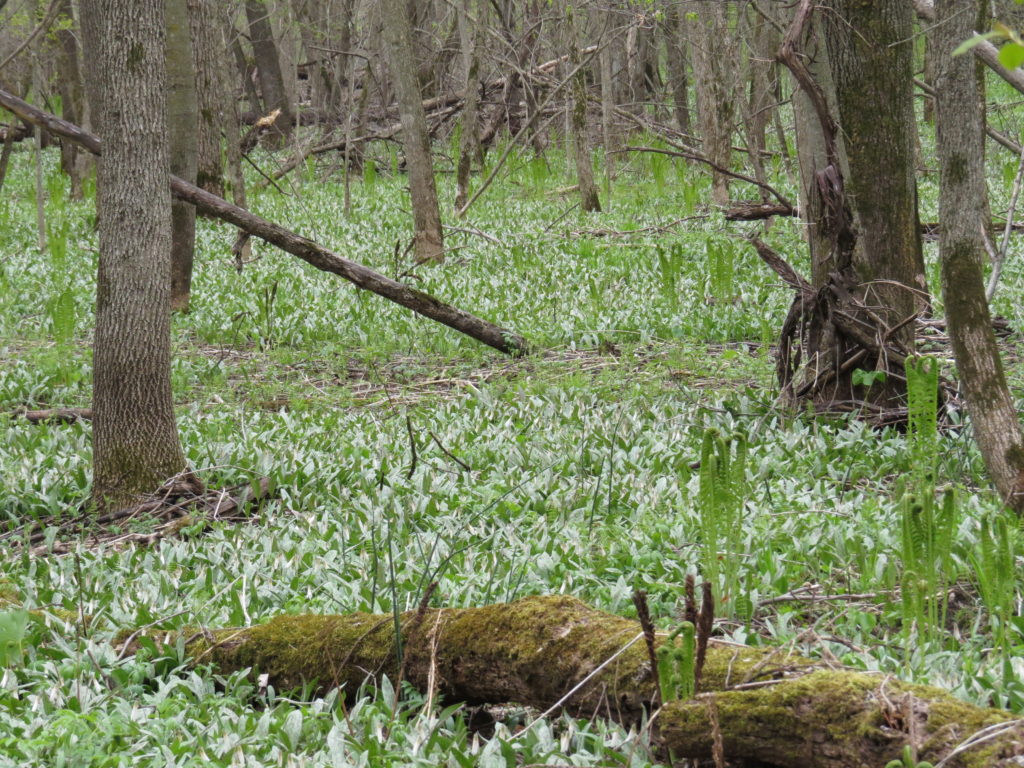
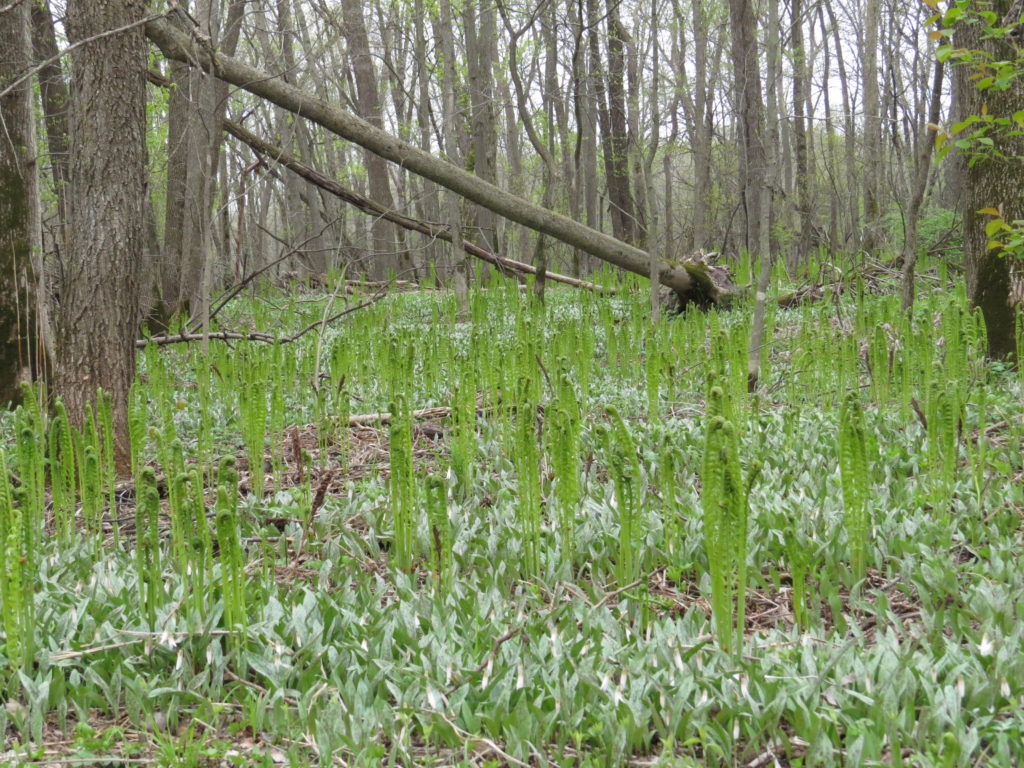
There were millions of spotted leaves and demure pink buds that mature and open to white, then curl back their petals as the sun moves across the sky, exposing the bright yellow stamens of the single-flowering plant. With nightfall, they close once again.
A flower-lined path of redemption wound through the woods where the gray torrent of devastation had taken up residence just weeks before. What if we had given up on this path? What if the gray water from our last visit had kept us away? We would have missed the incredible beauty of this morning, these flowers, these unfurling ferns and leaves.
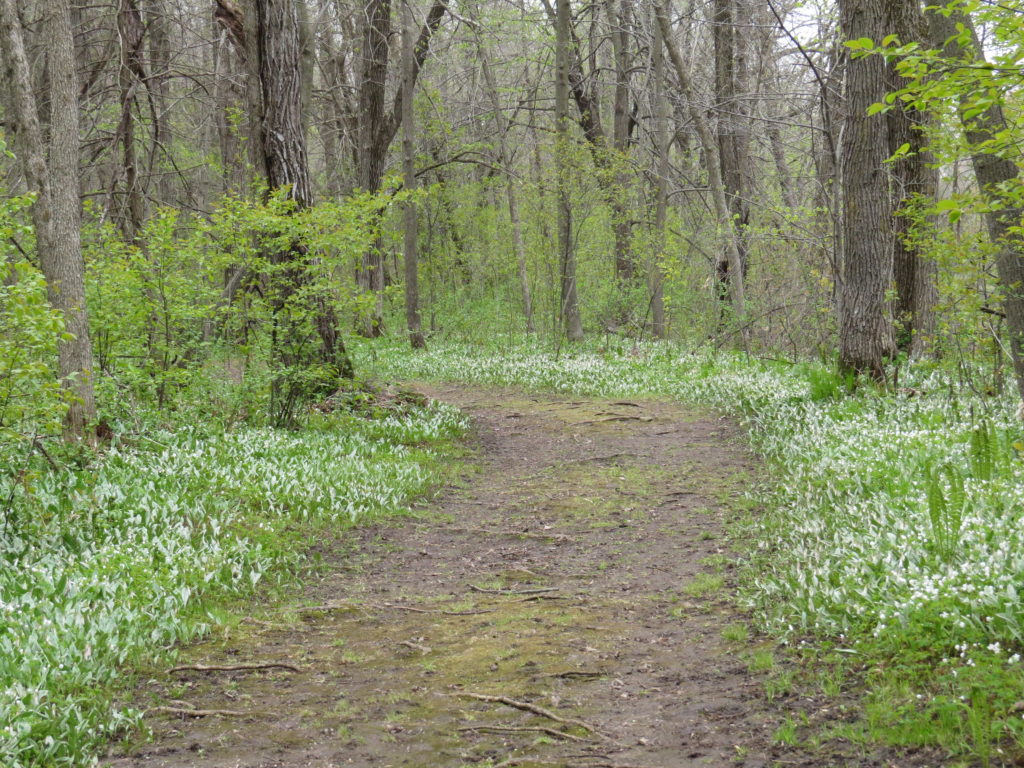
As we walked the flower-flooded River peninsula, we slowly realized that this land we were walking on was built for this—the flooding was just a natural part of the seasonal evolution. In fact, perhaps the devastation of the flooding was exactly what the plants needed to thrive! We think of flooding as being devastating because we often place things in the wrong place—we build houses where they don’t belong, want fields where Mother Nature has had wetlands and floodplains for millennia (for a reason). Devastation, messiness, and pain precede the growth and flowering. The coronavirus pandemic is making a mess of our collective lives right now. We need to leave behind the idea of ‘back to normal.’ Redemption is the act of making something better. What have we placed in the wrong place? How do we rise from the debris with certainty and blossom into exquisite beauty?
No One is Exempt
There is a collective suffering in the world right now. We can’t ignore it like we have conveniently done in the past—when the suffering didn’t affect us or threaten us or kill us or shut down our businesses or make us lose our jobs or change the way we lived our lives. But now…now all of those things are possible or happening. No one is exempt. Some are better off than others, but no one is exempt.
Suffering is personal, even as we do this together as a world. It hurts our bodies, our spirits, our resolve, our bank accounts, our hearts. In the throes of our personal suffering, we slip into survival mode—we become less social, more focused on ourselves. We may lash out at those around us—the very ones we love and adore who are standing up in the shaky boat with us. Or we may project our pain and suffering onto ‘them,’ the ‘others’—the ones making the ‘rules’ to try to keep us from dying, the media who are informing us, our neighbors who aren’t following the ‘rules,’ the ones who think, act, look, or believe differently than we do. ‘They’ are to blame for the pain.
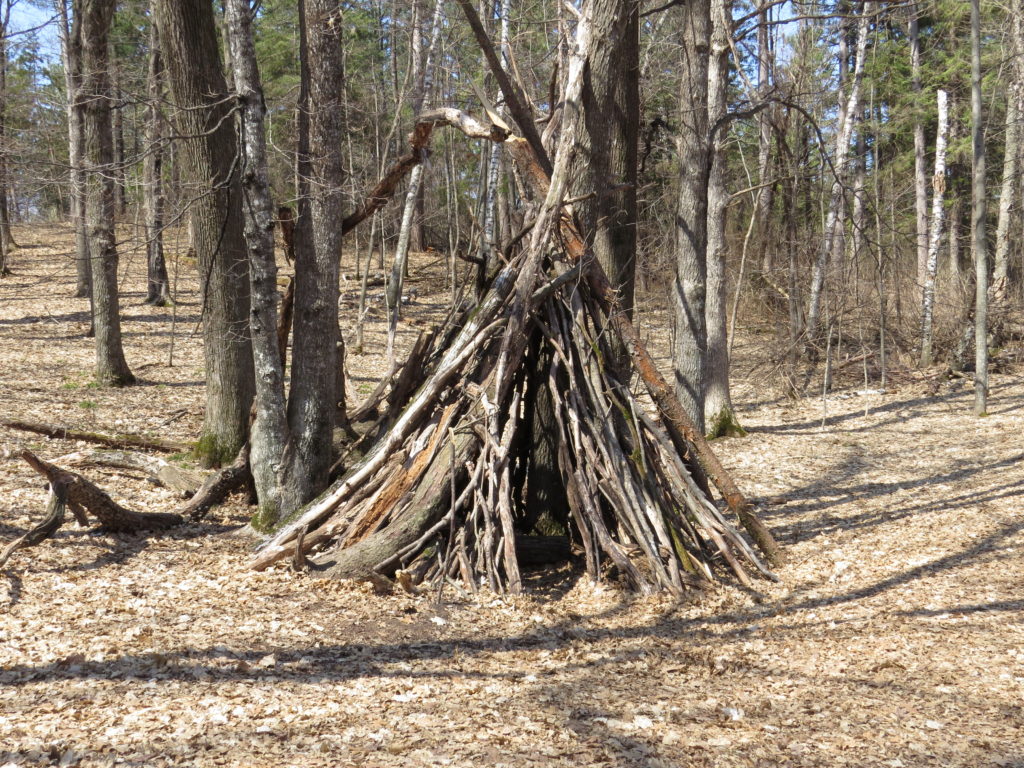
Personal suffering feels like living all alone in a hermit hut in the wilderness—and the roof leaks when it rains—and the cold wind blows in through the cracks—and there’s barely room to lay down—and the food is scarce—and there are creatures lurking about outside and inside the tiny hut….
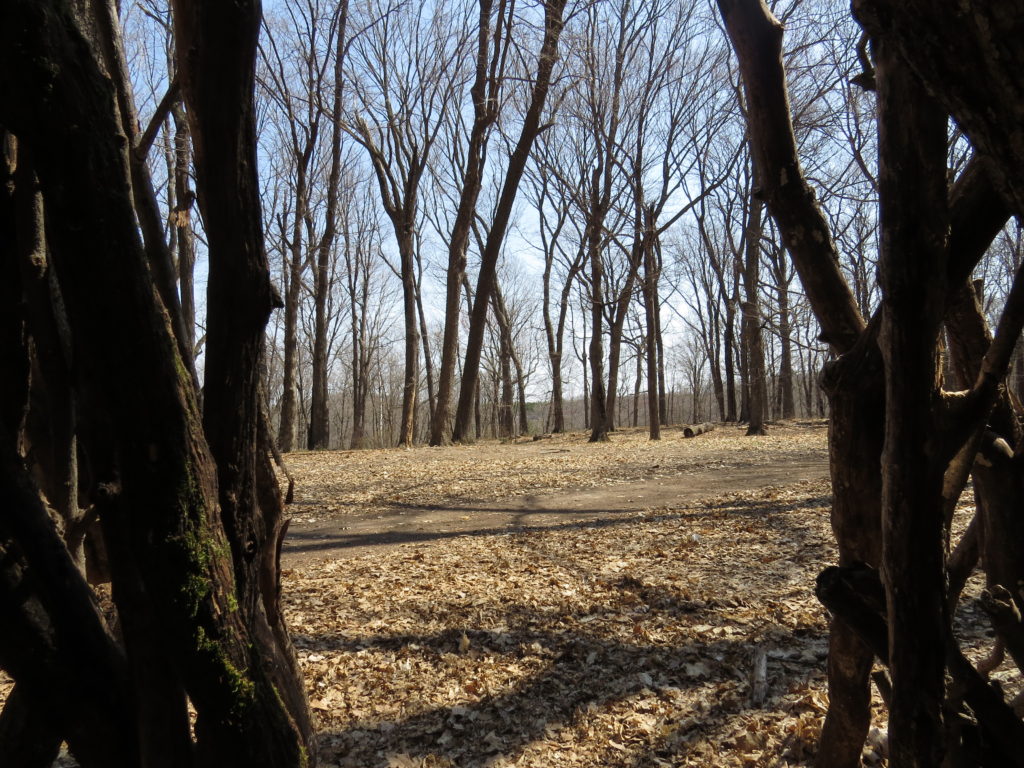
…and looking out, the world looks bleak and bare.
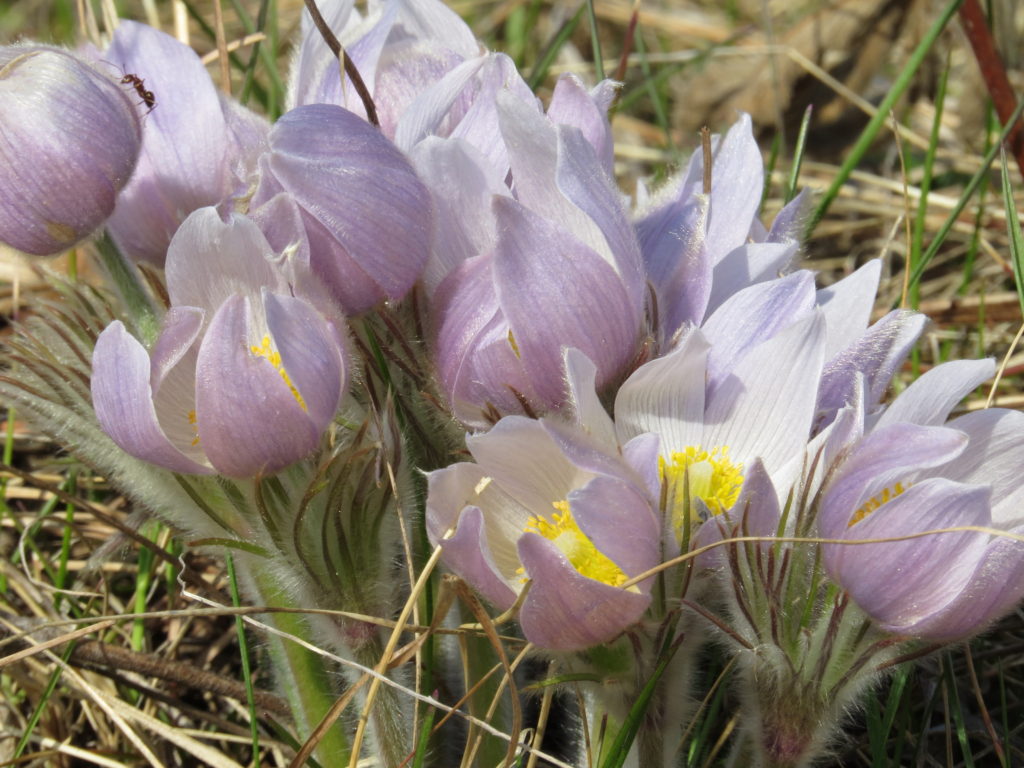
Chris and I hiked at Saint John’s Arboretum last weekend. We were not very far into our walk before I saw a sight that made my heart so happy—a cluster of Pasque flowers! Lavender sepals with delicate stripes, bright yellow stamens, soft, fuzzy stems to insulate them from the still-cold nights. Pasque flowers are the first prairie flowers to bloom; they signal the end of Winter, as they can bloom surrounded by snow. They are a sign of Spring and hope. (The word Pasque is derived from the Hebrew word for Passover.) So lovely!
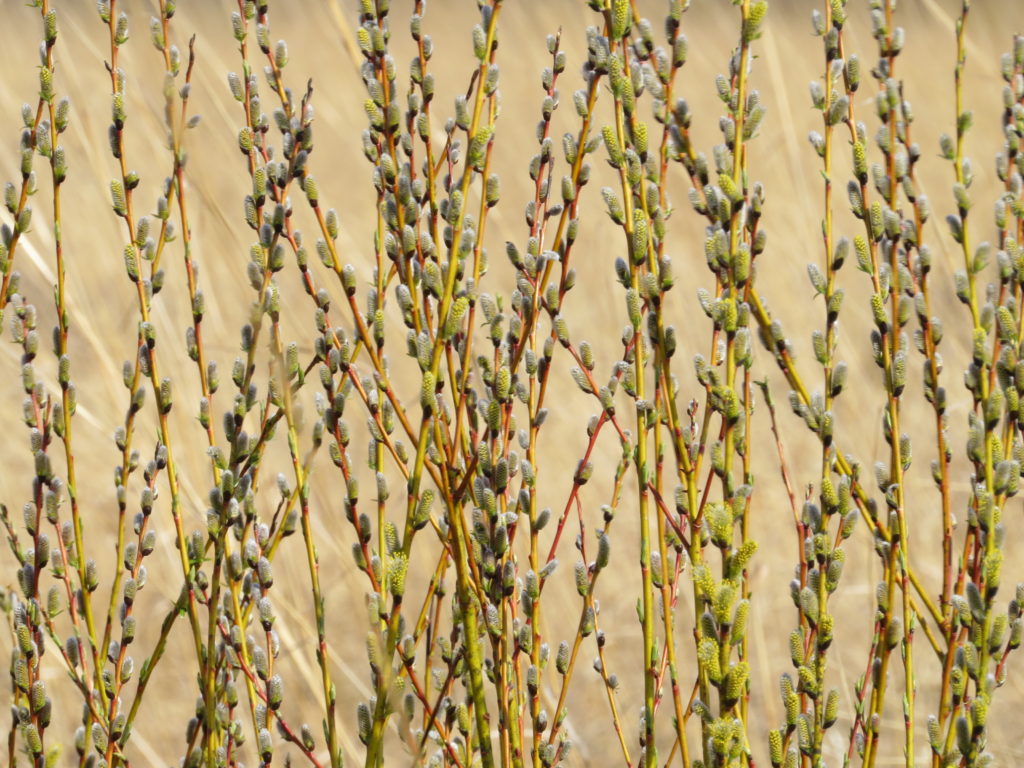
Yellow and red-twigged Willows with yellow-flowering catkins burst into life around the lakes.
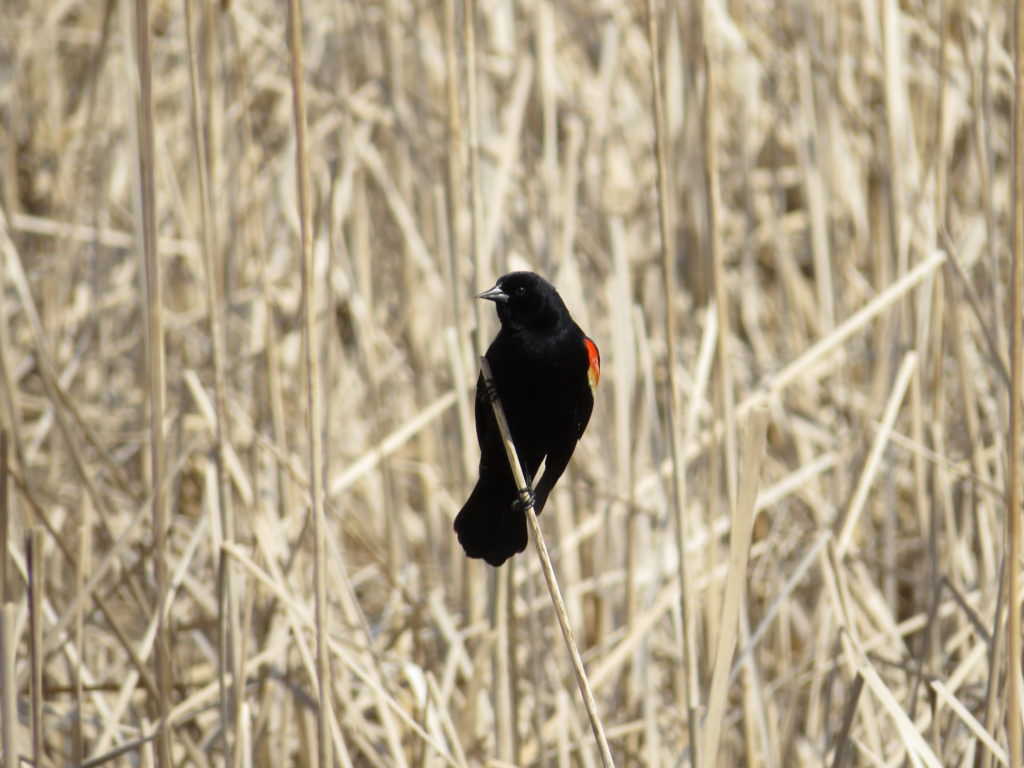
Red-winged blackbirds sang their joyous melody from their precarious perches on old Cattail stems.
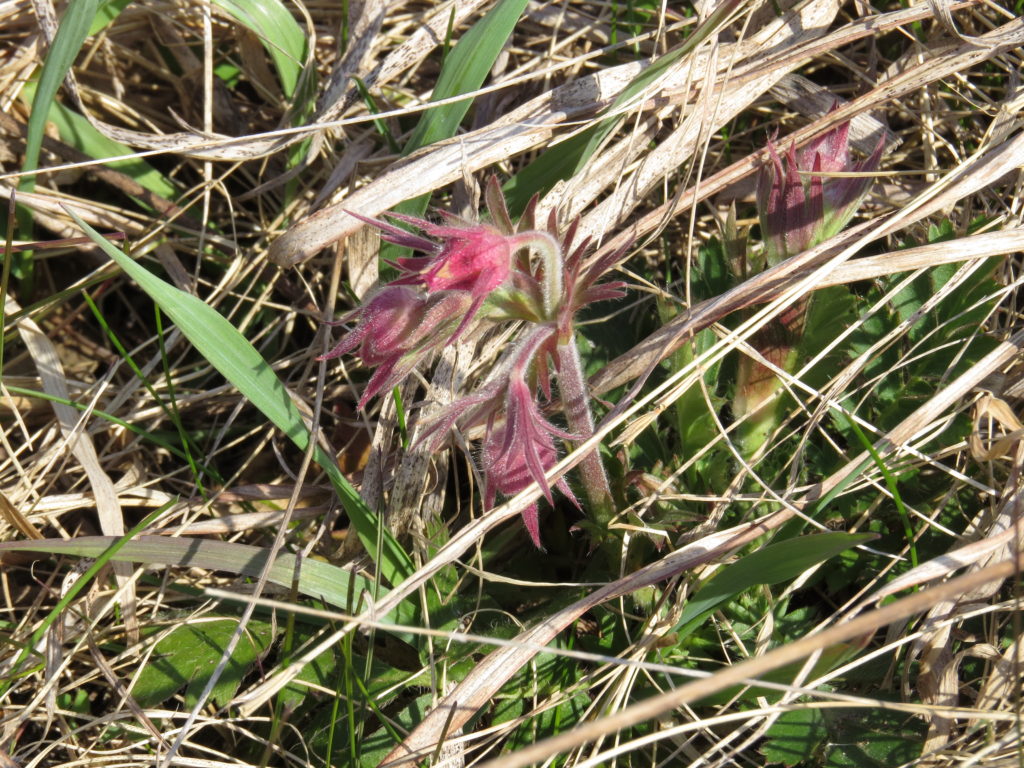
Another early-blooming grassland plant is Prairie Smoke. I scarcely caught sight of the pinkish-red flower buds in the old and new growth of the prairie grasses.
The waterfowl birds were in the predictable, peaceful process of nest-building, mating, and raising a family. The seasonable cycle, the circle of Life. New life among the remains of last season’s life.
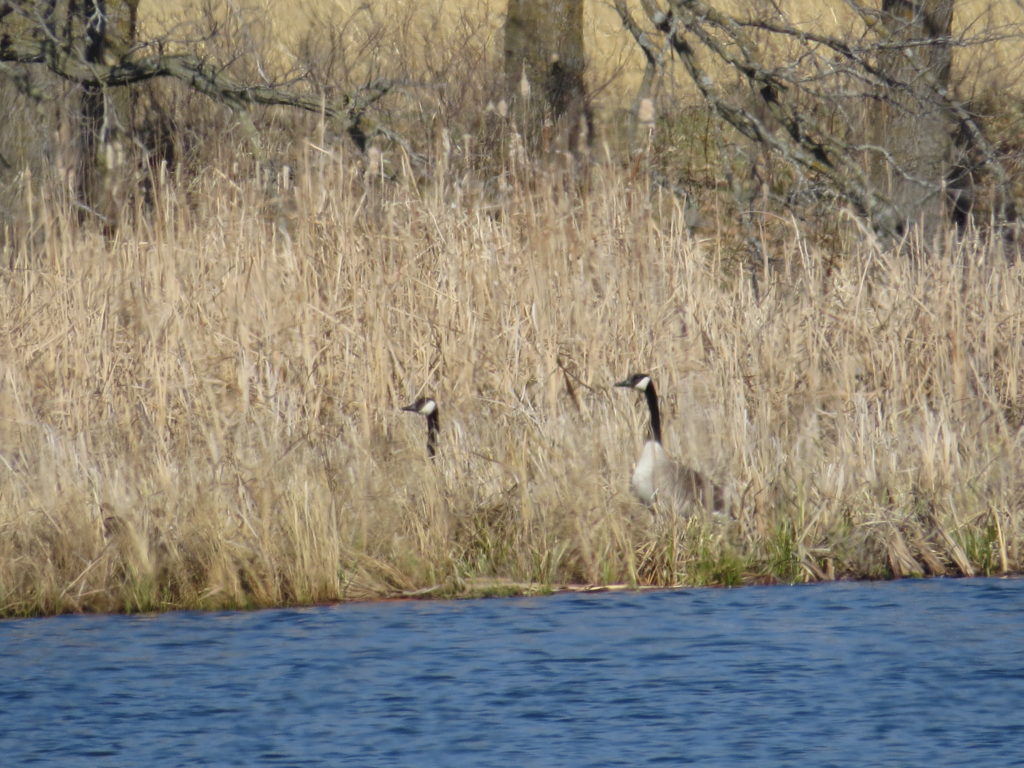
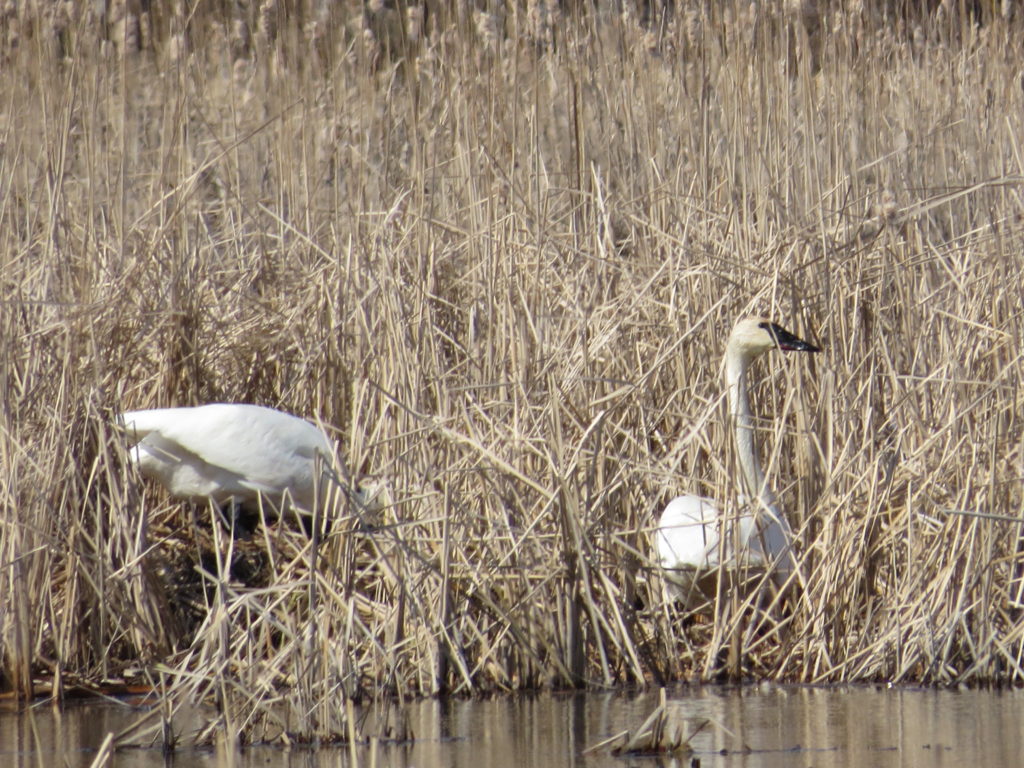
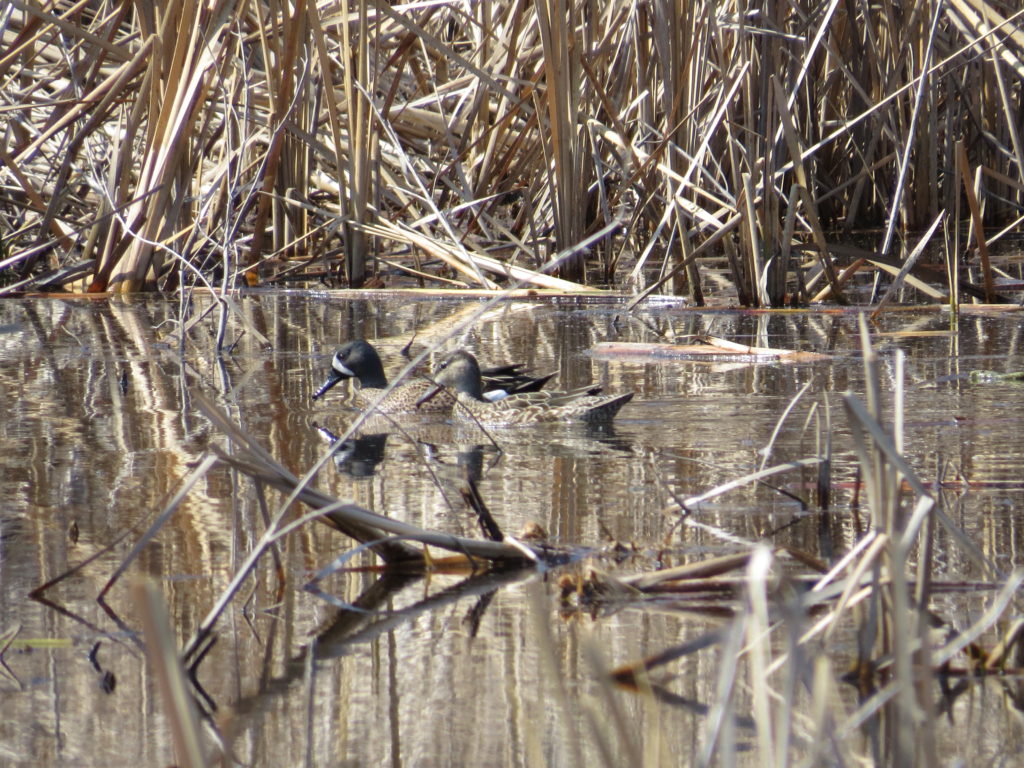
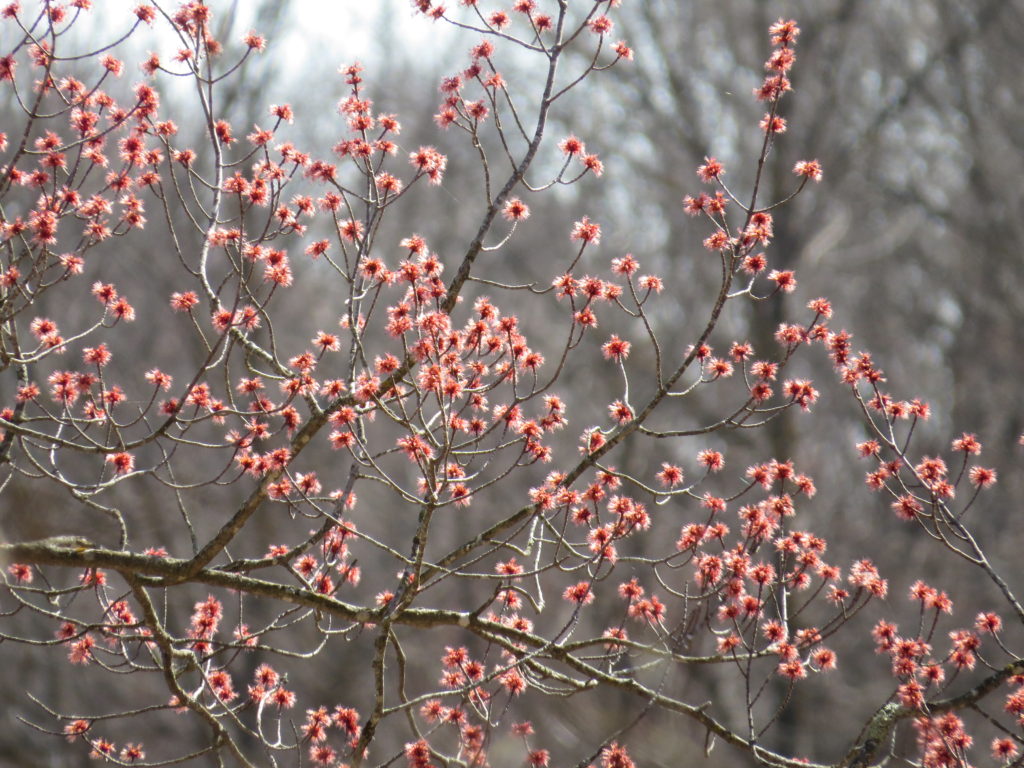
Trees at the Arboretum had just begun to bloom—the pinkish-red cloud of Maple tree blossoms…
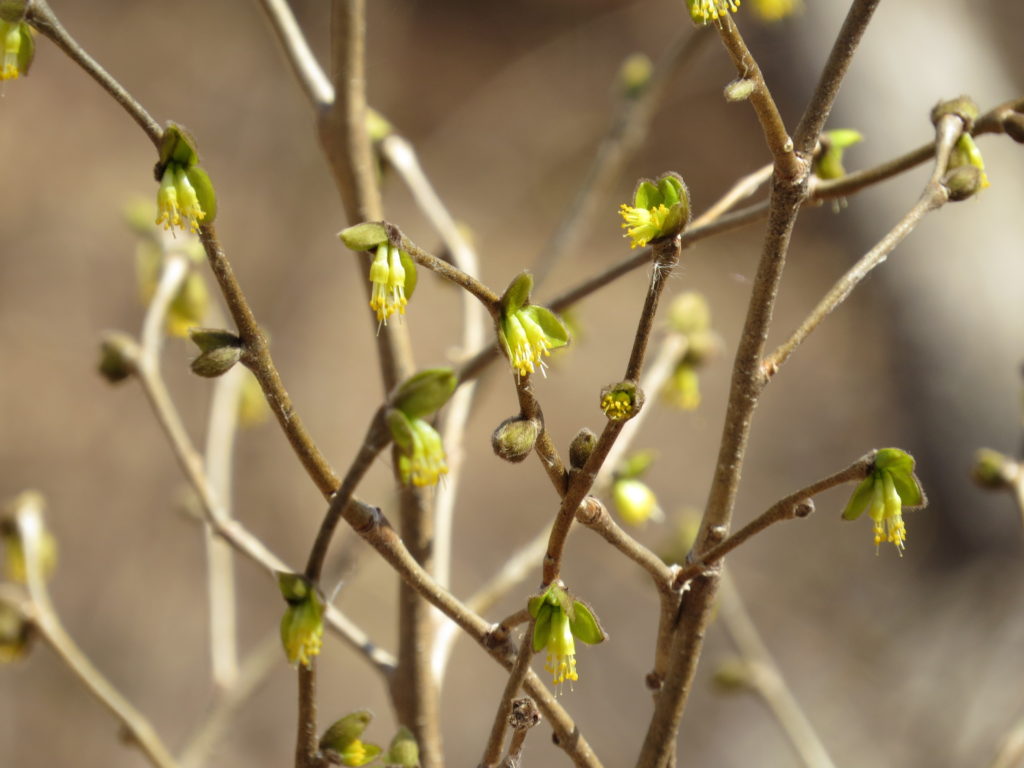
…and the delicate yellow blooms on my favorite flexible little tree, Leatherwood!
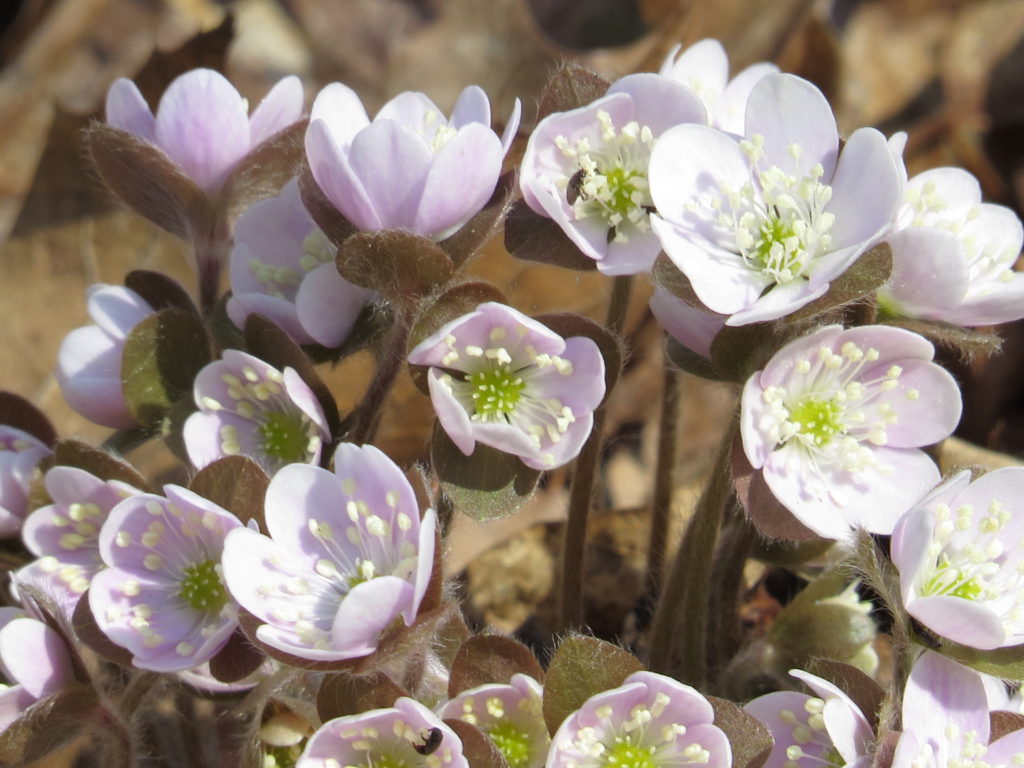
No matter the length or harshness of Winter, when the warming sun of early Spring hits the bare, leaf-covered ground in the forest, the Spring Ephemerals burst into bloom! They grow, flower, and fade away quickly, but they are an important part of the ecosystem being the first food for pollinators.
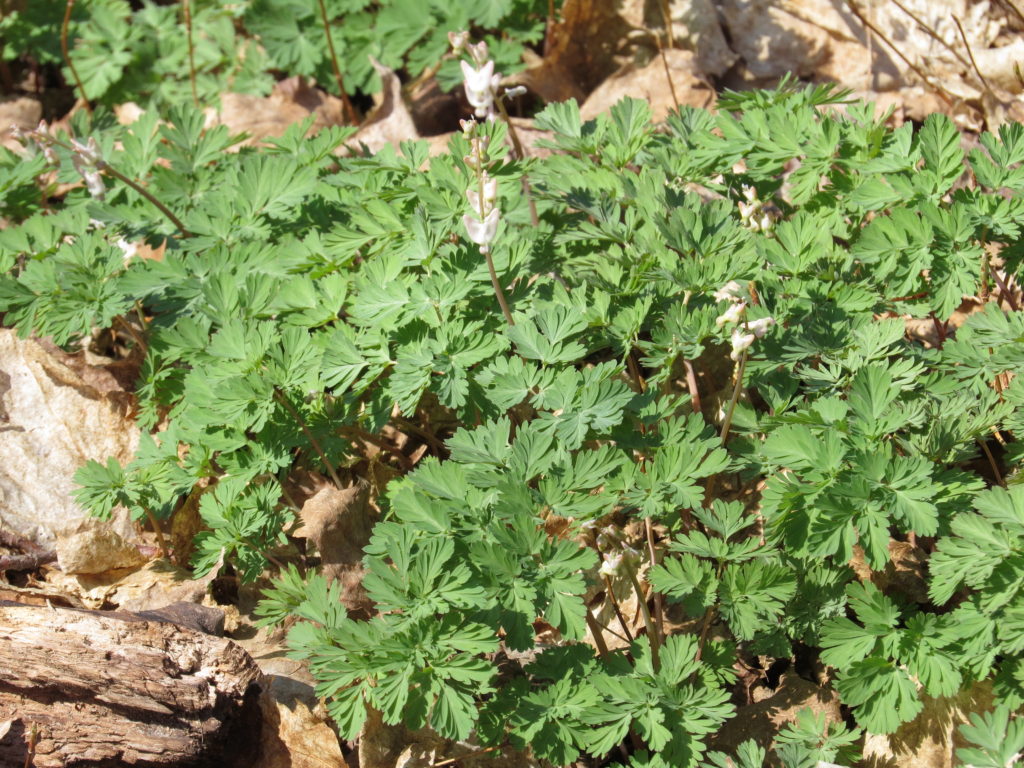
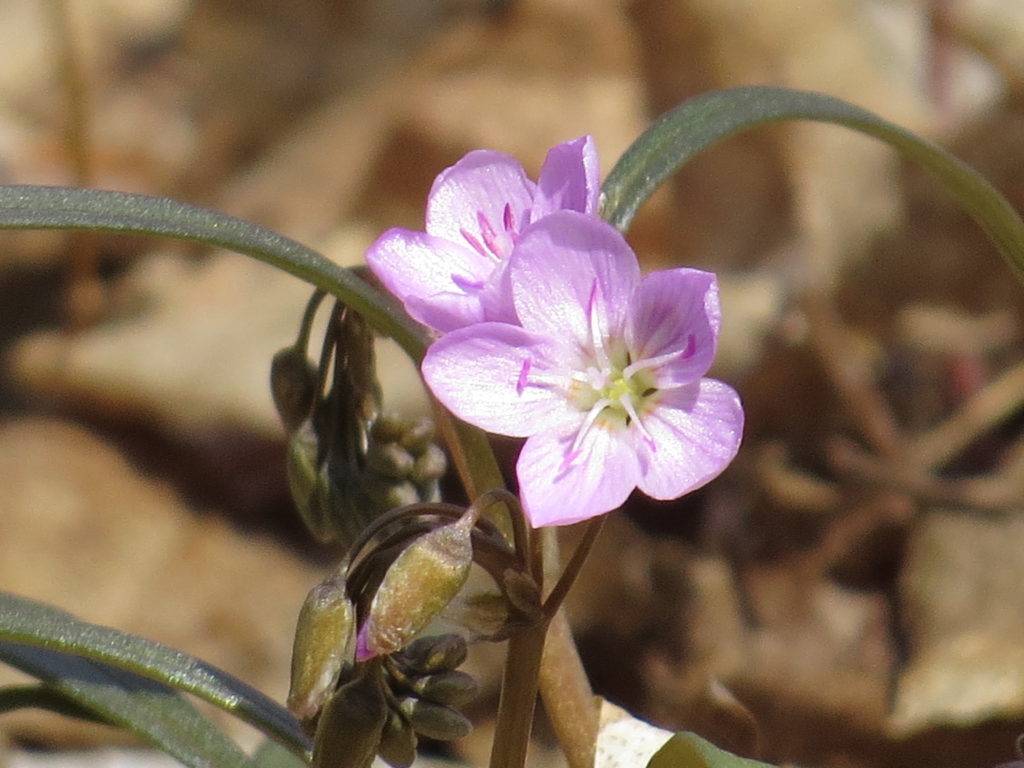
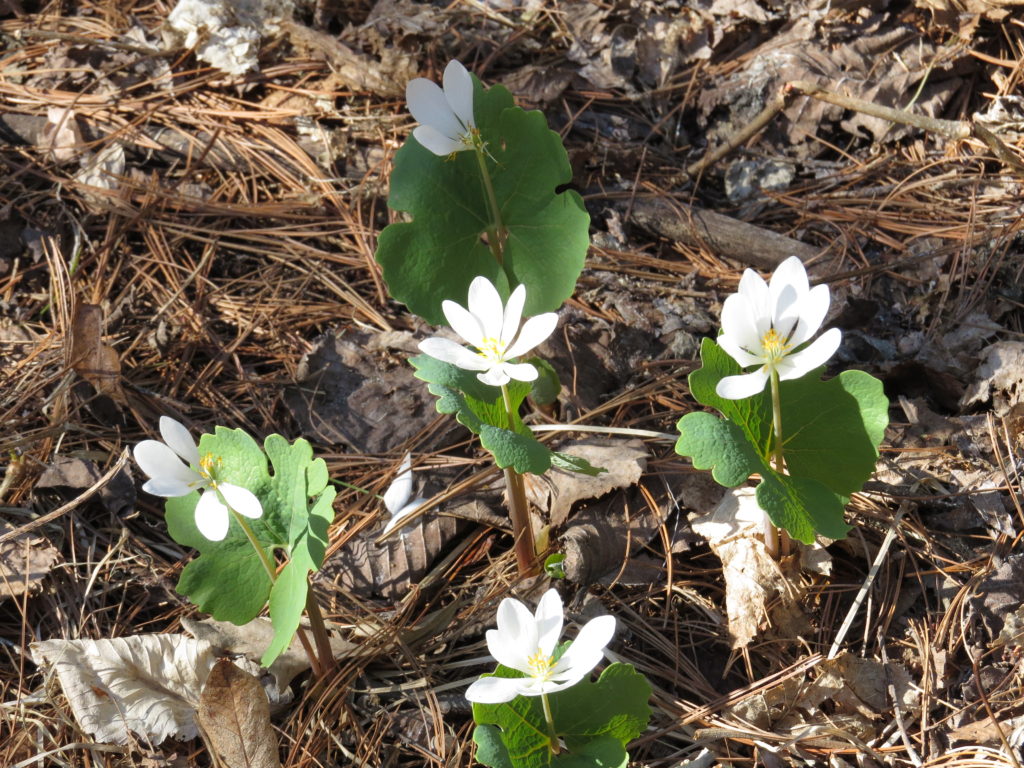
Life was coming to life again after a cold, seemingly lifeless Winter. It is the way of Mother Nature. The bleak and bare world was an illusion—the life force was hidden for a while, resting, quiet, gathering nutrients and strength, preparing itself for the growth and renewal of Spring.
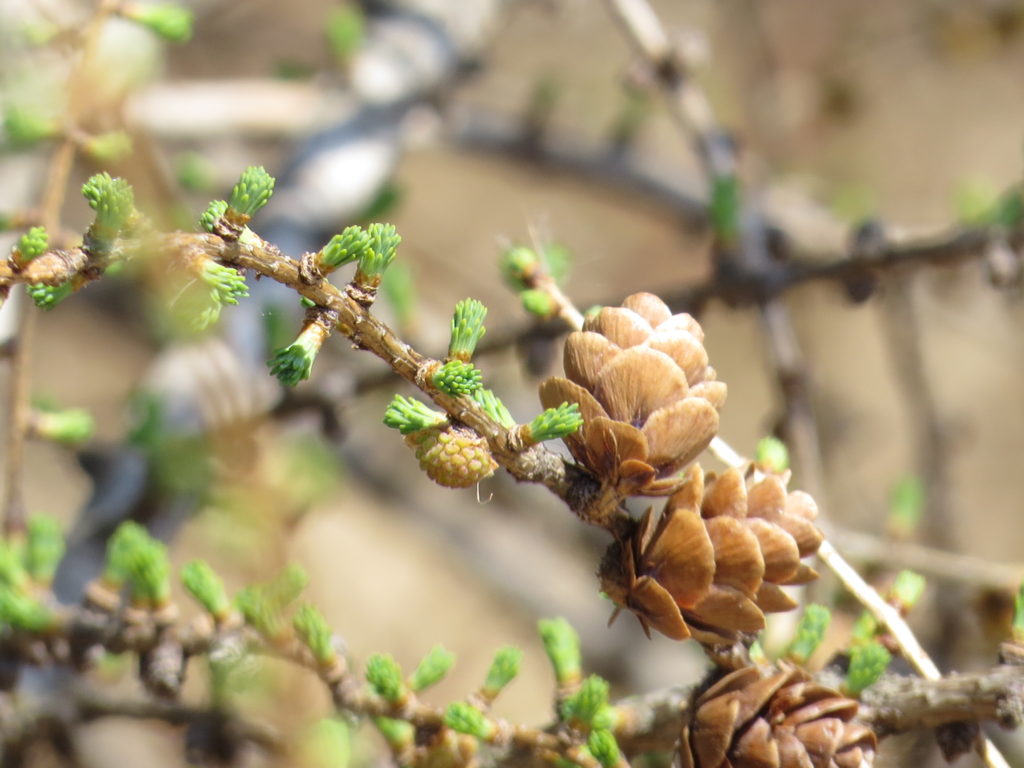
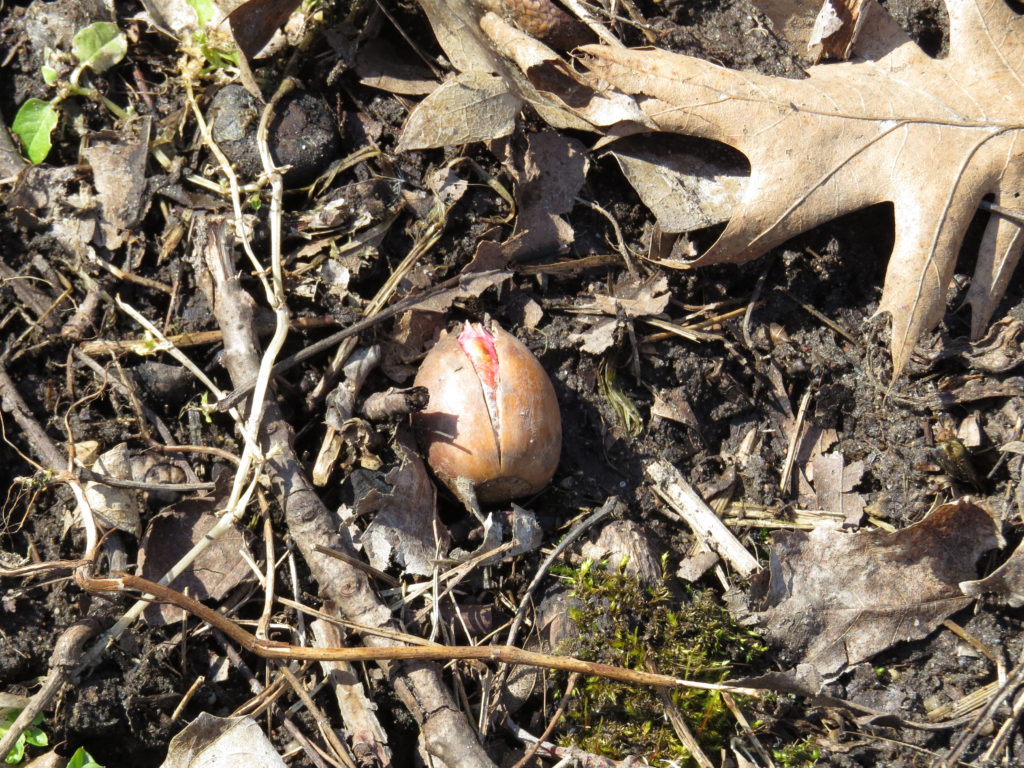
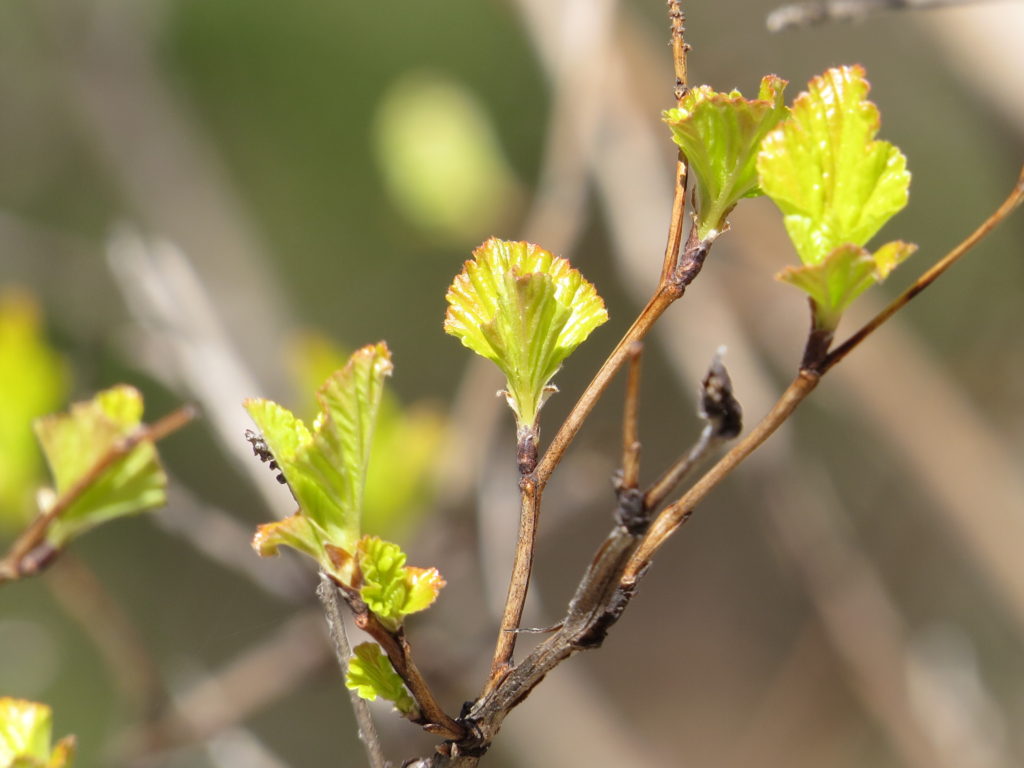
Mother Nature brokers in miracles.
What if no one was to blame for the pain and suffering of this virus? Not China or Trump or Democrats or Republicans or immigrants or Pelosi or that woman governor or fill-in-the-blank. That’s not to say that no one has responsibility or that no one has made mistakes or even that no one hasn’t purposely tried to injure or subject another group of people to hardship. In leadership there is accountability, responsibility, and consequences. Blame is a useless act of projection based on trying to get rid of our own very real pain. Suffering is the illusion of a bleak and bare world. It is the winter of our lives. It is living in a hermit hut and hating every minute of our existence. It is lashing out at those we love and those we oppose. What if pain and suffering are actually harnessing our virtuous qualities to pull us away from the perils in the old life? What if we are resting, a needed rest, in order to burst into new growth? What if right beyond our suffering is a blooming, melodious, life-creating world? Nature is the harbinger of miracles. No one is exempt from the Grace.
The Connection of All Things
“Whatever affects one directly, affects all indirectly.” –Martin Luther King, Jr., pastor and activist
“We are not only a part of the world, but we are the world….Everyone is connected to each other just like a single cell in the body is connected with every other cell through a network of nerves and flow of blood.” –Awdhesh Singh, engineer
“When we try to pick out anything by itself, we find it hitched to everything else in the Universe. –John Muir, environmentalist
“Everything in the world is actually connected. That means even if we get separated, we’ll never be alone. –Ohtaka Shinobu, artist
From a young Japanese manga artist to an Indian engineer and leadership specialist to the iconic social justice minister to a nineteenth-century environmentalist, the theme of the connection of all things is the conclusion of their diverse experiences. This connection is pertinent in the physiology of our bodies as we strive to stay healthy while the coronavirus infects people across the world, and it is imperative in our global efforts to fight the destructive effects of climate change. Our bodies. Our environment. Health Day. Earth Day.
I have been rather obsessed lately about the lessons that are hanging like shiny red fruit from an Autumn apple tree—abundant, nourishing, and ours for the picking. Every one of us has unique and profound lessons that are being brought to the surface with our shelter-in-place, work-from-home, social-distancing lifestyle of the time-being. What do I really need? Who are the most important people in my life? What do I really want to do for the rest of my life? How can I be my healthiest self? It matters what we do to our bodies. Smoking, eating too much, drinking, junk food, not exercising—the list is too long. And the list of things that affect our bodies that we do not control is also long and overwhelming—air pollution, water quality, food chemicals, etc.
Lesson # 1: We have great control over what we put in and on our bodies. Start there. Do one small thing each day that makes our bodies better, healthier, happier.
Lesson # 2: Sleep is the great healer. So much of our health comes from getting enough sleep. It is when our body repairs itself, and we are efficient, amazing organisms when it comes to the function of repair—from the repair mechanisms of our DNA to the healing of wounds to the removal of toxins.
Lesson # 3: Movement helps with the first two lessons. Walk, bike, swim, do yoga, garden, run, etc. Fuel your body for movement, then sleep like a baby.
Lesson # 4: Figure out what is getting in the way of obtaining the first three lessons. This is the hard part. But it’s still within our control. Think about it. Write about it. Talk about it. Figure it out.
The same process can be used with our Earth. What is harming it? What will help it? Ironically—or maybe not—the Earth is getting a reprieve during this Covid-19 time. There’s less air pollution, the water is running cleaner and clearer, and there is less seismic activity. All things are connected. What we do to our Earth matters.
Lesson # 1: We have great control over who we put in as our leaders who make the decisions about protecting our health and protecting our Earth. Start there.
Lesson # 2: The health of our Earth comes from Nature. What does healthy soil look like for optimum growth of nutritious food? What does pristine air not have in it? How does Nature provide clean water? Nature is the great healer.
Lesson # 3: Earth Day is a movement that started 50 years ago. Let’s not go backwards. Let’s not lay on the couch and pretend that everything will be okay if we do nothing to change the current trends.
Lesson # 4: What is getting in the way of the first three lessons? This is the hard part. Think about it. Write about it. Talk about it. Vote about it. Figure it out.
So whether you are an artist, a preacher, an engineer, an environmentalist, a farmer, a teacher, a politician, a CEO, a student, or any other, we are all connected. The health of our bodies and the health of our planet are connected, not just in a physical way but also in a spiritual way. How do we overcome the obstacles, roadblocks, and barriers that get in the way of having healthy bodies and a healthy Earth? With Love. When we love something, we take good care of it. Love is the great healer.
Room to Grow Into Our Best Selves
After a cold, snowy Winter, all I want is some warm sunshine, green leaves, and colorful flowers. Winter in the North hones our patience. Winter after the calendar proclaims Spring tries our patience, which is all a part of the honing process, I guess. We “can’t always get what (we) want,” as Mick Jagger sings.
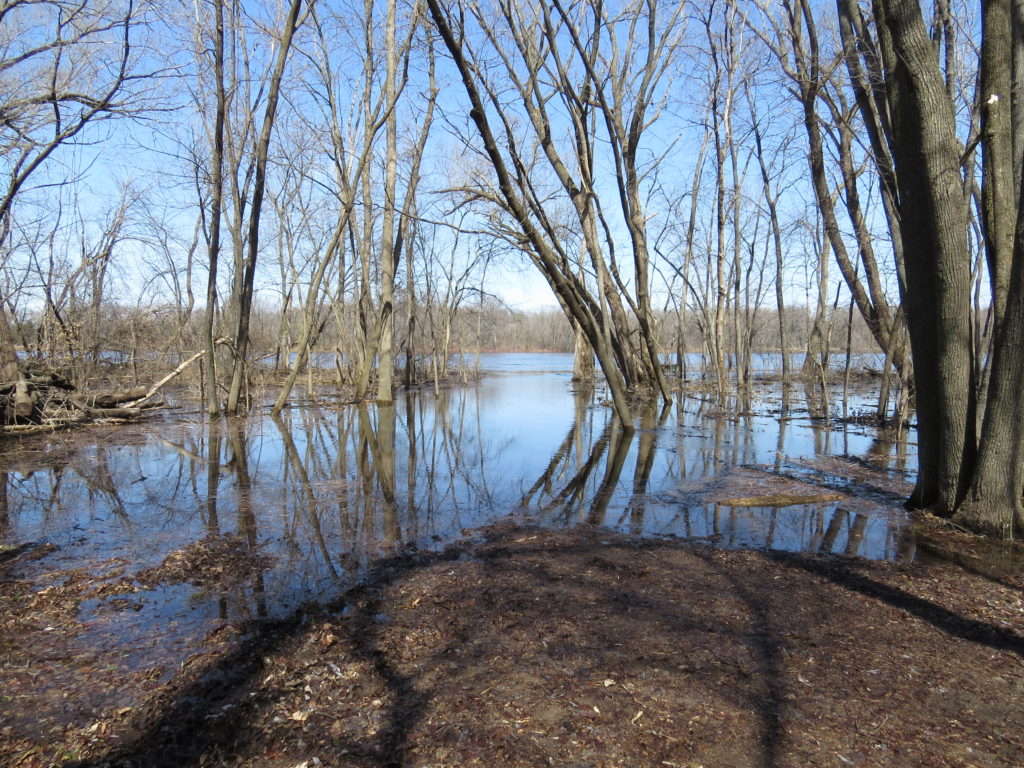
Twelve days ago we did have a sunny, relatively warm day! Chris and I decided to hike down at the Mississippi River’s edge, because we hadn’t been there (seen it) since ice-out. We followed the trail down the hill—to a beautiful blue… River-flooded trail. I guess we won’t be going that way….
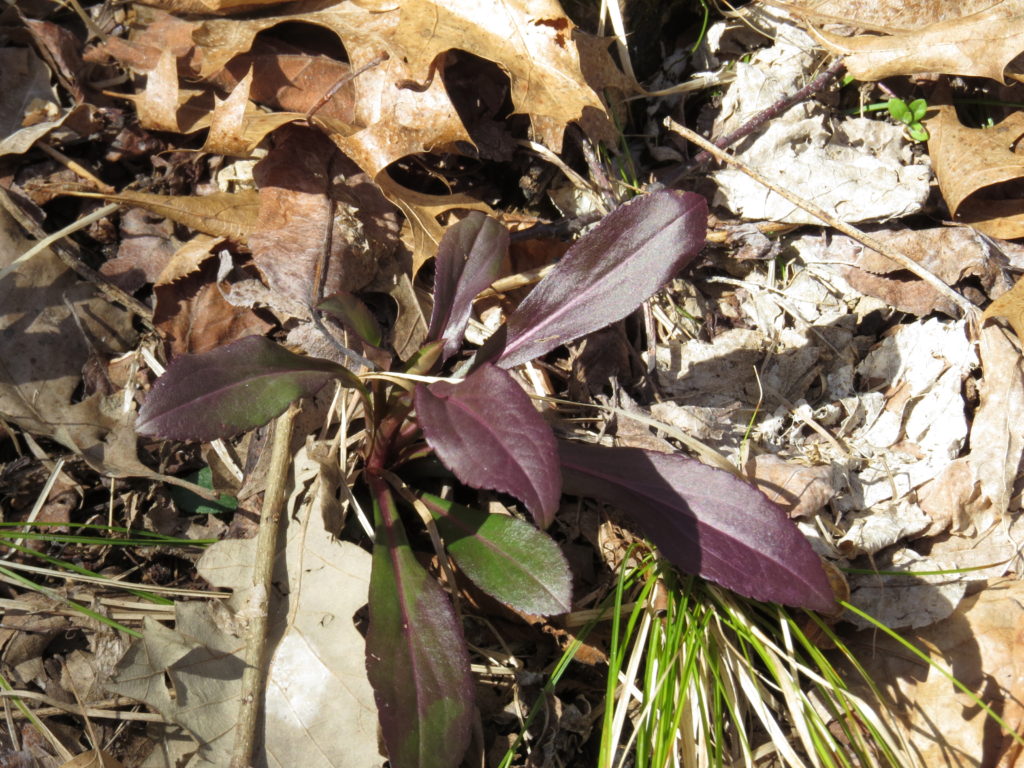
We turned around, walked back up the hill, and went a different way. I spotted what looked like a Penstemon growing its greenish-purple leaves through the brown leaf litter. There will be Spring flowers in this spot in the weeks to come!
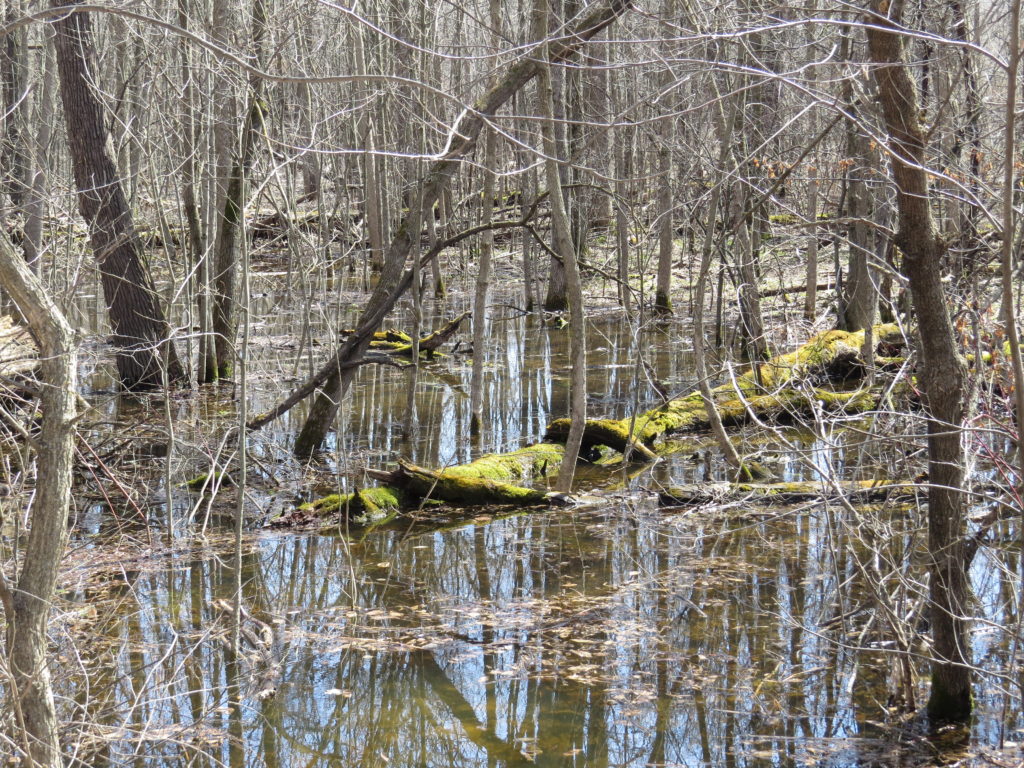
But on the other side of the road was a gray swamp with a green swamp-log, like a huge alligator laying-in-wait in the water, in the shadows and reflections, in the Winter debris.
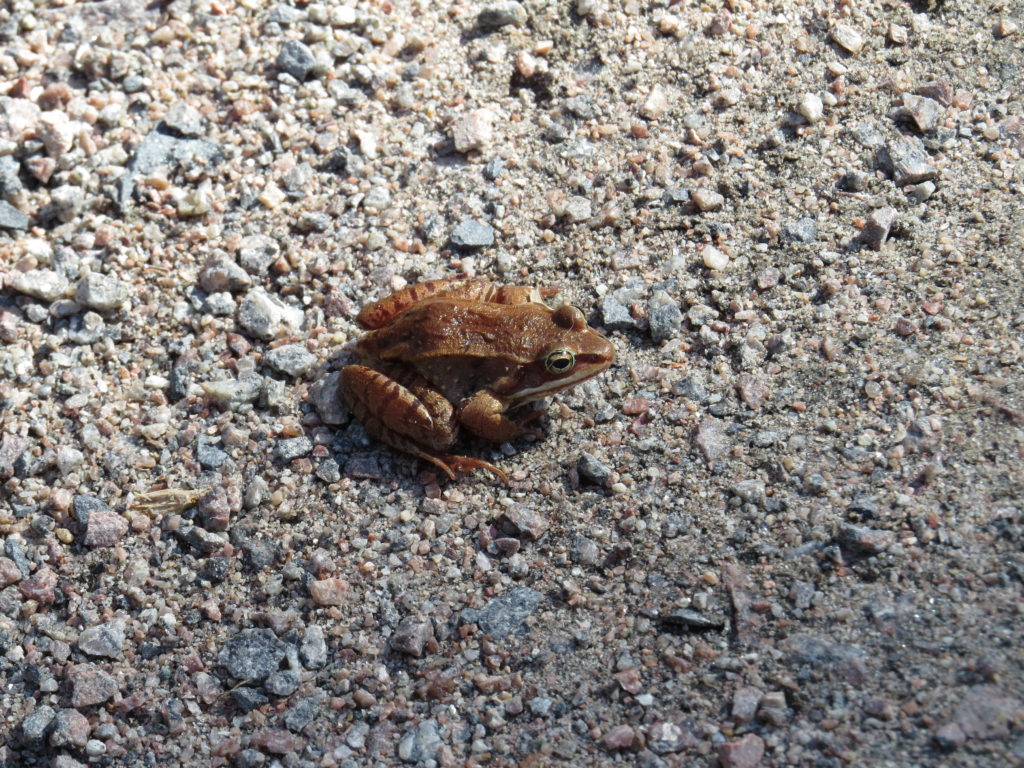
A real water creature hopped up onto the road to warm itself in the sunshine.
The boat landing road did get us down to the River. This was where we had walked across the ice just six weeks before. (Walking Across the Mississippi River)
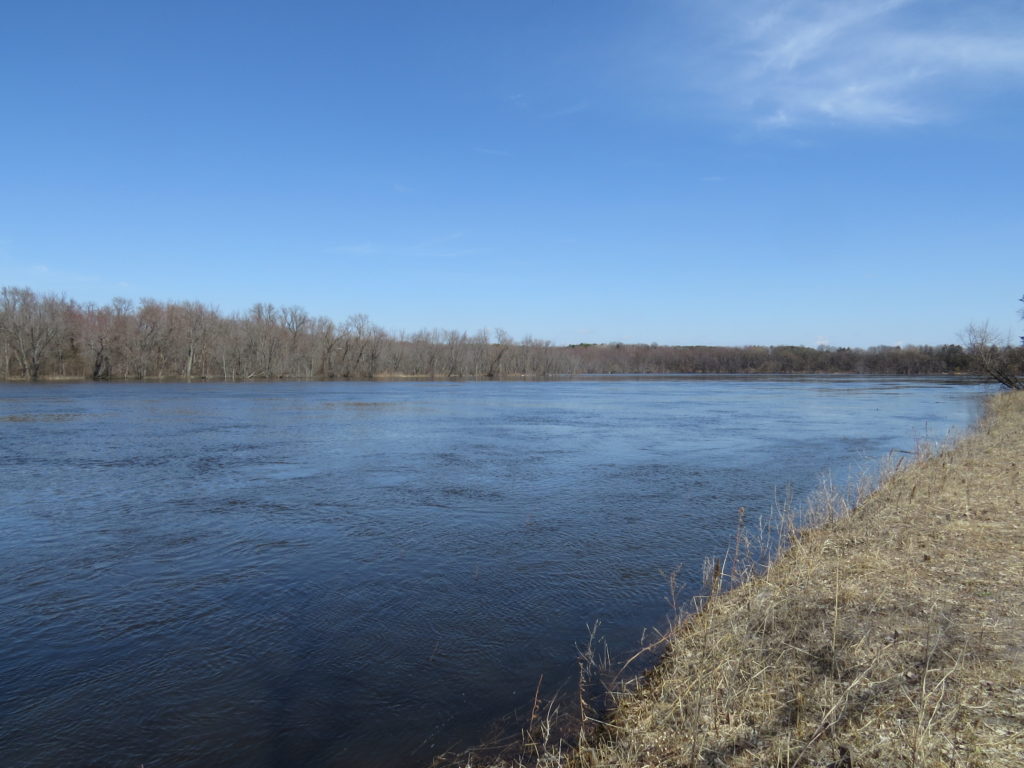
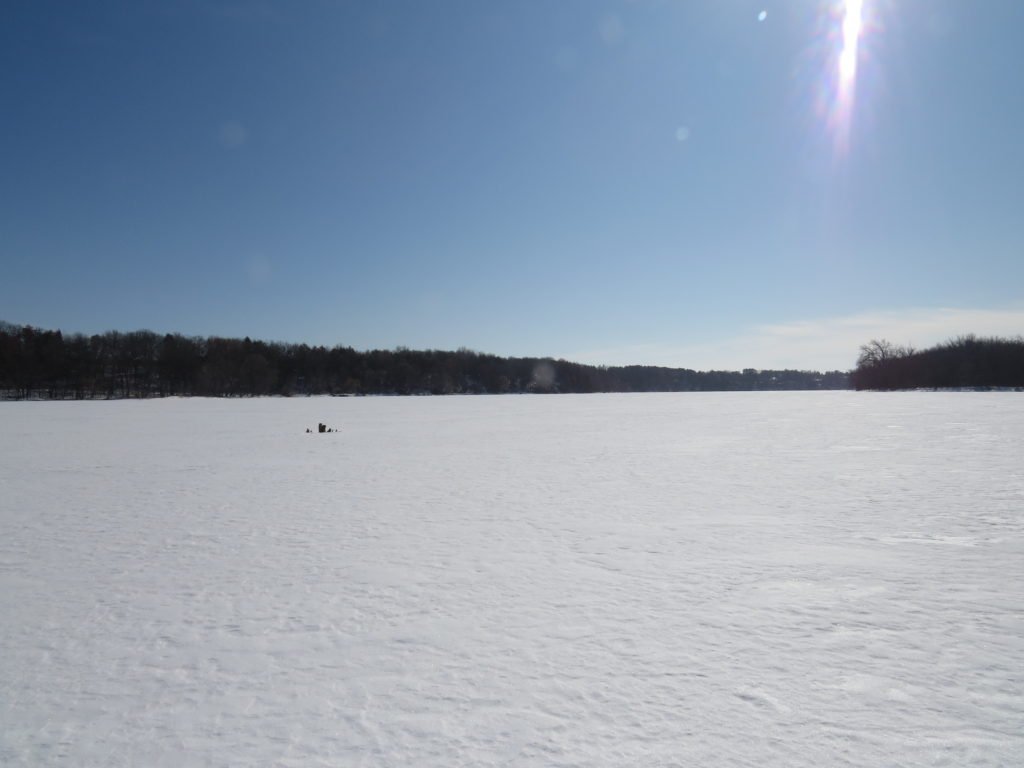
Even though we weren’t where we wanted to be—on the trail, in the weather, in the Spring—we were in a much different place than we were just six weeks ago. Sometimes we forget how far we’ve come when it looks like we have a long way yet to go.
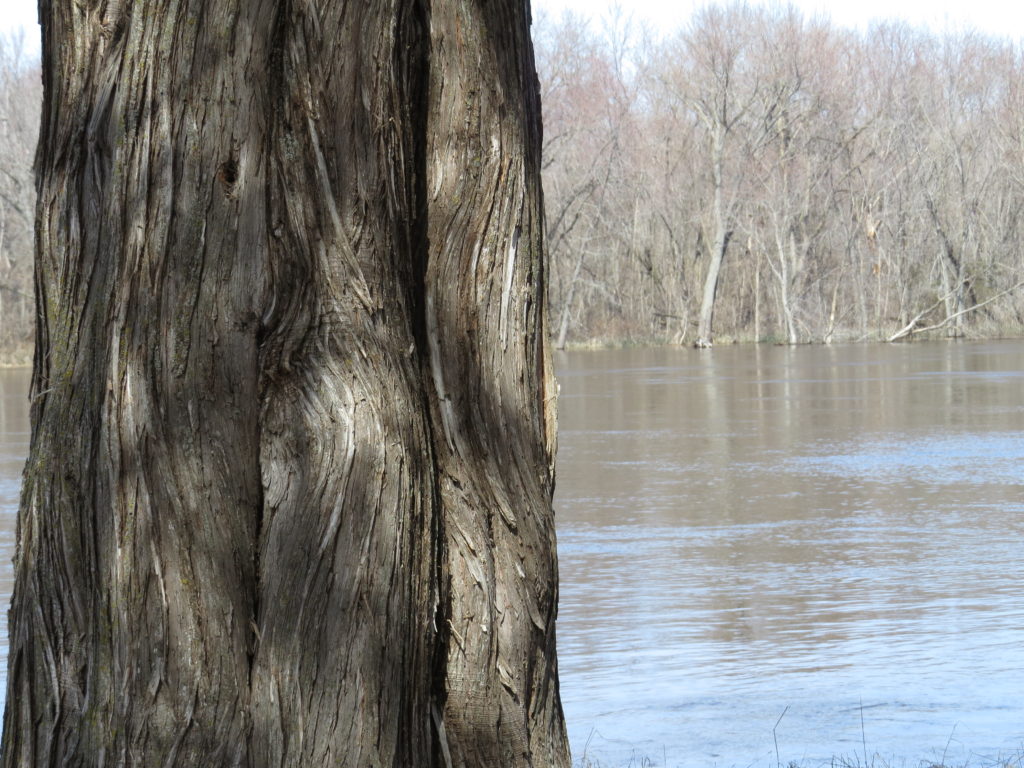
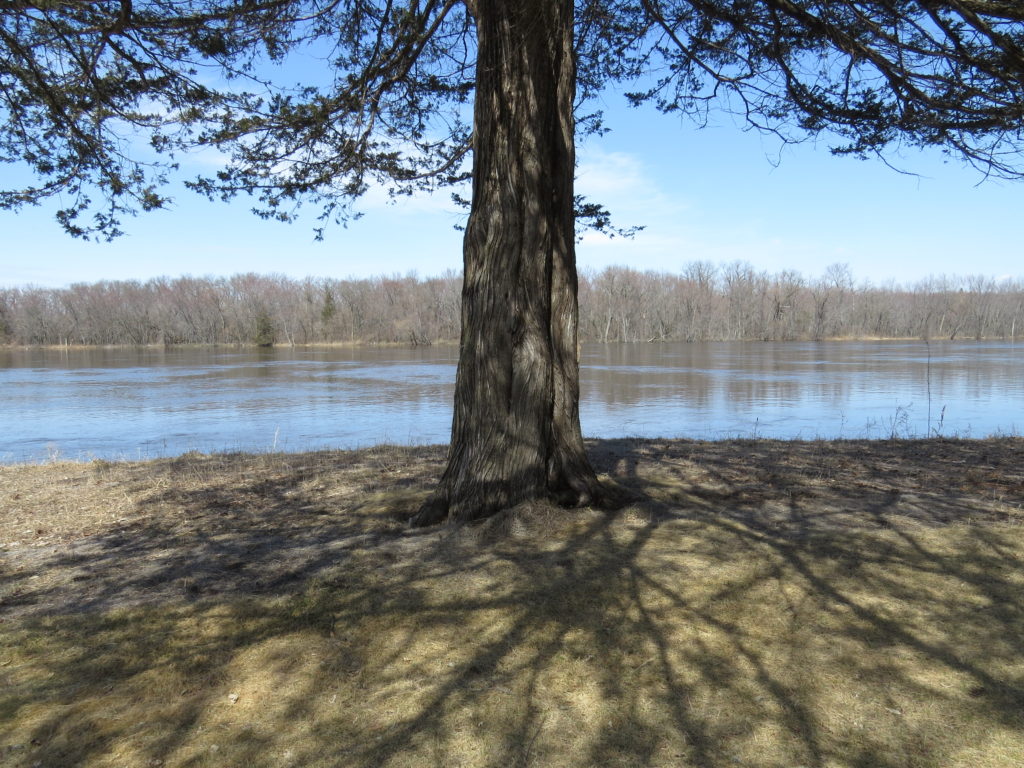
A lone Red Cedar tree, well-watered by the near-by River and unencumbered by any other tree in its proximity, had grown into a specimen tree. All the characteristics, all the best qualities of the Cedar were showcased in this tree. It had had room and nourishment to grow into its best self.
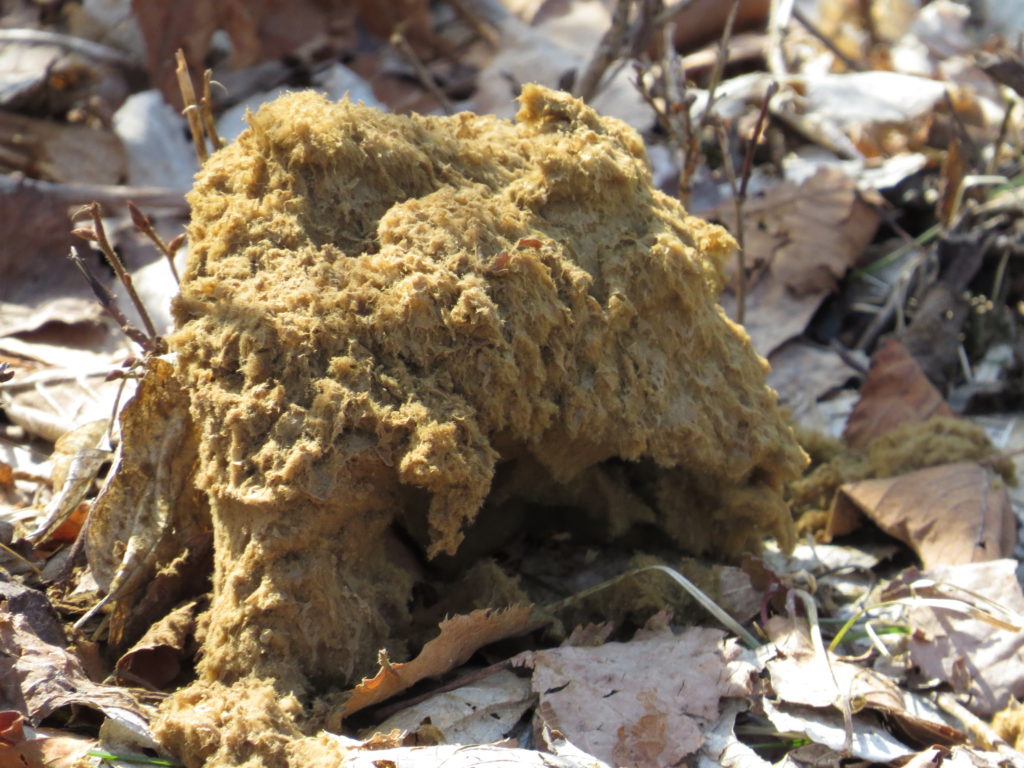
The trail from the boat ramp along the River was squishy, yet passable. By an old Oak stump, puff-ball fungi grew from the decaying roots. When I stepped on one, it disintegrated into near-nothingness. Poof!
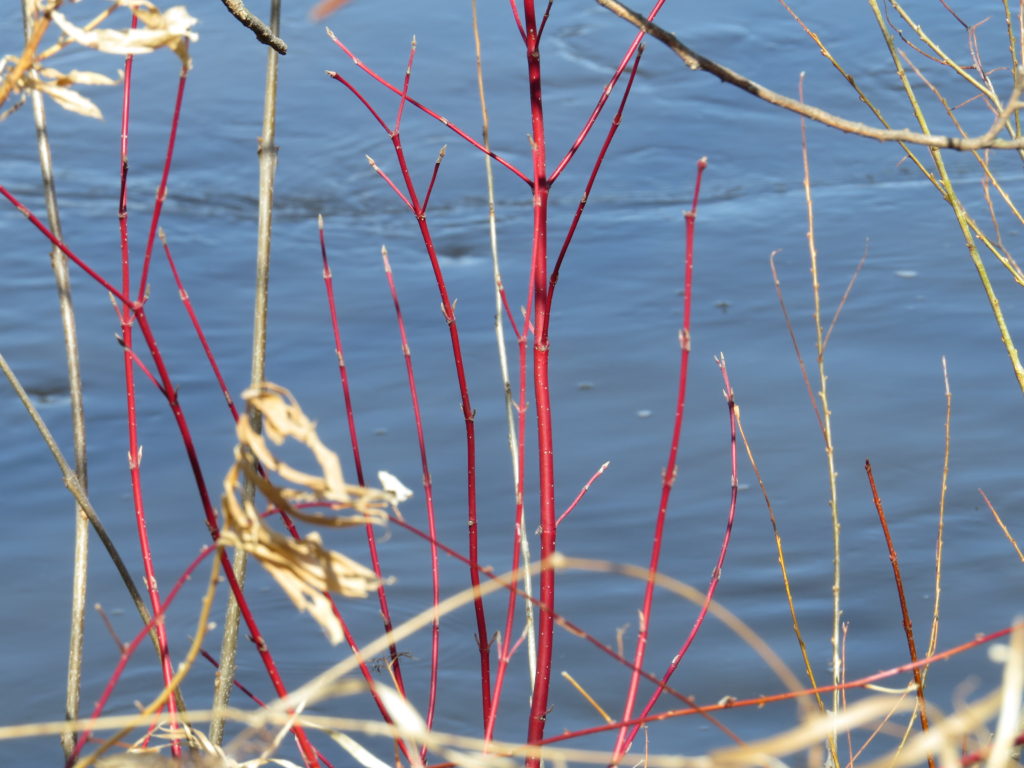
Colorful Red-twigged Dogwoods grew on the bank of the River—Winter and early Spring are their times to shine.
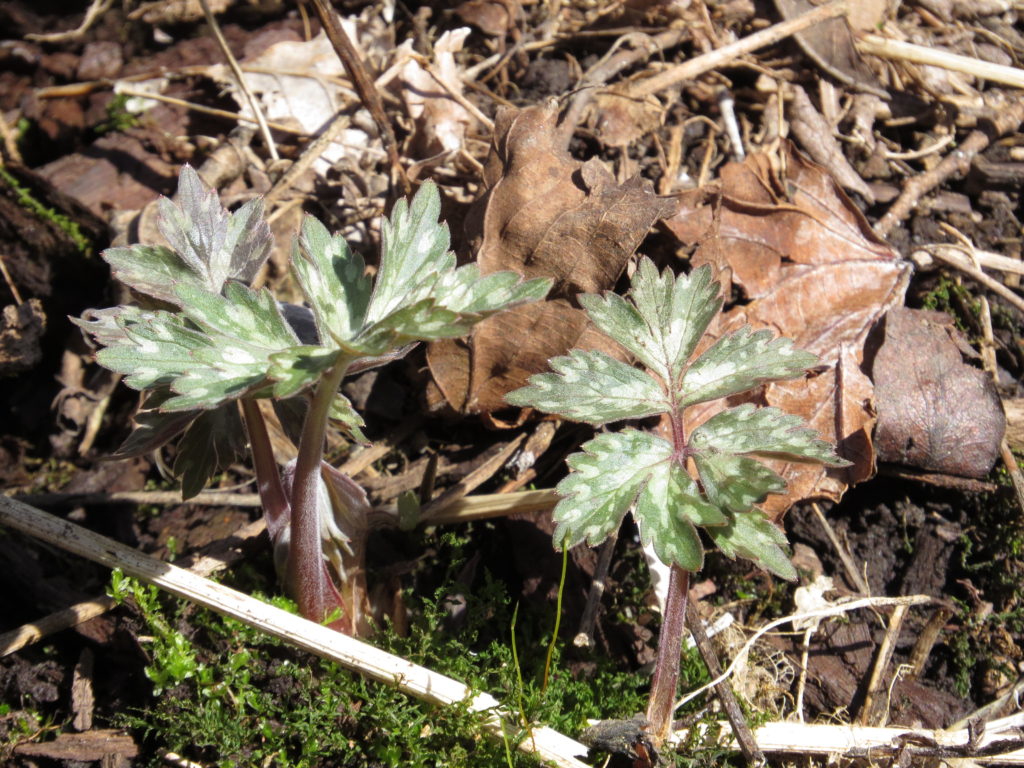
Brave cool season plants who can tolerate the fluctuating temperatures of early Spring have started to pop up in the woods. The beginning of the season of miracles.
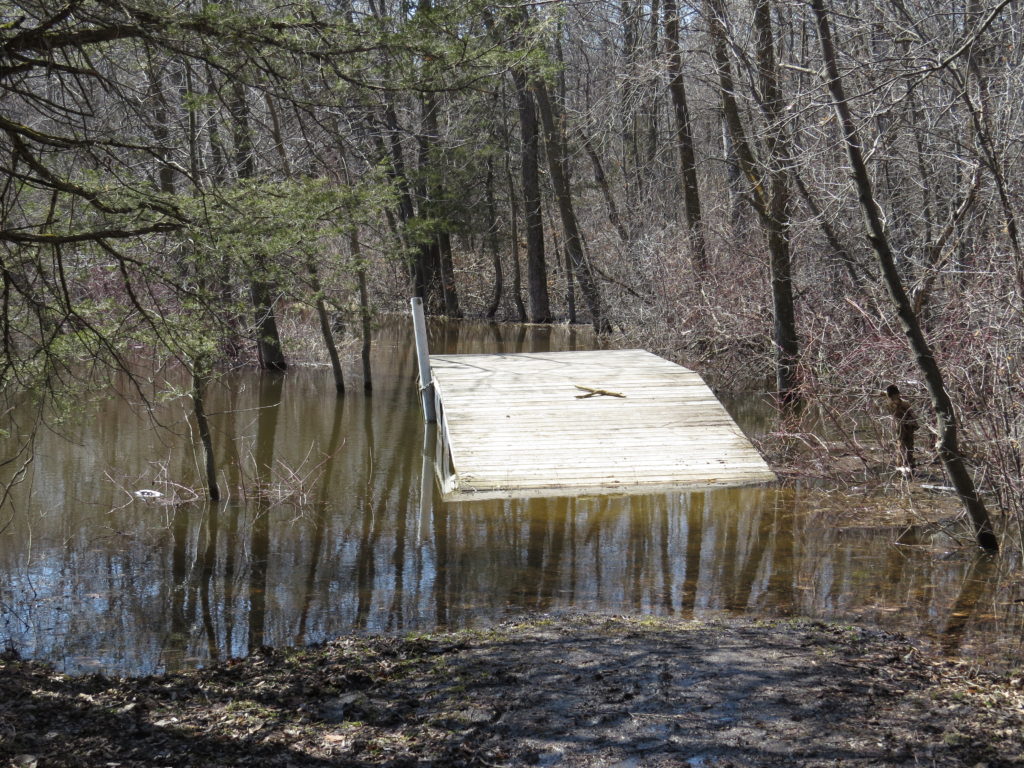
When the trail left the riverside, we hoped to find our way to another part of the Park. The trail was muddy, with low spots in the woods filled with water. But once again we were stopped by the flood waters when we encountered a bridge in troubled waters. We turned around and re-traced our steps all the way back to the boat dock road—the only way out.
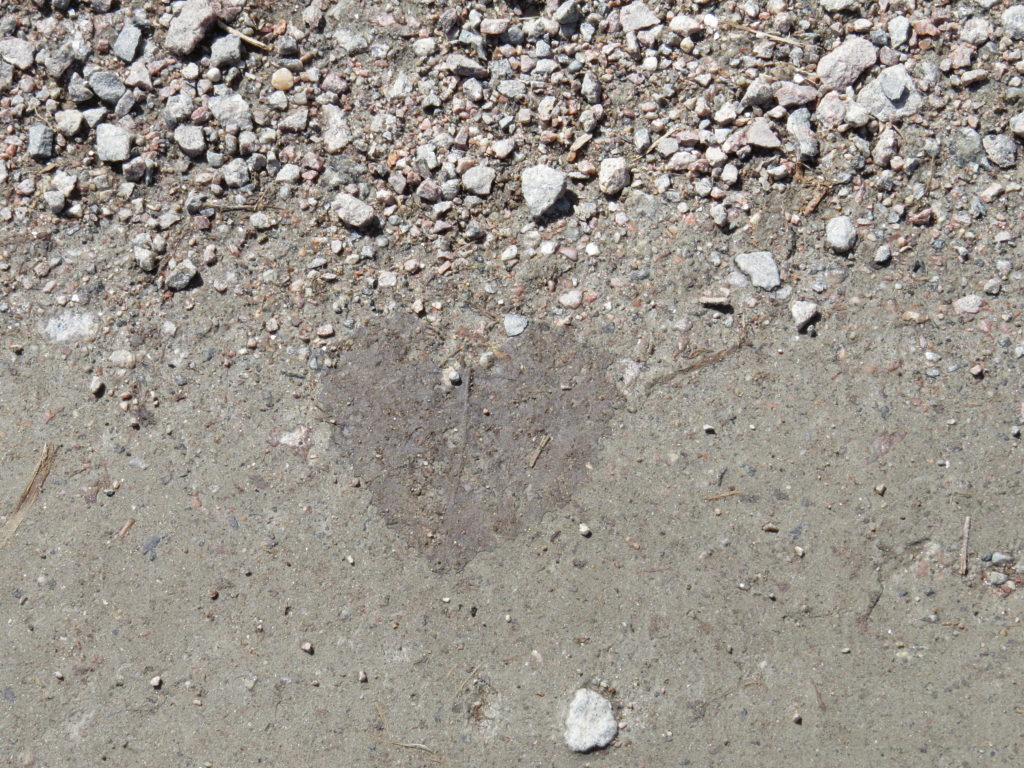
A Poplar leaf had imprinted in the mud of the road.
Spring is slow to show its pretty face this year. There has not been much change in the twelve days since we walked that trail. The temperatures have been cold at night and marginal during the day. We’ve had a day or two of rejoicingly warm weather, but we’ve also had snow. The grass is a tinge greener, and there are some swollen tree buds. We continue to hone our patience. And we continue to hone our patience with Covid-19, as trying as that is. It looks like we have a long ways to go—and we may—but look at how far we’ve come in our knowledge of the virus and the navigation of the road ahead. Sometimes we have to backtrack or take a different way. We also have an opportunity to be like the Red Cedar tree—unencumbered, socially isolated, and able to grow into our best selves. We can tromp through the mud, be respectful of the flood waters (which will recede), and we can shine even when all around us seems bleak. Sometimes it takes the mud in order to see the Love.
Without a Map or an App
In this stay-at-home/ social distancing/ unprecedented time of the Covid-19 pandemic, we find ourselves without a map or an app. How do we do this? Which way is the best way to go? Where do we end up if we follow this path? The unknown is unnerving. Even as the hope of Spring is pulling us out of the dark, bleak Winter, there is still bleakness all around—death, sickness, chaos, partisanship, job loss, fear, hunger, and more. We haven’t done this before! What are we supposed to do?!
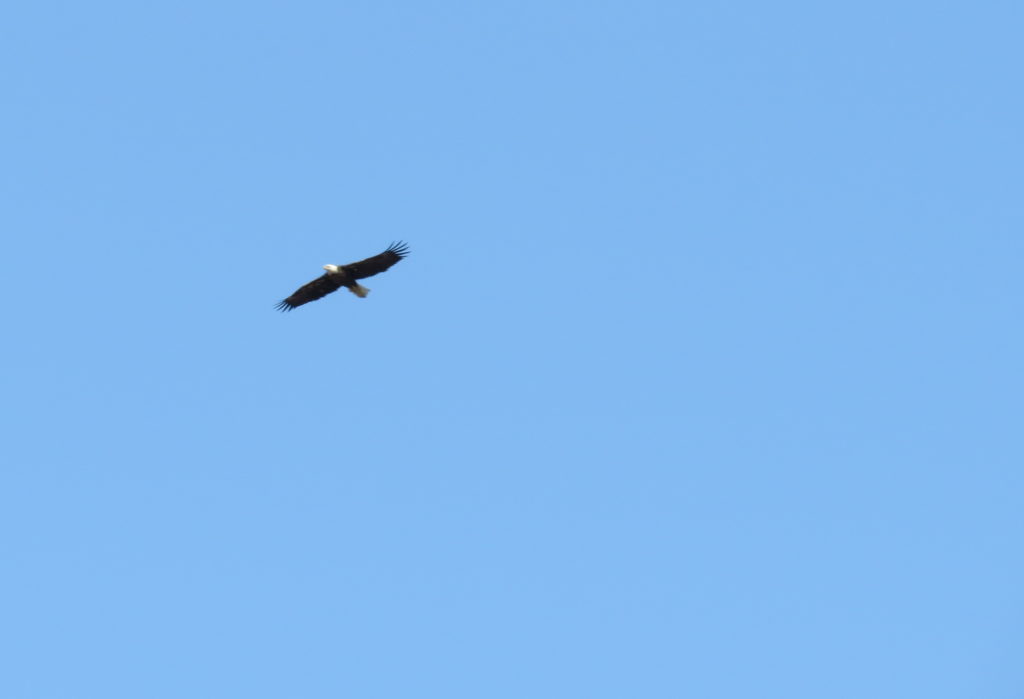
Twelve days ago Chris and I drove west to Birch Lakes State Forest. We had been there once before, a number of years ago. The gate was closed at the entrance, as the unplowed, sandy road was still snowy in places and soggy in the rest. We parked by the sign, the only ones—the only human ones, that is—to inhabit the forest for the afternoon. Before we were even out of the car, we saw an eagle circling above our heads. They are so impressive and free—watching them fly takes me out of my earthly worries into the clear blue strata above.
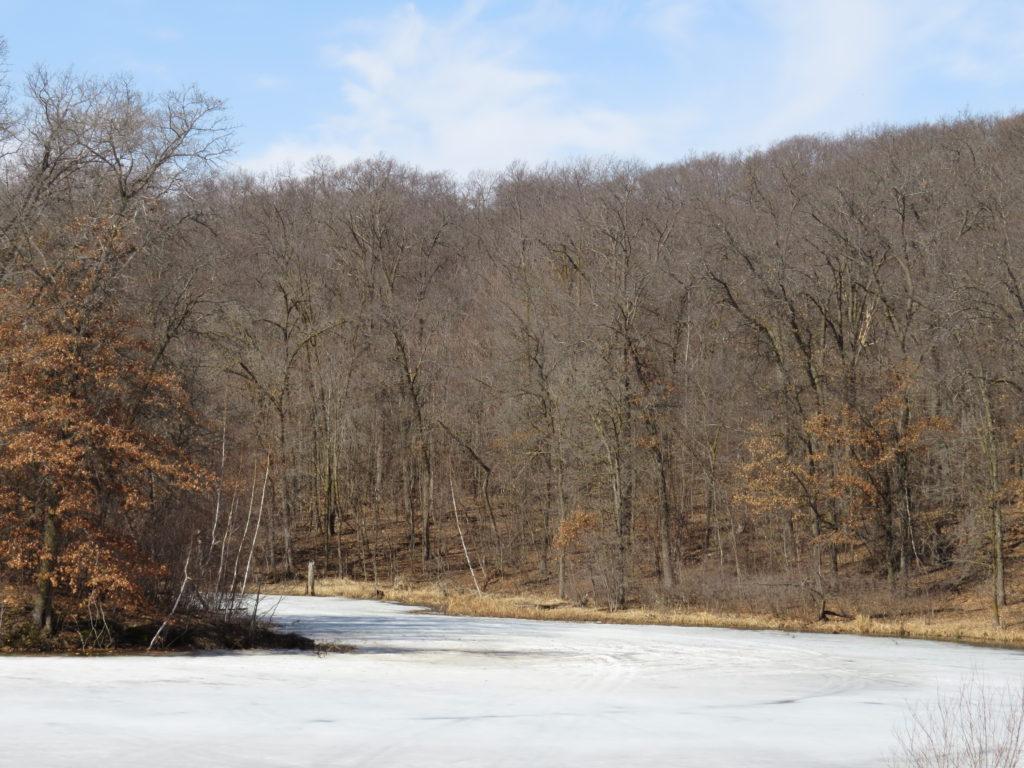
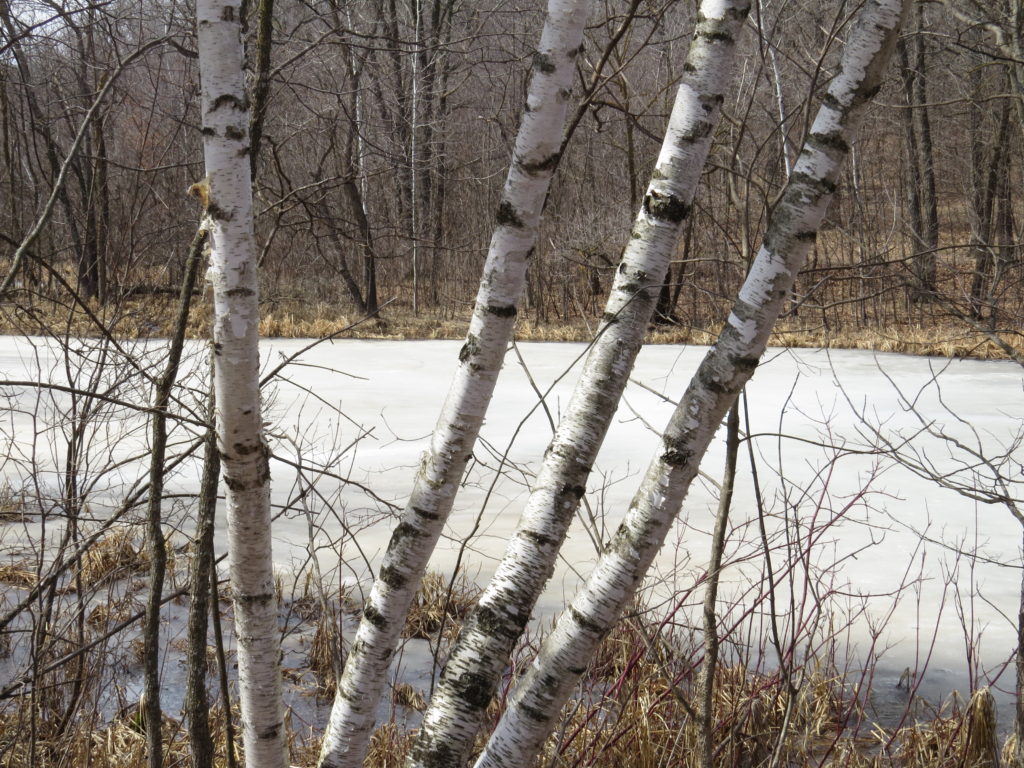
The pond across the road was still ice-covered, the snowmobile tracks still visible, the trees in the forest still unadorned. As much as we want our beautiful, full-blown Spring, this is our Spring reality.
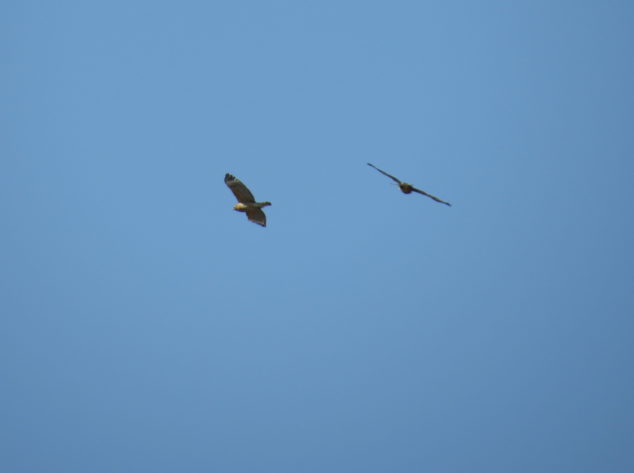
Before we left the car side, we heard a high-spirited screeching in the sky. Two hawks were singing and swooping in a joyful sky dance! The mated pair flew apart, then close together (one carrying a stick in its beak) with grace and energy for the Spring ritual of mating, nesting, and raising a family.
It was only when we saw a path and entered the forest that I remembered we didn’t have a map of the trails. No worries—even though we hadn’t hiked in this area before, I knew Birch Lake was at the end of the road, and we would find our way.
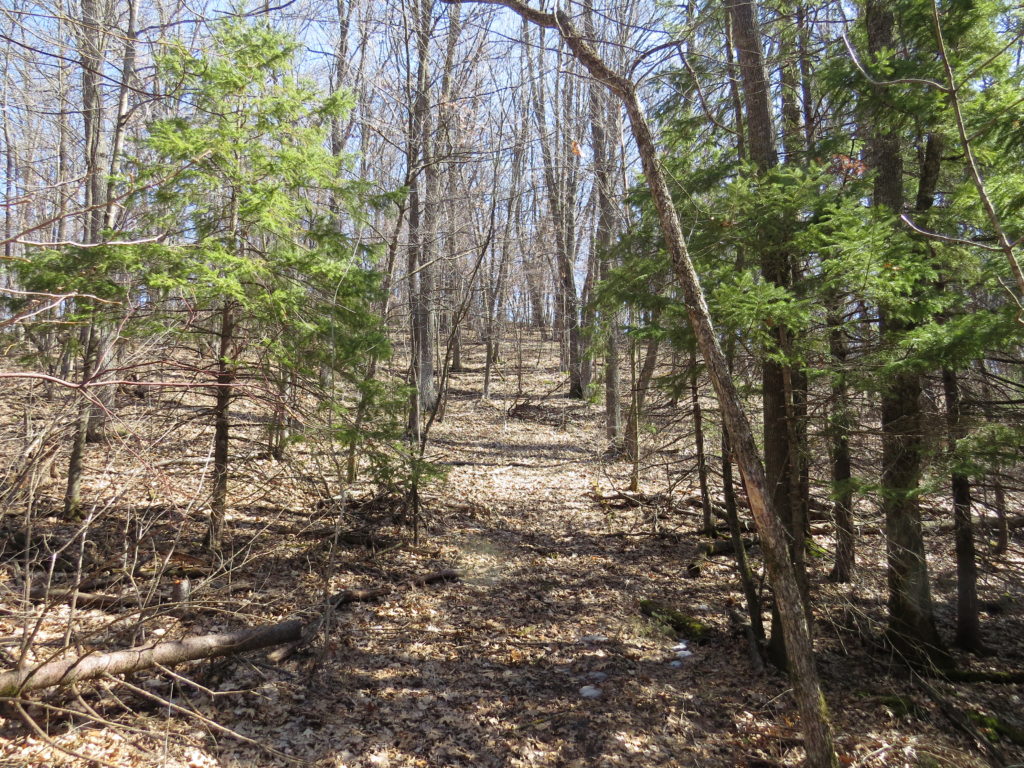
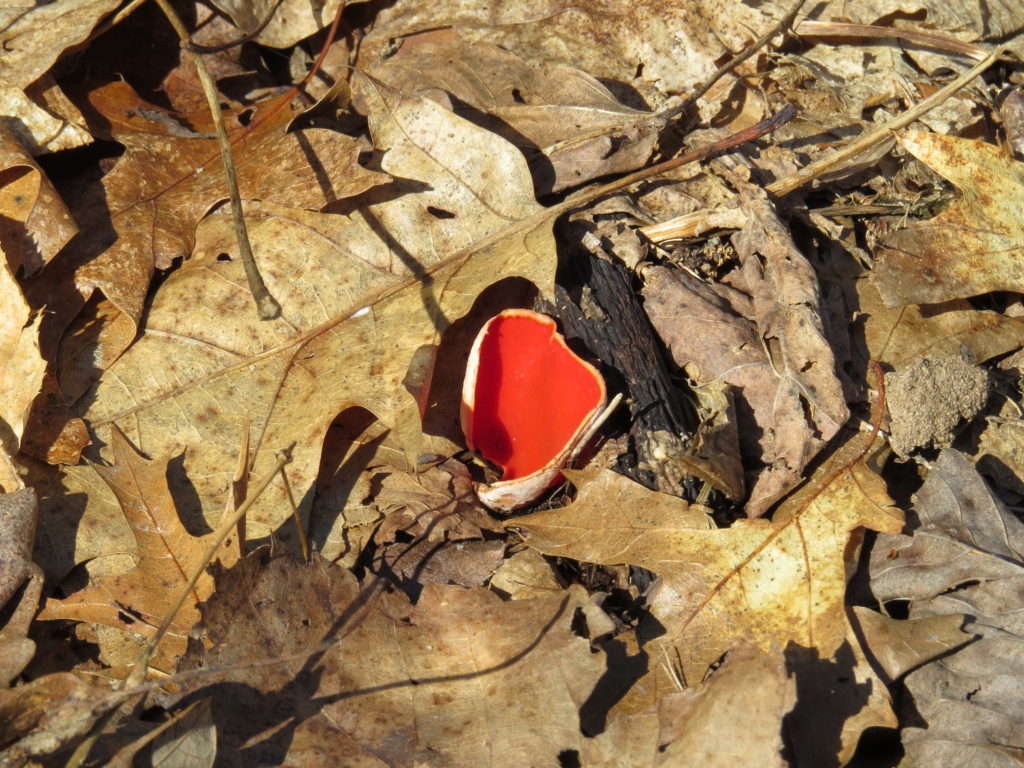
With the exception of a few Fir and Spruce trees, the landscape was brown and gray—until we walked a little farther and looked a little closer. I saw a bright red dollop in the brown leaves—one of the earliest, showiest fungi—the Scarlet Elf Cup.
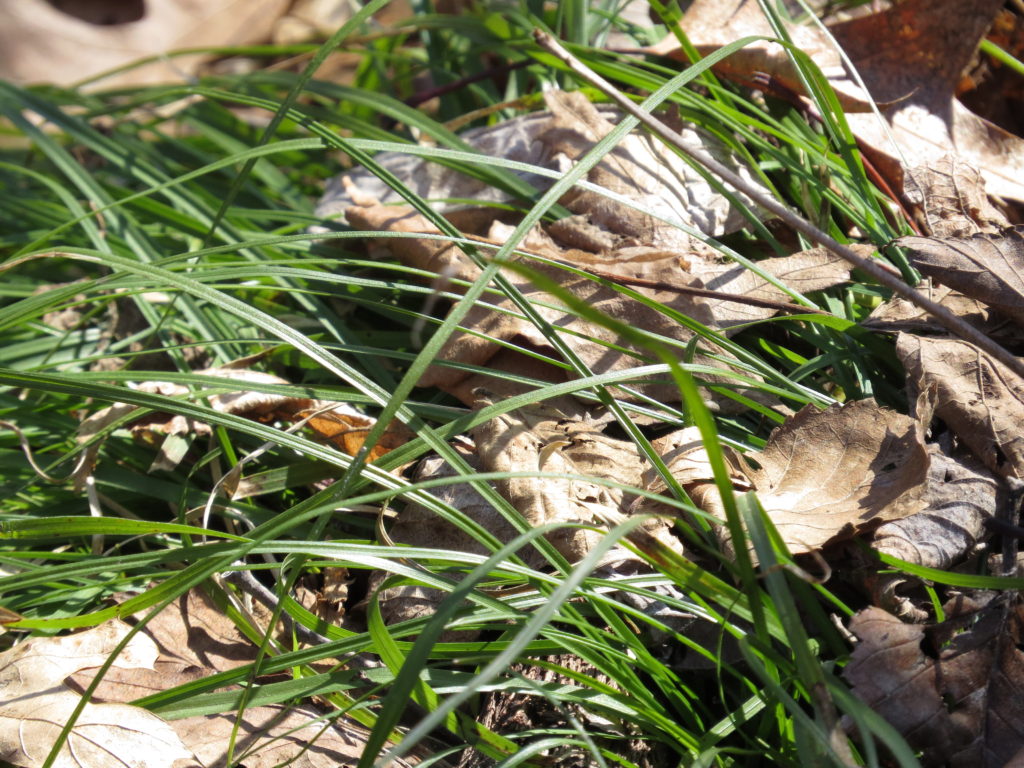
Vibrant green Sedge grass looked unscathed by five months of being buried under snow.
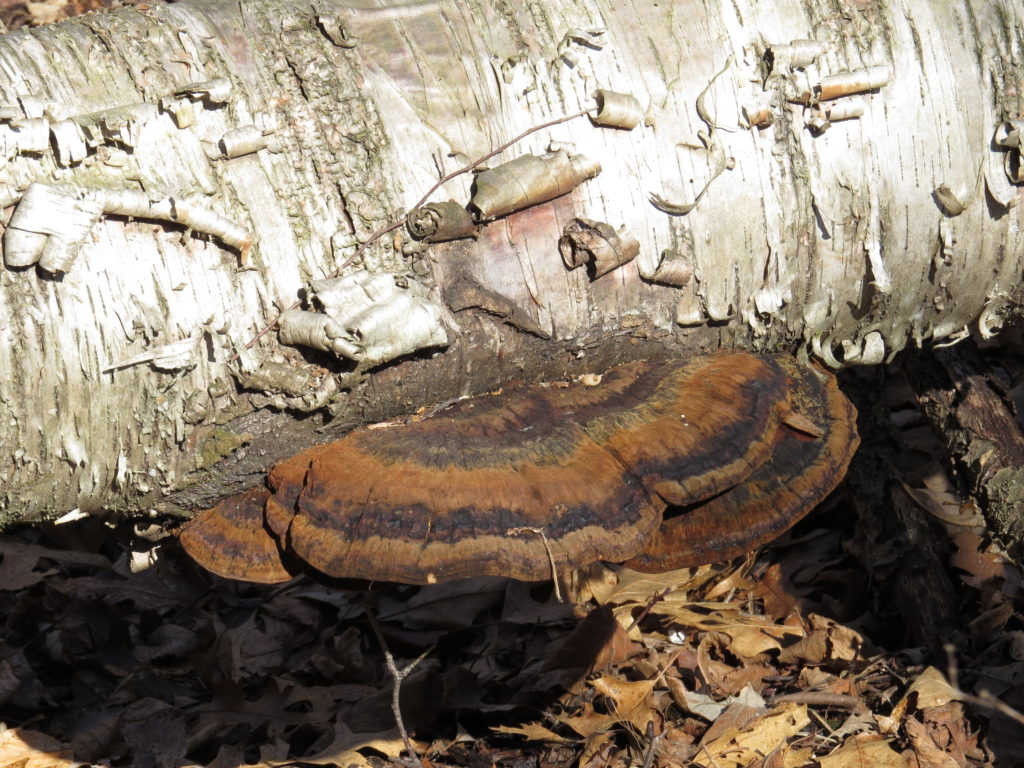
Fungi was the star of the show in the brown woods, in color, texture, and form with expressive names like Turkey Tail, Oyster, and Artist’s Conk.
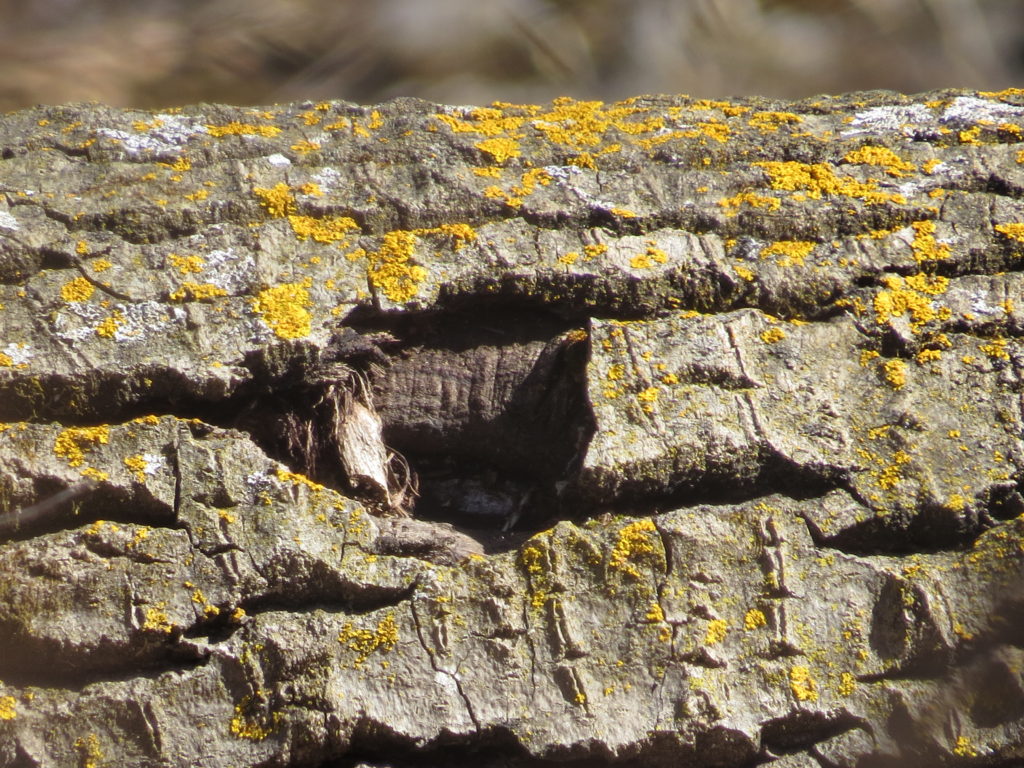
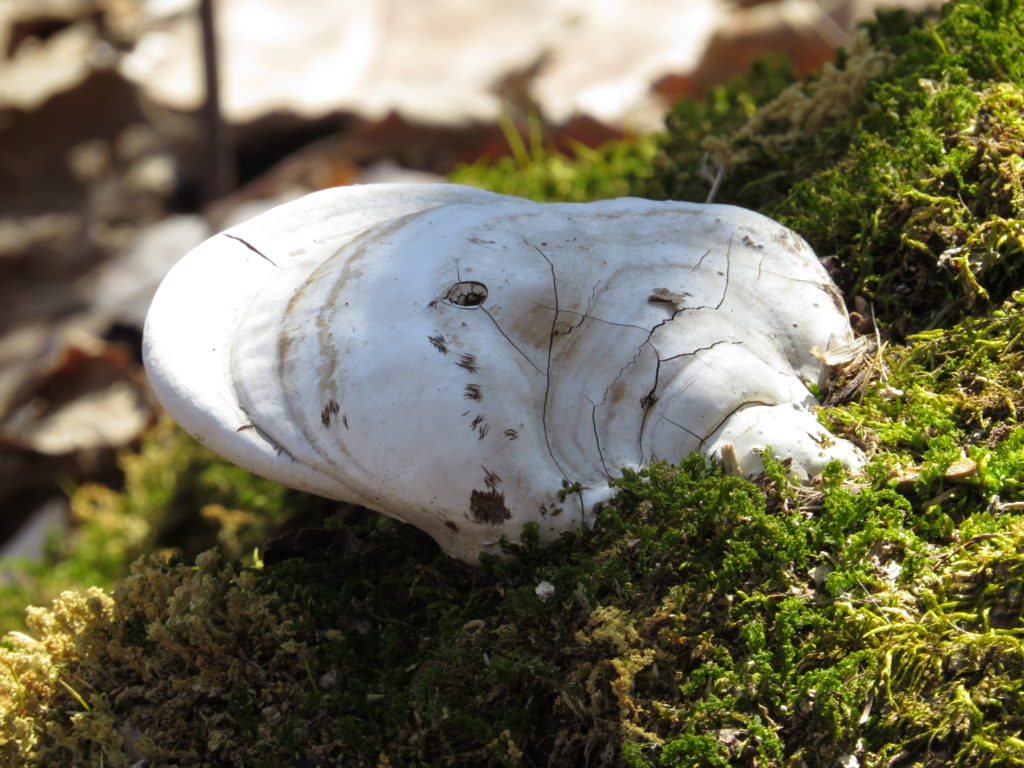
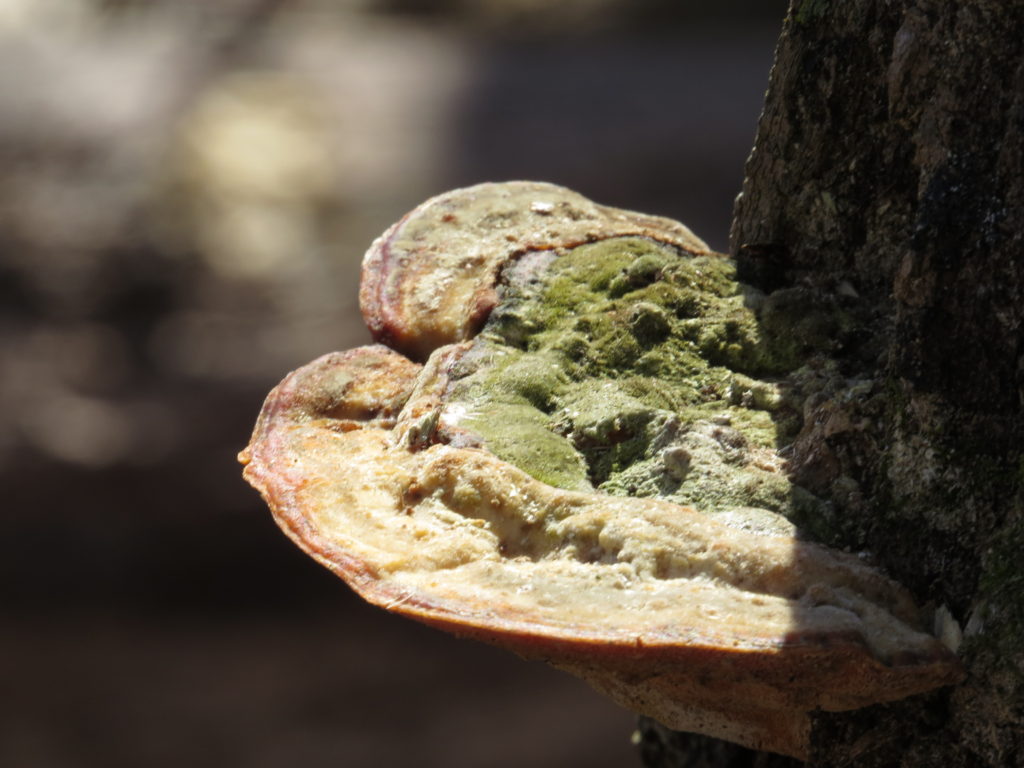
Lush green moss covered areas of trees, logs, and ground in impressive mini-scapes.
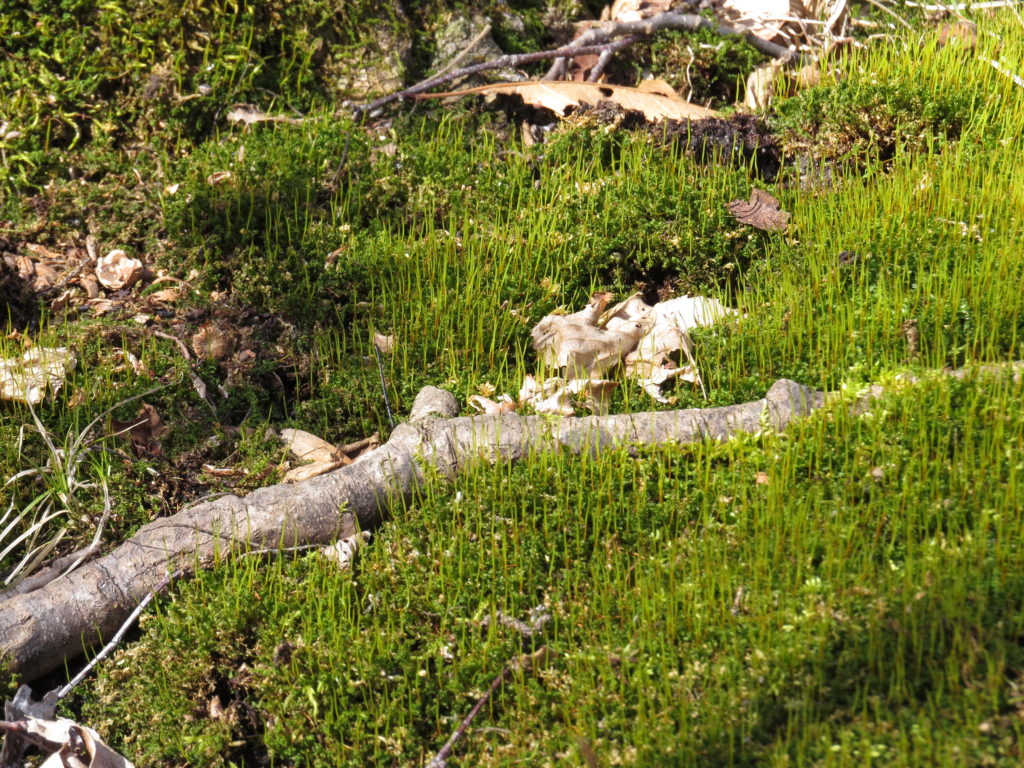
From the hardwood, deciduous forest we entered a quiet, moss-covered Spruce forest. The sun streaked through in an other-worldly way.
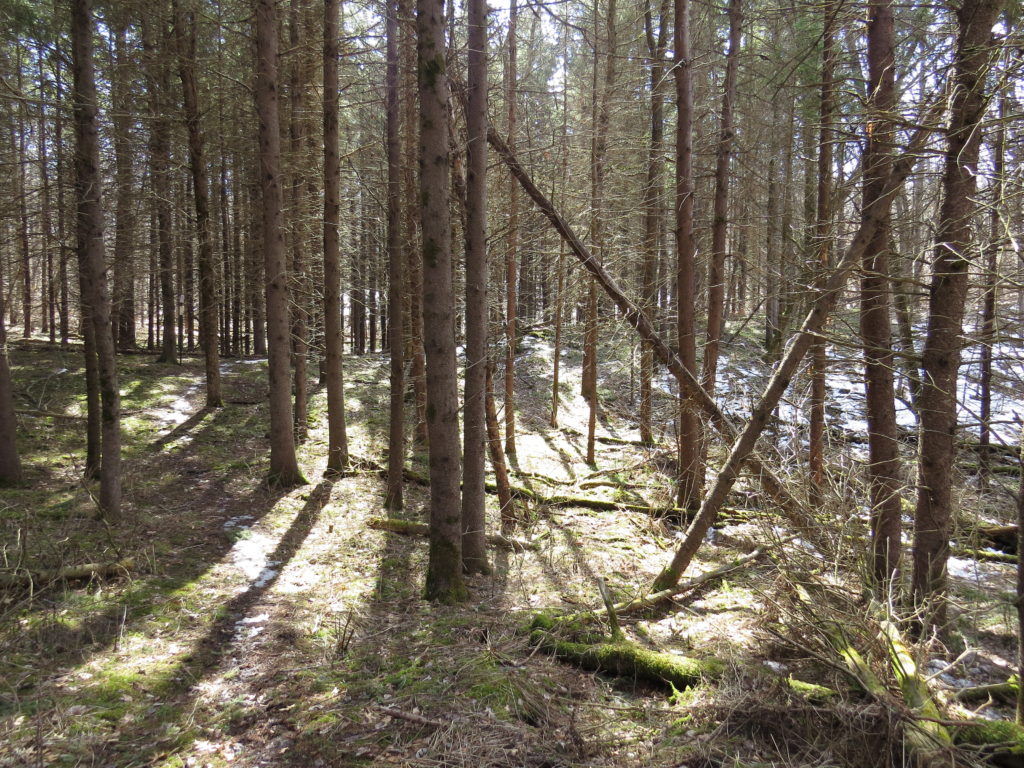
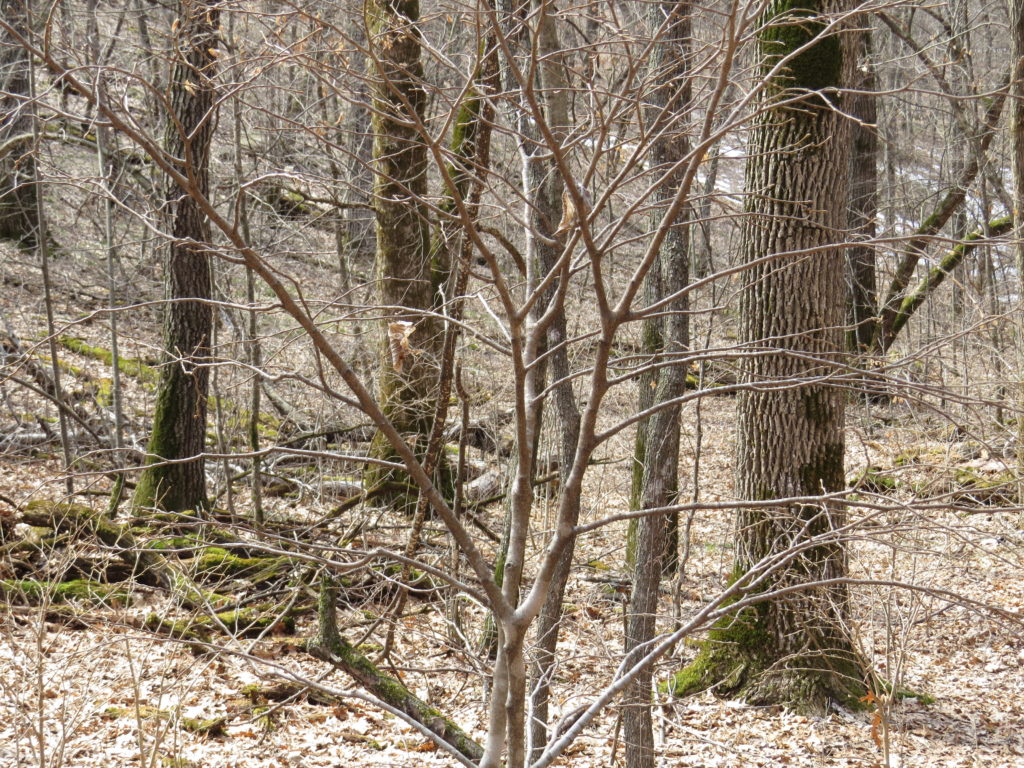
A number of times the trail diverged in the woods—which way to go? Where will it lead? I would choose one. The hills were steep in places, and the north faces still had quite a bit of snow. One lower area had a population of Leatherwood trees—short, almost shrub-like trees with pliable, yet strong branches. They bloom in early Spring with tiny yellow flowers before getting any leaves, but we were still a little too early to see them.
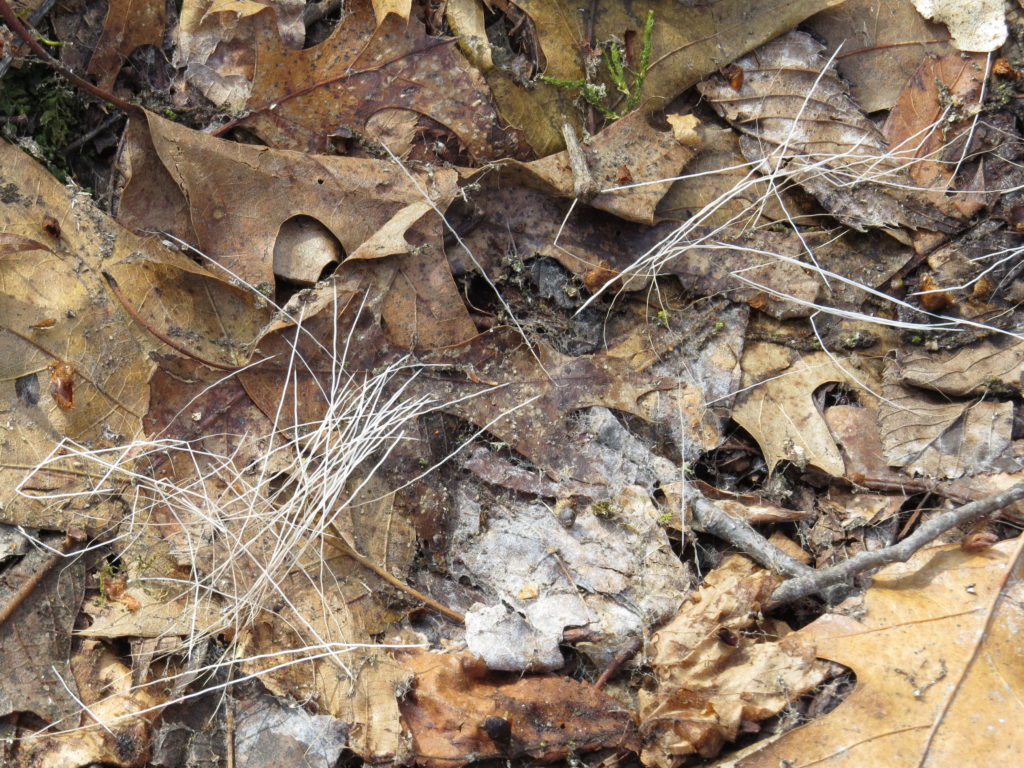
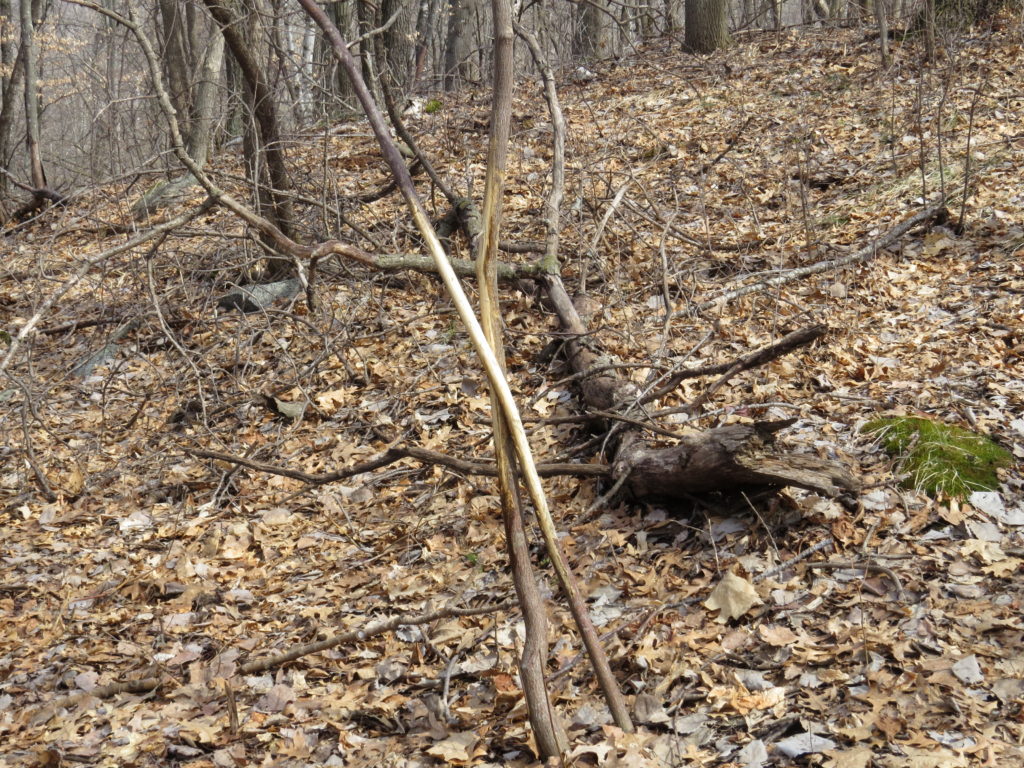
We found evidence of the non-human occupants of the forest—a clump of deer hair in a patch of snow mold and a deer rub where the bucks rub their antlers against a young tree.
The landscape looked bleak after the snow melt, but small signs of the hope of Spring could be found—the moss was flowering!
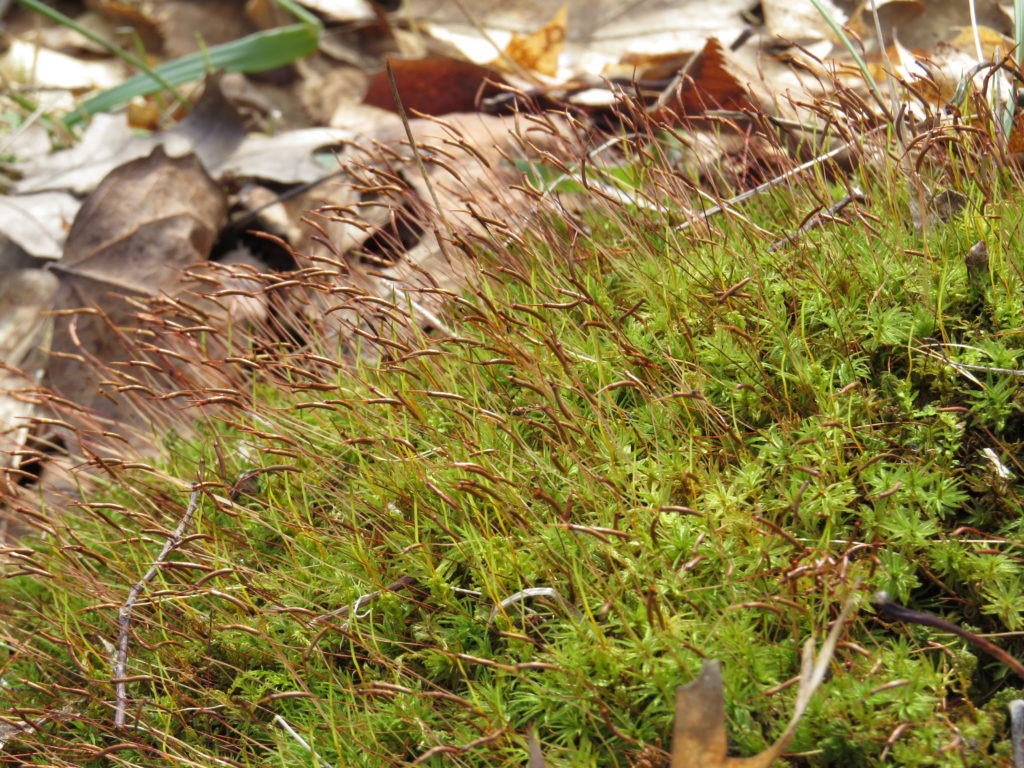
The ice was melting!
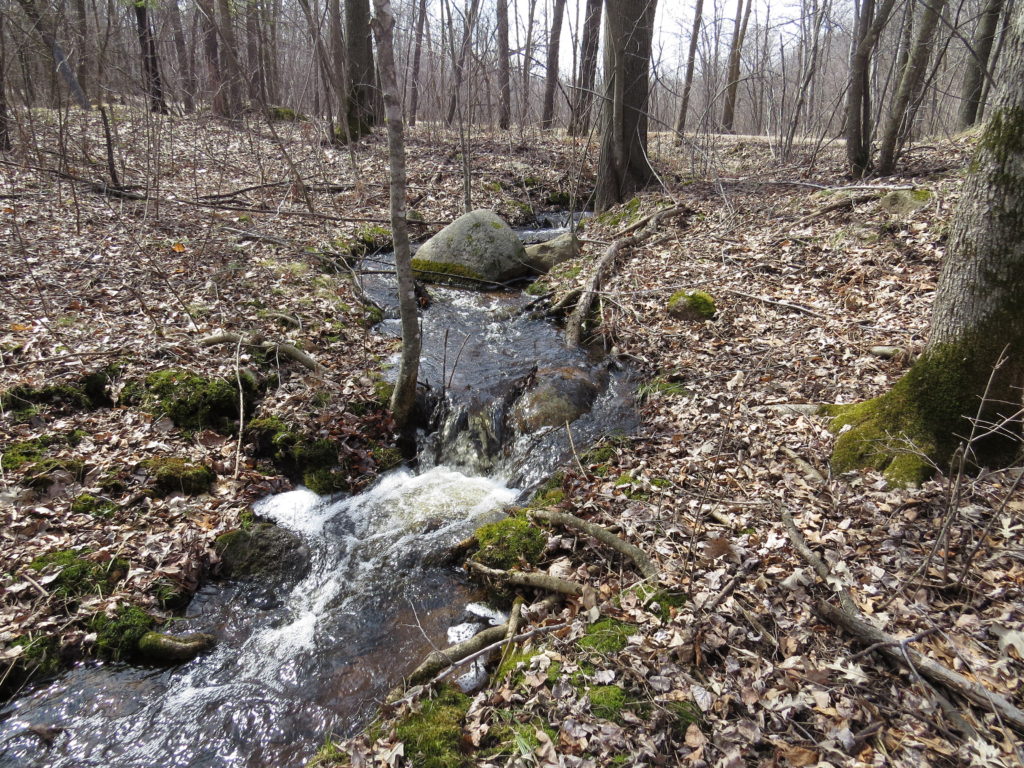
The water was flowing!
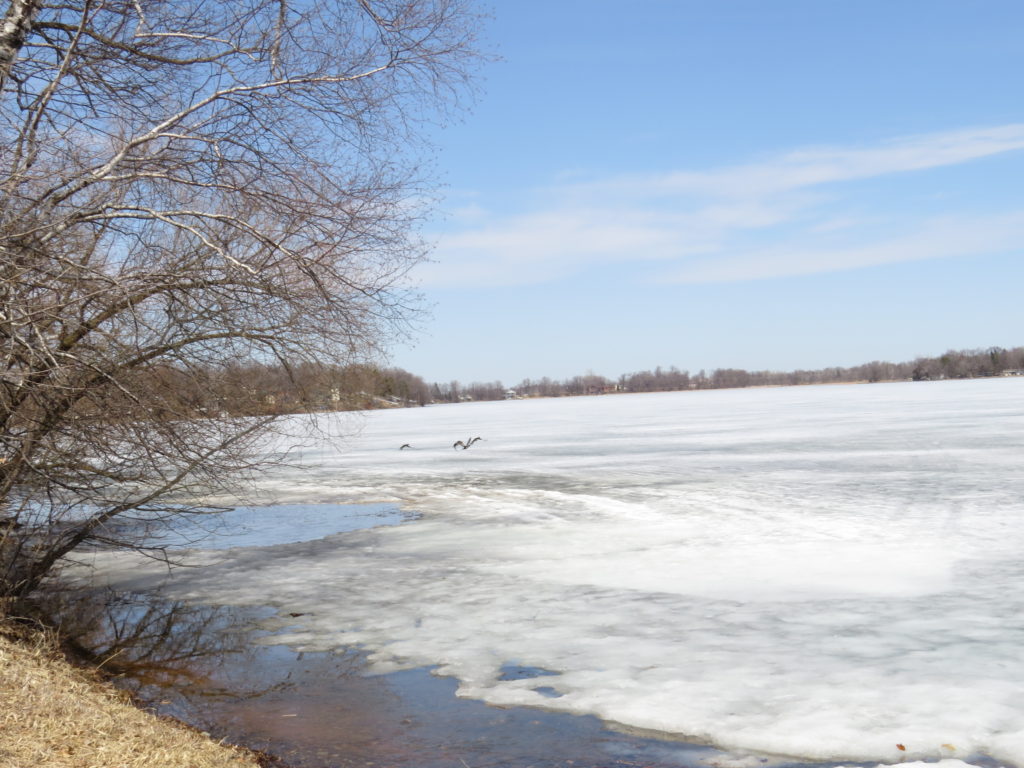
The geese were flying!
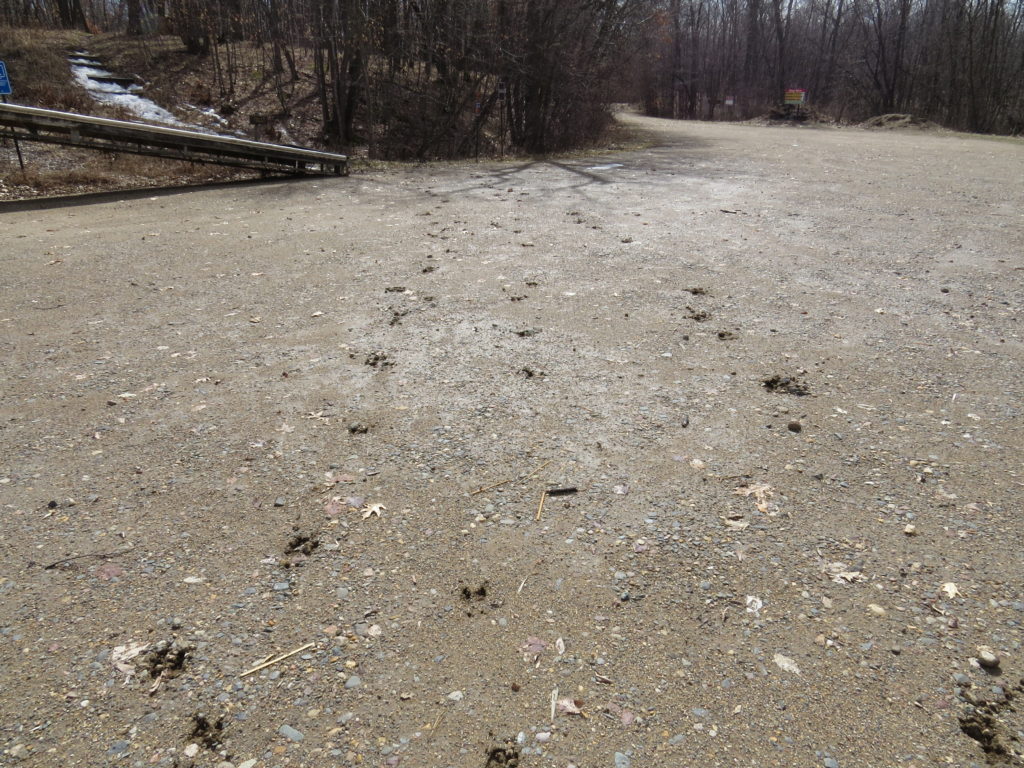
With no map, we navigated our way through the forest and ended up at Birch Lake. We walked back to the car in the soggy sand road marked occasionally by fresh deer tracks.
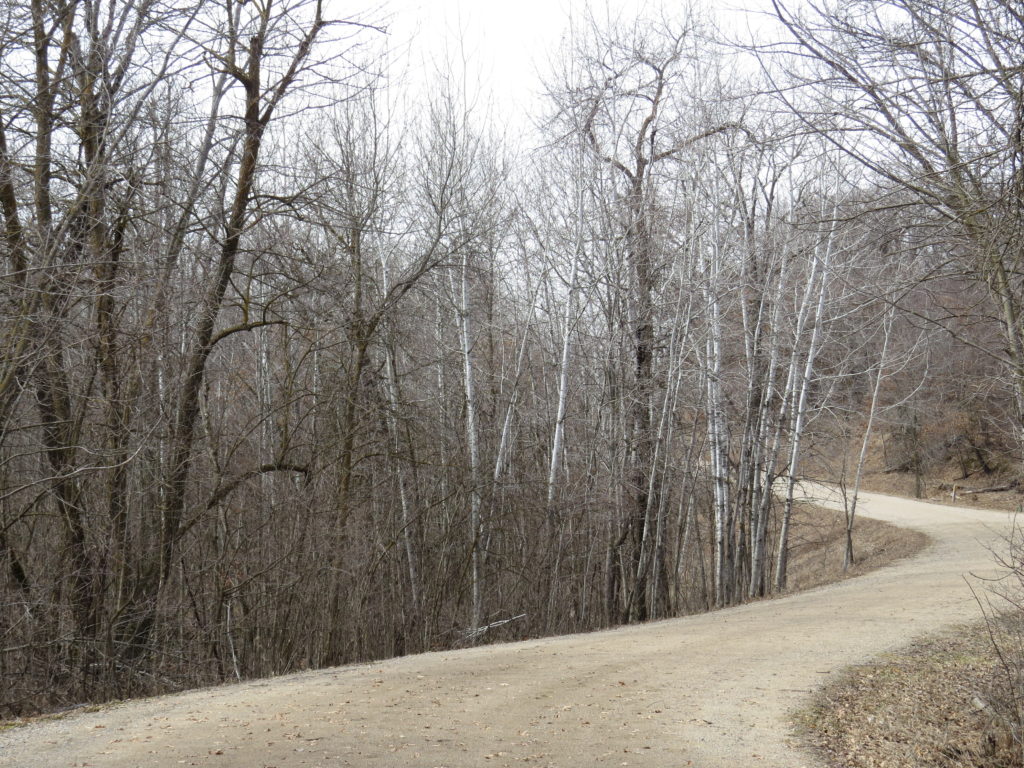
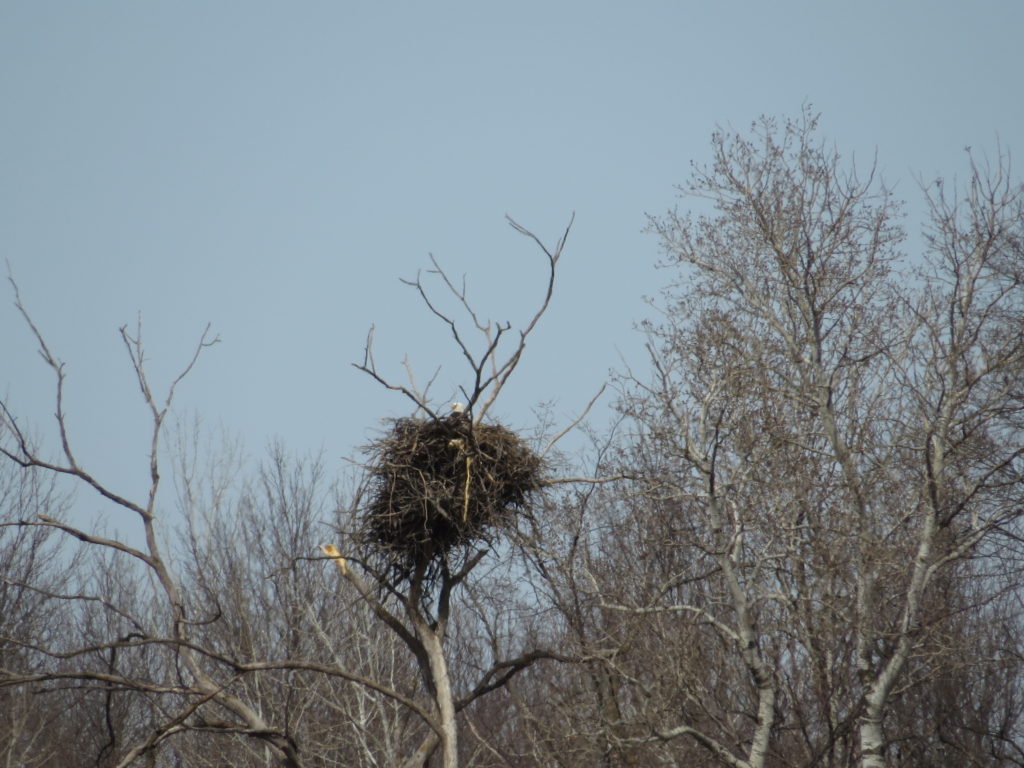
When we left the State Forest, we circled around Birch Lake by car, and we saw a huge, dark eagle’s nest in the distant trees. Our hike had begun and ended with an eagle—one high in the sky with his bird’s eye view and eagle eyes looking for food and the other sitting high in a tree with her nest of eggs or young ones.
The unknown doesn’t need to be unnerving—it can be an adventure. How do we do this? One day at a time with patience, faith, and love. Which way is the best way to go? Follow the signs (six feet apart) and maintain that inside sense of direction. Where do we end up if we follow this path? Expertise, knowledge, science, and history of past hard times will guide our path in this new time with the novel virus. What does a bird’s eye view show us about how we were living in the past, how we are living now, and how we want to choose to live in the future? This is our Spring reality—not how we’d like it to be, certainly not beautiful, definitely bleak in many ways, but there are small signs of hope everywhere when we look closely. No worries, dear people of our Earth, the process and the path will unfold. We will find our way.
The Tallest Shining Example
The Tale of Three Trees—A Folktale
Once upon a time, three little trees stood in a forest high on a mountain, dreaming of what they would be when they were grown. The first little tree looked up at the stars twinkling like diamonds in the night sky. “I want to hold treasure,” it said. “I want to be filled with gold and decorated with jewels. I will be the most beautiful treasure chest in the world!” The second little tree looked down the mountainside at the ocean far below. “I want to be a strong sailing ship,” it said. “I want to travel mighty waters and carry powerful kings. I will be the strongest ship in the world!” The third little tree said, “I don’t want to leave this mountaintop at all. I want to grow so tall that when people stop to look at me their eyes will raise up to heaven, and they will think of God. I will be the tallest tree in the world!”
Years passed, and the trees grew. And then one day, three woodcutters climbed the mountain. One woodcutter looked at the first tree and said, “This tree is beautiful! It is perfect for me.” With a dozen swoops of his axe, the first tree fell. “Now I shall be made into a beautiful treasure chest,” thought the first tree. “I shall hold marvelous treasures!” Another woodcutter looked at the second tree and said, “This tree is strong! It is perfect for me.” With a dozen swoops of his axe, the second tree fell. “Now I shall sail mighty waters,” thought the second tree. “I shall be made into a strong ship fit for powerful kings!” The third tree felt its heart sink as the last woodcutter approached. It stood straight and tall and pointed bravely towards heaven. But the last woodcutter never even looked up. “Any kind of tree will do for me,” he muttered. With a dozen swoops of his axe, the third tree fell.
The first tree rejoiced when the woodcutter took it to a carpenter’s shop. But the carpenter was not thinking about treasure chests. Instead, he cut and carved the tree into a simple feedbox. The once-beautiful tree was not filled with gold or decorated with jewels. It was covered with dust, and filled with hay for hungry farm animals. The second tree rejoiced when the wookcutter took it to a shipyard. But the shipbuilder was not thinking about mighty sailing ships. Instead, he hammered and sawed the tree into a simple fishing boat. The once-strong tree was too weak to sail the ocean. It was taken to a little lake, where every day it carried loads of dead, smelly fish. The third tree was confused when the woodcutter took it to a lumberyard, where it was cut into strong beams and then left alone. “What happened?” the once-tall tree wondered. “All I ever wanted to do was stay on the mountaintop, grow tall, and make people think of God.”
Years passed, and the three trees nearly forgot their dreams. But then one still and silent night, golden starlight poured over the first tree, as a young woman placed a newborn baby into the feedbox. “I wish I could make a cradle for him,” her husband whispered. The mother squeezed his hand and smiled as the starlight shone on the clean and shining wood. “This manger is beautiful,” she said. And suddenly the first tree knew it was holding the greatest treasure in the world. And then one humid and cloudy day, a tired traveller and his friends crowded into the small fishing boat. The traveler fell asleep as the second tree sailed quietly out into the lake. But a thundering storm arose, and the second tree shuddered, knowing that it did not have the strength to carry so many passengers safely through the fierce wind and rain. The tired traveler awoke. He stood up, stretched out his hand, and said with a strong voice, “Peace, be still.” The storm stopped as quickly as it had began. And suddenly the second tree knew it was carrying the King of heaven and earth.
And then one terrible Friday morning, the third tree was startled as its beams were yanked from the old lumberyard. It flinched as it was was carried through an angry, jeering, spitting crowd. It shuddered when soldiers nailed a man’s hands and feet to her. It groaned as the man cried out in agony and died. It felt ugly and harsh and cruel. But at dawn the next Sunday, on the first Easter morning, the earth trembled with joy beneath the third tree, and it knew that God’s love had changed everything. It had made the first little tree a beautiful treasure chest. It had made the second little tree a strong sailing ship. And every time people looked upon the third little tree, they would think of God. That was even better than being the tallest tree in the world.
************************************************************************
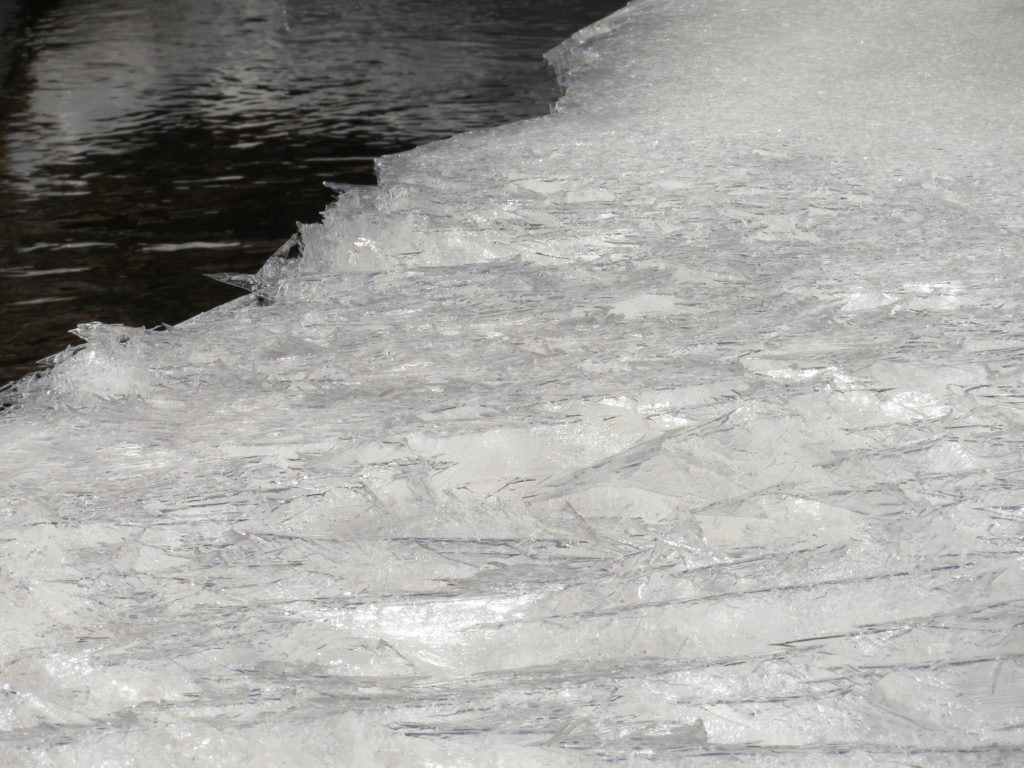
I wasn’t thinking about Easter when Chris and I started our hike two weeks ago at Fritz Loven Park. The dark, bubbling Stoney Brook was picturesque within the snowy banks. The Pine trees rose high into the clear, blue sky. It was a beautiful brisk day, more like Winter than the newly-announced Spring. I was zooming in on some ice over the creek that sparkled like a thousand diamonds in the sunshine (no justice for sparkles in this photo).
A few steps beyond the ice, I pointed and exclaimed, “Look at that cross!”
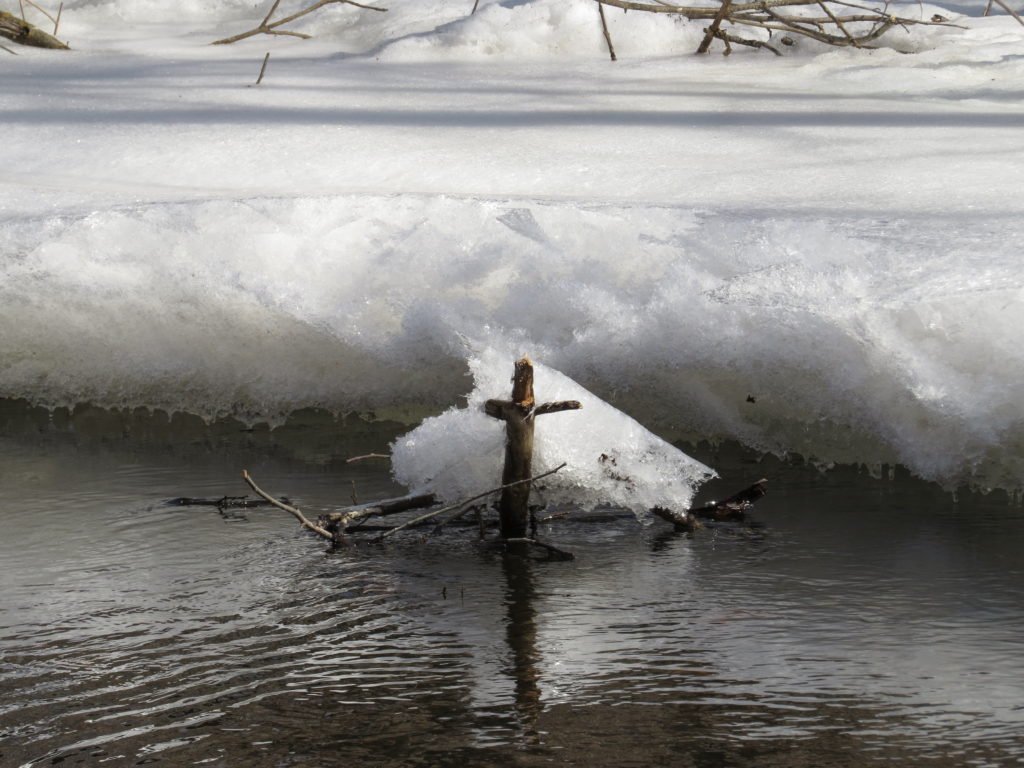
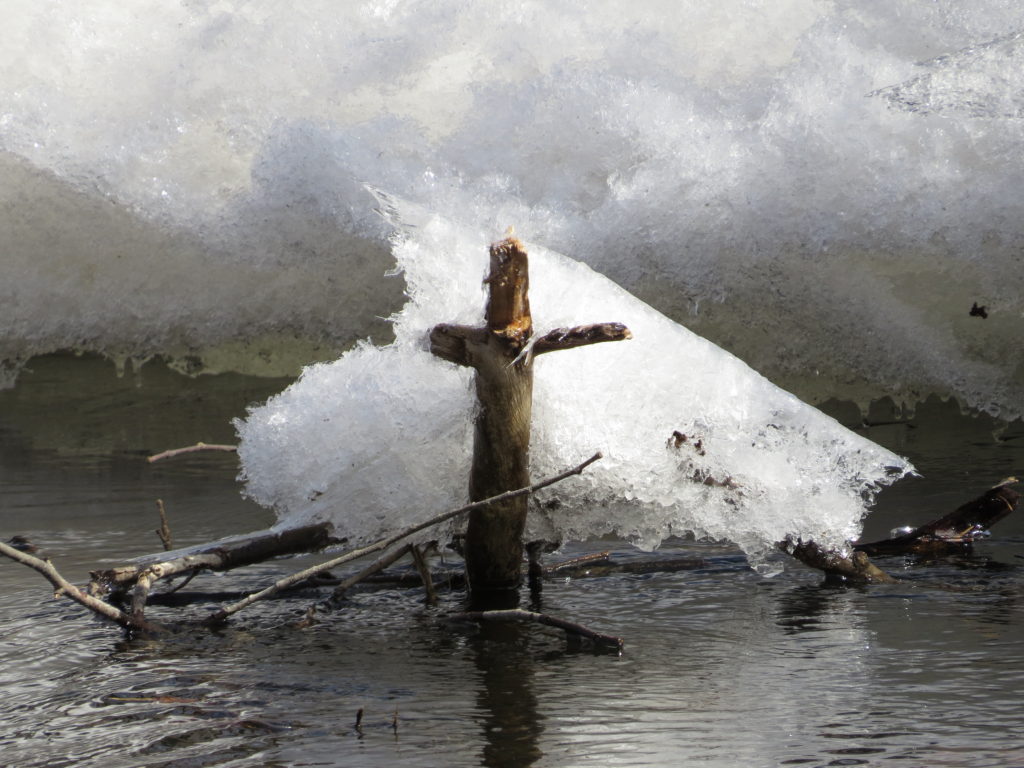
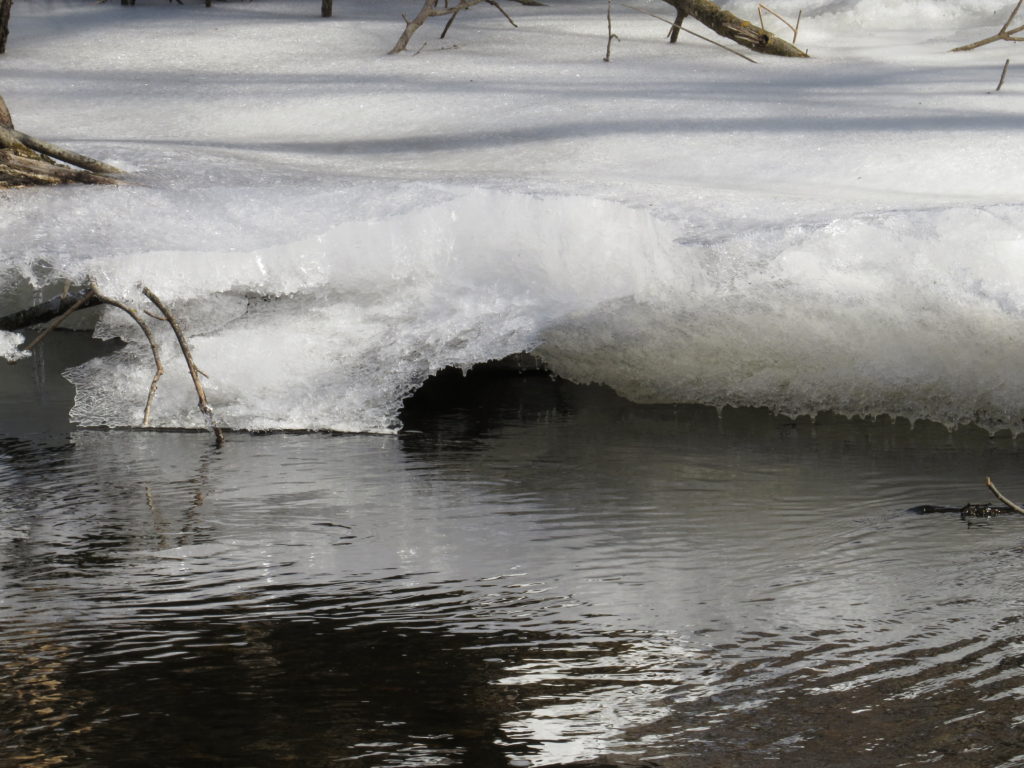
The sticks and broken ice/snow chunks had fallen–mashed–piled–converged–lined up so that a wooden cross was outlined against the white snow in the dark water. To the left of the cross was an ice cave, like a tomb, I thought. Interesting.
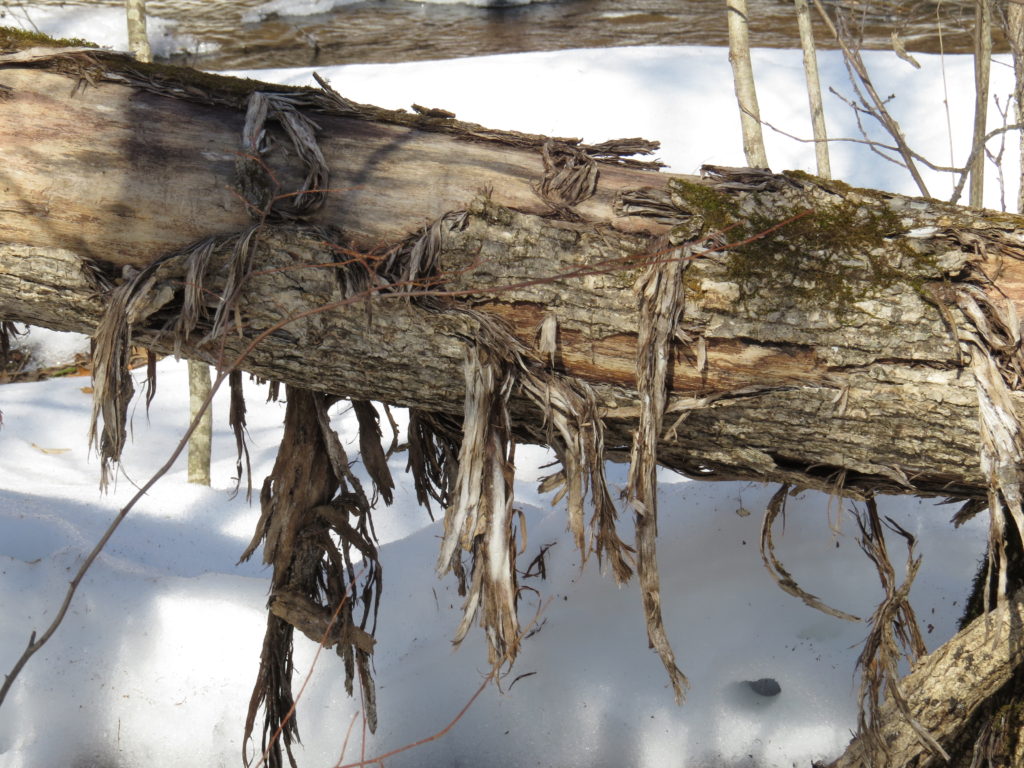
There were fallen logs all over the park, but there was one by the creek with its bark stripped off, ragged, and hanging in shreds—like the flesh ripped off someone’s back in a whipping, I shuddered.
The Passion continued to instill itself in our hike. A towering, lone Pine tree, pointing bravely towards heaven, was crossed by a still-live Birch tree. I have no idea how they got into this position, but the striking thing to me was the s-c-r-a-p-i-n-g of one live tree against the other—as the Birch fell or as the wind still blew it to and fro. Wounded.
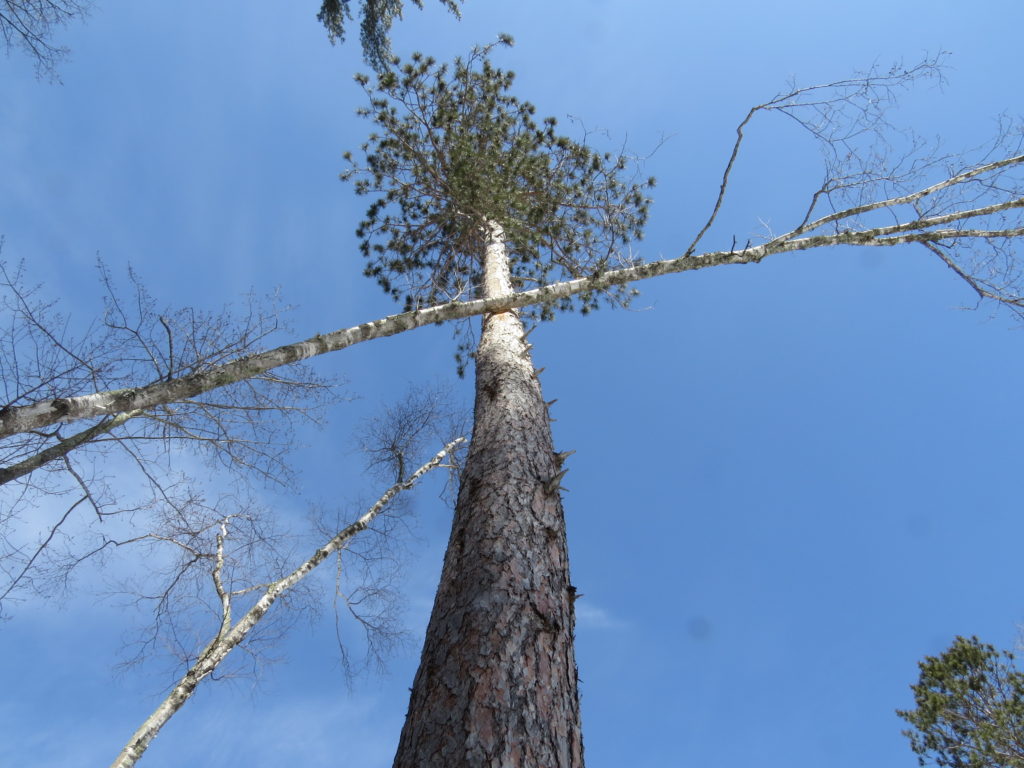
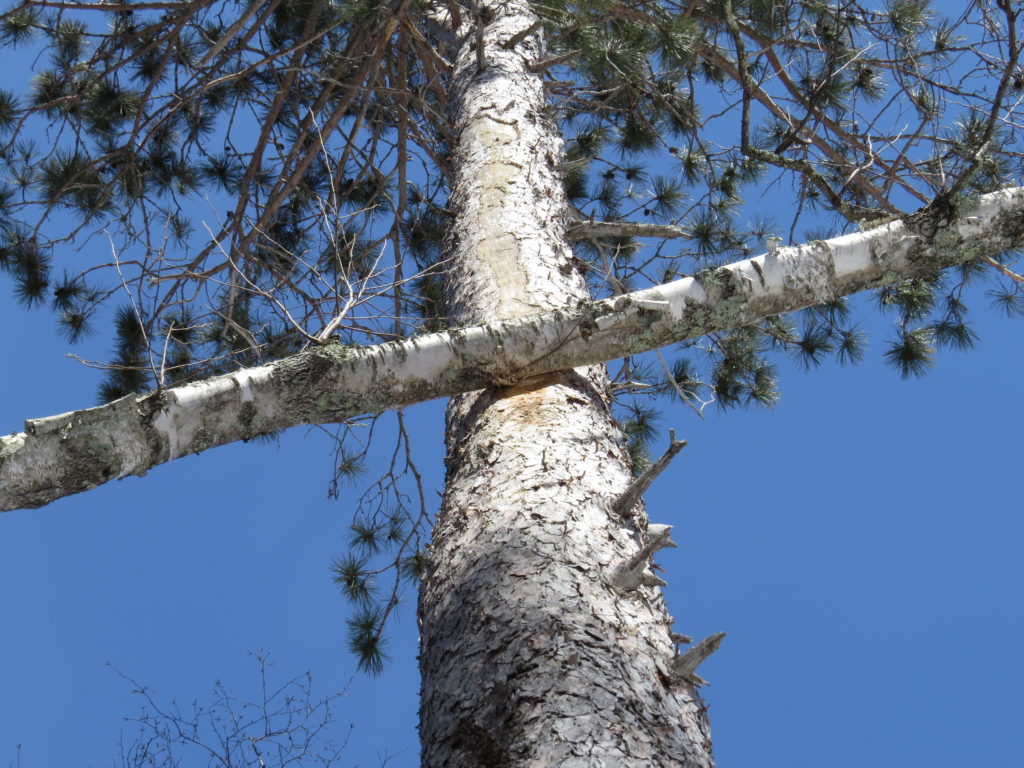
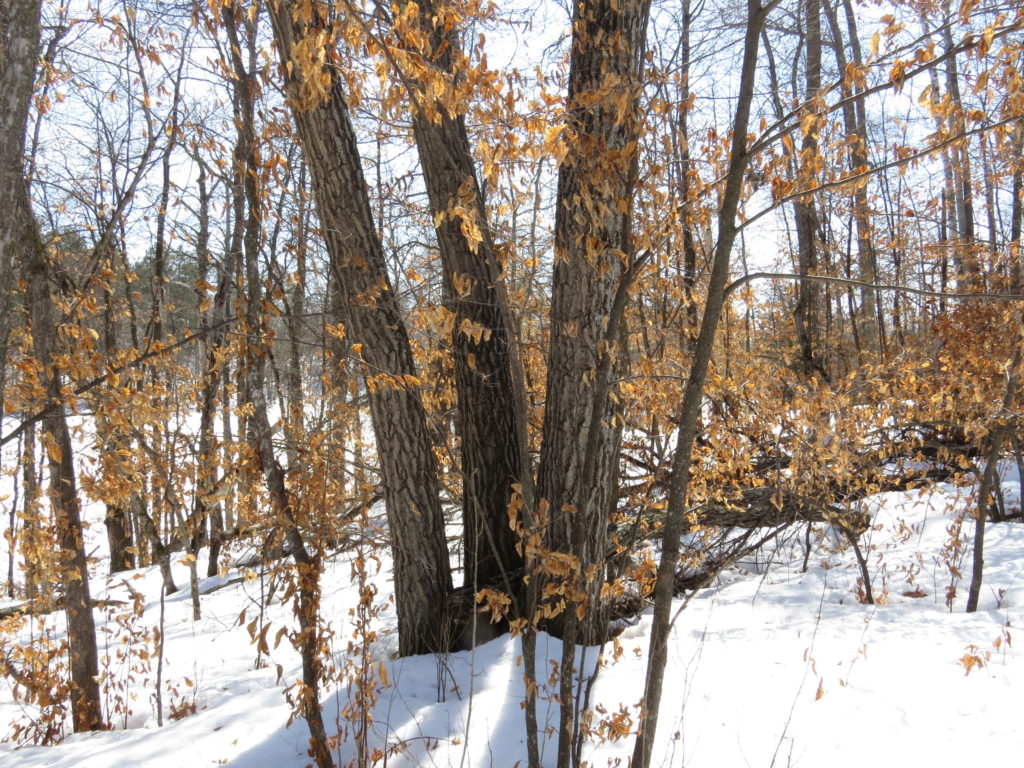
As we circled the park towards Upper Gull Lake, three large trees growing in a cluster reminded me of the picture book I read to the kids when they were little—The Tale of Three Trees. Surrounding the three trees were a host of golden-leaved Ironwood trees—like a shimmering aura in the sunlight.
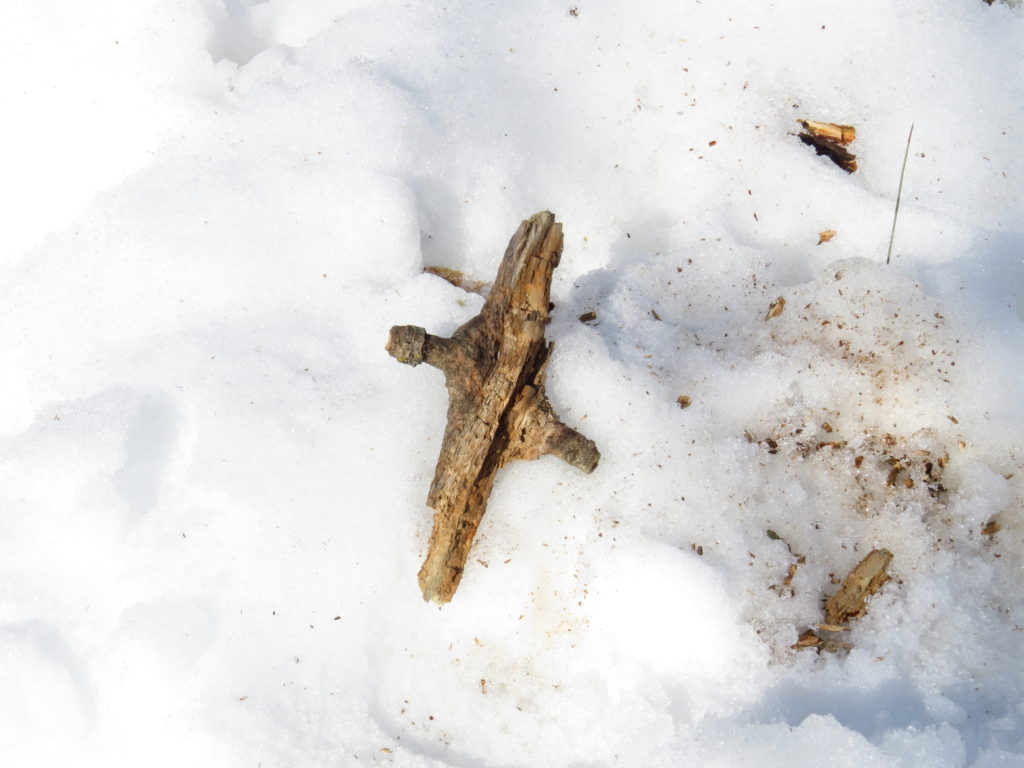
Steps away from the three trees lay a pine knot cross, not uncovered by the melted snow, by somehow placed on top of it. Deer tracks and wood debris were around the cross but still didn’t tell the whole story. Pine knot crosses form when a pine branch rots away—the knots are where branches formed on a larger branch or trunk, where the wood is more dense and hard, and thus last to rot. When I worked at a church camp in the Black Hills, we would find them to give to special people in our lives. I haven’t seen such a perfect one in forty-three years….
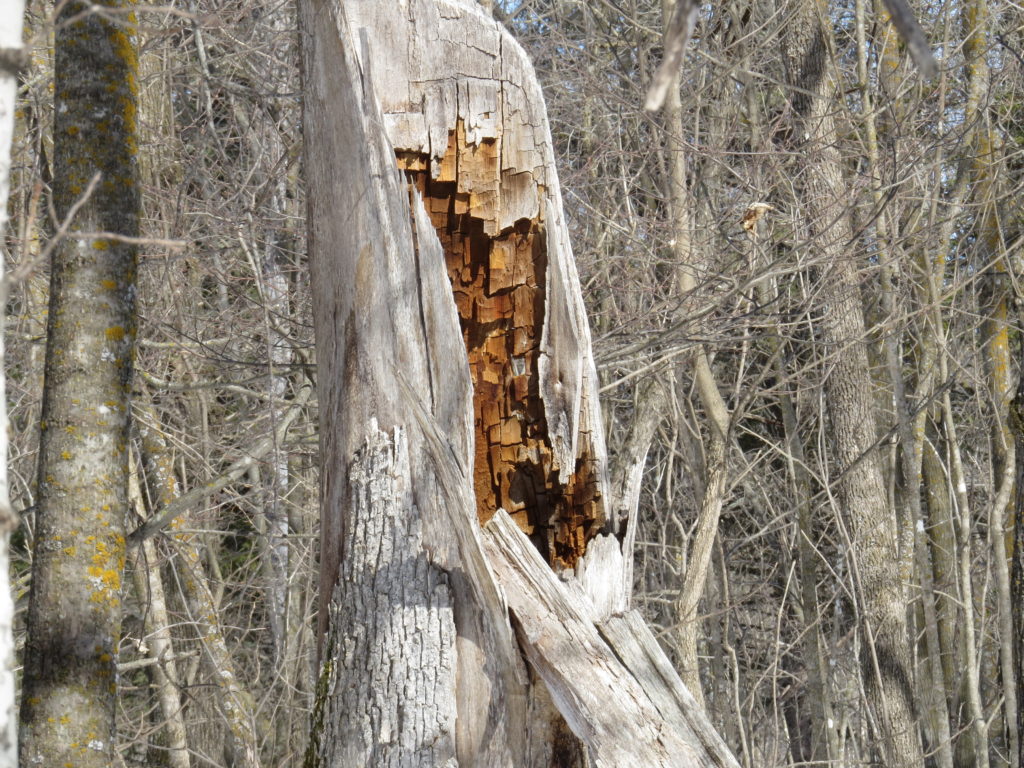
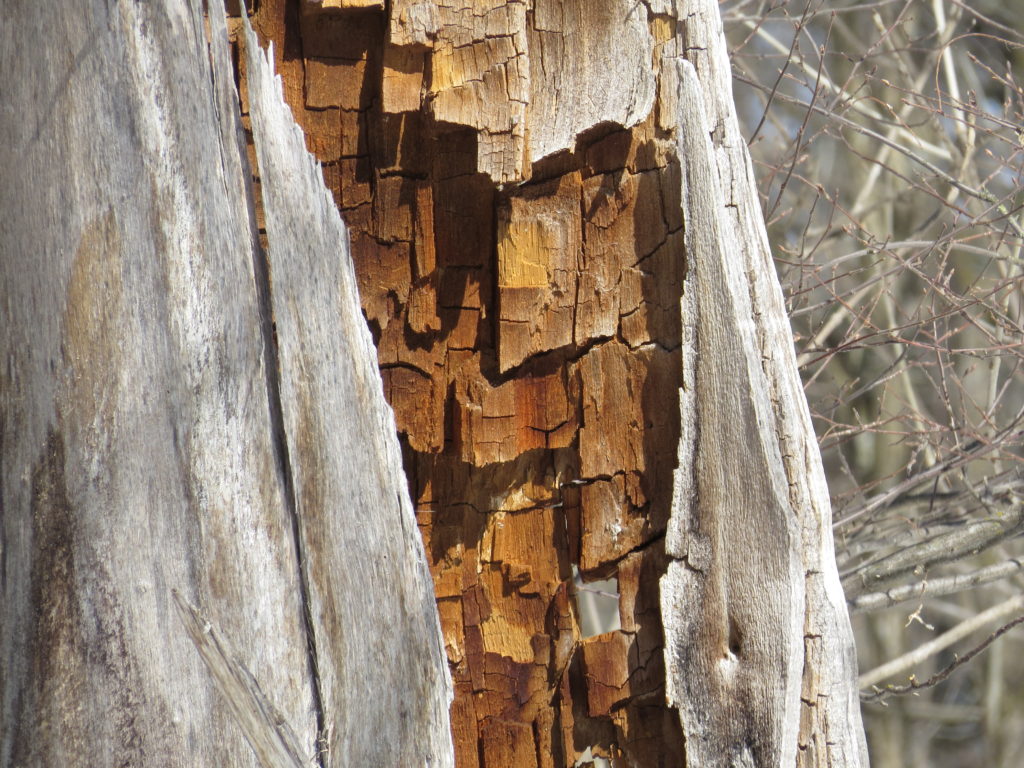
Towards the end of the trail, I spotted an old, gray, weathered stump that had been there for a while. Most of the bark had peeled off, leaving the smooth gray wood. A chunk of the gray wood had fallen away revealing a puzzlework of rusty-brown-golden-amber art. Even after death, this tree was showcasing Nature’s beauty.
I confess I am in heaven on earth every time I’m out in Nature. There is so much to see, to wonder, to ponder, and to appreciate, and at the same time, it calms my nervous system, grounds my anxieties, and tunes me towards the power that is greater than all of us. But our Lenten hike two weeks ago lassoed my attention towards the cross and what that means for each of us. The folktale of The Three Trees has lessons, too. These dreams we have to be the most beautiful holder of treasure, the strongest ship in the ocean, and the tallest, shining example of God—and how years pass, and we wonder what happened. Yet, as the years pass, we grow—we learn and change, struggle and transform, and often end up becoming something entirely different in exactly the right way. The Power is greater than all of us: it’s the diamonds in ice, the healing for wounds, the angels of light, the art after death. Behold the treasures of our hearts and lives, the strength of our resolve as we navigate our trails, and the tallest, most shining example of God-in-us that we can be. Behold!
Lovable Hermits
Have you ever asked yourself to see a situation from a wider perspective? Easy question to ask, but difficult, so very difficult, to actually do. I’m reading The Book of Joy—Lasting Happiness in a Changing World by His Holiness the Dalai Lama and Archbishop Desmond Tutu with Douglas Abrams. Abrams writes, “The Dalai Lama used the terms wider perspective and larger perspective. They involve stepping back, within our own mind, to look at the bigger picture and to move beyond our limited self-awareness and our limited self-interest. Every situation we confront in life comes from the convergence of many contributing factors….When we confront a challenge, we often react to the situation with fear and anger. The stress can make it hard for us to step back and see other perspectives and other solutions….We (can) see that in the most seemingly limiting circumstance we have choice and freedom, even if that freedom is ultimately the attitude we will take.” Fear and stress, anger and limiting circumstances sound very familiar to all of us, all of a sudden, in this changing world.
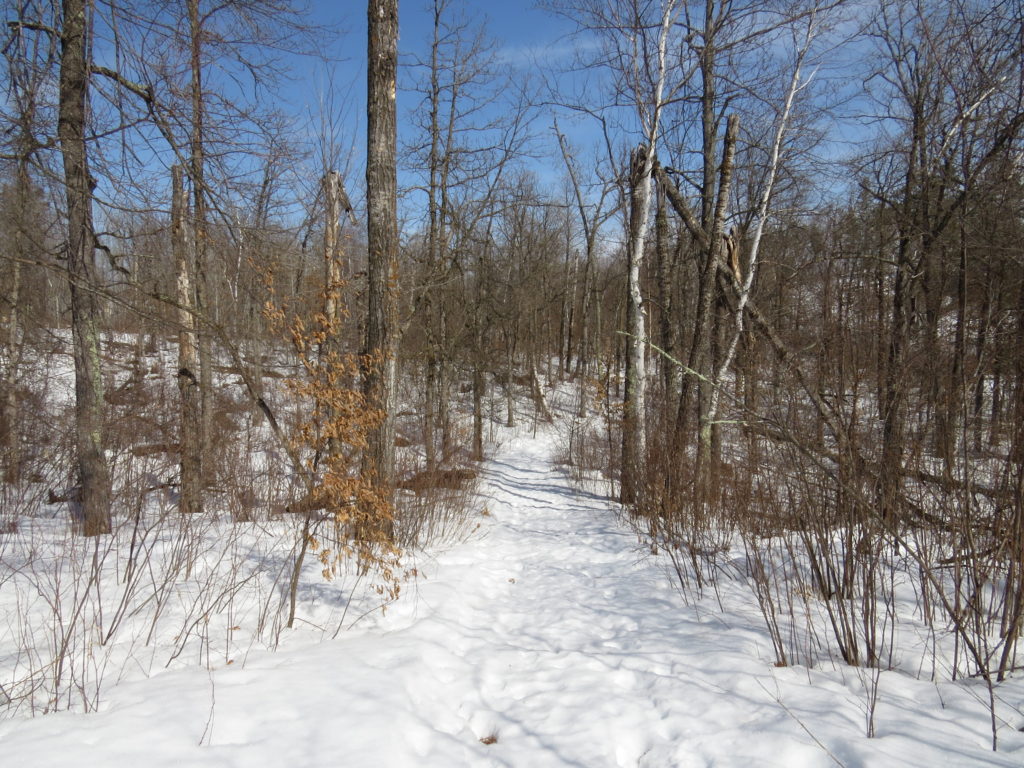
I’ve always appreciated a ‘big picture’ approach, but only on the basis of a multitude of information from many small observations and facts (science). The big picture requires us to look beyond what we see (and believe). Our hike at Fritz Loven Park last weekend was an unfolding of that process. The trail circled the bottom of a tree-covered, almost snow-bare hill. Warm, crunchy leaves and bright sunshine belied the deep snow and cold temps of the hours ahead.
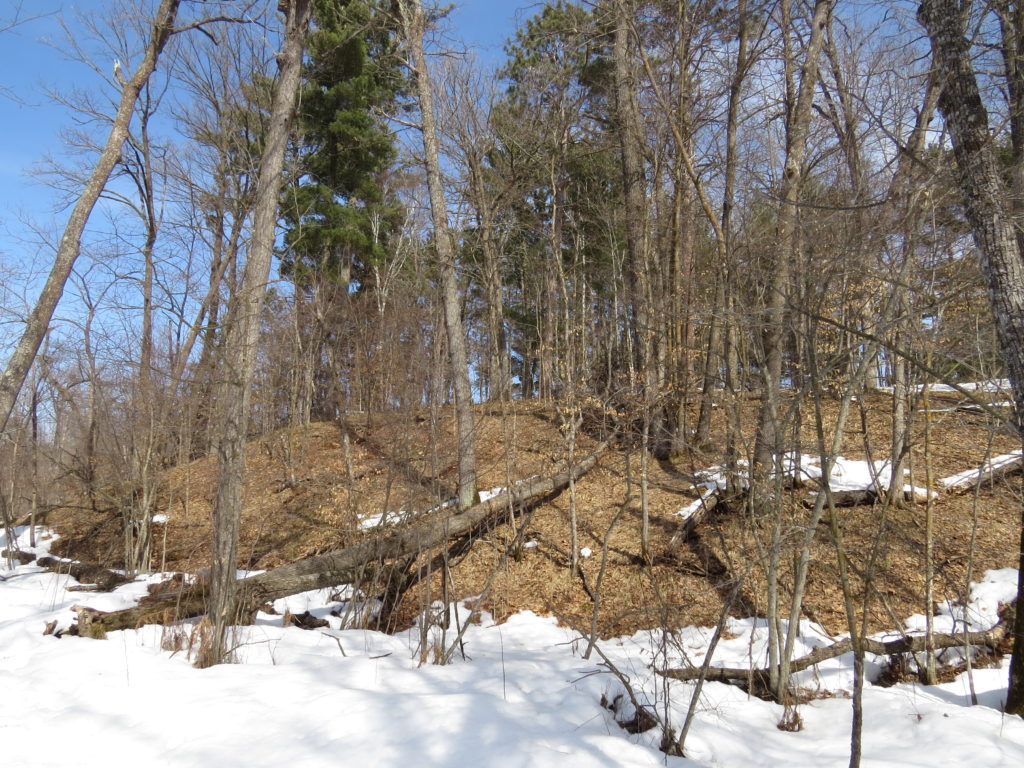
As we walked along the flatlands by the fast-flowing Stoney Brook, I noticed that most of the trees were young compared to a small number of very large ones. I wondered if this area had flooded. One distinct and eye-catching tree was a large Cottonwood, who would thrive having wet feet, so to speak.
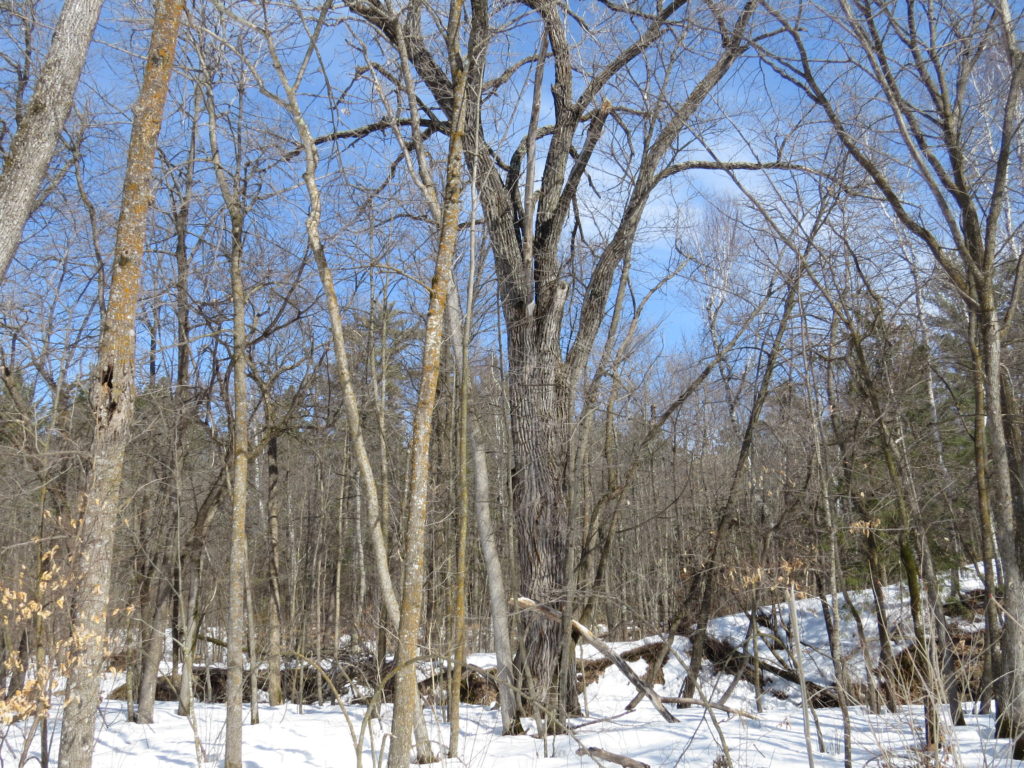
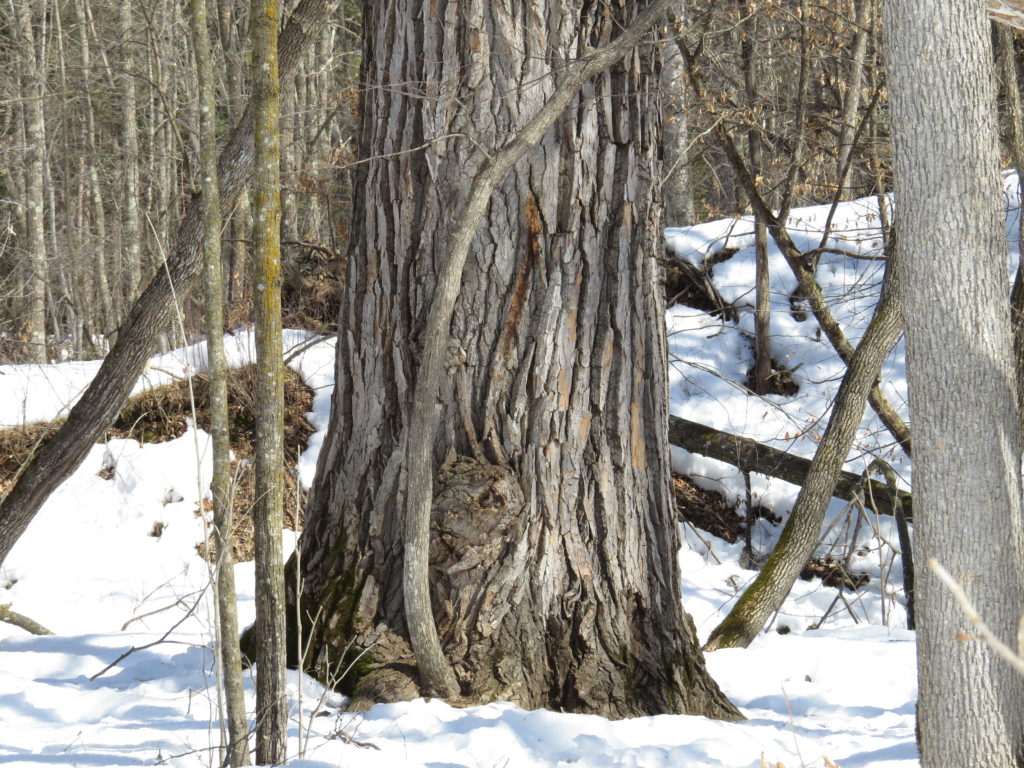
But as we walked up toward a ridge, I then wondered if there had been a fire at one time. Often the tallest, strongest trees can survive a fire that consumes the smaller ones.
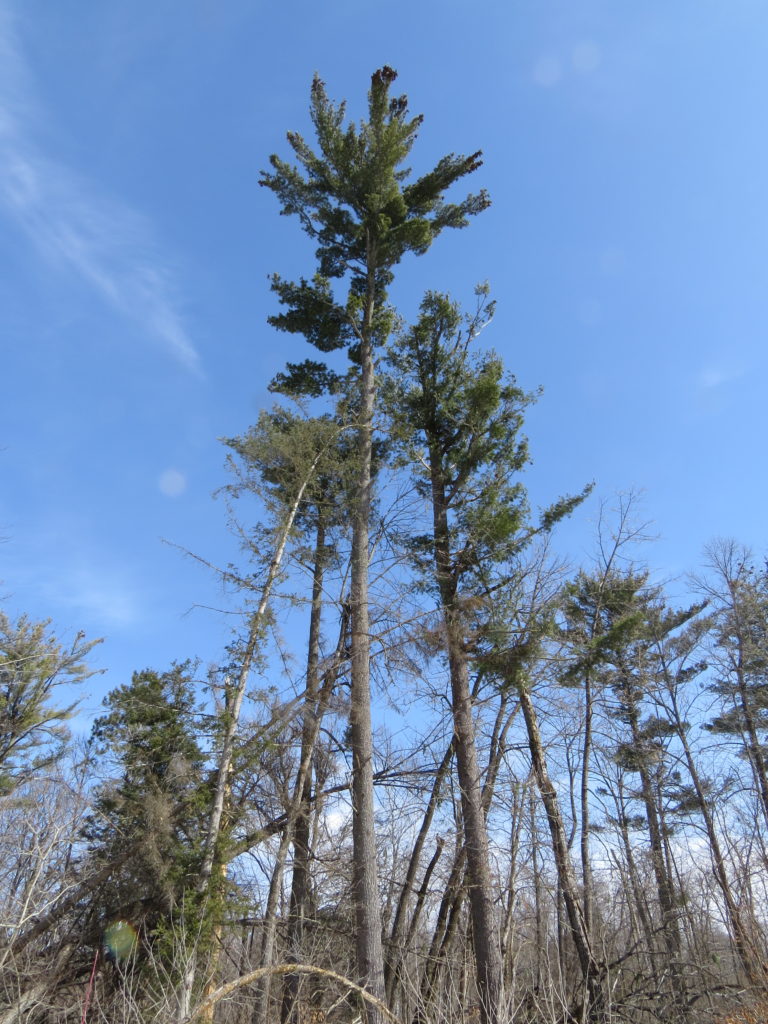
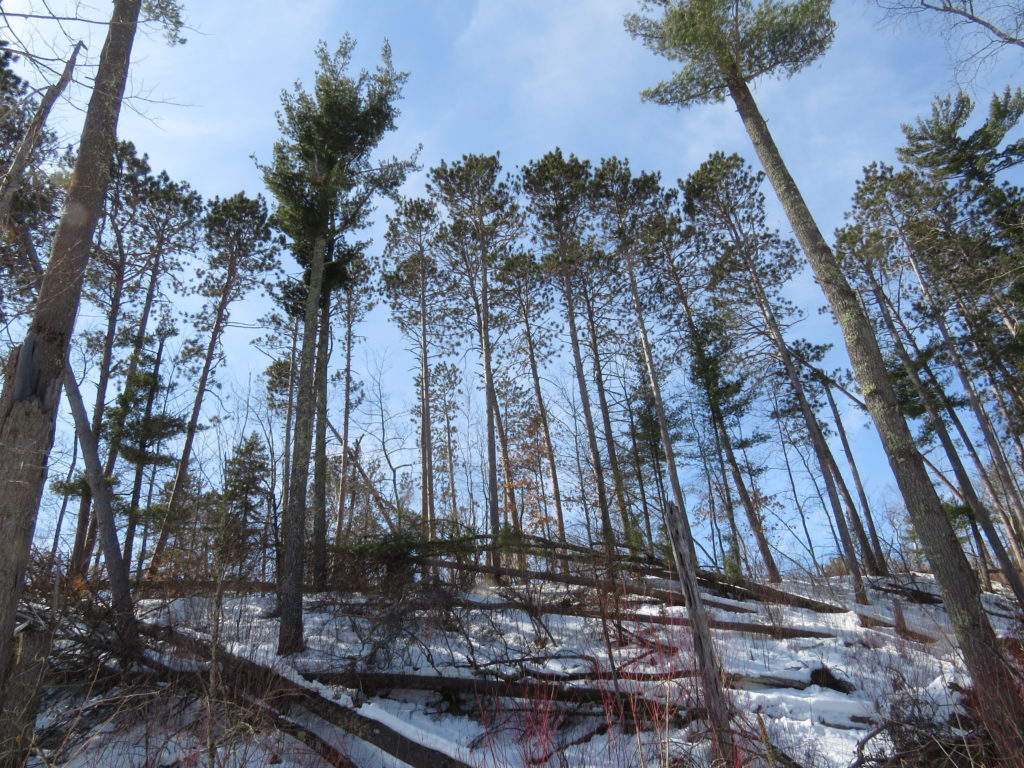
It wasn’t until the trail crossed a wide swath of nothingness (and stumps) that I realized the area had been logged. Logging was the predominant industry in northern Minnesota starting in the late 1800’s. Virgin timber was cut in this area around Gull Lake, and a railroad was built in order to transport logs. And in the summer of 1894, Fred Oscar Loven was born in Minneapolis, Minnesota.
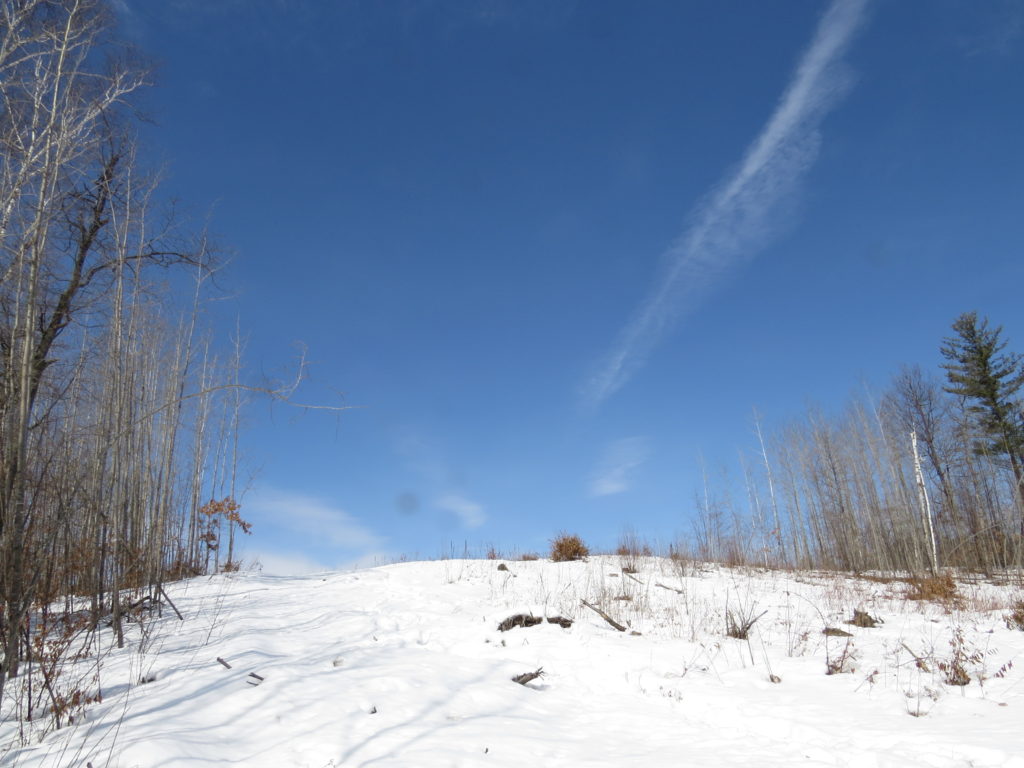
Though tourism is now a major industry in the Northwoods region, logging continues. Large wooded areas will reside beside a clean-cut swath or a shaggy area of young saplings or brush that had previously been logged.
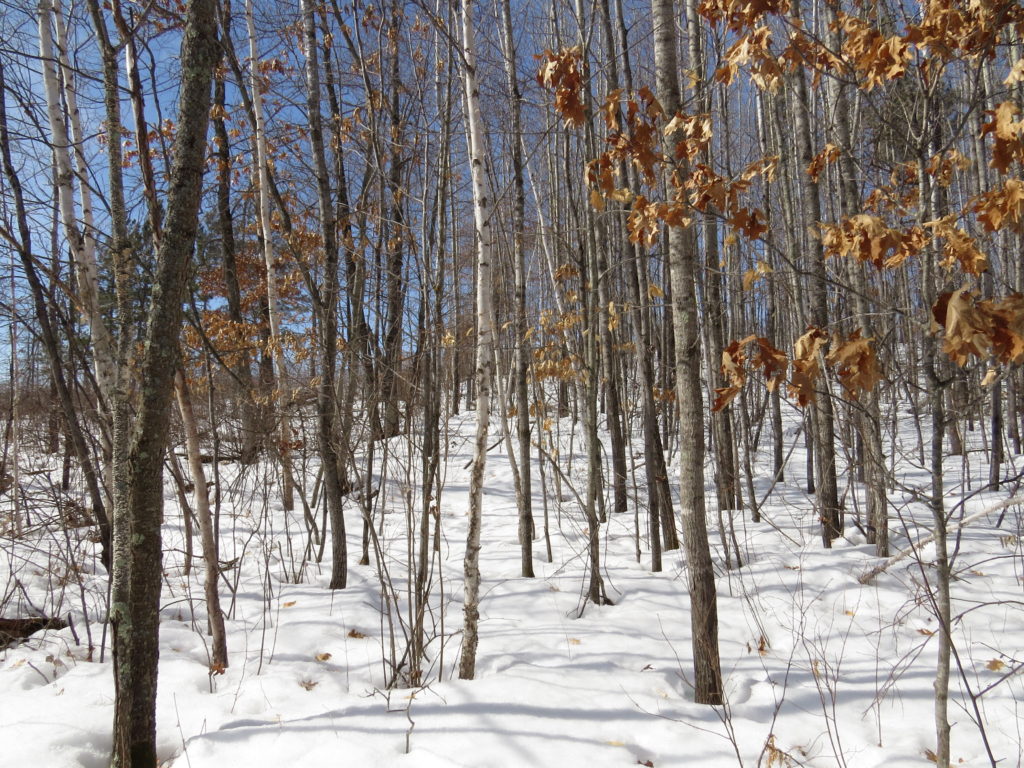
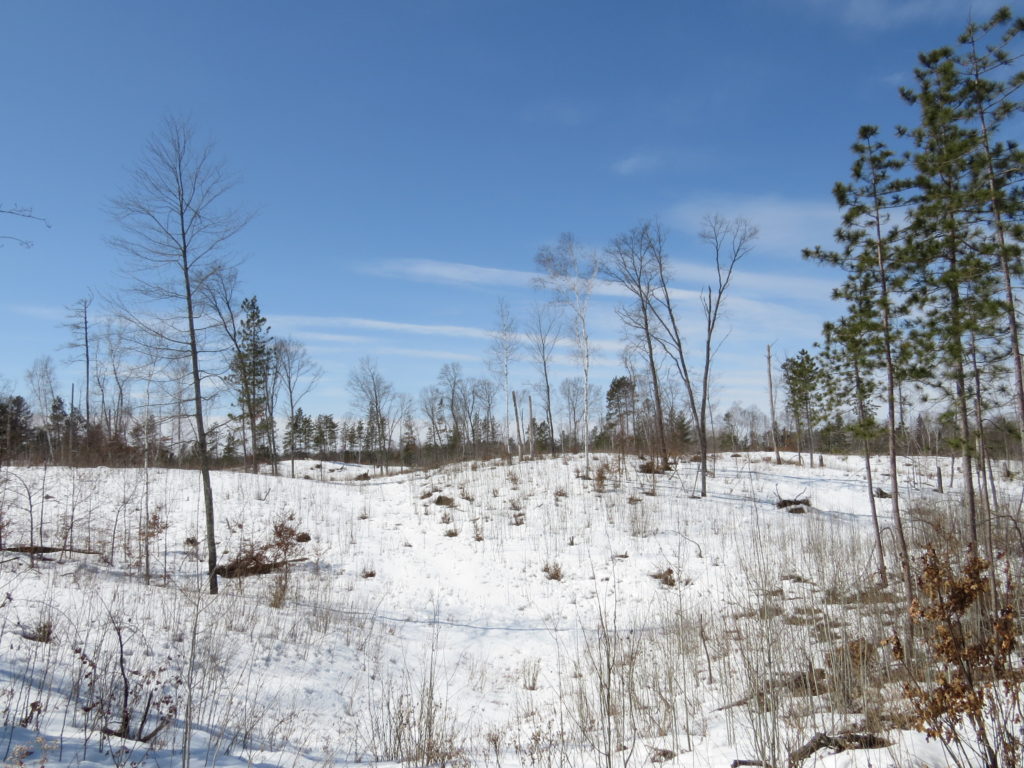
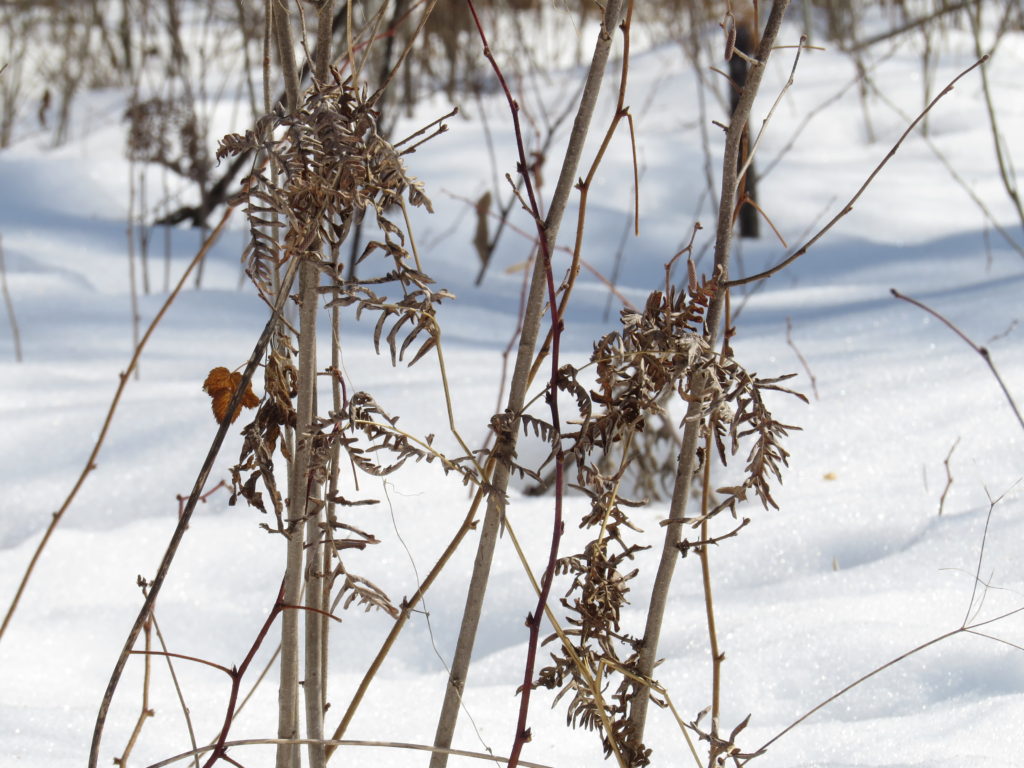
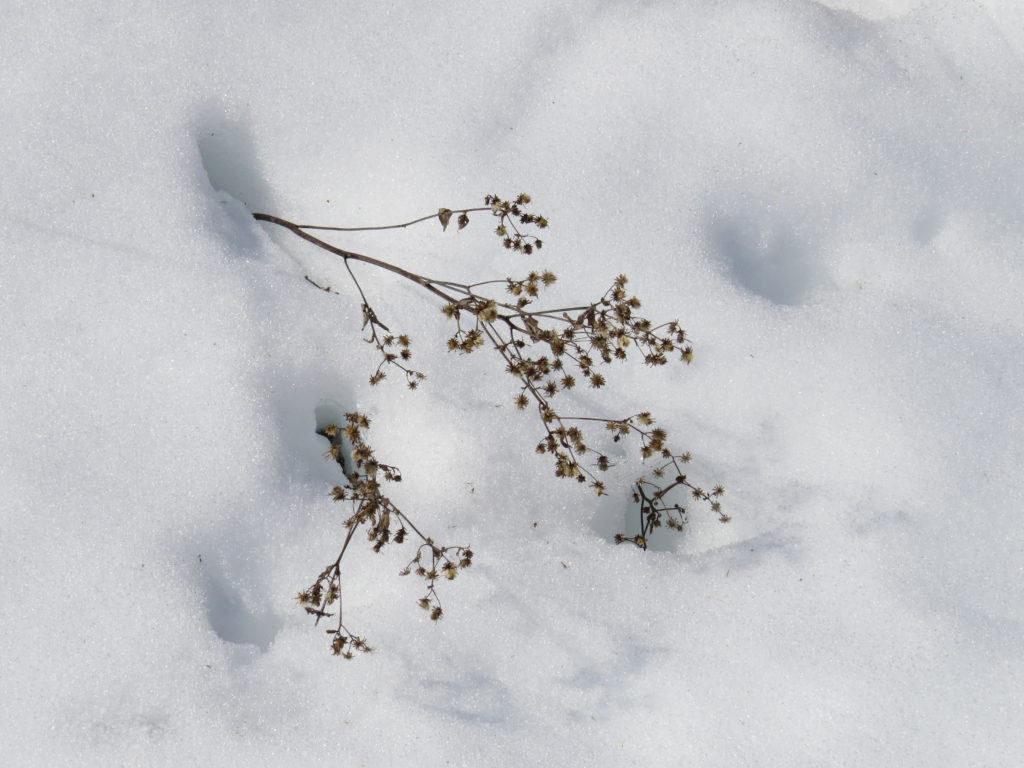
Even through the deep snow, we could see evidence of the destruction of a forest and the life and vibrancy that remained. Dried ferns and wild flowers were visible beacons of the coming Spring when Nature effortlessly performs her miracles of new life.
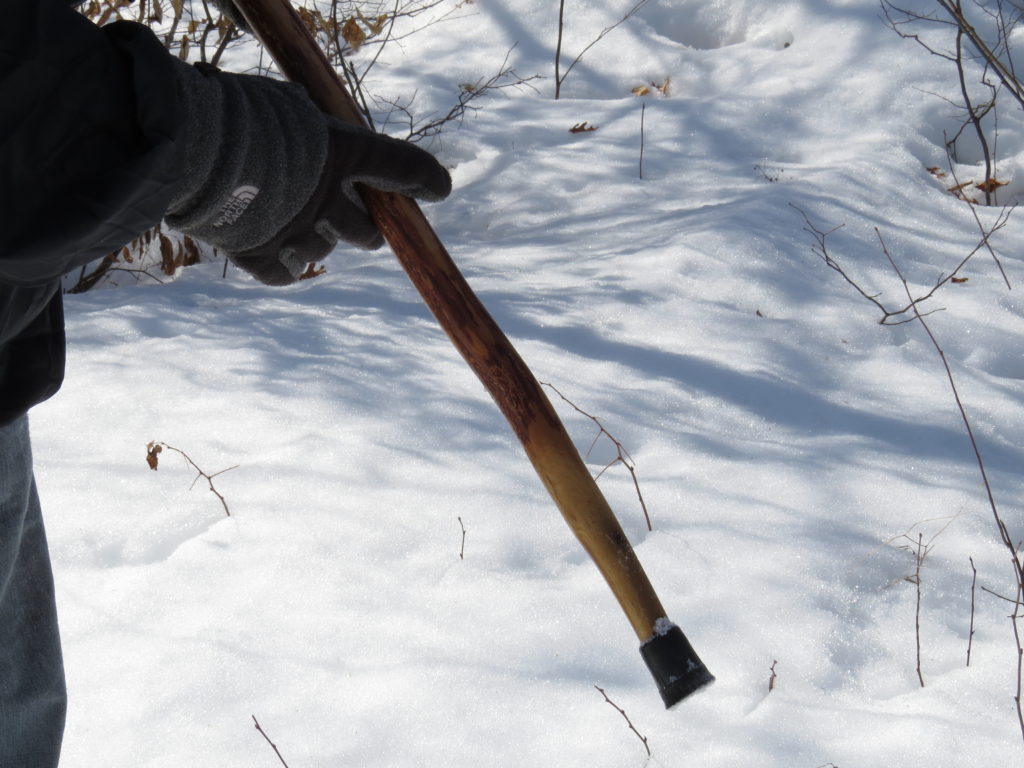
Our trail through the park had been groomed numerous times throughout the winter for cross-country skiing and snowshoeing. It was packed down and relatively easy to walk on—not too rough and not too icy. The snow pack beyond the trail was also hard enough to walk on, and I asked Chris to use his walking stick to measure the depth of the snow.
It will be a little while until all of it melts…
The trail of Fritz (Fred) Loven’s life is sparse on details (that I could find), but one mention came up from the Pro Football Reference. He played guard one season with the Minneapolis Red Jackets in 1929 at the age of 35. Pro football before the NFL. We do know that Fritz’s trail three years later led him to 80 acres of land west of Nisswa that was his home for 43 years. He lived in a cabin with no electricity, running water, gas, or telephone. The ‘lovable hermit’ (may we all be lovable hermits during this time) didn’t have a car but traveled by foot, snowshoes, or boat.
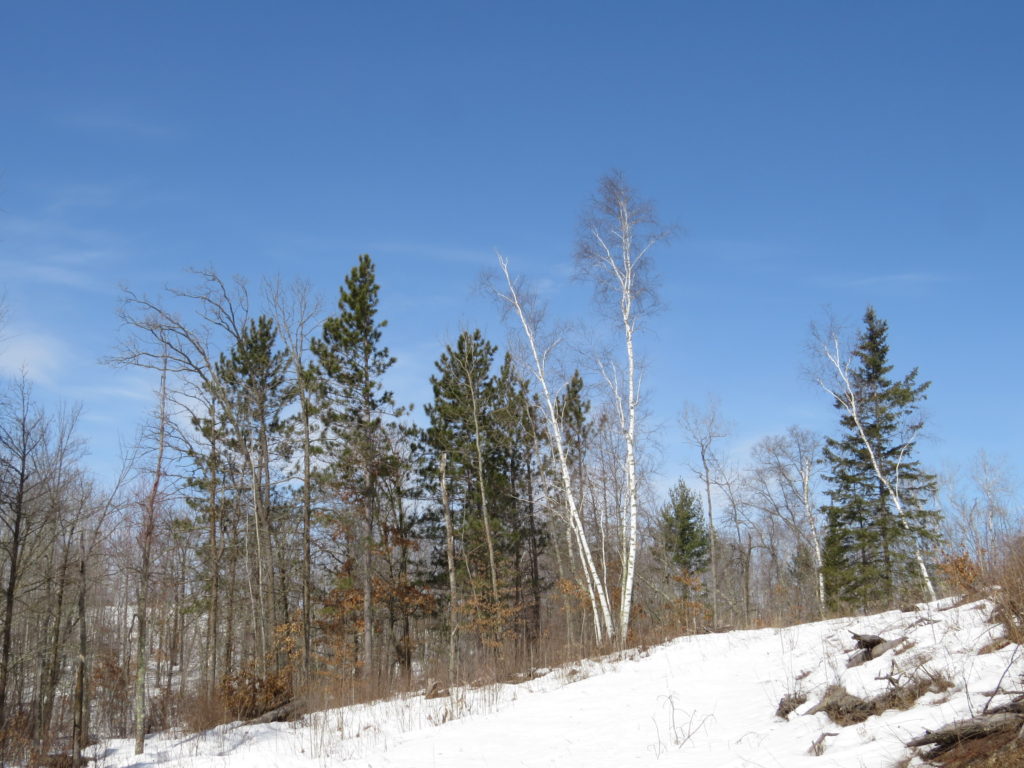
His greatest contribution, in my opinion, besides his wish for his land to become a park, was that he normally planted 400 trees each year! Most people underestimate or take for granted the true value of a tree. Fritz Loven was a bower billionaire—he lived and worked under the shade of the existing trees and eventually, of the ones he planted—and we are the beneficiaries of his generosity and vision.
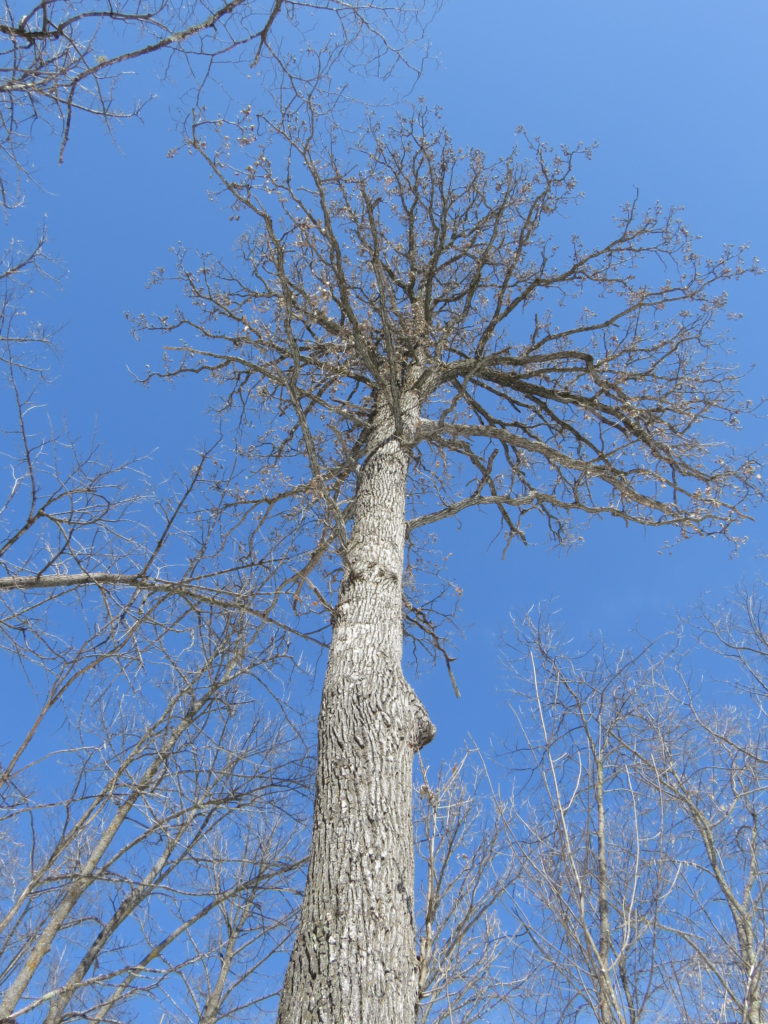
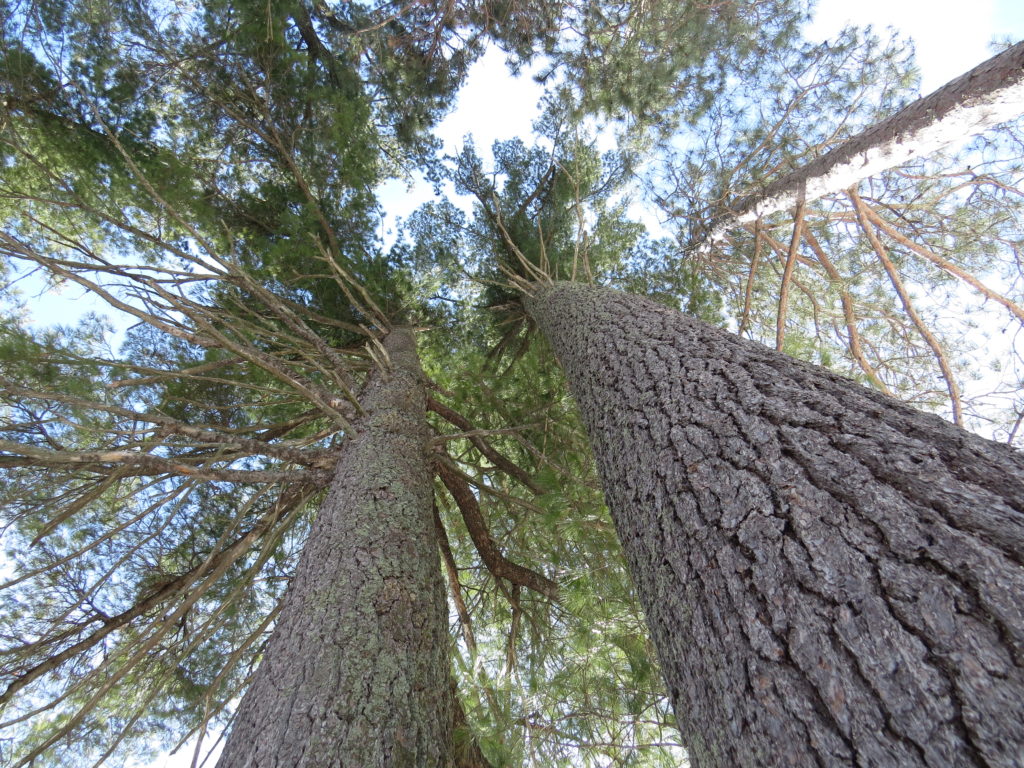
Like most ‘big pictures’ of any given situation, the larger perspective of Fritz Loven and his park is complicated. Signage on our hike told us that we were crossing private property at some points, though we didn’t know exactly where that was. Was the logging on the park land or on private property? Did the city need funding from the logging in order to maintain the park? It was sad to see incredible giant Pines and Oaks beside the clear-cut areas. How many trees that Fritz planted were cut down for timber? Who is replanting? Along with the logging, there was also damage from storms, these extreme weather events that are becoming common-place due to climate change. ‘Every situation we confront in life comes from the convergence of many contributing factors.‘ What are the facts? What are the observations? How do we look beyond what we see at any given moment and more importantly, beyond what we believe?
Fritz Loven was the guardian of the beautiful little trout stream, the keeper of the forest, and protector of the trees. He had faith that the trees would grow, the fish would reproduce, and that his vision and work would be a place for people to enjoy decades and decades after he was gone. With the fear and stress of our present coronavirus situation, how do we step back from our limited self-awareness and our limiting self-interest to see the larger perspective? Within our own minds, how do we tamp down the fear in order to see the factors that converged to get us into this situation and the solutions to get us out? We are the guardians of our own bodies and minds, and collectively, we are the guardians of our earth. Faith is how we look beyond what we see. Openness is how we look beyond what we believe. Love is how we show up for ourselves, one another, and for our sustaining Mother Earth. May we be lovable hermits at this time and have all three.
Hunkering Down
I love when a cool, old word all of a sudden becomes apropos (another cool word meaning ‘suitable in a particular situation or at a particular time.’) I’ve been saying it, my friends have been saying it, and the newscasters and experts have been saying it—hunker down. ‘Hunker’ is a good word to say out-loud (almost always said with the word ‘down’); it has grit and meaning and motion. The word/phrase emerged in the 18th century in the Scots language referring to ‘squatting down on the balls of one’s feet, keeping low to the ground, but still ready to move if necessary.’ Over the centuries and in this situation and time we find ourselves in, it also means ‘to be prepared to stay in a particular place or situation for as long as necessary, usually in order to achieve something or for protection.’ Yep—here we are hunkering down.
At this particular time, hunkering down for Chris and I includes what has always been a part of our lives—going out in Nature, and this weekend was no exception. We drove north again, even a little farther than we did last weekend. We contemplated the different parks in the Brainerd region and saw one called Fritz Loven Park, west of Nisswa. It was the name—great to say and intriguing as to why it was so named—that was the deciding factor for our Saturday destination. The park is named after Fritz Loven who settled on the 80 acres of land in 1932. He was known as ‘the lovable hermit’ of Upper Gull Lake. Social distancing was his norm for decades. I will tell you more about him in my next post; for now, just know it was his wish that after his death, his land would go to the town of Lake Shore. It will be forever protected by the Minnesota Land Trust.
The first surprise and delight when we emerged from our vehicle was the sound of running water—literally a babbling brook aptly named Stoney Brook. The dark water coursed between the banks still deep in snow.
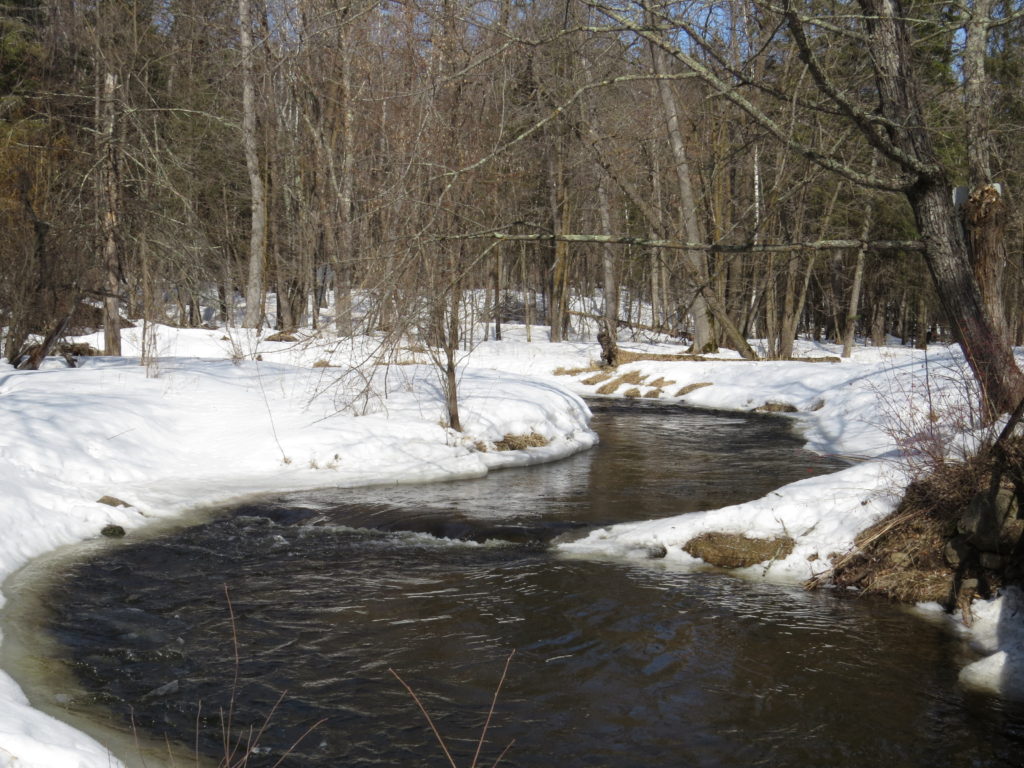
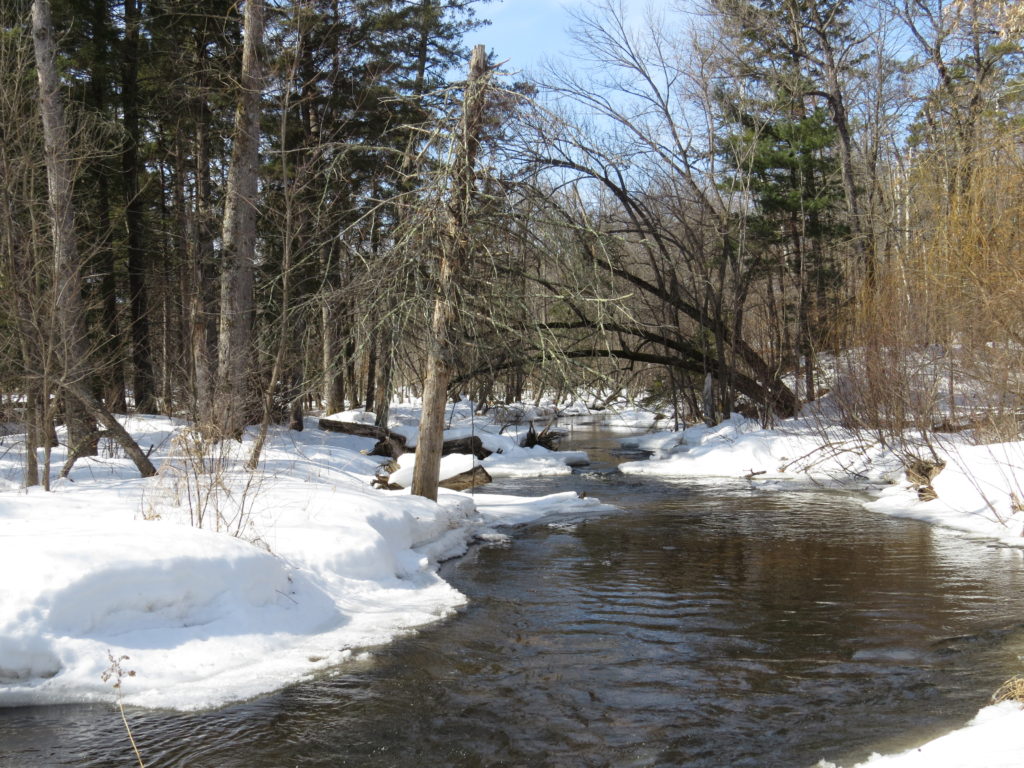
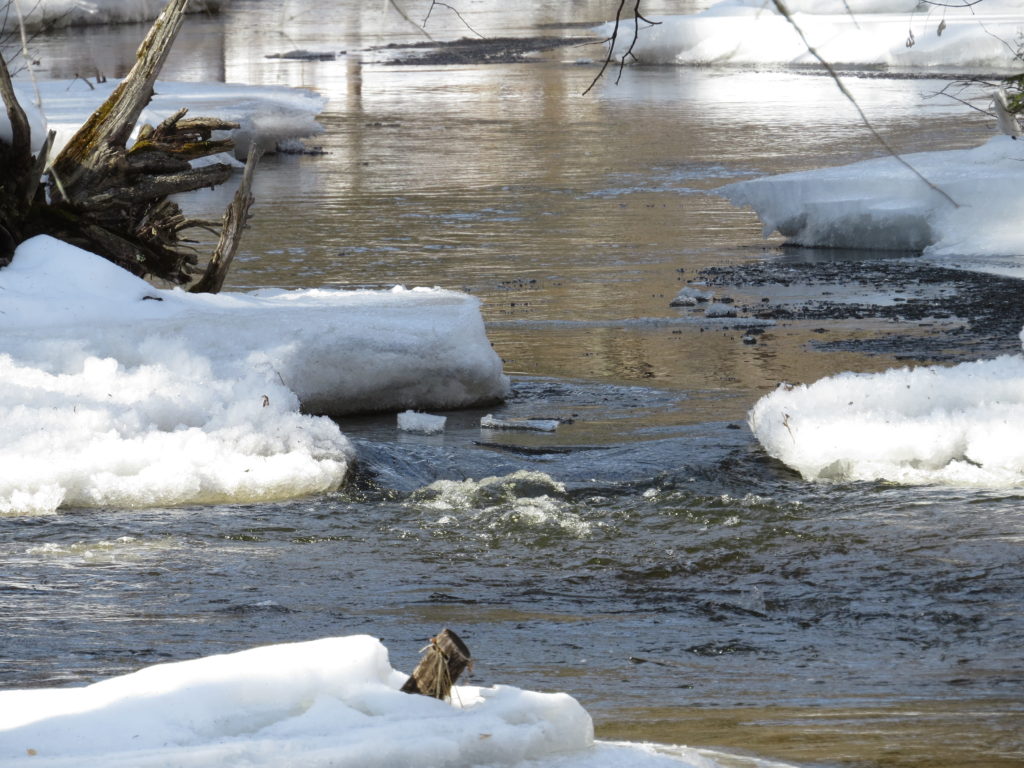
As we hiked, another striking observance was the number of huge fallen trees in the park—some broken off, others uprooted. A summer storm in 2015 and another in May of 2016 that carried with them devastating extreme winds, had toppled trees and power lines. The evidence starkly remains.
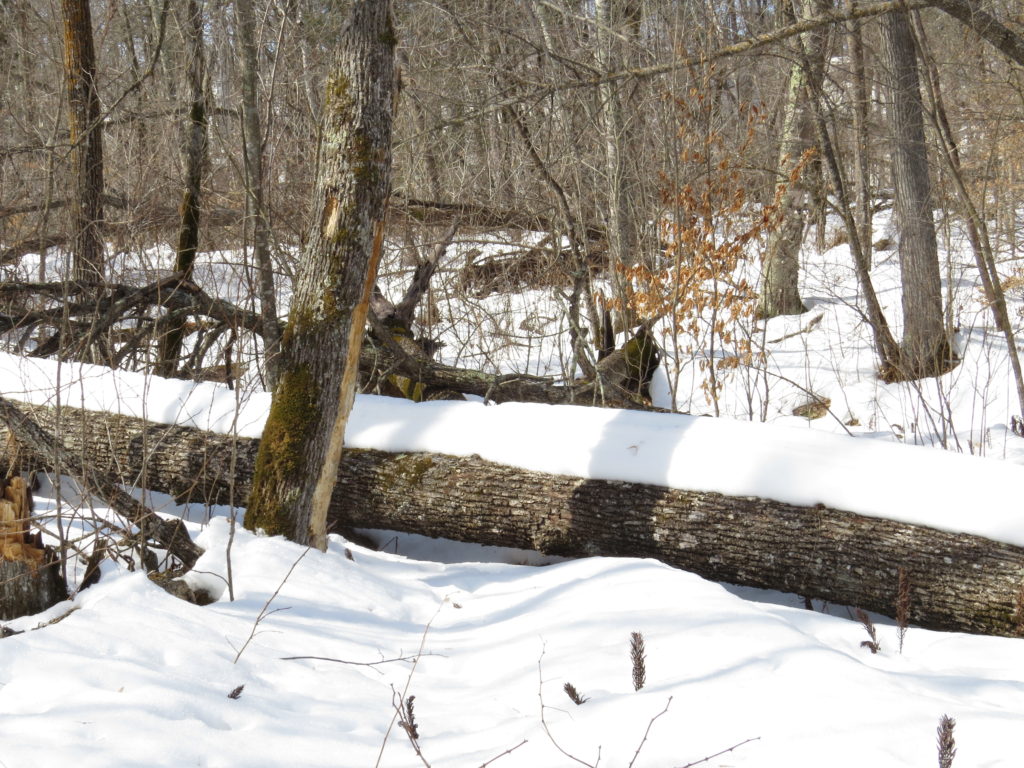
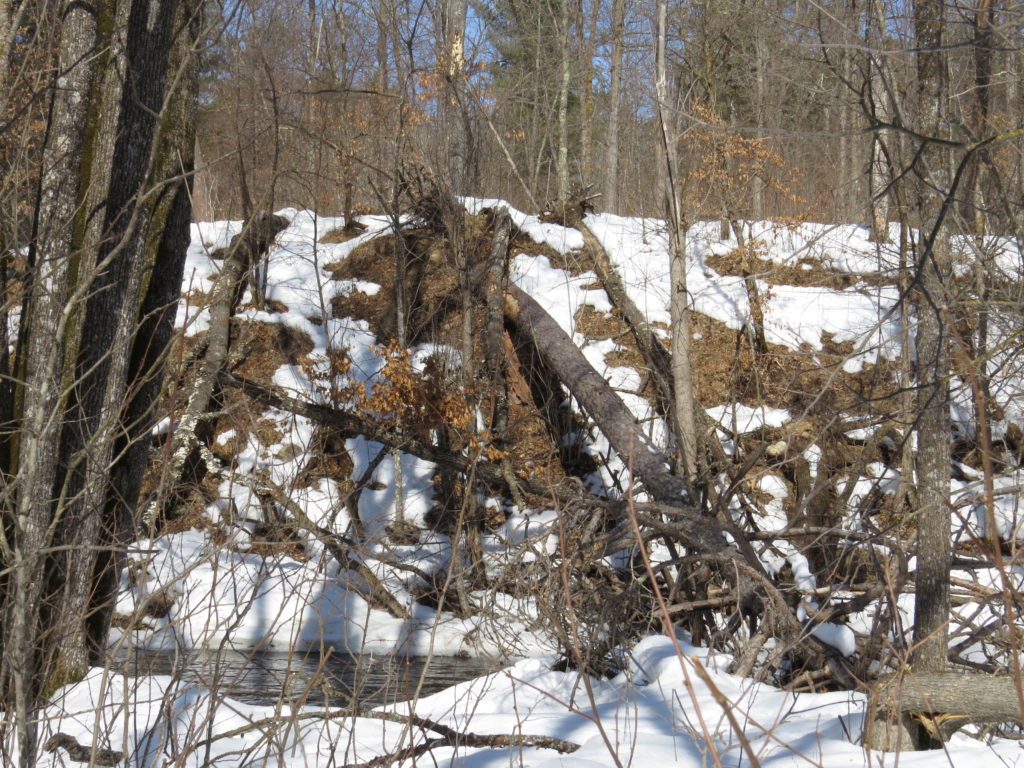
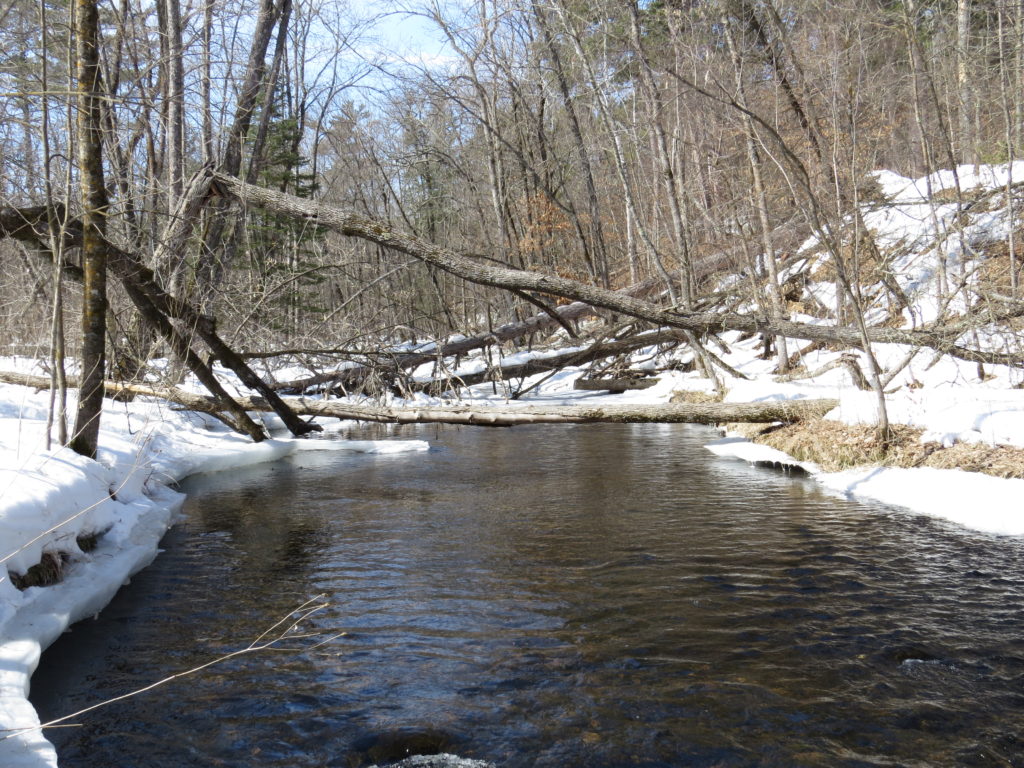
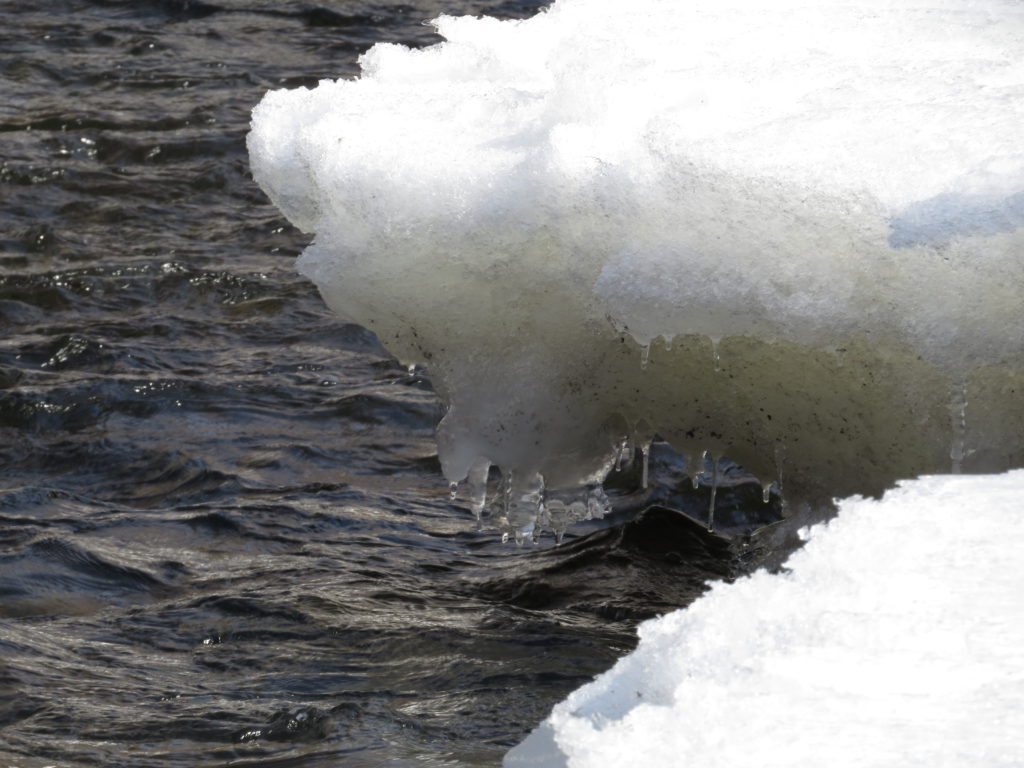
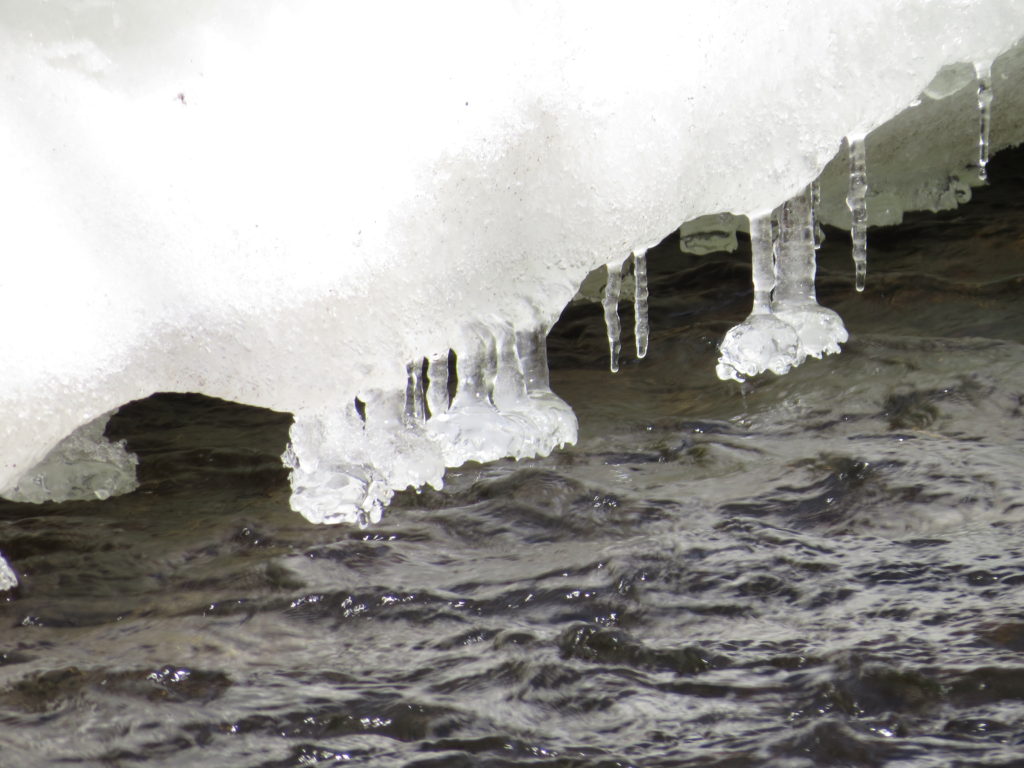
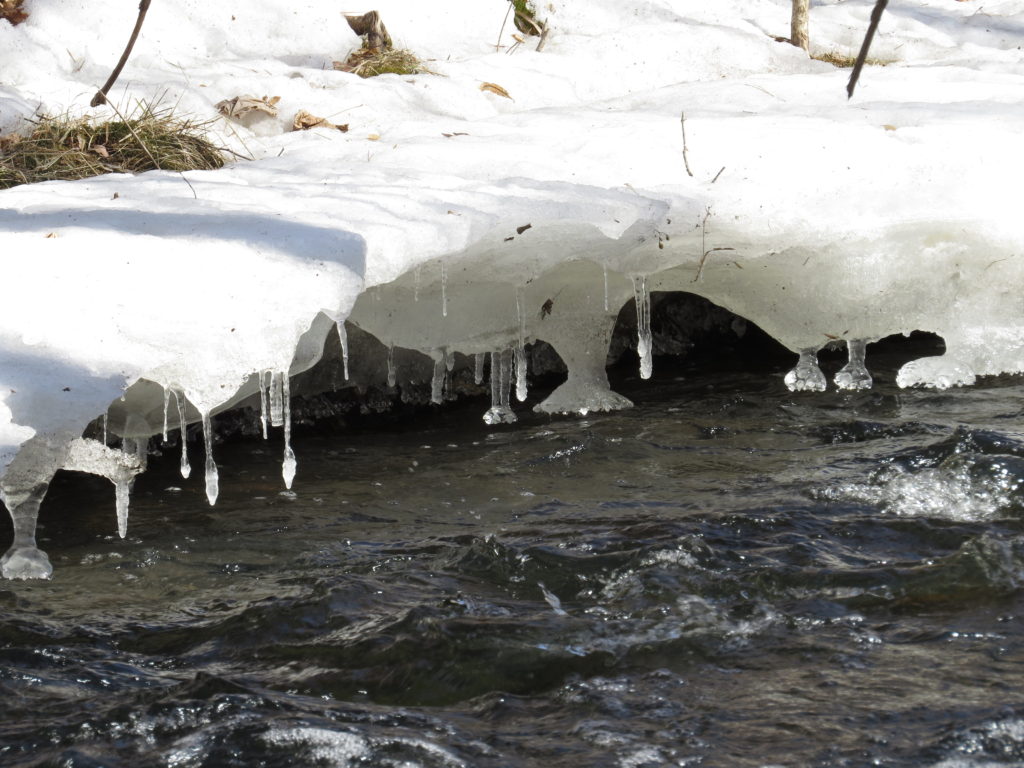
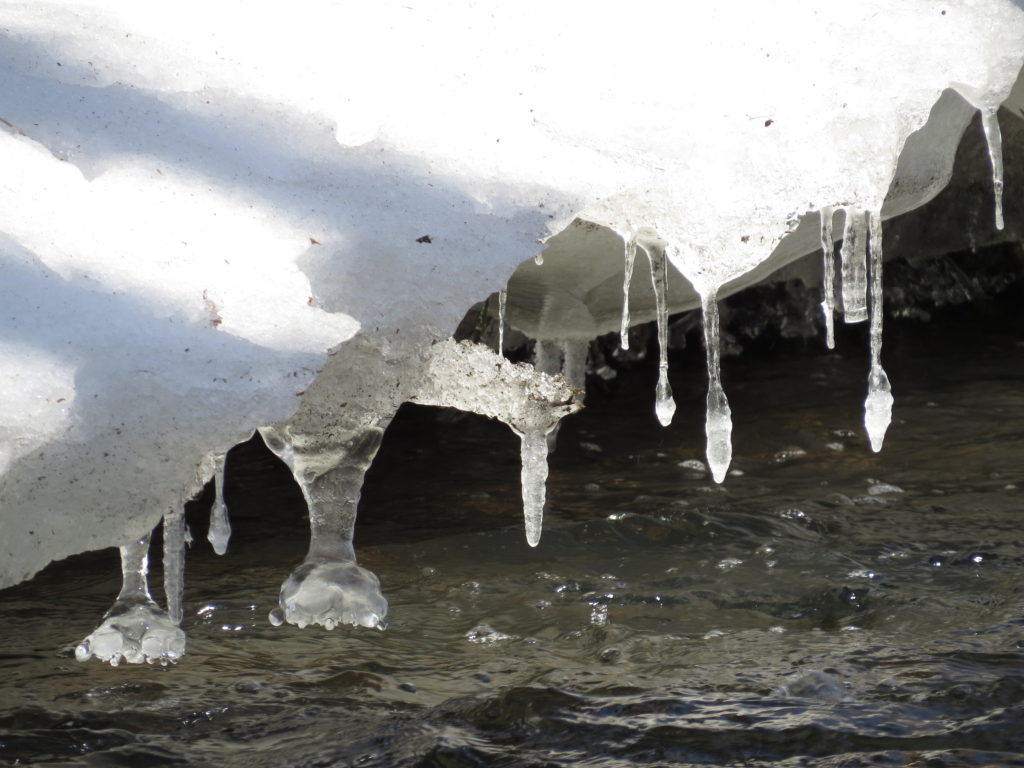
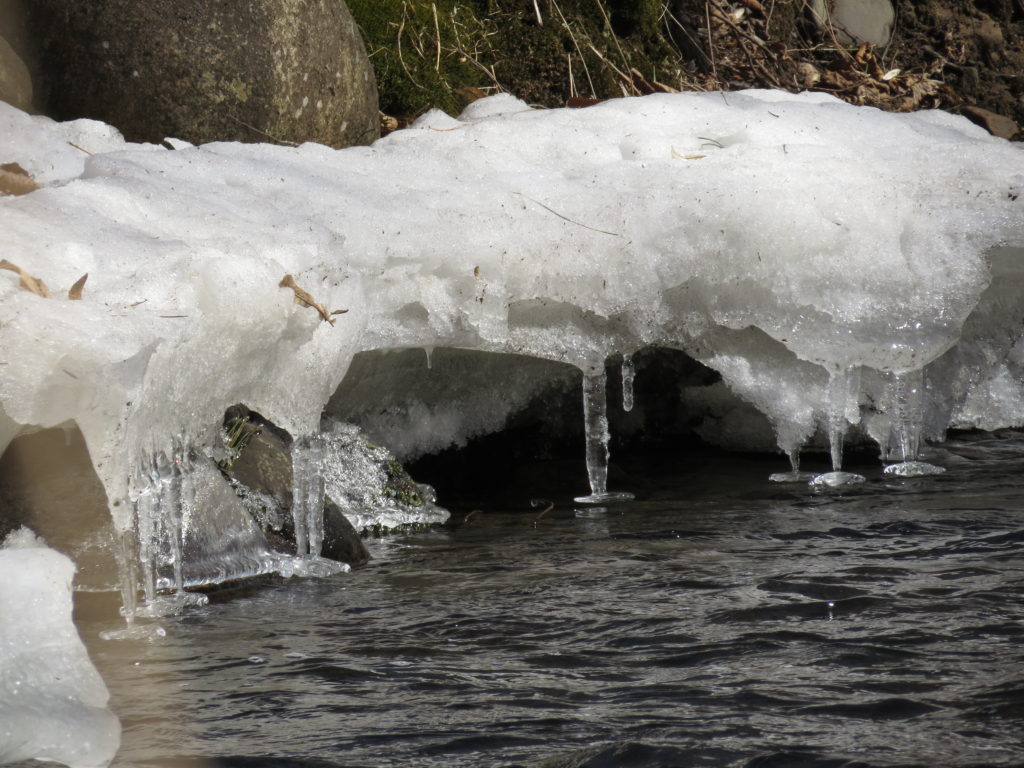
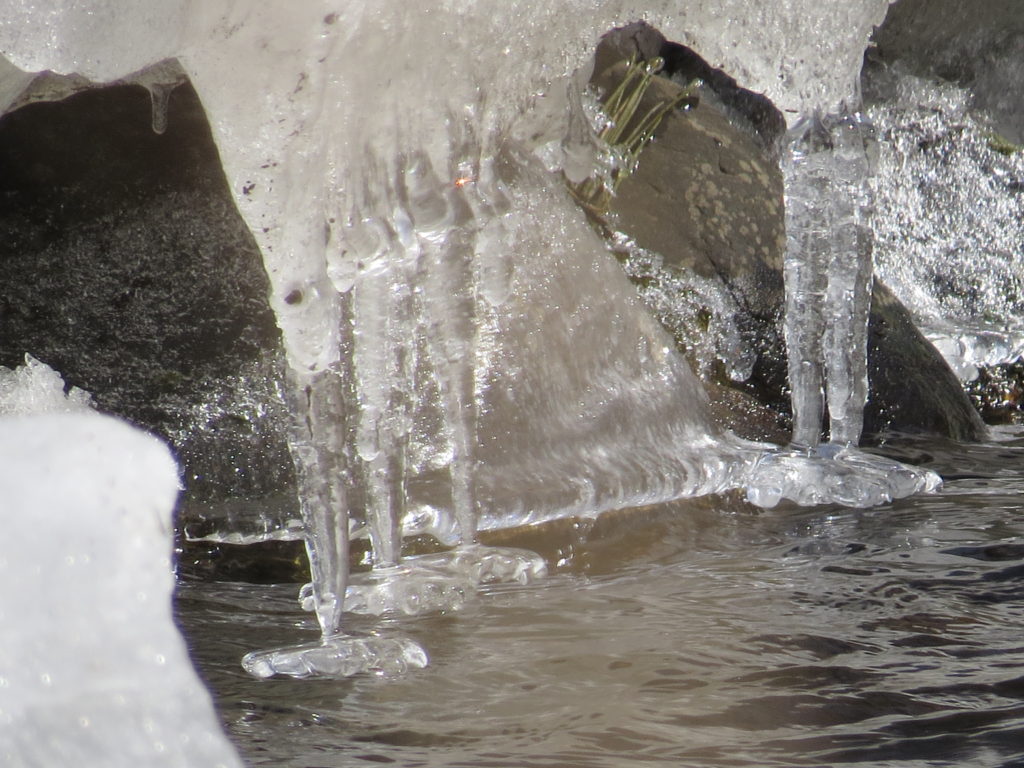
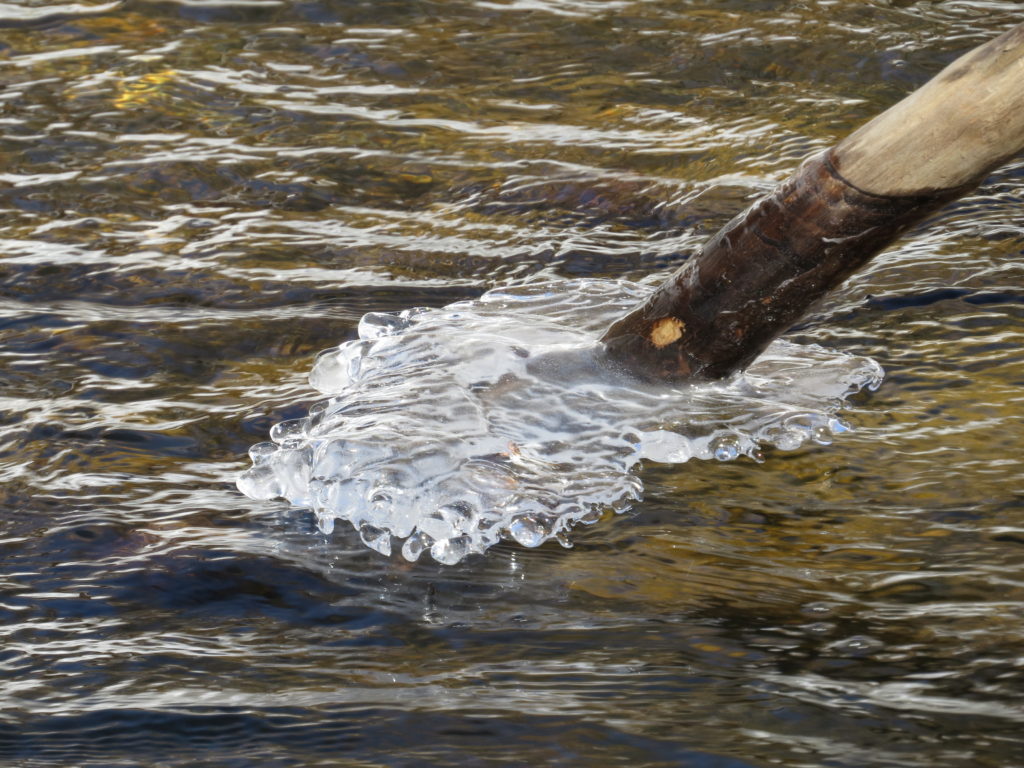
In the midst of the past destruction and the as-of-yet-ongoing Winter (despite the calendar’s announcement of the arrival of Spring), we saw great beauty. Mother Nature creates amazing art at any particular place and time of year—and at this time and place, it was intricate ice art. The brook was lined with it, and I hunkered down (first definition) at the edge of the water with camera in hand.
We are living in the vast gray area where things don’t fit into neat ‘us and them’ categories and when trying to incite that division falls flatly with a resounding thud to our humanity and decency. The picture is bigger now. We are all team players, like we should have been all along. It’s always been about life and death—if not physically, then spiritually, emotionally, and socially. We are losing people—the fallen—for reasons we will never understand and for reasons we should have been more prepared for. And in the midst of the fear, confusion, collapse, sickness, and death is an upsurgence of art and creativity and caring. Music, visual arts, poetry, stories, and heroism are being brought to the fore, and it’s making a difference in our isolation. The loss of lives and livelihood is tragic, but it does not have to be without meaning. With such a trauma to our world, there is no going back to the way it used to be—we have an opportunity to go forward to a new way of being with the very things that are most important to us now in this time of quarantine. Hunker down in love, self care, creativity, renewal, and charity for others—we’re all in this together with grit and meaning and motion.
A Picture of Calm and Quiet
Yesterday Chris and I had a mission: to explore strange new lands, to seek out new sites and old civilizations, and to boldly go where no coronavirus has gone before (us). We headed north to Crow Wing State Park near Brainerd, Minnesota. We actually had been to this park in August of 2014 for a short camp-out and hike. We chose a trail we hadn’t been on before, and of course everything looks different in Winter! The Red River Oxcart Trail follows the Mississippi River as it bends around this peninsula of beautiful forested land.
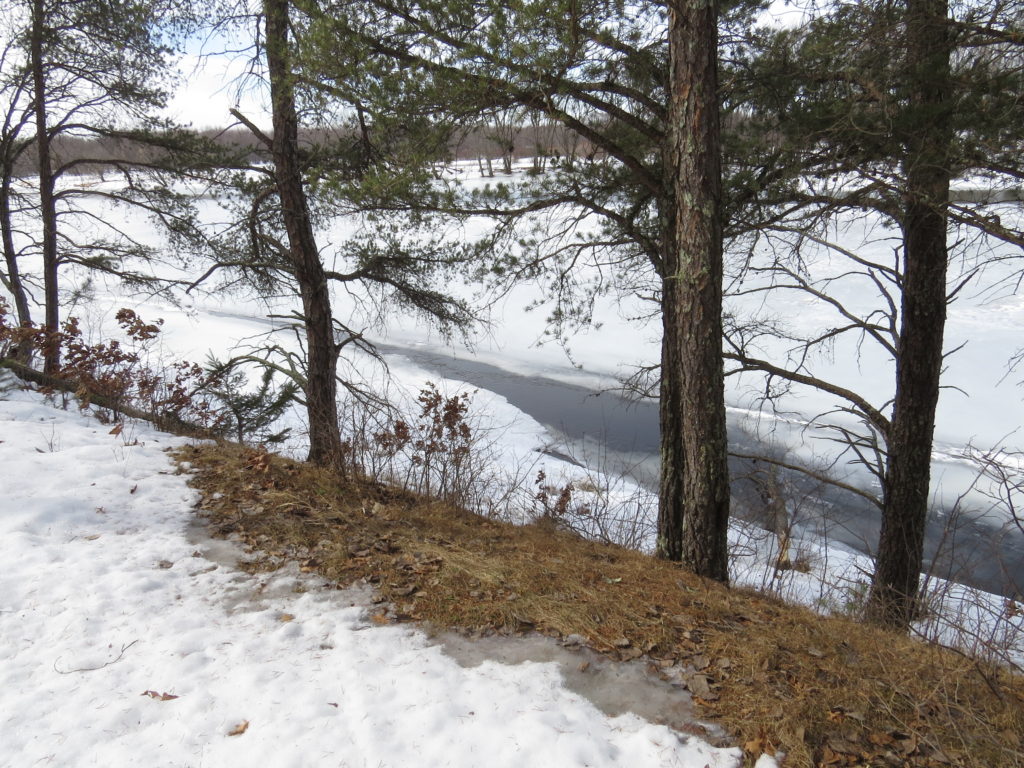
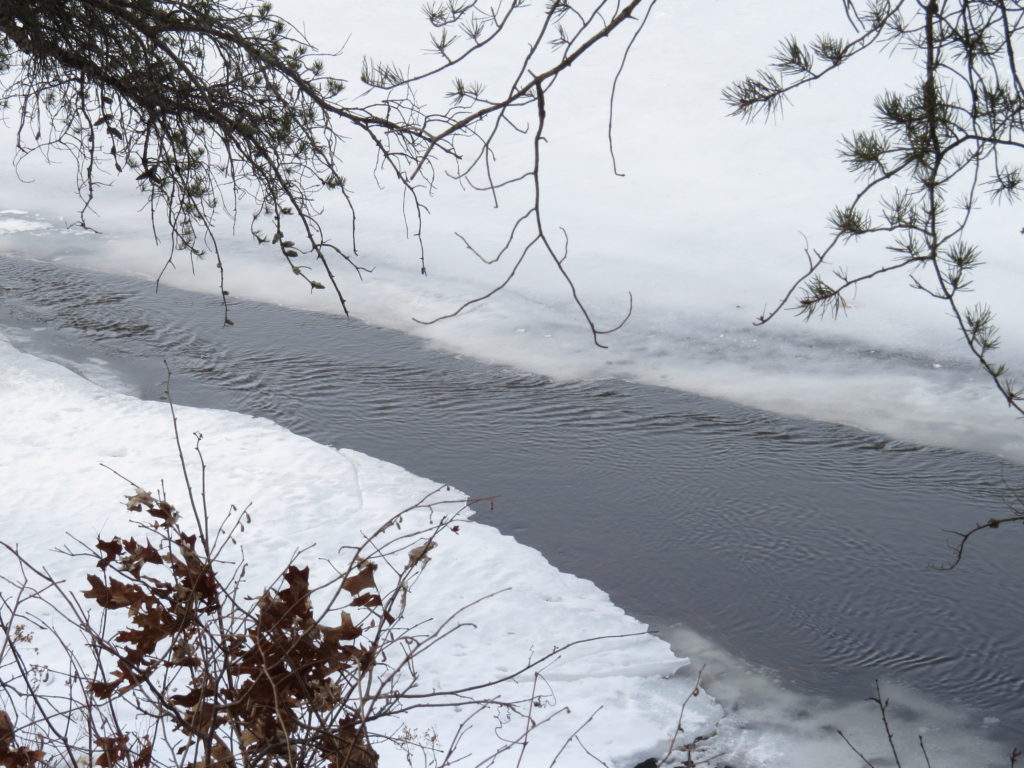
There was no walking across the Mississippi River like we had done a couple of weeks ago. Ice still covered most of the River, but a couple of ribbons of dark, flowing, open water burgeoned forth towards Spring and St. Paul.
This site is the confluence of the Crow Wing and Mississippi rivers. The Crow Wing River splits before entering the Mississippi, creating an island in the shape of a wing. Early French explorer accounts had translated the name into Crow Wing. This area of land had long been a favored hunting and meeting place for the Dakota and Ojibwe nations, and it became a famous fur trading location.
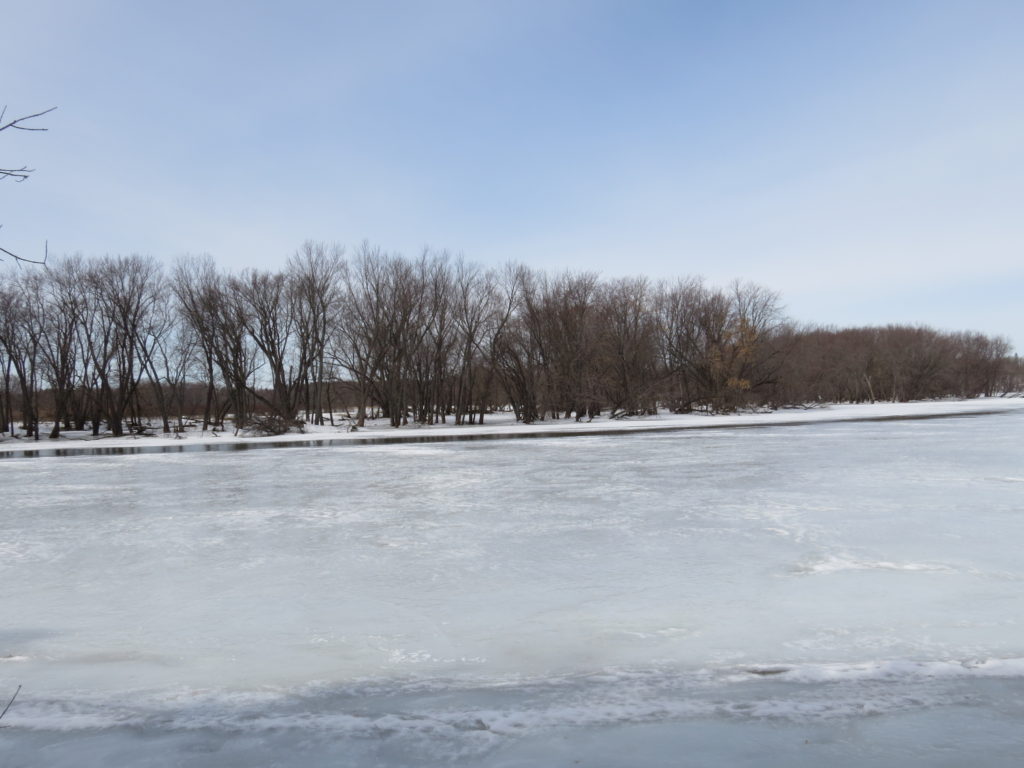
The snow on the trail had been snowshoed and walked, so the path was packed down and rough. The snow pack to the sides were mostly hard enough for us to walk on, but every once in a while our foot would break through the surface snow and sink in to almost a foot deep.
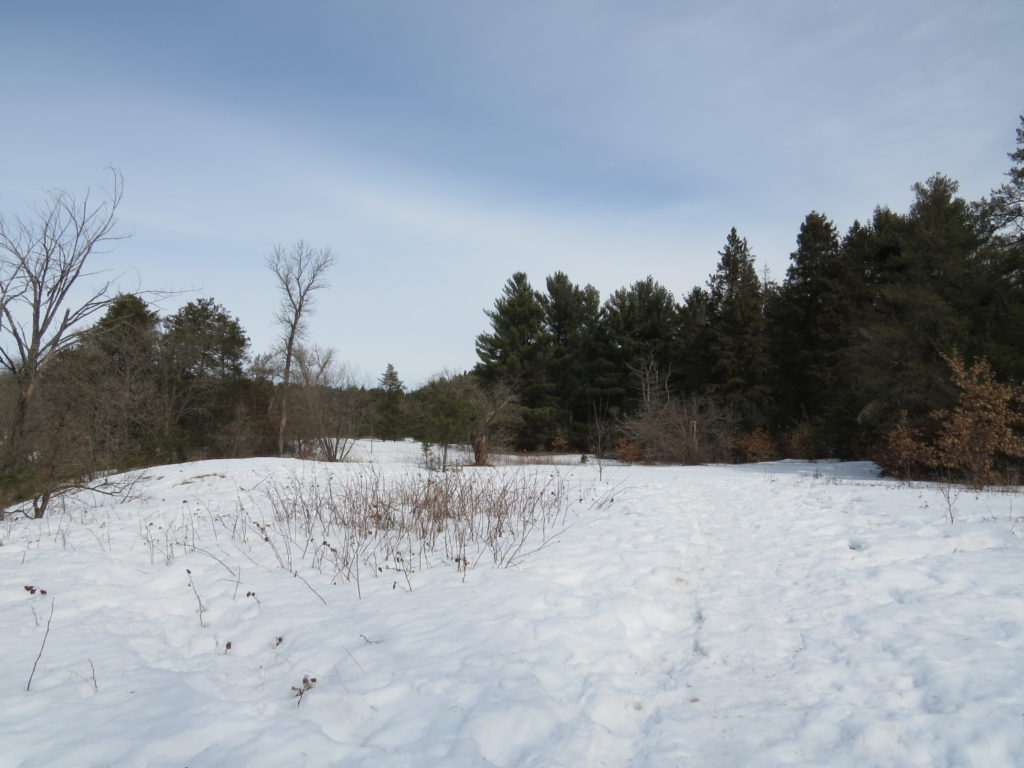
We walked between the ice-covered River and the forest of towering Pines and ancient Oaks. It was exquisitely beautiful.
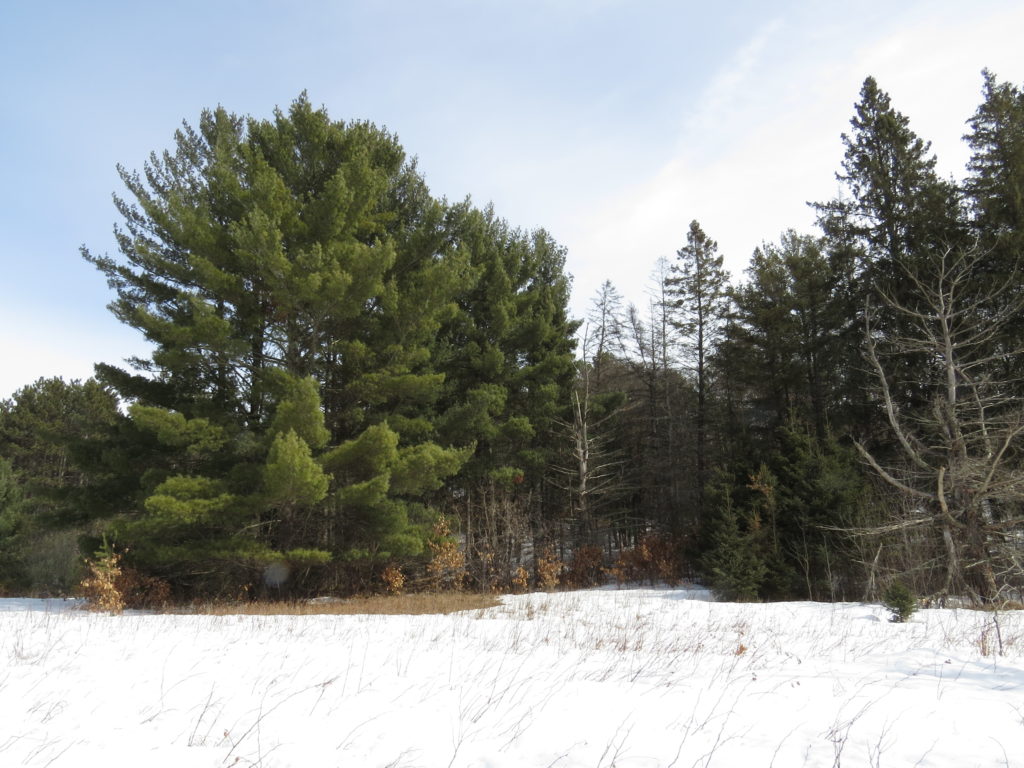
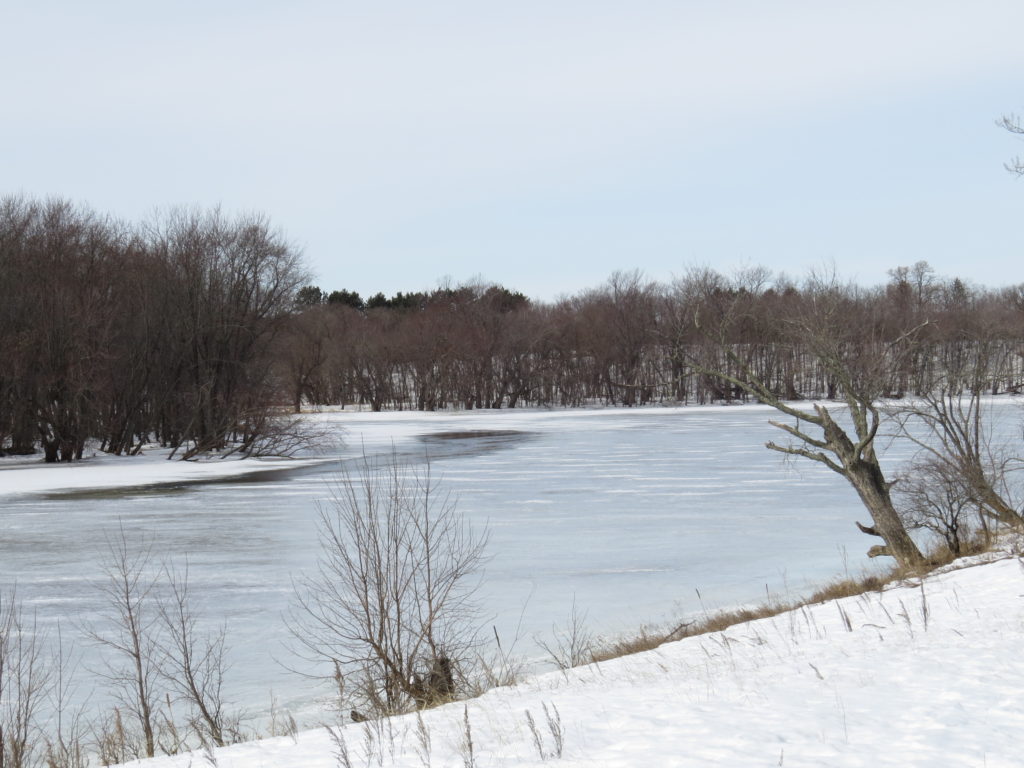
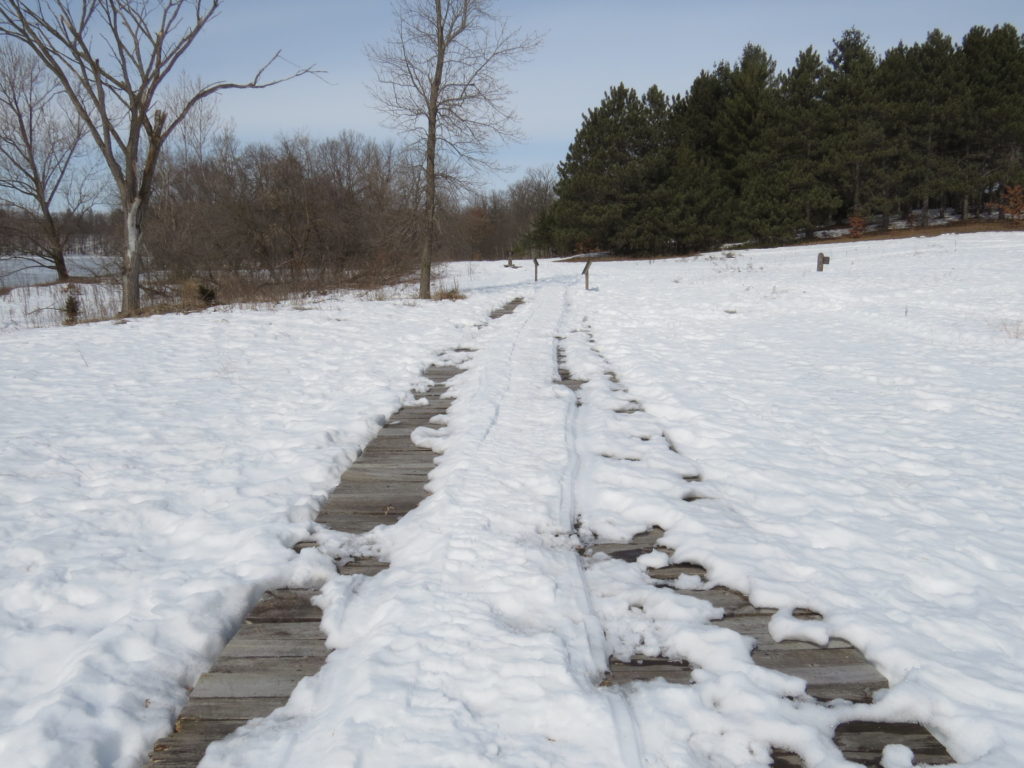
We came to a clearing where we learned we were walking on a boardwalk of the old town road. This was the site of the old village of Crow Wing where the fur trading post had developed into the foremost trade, travel, and political center of the region. By the 1860’s, it was hostel and home to over 600 people, with stores, warehouses, saloons, hotels, and churches.
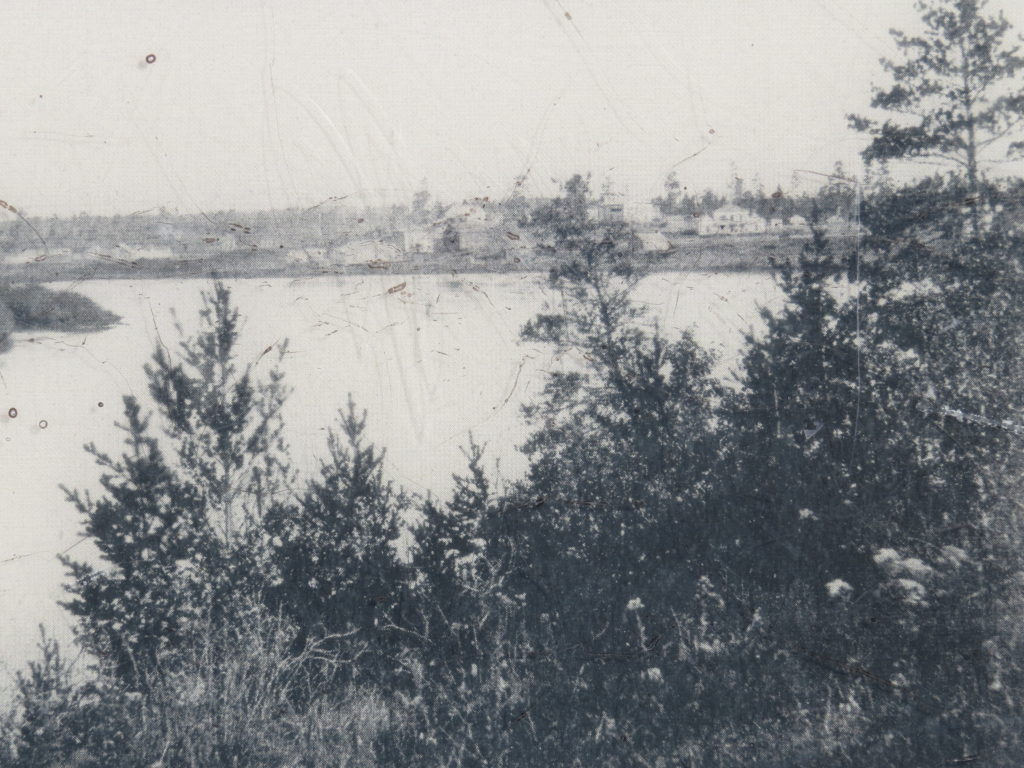
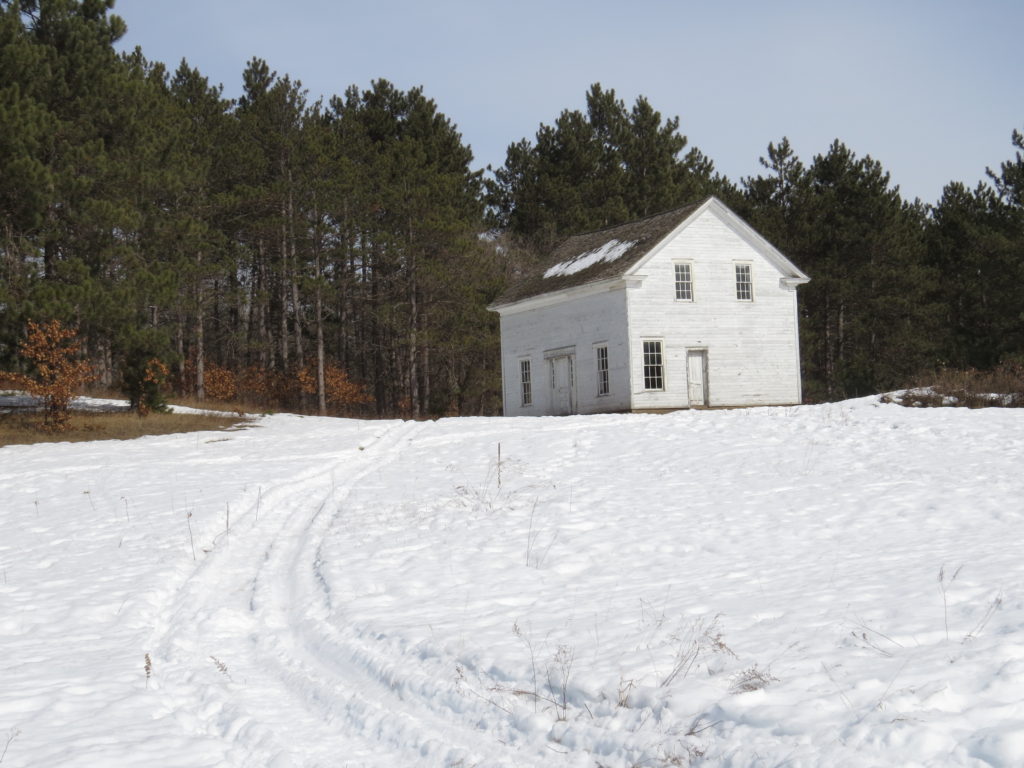
Fur trader and developer Clement Beaulieu and his wife Elizabeth built this house on the hill in 1849. The booming town of Crow Wing began its decline in the 1870’s when the railroad crossing was built up-river where the town of Brainerd grew. The Beaulieu house was moved in 1880 and occupied until the 1980’s, when it was donated to the Minnesota DNR, moved back to its original location, and restored to its original design.
We continued along the Red River Oxcart trail and came to the place where the oxcarts would ford the River. At that time, cargo was brought from the north by oxcart, then transferred to wagons for the rest of the trip to St. Paul and vice versa.
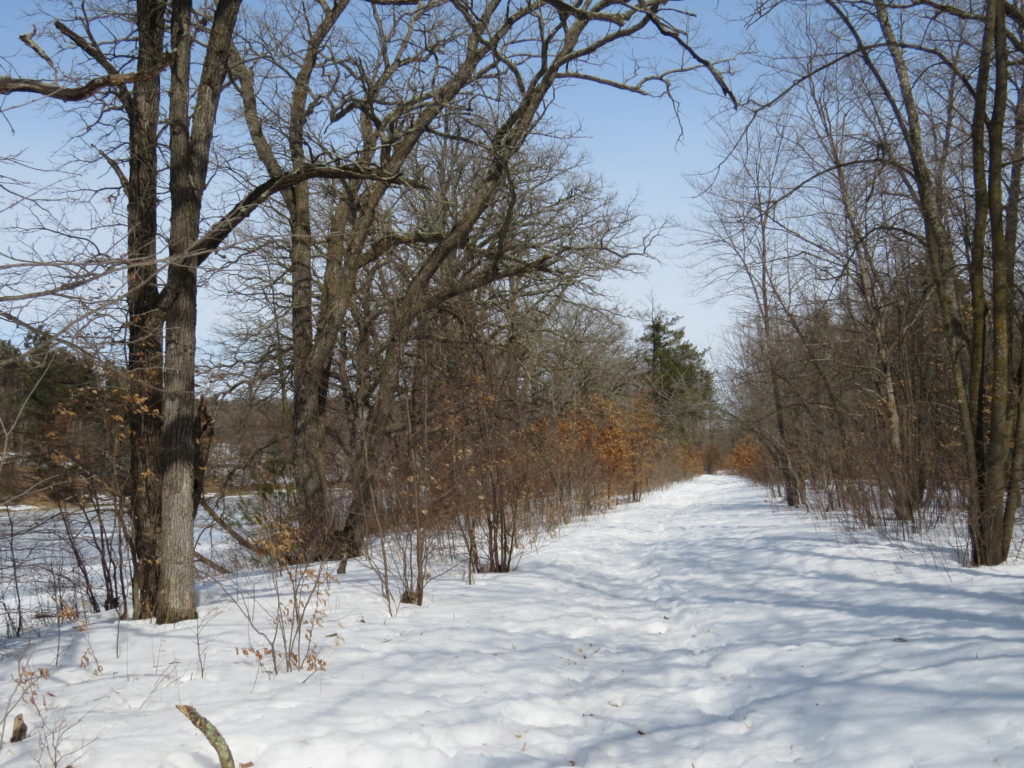
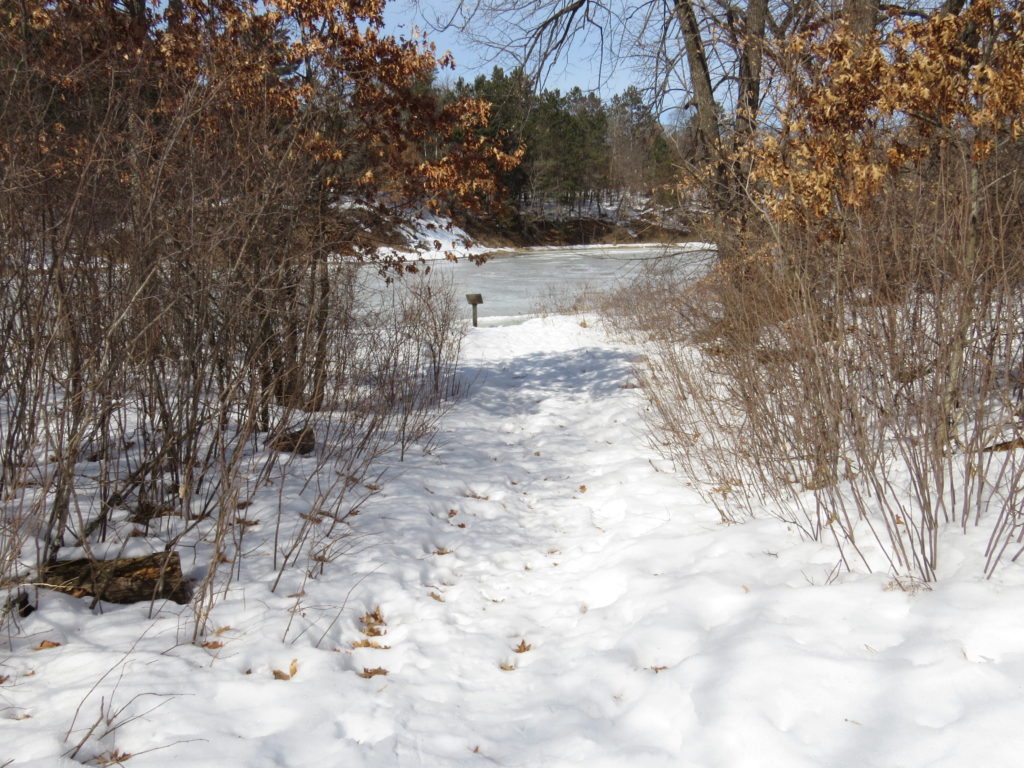
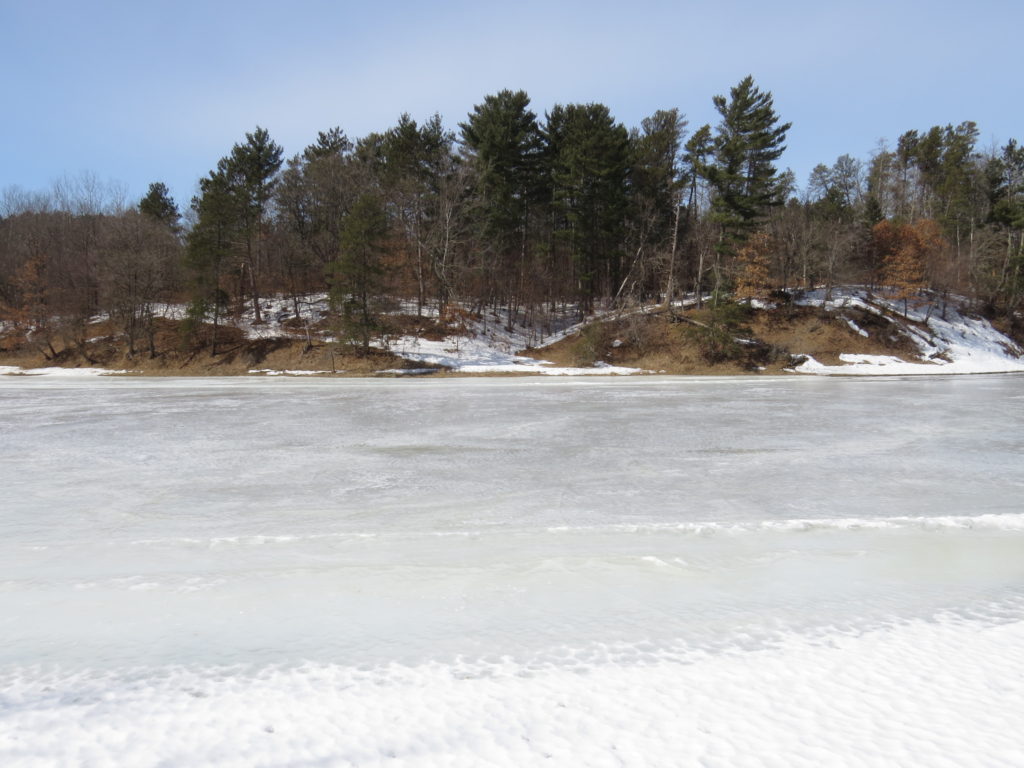
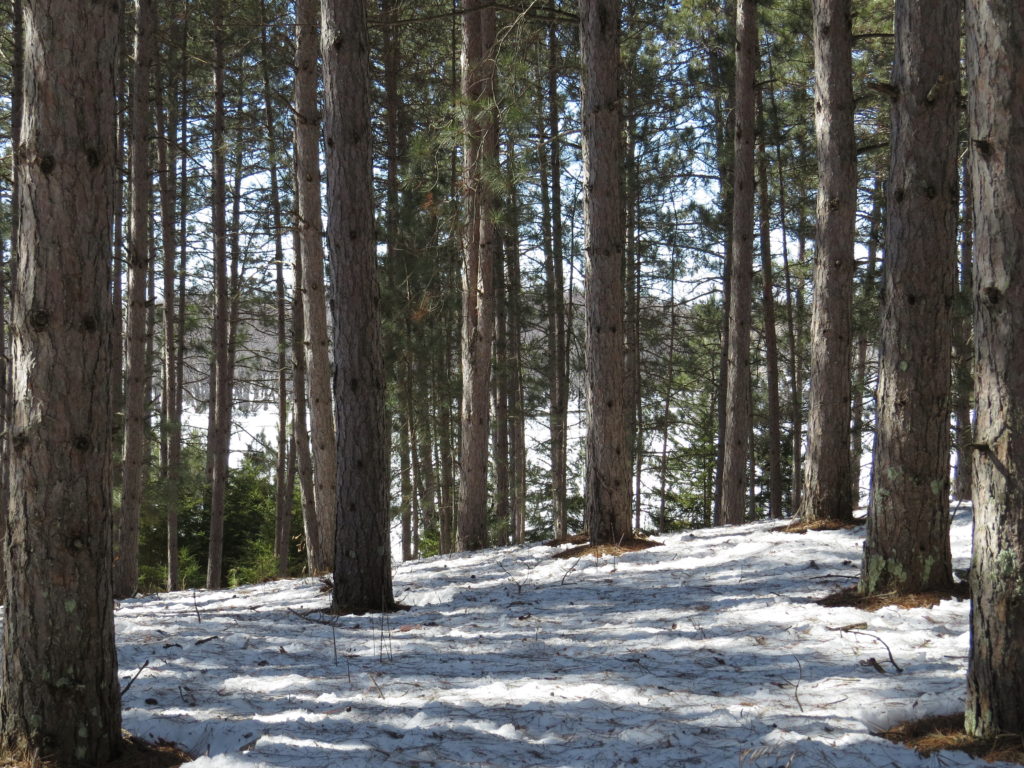
Our trail brought us around the peninsula to Chippewa Lookout, then into a Pine forest.
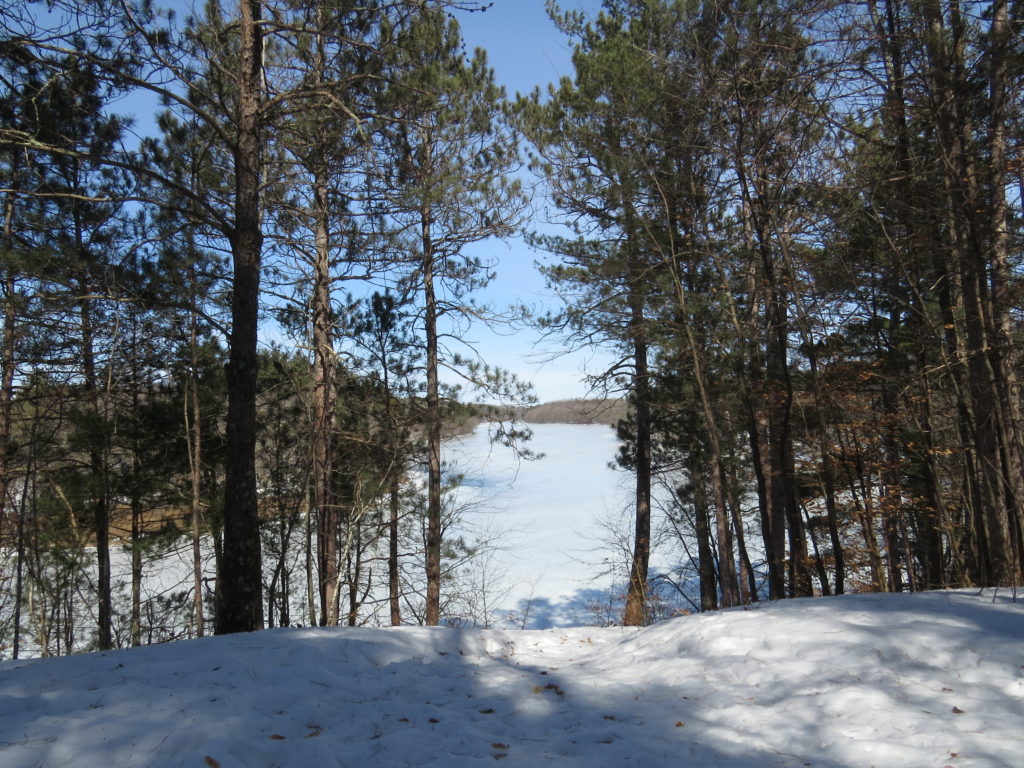
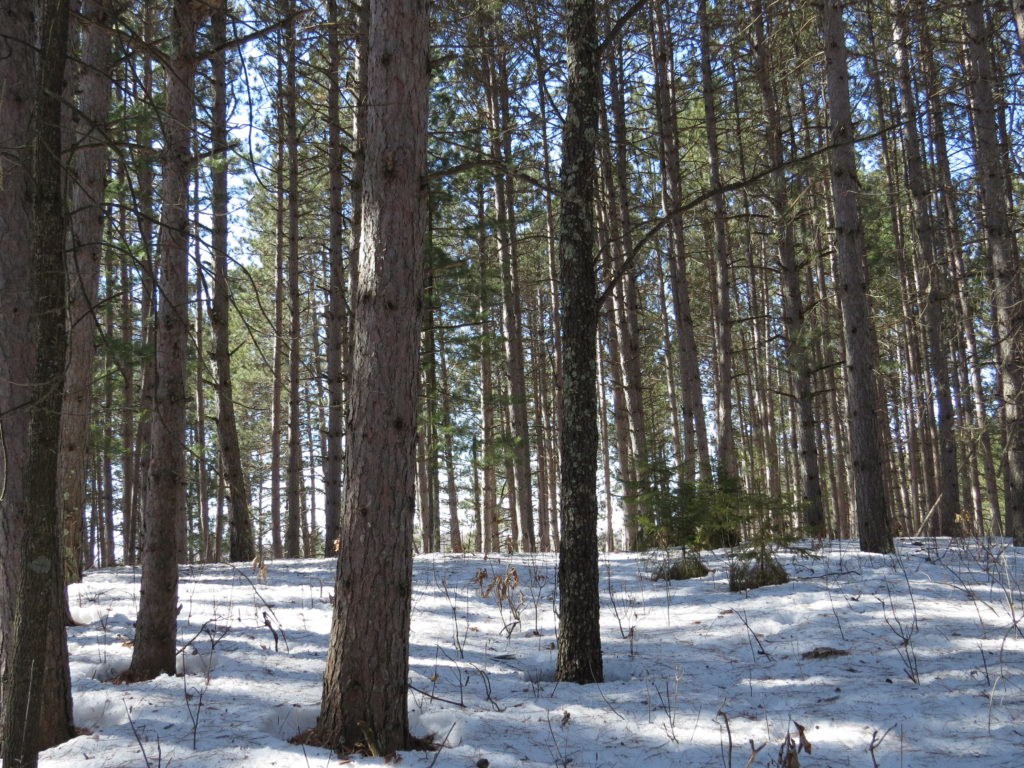
The forest and the River beyond were a picture of calm and quiet. The sun and hiking had warmed us from the original chill at the beginning of the trail. The last two hours had felt like we were explorers in the wilderness…
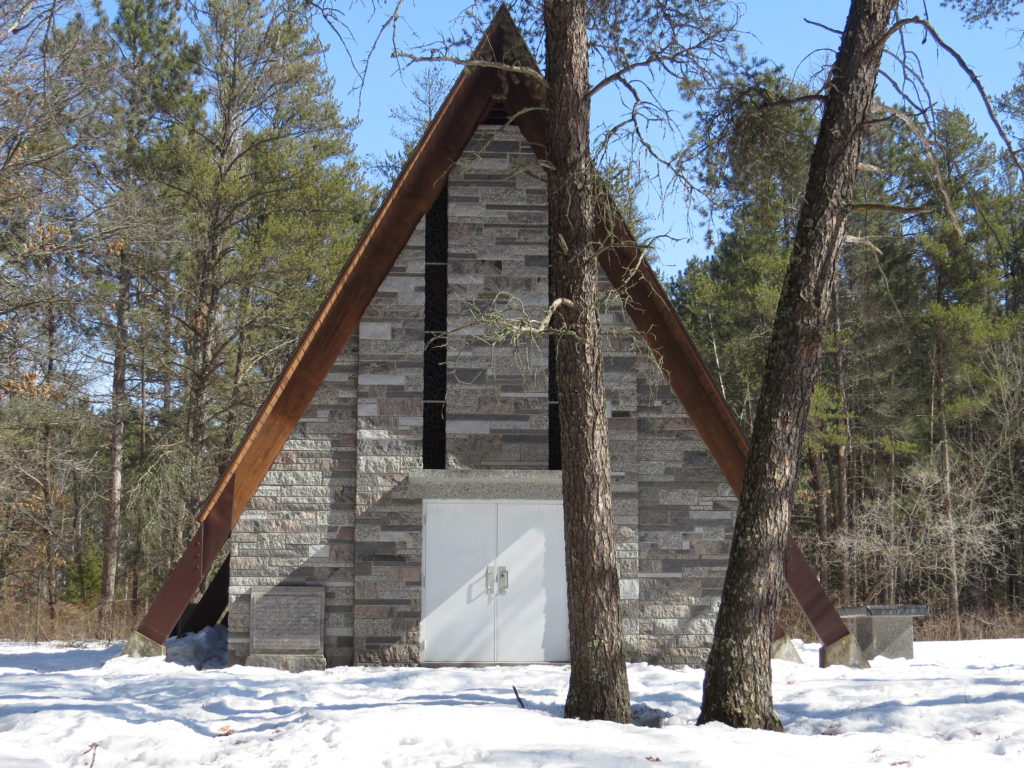
…so I was surprised when we suddenly saw a stone chapel in a clearing! The Father Pierz Chapel, named after the first Catholic missionary of the area, is now in its third or fourth iteration from the log structure that was his first church.
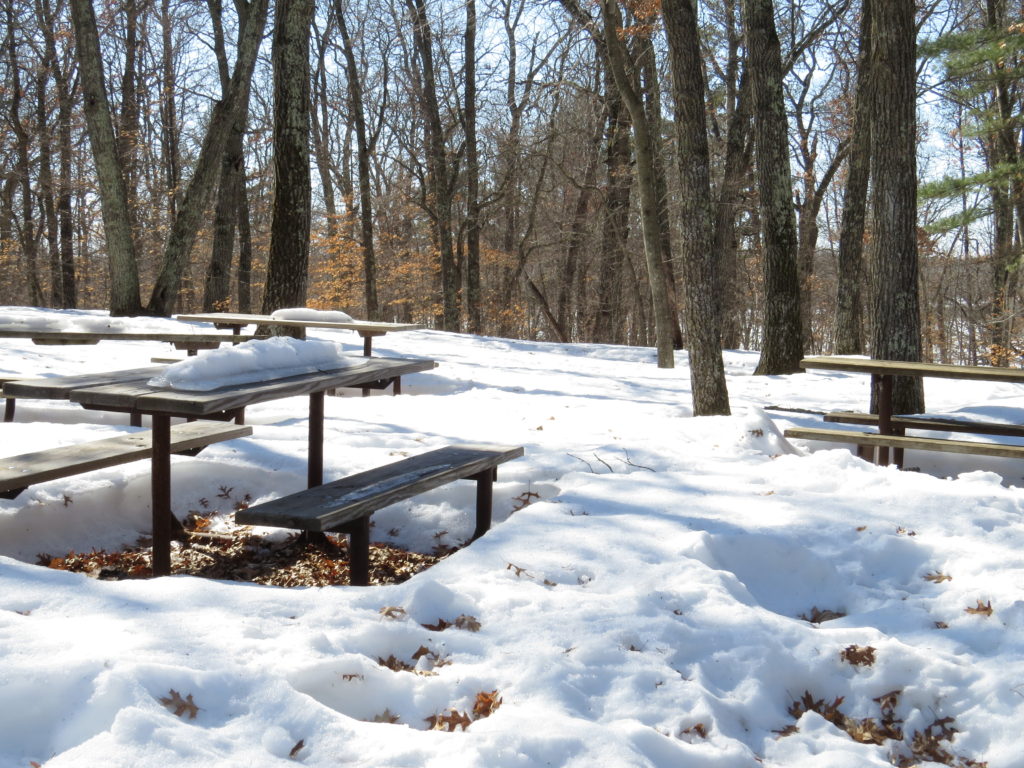
For our late lunch, we sidled into the snow-enveloped picnic table, careful not to slide on the ice beneath our feet, and munched our veggies, nuts, and fruit. It had been a good day.
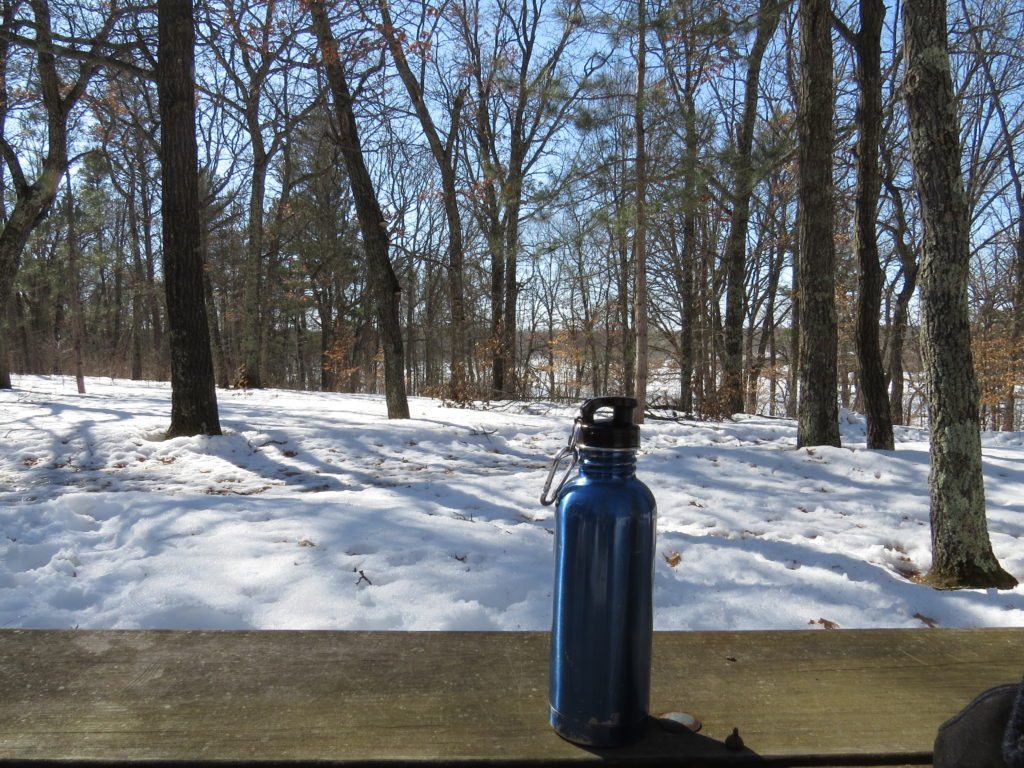
For over two hours we had hiked the woods without seeing anyone else. Thoughts of the burgeoning Covid 19 virus and its wake of disruption and destruction evaporated from our minds. There is a whole world beyond disease, the stock market, panic hoarding, and anxiety that waits for us to explore. Nature offers us a calm and quiet place to rest our fears and jitters—seek it out. This, as in any other time, is when a confluence of knowledge (both past and present) and compassion can create an island of security. Go boldly with those virtues. Nourish yourself. Say a prayer. Walk the walk. Mission accomplished.