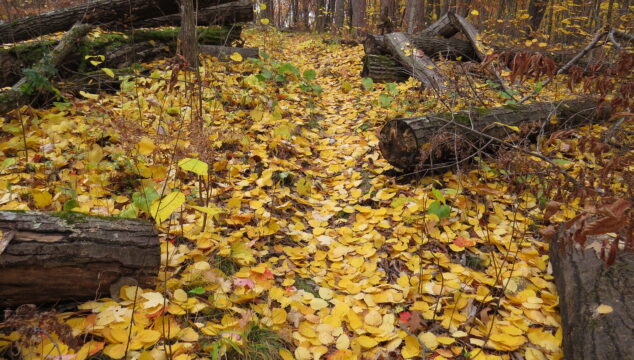
Come walk with me in the peak Autumn beauty of the Northwoods. To say that I love this time of year is an understatement. Most everyone can appreciate the colorful falling leaves---it reveals the 'true self' of a tree when its leaves are no longer producing chlorophyll. Their true colors are revealed, and there is something simple … [Read More...]
Archives for September 2017
Shifting Gears
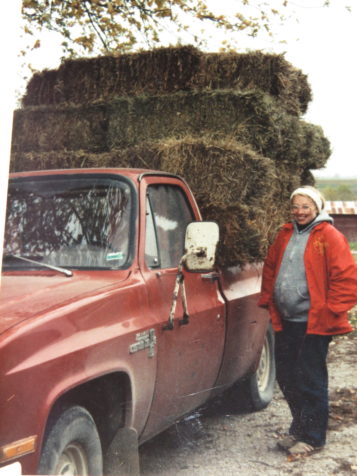
We were still newlyweds when Chris taught me to drive a vehicle with a manual transmission. We had just bought a used 1981 Chevy C-10 1/2 ton pick-up truck. It was a bold red color—the only choice for a truck, according to Chris. The single cab and long bed (the standard back then) looked sleek and utilitarian and housed a ‘three on the tree’—a manual three-speed shifter on the steering wheel column! He drove us to a way-out-yonder gravel road north of Bates City where no extraneous traffic would interfere with my concentration, and then we switched places. He was a patient, methodical teacher, and I tried to be the good student that had carried me through all my years of schooling. But studying books and operating clutches are two different things! I don’t care to remember how many times I killed the engine before I even got going. There was gear grinding, bucking action, nervous laughter, and many “I’m sorrys” when I thought I was wrecking it. Trying to get the hand-foot timing down—letting off the gas, pushing in the clutch, moving the gear shift to the right position, then letting out the clutch slowly and giving it gas—was hard and frustrating. And how do you even get braking in there, too?
Fall is a time for shifting gears—luckily Mother Nature has done it more times than we know and does it smoothly and seamlessly. The growing, producing season is in decline; the fruits of that season are gathered or hanging heavily on the vine, ready for harvest. Internal systems in trees take their cues from the external world—length of daylight and temperature—to stop production of chlorophyll, which unmasks the carotenoids and anthocyanins that give leaves their fall colors and eventually causes the leaves to drop off.
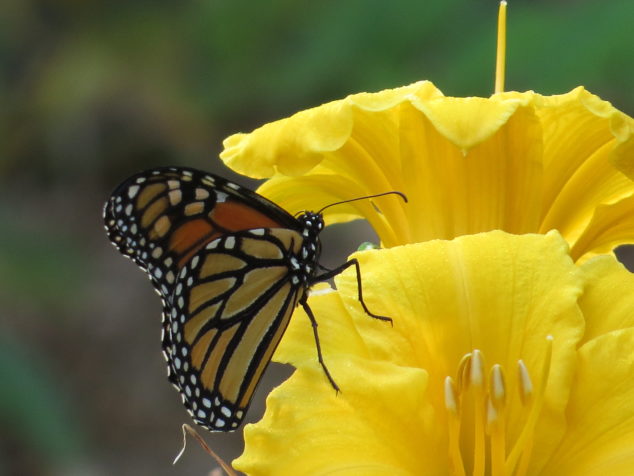
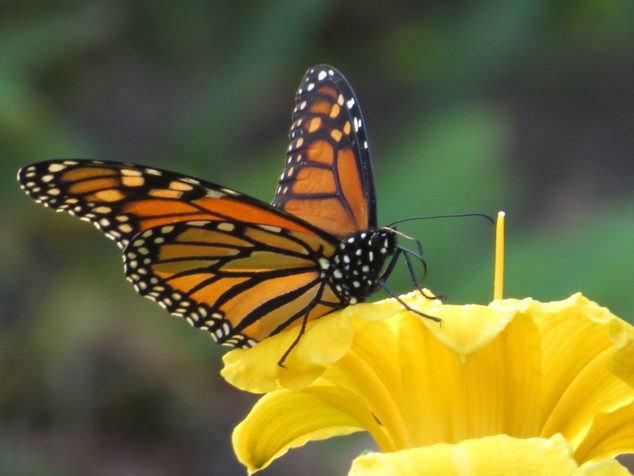
Fall flowers provide needed nectar to insects that may be migrating, hibernating, or laying eggs for the last cycle before winter. One last hurrah of the repeat bloomer Stella D’Oro Lily entices a Monarch butterfly to linger and feed.
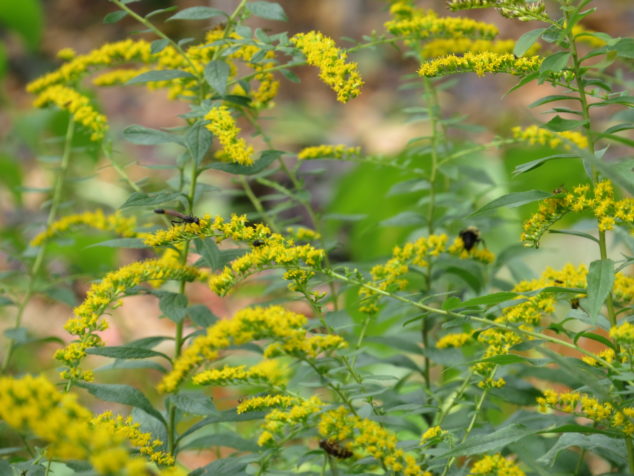
The beautiful ‘Fireworks’ Goldenrod attracts bees and wasps of all kinds.
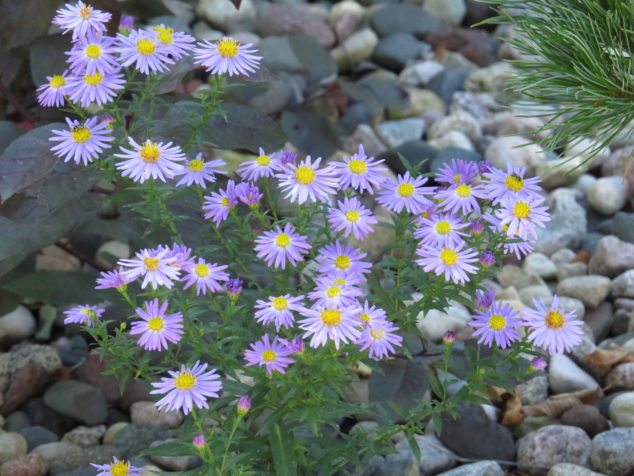
Showy purple Asters bloom vibrantly as one of the late season stars of the perennial world.
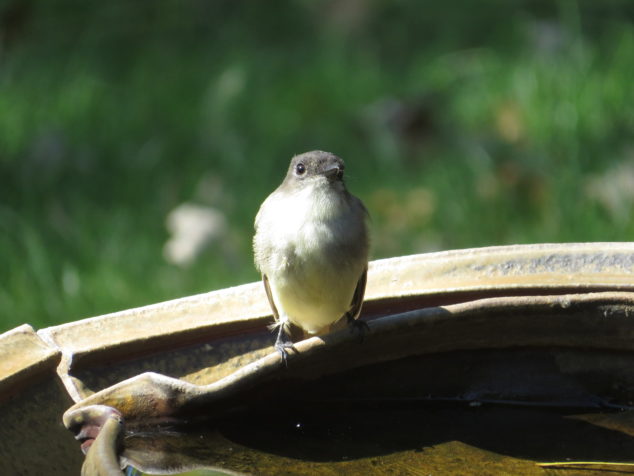
A shift happens with the bird population. The summer birds have mostly migrated away—we no longer see the graceful swoops of the bluebirds or hear the incessant chatter of the house wrens. It is rather quiet on the bird front, though we heard a flock of geese just this morning. A quiet little guy visited the bird bath recently and seemed to be wondering where everybody else was also!
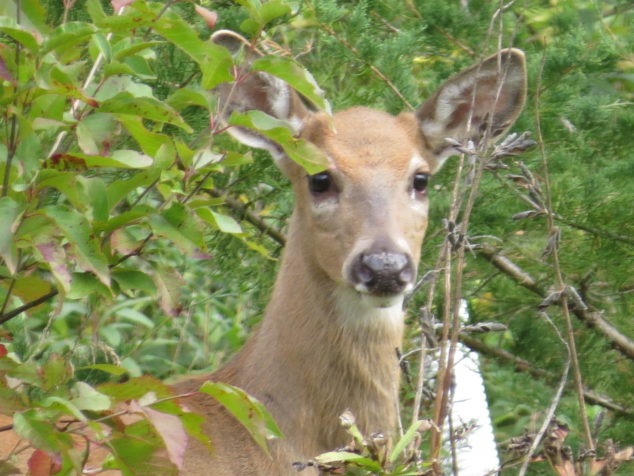
Spring fawns are losing their spots to a winter coat and are almost as big as their mothers. They are the reason we must be so diligent in guarding young trees and shrubs.
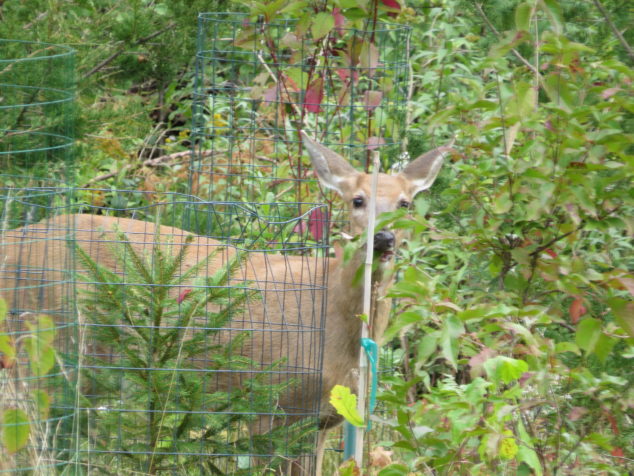
The male spotted fawn shifts to a ‘button buck’ as the pedicels form into small hair-covered bumps at 4-5 months of age that will grow into antlers next April or May.
With the patient tutelage of Chris and lots of practice, shifting gears with a manual transmission was soon second nature to me. The old ’81 Chevy was a stalwart worker for us for many years.
Fall not only shifts gears for plants and animals, but for us also. Some of us harvest and preserve food for winter. We start craving hot soups, pumpkin anything, and apple pie. We slowly and effortlessly morph from outside evening activities to reading or tv watching. Daylight and temperature influence our internal systems and our external choices, showing that we are an integral part of Nature that is often overlooked. Yet we also have a huge cortical brain that can override the more animal aspects of our existence. We can choose to shift gears! We can choose to migrate to a new place, choose to live in the way-out-yonder quietness or the busy bee metropolis. We can choose to be bold, choose our schooling, linger in darkness or seamlessly let our Light shine.
Checking Our (River) Bank Statements
One of the greatest lessons children can teach us is to hold two very divergent ideas in our mind and hearts at the same time. It may just be a matter of days after their birth before we are holding the most precious thing we have ever seen at arms length while contemplating the extreme mess of diaper, clothes, and blankets that needs to be cleaned up. Or there is non-stop crying that wears on our sleep-weary ears and nerves from the perfectly beautiful baby we brought home.
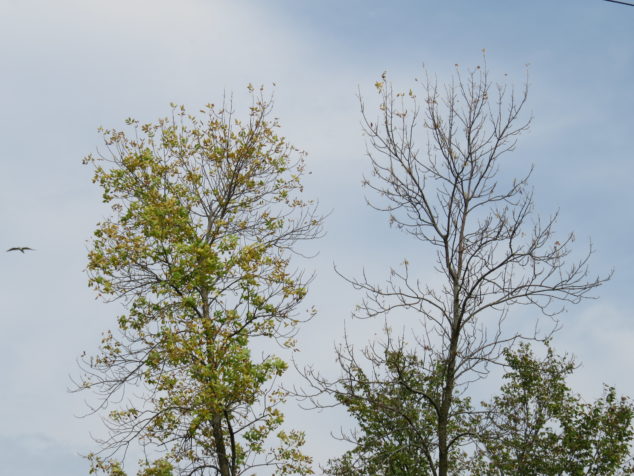
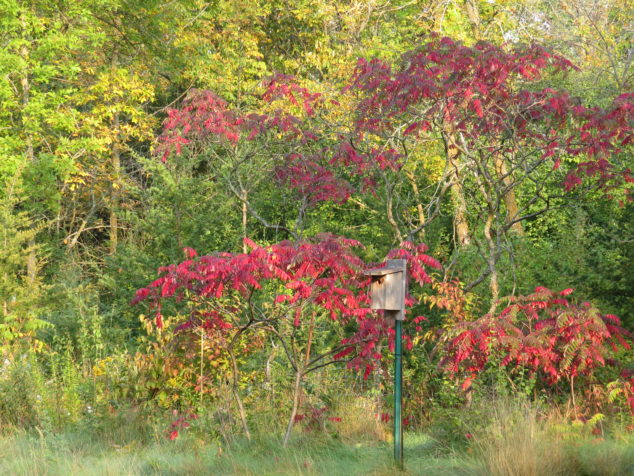
This past week was hot and muggy with uncomfortable nights and air quality alerts that tightened my airways with ozone. Summer’s bad qualities. But it looked like Fall. The Ash trees were mostly all yellow and dropping leaves. The Sumac trees had turned showstopping crimson and scarlet. The Linden trees were quickly turning lemon-colored with a circular blanket of leaves covering the green grass underneath them. So is it Fall or Summer?
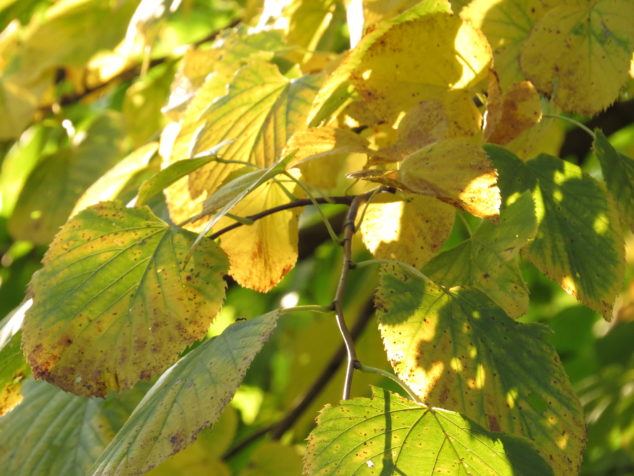
Our neighbor’s Buckeye trees glowed golden with leaves and spiny seed capsules that encase the ‘eyed’ dark brown seed.
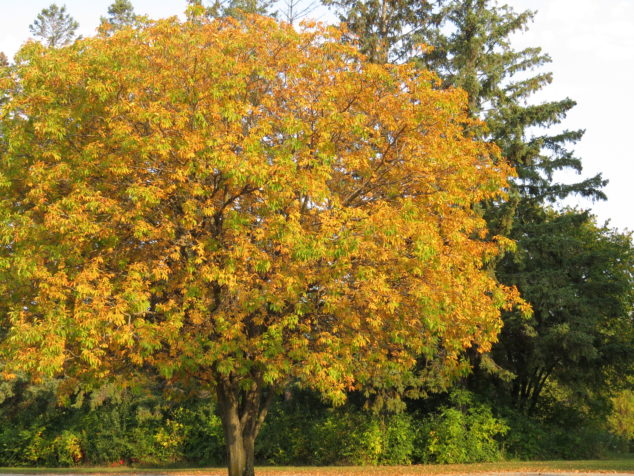
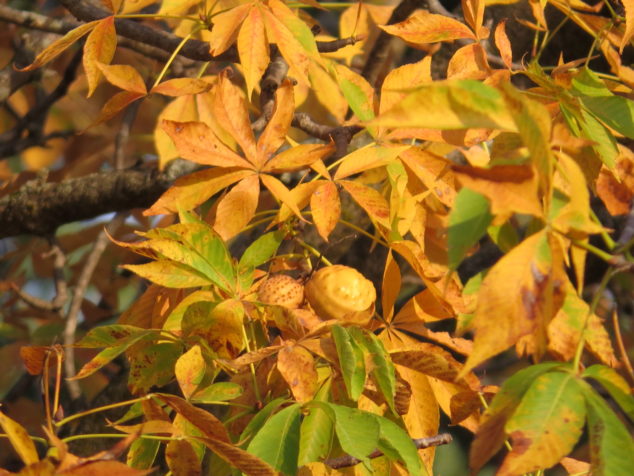
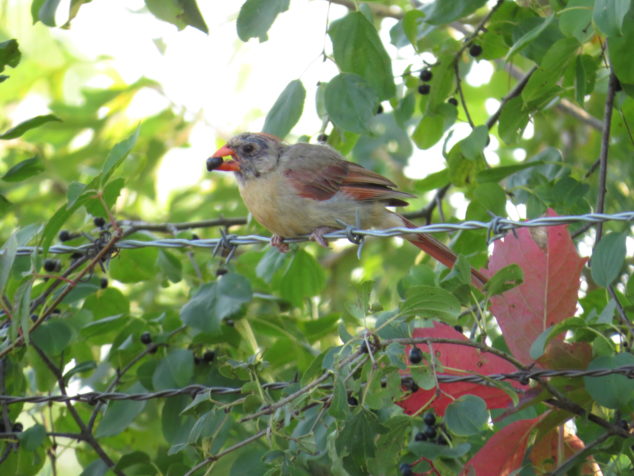
Fall harvesting by the birds has begun. A juvenile Cardinal plucked a seed from a nearby tree—unfortunately it was a seed from the dreadful Buckthorn! Is Buckthorn good for food or a worthless tree?
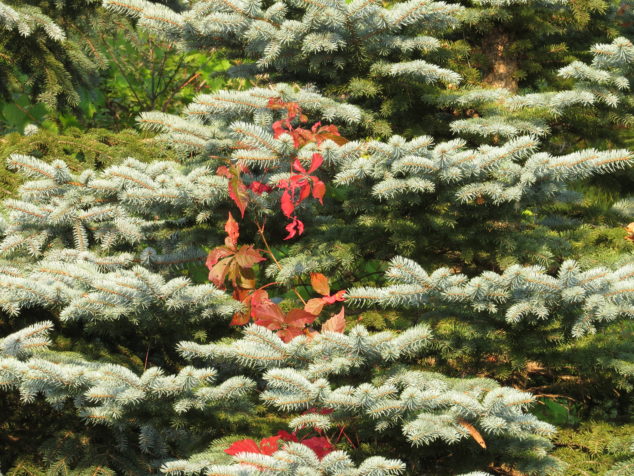
Virginia Creeper vines are turning red, going from camouflage to conspicuous.
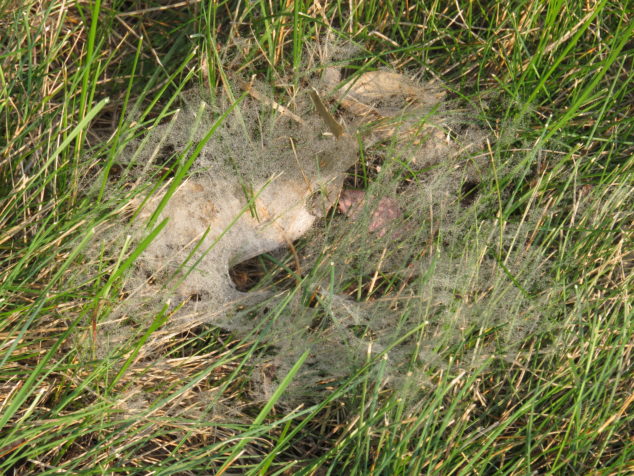
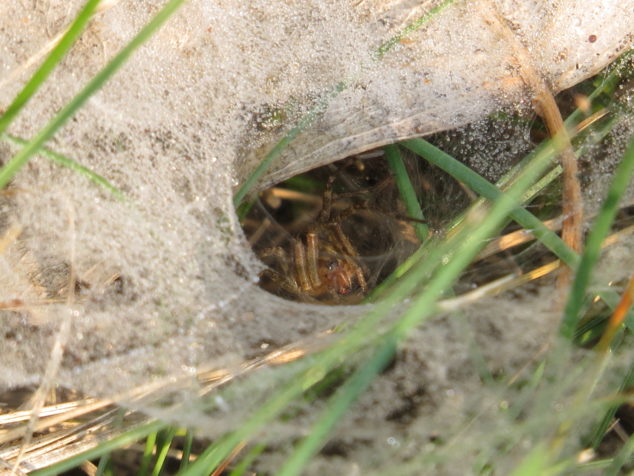
Also conspicuous in the morning dew was a funnel weaver spider’s sheet web. Most likely a grass spider, she hid herself in the entrance of the funnel to wait for a tasty insect to stumble upon her web. Are spiders terrible pests or architectural geniuses?
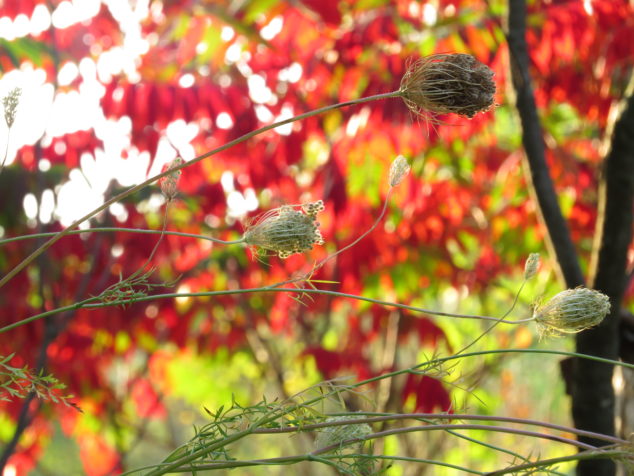
Drying seeds of Queen Anne’s Lace leaned over against the background of fall-colored Sumac.
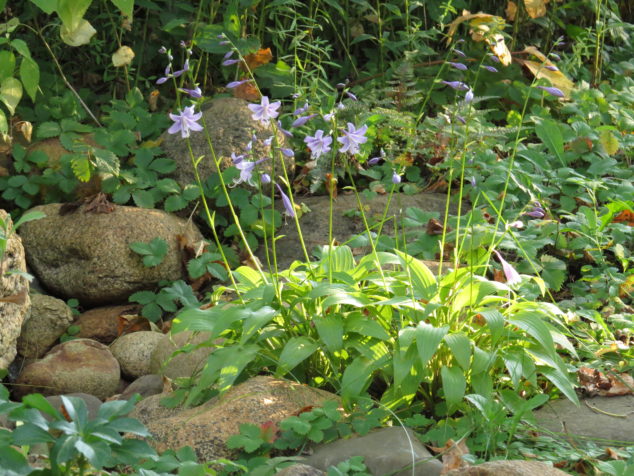
The smallest Hostas are just now blooming, fresh and summer-like…
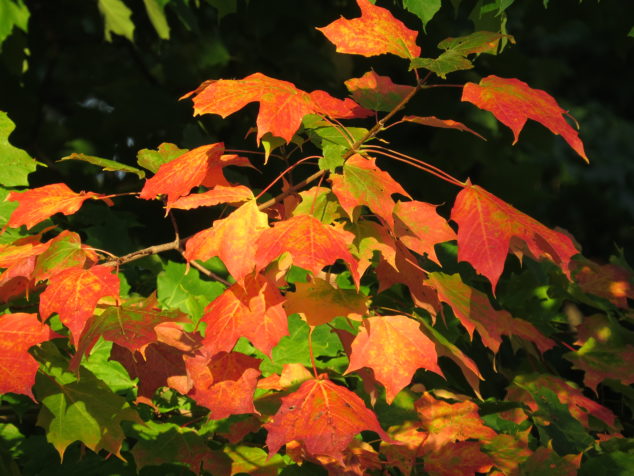
…while the sun-kissed Maple trees are beginning to show their colors.
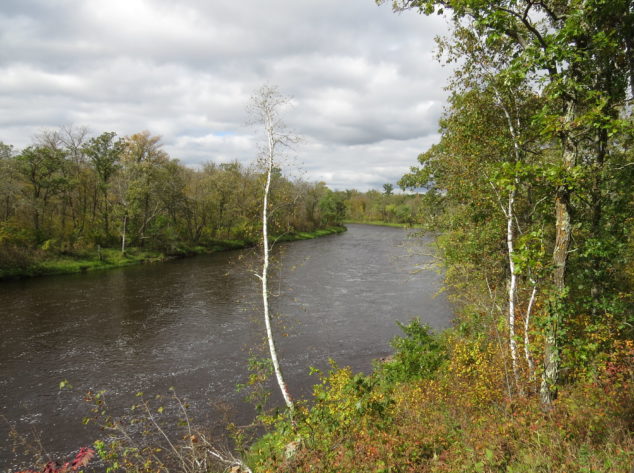
We are a society based on labeling. The calendar says it is still Summer and will be Fall on Friday; the meteorologists say it was Fall on September 1st. If we had no way of orderly keeping track of days, what would it be called? Perhaps it would not be named at all. Often labeling comes with black and white thinking, with opposite and extreme judgments—good or bad, right or wrong, all or nothing. We run into a web of tangled trouble when we try to determine who has the ‘right’ to decide what is right or wrong. Does the person who is deathly afraid of spiders get to determine a spider’s worth or does an entomologist? Does a person who is trying to eradicate Buckthorn from his property have the right to determine its value or does the person who loves it for a privacy hedge? I believe black and white thinking are like two banks of a river, and the river is the gray area. We can be the sturdy boats with thick ropes and strong oars and sails that navigate the River of Life. At times it is imperative for us to tie up to one of the two banks—for order in a society or for taking care of our personal space. But most of the time we are moving through life on the gray River, and we must hold two very divergent ideas in our thoughts and hearts with compassion. Our child who just made a huge mess is our beloved. The dreadful Buckthorn provides food for the birds. The scary spider or bat eats many destructive insects, and on and on it goes. Many people live on one of the two banks, like I used to—it is familiar and safe there, but Life passes by. We call out with disdain or hope to the people on the River—“We know the answer!” And while the River at times can be dangerous and fast-moving or stagnant and stale, most of the time it is life-giving, refreshing, cleansing, and invigorating. Through rough waters and smooth sailing, may we navigate well, anticipate the rocks and snags, learn what we need to learn, look to both horizons, and enjoy the unexpected treasures around the bend.
Butterfly Wings and Cowgirl Dreams
I have a printed meme on my refrigerator that says, ” Your time as a caterpillar has expired. Your wings are ready.” It has a photo of a horse on it with wise-looking eyes, a star on her forehead, and alert ears. I want to wrap my arms around her neck and smell the sweet goodness that only a horse lover so deeply appreciates. The quote is referenced to Unknown; the meme was posted by Cowgirl Dreams and was passed on to me by my sister. I look at it every day.
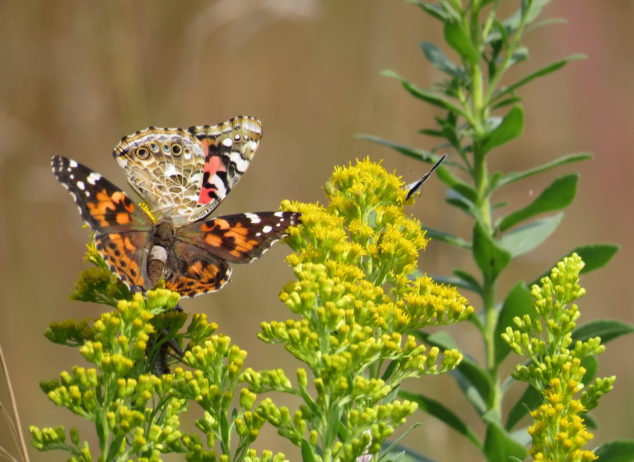
Last weekend when we were picnicking at Big Stone Lake State Park to celebrate my Mom’s birthday, Painted Lady butterflies filled the air and lit on wildflowers of all kinds to gather nectar. When I stood still, they landed on me. Painted Lady butterflies migrate in large numbers, so this ‘gathering up’ time occurs in late August into September. They migrate to southwestern United States and northern Mexico, traveling 100 miles a day and continuing to reproduce throughout their migration.
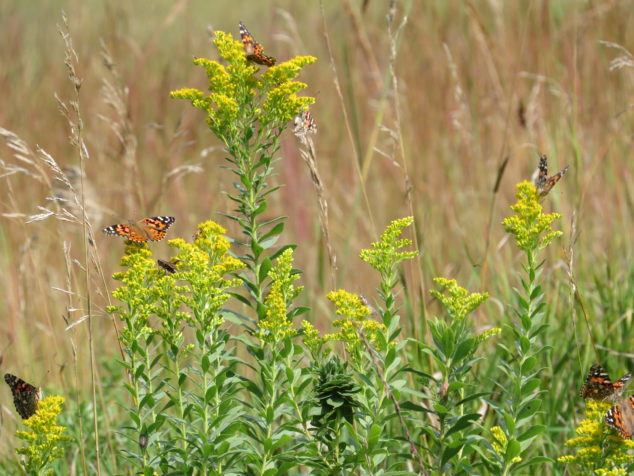
The Painted Lady is the most widely distributed butterfly in the world. They lay their eggs on asters, thistles, burdock, and legumes. (Vanessa cardui means ‘butterfly of thistle.’) The eggs are pale green and the size of a pin head.
In 3-5 days, the tiny caterpillar hatches from the egg, constantly eats the host plant, and grows quickly. The caterpillar literally grows out of its skin four times before being fully grown (each phase between molts is called an instar.) The yellowish-green and black caterpillar makes a silk nest on the host plant to protect itself from predators.
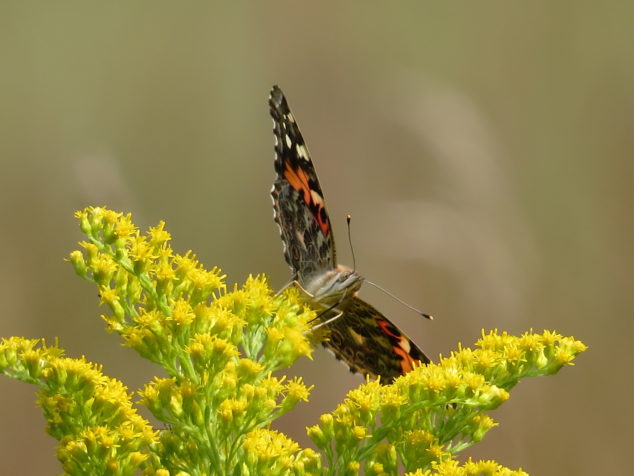
When fully grown, in 5-10 days, the caterpillar attaches itself with a silk button to the underside of a leaf. Its skin splits open to reveal a dull, brown case and becomes a pupa or chrysalis, and metamorphosis begins.
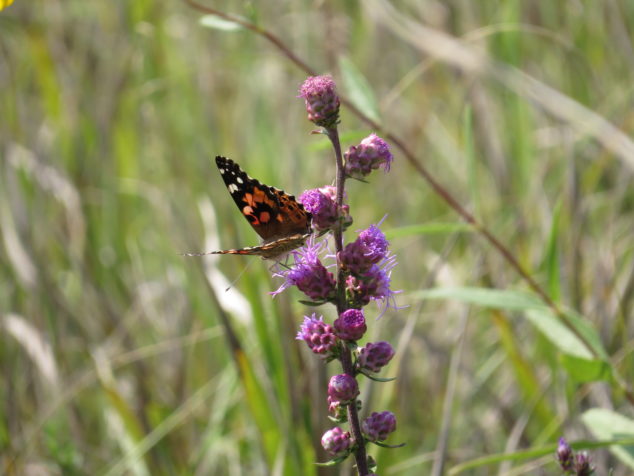
In the 7-10 days of metamorphosis, the caterpillar breaks down and becomes liquid and re-forms into a butterfly. The chrysalis splits open, and the Painted Lady butterfly emerges with crumpled wings that take a few hours to dry and straighten out. Then she/he flies away to drink nectar and mate to begin the cycle all over again.
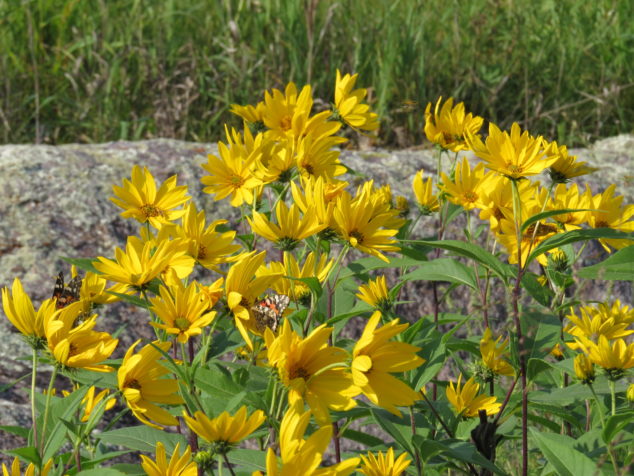
And what does that have to do with horses and cowgirls and all of us? Well, I think everyone wants to be a butterfly. Their bright colors attract attention, their delicate, velvety wings are marvels of flight and design, and they make even the most beautiful flowers more beautiful by their presence. But nobody gets to be a butterfly without the other steps. The tiny egg of an idea—the ‘imagineering’ of becoming a barrel racer, a nurse, or a composer—begins the process. Then comes the ingesting of information and the growth of practice—again and again and again. When maturation occurs, there is a period of stillness, a breaking down of the old to rebuild the new, the metamorphosis. Like Chris always says, “You can only get ready for so long; pretty soon you have to leave.” Your time as a caterpillar has expired. Your wings are ready. But in our all or nothing thinking, we believe we, as a whole person, are either a caterpillar or a butterfly, and if we’re not yet a butterfly, then we are somehow lacking, not good enough. I propose that we are all—at any given time—a compilation of all the stages in different areas of our lives. I am an aging tattered-winged butterfly of a Mom; I am a voracious student caterpillar in learning about trauma and attachment; I am a pupa in my spiritual life—breaking down old ideas and rebuilding new ones, and I have some tiny green eggs of ideas that I want to hatch out and grow. Cowgirl dreams…anybody dreams…dreams we can wrap our arms around. We are marvels of design, bright with the colors of creativity, and we can each make the world a more beautiful place by our presence.
My Mom, the Adventurer
My Mom is an adventurer. I’m not sure when I realized it. It was not when we were kids and she skirted around a barricade on a highway because she knew she wanted to get over to that other side. It wasn’t when she drove half way across the country by herself with three kids or when she and my Dad literally built our house and barn. I didn’t think it was out of the ordinary that she raised cattle by herself after the divorce. I did start to get an inkling when she went to India for a month, and I thought to myself that I would never do that! The older I got, the more adventurous my young Mom seemed to be! She went to France, drove to Montana, visited the Northwest, vacationed with us on a houseboat in Canada, hiked with her newlywed granddaughter in the Texas Hill country, and picked wild blueberries with us in the Northwoods even after we saw evidence of a bear. In just the last six months she has visited Minnesota three times, tent-camped for a week-long trip to Wyoming, and oh, did I mention she’s refurbishing an old camper?
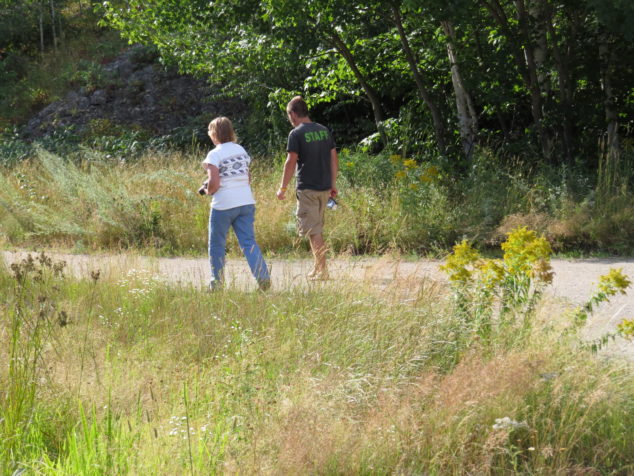
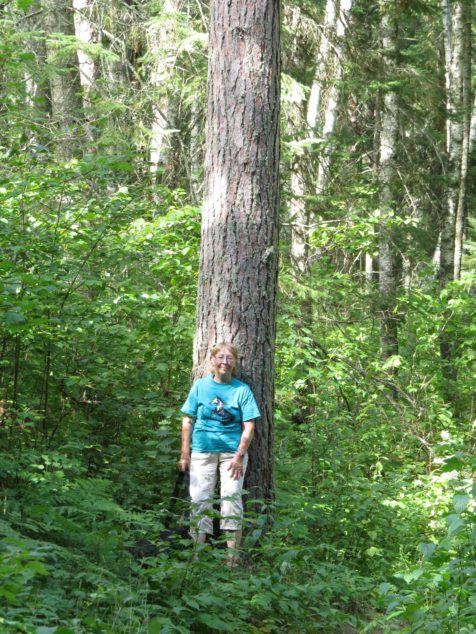
My Mom met us at Big Stone Lake State Park yesterday, where South Dakota meets Minnesota—at the Big Stone and the Big Lake.
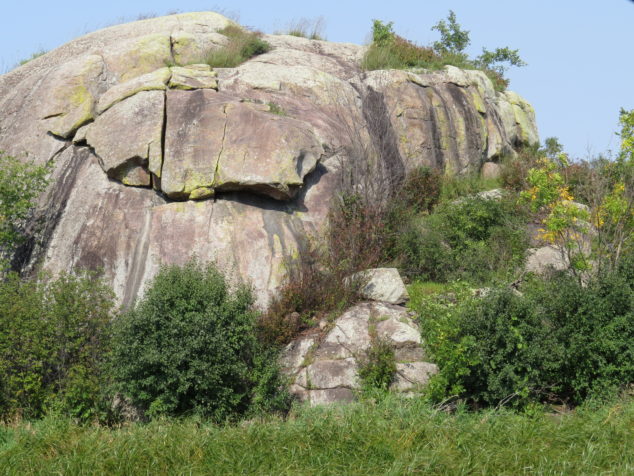
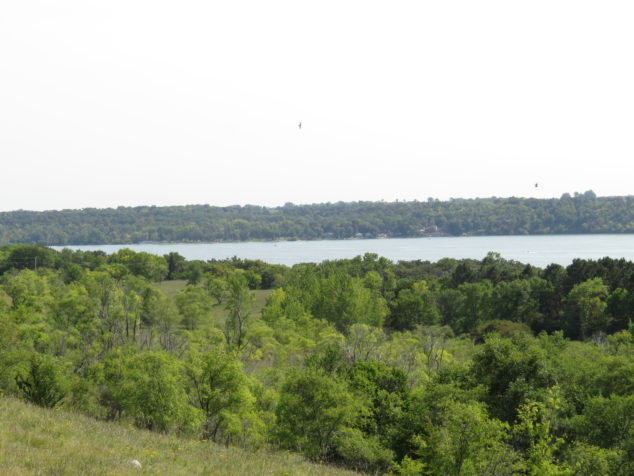
We met to celebrate my Mom and her eight decades of life. We picnicked, ate cake, hiked a little, drove through Big Stone National Wildlife Refuge, and took photos. It was a good day. My Mom and I share a love for Nature, and I am ever so grateful for that. I don’t think I’ll ever be as adventurous as my Mom—I think I’m too cautious and worry too much (that long plane ride over the ocean makes me shudder.) But I also realize that we can all be adventurous in our own way—my friend Lynda is a spiritual adventurer, graduate school is an intellectual adventure for our daughter Anna, climbing mountains and moving to a new state are two kinds of adventures for my friend Michaela, and so on down the list of family and friends. So here’s to my Mom, the adventurer, and to all you other adventurers out there, no matter what your horizons!