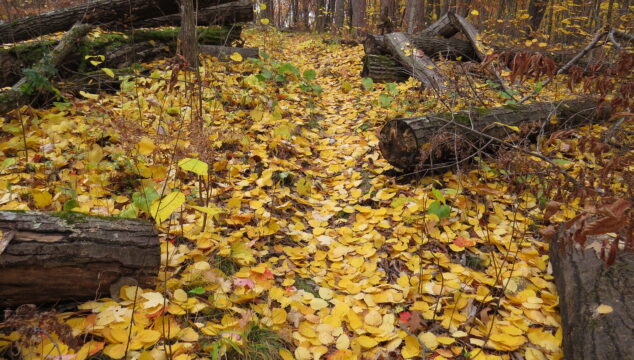
Come walk with me in the peak Autumn beauty of the Northwoods. To say that I love this time of year is an understatement. Most everyone can appreciate the colorful falling leaves---it reveals the 'true self' of a tree when its leaves are no longer producing chlorophyll. Their true colors are revealed, and there is something simple … [Read More...]
Archives for June 2017
Imminent Failure
Warnings are posted for a reason, but sometimes the message is rather cryptic, and one is left wondering the exact meaning of the short notification. I guess it helps when one knows the language and context—which I don’t when it comes to computer talk. “Smart hard drive detects imminent failure.” It doesn’t sound good, no matter the language and context. Imminent and failure are two words that don’t belong together if a person wants to feel good about what’s to come.
What I do feel good about is the week we spent with our oldest daughter Emily and her husband Shawn—no computer needed! It had been three years since they were here for a visit, a year and a half since we saw them in Texas—much too long for a mother not to be in the presence of her child. We went hiking at Charles A. Lindbergh State Park one day this week in Little Falls, Minnesota—570 acres that included the boyhood home of the famous aviator Charles A. Lindbergh, Jr. who completed the first solo nonstop trans-Atlantic flight on May 21, 1927. The family donated the land for a park in 1931 in memory of Charles A. Lindbergh, Sr. who was a lawyer and US Congressman.
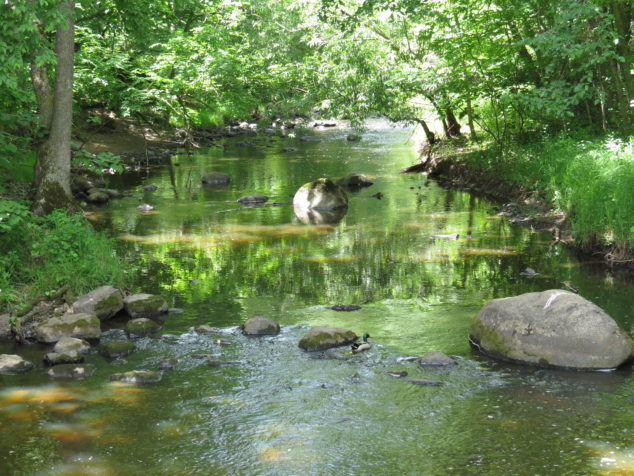
Pike Creek runs through the park and meets up with the Mississippi River. Charles Lindbergh, Jr. spent most of his time as a youngster outdoors exploring the woods, creek, and River. He collected rocks, butterflies, feathers, and other natural objects.
“When I was a child on our Minnesota farm,” Linbergh wrote, ” I spent hours lying on my back in high timothy and redtop…How wonderful it would be, I thought, if I had an airplane…I would ride on the wind and be part of the sky.”
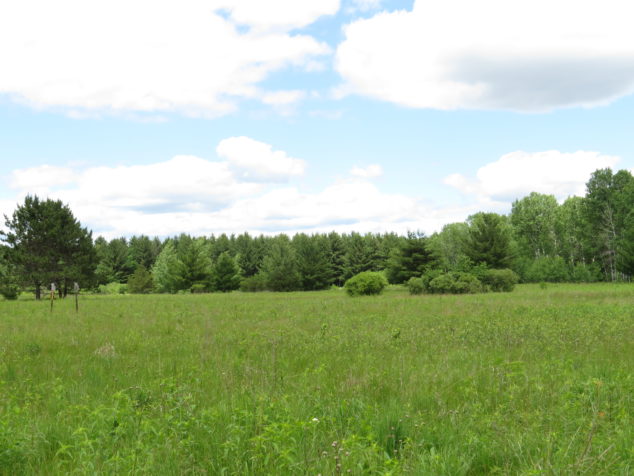
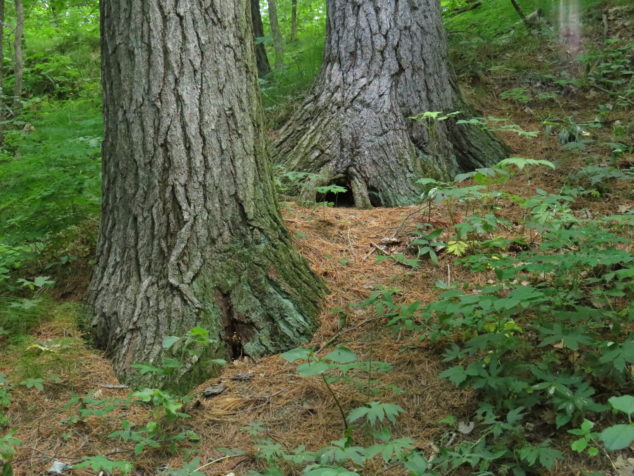
The forested area of the park has many old white and red pines. Imminent failure struck this 280-year-old white pine when it was hit by lightning in 1986 and died the following year.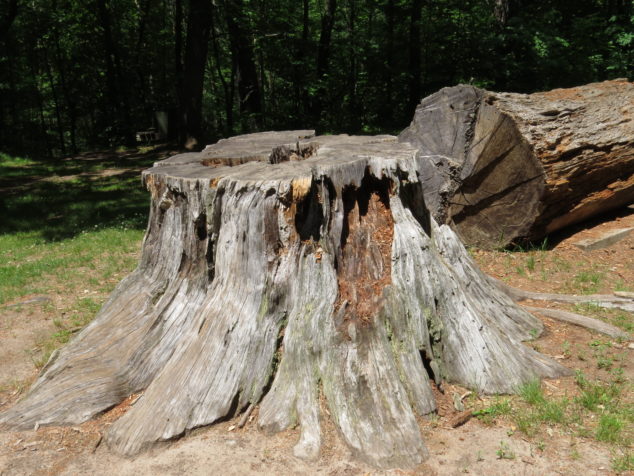
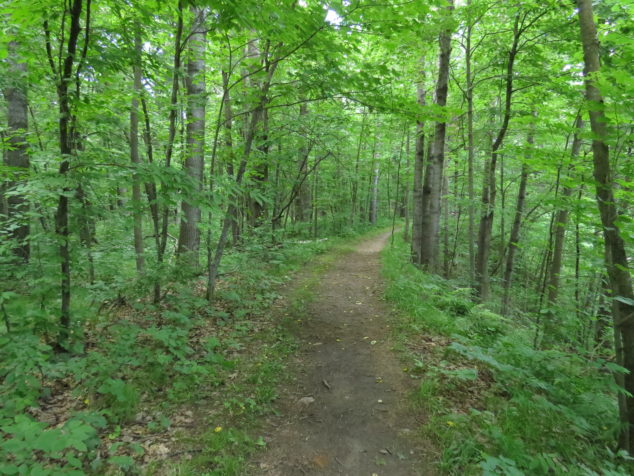
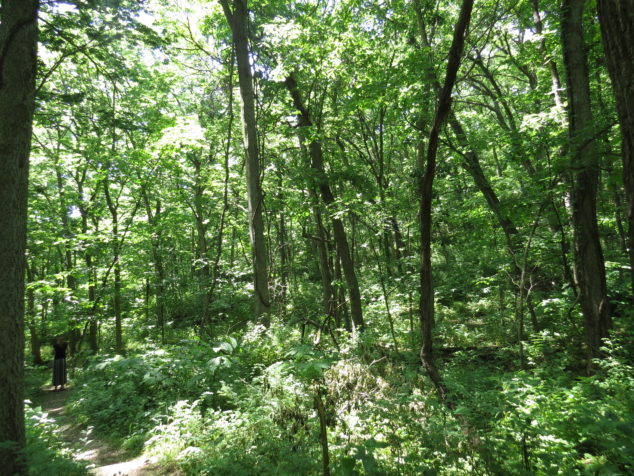
Have you heard of Forest Bathing? Shinrin-yoku or ‘taking in the forest atmosphere’ originated in Japan in the 1980’s for its health benefits. Studies have confirmed that being in the presence of trees lowers cortisol levels, lowers pulse rate and blood pressure, improves immune system function, and increases overall feelings of well-being.
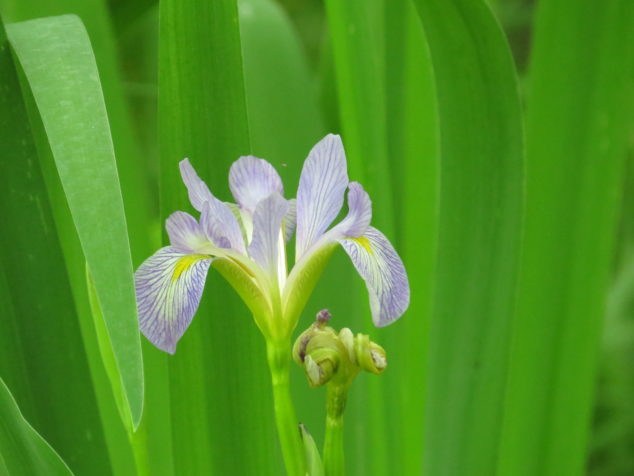
The beauty of flowers like this blue flag iris…
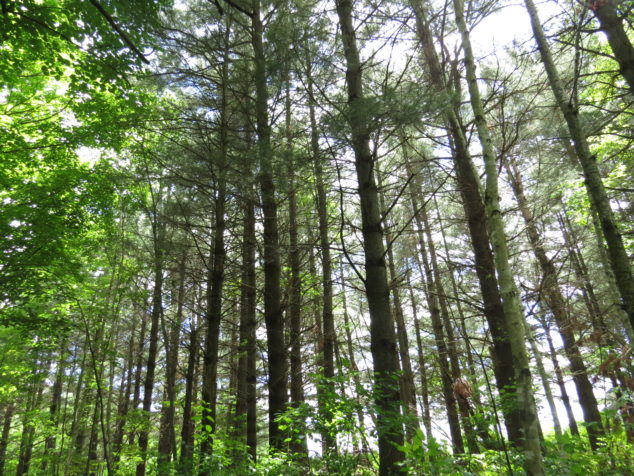
the calming smell of a pine forest…
the intricate essence and relationship of flowers and insects…
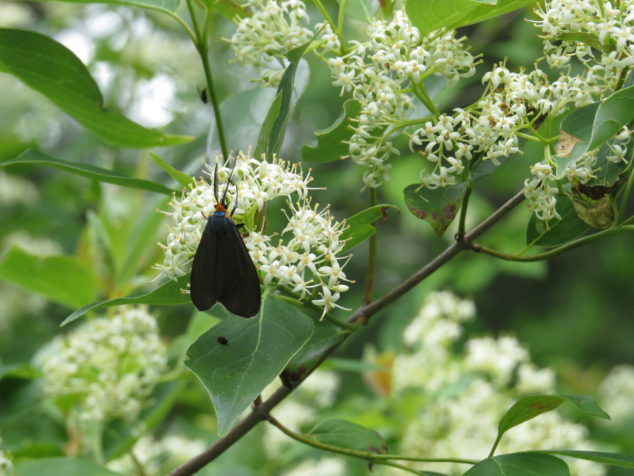
and the unassuming presence of old, stately trees all contribute to the forest atmosphere that calms our bodies and improves our well-being.
At the hydroelectric dam on the Mississippi River not far upstream from where Pike Creek empties into it, there are warning signs and barriers to keep people from imminent danger.

Torrents of rushing, splashing water tumbled from the spillways, hitting rocks, causing chaos, stress, and danger. It’s not hard to interpret these warning signs to stay away when the destructive power of the water is literally hitting you in the face.

I am sure there were many times in Charles Lindbergh’s life when warning signs of imminent failure flashed before his eyes—during his childhood raft-building days floating on the Mississippi, during his barn-storming days, his trans-Atlantic flight, his military flight training and midair collision, Air Mail routes, and combat missions during World War II. Imminent failure also presented itself in 1932 when his 20-month old son was kidnapped from their home, ransomed, and killed. How does one go on after the gruesome loss of a child and years of public attention in the wake of ‘The Crime of the Century?’ What saves us from imminent failure?
Lindbergh and his wife Anne Morrow fled to Europe with their second son in December of 1935—a hiatus from the spotlight and turmoil that had engulfed them after the kidnapping of their son, a time apart from the normal routine of life, a sequestration of the body for the healing of the soul. I’d like to think that his forest days in Minnesota, his riding on the wind and being part of the sky days helped to save him from imminent failure, though his subsequent years of questionable political beliefs and secret double life with three European women and seven children he fathered point to an acting out of destructive wounds. “Life is like a landscape. You live in the midst of it but can describe it only from the vantage point of distance,” wrote Lindbergh. If life is stressing you out, get some distance from it by immersing yourself in a forest, by surrounding yourself with children and loved ones, by exploring trails and collecting memories, and by forgetting about phones, failing hard drives, and imminent failures.
Over the Edge in Love
I remember the electricity I felt when I met Chris—could he be more handsome or sweet? Gosh, he was a good dancer. He talks kindly of his mother (important!) He was humble, interested in this unusual prairie girl, and had a sense of humor I had never experienced that kept me on my toes. I wanted more of him, even as he drove away down 400 miles of interstate highway. What I didn’t know at the time was that I was falling over the edge in love for the first time in my life. There were three other times when I stood, with Chris, on the precipice, staring into the face of a newborn child, and I was swept away, over the edge in love, for no rational reason—when you know you are either in the realm of crazy or the sacred realm of Spirit.
We traveled 400 miles of interstate highway last weekend to celebrate Chris’ brother and sister-in-law and their 50 years of marriage! How does one go from falling over the edge in love to celebrating 50 years together?! I was also fortunate to once again stare into the faces of my first- and second-born and feel the electricity of the all-consuming love parents have for their children, even when they are adults. My spirit sang its song of joy.
The day before the anniversary party, we took to the trails like we had done so many times when the kids were little. We explored Parkville Nature Sanctuary on a blue-sky, hot and humid day. (All relative when coming from Texas and Minnesota to Missouri!)

Most of the 115 acres of the Sanctuary and White Alloe Creek Conservation Area is forested, along with streams and wetlands.
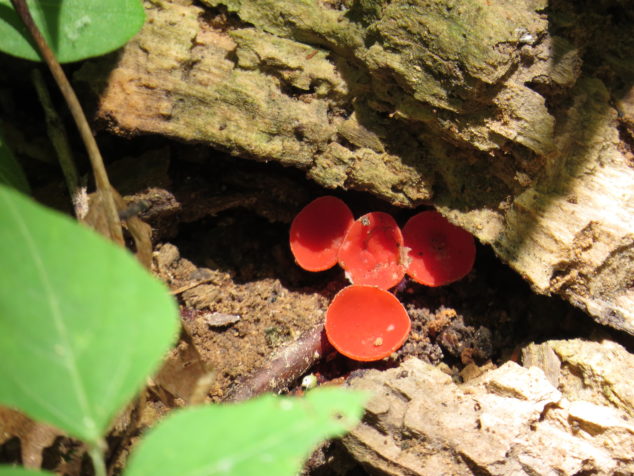
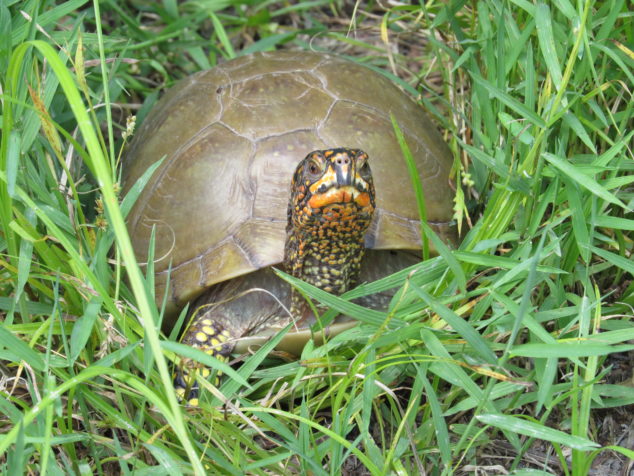
We found some little treasures along the trail—bright red fungi and a wise old turtle.
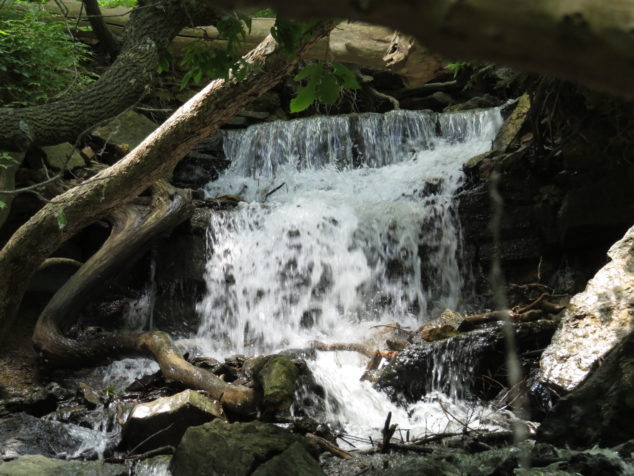
But the main attraction of the Sanctuary was the waterfall. Water cascaded and tumbled over rocks, bubbling with activity in places, then calmly pooling in others.

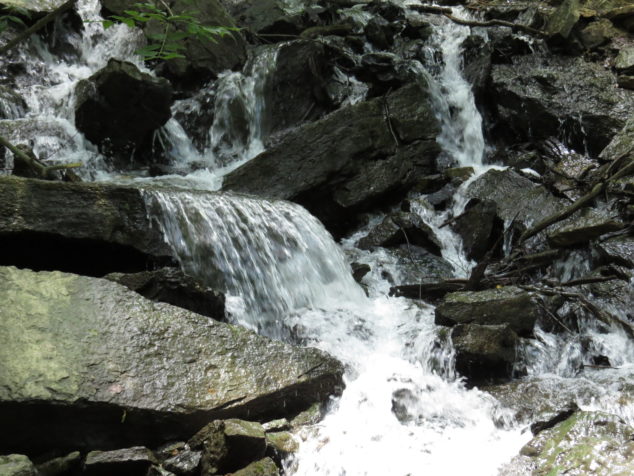
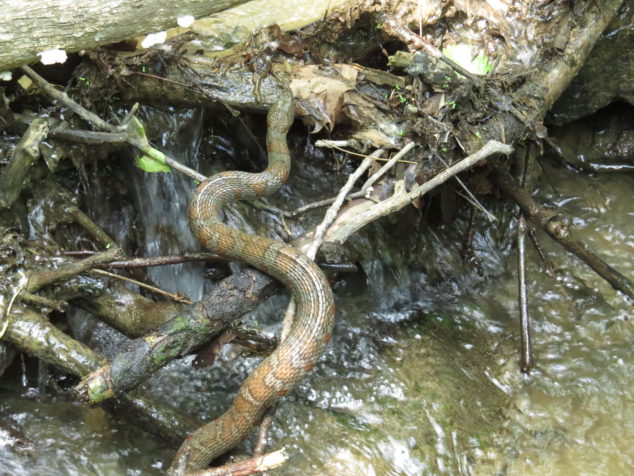
Downstream from the main falls was a bridge where a mom and her kids were watching a couple of Northern Water snakes in the swift current. The female snakes are much larger than the males and both get darker with age. Gestation is 3-5 months with a single litter of 30 live snakes in August to October!
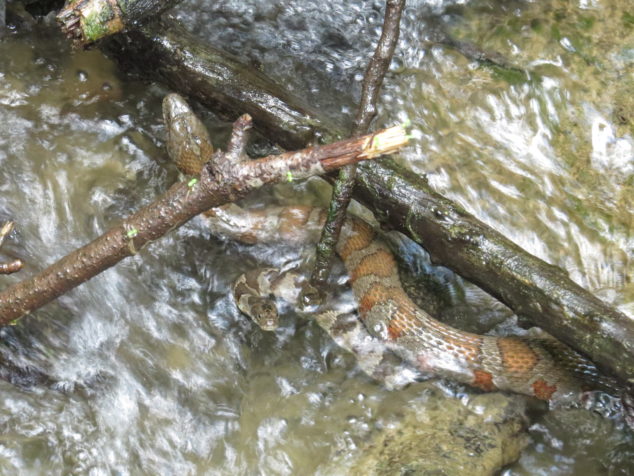
The female climbed back up a small debris dam as the male washed down over more rocks and falls.
Nothing says ‘beware’ or ‘stay away’ like this tree. Honey Locusts have frondy branches with small leaves that turn a brilliant yellow in the fall. The spring flower is strongly scented, and the fruit is a flat pod, 6-8 inches in length, with an edible pulp that encases the seeds. Honey Locusts are hardy, resilient, and fast-growing.
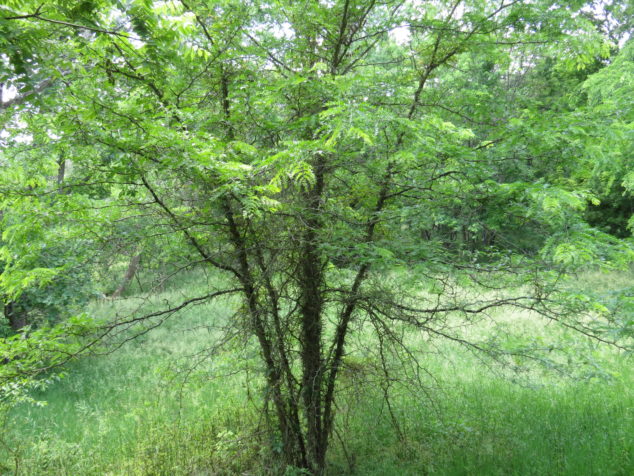
The trunk and branches, however, are covered in huge thorns that negate the positive qualities of these trees. Luckily, cultivated thornless varieties have been established.
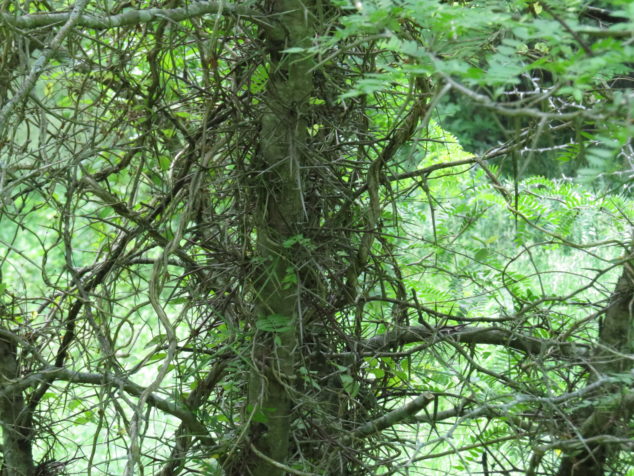
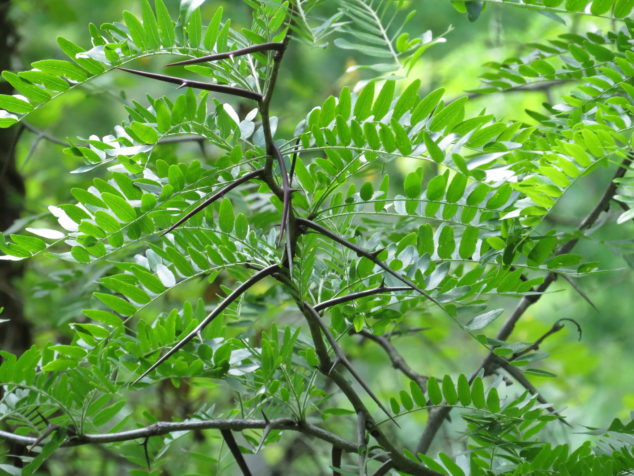
We all stand at the precipice, at the top of the falls, at some points in our lives. The air is electric, and the water is urging us forward. Things look pretty beautiful from our dopamine- and serotonin-saturated brains. It’s easy to fall over the edge in love. At first, falling over the edge is beautiful and effervescent and carefree—until we hit some rocks, and we lose our way. Until we encounter snakes and things that scare us. Until we are tangled up in a mess of thorns that we didn’t ‘see’ until it was too late. So how do we avoid a false positive for happy-ever-after? What gets us through those tough times? What keeps us connected to the things that matter?
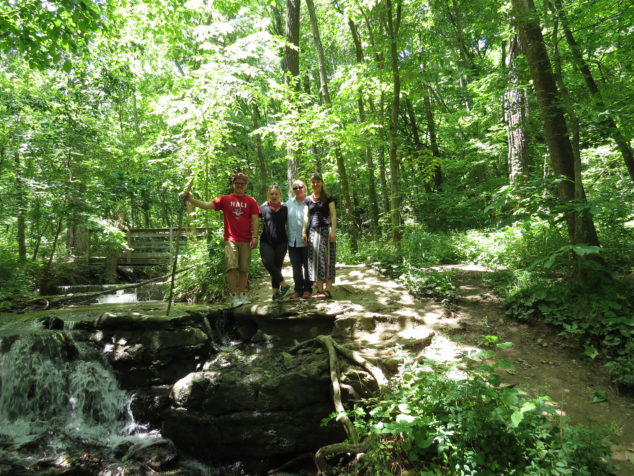
Sanctuary. Walking stick. Bridge. Sanctuary is a sacred or holy place, a place of refuge. It is for protection, peace, growth, faith, and hope—qualities that sustain us over a lifetime. Walking sticks are used to more easily navigate a tough trail, to keep us safer, to help us out. There are many times in the span of 35 or 50 years of marriage when we need something or somebody to help us get through the tough spots. Bridges allow us to move from one side of something to the other side across a divide that may seem impassable. Love is a bridge—the enduring, respectful, committed, treasure-filled type of Love when you know in your heart and soul that you are in the sacred realm of Spirit.
last photo by Chris