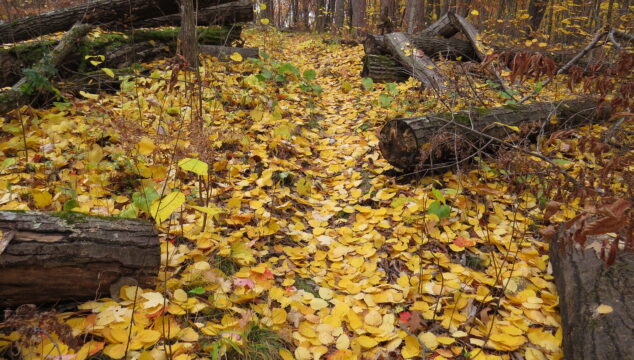
Come walk with me in the peak Autumn beauty of the Northwoods. To say that I love this time of year is an understatement. Most everyone can appreciate the colorful falling leaves---it reveals the 'true self' of a tree when its leaves are no longer producing chlorophyll. Their true colors are revealed, and there is something simple … [Read More...]
Archives for June 2016
Sorrow in the Wind*
I hear the soft wind sighing, in every bush and tree. The sound of my heart crying, when you are far from me.
When we’re apart, my darlin’, there’s sorrow in the wind. When we’re apart my darlin’, sweet sorrow in the wind.
*Sorrow in the Wind, written by American folk singer/songwriter Jean Ritchie, was recorded by Emmylou Harris on her Grammy winning album ‘Blue Kentucky Girl.’ Harmonies by Cheryl and Sharon White, simple guitar picking, and the cries of violin emote the very essence of the song. The word sorrow means distress, misery, and regret associated with loss, grief, disappointment, and sympathy for another’s suffering.
Many of us who have lived with animals know that our mammal friends feel sorrow when a special person or companion is gone from their lives. What about birds? I think we know less about this; however, from watching birds build intricate nests, fiercely protect their eggs and nests, and tirelessly provide food for the tiny young ones, I would guess that in some way, they know the sorrow of loss.
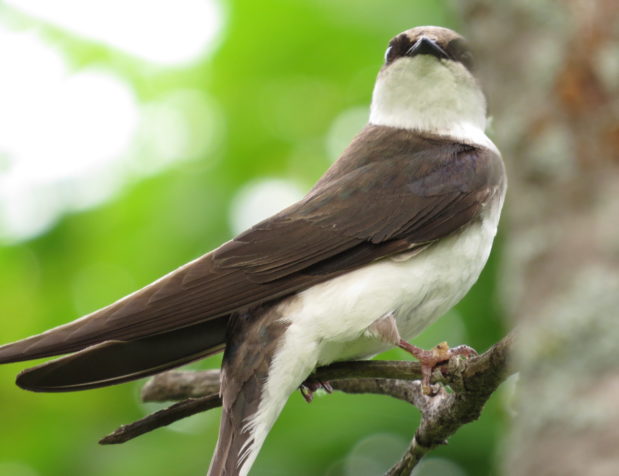
One of our bluebird nesting boxes was occupied by a Tree Swallow. She is a young female, as her plumage is mostly brown and not the iridescent blue and green of a mature bird. She flew from the nest and perched on a near-by tree branch when I took a peek into her house.
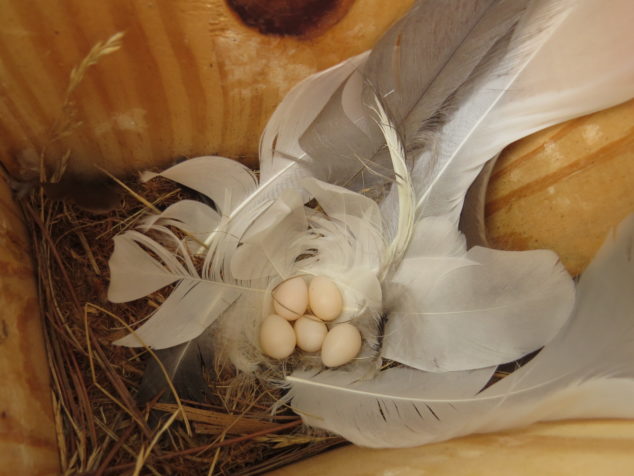
What a surprise when I looked in! The nest was lined with feathers of all sizes–my guess is they were goose and swan feathers from the River and wetland areas not far from our hill. Five blush white eggs nestled in the softness.
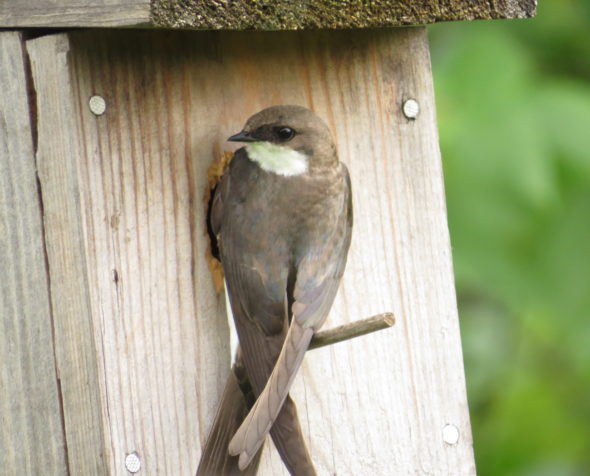
She cautiously returned to her nest when I moved far enough away.
Two days later, the evidence of a raid spilled from the nesting box.
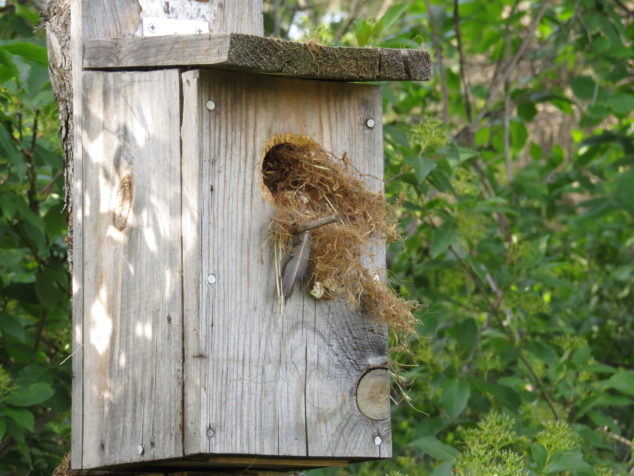
The nest was torn up, broken egg shells were stuck to feathers and grass, and feathers were on the ground. I don’t know who raided her nest or why. But I felt sadness for her. She had carefully crafted her first amazing feather nest and had laid and warmed the beautiful little eggs.
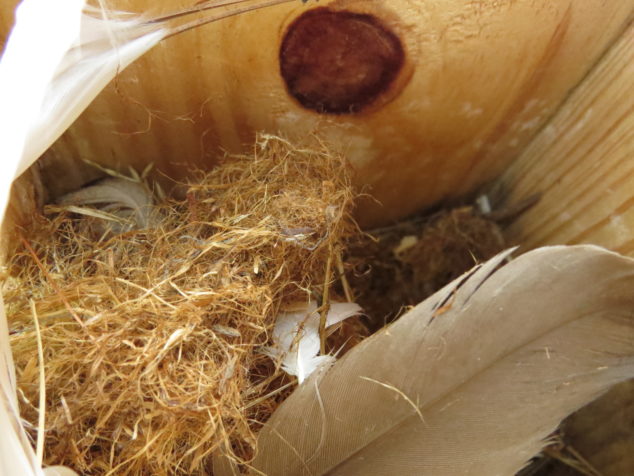
And then suddenly, they were destroyed. Expectation and hope were dashed.
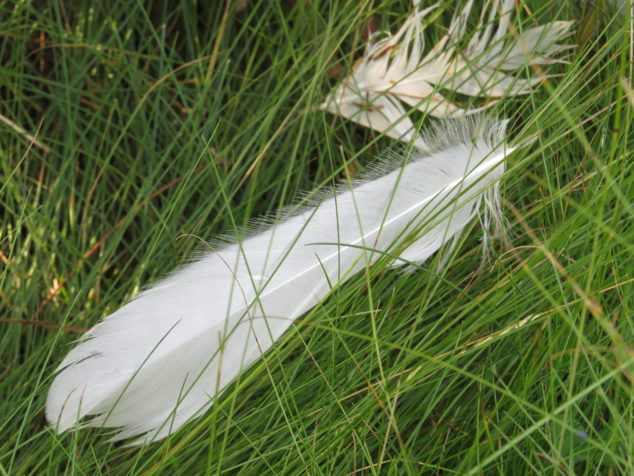
Nature has its ugly side. Perhaps the raider was the red squirrel who had chewed away at the hole of the nesting box earlier in the season. Maybe it was the aggressive House Wren that has since moved into the nesting box. Perhaps the young swallow couldn’t defend herself and her eggs as well as a mature bird. Who knows? Violence in Nature is often related to hunger and food, territory, or mating.
There’s sorrow in the wind in our world, too. The horror of forty-nine dead and many seriously injured people from the Orlando shooting just two weeks ago is still fresh in our minds and hearts. Dashed hopes and expectations. Destroyed lives. Not to mention the children and staff of Sandy Hook, the co-workers of San Bernardino, students and faculty at Virginia Tech, and the thousands of others who were killed at military bases, colleges, places of employment, and homes. And with each person killed there is a rippling circle of distress, loss, fear and grief among the family, friends, co-workers, first responders, and even bystanders. I hope we are all feeling deep sorrow. I hope we can feel not just sympathy, but empathy for those who are suffering. What if it were our child, our husband, our wife, father, mother, or loved one? The sound of our hearts crying should transform our daily lives to spread love, not hate, to practice patience, not annoyance, to commit to self reflection and peace, not blame and violence. Only then will the sweetness of the sorrow be revealed in the resurrection of faith, hope, and love.
Listen to Sorrow in the Wind
Fathers, Summers, and Moments
It’s my first Father’s Day without my Dad. Less than six month’s time doesn’t seem like much when one is more than halfway through the sixth decade of life, but it feels like such a long time ago that he died. I will never again send a Father’s Day card–something I know he enjoyed receiving. I have ‘Dad’ programmed in my cell phone, yet I will never be able to call him again to hear his gruff ‘Hello,’ to laugh at his silly jokes, to bear with his political rantings, or to hear him say, ‘I love you, babe–thanks for calling.’
Tomorrow is the first day of Summer, though for most of the country the calendar is not keeping up with the warming temperatures of the seasons–record heat has already scorched the land. When I think of Summer and my Dad, one of the best memories I have is putting up hay for our horses. Sometimes we would just buy hay and artfully stack it in the back of the GMC pick-up–if we did it right, we could haul so many bales without tying them down or losing the load. But the best way was when we put up the hay ourselves. Dad would cut the hay with a sickle mower, let it cure, rake it over with the big-toothed rake at just the right time, then get out the old International #46 baler. With the patience of a saint and only a few cuss words, he would bale the long rows of hay, stopping when a bale flew out of the chute with only one string tied. He would tie the string of the bale still in the baler and adjust the knotter so it would tie again. The scattered, untied bale would be put back into the windrow to be baled again. Sometimes we pulled the hay rack behind the baler and grabbed the bales as they exited from the faded red International, but more often the bales were spit out on the ground in a rhythmic, geometric pattern, and we picked them up later. At times it was my job to drive the tractor at a slow, steady speed while my Dad, Mom, brother and sister picked up the bales or stacked them on the hay rack. Other times I would walk along one side of the tractor, pick up a bale, and with the help of elbows and knees, I would chuck it up on the moving wooden planks. As the stack got higher, it was harder to get the bales up to where they belonged. I marveled at how my Dad (and later my brother) could pick up a bale and toss it above his head with seemingly no effort at all–no knees, forearms or pushing involved! The job I liked best was stacking the bales on the hay rack–it was almost like a puzzle. Dad taught us the best way to stack them so the bales on top would ‘tie in’ the ones below and inside so the stack was tight and stable. And when we had a load, I loved the feeling of sitting on the top of the stack, smelling the sweet, hot smell of fresh hay, and riding back to the barn to start unloading.
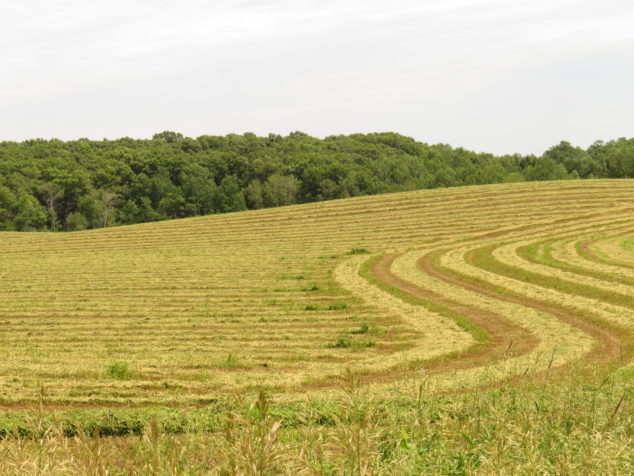
It was hard, hot work putting up hay, and it was a family endeavor. The smell of the hay, the sound of the baler, the feel of standing on the swaying hay rack, the sight of a stack of bales, and the delicious taste of cold tea going down our throats when the work was done will forever be etched in my mind and body. It was fun work, together work, important work. Most of the time, we don’t even realize how important those moments are when they are happening. On this Father’s Day and eve of Summer, I am so thankful for all those moments I had with my Dad.
Biking and Hiking Where the Wild Things Are
Our copy of Maurice Sendak’s classic picture book ‘Where the Wild Things Are’ is tattered and worn, the shiny gold Caldecott Medal sticker peeling along the circular edge. I would hate to guess how many times we read it. The story is about play, actions, feelings, imagination, and processing. (If you are unfamiliar with ‘Where the Wild Things Are,’ click here to see a YouTube reading of the book.)
These wild things in Max’s imagination are at the opposite end of the spectrum to the literally wild things in Nature. And before I go any further, I must give due respect to the multitude of places across the world that are much more ‘wild’ than here in Central Minnesota. Nonetheless, all it takes is a bike ride or a hike close to home to encounter the wild things.
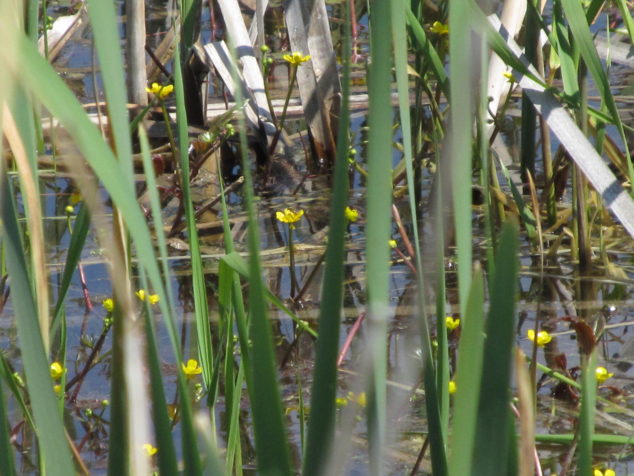
We can cross the highway down the hill from our house and ride the twelve-mile bike trail to the west. Redwing blackbirds sing from their cattail podiums and frogs chortle in the wetland area strewn with Yellow Water Buttercups.
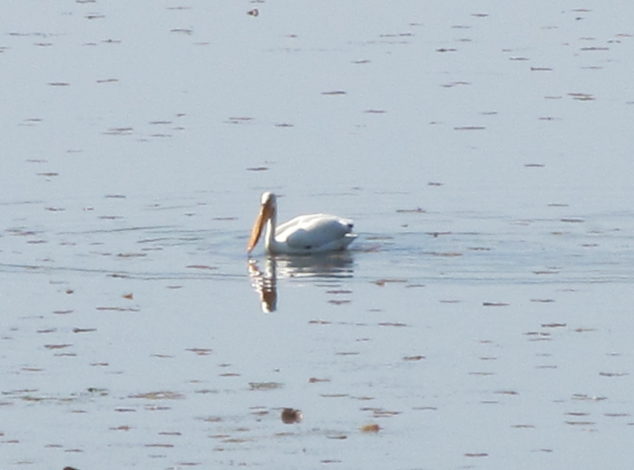
Farther down the trail, the Sauk River flows from the Chain of Lakes where the geese and the pelicans float. Beware–if you were a fish, he’d eat you up, he loves you so.
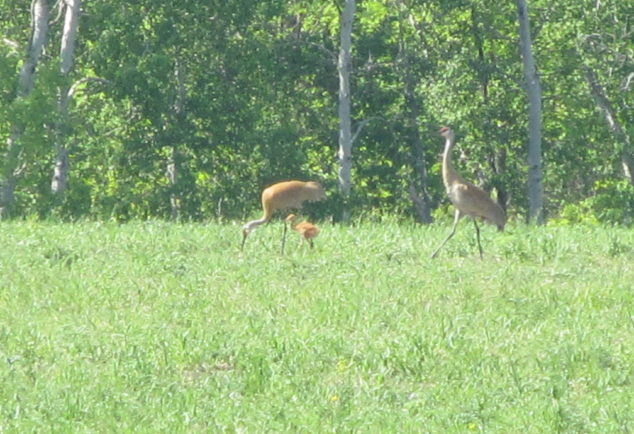
Down the ditch, across the busy highway, through trees and grass, I saw the strange walking movement of a family of Sandhill Cranes. These red-masked, five-foot-tall birds with a wingspan of nearly seven feet are formidable defenders of their young ones. They survey the world all around them for tasty frogs, snakes, insects, small mammals, and grains. Their distinctive trilling call draws your eyes skyward during spring and fall migration.
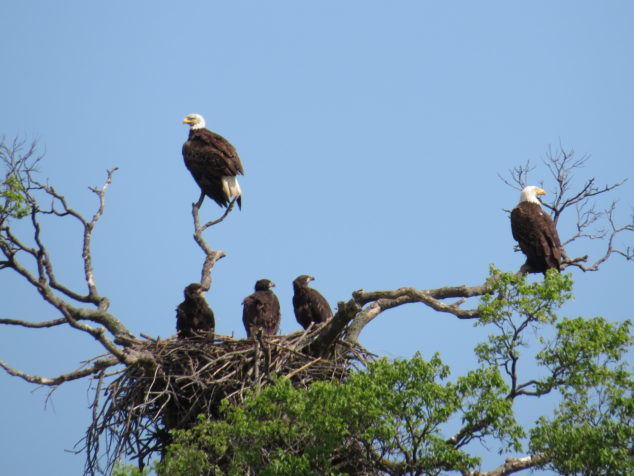
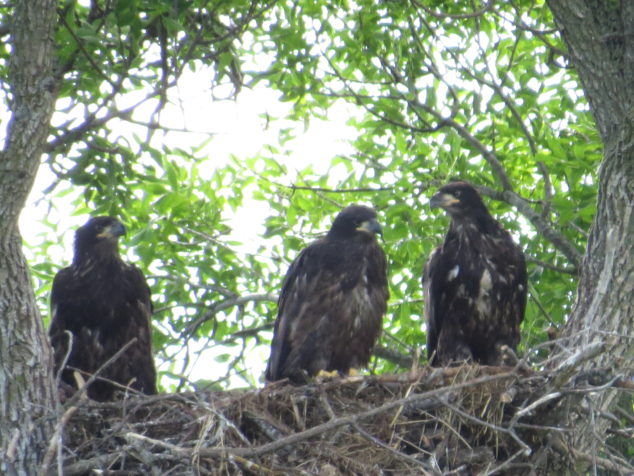
Last weekend we hiked through Rockville County Park to discover we are six baby eagles richer than we were a year ago. The family of five, with all their yellow eyes and terrible claws, sat peacefully in their lofty nest, watching as we walked around their prairie.
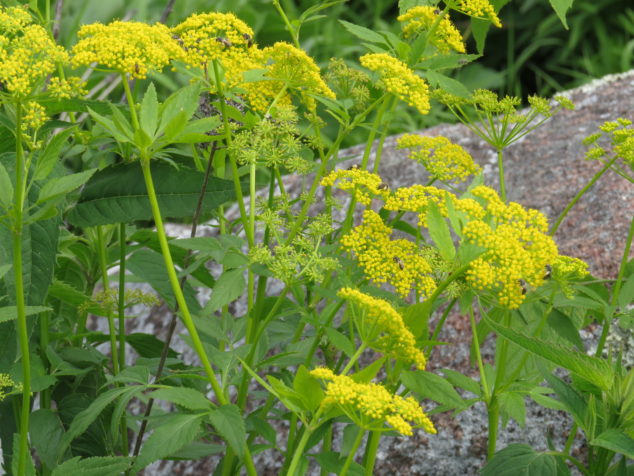
Golden Alexander, a member of the carrot family, is a host plant for Black Swallowtail caterpillars. It has a wild, beautiful scientific name–Zizia aurea–one that is meant to be proclaimed out loud! ZIZIA AUREA!
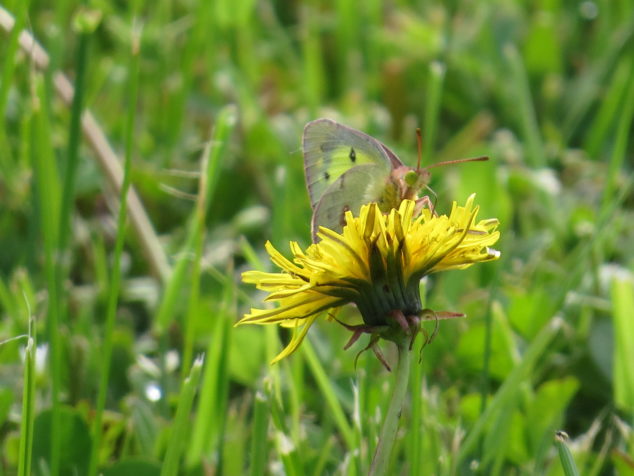
Be still and look at this beautiful little butterfly on the most common of all wildflowers.
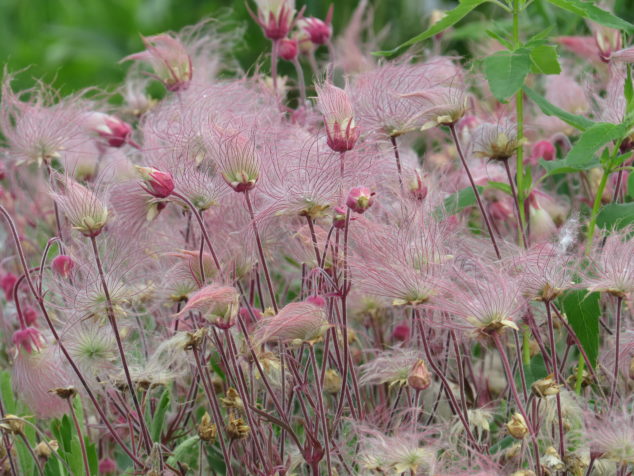
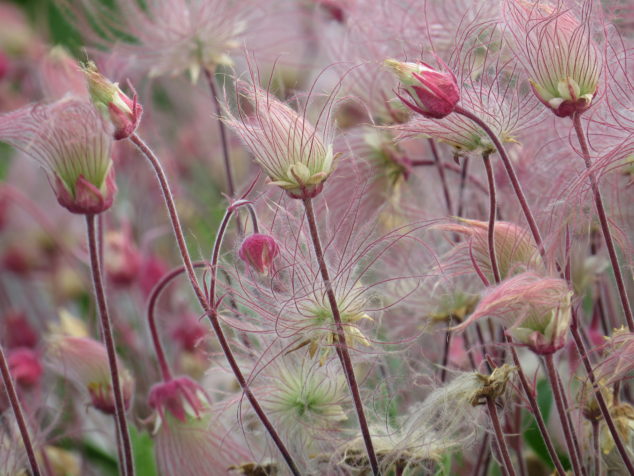
The exuberant wildness of Prairie Smoke drifted in the breeze. The nodding pink-red flowers stand up and open up after pollination and has a seed at the base of each feathery plume.
The other eagle’s nest is on the edge of the forest, and the three young ones sat patiently waiting for their parents to return with supper.
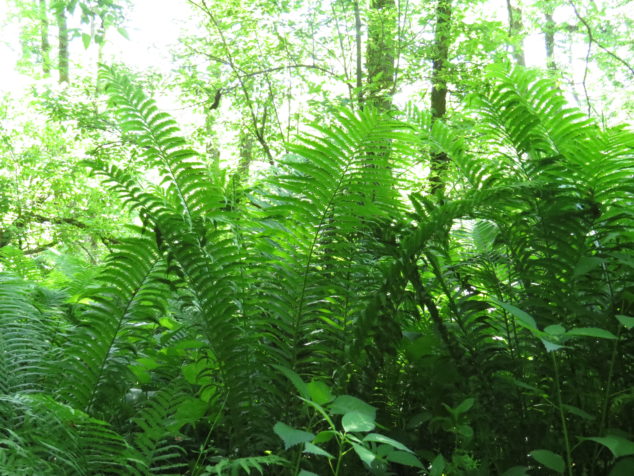
As we walked through the forest towards the Sauk River, we saw ferns that grew and grew and grew until they were as tall as we were!
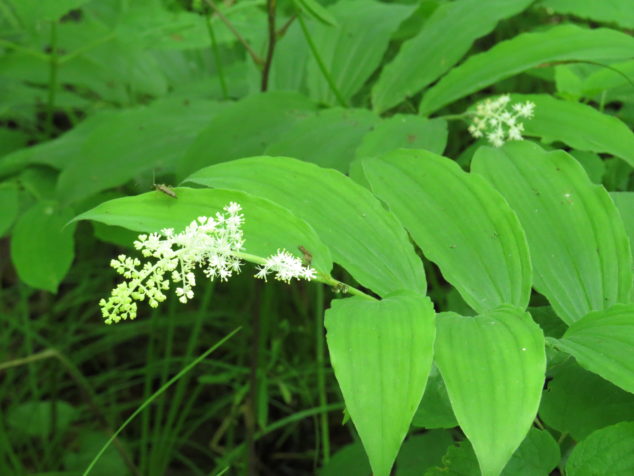
We saw a woodland plant that looked like Solomon’s Seal, but it had a different flower from the ones that hang from the underside of the arching stems. When we got home, I looked it up–it’s False Solomon’s Seal–I was both right and wrong.
We all possess the magic trick of staring into our own eyes, letting our imagination run wild, and believing it to be the truth. We become the king of our own wild imaginations. We like being in charge of the wild rumpus that ensues. But like Max, we eventually become lonely, and something from far away entices us to give up being king. Our ego cries, “Oh please don’t go.” But we say “No!” Amid the terrible roars and gnashing of teeth, we step into our true self and sail back to where Someone loves us best of all.
Gleanings from May–Birds and Blossoms
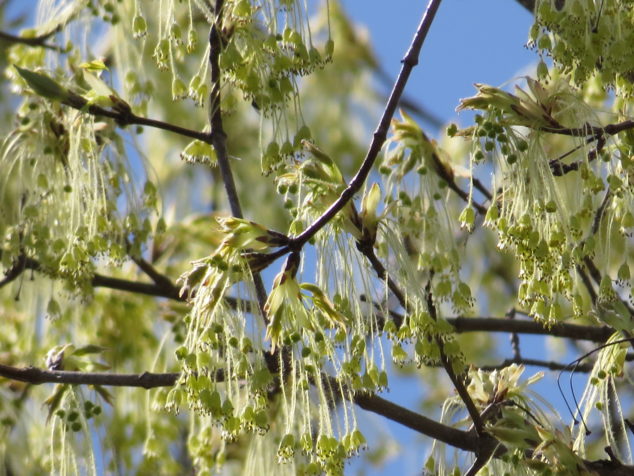
What a month is May! It’s a showcase of blossoms on trees, shrubs, and early blooming perennials. And while we have a great number of ‘winter’ birds that also stay around for the summer, we now see the birds that are passing through to their summer lands in Canada or those that nest and live in Minnesota for the warm season. May is the pleasant month of transformation when trees fully leaf out, exuberant growth occurs, sunshine begins to warm the lakes, and long, light evenings change the way we structure our activities. But back to the beginning of May–one of our maple trees was aglow with golden filaments of pompom-like flowers. Trees are heavily flowered (and thus seed producing) in different yearly intervals–some years it is difficult to notice any flowers at all, but this particular tree was spectacular this year!
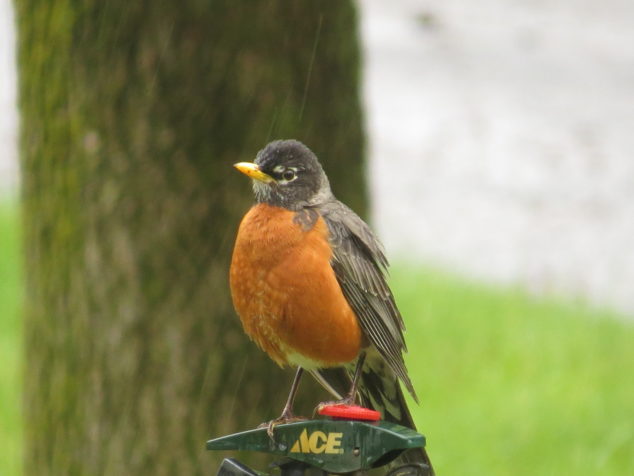
What is Spring without Robins? The sight of Robins is the herald of the vernal season when we know that any traces of Winter will soon be gone. Whether perching on the water sprinkler during a rain shower or hopping in the grass and pulling out worms after the rain, the Robin is a common companion of May.
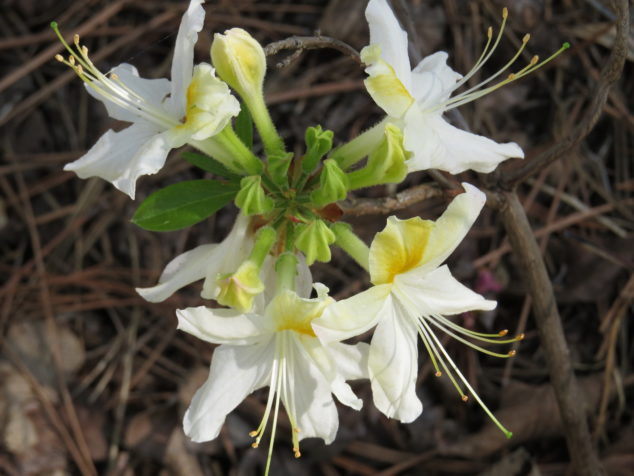
Northern Lights Azaleas, hardy deciduous shrubs developed at the University of Minnesota, allow us a small taste of the incredible beauty of azaleas in our northern climate. This is ‘Northern Hi-Lights,’ and while ours still struggle in our sandy soil, they do treat us to some amazing blossoms.
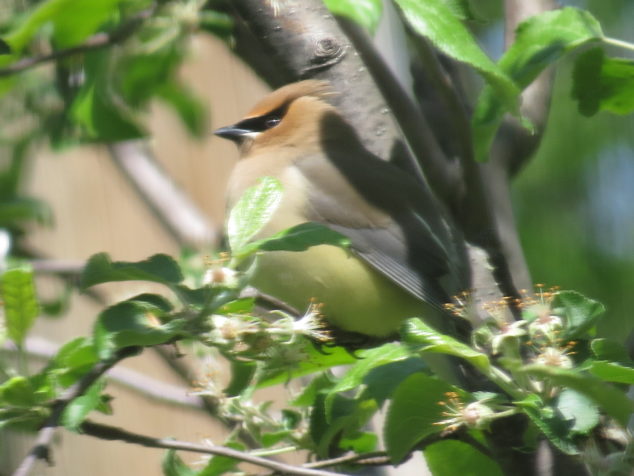
A couple of weeks ago the flower petals were falling off the apple tree. It was a super windy day, and I noticed a number of birds flying among the branches. With the zoom on the camera, I was able to identify the small flock of Cedar Waxwings–they were plucking the white flower petals and eating them!
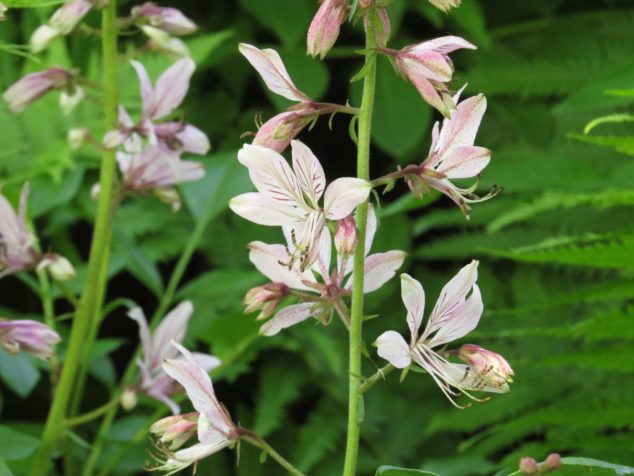
One of the delightful additions to our garden is the Gas Plant. Tall spikes of orchid-looking flowers peek above the ferns that make a lovely background for the pink flower. Gas Plants grow in sun or shade–we have ours on the edge of the woods. They are hardy, drought-tolerant, and not picky about soil. They do not like to be moved once established, as they have a deep tap-root. The name is derived from the citrusy, flammable fumes the flowers give off–on a still day, you can hold a match by the flowers and see a poof of blue flame!
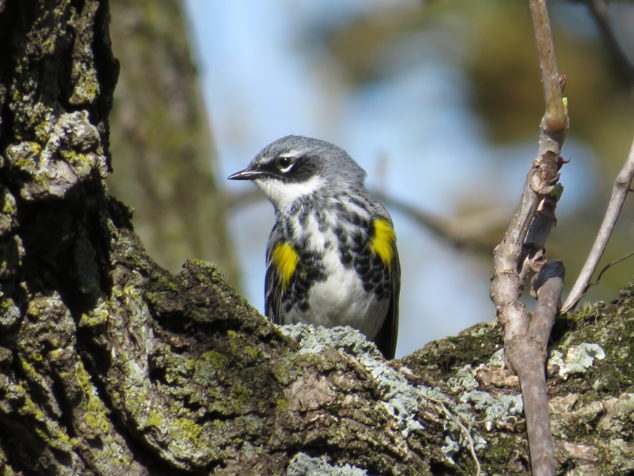
This little bird was flying in the woods before the leaves were fully out. I believe it to be a warbler of some kind, perhaps a Magnolia Warbler or a Yellow-rumped Warbler, both of which have their summer range in Canada.
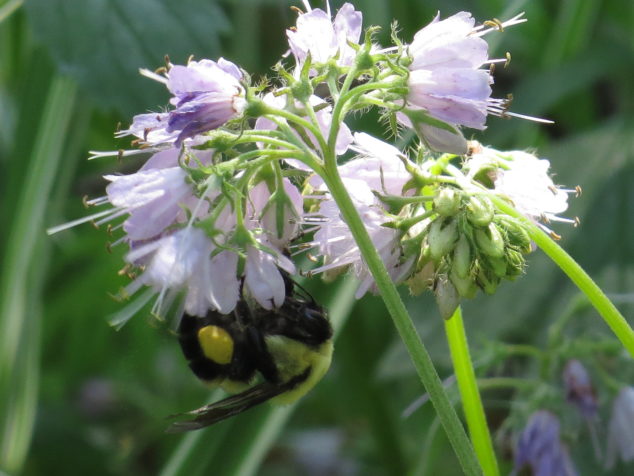
Once we got the buckthorn cleared out from beneath the oaks in our woods, this woodland perennial appeared–Virginia Waterleaf. The leaves are mottled with what looks like water stains, and clusters of white to violet flowers rise above the leaves. As you can see, they are a favorite of the bumblebee at this time of year.
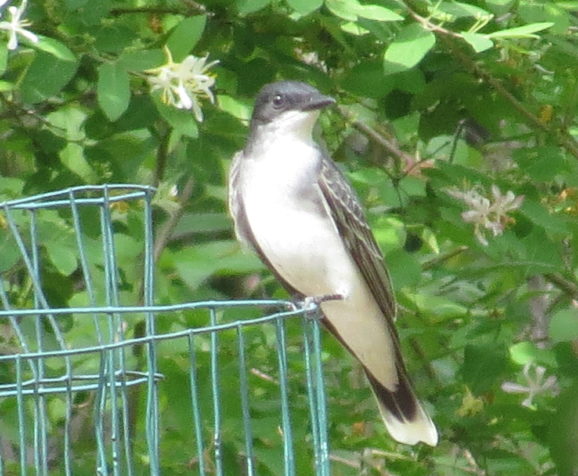
Eastern Kingbird’s scientific name is Tyrannus tyrannus, indicating his tyrannical traits of defending his territory. When defending the nest, he will aggressively attack hawks, crows and squirrels. He has a neat, suit-like appearance. The Kingbird has a crown of red, orange, or yellow feathers on its head that is usually concealed, but is raised when confronting an attacker. Both the male and female hunt for insects and feed the young for about seven weeks.
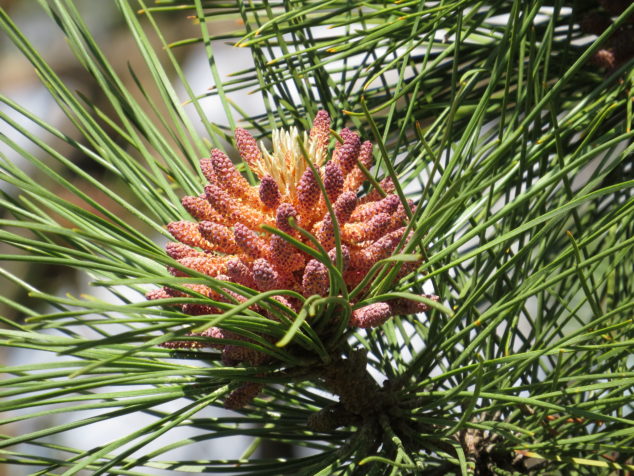
We don’t often think of evergreen trees flowering, but this is a pollen cone or male flower of the Red Pine tree. The pollen cones are most often found in the lower crown of the tree, while the small female flowers are in the middle to upper crown of the tree. Red Pine or Norway Pine is the state tree of Minnesota.
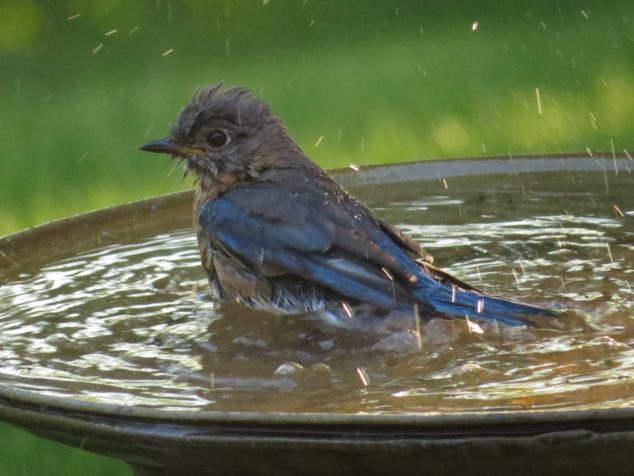
It was evening bath time for this little Bluebird! It’s so nice to have these birds in our yard, seeing them drop and dive for insects with a flash of blue color.
Birds and blossoms are the showcase of May. Spring bulbs, flowering shrubs and trees, and perennials become the houses and food for animals, birds, and insects as the yearly reproductive cycle of each creation happens before our eyes. We once again marvel at the transformation that occurs in this month as plants emerge from the ground, grow, and flower in such a short time! This Life Force of Nature is awe-inspiring! Do you see it? Do you notice and appreciate it? It is a privilege to be the observer, the caretaker, and the participant in this season of growth and beauty.